Last Chance Emails: How to Write Breakup Emails That Convert
The final email in a cold sequence often outperforms every message before it. Here's what actually makes a last chance email work — and the three patterns that kill your reply rate.
TL;DR
- Last chance emails (also called breakup emails) are the final message in a cold sequence that signals you're closing the loop — and they routinely pull the highest single-email reply rate in the sequence.
- The lift comes from loss aversion plus release of pressure, not from urgency theatrics. Fake deadlines and guilt-trips hurt more than they help.
- Send it 3–5 business days after your last touch, keep it under 60 words, and make "no" an easy, explicit option.
- A last chance email sent to an unverified or wrong address doesn't underperform — it never arrives. Deliverability is the precondition, not the polish.
- Expect roughly 10–25% of your sequence's total replies to come from this one email, with a meaningful share being polite negatives. That's a feature.
Your sequence is five emails deep. Nothing. You can send a sixth that says "just bumping this to the top of your inbox," or you can send the one email that consistently beats the five before it: the last chance email.
What Is a Last Chance Email?#
A last chance email is the closing message of a cold outreach sequence. It tells the prospect you're stopping outreach, offers a frictionless way to say no, and leaves the door open if the timing was simply wrong. Sales teams also call it a breakup email, a closing-the-loop email, or a permission-to-close email.
Think of it like a waiter at a table you've been hovering over. Asking "anything else?" for the fifth time is annoying. Saying "I'll leave the check here — flag me if you need anything" gets a response, because you've handed control back.
Mechanically, three things are happening at once:
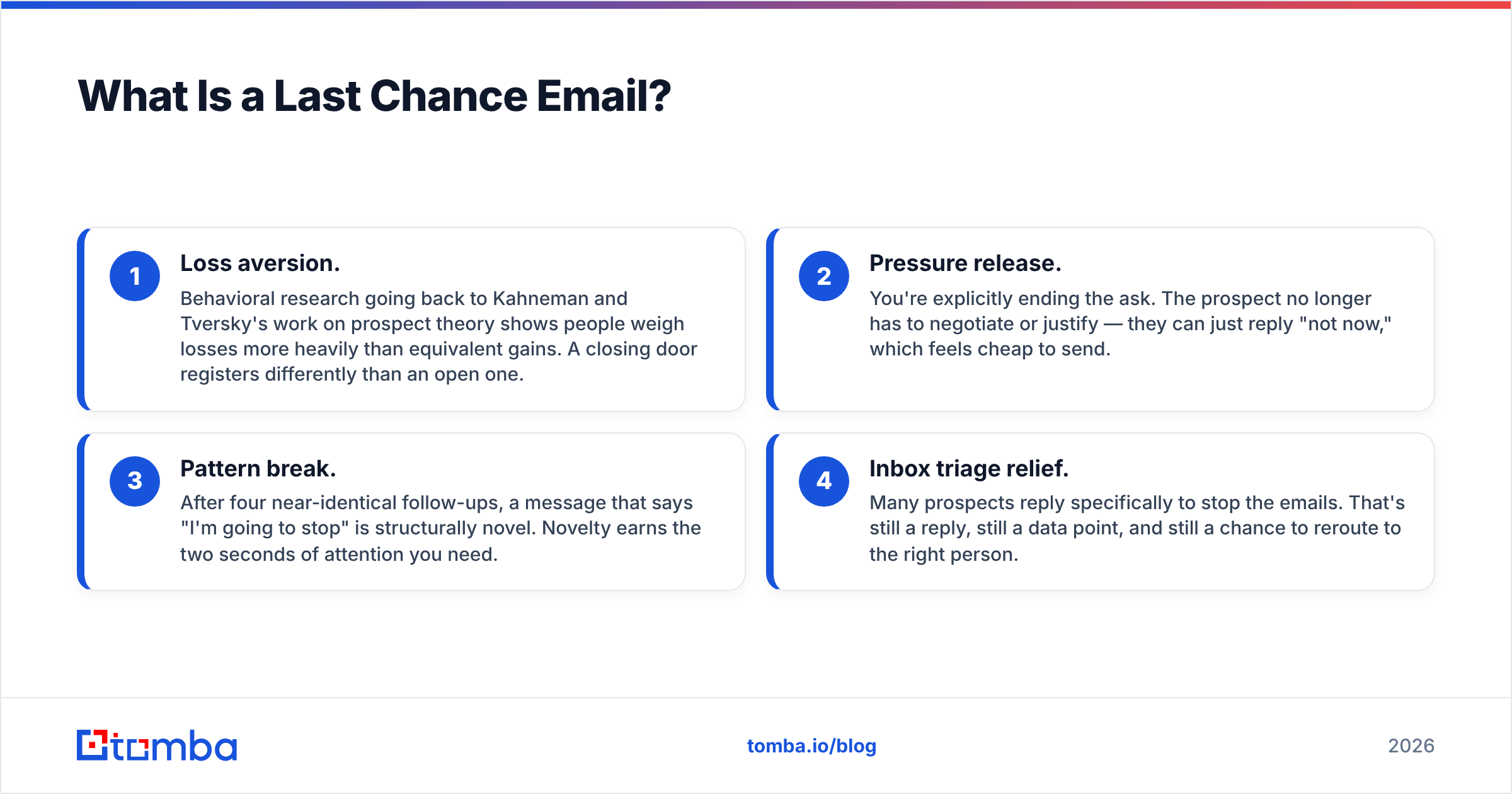
- Loss aversion. Behavioral research going back to Kahneman and Tversky's work on prospect theory shows people weigh losses more heavily than equivalent gains. A closing door registers differently than an open one.
- Pressure release. You're explicitly ending the ask. The prospect no longer has to negotiate or justify — they can just reply "not now," which feels cheap to send.
- Pattern break. After four near-identical follow-ups, a message that says "I'm going to stop" is structurally novel. Novelty earns the two seconds of attention you need.
- Inbox triage relief. Many prospects reply specifically to stop the emails. That's still a reply, still a data point, and still a chance to reroute to the right person.
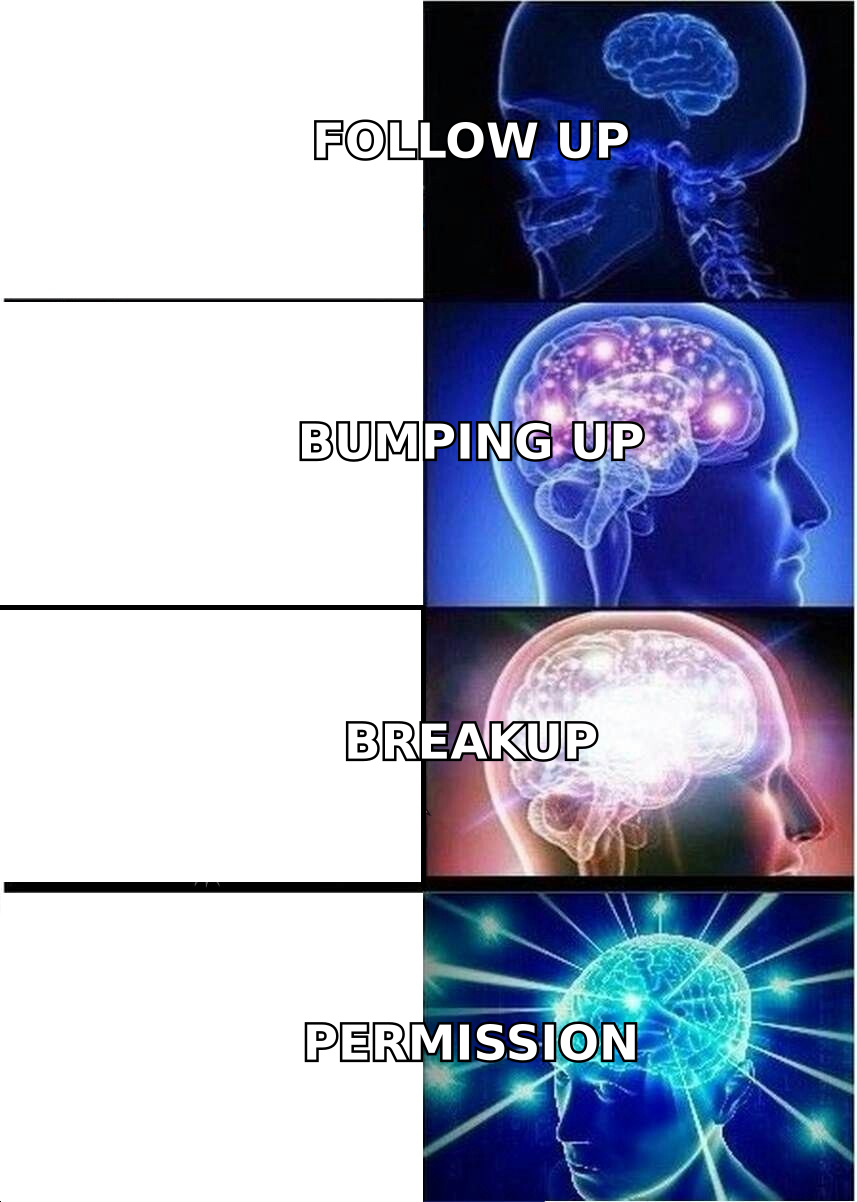
The part most teams get wrong: the last chance email is not a last pitch. It's a last question. The moment you re-pitch, you've turned the release of pressure back into pressure and the mechanism collapses.
Why Do Last Chance Emails Outperform Regular Follow-Ups?#
Because they ask for something the prospect can actually give. A follow-up asks for a meeting — a 30-minute commitment plus internal justification. A last chance email asks for a word.
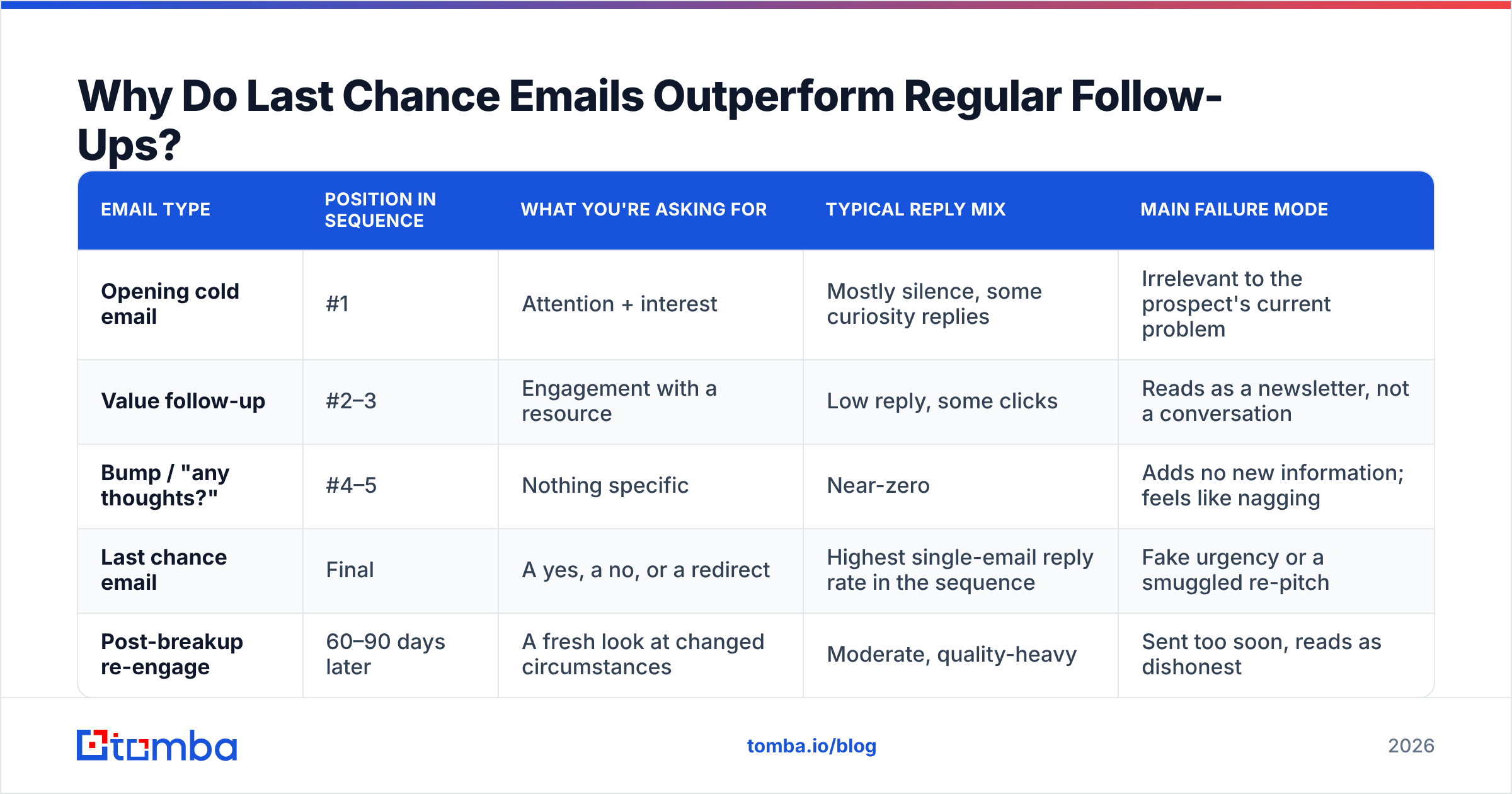
Compare what each message type is really requesting:
| Email type | Position in sequence | What you're asking for | Typical reply mix | Main failure mode |
|---|---|---|---|---|
| Opening cold email | #1 | Attention + interest | Mostly silence, some curiosity replies | Irrelevant to the prospect's current problem |
| Value follow-up | #2–3 | Engagement with a resource | Low reply, some clicks | Reads as a newsletter, not a conversation |
| Bump / "any thoughts?" | #4–5 | Nothing specific | Near-zero | Adds no new information; feels like nagging |
| Last chance email | Final | A yes, a no, or a redirect | Highest single-email reply rate in the sequence | Fake urgency or a smuggled re-pitch |
| Post-breakup re-engage | 60–90 days later | A fresh look at changed circumstances | Moderate, quality-heavy | Sent too soon, reads as dishonest |
Notice the "reply mix" column. The last chance email wins on volume of replies, not exclusively on positive replies. Vendors quoting reply lifts rarely separate the two. When you dig into aggregated outbound benchmarks published by sales-engagement vendors and reviewed on G2, breakup emails frequently land in the top slot for raw response — with a large slice being "no thanks" and "wrong person, try Dana."
Both of those are worth more than silence. A hard no removes a contact from your pipeline math and stops you burning sends. A redirect hands you a warm intro to the right buyer. Track your response rate with positive, negative, and referral replies as separate buckets, or you'll misread what this email is doing for you.
What Are the Best Last Chance Email Templates?#
Four patterns cover almost every situation. Keep all of them under 60 words. Every one should survive being read on a phone lock screen.
1. The permission close (default)
Subject: Closing the loop
Hi Mara — I've reached out a few times about cutting your data-enrichment spend and haven't heard back, which usually means it's not a priority right now.
I'll stop here. If that changes, reply anytime and I'll pick it back up.
— Sam
2. The one-word reply
Subject: 1, 2, or 3?
Hi Mara, before I close this out, which is it?
- Interested, bad timing
- Not the right person
- Not a fit — stop emailing
Just the number works.
— Sam
3. The honest-diagnosis close
Subject: I probably got this wrong
Hi Mara — I assumed list quality was slowing your SDRs down. Silence usually means I misread the problem.
If I did, what is the bottleneck? Genuinely curious, no pitch attached.
— Sam
4. The asset handoff
Subject: Last note from me
Hi Mara, closing your file. Before I do — here's the teardown of how three companies in your space cut bounce rates below 2%. Yours whether we ever talk.
— Sam
Template 2 gets the most replies. Template 3 gets the most useful ones — it surfaces the real objection, which is what feeds your next quarter's messaging. Template 4 works when you have something genuinely worth sending; it fails badly when the "asset" is a gated demo request in disguise.
If you're drafting variants at scale, a subject line generator helps you A/B the header without rewriting the body each time. But the body is where the win lives.
When Should You Send a Last Chance Email?#
Three to five business days after your previous touch, on a Tuesday, Wednesday, or Thursday morning in the prospect's timezone. Not Friday — your email dies in the weekend backlog. Not Monday before 10am — it lands under the weekend pile.
On sequence position: send it after 4–6 total touches for mid-market prospects and after 6–8 for enterprise, where buying committees move slower and three weeks of silence means nothing. HubSpot's ongoing sales research has consistently found that a majority of closed deals require five or more follow-ups, so breaking up at touch three is just quitting early with better copy.
Three timing rules that matter more than the day of week:
- Never send it to someone who has engaged. If they opened five times or clicked twice, they're reading. A breakup email to an engaged-but-silent prospect wastes a live lead.
- Mirror the buying cycle, not your quota calendar. If your product takes four months to buy, a breakup at day 12 is premature by design.
- Schedule the re-engage before you send the breakup. Sixty to ninety days out, with a genuinely new reason to reach out — a funding round, a new hire, a shipped feature. Without that trigger, your re-engage is a lie about the word "last."
What Mistakes Kill a Last Chance Email?#
Four, in descending order of damage.
Fake urgency. "This offer expires Friday" when nothing expires Friday. Sophisticated buyers have seen this a thousand times, and once they catch it, everything else you've written is retroactively suspect. If there's a real deadline — a pricing change, a cohort start — say it plainly. If there isn't, the close itself is the only urgency you need.
Guilt framing. "I guess you're not interested in growing revenue?" and its cousin "I've reached out four times and gotten nothing." Passive aggression gets you marked as spam, and complaint rates feed directly into your sender reputation. One snarky breakup template deployed across 2,000 contacts can cost you a domain.
Smuggling the pitch back in. The third paragraph that starts "but before I go, here's what we do for companies like yours." You just reopened the ask. The prospect's relief evaporates, and so does your reply.
Sending it to a dead address. This is the silent one. Your breakup email doesn't underperform — it bounces, or it lands in a catch-all void where nobody reads it. If your list has a 12% bad-address rate, your "last chance email reply rate" is measuring the wrong denominator entirely.
That last point deserves its own section, because it's the one nobody audits.
How Does List Quality Change Your Last Chance Email Results?#
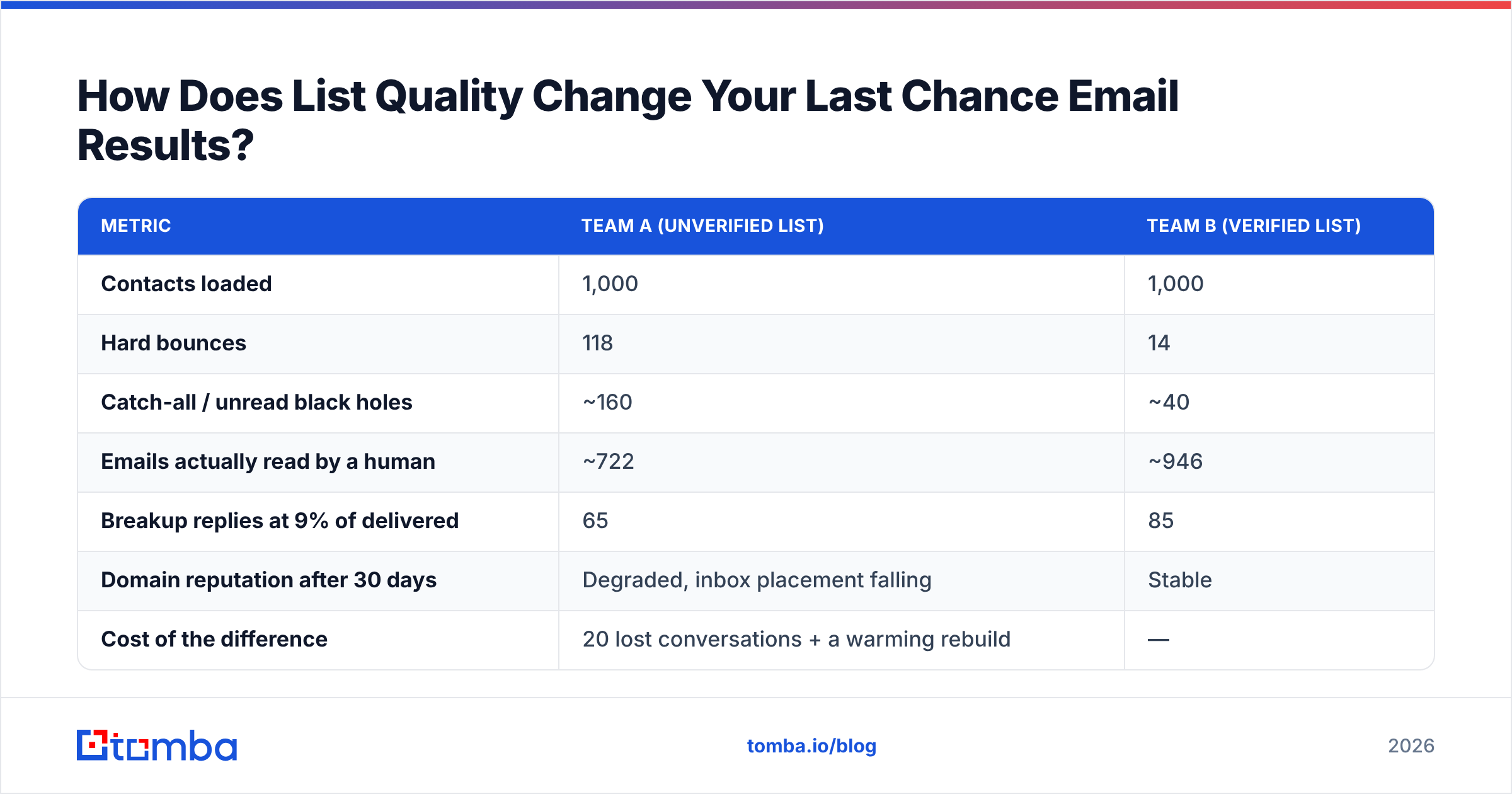
It changes them more than the copy does. Run the arithmetic on two teams sending the same 1,000-contact sequence with the same templates:
| Metric | Team A (unverified list) | Team B (verified list) |
|---|---|---|
| Contacts loaded | 1,000 | 1,000 |
| Hard bounces | 118 | 14 |
| Catch-all / unread black holes | ~160 | ~40 |
| Emails actually read by a human | ~722 | ~946 |
| Breakup replies at 9% of delivered | 65 | 85 |
| Domain reputation after 30 days | Degraded, inbox placement falling | Stable |
| Cost of the difference | 20 lost conversations + a warming rebuild | — |
Team A didn't write worse emails. They measured a worse list. And the reputation damage compounds: once your bounce rate crosses roughly 2%, mailbox providers start routing your good sends to spam, which means next month's sequence underperforms before a single word is written. That's the mechanism behind most email deliverability collapses teams blame on copy.
Two habits fix it:
- Verify before the sequence starts, not after it fails. Running your list through an email verifier at import strips hard bounces before they touch your domain.
- Handle catch-all domains explicitly. Roughly a fifth of B2B domains accept every address, which means standard verification returns "unknown." A catch-all verifier resolves a large share of those into a real yes or no instead of leaving you to guess.
There's a second-order benefit. When your list is clean, your breakup email becomes a genuine measurement instrument. A 4% reply rate on a verified list tells you the copy or the targeting is off. A 4% reply rate on an unverified list tells you nothing at all.
How Do You Measure Whether Your Last Chance Email Worked?#
Track four numbers, separately:
- Total reply rate — every human response, positive or not. This is the headline number and the one most likely to be inflated in vendor case studies.
- Positive reply rate — anything that continues the conversation. Expect this to be roughly a quarter to a third of total replies.
- Referral rate — "wrong person, talk to X." Underrated. These convert better than cold opens because you arrive with an internal name attached.
- Explicit opt-out rate — people asking you to stop. Rising opt-outs mean your targeting is wrong, not your copy. Fix the list before you rewrite the template.
Then compare against a control: run the same sequence with and without the final email for two weeks. If the breakup email isn't adding at least 15% to total sequence replies, the problem is upstream — in targeting or data quality, not in the closing paragraph.
One more thing worth watching: reply latency. Breakup emails tend to get faster replies than any other message in the sequence, often within a few hours. If yours are trickling in over a week, your prospects aren't feeling the close — usually a sign the subject line buried the point.
Should You Automate Last Chance Emails?#
Yes for delivery, no for handling. The send itself should be automated and triggered off sequence state — number of touches, days since last engagement, no opens in the window. Doing it manually means you'll skip it on busy weeks, which is exactly when your pipeline needs it.
But the replies need a human. Breakup emails generate a disproportionate share of nuanced responses: "not now, ask me in Q3," "we just signed with a competitor," "I'm not the buyer but Priya is." Route these to a person, not an auto-responder. The Q3 answer is a calendar reminder. The competitor answer is competitive intel worth logging. The referral is a warm lead that dies if it sits in a queue for four days.
A workable split:
- Automate: trigger conditions, send timing, timezone handling, suppression of engaged contacts, the 60–90 day re-engage scheduling.
- Keep human: reply classification, referral follow-through, objection logging, and the decision to override the breakup for a genuinely high-value account.
If you're building the list side of this in-house, the Tomba API handles the find-and-verify step programmatically so contacts enter your sequence already validated, which removes the most common cause of a breakup email that measures nothing.
What Should You Do Next?#
Audit one sequence this week. Pull the last 200 contacts, check what percentage of your final-touch sends actually delivered, and read the replies your breakup email generated. If there's no breakup email in the sequence, add template 2 — the numbered one-word reply — and measure for two weeks.
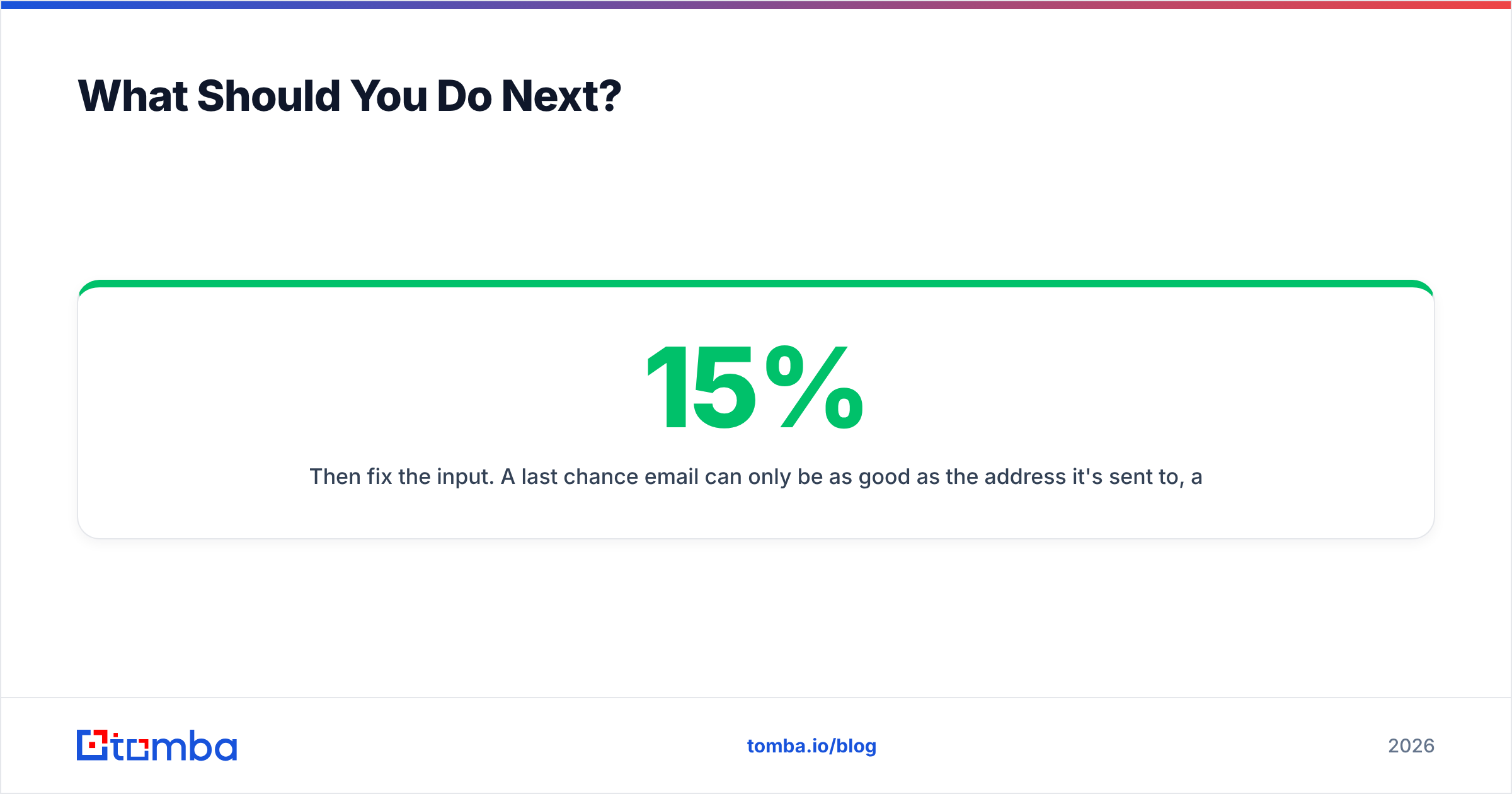
Then fix the input. A last chance email can only be as good as the address it's sent to, and most teams are quietly losing 10–15% of every sequence to addresses that were never real. Start with the Tomba Email Finder to build contact lists from a domain or a name, with verification built into the same step. The free tier covers 25 searches a month if you want to test the delivery rate on a sample before committing; paid plans start at $49/mo on Starter with Growth at $99/mo — full Tomba pricing is public, no sales call required.
Write the close honestly, send it to a real inbox, and let the prospect say no. A clean no is worth more than a hundred more bumps.
Related guides#
// get started
Find, verify and enrich your first contacts today
Start on the free plan with 25 searches a month, then scale when your team is ready.
Free plan · No credit card required · GDPR & CCPA
Get the Tomba newsletter
Product and data updates
// about the author