LavaReach Pricing, Reviews, Pros and Cons: A 2026 Breakdown
LavaReach sells AI research agents, not rows of data — which makes its pricing hard to compare. Here is how the credit model actually behaves, what reviewers complain about, and when a cheaper stack does the same job.
TL;DR — LavaReach pricing in 30 seconds
- LavaReach pricing charges for AI research agents, not contact records. Your bill tracks how many steps you run, not how many leads you keep.
- Most LavaReach pricing tiers sit behind a demo. Expect an annual deal and a seat floor, not a $49 self-serve checkout.
- Reviewers praise the research quality. They flag two things: credit burn on failed lookups, and a learning curve that eats your first month.
- The hidden cost comes later. Agent output still needs a check before it touches a sending domain.
- Need to find and verify work emails at scale? A dedicated email finder does that for far less. Need 40 signals per account? Then LavaReach earns its price.
What is LavaReach, and who actually buys it?#
LavaReach is a go-to-market research tool built on AI agents. The agents browse the web, read pages, and return clean answers about accounts and people. Think of it less like a contact database and more like a junior researcher who never sleeps. You ask a question — "does this company run a partner program?" — and you get a filled column, not a link.
That framing matters for LavaReach pricing. It changes the unit you pay for. A normal data vendor sells you rows: 10,000 contacts, take them or leave them. LavaReach sells you work. Each agent run spends credits, whether or not the answer helps. You can see the current pitch on the official LavaReach site. It leans hard on outbound teams doing account research at volume.
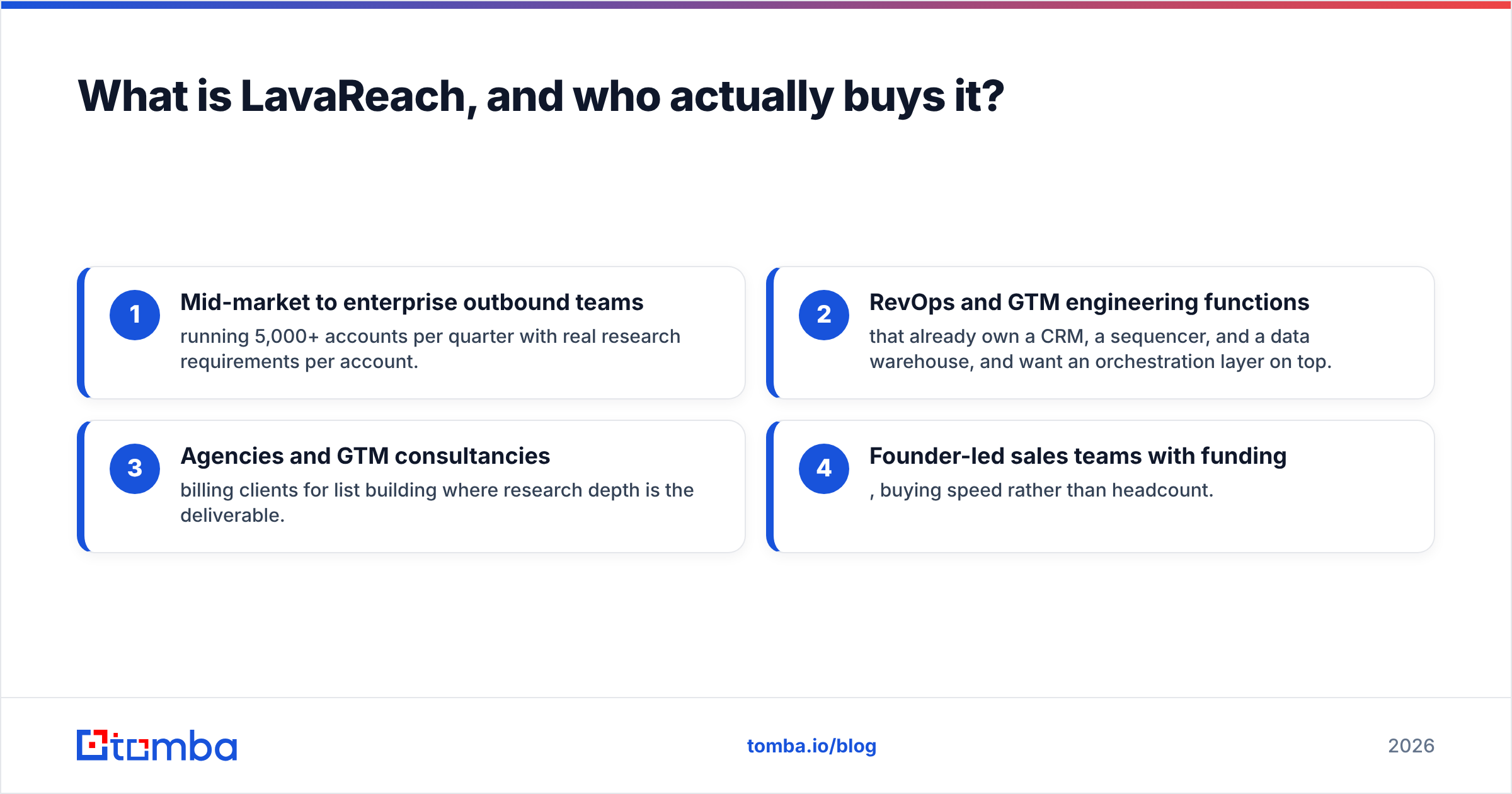
The typical buyer looks like this:
- Mid-market and enterprise outbound teams that work 5,000+ accounts a quarter and need real research on each one.
- RevOps and GTM engineering teams that already own a CRM, a sequencer, and a data warehouse, and want a layer on top.
- Agencies and consultancies that bill clients for list building, where research depth is the product.
- Founder-led sales teams with funding that buy speed instead of headcount.
Not one of those four? If you are a two-person team that needs verified emails for a named list, LavaReach pricing is built for a problem you do not have yet.
How does LavaReach pricing actually work?#
LavaReach pricing is credit-based, with a seat fee on top. That mix is where most budget surprises start. So look at the mechanics before you look at any number.
- Credits are spent per agent action, not per result. One enriched row can burn several credits. The agent may visit a few pages, run a waterfall, or retry. Ten columns across 1,000 accounts is not 1,000 units of use.
- Failed lookups still cost you. This is normal for AI enrichment tools. It is also the top complaint in reviews. If the agent looks and finds nothing, the compute still happened.
- Seats are billed apart from credits. Adding a rep is its own line item. That makes the math worse for small teams than for large ones.
Two more parts of LavaReach pricing decide the final number:
- Annual terms are the default at real volume. Month-to-month exists at entry level. But prices drop sharply on annual terms, so the list price and the price you sign often differ by 20-30%.
- Overages are negotiated, not automatic. Run out mid-quarter and you get a call with your AE, not a $0.001 top-up.
- Integrations are tier-gated. CRM write-back, API access, and warehouse sync usually sit above the entry plan.
Actually, that renders as a plain image below:

What do LavaReach plans cost in 2026?#
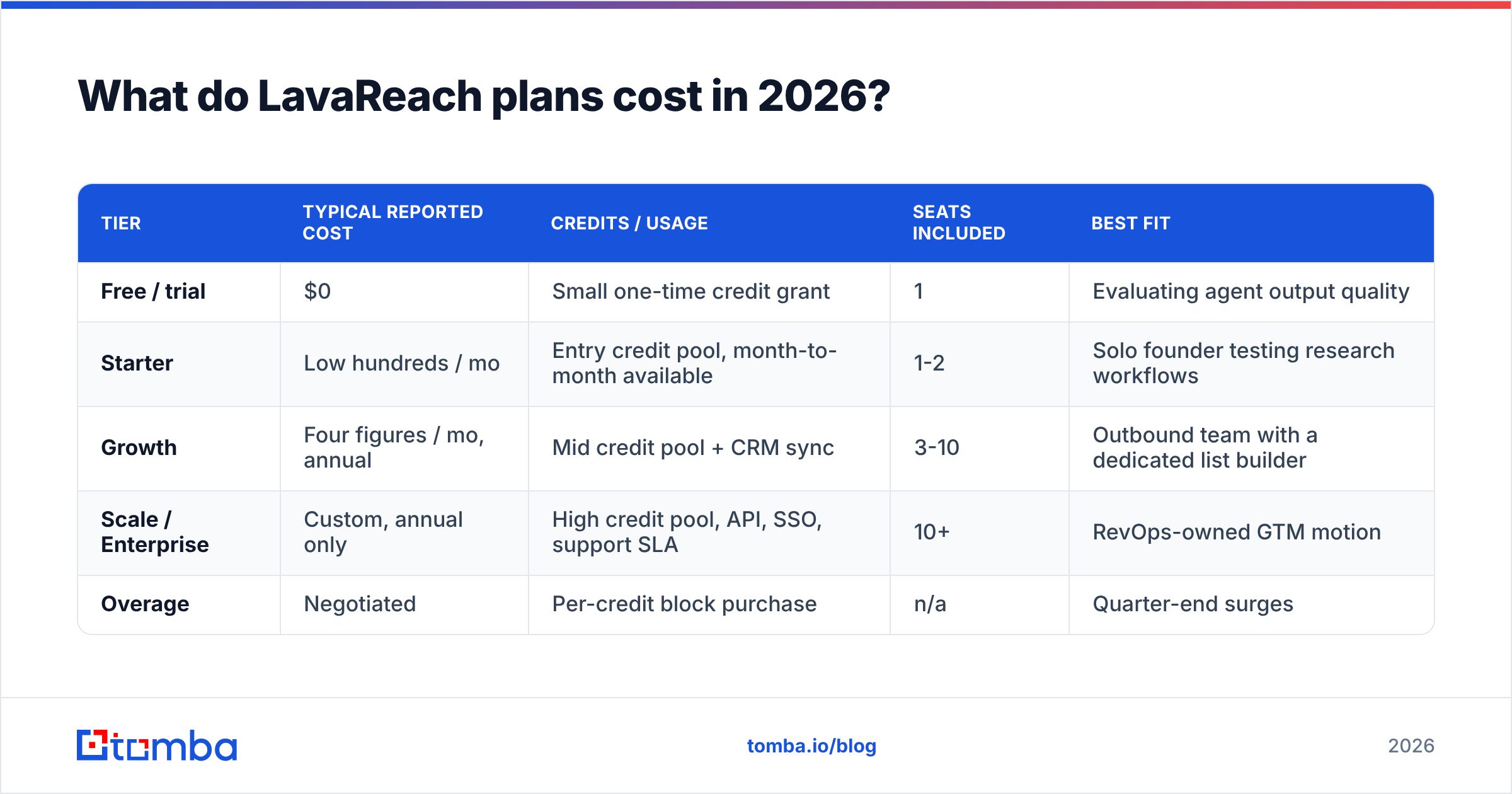
Honest caveat first. LavaReach pricing does not show up as a full self-serve grid, the way a $49/mo tool does. Most tiers route through a demo. Reported figures move with seat counts and annual terms. So treat the table below as the shape of the market in 2026. Validate the numbers on a call.
| Tier | Typical reported cost | Credits / usage | Seats included | Best fit |
|---|---|---|---|---|
| Free / trial | $0 | Small one-time credit grant | 1 | Evaluating agent output quality |
| Starter | Low hundreds / mo | Entry credit pool, month-to-month available | 1-2 | Solo founder testing research workflows |
| Growth | Four figures / mo, annual | Mid credit pool + CRM sync | 3-10 | Outbound team with a dedicated list builder |
| Scale / Enterprise | Custom, annual only | High credit pool, API, SSO, support SLA | 10+ | RevOps-owned GTM motion |
| Overage | Negotiated | Per-credit block purchase | n/a | Quarter-end surges |
Compare that to a published, self-serve plan and the gap is obvious. Tomba pricing runs Free (25 searches/mo), Starter at $49/mo, Growth at $99/mo, Pro at $249/mo, and custom Enterprise. No demo gate. No seat floor. No call just to learn the number. That is not a claim that Tomba does what LavaReach does. It is a claim that the two tools ask you to think about money in very different ways.
The practical budgeting rule: treat LavaReach pricing as a headcount swap, not a tool line item. If it replaces 20 hours a week of manual research, a four-figure month is easy to defend. If it sits next to a researcher who still does the work by hand, it is not.
What do LavaReach reviews say?#
Review coverage is thin. LavaReach is newer, and its users skew technical. They write posts instead of leaving star ratings. Cross-reference what sits on G2 and Capterra with practitioner notes, and the sentiment is clear.
What reviewers praise:
- Research depth no static database can match. Custom questions get useful answers. A contact database cannot do that.
- Clean output. Columns come back structured and ready for your CRM, not as a blob of text.
- Speed. Work that took an SDR a full afternoon now takes minutes.
- Support during onboarding. Small-vendor perk: you get real humans.
What reviewers criticize:
- Credit use is hard to predict. This is the top gripe, by a wide margin. Some teams burn a month of credits on one bad bulk run.
- The learning curve is real. Prompting an agent well is a skill. Your first two weeks will produce weak output.
- Checking the data is not the product. Agents surface contact data, but inbox hygiene is on you. That is why most buyers add a separate email verifier.
- LavaReach pricing is opaque. Buyers dislike booking a call to learn a number, and they say so in reviews.
- Coverage gaps outside North America and Western Europe. Agents can only read what is on the web. A thin web footprint returns thin answers.
What are the pros and cons at a glance?#
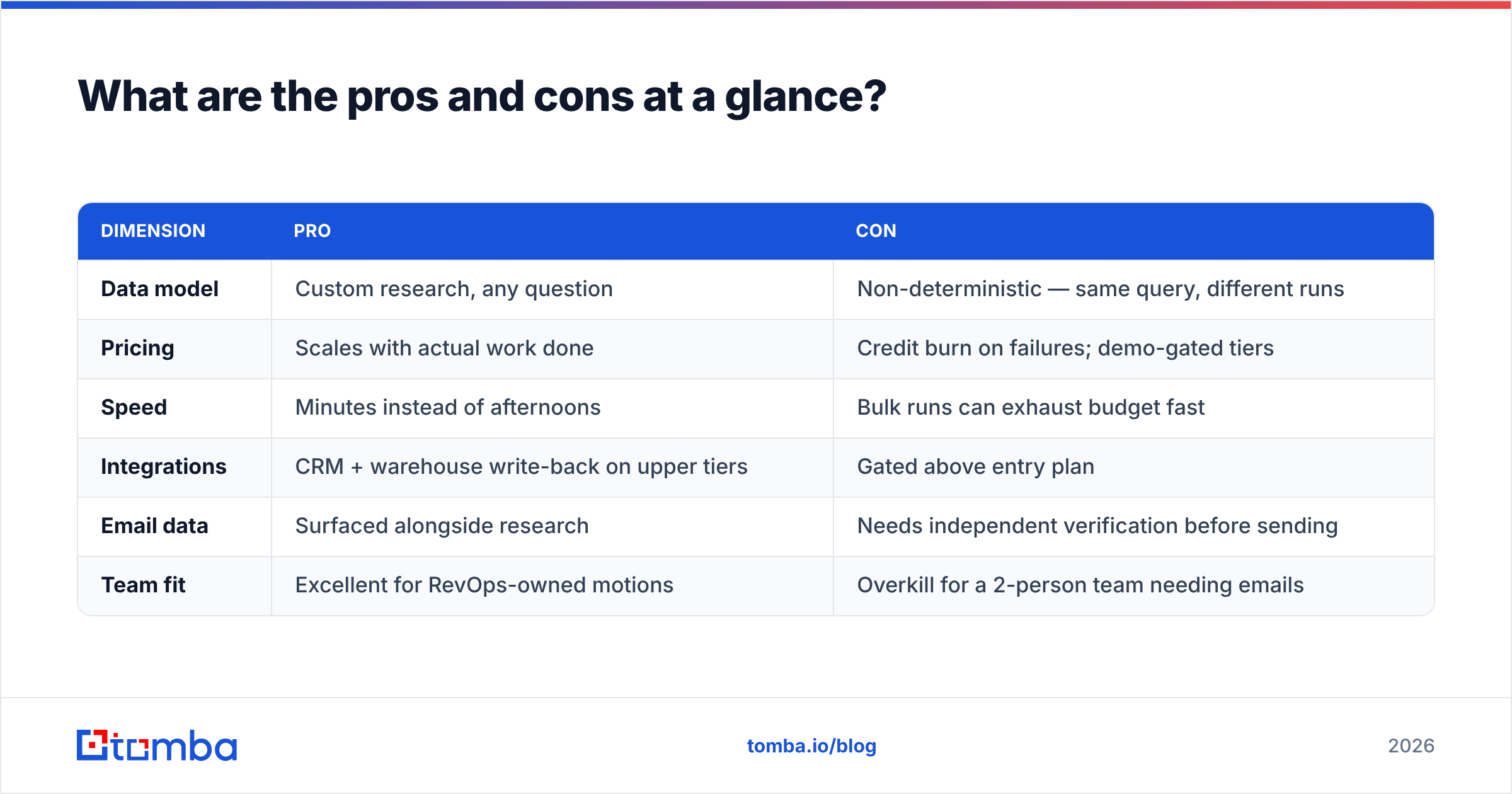
| Dimension | Pro | Con |
|---|---|---|
| Data model | Custom research, any question | Answers can shift — same query, different runs |
| Pricing | Scales with actual work done | Credit burn on failures; demo-gated tiers |
| Speed | Minutes instead of afternoons | Bulk runs can exhaust budget fast |
| Integrations | CRM + warehouse write-back on upper tiers | Gated above entry plan |
| Email data | Surfaced alongside research | Needs a separate check before sending |
| Team fit | Excellent for RevOps-owned motions | Overkill for a 2-person team needing emails |
Read that table this way. LavaReach is strong when the question is fuzzy. It is weak when the question has one right answer. "Find the head of RevOps and tell me if they use Salesforce" is fuzzy work. "Give me the verified email for this person" has one right answer. That kind of work is cheaper to buy from tools built for it.
Rendered:

Where does the LavaReach bill actually leak?#
LavaReach pricing leaks in four places. Here they are, in the order teams get caught:
- Untested bulk runs. You run a new agent setup across 5,000 accounts before testing it on 50. That is the classic way to lose a month of credits in an hour. Always pilot first.
- Over-enrichment. Teams ask for 15 columns when 4 drive the email. Every extra column is paid compute that never reaches a sequence.
- Duplicate work across tools. Your CRM may already hold firmographics. Your database may already hold titles. Paying an agent to find them again is pure waste. Clean your input list first — even a basic remove duplicates pass before upload saves real money.
- Bounces from unchecked output. This one costs the most. It burns credits and your domain reputation. A 6% bounce rate on a 3,000-send campaign hurts your quarter far more than the subscription does.
That is why most serious LavaReach setups sit inside a stack. The agent answers the research question. Something else still has to confirm the mailbox is real.
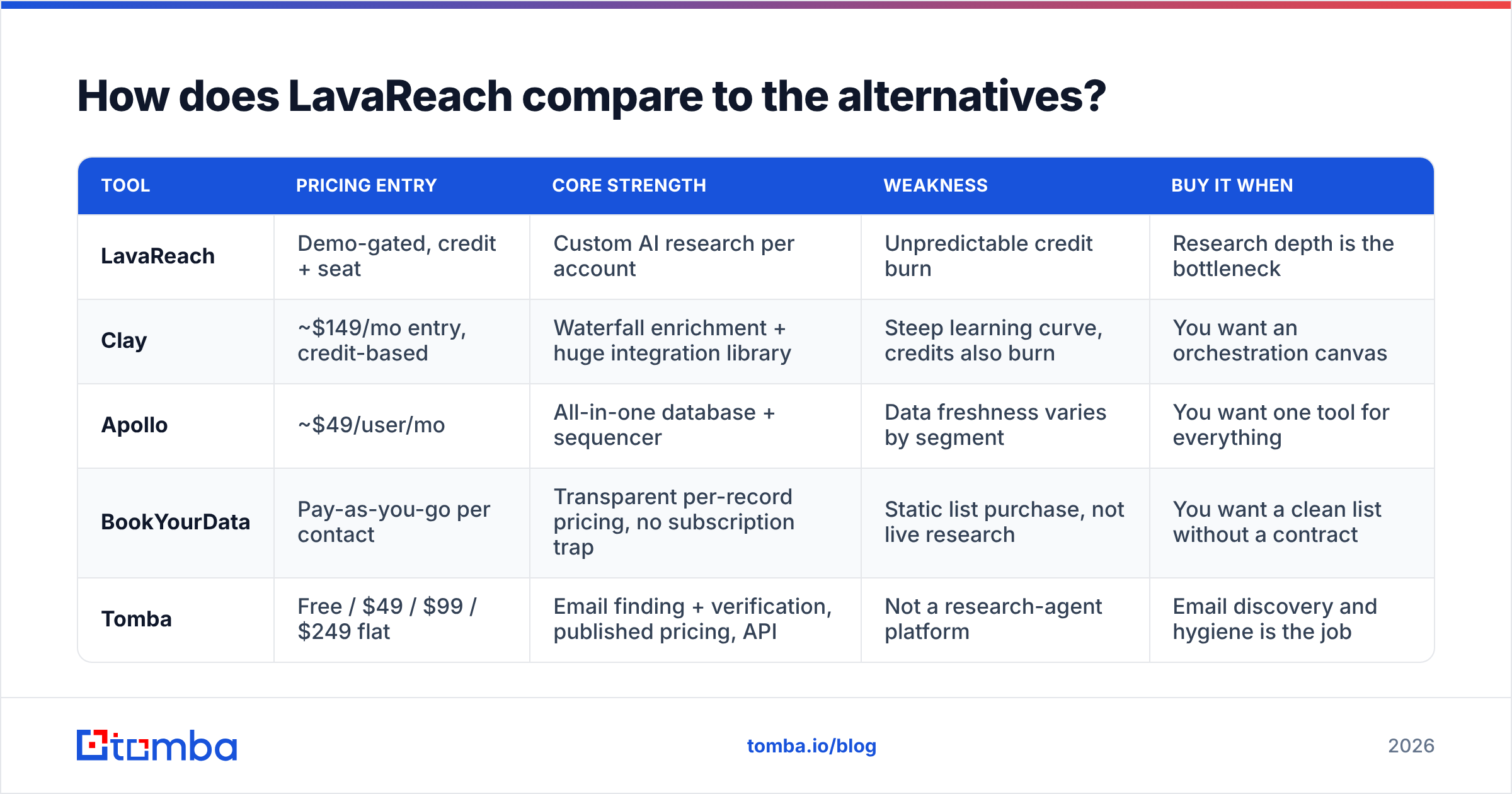
How does LavaReach compare to the alternatives?#
| Tool | Pricing entry | Core strength | Weakness | Buy it when |
|---|---|---|---|---|
| LavaReach | Demo-gated, credit + seat | Custom AI research per account | Unpredictable credit burn | Research depth is the bottleneck |
| Clay | ~$149/mo entry, credit-based | Waterfall enrichment + huge integration library | Steep learning curve, credits also burn | You want an orchestration canvas |
| Apollo | ~$49/user/mo | All-in-one database + sequencer | Data freshness varies by segment | You want one tool for everything |
| BookYourData | Pay-as-you-go per contact | Transparent per-record pricing, no subscription trap | Static list purchase, not live research | You want a clean list without a contract |
| Tomba | Free / $49 / $99 / $249 flat | Email finding + verification, published pricing, API | Not a research-agent platform | Email discovery and hygiene is the job |
Two honest notes on that grid.
First, BookYourData and Tomba both fix the price-opacity problem — one by posting a per-contact rate, the other by posting a flat monthly plan. If the demo gate in LavaReach pricing is what puts you off, either one is a fair place to look before you book a call.
Second, Clay is LavaReach's closest rival, not Apollo. Both sell credit-metered enrichment. Price Clay too, or your comparison is incomplete.
Is LavaReach worth it in 2026?#
Yes, if all three of these are true:
- One named person owns list building and will learn the tool well.
- Your ICP needs signals no database sells: partner models, tech-stack nuance, hiring intent, expansion triggers.
- Your deal size is big enough that 30 well-researched accounts beat 3,000 generic ones.
No, if any of these are true:
- Your real problem is "I have the company list, I need the emails." That is solved, and it is cheap.
- You cannot commit for a year, or cannot get a number without a demo you do not want.
- Nobody will own prompt quality. Then you pay agent prices for weak agent output.
The common mistake is buying LavaReach to fix bounces or coverage. It fixes neither. It fixes a knowledge gap. Teams who name their real problem buy better. Many find that a lean research budget, a solid data enrichment layer, and steady verification hit 80% of the result for 20% of the cost.
One more note. Keep the finding layer and the checking layer apart. Vendors change prices. Credit models get re-tiered. If your whole pipeline rides on one opaque annual contract, you have no leverage at renewal.
What should you do next?#
Run the cheap test before the costly one. Take 100 accounts from your live pipeline. Build the contact list with a tool that posts its prices. Verify every address, then send. Measure bounce rate and reply rate. Then ask if deeper research would have lifted replies enough to justify LavaReach pricing at four figures a month. Most teams find the answer is "not yet." The ones who find it is "yes" walk into the demo with a number they can defend.
Need that first test now? Start with the Tomba Email Finder. The free tier gives you 25 searches a month to prove the workflow. Starter is $49/mo, with no seat minimum and no demo call. Every address runs through verification before it reaches your sequencer. Find the emails, prove the motion works, then buy research depth once you know what it has to earn.
Related guides#
// get started
Find, verify and enrich your first contacts today
Start on the free plan with 25 searches a month, then scale when your team is ready.
Free plan · No credit card required · GDPR & CCPA
// about the author