Law Firm Lead Generation: A 2026 Guide That Actually Converts
Most law firm lead generation guides stop at "blog more." This one breaks down cost per signed case by channel, where outbound actually works for legal, and the compliance lines you cannot cross.

TL;DR
- Cost per lead is a vanity metric for law firms. The only number that runs a practice is cost per signed case — and it can be 10-40x your CPL depending on intake quality.
- Paid search is the fastest channel and the most brutal: legal keywords regularly clear $50-$300 per click, and personal-injury terms go higher.
- Referrals and SEO produce the cheapest signed cases but take 6-18 months to compound. Budget for the gap, don't pretend it doesn't exist.
- Outbound email works for B2B legal work (corporate counsel, employment, IP, immigration for employers, M&A) and for referral-partner development — not for consumer practice areas.
- Intake speed beats channel choice. Firms that respond in under 5 minutes convert dramatically better than firms that respond the next business day, no matter where the lead came from.
What is law firm lead generation, really?#
Law firm lead generation is the system that turns a stranger with a legal problem into a signed engagement letter. That is a longer sentence than most agencies use, and the extra words matter: a "lead" that never gets a consult is not lead generation, it's data collection.
Think of it like a restaurant. Marketing fills the dining room, intake seats people, and the consult is the meal. Most firms obsess over filling the room and then let half the guests stand at the door for twenty minutes. The bottleneck is almost never traffic.
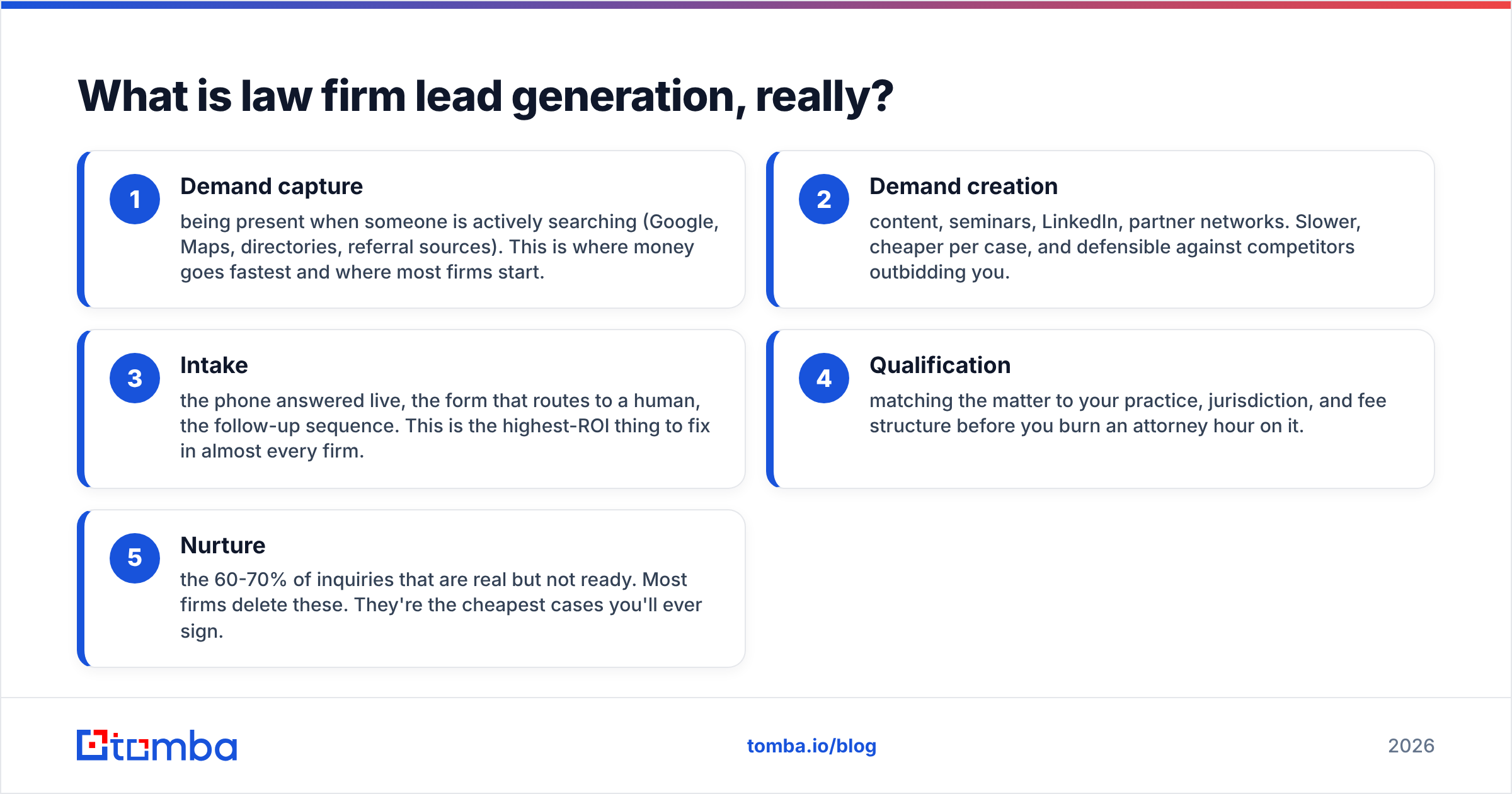
A working system has five parts, and they fail in this order:
- Demand capture — being present when someone is actively searching (Google, Maps, directories, referral sources). This is where money goes fastest and where most firms start.
- Demand creation — content, seminars, LinkedIn, partner networks. Slower, cheaper per case, and defensible against competitors outbidding you.
- Intake — the phone answered live, the form that routes to a human, the follow-up sequence. This is the highest-ROI thing to fix in almost every firm.
- Qualification — matching the matter to your practice, jurisdiction, and fee structure before you burn an attorney hour on it.
- Nurture — the 60-70% of inquiries that are real but not ready. Most firms delete these. They're the cheapest cases you'll ever sign.
Fix them in reverse order of cost: intake first (free), nurture second (cheap), then spend on capture.
How do the main channels compare on cost per signed case?#
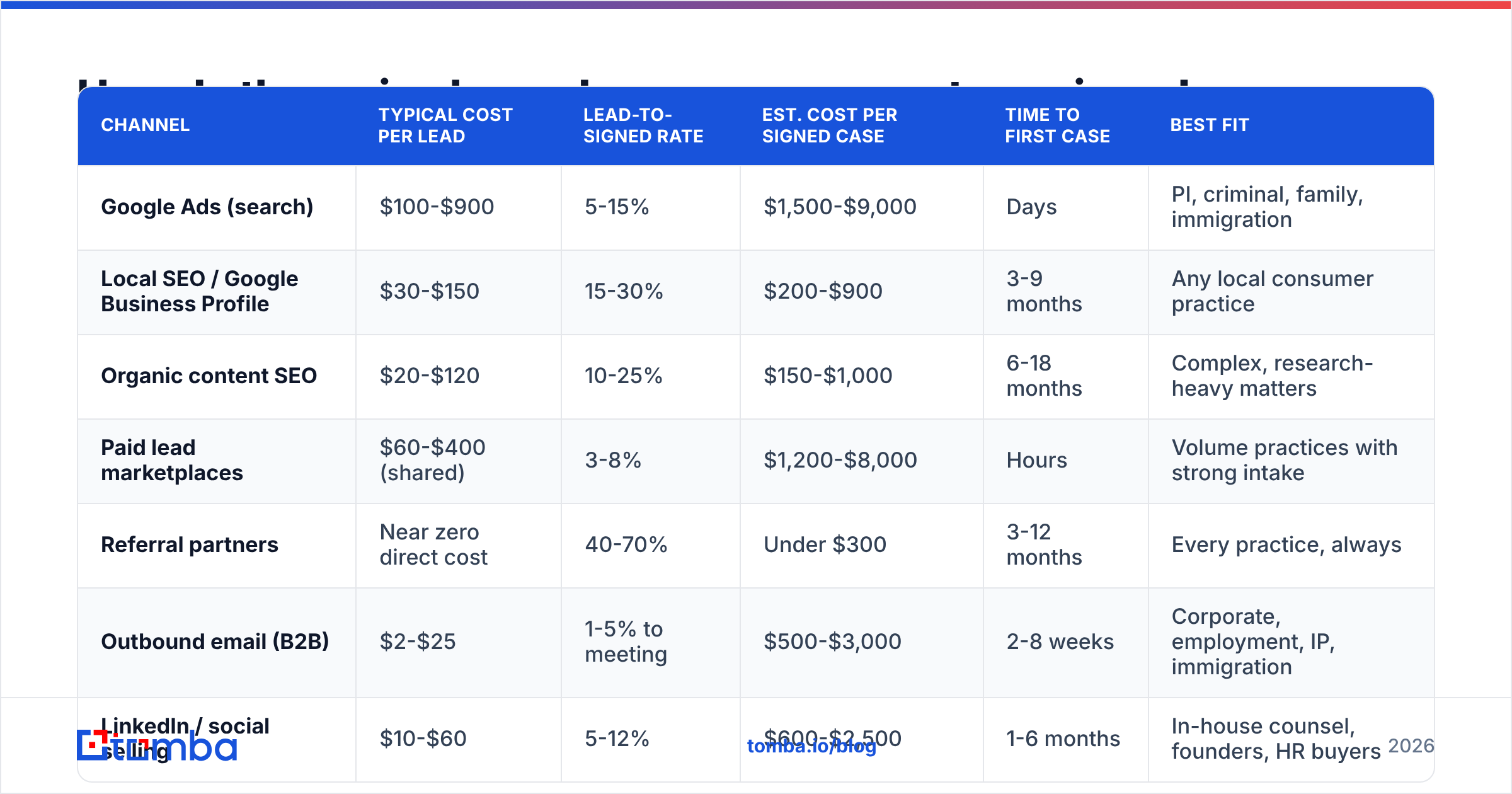
Here's the honest comparison. Ranges are wide because practice area and market drive everything — a family law lead in Boise and a mass-tort lead in Los Angeles are not the same product.
| Channel | Typical cost per lead | Lead-to-signed rate | Est. cost per signed case | Time to first case | Best fit |
|---|---|---|---|---|---|
| Google Ads (search) | $100-$900 | 5-15% | $1,500-$9,000 | Days | PI, criminal, family, immigration |
| Local SEO / Google Business Profile | $30-$150 | 15-30% | $200-$900 | 3-9 months | Any local consumer practice |
| Organic content SEO | $20-$120 | 10-25% | $150-$1,000 | 6-18 months | Complex, research-heavy matters |
| Paid lead marketplaces | $60-$400 (shared) | 3-8% | $1,200-$8,000 | Hours | Volume practices with strong intake |
| Referral partners | Near zero direct cost | 40-70% | Under $300 | 3-12 months | Every practice, always |
| Outbound email (B2B) | $2-$25 | 1-5% to meeting | $500-$3,000 | 2-8 weeks | Corporate, employment, IP, immigration |
| LinkedIn / social selling | $10-$60 | 5-12% | $600-$2,500 | 1-6 months | In-house counsel, founders, HR buyers |
Two things jump out of that table. First, the channels with the lowest cost per signed case are the slowest to start. Second, paid search only looks expensive until you compare it to the alternative of an empty calendar in month one.

The strategic move is not picking a winner. It's running paid as a bridge while referrals and content compound underneath it, then throttling paid down as the cheap channels carry more of the load.
Why do most law firm leads never convert?#
Because nobody called them back fast enough. That's the boring, unglamorous answer, and it's supported by decades of lead-response research across industries — including the well-known finding that contact rates collapse when response time stretches past the first few minutes.
The specific failure modes, in order of how often we see them:
- The phone goes to voicemail after hours. Legal problems happen at 9pm. A legal-trained answering service costs less than one week of paid search.
- Web forms route to a shared inbox. If the form email lands somewhere without an owner, the lead is gone.
- No second, third, or fourth touch. A single follow-up email is not a sequence. Five touches over two weeks roughly doubles contact rates in most intake data.
- Attorneys do intake. Partners are expensive, busy, and terrible at chasing. Non-attorney intake staff with a script outperform them almost every time.
- No tracking back to the source. If you can't tell which channel produced the signed case, you're optimizing on cost per lead — which is how firms end up buying thousands of cheap, worthless leads.
Practice management platforms like Clio and general CRMs like HubSpot both solve the tracking problem well enough. The one that works is the one your intake team will actually update.
Does outbound prospecting work for law firms?#
Yes — but only for a specific half of the market, and only inside the rules.
Where outbound works: any matter where your client is a company, not a person in crisis. Employment counsel selling to HR directors. IP firms reaching product and R&D leaders. Immigration firms selling employer-side visa work to talent acquisition. Corporate and M&A teams building relationships with CFOs and founders years before a transaction. Commercial litigation boutiques targeting general counsel at mid-market companies.
Where outbound does not work: personal injury, criminal defense, family law, bankruptcy, estate planning for individuals. These are need-triggered consumer matters. Cold-emailing someone about their car accident is, aside from being ineffective, a direct route to a bar complaint.
The compliance line. Attorney solicitation is regulated, and the rules vary by state. ABA Model Rule 7.3 and its state analogues restrict live, person-to-person solicitation of prospective clients known to need legal services in a specific matter; many jurisdictions also require advertising disclaimers or copies filed with the bar. Written and electronic communications are generally treated more permissively than a phone call, but "generally" is doing real work in that sentence. Read your state's rules before the first send, and ask your ethics counsel about disclaimer language. The American Bar Association publishes the model rules; your state bar publishes the ones that actually bind you.
The other outbound use case nobody talks about: referral partner development. Reaching out to accountants, financial advisors, HR consultants, insurance brokers, and complementary firms is business development, not client solicitation, and it produces the cheapest signed cases in the table above. Same tooling, far less regulatory friction.
What does a B2B legal outbound stack look like?#
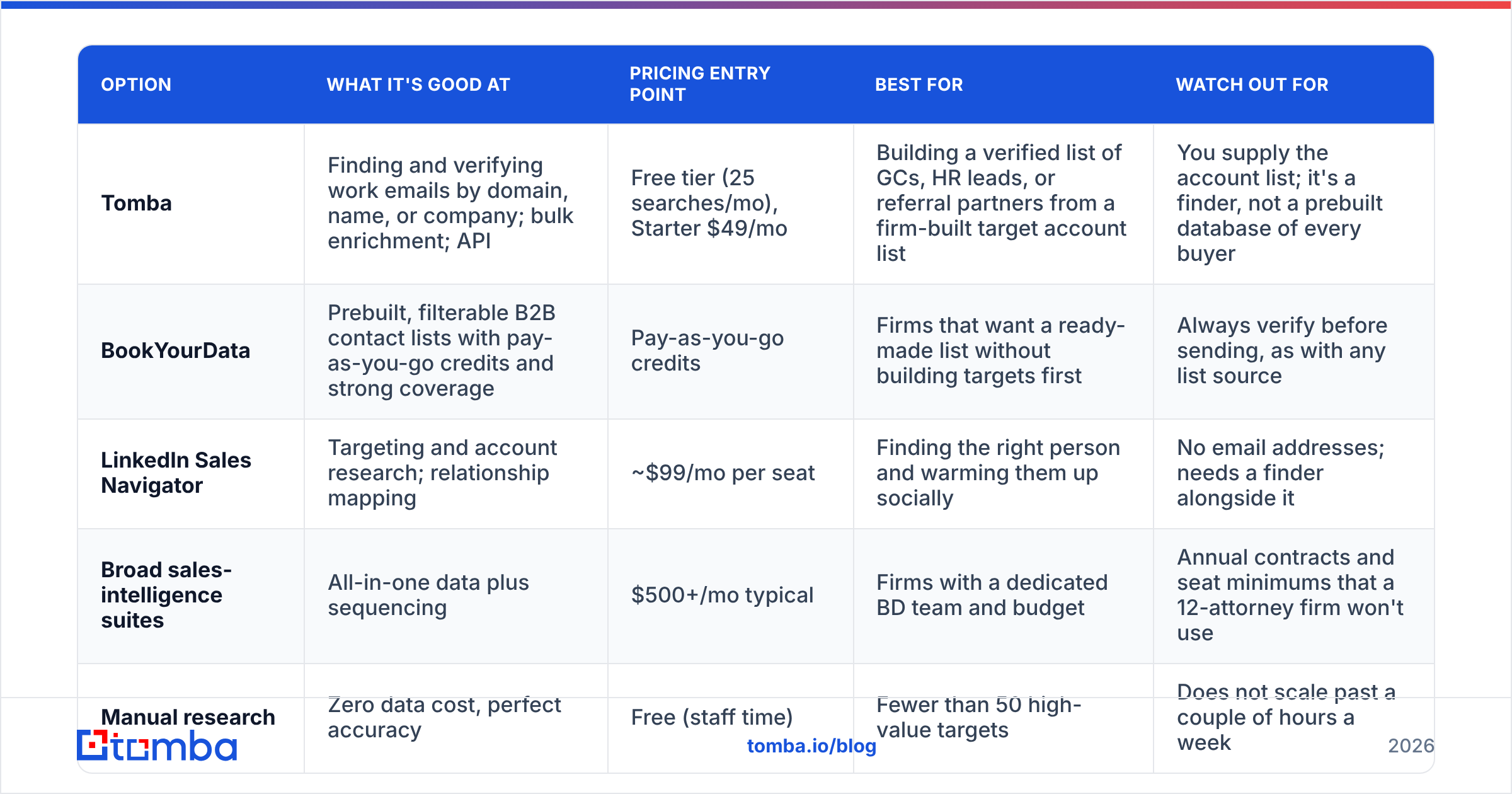
You need four things: a target list, contact data, deliverability, and a CRM to remember what happened. Here's how the common data options compare for a law firm building an in-house list.
| Option | What it's good at | Pricing entry point | Best for | Watch out for |
|---|---|---|---|---|
| Tomba | Finding and verifying work emails by domain, name, or company; bulk enrichment; API | Free tier (25 searches/mo), Starter $49/mo | Building a verified list of GCs, HR leads, or referral partners from a firm-built target account list | You supply the account list; it's a finder, not a prebuilt database of every buyer |
| BookYourData | Prebuilt, filterable B2B contact lists with pay-as-you-go credits and strong coverage | Pay-as-you-go credits | Firms that want a ready-made list without building targets first | Always verify before sending, as with any list source |
| LinkedIn Sales Navigator | Targeting and account research; relationship mapping | ~$99/mo per seat | Finding the right person and warming them up socially | No email addresses; needs a finder alongside it |
| Broad sales-intelligence suites | All-in-one data plus sequencing | $500+/mo typical | Firms with a dedicated BD team and budget | Annual contracts and seat minimums that a 12-attorney firm won't use |
| Manual research | Zero data cost, perfect accuracy | Free (staff time) | Fewer than 50 high-value targets | Does not scale past a couple of hours a week |
For most firms the practical path is: build the account list by hand (you know your ideal client better than any filter does), then use an email finder to get the contacts, then run every address through an email verifier before the first send. Skipping verification is how a firm domain that's been sending clean client email for fifteen years ends up in spam folders.
If you're working from a list of target companies rather than named individuals, domain search pulls the contacts at each firm in one pass, and the bulk email finder handles the list in a single upload rather than one lookup at a time.

Deliverability matters more for law firms than for anyone else. Your domain is also the domain your clients receive privileged communications on. Never run cold outreach from your primary firm domain — buy a separate sending domain, warm it slowly, keep daily volume low, and authenticate properly. One blacklisting event on your main domain is a very bad week.
Which metrics should a law firm actually track?#
Five numbers. If your dashboard has more than that, nobody reads it.
- Cost per signed case, by channel. The only number that decides next quarter's budget.
- Speed to first contact. Measure in minutes, not hours. Report the median and the 90th percentile, because the 90th is where cases die.
- Consult-to-signed rate. If this is under 30%, your problem is qualification or your fee conversation, not marketing.
- Average case value by channel. Cheap channels that deliver small matters can lose to expensive channels that deliver large ones. Rank by margin, not by cost.
- Lead source attribution completeness. What percentage of signed cases have a known source? Under 80% and every other number above is a guess.
Review monthly, not weekly. Legal sales cycles are long enough that weekly numbers are mostly noise, and reacting to noise is how firms kill channels three months before they would have worked.
What's a realistic law firm lead generation budget in 2026?#
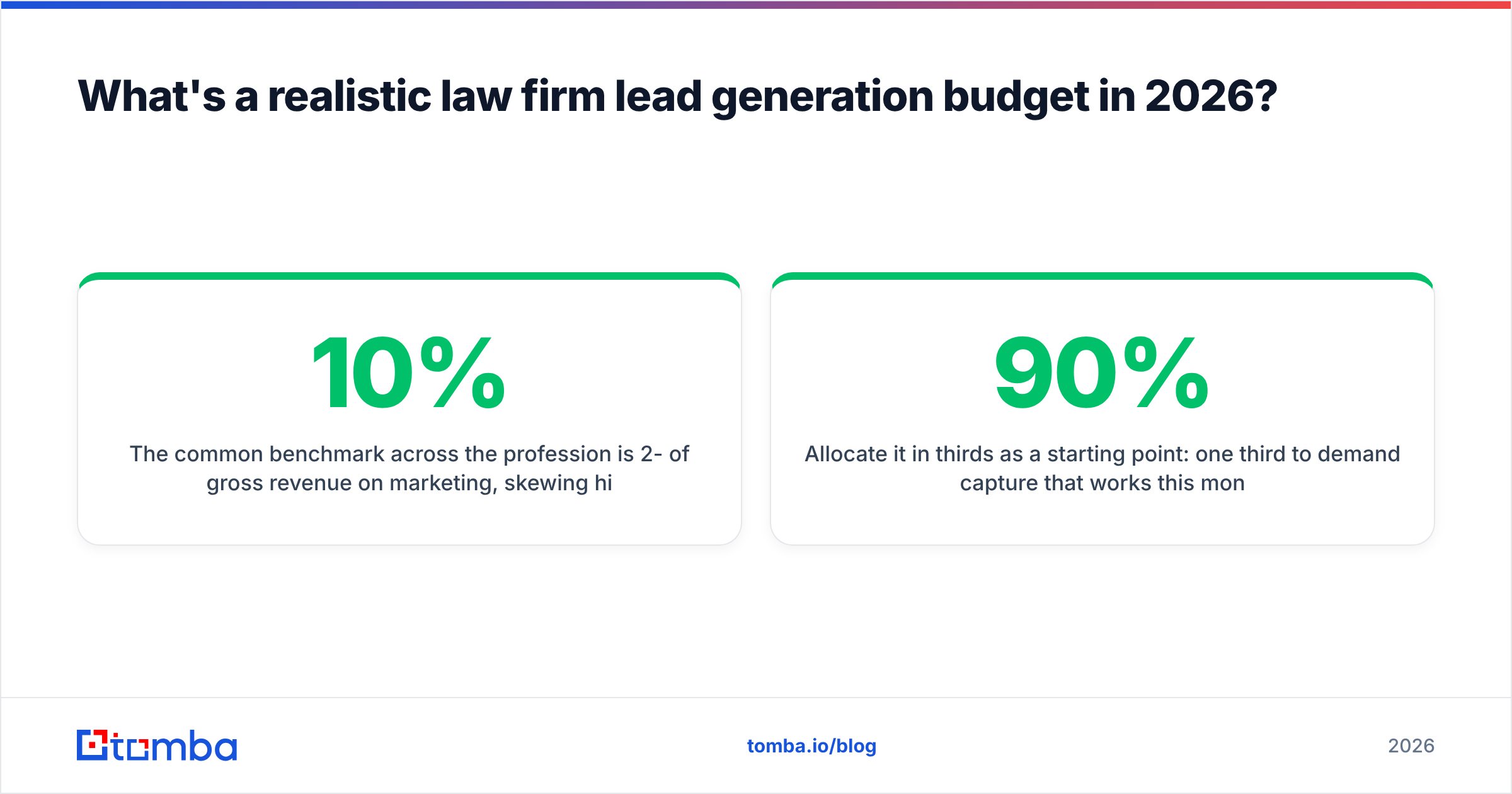
The common benchmark across the profession is 2-10% of gross revenue on marketing, skewing higher for consumer practice areas and newer firms. A $3M consumer-facing practice spending 8% is at $240K/year — roughly $20K/month, which in a competitive metro buys a modest paid search program, an SEO retainer, and not much else.
Allocate it in thirds as a starting point: one third to demand capture that works this month, one third to compounding assets (content, local SEO, reviews), one third to intake and follow-up infrastructure. Most firms spend 90% on the first bucket and wonder why the cost per signed case never improves. Tool reviews on G2 are useful for shortlisting vendors in each bucket, but ignore the star ratings and read the reviews from firms your size.
One more rule: don't add a channel until the current one is measured. A firm running paid search without call tracking that adds LinkedIn ads now has two channels it can't evaluate instead of one.
Where should you start this quarter?#
Pick the cheapest fix first. Audit your intake response time this week — call your own firm at 7pm and see what happens. Then set up source tracking so next quarter's decisions have data behind them. Only after those two are done should you argue about ad spend.
If your practice sells to businesses, or if referral-partner development is part of the plan, the list-building piece is the straightforward part. Use the Tomba Email Finder to turn a target list of companies, in-house counsel, HR leaders, or referral partners into verified, deliverable contacts — the free tier covers 25 searches a month if you want to test the data quality on accounts you already know, and paid plans start at $49/month. Check the full Tomba pricing to size it against your BD volume, verify everything before you send, and keep the cold outreach on a domain that isn't the one your clients trust.
Related guides#
// get started
Find, verify and enrich your first contacts today
Start on the free plan with 25 searches a month, then scale when your team is ready.
Free plan · No credit card required · GDPR & CCPA
Get the Tomba newsletter
Product and data updates
// about the author