What Is an LDR (Lead Development Representative)? 2026 Guide
An LDR works the leads marketing already paid for, and most teams staff the role wrong. Here is what a lead development representative actually owns, what the seat costs in 2026, and when an SDR is the better hire.
TL;DR
- An LDR (lead development representative) works inbound and marketing-sourced leads — form fills, content downloads, webinar lists, free-trial signups — and qualifies them into sales-accepted opportunities. An SDR runs cold outbound; a BDR chases net-new accounts and partnerships.
- The role exists because of one number: speed to lead. Leads contacted within five minutes convert dramatically better than leads contacted the next day, and nobody carrying a cold-calling quota will drop everything to hit that window.
- Typical 2026 US comp: $52K–$68K base, $70K–$92K OTE, with quota expressed in sales-accepted leads (SALs) or meetings held, not raw dials.
- Hire an LDR when marketing produces more than roughly 250–400 qualified leads a month and your AEs are cherry-picking from the pile. Below that volume, an SDR who splits inbound and outbound is cheaper and more flexible.
- The failure mode is almost always data, not effort: incomplete form records, missing direct-dial numbers, and unverified emails turn a good LDR into a very expensive researcher.
What is an LDR (lead development representative)?#
A lead development representative is the sales rep who owns the handoff between marketing and sales. Marketing generates interest; the LDR decides which of those hands actually belong to a buyer, and books the ones that do onto an account executive's calendar.
Think of a restaurant on a Friday night. Marketing is the sign out front pulling people off the street. The AE is the chef. Without a host at the door, either everyone walks straight to the kitchen or half the crowd stands around until they leave. The LDR is the host: greet fast, size up the party, seat the ones you can actually serve, and politely park the rest.
Concretely, the LDR's inbox is fed by:
- Demo requests and "contact sales" forms
- Content downloads, webinar registrations, and newsletter signups
- Free-trial and freemium activations
- Event scans and conference badge lists
- Website visitor identification and intent signals
- Chatbot conversations that need a human
What distinguishes the seat from the rest of the sales development family is the starting condition. An LDR always begins with a signal. Somebody raised a hand, however faintly. The job is to figure out whether the hand belongs to a buyer, an influencer, a student writing a paper, or a competitor doing research — then route accordingly.
What does an LDR actually do all day?#
The calendar of a working LDR looks nothing like the job description. Here is a realistic split for a rep handling roughly 120–180 new leads a month:
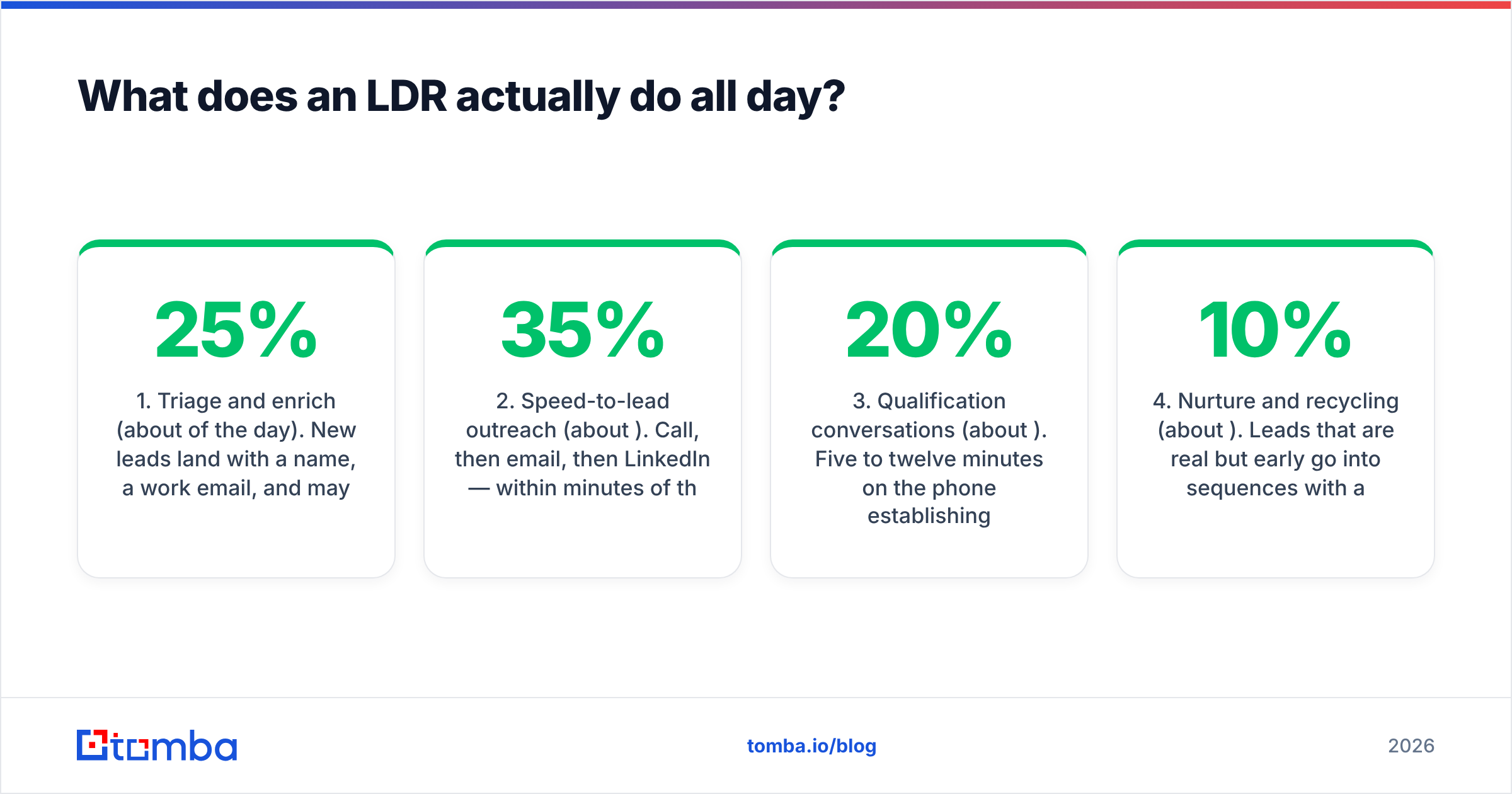
- Triage and enrich (about 25% of the day). New leads land with a name, a work email, and maybe a company. Before anyone gets called, the record needs a title, headcount, tech stack, and a phone number. Most teams automate this with data enrichment so the rep is reading a complete record instead of building one.
- Speed-to-lead outreach (about 35%). Call, then email, then LinkedIn — within minutes of the form fill where possible. The first touch is a phone call for high-fit leads and a personalized email for everyone else.
- Qualification conversations (about 20%). Five to twelve minutes on the phone establishing fit, problem, timing, and who else needs to be in the room. Not a full discovery call — a fit check.
- Nurture and recycling (about 10%). Leads that are real but early go into sequences with a defined re-touch date. This is where most of the compounding pipeline lives, and where most LDRs are weakest.
- CRM hygiene and handoff notes (about 10%). Every booked meeting needs context an AE can read in 30 seconds. Sloppy handoff notes are the single fastest way to lose AE trust.
Notice what is missing: list building. If your LDR is spending afternoons hunting for email addresses, you have staffed a research role and called it sales.

Is an LDR different from an SDR, BDR, or MDR?#
Yes, and the differences are operational, not cosmetic. The titles get used interchangeably at companies under 50 people, which is fine — but once you split the functions, the job specs, comp plans, and hiring profiles diverge fast.
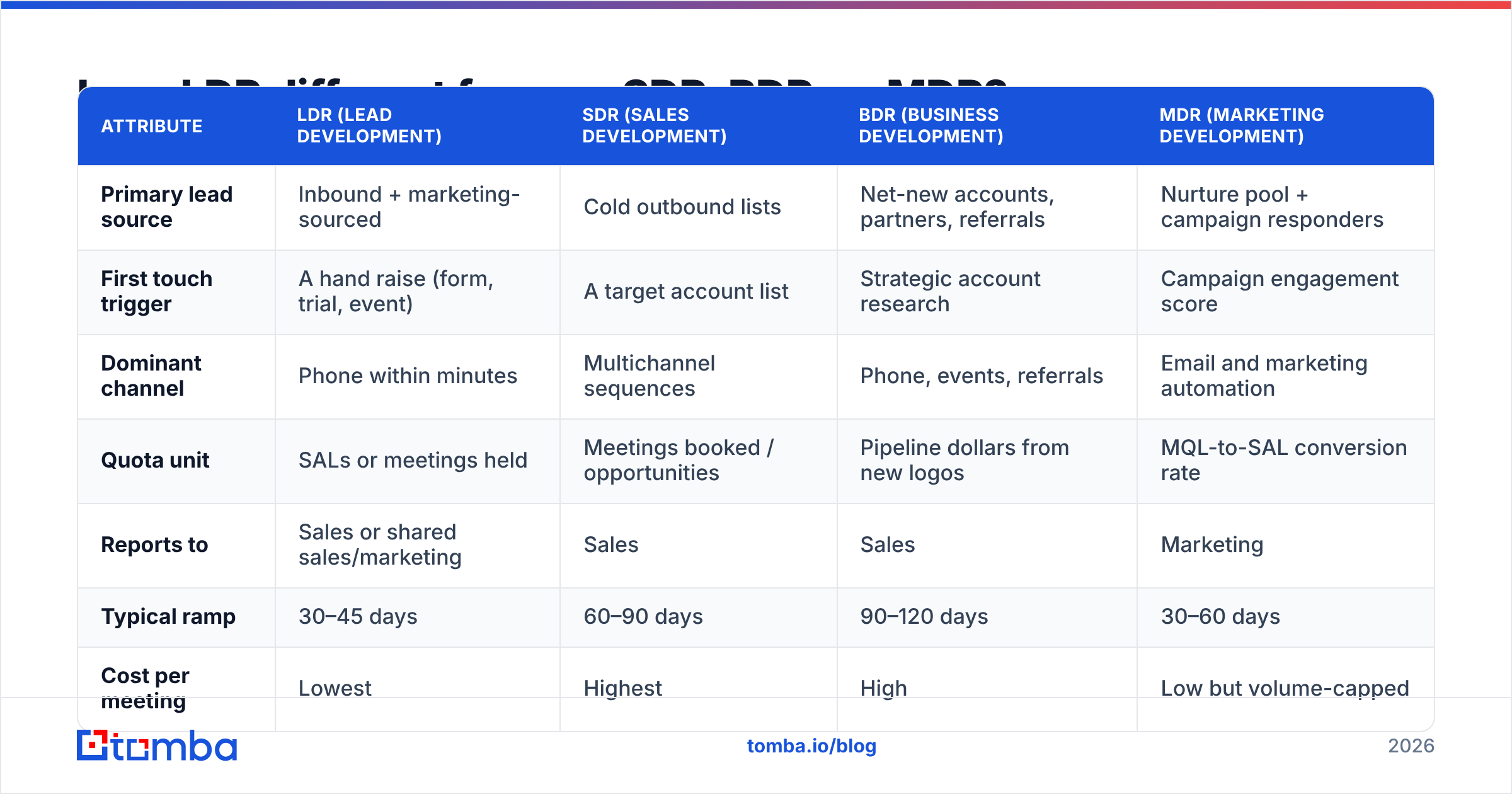
| Attribute | LDR (Lead Development) | SDR (Sales Development) | BDR (Business Development) | MDR (Marketing Development) |
|---|---|---|---|---|
| Primary lead source | Inbound + marketing-sourced | Cold outbound lists | Net-new accounts, partners, referrals | Nurture pool + campaign responders |
| First touch trigger | A hand raise (form, trial, event) | A target account list | Strategic account research | Campaign engagement score |
| Dominant channel | Phone within minutes | Multichannel sequences | Phone, events, referrals | Email and marketing automation |
| Quota unit | SALs or meetings held | Meetings booked / opportunities | Pipeline dollars from new logos | MQL-to-SAL conversion rate |
| Reports to | Sales or shared sales/marketing | Sales | Sales | Marketing |
| Typical ramp | 30–45 days | 60–90 days | 90–120 days | 30–60 days |
| Cost per meeting | Lowest | Highest | High | Low but volume-capped |
| Best fit | Content or PLG-heavy funnel | Defined ICP, low inbound | Enterprise or channel motion | Large database, long cycles |
The practical takeaway: LDRs are cheap per meeting and expensive per lead. They convert an asset marketing already paid for, so the marginal cost of a meeting is low — but they only work if the top of the funnel is full. SDRs are the inverse: expensive per meeting, but they manufacture demand where none exists.
Most teams that "tried an LDR and it didn't work" simply didn't have enough inbound to keep one busy. A rep with 40 leads a month will invent work, usually bad work.
What should an LDR be measured on in 2026?#
Activity metrics are still useful for coaching, but they make terrible quotas. If you pay on dials, you get dials. Here is the metric stack that holds up:
- Speed to first touch (median, not average). Median minutes from form submission to first human contact attempt. Averages hide the disaster cases. Target: under 10 minutes during business hours.
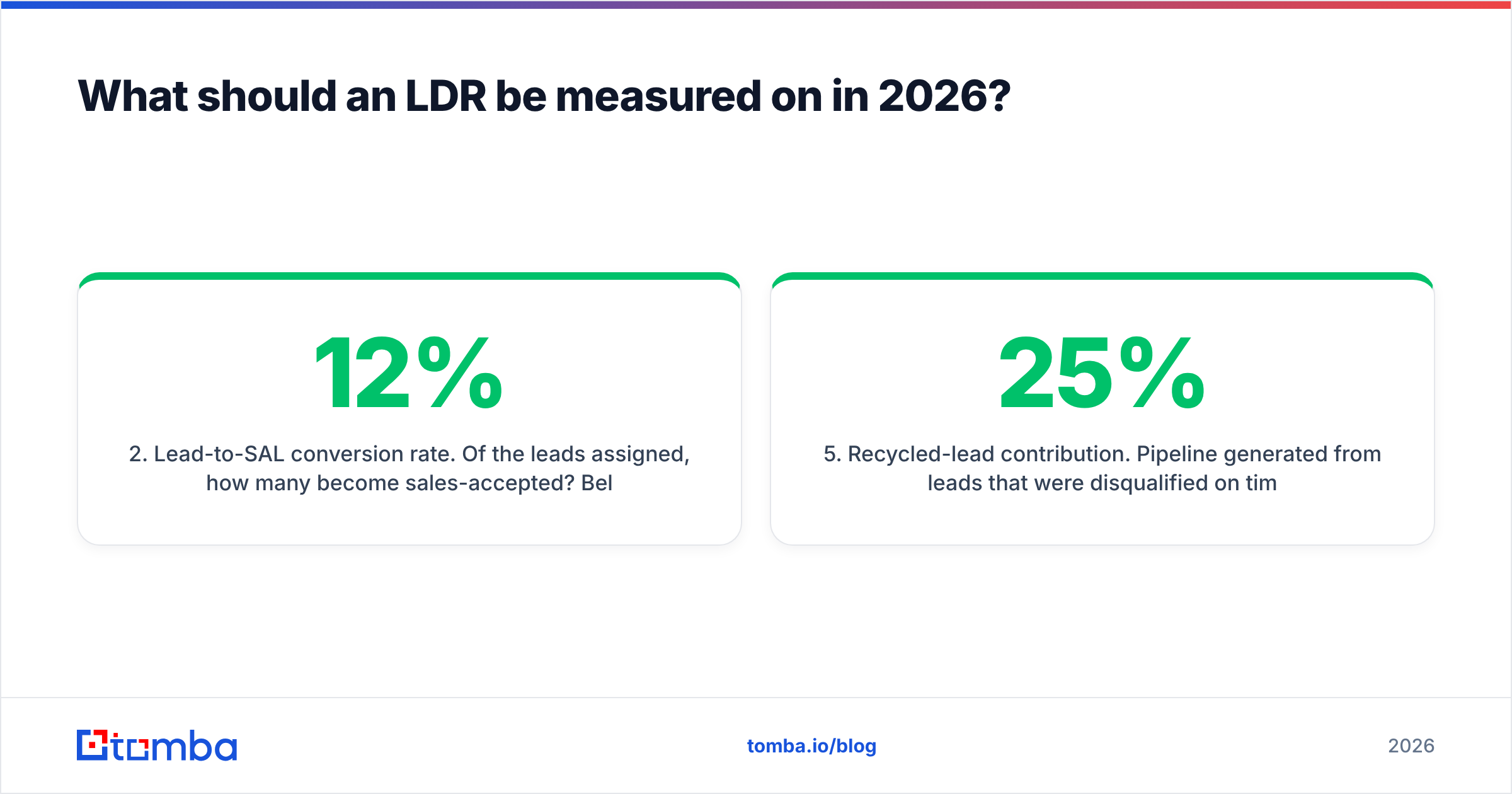
- Lead-to-SAL conversion rate. Of the leads assigned, how many become sales-accepted? Below 12% usually means marketing is sending junk; above 45% usually means the LDR is accepting junk.
- Meetings held, not booked. No-shows are an LDR problem, not an AE problem. Confirmations, calendar invites with agendas, and a day-of text are all in scope.
- SAL-to-opportunity rate. The AE's verdict on lead quality. This is the honest referee of whether qualification is real.
- Recycled-lead contribution. Pipeline generated from leads that were disqualified on timing and re-touched later. Healthy teams see 15–25% of LDR-sourced pipeline come from this bucket.
- Data completeness at handoff. Percentage of booked meetings with verified email, direct phone, title, and headcount populated. Unglamorous, and the leading indicator for everything above it.
If you need a shared vocabulary between sales and marketing before you set any of these targets, nail down what counts as a marketing qualified lead first. Half the LDR arguments in the world are two teams using the same word for different things.
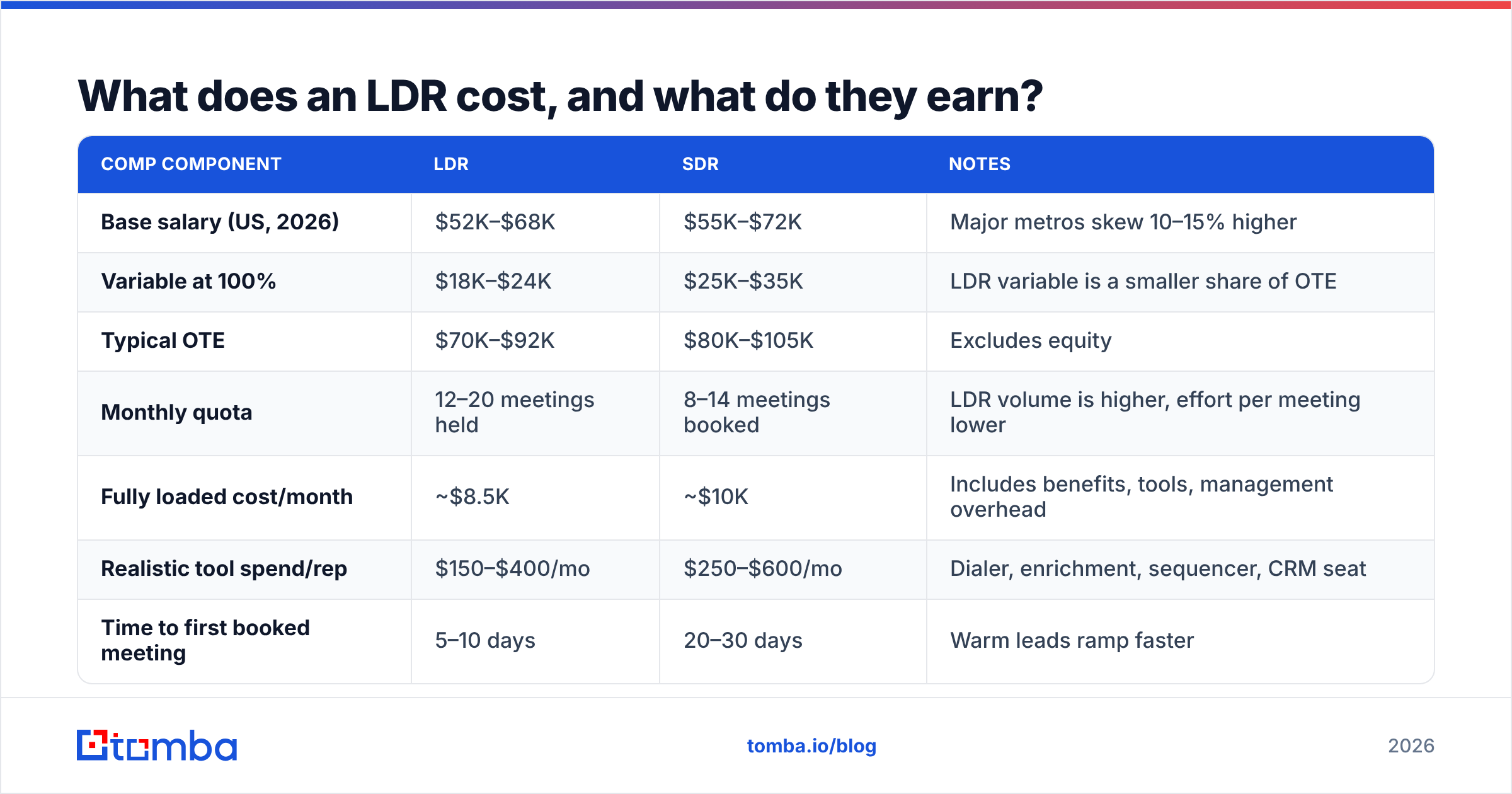
What does an LDR cost, and what do they earn?#
Compensation for the role has compressed toward the rest of sales development, though LDRs still sit slightly below SDRs on OTE because the pipeline is warm and the ramp is shorter.
| Comp component | LDR | SDR | Notes |
|---|---|---|---|
| Base salary (US, 2026) | $52K–$68K | $55K–$72K | Major metros skew 10–15% higher |
| Variable at 100% | $18K–$24K | $25K–$35K | LDR variable is a smaller share of OTE |
| Typical OTE | $70K–$92K | $80K–$105K | Excludes equity |
| Monthly quota | 12–20 meetings held | 8–14 meetings booked | LDR volume is higher, effort per meeting lower |
| Fully loaded cost/month | ~$8.5K | ~$10K | Includes benefits, tools, management overhead |
| Realistic tool spend/rep | $150–$400/mo | $250–$600/mo | Dialer, enrichment, sequencer, CRM seat |
| Time to first booked meeting | 5–10 days | 20–30 days | Warm leads ramp faster |
Run the math before you post the job. At roughly $8.5K fully loaded per month and 15 meetings held, you are paying about $570 per meeting held. If your average deal size is $12K and your AE closes one in five LDR-sourced meetings, the seat pays for itself at around four meetings a month. Everything above that is margin.
Compare that against the alternative: an AE working their own inbound. AE hours are worth two to three times as much, and they will skim the top 20% of leads and let the rest rot. That skimming is exactly what an LDR exists to prevent.
What tech does an LDR actually need?#
Less than vendors would like you to believe, but the four essentials are non-negotiable:
- A CRM with clean routing rules. Round-robin, territory, or account-based — pick one and enforce it. Manual assignment collapses at volume. Both Salesforce and HubSpot handle this natively.
- A dialer with local presence and call recording. Call connect rates are the whole ball game, and recordings are how you coach.
- A sequencer. Phone-only LDRs cap out fast; email and LinkedIn steps carry the leads who never pick up.
- Enrichment and contact data. The form gave you an email. You need a title, a company size, and a phone number before the first dial. A phone finder plus an email verifier closes the gap between what the form captured and what the rep needs.
The one piece teams consistently underinvest in is verification. An LDR who sends 60 emails a day into an unverified list burns sender reputation for the entire domain, and then marketing's nurture campaigns start landing in spam too. The blast radius of bad data is larger than the LDR's own numbers.

What are the most common ways LDR teams fail?#
Four patterns account for most of the wreckage:
Volume mismatch. The seat needs 120+ real leads a month to stay busy. Below that, the rep drifts into cold outbound they were not hired or trained for, then underperforms against an SDR-style quota nobody adjusted.
Qualification theater. LDRs asked to run full BANT on a five-minute call will produce beautifully filled-out fields and meetings that go nowhere. Qualify for fit and problem. Let the AE qualify for budget and authority.
No recycling loop. A lead that says "not this quarter" is worth more than a cold account, and most teams throw it away. Define a re-touch date, put it in a sequence, and measure what comes back.
Data decay nobody owns. Contact records rot at roughly 25–30% a year as people change jobs. If nothing re-enriches the database on a schedule, an LDR's nurture pool quietly turns into a bounce generator. Keeping a maintained B2B database underneath the CRM is the boring fix that prevents the loud problem.
For a deeper look at the mechanics behind the funnel stage itself, the lead generation fundamentals and HubSpot's ongoing sales research are both reasonable neutral starting points.
How do you ramp a new LDR in 30, 60, and 90 days?#
Days 1–30: absorb and observe. Product training, ICP definition, and 40+ recorded call reviews. The rep handles low-priority leads only — newsletter signups, content downloads — where mistakes are cheap. Target: first meeting booked by day 10.
Days 31–60: own the queue. Full lead assignment, 50% of quota, weekly call coaching with a scorecard. This is where you find out whether they can hold a conversation with a director-level buyer or only a practitioner.
Days 61–90: full quota and improvement. 100% of quota, plus one owned process improvement — a better voicemail script, a rewritten confirmation email, a cleaned-up disqualification taxonomy. LDRs who never improve the system stall out at the seat; the ones who do become your next AE or SDR manager.
One hiring note: the best LDRs are rarely the most polished interviewers. Look for people who ask you sharp questions about your own business during the interview, and who are comfortable being told no twenty times before lunch. Curiosity and recovery speed beat pedigree in this seat every time.
Should you hire an LDR or fix your data first?#
Fix the data first. It is cheaper, faster, and it changes the answer to the hiring question.
Audit one month of inbound leads. Count how many have a verified work email, a direct phone number, a confirmed title, and a company size. If that number is under 60%, your first LDR will spend their first quarter doing research instead of selling, and you will conclude the role does not work. It does. The inputs did not.
Once the records are complete, the ROI math above holds and the seat becomes one of the easiest hires in sales to justify.
Start with the inputs. Tomba's Email Finder fills in the verified work emails your forms never captured, so every lead that reaches your LDR is callable on the first attempt instead of the third. The free tier covers 25 searches a month to test the accuracy on your own lead list, and paid plans start at $49/mo on Starter — see full Tomba pricing for Growth at $99/mo and Pro at $249/mo. Clean the inputs, then hire the rep.
Related guides#
// get started
Find, verify and enrich your first contacts today
Start on the free plan with 25 searches a month, then scale when your team is ready.
Free plan · No credit card required · GDPR & CCPA
// about the author