Lead Acquisition Specialist: Role, Skills, and Salary in 2026
A lead acquisition specialist owns the top of the funnel — sourcing, verifying, and qualifying contacts before sales touches them. Here's the real scope, stack, salary range, and how the role differs from an SDR.
TL;DR
- A lead acquisition specialist owns everything upstream of the first sales touch: sourcing, verifying, enriching, scoring, and routing contacts. They do not run sequences or book meetings — that's the SDR.
- US base salaries run roughly $52k–$85k, with EU/LATAM/remote hires landing $28k–$55k. Most teams add a data-quality bonus rather than a meeting quota.
- The role pays for itself when your SDRs spend more than ~25% of their week building lists instead of talking to people.
- The stack is small and cheap: one finder/verifier, one intent or firmographic source, one CRM, one enrichment layer. Budget $300–$900/month in tooling, not $5k.
- Measure them on verified-contact cost, bounce rate, and ICP-match rate — not on volume of rows added.
What is a lead acquisition specialist?#
A lead acquisition specialist is the person who builds and cleans the pipeline of contacts before anyone tries to sell to them. Think of a restaurant: the SDR is the server taking orders, the AE is the chef closing plates. The lead acquisition specialist is the buyer at the produce market at 5am, deciding which suppliers are reliable and rejecting the bruised crates. Nobody sees them. Everything downstream tastes like their decisions.
Technically, the role sits between marketing operations and sales development. It's a data-operations function with a revenue target attached. In 2026 the title has settled into meaning roughly the same thing across mid-market B2B: someone who owns list build, contact data quality, enrichment logic, and handoff rules into the CRM.
Here's the concrete scope most job descriptions converge on:
- Source definition — decide where leads come from: job boards, funding announcements, tech-stack signals, conference attendee lists, website visitors, review-site traffic.
- Contact discovery — turn a company and a job title into a verified work email and, where legal, a direct phone number.
- Verification and hygiene — run every address through validation, quarantine catch-all domains, and de-duplicate against existing CRM records.
- Enrichment — attach firmographics, tech stack, headcount, funding stage, and any intent signal you can defend.
- Scoring and routing — apply the ICP filter, assign a tier, and push into the right sequence or territory queue.
- Feedback loop — pull bounce data, reply data, and closed-won attributes back into the sourcing rules every month.
If a candidate's experience stops at step two, they're a list builder, not a specialist. The compounding value is in steps five and six.
How is it different from an SDR or a demand-gen manager?#
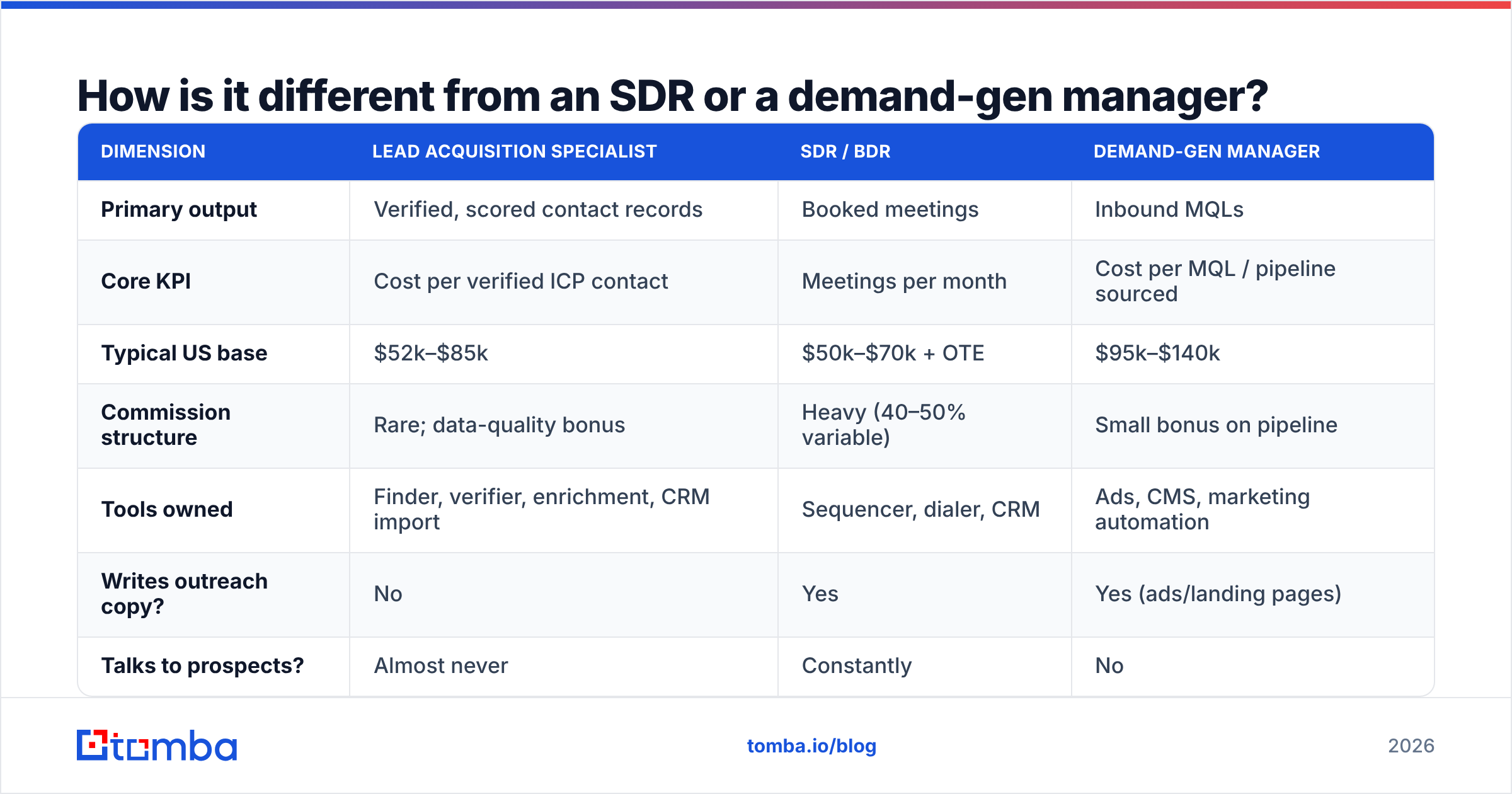
The three roles get conflated constantly in job ads, which is why hiring goes wrong. An SDR is measured on conversations. A demand-gen manager is measured on inbound volume. A lead acquisition specialist is measured on the quality and cost of the raw material both of them consume.
| Dimension | Lead Acquisition Specialist | SDR / BDR | Demand-Gen Manager |
|---|---|---|---|
| Primary output | Verified, scored contact records | Booked meetings | Inbound MQLs |
| Core KPI | Cost per verified ICP contact | Meetings per month | Cost per MQL / pipeline sourced |
| Typical US base | $52k–$85k | $50k–$70k + OTE | $95k–$140k |
| Commission structure | Rare; data-quality bonus | Heavy (40–50% variable) | Small bonus on pipeline |
| Tools owned | Finder, verifier, enrichment, CRM import | Sequencer, dialer, CRM | Ads, CMS, marketing automation |
| Writes outreach copy? | No | Yes | Yes (ads/landing pages) |
| Talks to prospects? | Almost never | Constantly | No |
| Ramp time | 3–5 weeks | 8–12 weeks | 10–14 weeks |
The practical test: if your SDRs are spending Monday and Tuesday building lists and Wednesday through Friday sending, you are paying commission-grade salary for data-entry hours. That's the arbitrage the role exists to capture. Most teams that make the switch report SDR sending volume climbing 40–60% without adding headcount to the sending side, simply because the list is waiting on Monday morning.

A second distinction matters for compliance. Under GDPR and the growing patchwork of US state privacy laws, someone needs to own lawful-basis documentation for every contact record — where it came from, when, and under which legitimate-interest claim. Demand-gen owns consent for inbound. The lead acquisition specialist owns provenance for outbound. If nobody owns it, your legal exposure lives in a spreadsheet nobody has opened since 2024.
What does a lead acquisition specialist actually do all week?#
A realistic week, from teams running this role at 20–200 employee B2B companies:
Monday — source and build. Pull trigger lists: companies that posted a relevant role, raised a round, or added a competitor's tech to their stack. Convert domains into decision-maker contacts. This is where a domain search does the heavy lifting — feed it a company domain and a department filter, get back the people who match, with confidence scores attached.
Tuesday — verify and dedupe. Every new batch goes through an email verifier before it touches the CRM. Catch-all domains get flagged separately rather than silently accepted, because a catch-all that accepts everything tells you nothing about whether a mailbox exists. Duplicates against open opportunities get killed — nothing burns an AE's trust faster than an SDR cold-emailing a contact already in a live deal.
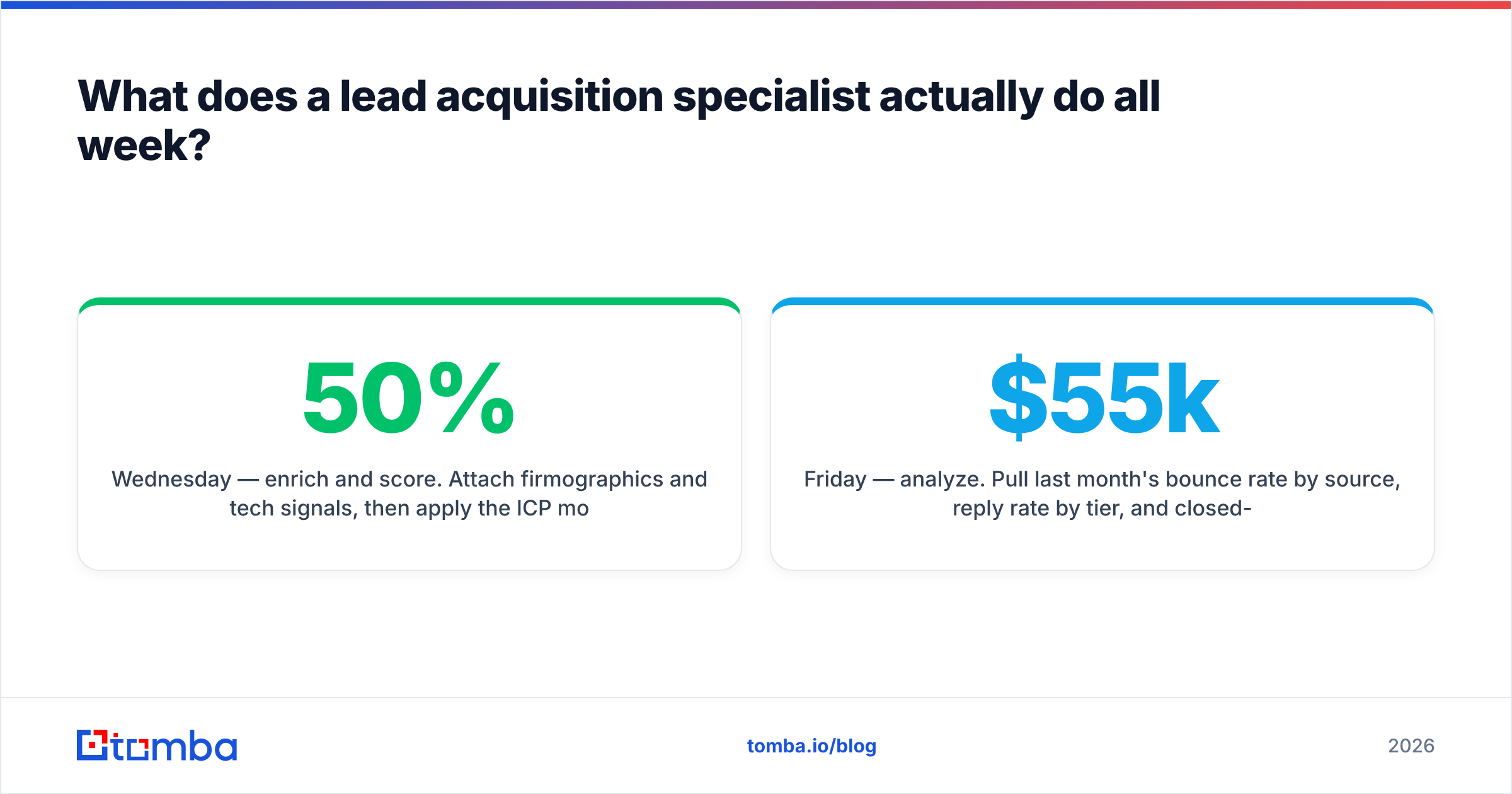
Wednesday — enrich and score. Attach firmographics and tech signals, then apply the ICP model. Tier A goes to senior SDRs, Tier B to sequences, Tier C to a nurture list or the bin. The discipline here is deleting: a good specialist throws away 30–50% of what they source.
Thursday — load and route. Push into the CRM with clean field mapping, source attribution, and suppression lists applied. Suppression matters more than people think — current customers, active opportunities, competitors, do-not-contact requests, and anyone who bounced in the last 90 days.
Friday — analyze. Pull last month's bounce rate by source, reply rate by tier, and closed-won firmographics. Adjust the sourcing rules. This is the day that separates a $55k hire from an $85k one.
What tools does the role need?#
Small stack, ruthlessly applied. The failure mode is buying a $30k/year all-in-one platform and using 8% of it.
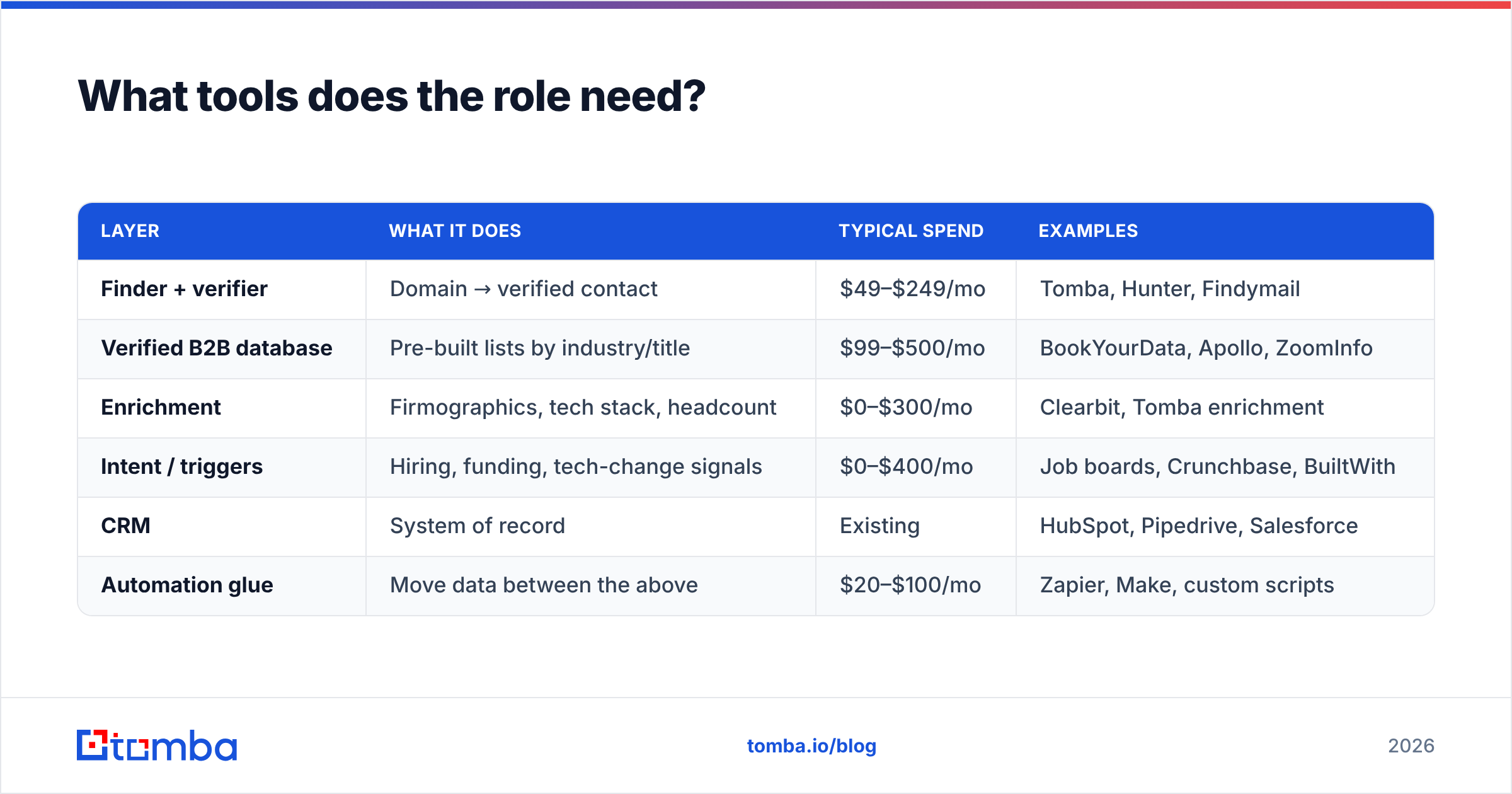
| Layer | What it does | Typical spend | Examples |
|---|---|---|---|
| Finder + verifier | Domain → verified contact | $49–$249/mo | Tomba, Hunter, Findymail |
| Verified B2B database | Pre-built lists by industry/title | $99–$500/mo | BookYourData, Apollo, ZoomInfo |
| Enrichment | Firmographics, tech stack, headcount | $0–$300/mo | Clearbit, Tomba enrichment |
| Intent / triggers | Hiring, funding, tech-change signals | $0–$400/mo | Job boards, Crunchbase, BuiltWith |
| CRM | System of record | Existing | HubSpot, Pipedrive, Salesforce |
| Automation glue | Move data between the above | $20–$100/mo | Zapier, Make, custom scripts |
Two notes on selection. First, prefer tools with an API over tools with only a UI — the whole point of the role is repeatable pipelines, and a specialist who can hit the Tomba API from a scheduled script will out-produce three people clicking through dashboards. Second, for teams that want ready-made verified lists rather than building from scratch, a curated provider like BookYourData is a legitimate complement to a finder — buy where the data is commoditized, build where your ICP is unusual.
On the free-versus-paid question: nearly every finder offers a free tier worth testing against your own known-good contacts before committing. Tomba's free tier gives 25 searches a month, which is enough to benchmark accuracy on a sample you can independently verify. See Tomba pricing for where the paid tiers land — Starter at $49/mo, Growth at $99/mo, Pro at $249/mo.

What should you pay a lead acquisition specialist in 2026?#
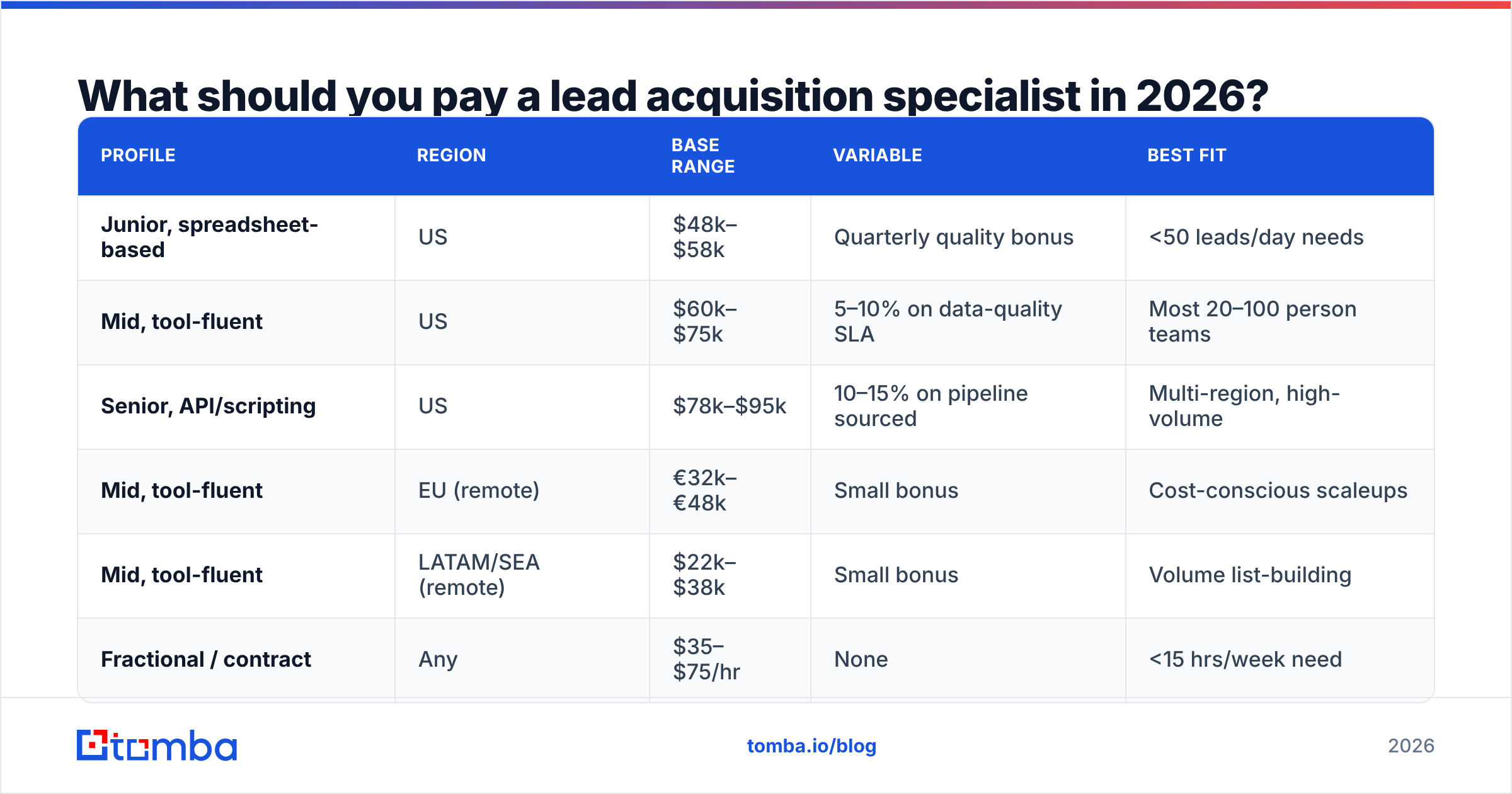
Salary depends more on whether the role is technical than on seniority. A specialist who writes Python and maintains API pipelines commands a 30–40% premium over one who works entirely in spreadsheets and browser extensions.
| Profile | Region | Base range | Variable | Best fit |
|---|---|---|---|---|
| Junior, spreadsheet-based | US | $48k–$58k | Quarterly quality bonus | <50 leads/day needs |
| Mid, tool-fluent | US | $60k–$75k | 5–10% on data-quality SLA | Most 20–100 person teams |
| Senior, API/scripting | US | $78k–$95k | 10–15% on pipeline sourced | Multi-region, high-volume |
| Mid, tool-fluent | EU (remote) | €32k–€48k | Small bonus | Cost-conscious scaleups |
| Mid, tool-fluent | LATAM/SEA (remote) | $22k–$38k | Small bonus | Volume list-building |
| Fractional / contract | Any | $35–$75/hr | None | <15 hrs/week need |
Benchmarks vary by source; cross-check against Glassdoor and G2's buyer surveys for your specific metro before you post a range. Broadly, the compensation logic is: this is an operations salary, not a sales salary, because the role has no closing risk. Teams that bolt a heavy commission plan onto it end up rewarding volume, which is exactly the behavior you don't want.
One structure that works well: pay base plus a quarterly bonus tied to two numbers — bounce rate under 3% and ICP-match rate above 80% on sampled records. Both are auditable. Neither rewards dumping garbage into the CRM.
How do you measure whether the role is working?#
Four metrics, reviewed monthly. Everything else is vanity.
- Cost per verified ICP contact. Total tooling plus loaded salary, divided by contacts that passed verification and ICP scoring. A healthy number for mid-market B2B is $0.40–$1.80. Above $3, you're over-tooled or under-targeted.
- Bounce rate on sent volume. Under 3% is the working threshold; under 1.5% is good. Anything above 5% is actively damaging your sender reputation, and no amount of clever copy recovers from that.
- ICP-match rate. Sample 50 records a month at random and have an AE grade them. Below 70% means the sourcing rules are too loose.
- SDR time-to-first-touch. How long from list delivery to first email sent. If lists sit unused for a week, the problem is trust, not throughput — go audit what the SDRs are finding wrong.
Deliberately absent from that list: number of contacts added. It is the easiest metric to game and the least correlated with revenue. A specialist who adds 400 clean, well-scored contacts beats one who adds 4,000 unverified rows, every quarter, without exception.
When should you hire one — and when shouldn't you?#
Hire when:
- You have three or more SDRs and they're each losing a day a week to list building.
- Your bounce rate has crept above 4% and nobody owns fixing it.
- You sell into a niche ICP where off-the-shelf lists don't exist and someone has to construct the target universe manually.
- You're expanding into a new region or segment and need the target universe mapped from zero.
- Compliance has started asking where contact data comes from and nobody has an answer.
Don't hire when:
- You have one or two reps. At that scale, the founder or the reps themselves should feel the pain of bad data — it's the fastest way to learn the ICP.
- Your ICP is fewer than 500 accounts total. Build the list once, manually, and maintain it in a spreadsheet.
- You're primarily inbound-led. Hire a demand-gen person instead.
- You haven't yet proven anyone will buy. A specialist scales a working motion; they do not invent one.
The honest middle path for teams of five to fifteen: don't hire, automate. A bulk email finder plus a scheduled verification job plus clean CRM routing rules covers maybe 70% of what a junior specialist would do, at a few hundred dollars a month instead of $60k a year. Hire the human when the remaining 30% — judgment, source discovery, feedback loops — starts costing you real pipeline.
What does a good job description look like?#
Keep it specific enough that unqualified applicants self-select out. A workable skeleton:
- Own the outbound contact pipeline from source identification through CRM handoff for lead generation across two segments.
- Maintain data-quality SLAs: bounce rate under 3%, ICP-match rate above 80%, zero duplicates against open opportunities.
- Build and run repeatable sourcing workflows using finder/verifier APIs, enrichment tools, and automation platforms.
- Own data provenance and compliance documentation for every record entering the CRM.
- Report monthly on cost per verified contact, source performance, and closed-won firmographic patterns.
Required skills worth screening for: spreadsheet fluency well past VLOOKUP, comfort with an API or at least a no-code automation builder, a working understanding of email deliverability mechanics, and the temperament to delete data rather than hoard it. Screen for the last one with a simple question: "Tell me about a list you threw away." Candidates who've never discarded anything have never had a quality standard.
Getting the data layer right first#
Whether you hire the role or absorb it, the bottleneck is the same: turning a target account into a contact you can actually reach, without torching your domain reputation on the way. That's a tooling problem before it's a headcount problem.
Start with the Tomba Email Finder — feed it a name and a company domain and get back a verified work email with a confidence score and the sources behind it. Free tier covers 25 searches a month, enough to benchmark it against contacts you already know are correct before you commit budget. Pair it with the verifier for hygiene and the API for anything you want to run on a schedule, and you'll have the data layer a specialist would build — whether or not you end up hiring one.
Related guides#
Ready to find emails that actually work?
Join 150,000+ professionals who stopped guessing and started sending. Free credits on signup — no credit card required.
Get the Tomba newsletter
Practical outbound tactics and product updates — once every two weeks.
About the author