Lead Acquisition Strategy: A Practical 2026 Framework
Most lead acquisition strategies fail on math, not creativity. Here's how to size channels, price a lead, and build an acquisition engine that survives a CFO review in 2026.
TL;DR
- A lead acquisition strategy is a documented plan for where leads come from, what each one costs, and how many convert — not a list of channels you're "trying."
- Pick channels on payback math, not popularity. A $180 CPL channel that closes at 8% beats a $30 CPL channel that closes at 0.4%.
- Owned channels (outbound, SEO, community, referral) compound; rented channels (paid social, marketplaces) reset to zero the day you stop paying.
- Data quality is the hidden multiplier. A 12% bounce rate doesn't just waste sends — it degrades sender reputation and silently caps every future campaign.
- Review the whole system quarterly on one number: blended CAC payback in months. Anything over 18 months in a $5–50k ACV business is a strategy problem, not an execution problem.
What is a lead acquisition strategy?#
A lead acquisition strategy is the set of deliberate, measurable decisions about how your company turns strangers into qualified pipeline — which audiences you target, which channels reach them, what you pay per lead, and what happens in the 90 days after the lead arrives.
Think of it like stocking a restaurant kitchen. Anyone can buy ingredients. A chef decides which suppliers deliver reliably, what margin each dish carries, and what to drop when the fish supplier gets flaky. Most companies "do lead gen" — they buy ingredients. A strategy is the supplier contract, the margin sheet, and the fallback plan.
The practical difference shows up in four artifacts. If you don't have all four written down somewhere, you have activity, not strategy:
- An ICP definition with exclusions. Not "B2B SaaS companies" — "Series A–C B2B SaaS, 50–500 employees, North America and UK, with an existing RevOps hire, excluding agencies and companies under $2M ARR."
- A channel P&L. Spend, leads, SQLs, closed-won, and CAC per channel, refreshed monthly. Not a dashboard you glance at — a sheet someone owns.
- A lead definition everyone agrees on. Marketing and sales using different definitions of "qualified" is the single most common reason acquisition numbers look great and revenue doesn't move.
- A data layer. Where contact records come from, how they're verified, how they're enriched, and who is accountable when 15% of them bounce.
Why do most lead acquisition strategies fail?#
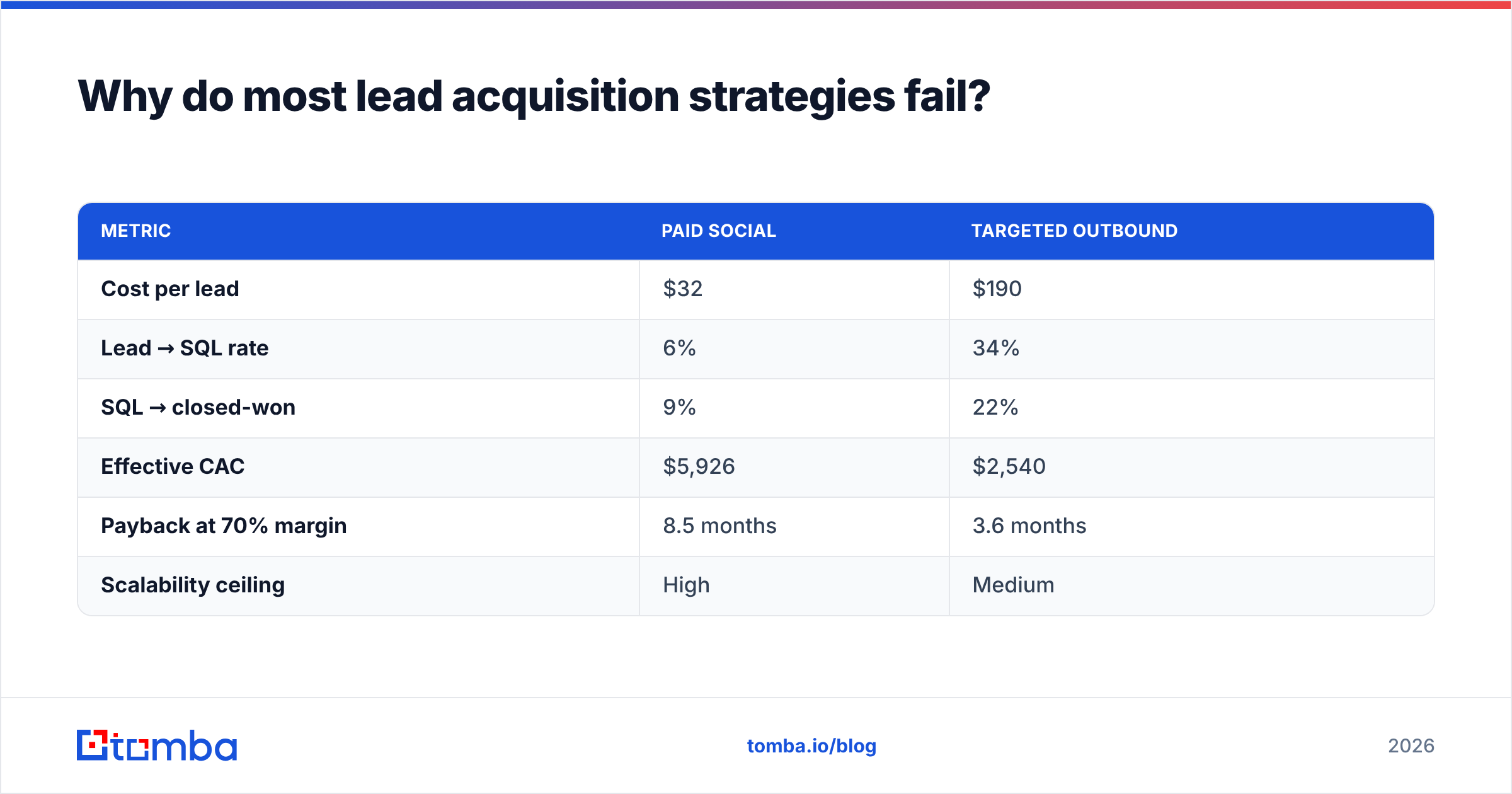
They fail on arithmetic. Specifically, teams optimize cost per lead when the only number that matters is cost per closed-won customer, and those two move in opposite directions more often than you'd expect.
Here's the trap in numbers. Say you run two channels for a $12,000 ACV product:
| Metric | Paid social | Targeted outbound |
|---|---|---|
| Cost per lead | $32 | $190 |
| Lead → SQL rate | 6% | 34% |
| SQL → closed-won | 9% | 22% |
| Effective CAC | $5,926 | $2,540 |
| Payback at 70% margin | 8.5 months | 3.6 months |
| Scalability ceiling | High | Medium |
The cheap channel costs 2.3x more per customer. Teams still default to it because CPL is visible on day one and CAC isn't visible for four months. That lag is where budgets go to die.
The second failure mode is treating acquisition as a marketing-only function. Acquisition spans marketing (demand), sales development (outbound), product (self-serve signup), and customer success (referrals and expansion). When one team owns the number and four teams influence it, nobody can fix it.
Third: no channel concentration limit. If a single channel produces more than 60% of your pipeline, you don't have a strategy — you have a dependency. Google's algorithm updates, LinkedIn's ad auction, and a marketplace's ranking rules are all things you don't control. Gartner's demand generation research has been flagging channel concentration risk for years, and buying committees keep getting larger, which makes single-channel coverage even weaker.
Which lead acquisition channels actually work in 2026?#
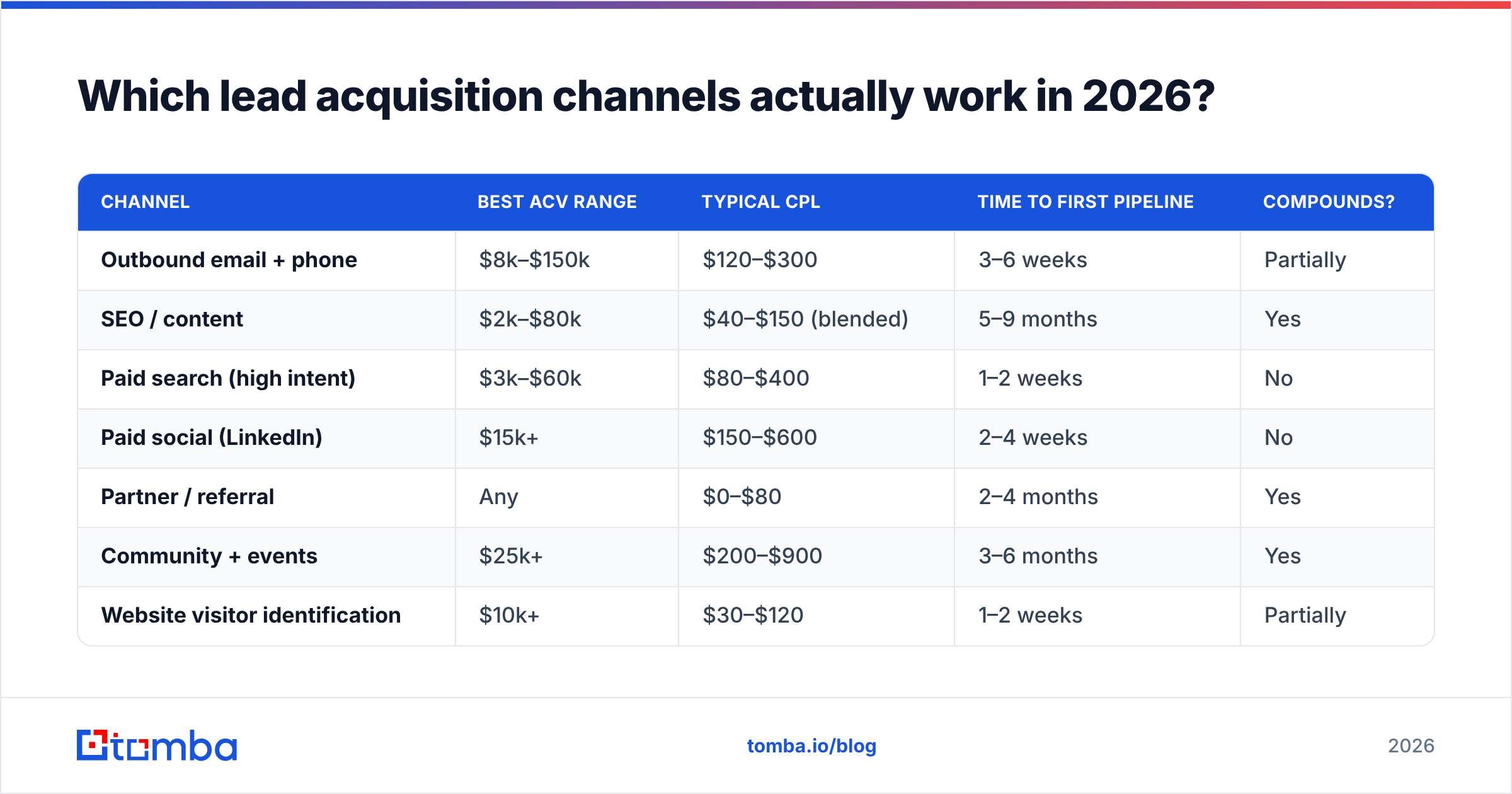
Depends on your ACV and sales motion. The honest answer is that channel effectiveness is almost entirely a function of deal size — nothing else predicts it as well.
| Channel | Best ACV range | Typical CPL | Time to first pipeline | Compounds? |
|---|---|---|---|---|
| Outbound email + phone | $8k–$150k | $120–$300 | 3–6 weeks | Partially |
| SEO / content | $2k–$80k | $40–$150 (blended) | 5–9 months | Yes |
| Paid search (high intent) | $3k–$60k | $80–$400 | 1–2 weeks | No |
| Paid social (LinkedIn) | $15k+ | $150–$600 | 2–4 weeks | No |
| Partner / referral | Any | $0–$80 | 2–4 months | Yes |
| Community + events | $25k+ | $200–$900 | 3–6 months | Yes |
| Website visitor identification | $10k+ | $30–$120 | 1–2 weeks | Partially |
| Product-led signup | Under $10k | $10–$60 | Immediate | Yes |
Two notes on reading this table. First, CPL ranges are wide because they're driven by how narrow your ICP is — a 4,000-account TAM will always cost more per lead than a 400,000-account one. Second, "compounds" is the column most teams ignore and the one that determines whether your CAC drops over three years or stays flat forever.
For most B2B companies between $10k and $60k ACV, the durable core is a three-channel mix: outbound for control and speed, SEO for compounding inbound, and referral/partner for the lowest-CAC volume you'll ever get. Paid is a throttle you turn up when you need a specific quarter to land, not a foundation.
Outbound deserves a specific caveat in 2026. It still works, but only with tight targeting and clean data. Blasting 10,000 scraped addresses is not outbound — it's a deliverability incident with a spreadsheet attached. The teams still getting 8–12% reply rates are sending 300–800 highly researched emails per month per rep, not 8,000.
How do you build the acquisition engine step by step?#
Start with the math, then the channels, then the tooling. Reversing that order is how companies end up with eleven tools and no pipeline.
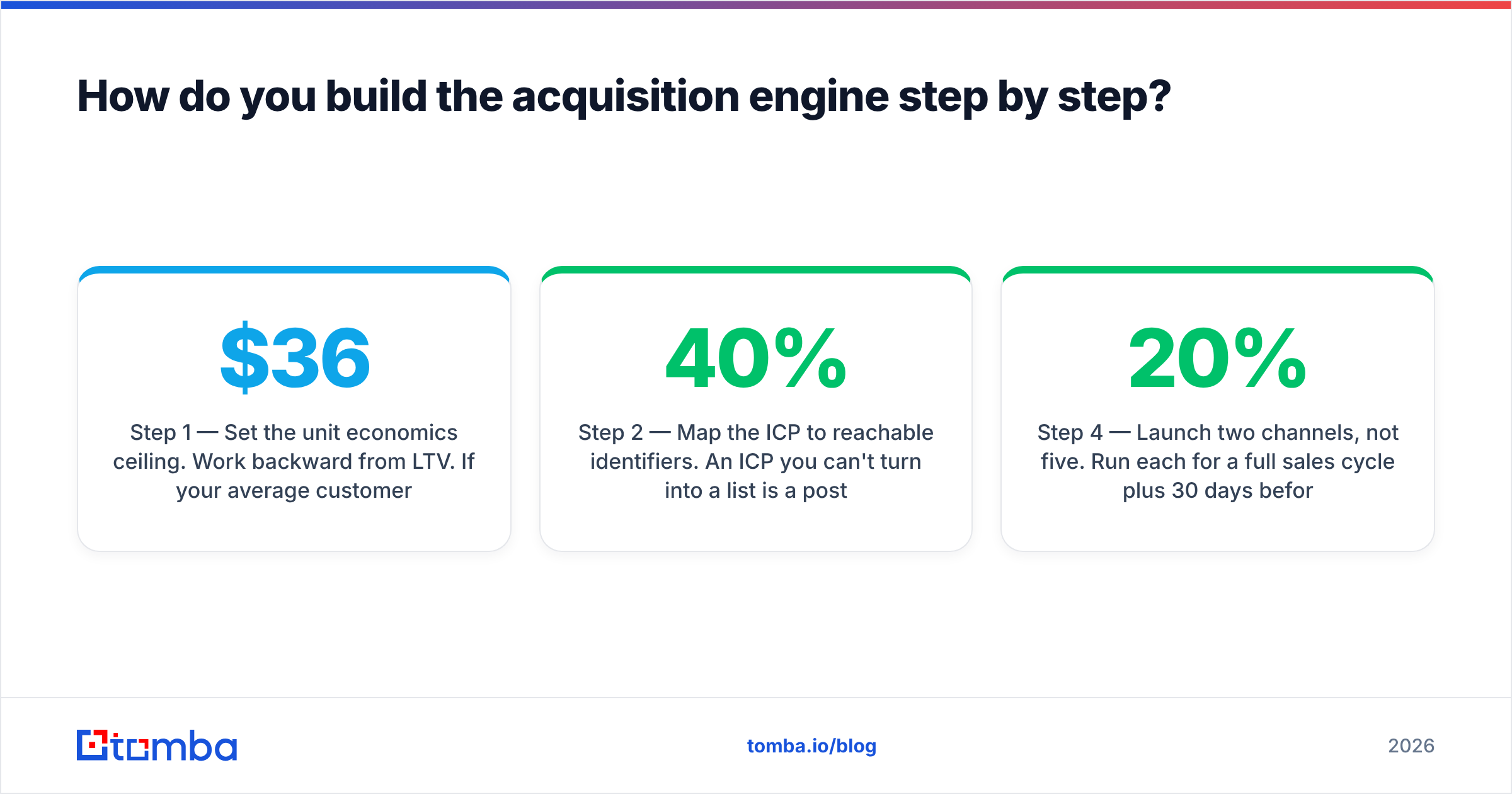
Step 1 — Set the unit economics ceiling. Work backward from LTV. If your average customer is worth $36,000 in gross profit over their lifetime and you want a 3:1 LTV:CAC ratio, your CAC ceiling is $12,000. Divide by your historical lead-to-customer rate to get your maximum viable CPL. That number is now your channel filter.
Step 2 — Map the ICP to reachable identifiers. An ICP you can't turn into a list is a poster, not a target. For each segment, write down exactly how you'll find them: job title filters, technographic signals, funding events, hiring signals, review-site activity. Then verify the list is actually addressable — run a sample of 200 accounts through a domain search and see how many yield decision-maker contacts. If you get under 40% coverage, your ICP is defined by attributes your data sources can't see.
Step 3 — Build the contact data layer before the campaign layer. This is the step everyone skips. You need a repeatable path from "account name" to "verified work email and phone for the right person." That means an email finder for discovery, an email verifier gate before anything enters a sequence, and enrichment to fill in the fields your personalization depends on. Set a hard rule: nothing enters a sending tool without passing verification.
Step 4 — Launch two channels, not five. Run each for a full sales cycle plus 30 days before judging it. Two channels done properly beat five done at 20% effort, and you'll actually be able to attribute results.
Step 5 — Instrument the handoff. Define SQL in writing. Set an SLA on lead response time — the difference between a 5-minute and a 60-minute response is well documented and enormous. Log every rejected lead with a reason code; that reject log is the highest-signal dataset you'll build all year.
Step 6 — Review quarterly, kill ruthlessly. Any channel over your CAC ceiling for two consecutive quarters gets cut or restructured. No exceptions for "brand value."
What role does data quality play in lead acquisition?#
It's the multiplier on everything else, and it's almost always the cheapest fix available.
Run the numbers on a 10,000-contact outbound quarter. At a 3% bounce rate, you lose 300 sends and your domain stays healthy. At 14% — typical for an unverified scraped list — you lose 1,400 sends, your sender reputation drops, and inbox placement on the remaining 8,600 falls from roughly 85% to somewhere in the 50s. You didn't lose 14% of the campaign. You lost closer to 45% of it, and the damage carries into next quarter.
Three data problems cause most of it:
- Stale records. B2B contact data decays at roughly 25–30% per year through job changes alone. A list built 18 months ago is half fiction.
- Catch-all domains. Roughly 15–20% of B2B domains accept everything at the SMTP layer, so standard verification returns "unknown." You need a catch-all verifier to resolve those instead of guessing — guessing means either discarding good leads or bouncing on bad ones.
- Role accounts. info@, sales@, support@ addresses inflate list size and depress every rate metric. Filter them at ingestion, not after.
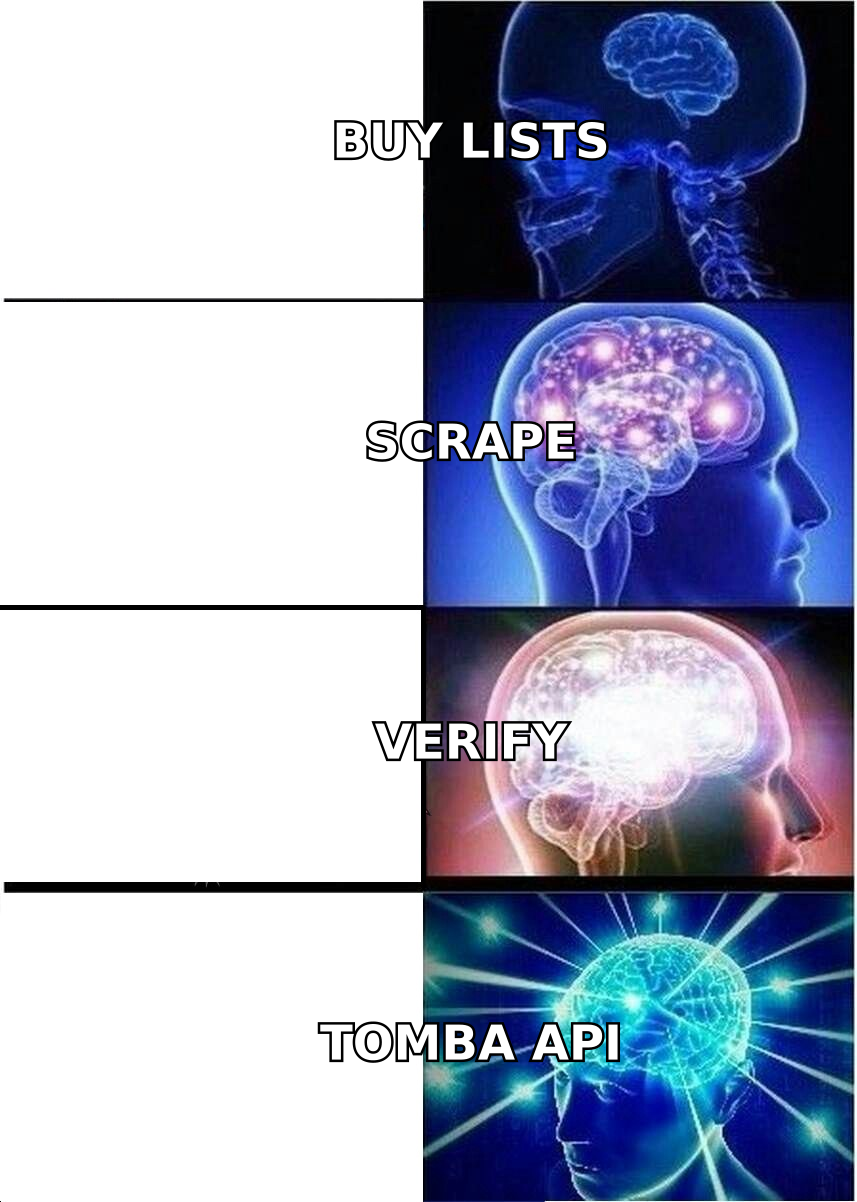
The fix is a standing pipeline, not a one-time cleanup. Verify at acquisition, re-verify anything older than 90 days before it re-enters a sequence, and enrich continuously rather than in annual panic projects. If you're processing lists in volume, a bulk email finder or the Tomba API wired into your CRM does this without anyone touching a CSV.
How do you choose tools without overbuying?#
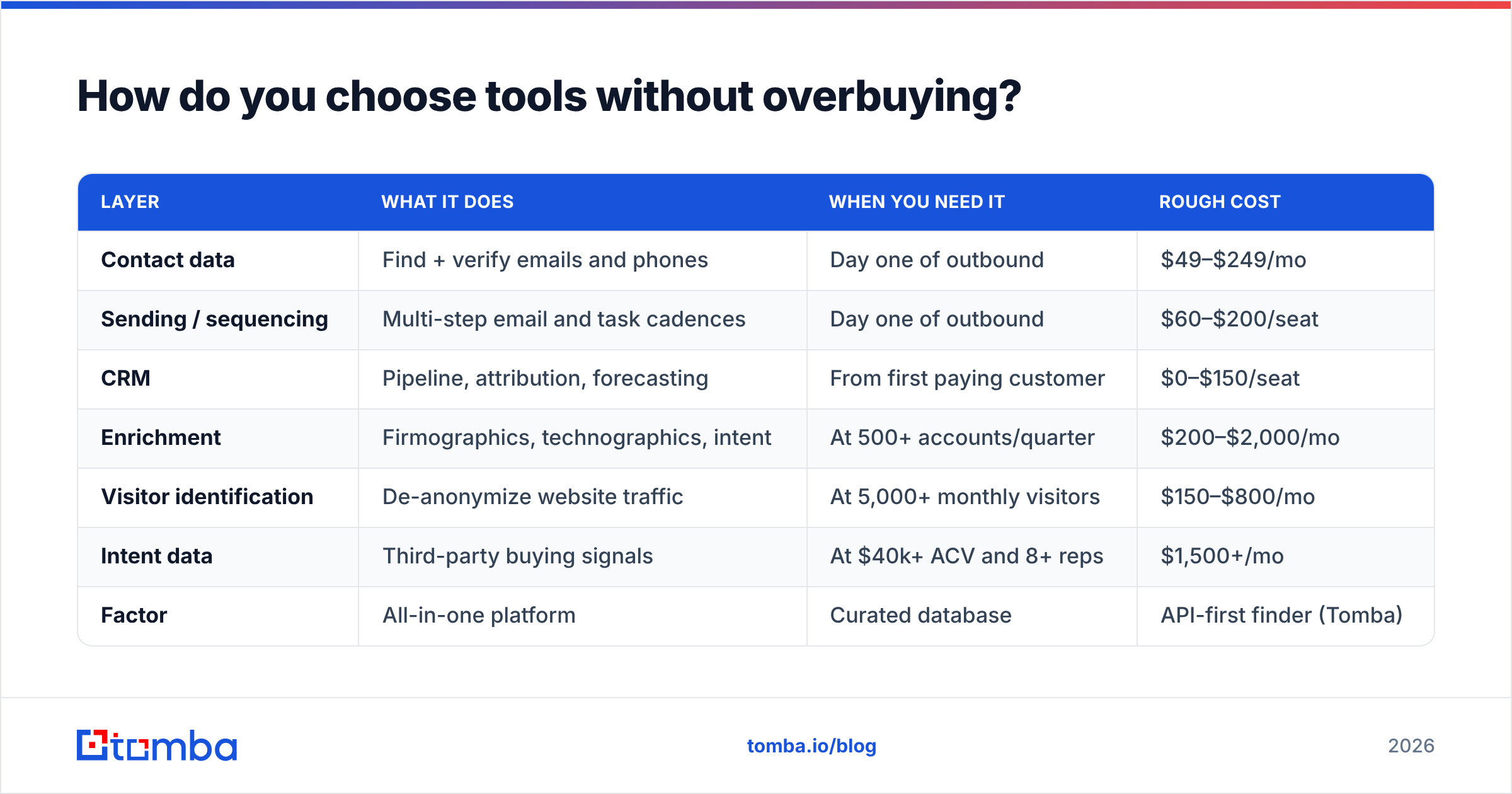
Buy for the bottleneck you have now. Most teams under 20 people need exactly four categories, and vendors will happily sell you nine.
| Layer | What it does | When you need it | Rough cost |
|---|---|---|---|
| Contact data | Find + verify emails and phones | Day one of outbound | $49–$249/mo |
| Sending / sequencing | Multi-step email and task cadences | Day one of outbound | $60–$200/seat |
| CRM | Pipeline, attribution, forecasting | From first paying customer | $0–$150/seat |
| Enrichment | Firmographics, technographics, intent | At 500+ accounts/quarter | $200–$2,000/mo |
| Visitor identification | De-anonymize website traffic | At 5,000+ monthly visitors | $150–$800/mo |
| Intent data | Third-party buying signals | At $40k+ ACV and 8+ reps | $1,500+/mo |
On the contact data layer specifically, the market splits into three shapes. Large all-in-one platforms like Apollo bundle data with sequencing, which is convenient until you want to change one component. Database-first providers like BookYourData sell curated, pre-verified lists — strong when you want volume up front with known coverage and don't want to build a discovery workflow. API-first finders like Tomba sit in the middle: you pull exactly the contacts you need, verify them in the same call, and wire it into whatever stack you already run.
Here's a concrete comparison of that layer:
| Factor | All-in-one platform | Curated database | API-first finder (Tomba) |
|---|---|---|---|
| Entry price | $49–$99/seat/mo | Per-record or credit packs | Free tier, then $49/mo |
| Best for | Small teams wanting one login | Bulk list purchase with known counts | Custom workflows and automation |
| Verification | Bundled, varies by tier | Pre-verified at purchase | Built-in, per lookup |
| Catch-all handling | Often returns "unknown" | Varies | Dedicated catch-all verification |
| Lock-in risk | High (data + sending coupled) | Low | Low |
| Automation depth | Native sequences only | Export-based | REST API, CLI, MCP, Sheets, Excel |
If you're evaluating vendors, pull the real numbers rather than the marketing pages — G2's lead intelligence category shows accuracy and support ratings that map reasonably well to actual experience, and HubSpot's research on lead response time is still the cleanest public data on why speed beats volume.
Check Tomba pricing against your monthly lookup volume before committing to a seat-based platform. If you're pulling 2,000 contacts a month across three people, per-lookup pricing is usually cheaper than three seats.
How do you measure whether the strategy is working?#
Four numbers, reviewed monthly, in this order of importance:
- Blended CAC payback in months. Total sales and marketing spend divided by new customers, divided by monthly gross profit per customer. Under 12 months is healthy for most B2B SaaS; over 18 is a red flag.
- Pipeline coverage ratio. Open pipeline divided by the quarter's target. Below 3x means you have an acquisition volume problem, not a closing problem.
- Lead-to-SQL rate by source. This is your targeting quality score. If it's dropping while volume rises, you're buying worse leads, not more leads.
- Time to first meaningful contact. From lead creation to a real conversation. Every hour of delay measurably reduces connect rates.
Deliberately not on that list: MQL count, website traffic, impressions, and follower growth. They're diagnostic at best. Nobody has ever fixed a pipeline problem by growing a follower count.
One review discipline worth adopting: each quarter, pick the worst-performing channel and decide explicitly whether to fix it, shrink it, or kill it. Writing "kill" next to a channel someone built is uncomfortable, which is exactly why it rarely happens without a forcing function.
What should you do in the first 30 days?#
If you're starting from scratch or rebuilding, here's the sequence that gets to measurable pipeline fastest:
- Week 1: Write the ICP with exclusions. Calculate your CAC ceiling from LTV. Get marketing and sales to sign the same SQL definition.
- Week 2: Build one target account list of 300–500 accounts. Run it through discovery and verification. Measure your actual contact coverage rate — this tells you whether the ICP is addressable.
- Week 3: Launch one outbound sequence to 200 contacts and one high-intent paid or SEO test. Instrument both with distinct source tracking.
- Week 4: Review reply rates, bounce rates, and meeting-set rates. Fix the data layer before touching the copy — bad data makes good copy look bad, and teams almost always rewrite the email when they should have rebuilt the list.
Then repeat monthly, adding one channel per quarter at most. Acquisition engines are built by compounding small, verified improvements, not by launching everything at once and hoping attribution sorts it out.
Getting the data layer right#
Every part of a lead acquisition strategy sits on top of one assumption: that you can reliably reach the specific person you decided to target. When that assumption breaks, nothing downstream works — not the sequence, not the personalization, not the forecast.
Tomba's Email Finder handles that layer directly. Search by domain, name, or company; verification runs in the same workflow, including catch-all domains that most tools return as "unknown"; and it plugs into your stack through the API, CLI, Chrome extension, Sheets, or CRM integrations rather than forcing you into another all-in-one platform. The free tier gives you 25 searches a month to test coverage against your own ICP before spending anything — start there, measure your actual contact coverage rate, and let that number tell you whether your targeting is real.
Related guides#
// get started
Find, verify and enrich your first contacts today
Start on the free plan with 25 searches a month, then scale when your team is ready.
Free plan · No credit card required · GDPR & CCPA
Get the Tomba newsletter
Product and data updates
// about the author