Lead Assignment Rules: How to Route Leads in 2026
Most leads die in the queue, not in the pitch. Here's how lead assignment rules actually work, which routing model fits your team, and the config mistakes that quietly cost you pipeline.
TL;DR
- Lead assignment rules are the logic that decides which rep owns which lead, and when. Get them wrong and your fastest-converting leads sit unclaimed for hours.
- The four routing models that matter in 2026 — round-robin, territory, account-based, and score-weighted — each break in different ways. Match the model to your motion, not to what your CRM defaults to.
- Speed-to-lead is the metric assignment rules actually move. Responding inside five minutes versus thirty minutes is a well-documented order-of-magnitude difference in qualification rates.
- Bad routing is usually a data problem wearing a workflow costume. If your
country,company_size, oremailfields are blank, no rule engine can route correctly. - Fix enrichment first, then routing. Rules that fire on complete records beat clever rules that fire on garbage.
What are lead assignment rules?#
Lead assignment rules are the if-this-then-that logic your CRM uses to decide who owns a new lead. A form fill comes in, the rule engine reads the record's fields — country, company size, industry, lead source, score — and hands the record to a specific rep, team, or queue.
Think of it like a hospital triage desk. Everyone who walks in gets seen, but the desk decides who goes to cardiology, who goes to the walk-in clinic, and who jumps the line. A hospital with no triage desk doesn't serve people faster — it serves the loudest person first and lets the heart attack wait.
That's what most B2B teams are running: a loudest-person-first queue dressed up as a process. Leads get assigned by whoever refreshes the list, or by a round-robin that ignores capacity, or by a territory map drawn in 2021 that nobody has touched since.
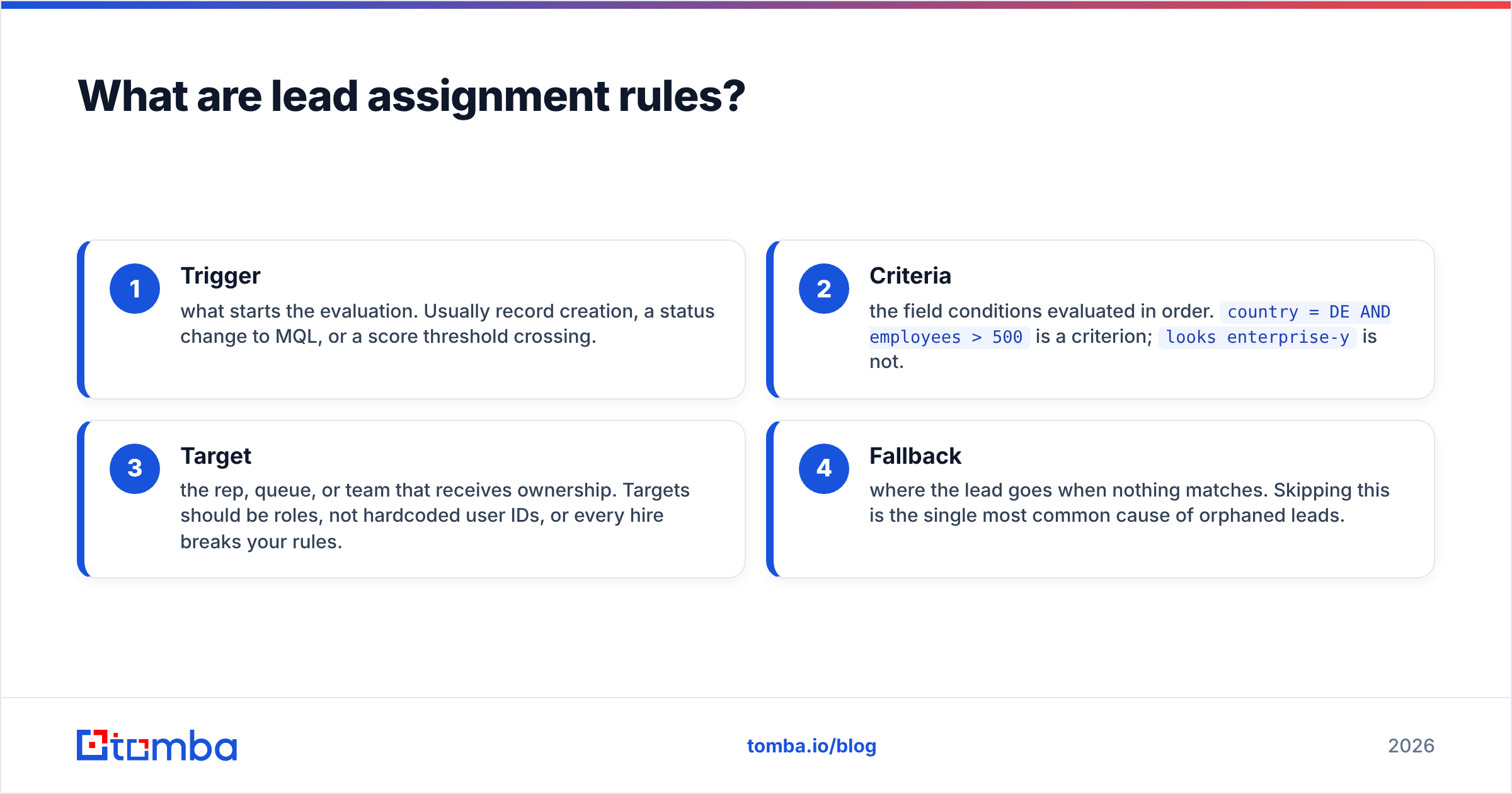
A working rule has four parts:
- Trigger — what starts the evaluation. Usually record creation, a status change to MQL, or a score threshold crossing.
- Criteria — the field conditions evaluated in order.
country = DE AND employees > 500is a criterion;looks enterprise-yis not. - Target — the rep, queue, or team that receives ownership. Targets should be roles, not hardcoded user IDs, or every hire breaks your rules.
- Fallback — where the lead goes when nothing matches. Skipping this is the single most common cause of orphaned leads.
Most CRMs evaluate rule entries top-down and stop at the first match. That ordering is the whole game. A broad rule sitting above a specific rule silently swallows every lead the specific rule was built for, and nobody notices until a quarterly pipeline review.

Which lead routing model should you use?#
There is no universally best model. There is a best model for your deal size, team shape, and data quality. Here's how the four dominant approaches compare.
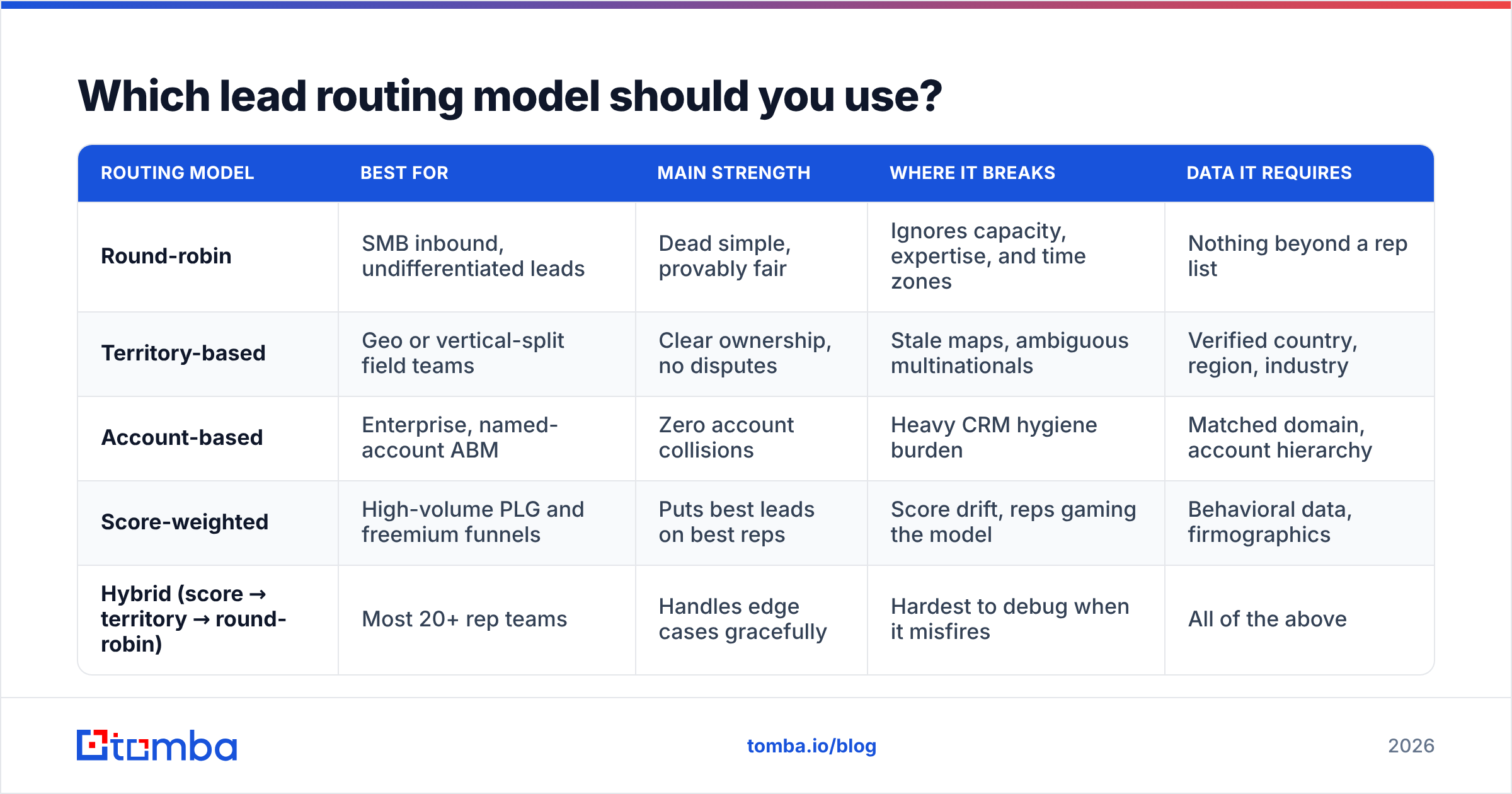
| Routing model | Best for | Main strength | Where it breaks | Data it requires |
|---|---|---|---|---|
| Round-robin | SMB inbound, undifferentiated leads | Dead simple, provably fair | Ignores capacity, expertise, and time zones | Nothing beyond a rep list |
| Territory-based | Geo or vertical-split field teams | Clear ownership, no disputes | Stale maps, ambiguous multinationals | Verified country, region, industry |
| Account-based | Enterprise, named-account ABM | Zero account collisions | Heavy CRM hygiene burden | Matched domain, account hierarchy |
| Score-weighted | High-volume PLG and freemium funnels | Puts best leads on best reps | Score drift, reps gaming the model | Behavioral data, firmographics |
| Hybrid (score → territory → round-robin) | Most 20+ rep teams | Handles edge cases gracefully | Hardest to debug when it misfires | All of the above |
Round-robin is where almost every team starts, and for teams under ten reps with a uniform inbound motion it's genuinely fine. The failure mode shows up at scale: a rep on PTO keeps receiving leads, a rep with 40 open opportunities receives the same volume as a rep with four, and your best closer gets whatever the rotation happens to hand them.
Territory routing solves ownership disputes but is only as good as the geographic data on the record. If a form only captures email and company name, you cannot route by territory without enriching the record first. This is where a data enrichment step in front of the rule engine changes the outcome — it fills country, industry, and employee_count before the rule evaluates, instead of dumping the lead into a fallback queue.
Account-based routing is the right answer for enterprise motions, and the hardest to maintain. You need reliable domain-to-account matching. A lead from emea.acme-group.com has to resolve to the same account as acme.com, or two reps will work the same buying committee.
Score-weighted routing is the most fashionable and the most fragile. It works when your marketing qualified lead definition is stable and your score model has been validated against closed-won data. It fails quietly when the score model drifts and nobody re-baselines it, at which point you're routing confidently on a number that no longer predicts anything.
How do you configure lead assignment rules that don't break?#
Start with the shape of the rule set, not the individual rules. A rule set that survives contact with reality looks like a funnel with an explicit floor.
Order rules from most specific to most general. Named-account rules first, then vertical or territory rules, then score tiers, then the catch-all. Every CRM that evaluates first-match-wins punishes the reverse order.
Always define a fallback queue. Not a fallback rep — a queue, monitored by a manager, with an SLA attached. Every lead that falls through is a data gap telling you what to fix upstream.
Route on verified fields only. If a rule depends on email, the email should have passed email verification before the rule fires. Routing a lead with a bounced address to your top AE burns a slot and produces a fake activity record.
Build capacity limits in from day one. Cap leads per rep per day. An uncapped round-robin during a webinar spike hands one rep 60 leads they'll never work, while the rest of the team sits idle.
Use roles, not people, as targets. Assign to "EMEA Mid-Market AE" and manage membership separately. When someone leaves, you update one list instead of auditing 30 rules.
Log every assignment decision. Store which rule matched and why. Without this, "the lead went to the wrong rep" becomes an unfalsifiable complaint instead of a fixable bug.
Salesforce's assignment rule documentation and HubSpot's routing tooling both implement first-match evaluation, so these principles transfer across platforms with only syntax differences.
Why does speed-to-lead matter more than perfect assignment?#
Because a good rep contacting a lead in four minutes beats a perfect rep contacting them in four hours, every time.
The research on this is old and consistent: the odds of qualifying a lead drop sharply once you pass the first five minutes after inbound submission, and by the end of the first hour the contact rate has collapsed. That's not a routing nuance. That's the dominant variable.
This reframes what your rules are optimizing for. Every additional condition in a rule chain adds evaluation complexity, and every enrichment lookup that runs synchronously adds latency. If your "perfect" routing logic takes eleven minutes to resolve because it's waiting on three API calls and a manual territory check, it is a worse system than a dumb round-robin that fires in two seconds.
Practical way to resolve the tension: assign immediately on the data you have, then reassign once enrichment completes. Provisional assignment from a round-robin gets a human moving inside 60 seconds. Thirty seconds later, enrichment returns firmographics and the record either stays put or transfers to the correct territory owner with full context attached.
Two other latency killers worth auditing:
- Weekend and after-hours leads. If your rules only target working-hours queues, a Friday-evening enterprise lead sits until Monday. Build a follow-the-sun fallback or an automated acknowledgement.
- Duplicate records. A new lead that matches an existing contact should route to the existing owner, not spawn a parallel conversation. Dedupe before assignment, not after.
How does data quality break your routing rules?#
Routing rules are functions. Functions with null inputs return garbage — the rule engine is not the bug.
Run this audit on your last 500 inbound leads and count how many have a usable value in every field your rules depend on. Most teams find 30–50% of records are missing at least one routing-critical field. Those leads all landed in the fallback queue, which means half your routing logic never actually executed.
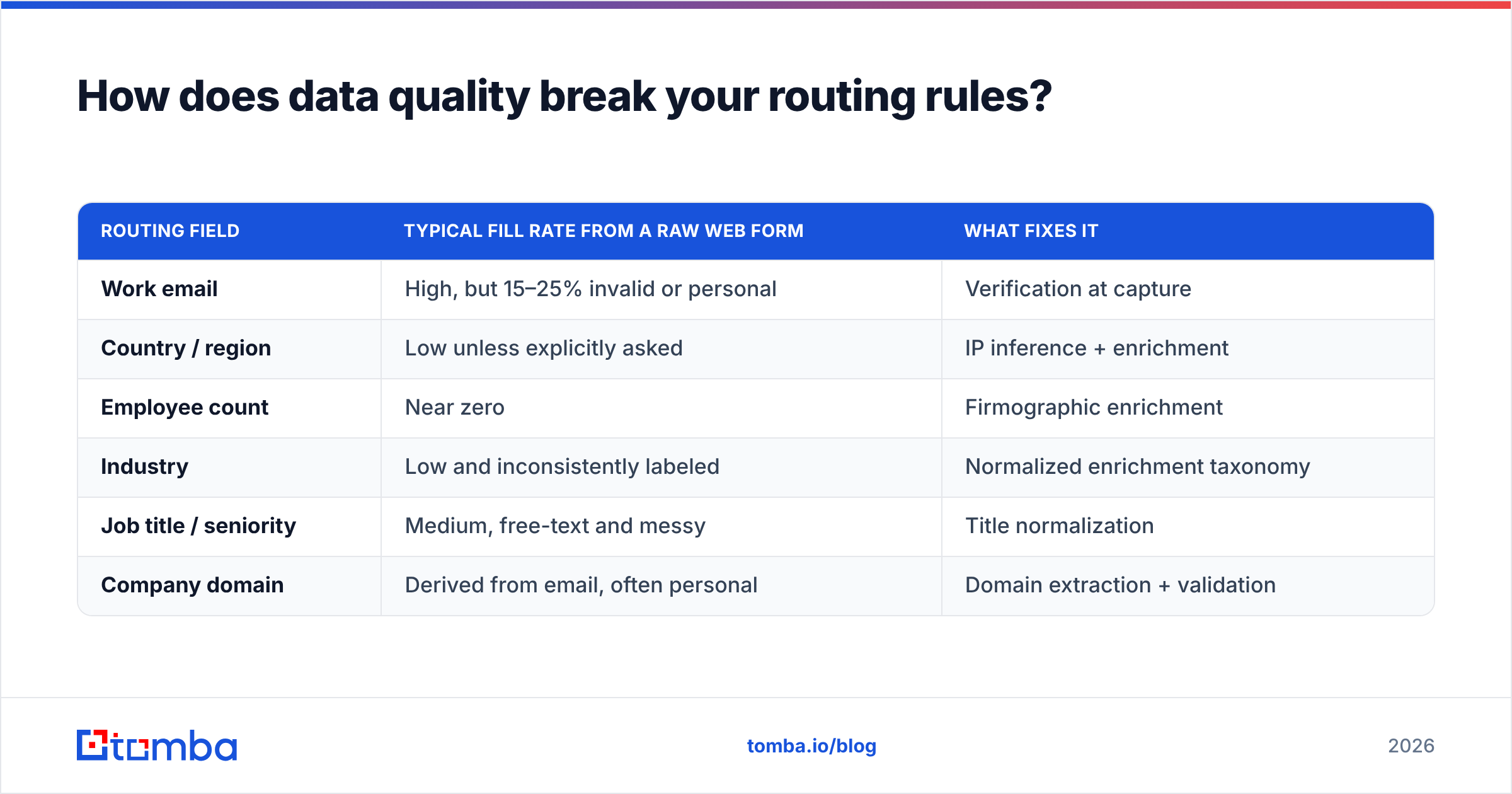
| Routing field | Typical fill rate from a raw web form | What fixes it |
|---|---|---|
| Work email | High, but 15–25% invalid or personal | Verification at capture |
| Country / region | Low unless explicitly asked | IP inference + enrichment |
| Employee count | Near zero | Firmographic enrichment |
| Industry | Low and inconsistently labeled | Normalized enrichment taxonomy |
| Job title / seniority | Medium, free-text and messy | Title normalization |
| Company domain | Derived from email, often personal | Domain extraction + validation |
The fix sequence is boring and it works: capture minimal fields, verify the email, enrich the record, normalize the values, then route. Asking for eight form fields to power your routing rules is the wrong trade — every added field cuts conversion, and you can derive most of them from a verified work email.
A domain search against the company domain gives you the org's email pattern and contact footprint, which is also how you find the other three people on the buying committee the form never captured. And if you're routing leads that arrived without a usable address at all, an email finder closes that gap before the record enters the queue.

How do you measure whether your assignment rules are working?#
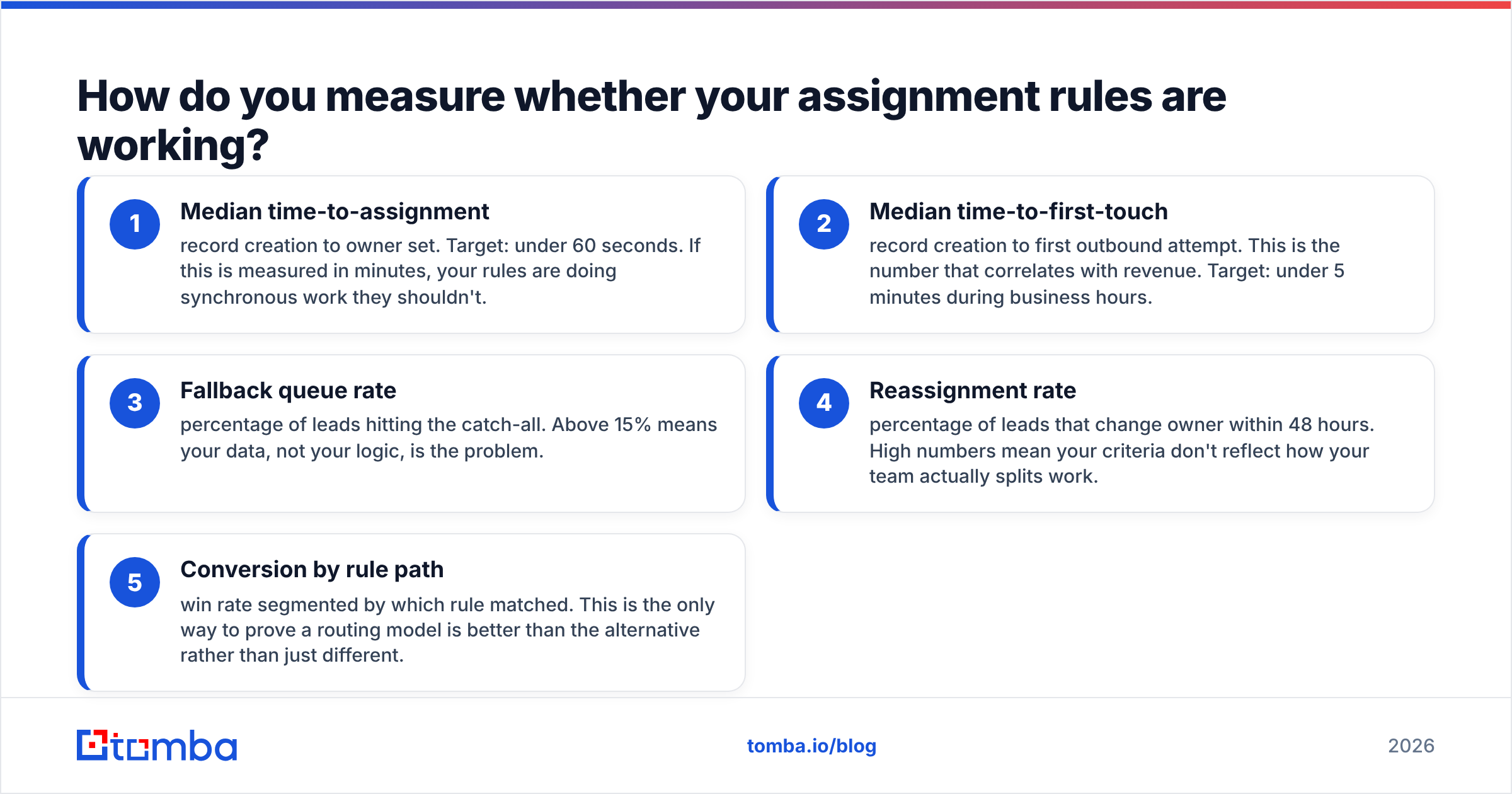
Track five numbers. If you only track one, track the second.
- Median time-to-assignment — record creation to owner set. Target: under 60 seconds. If this is measured in minutes, your rules are doing synchronous work they shouldn't.
- Median time-to-first-touch — record creation to first outbound attempt. This is the number that correlates with revenue. Target: under 5 minutes during business hours.
- Fallback queue rate — percentage of leads hitting the catch-all. Above 15% means your data, not your logic, is the problem.
- Reassignment rate — percentage of leads that change owner within 48 hours. High numbers mean your criteria don't reflect how your team actually splits work.
- Conversion by rule path — win rate segmented by which rule matched. This is the only way to prove a routing model is better than the alternative rather than just different.
Set a monthly review on the rule set itself. Territories change, reps join and leave, scoring models drift. A rule set nobody has opened in nine months is a liability, and it will be silently routing your German enterprise leads to a rep who left in March.
One more discipline: version your rules and note why each change was made. When conversion drops in Q3 you want to know that someone reordered two entries in July, not spend three weeks theorizing about market conditions.
What should you fix first?#
In order, because sequence matters more than effort here:
- Add a monitored fallback queue with an SLA. One afternoon of work, immediate stop on lead leakage.
- Audit rule order. Find the broad rule sitting above a specific one. There's almost always at least one.
- Measure time-to-first-touch honestly. Not the average — the median and the 90th percentile. Averages hide the leads that sat for two days.
- Fix field fill rates with enrichment. This unlocks every routing model beyond round-robin, and it's the step teams skip because it feels like infrastructure rather than strategy.
- Add capacity caps and OOO handling. Cheap to implement, prevents the worst spike-day outcomes.
- Only then consider a more sophisticated routing model. Score-weighted routing on top of 40% null fields makes things worse, not better.
Most teams get this backwards. They buy a routing tool, configure an elaborate rule tree, and route incomplete records with impressive precision into the wrong hands. The tooling was never the constraint.
Get the data right before you get the routing right#
Every routing model above depends on knowing who the lead actually is. If your records arrive with a personal Gmail address and a company name typed by hand, no rule engine will save you.
Start upstream. Tomba's Email Finder resolves work email addresses from a name and domain, verifies them, and returns the firmographic context your assignment rules need to fire correctly — country, company size, and confirmed company domain. The free tier covers 25 searches a month so you can test it against a sample of your fallback queue before committing; paid plans start at $49/mo on Starter, with Growth at $99/mo. Full Tomba pricing is public, and the Tomba API lets you run enrichment inline with lead capture so the record is complete before your rules ever evaluate it.
Fix the inputs. The routing gets easy.
Related guides#
// get started
Find, verify and enrich your first contacts today
Start on the free plan with 25 searches a month, then scale when your team is ready.
Free plan · No credit card required · GDPR & CCPA
// about the author