What Are Lead Brokers? How B2B Lead Buying Works in 2026
Lead brokers sell you pipeline in a spreadsheet. Some deliver clean, opted-in contacts. Others sell you a recycled list that torches your domain. Here is how to tell the difference before you wire the money.
TL;DR
- A lead broker is a middleman who sells you contact records — usually aggregated from third-party sources, not collected first-party. Quality ranges from excellent to unusable, and the price tells you almost nothing about which you're getting.
- Typical 2026 pricing runs $0.10–$1.50 per record for bulk B2B lists, and $15–$75 per record for qualified, appointment-grade leads.
- The real cost of a bad broker list isn't the invoice. It's the bounce rate, the burned sending domain, and the three weeks your SDRs spend calling disconnected numbers.
- Brokers make sense for net-new market entry, hard-to-reach verticals, and volume plays. Self-serve data platforms win for ICP-specific, continuously refreshed lists.
- Whatever you buy, verify it before it touches your sequencer. A $30 verification pass on a 20,000-row list is the cheapest insurance in outbound.
What is a lead broker?#
A lead broker sells contact data they did not originally collect. Think of them as a wholesale fruit distributor: they don't own the orchard, they buy from dozens of growers, sort by grade, and resell to grocery stores. Some distributors are scrupulous about what goes in the crate. Others mix last week's bruised inventory in the middle of the box.
In practice, "lead broker" covers three distinct business models that people lump together:
- List brokers sell static files — CSV or XLSX exports of contacts matching filters you specify (industry, headcount, title, geography). You pay per record, you own the file, and it starts decaying the moment it lands in your inbox.
- Lead generation agencies sell qualified leads — often a person who filled out a form, answered a phone screen, or booked a meeting. Price per lead is 20–100x a list record, because there's human labor and intent behind it.
- Data aggregators and resellers license a database and resell access, sometimes white-labeled. You're often two or three hops away from whoever actually sourced the record.
The distinction matters because the failure modes are different. A bad list broker sells you stale emails. A bad lead-gen agency sells you a "qualified appointment" with someone who has no budget and no memory of agreeing to the call.
For a broader primer on where this sits in the funnel, the lead generation category has been around far longer than SaaS — direct-mail list brokerage is the same business with different plumbing.
How do lead brokers actually source their data?#
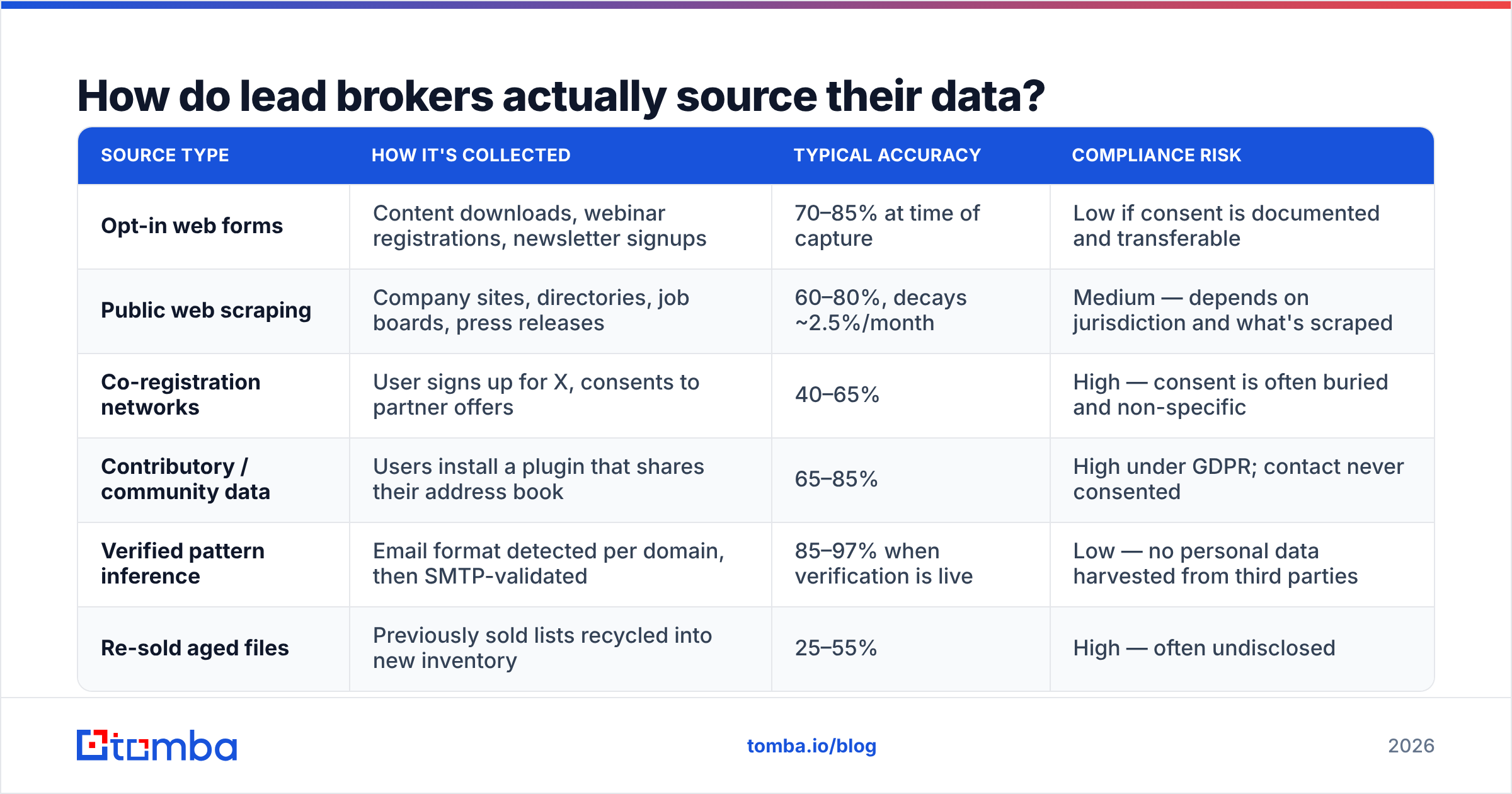
This is the question most buyers skip, and it's the one that predicts everything downstream. Ask any broker where a record came from and you should get a specific answer, not "proprietary sources."
| Source type | How it's collected | Typical accuracy | Compliance risk |
|---|---|---|---|
| Opt-in web forms | Content downloads, webinar registrations, newsletter signups | 70–85% at time of capture | Low if consent is documented and transferable |
| Public web scraping | Company sites, directories, job boards, press releases | 60–80%, decays ~2.5%/month | Medium — depends on jurisdiction and what's scraped |
| Co-registration networks | User signs up for X, consents to partner offers | 40–65% | High — consent is often buried and non-specific |
| Contributory / community data | Users install a plugin that shares their address book | 65–85% | High under GDPR; contact never consented |
| Verified pattern inference | Email format detected per domain, then SMTP-validated | 85–97% when verification is live | Low — no personal data harvested from third parties |
| Re-sold aged files | Previously sold lists recycled into new inventory | 25–55% | High — often undisclosed |
The last row is the one that quietly destroys campaigns. A file that has been sold to nine other companies has already been mailed nine times. The contacts who were going to unsubscribe already did, and the spam-trap addresses seeded into the file are still sitting there, waiting.
What do lead brokers cost in 2026?#
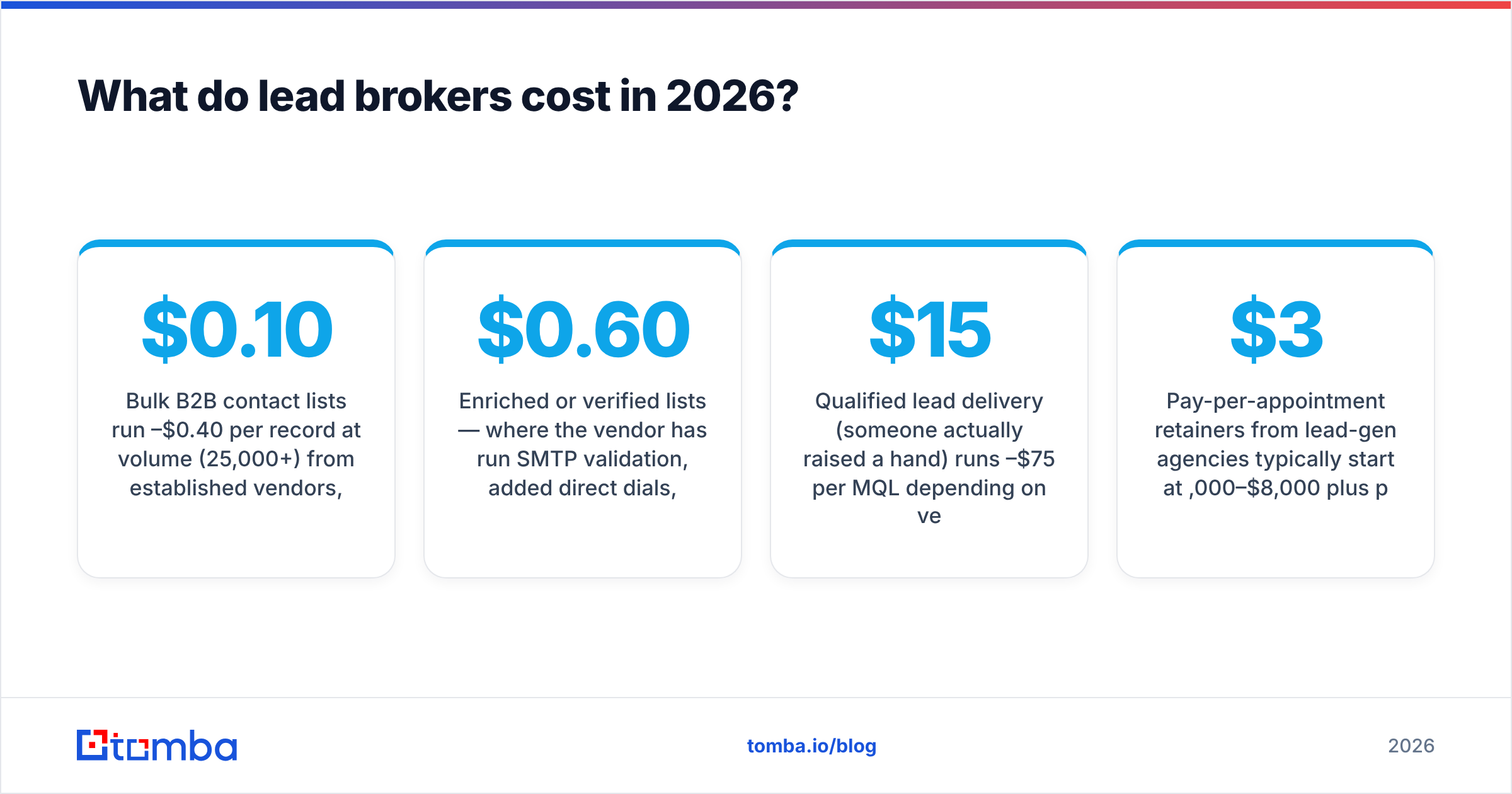
Pricing splits sharply by what you're actually buying.
Bulk B2B contact lists run $0.10–$0.40 per record at volume (25,000+) from established vendors, and $0.50–$1.50 per record for niche or hard-to-source segments — healthcare decision-makers, manufacturing plant managers, government procurement. Minimum orders of 5,000–10,000 records are common.
Enriched or verified lists — where the vendor has run SMTP validation, added direct dials, or appended firmographics — land at $0.60–$2.50 per record. You're paying for the verification pass you'd otherwise run yourself.
Qualified lead delivery (someone actually raised a hand) runs $15–$75 per MQL depending on vertical, and $150–$600 per booked sales appointment. Cybersecurity, fintech, and enterprise IT sit at the top of that range.
Pay-per-appointment retainers from lead-gen agencies typically start at $3,000–$8,000/month plus per-meeting fees.
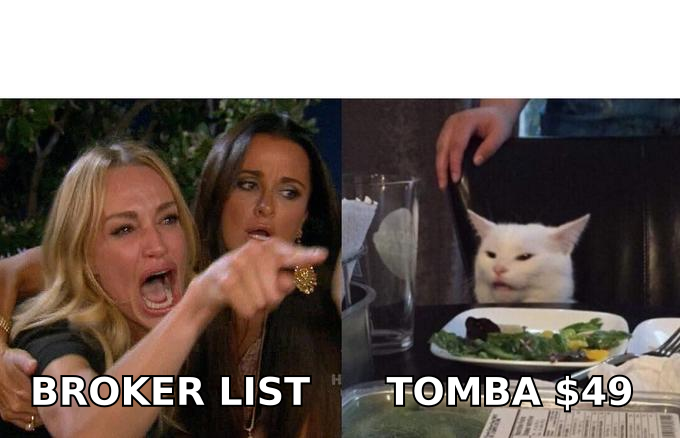
Compare that to self-serve platforms. Tomba's pricing starts with a free tier at 25 searches per month, Starter at $49/mo, Growth at $99/mo, and Pro at $249/mo — with the search-and-verify built into the same credit. At Growth-tier volume, your effective cost per verified contact lands well under a cent for most use cases, because you're pulling exactly the contacts you need rather than buying 10,000 to use 800.
That's the structural difference. Brokers sell you inventory. Platforms sell you access. If your ICP is narrow, inventory is the wrong shape.
Is buying leads from a broker legal?#
Short answer: buying is generally legal in the US, conditionally legal in the EU, and the mailing is where you get into trouble.
Under CAN-SPAM (US), there is no consent requirement for B2B commercial email. You need accurate headers, a real physical address, a working unsubscribe, and no deceptive subject lines. Purchased lists are legal to mail.
Under GDPR (EU/UK), the lawful basis usually cited is legitimate interest, which requires a documented balancing test, a genuine business relevance to the recipient, and a clear opt-out. Critically, consent obtained by a broker for their processing does not automatically transfer to you. Ask the broker for the consent record and the original capture context. If they can't produce it, assume you don't have it.
Under CASL (Canada), express or implied consent is required, and purchased lists rarely satisfy either. Canada is the strictest of the three.
Under CCPA/CPRA (California), contacts have a right to know where their data came from and to opt out of its sale. You inherit disclosure obligations as a downstream recipient.
The practical compliance move: keep a provenance record for every list you buy — vendor, date, source type, consent basis — stored alongside the file. If a regulator or an angry prospect asks, "where did you get my email?", you want a one-sentence answer, not a Slack archaeology dig.
Lead brokers vs self-serve data platforms: which should you use?#
Neither category is universally better. They solve different problems, and mature outbound teams run both.
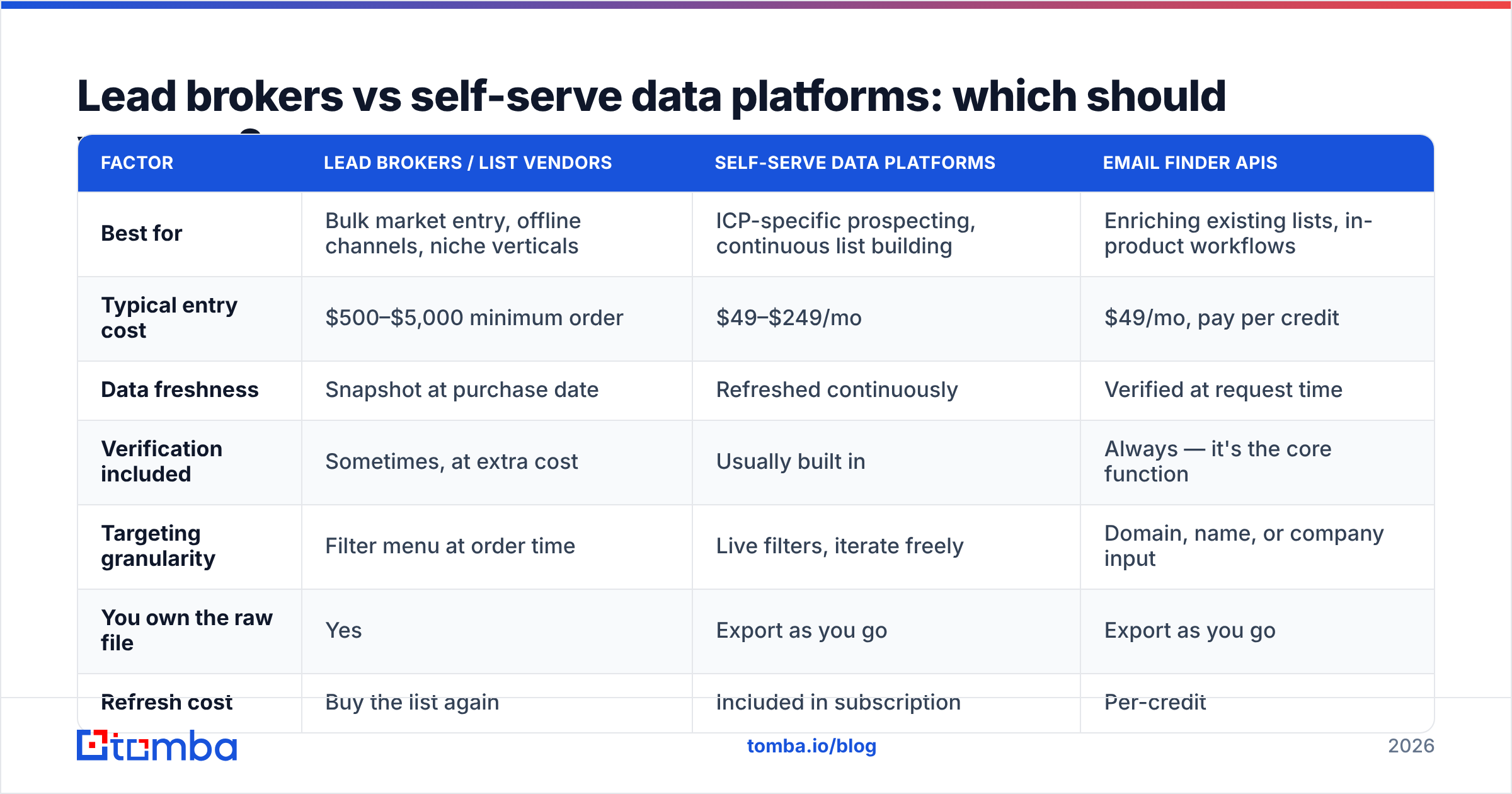
| Factor | Lead brokers / list vendors | Self-serve data platforms | Email finder APIs |
|---|---|---|---|
| Best for | Bulk market entry, offline channels, niche verticals | ICP-specific prospecting, continuous list building | Enriching existing lists, in-product workflows |
| Typical entry cost | $500–$5,000 minimum order | $49–$249/mo | $49/mo, pay per credit |
| Data freshness | Snapshot at purchase date | Refreshed continuously | Verified at request time |
| Verification included | Sometimes, at extra cost | Usually built in | Always — it's the core function |
| Targeting granularity | Filter menu at order time | Live filters, iterate freely | Domain, name, or company input |
| You own the raw file | Yes | Export as you go | Export as you go |
| Refresh cost | Buy the list again | Included in subscription | Per-credit |
| Failure mode | Stale file, recycled records | Coverage gaps in long-tail markets | Needs a target list as input |
A reasonable hybrid: use a reputable broker for a one-time TAM sweep in a market you've never sold into, then use a domain search and email verifier workflow to keep the accounts that respond fully enriched and current. The broker gets you the map. The platform keeps it from going out of date.
On the broker side, vendors like BookYourData have built their reputation on pay-as-you-go pricing and per-record verification guarantees, which is a meaningfully different posture from the minimum-order, sold-as-is end of the market. If you're going to buy a list, buy from someone who publishes their accuracy terms and honors a bounce credit. Checking recent buyer reviews on G2's lead intelligence category before you sign is twenty minutes well spent.
What does bad broker data actually cost you?#
Run the math once and you'll never skip a verification pass again.
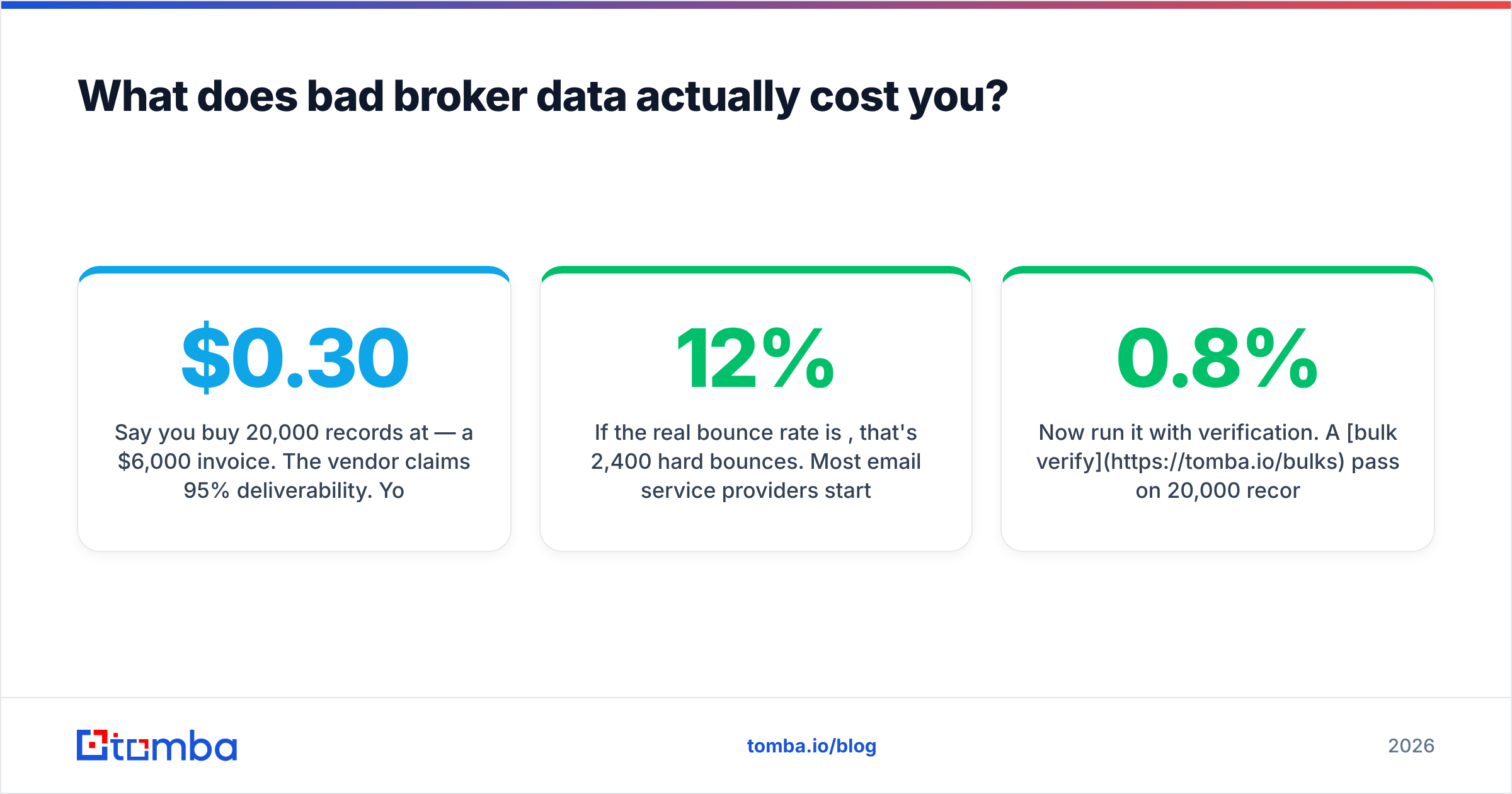
Say you buy 20,000 records at $0.30 — a $6,000 invoice. The vendor claims 95% deliverability. You skip verification and load it straight into your sequencer.
If the real bounce rate is 12%, that's 2,400 hard bounces. Most email service providers start throttling above 2% and many will suspend a sending domain above 5–8% sustained. You don't just lose 2,400 contacts — you lose the domain, which means the 17,600 good contacts never get a clean send either. Domain reputation recovery takes 4–8 weeks of warmup, and your Q1 number is gone.

Now run it with verification. A bulk verify pass on 20,000 records costs a fraction of the list price, takes under an hour, and flags the hard bounces, role accounts, and catch-all domains before they touch your sender. You mail 17,600 clean addresses at a 0.8% bounce rate. Same list, same invoice, completely different outcome.
The rule is simple: never mail a purchased list unverified, no matter what the vendor guarantees. The guarantee refunds your money. It does not refund your domain reputation.
How do you vet a lead broker before you buy?#
Six questions. Ask all of them in writing, before any money moves.
- Where did this specific segment come from? Not "our network" — the actual collection method for the records you're buying. If the answer is vague across two follow-ups, walk.
- When was each record last verified, and by what method? "Last updated" is a database timestamp and means nothing. Ask for SMTP validation dates. A record verified 14 months ago is a guess.
- How many times has this file been sold? Exclusivity costs more and is worth it in competitive verticals. Ask whether records are suppressed after N sales.
- What's the bounce guarantee, and how is it honored? Credit or cash? What's the claim window? Does it cover soft bounces and role accounts, or only hard bounces?
- Can I test a sample of 200 records before committing? Any broker confident in their data will say yes. Run the sample through an independent email verifier and compare the result to their claimed accuracy. This single test is the highest-signal thing you can do.
- What's the documented consent basis for EU/UK records? If you sell into Europe, this is not optional, and "we're GDPR compliant" is not an answer.
If a broker clears all six, you're probably dealing with a real data business. If they stall on three or more, you're dealing with a reseller who doesn't know what's in the file either.
When should you buy from a broker — and when should you build?#
Buy when:
- You're entering a market you have zero account knowledge of and need a TAM snapshot fast.
- The channel is offline — direct mail, cold calling, events — where per-record cost matters less than volume.
- The vertical is genuinely hard to source from public web signals (skilled trades, regional SMBs, non-English markets).
- You need a one-time, large, disposable list and have the budget to treat 30% of it as waste.
Build when:
- Your ICP is narrow and defined by signals a filter menu can't express — tech stack, hiring patterns, recent funding, specific job-posting language.
- You need the list to stay current, because you're running always-on outbound rather than a campaign burst.
- Deliverability is existential to your business and you can't risk unverified records.
- You want the same contact record to flow into your CRM, your sequencer, and your enrichment pipeline without a manual import step.
Most teams that scale outbound past a few hundred sends a week end up building. Not because brokers are bad, but because a static file has a half-life and a subscription doesn't. If you want to see how the sourcing side works in practice, Tomba publishes its data sources rather than hiding behind "proprietary," which is the same transparency test you should apply to any broker.
For a broader view on how bought data fits alongside inbound demand generation, HubSpot's marketing blog remains one of the few vendor resources that argues honestly against over-relying on purchased lists — worth reading before you set the budget.
Build the list you actually need#
Lead brokers solve a real problem: getting from zero to a workable universe of accounts without spending a quarter on research. Use them for that, verify everything they send you, and keep the provenance record.
But for the accounts you actually care about — the ones in your ICP, the ones you'll work for six months — stop renting a snapshot. Point the Tomba Email Finder at a company domain or a first-and-last name and get a verified, sourced email address in seconds, with the confidence score and the source attached. Start on the free tier at 25 searches a month, move to Starter at $49/mo when you're running volume, and skip the minimum order entirely.
The best list isn't the biggest one you can buy. It's the one where every row is real.
Related guides#
// get started
Find, verify and enrich your first contacts today
Start on the free plan with 25 searches a month, then scale when your team is ready.
Free plan · No credit card required · GDPR & CCPA
// about the author