Lead Campaign Strategy: How to Build One That Converts
A lead campaign is not a blast — it is a scoped, measurable offer aimed at one segment. Here is the 2026 playbook for scoping, data, channels, and metrics that hold up.
TL;DR
- A lead campaign is a time-boxed, single-offer push at one defined segment — not your always-on lead gen program, and not a newsletter blast.
- Roughly half of underperforming campaigns fail on data quality, not copy. Fix the list before you rewrite the subject line.
- Multi-channel beats single-channel, but only after you can run one channel cleanly. Email plus LinkedIn plus phone is the default 2026 stack.
- Measure reply rate and cost per qualified meeting, not opens. Apple Mail Privacy Protection made open rate decorative years ago.
- Budget 30–40% of campaign hours to list building and verification. That is the part nobody wants to do and the part that decides the result.
What is a lead campaign?#
A lead campaign is a finite, coordinated push to convert a specific audience segment into qualified leads using one primary offer, across one to three channels, inside a fixed window.
Think of it like a restaurant running a two-week tasting menu. The kitchen still serves its regular menu every day — that's your always-on lead generation. The tasting menu has a start date, an end date, a specific dish, and a specific type of diner it's aimed at. You can tell within two weeks whether it worked. Technically, a lead campaign is a scoped acquisition experiment with a defined audience, offer, channel mix, and success metric.
Five elements separate a real campaign from a blast:
- A single segment. "SaaS ops leaders at 50–200 person companies in North America," not "our ICP." If your segment description doesn't produce a buildable list, it's a positioning statement, not a segment.
- One primary offer. A benchmark report, a teardown, a free audit, a pilot. Two offers in one campaign means you learn nothing about either.
- A fixed window. Two to six weeks. Long enough for a full sequence, short enough to force a decision.
- A defined channel mix. Email, LinkedIn, phone, paid, or a documented combination — chosen before launch, not improvised in week two.
- One north-star metric. Usually qualified meetings booked or cost per qualified meeting. Everything else is diagnostic.
Miss any of the five and you end up with activity you can't attribute. HubSpot's lead generation research has consistently found that marketers who can't tie campaigns to pipeline end up defending budget with volume metrics — which is how "we sent 40,000 emails" becomes an achievement.
Is a lead campaign different from a lead generation program?#
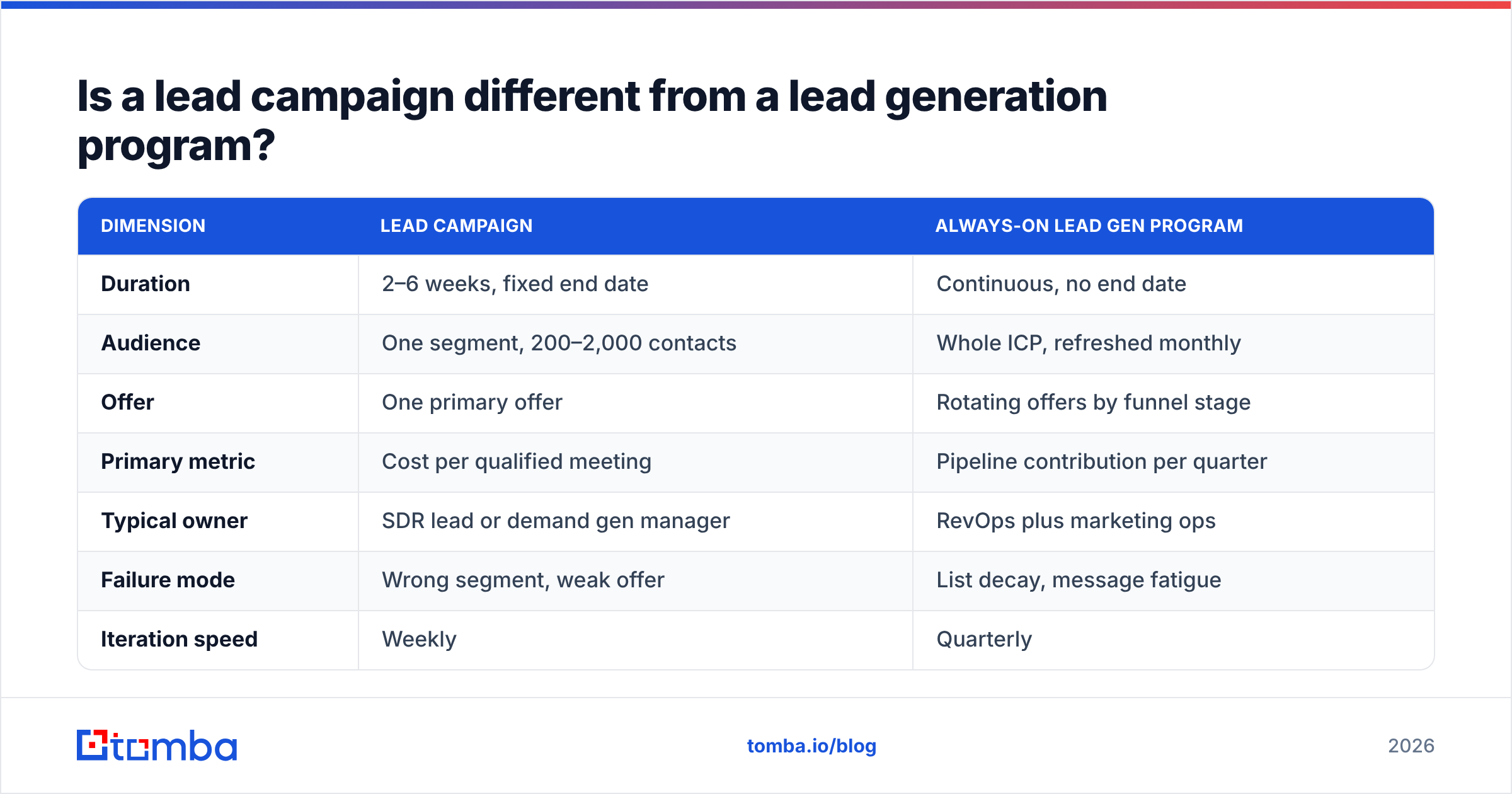
Yes, and confusing the two is the most expensive planning mistake in outbound.
| Dimension | Lead campaign | Always-on lead gen program |
|---|---|---|
| Duration | 2–6 weeks, fixed end date | Continuous, no end date |
| Audience | One segment, 200–2,000 contacts | Whole ICP, refreshed monthly |
| Offer | One primary offer | Rotating offers by funnel stage |
| Primary metric | Cost per qualified meeting | Pipeline contribution per quarter |
| Typical owner | SDR lead or demand gen manager | RevOps plus marketing ops |
| Failure mode | Wrong segment, weak offer | List decay, message fatigue |
| Iteration speed | Weekly | Quarterly |
The program is your infrastructure — routing rules, scoring, nurture, CRM hygiene. The campaign is a sprint that runs on top of it. Teams that skip the program and run campaign after campaign burn their domain reputation and their total addressable market at the same time. Teams that build only the program and never run focused campaigns learn nothing new about their market.
Run both. Fund them separately.
What data does a lead campaign actually need?#
More than a name and a company, and less than the 47-field enrichment schema someone built in 2023 and nobody maintains.
Your working minimum for a B2B lead campaign:
- Verified work email. Non-negotiable. A bounce rate above 3% starts damaging sender reputation within days, and Google and Yahoo's bulk-sender rules made that damage faster to acquire and slower to undo.
- Role and seniority. Not job title strings. Normalize to a role bucket so your copy can actually branch.
- Company size and industry. The two fields that drive most segmentation logic.
- One trigger signal. Hiring, funding, tech stack change, leadership move, or site visit. A trigger is what turns a cold email into a relevant one.
- A secondary channel handle. LinkedIn URL or a direct dial, so the campaign doesn't die if email underperforms.
Everything past that is nice-to-have. Enrichment budget is finite; spend it on coverage of those five fields across your whole segment rather than depth on 40 fields for a quarter of it.
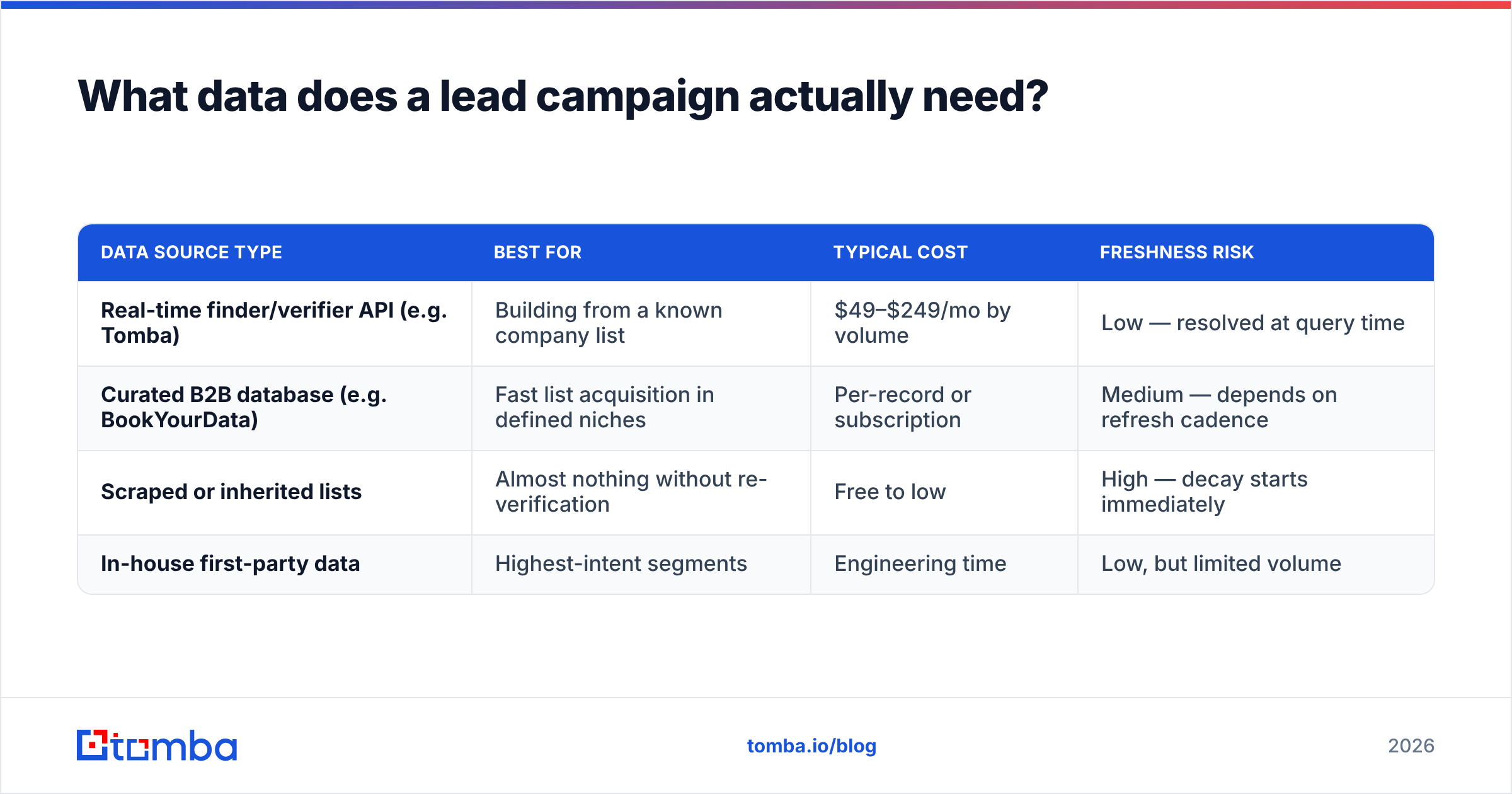
For sourcing, you have three realistic paths, and most teams blend them:
| Data source type | Best for | Typical cost | Freshness risk |
|---|---|---|---|
| Real-time finder/verifier API (e.g. Tomba) | Building from a known company list | $49–$249/mo by volume | Low — resolved at query time |
| Curated B2B database (e.g. BookYourData) | Fast list acquisition in defined niches | Per-record or subscription | Medium — depends on refresh cadence |
| Scraped or inherited lists | Almost nothing without re-verification | Free to low | High — decay starts immediately |
| In-house first-party data | Highest-intent segments | Engineering time | Low, but limited volume |
A curated database gets you a list in an afternoon, which matters when a campaign window is short. A finder API gets you exactly the people at exactly the accounts you chose, which matters when your segment is narrow. Pair them: pull the account list from the database, then run domain search and email verification to fill and validate the contacts you actually intend to message. B2B contact data decays at roughly 22–30% per year depending on whose study you read, so treat any list older than 90 days as a hypothesis.
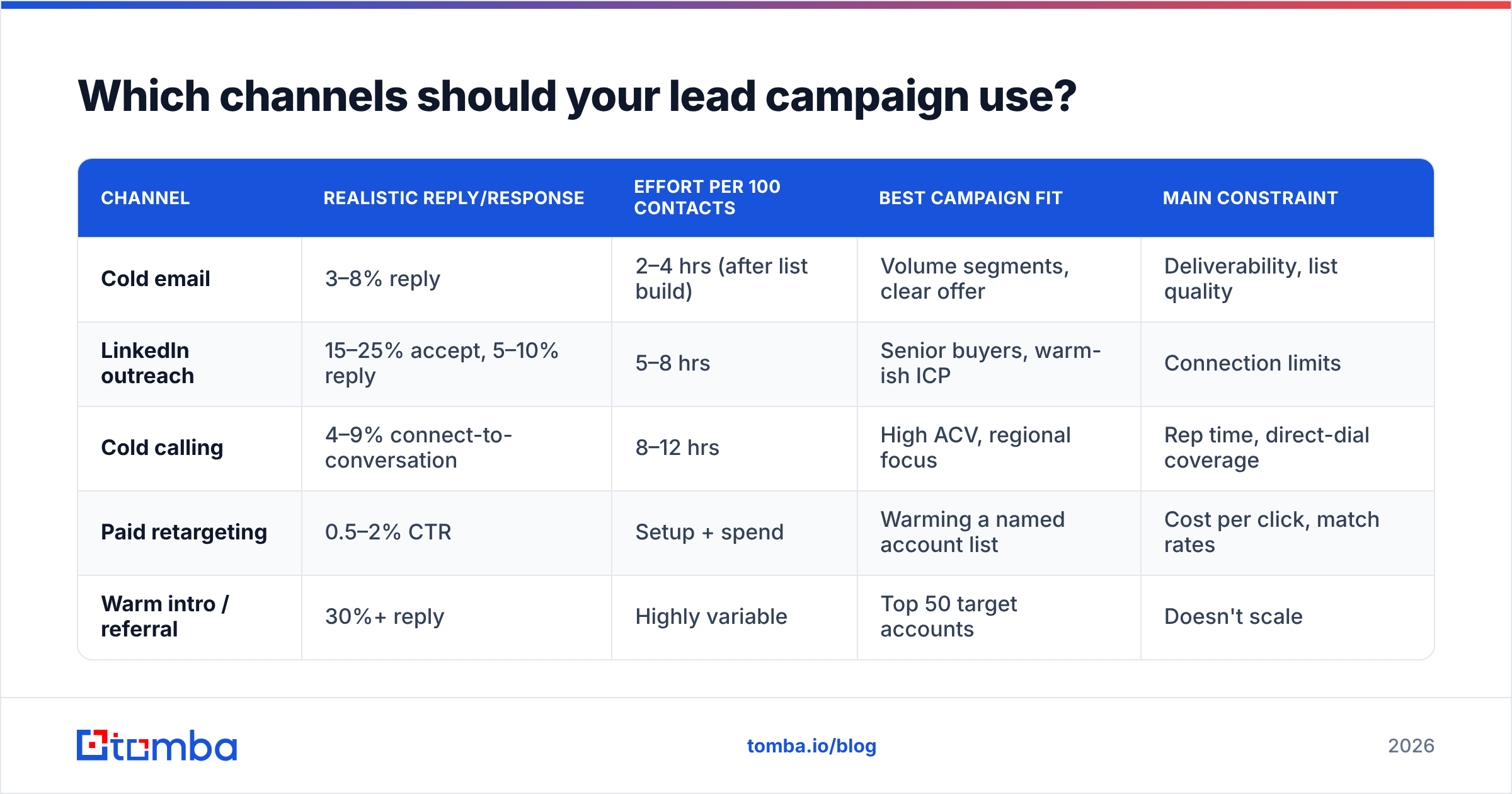
Which channels should your lead campaign use?#
Start with one channel executed well, then add a second. The teams that jump straight to five-channel orchestration usually run all five badly.
| Channel | Realistic reply/response | Effort per 100 contacts | Best campaign fit | Main constraint |
|---|---|---|---|---|
| Cold email | 3–8% reply | 2–4 hrs (after list build) | Volume segments, clear offer | Deliverability, list quality |
| LinkedIn outreach | 15–25% accept, 5–10% reply | 5–8 hrs | Senior buyers, warm-ish ICP | Connection limits |
| Cold calling | 4–9% connect-to-conversation | 8–12 hrs | High ACV, regional focus | Rep time, direct-dial coverage |
| Paid retargeting | 0.5–2% CTR | Setup + spend | Warming a named account list | Cost per click, match rates |
| Warm intro / referral | 30%+ reply | Highly variable | Top 50 target accounts | Doesn't scale |
The numbers above are ranges from vendor benchmark reports and practitioner surveys, not guarantees — your own baseline after two campaigns is worth more than any published figure. Software review data on lead intelligence tools is useful for shortlisting vendors, but the response benchmarks in vendor marketing skew toward their best customers.
A practical default for a first campaign: email as the primary channel, LinkedIn as the touch that runs in parallel for the top 20% of the list, phone reserved for anyone who opens twice or clicks. That sequence respects rep time and gives you clean attribution per channel.
How do you structure a 30-day lead campaign?#
Here's a timeline that survives contact with reality. Days are working days.
Days 1–5: Scope and list. Lock the segment definition, the offer, and the success metric in writing. Build the account list. Pull contacts, then run bulk verification. Expect to discard 10–20% of what you pulled — that's the system working, not failing.
Days 6–8: Assets and infrastructure. Write the sequence (four to five touches, not nine). Check SPF, DKIM, and DMARC. Warm any new sending domain for at least two weeks before this — if you're starting warmup on day 6, your campaign starts on day 20.
Days 9–10: Pilot send. Ship to 10% of the list. Watch bounce rate, spam complaints, and reply sentiment. Under 2% bounce and zero complaints means proceed. Anything worse means go back to the list, not the copy.
Days 11–22: Full rollout. Send in daily batches. Keep per-inbox volume conservative. Run the LinkedIn parallel track on your priority tier. Log every reply category — interested, not now, wrong person, unsubscribe — because "wrong person" above 15% is a segmentation problem you can fix mid-campaign.
Days 23–28: Follow-up and routing. Most positive replies arrive after touch three. Make sure routing to calendars is instant; a two-day lag between reply and booking link kills a meaningful share of interest.
Days 29–30: Teardown. Cost per qualified meeting, reply rate by segment slice, best-performing touch, and a written list of what you'd change. Then archive the list state so the next campaign doesn't re-message the same people cold.
What metrics tell you a lead campaign is working?#
Open rate is not one of them. Mail Privacy Protection and image-proxy prefetching inflate opens unpredictably, so any decision made on open rate is a decision made on noise.
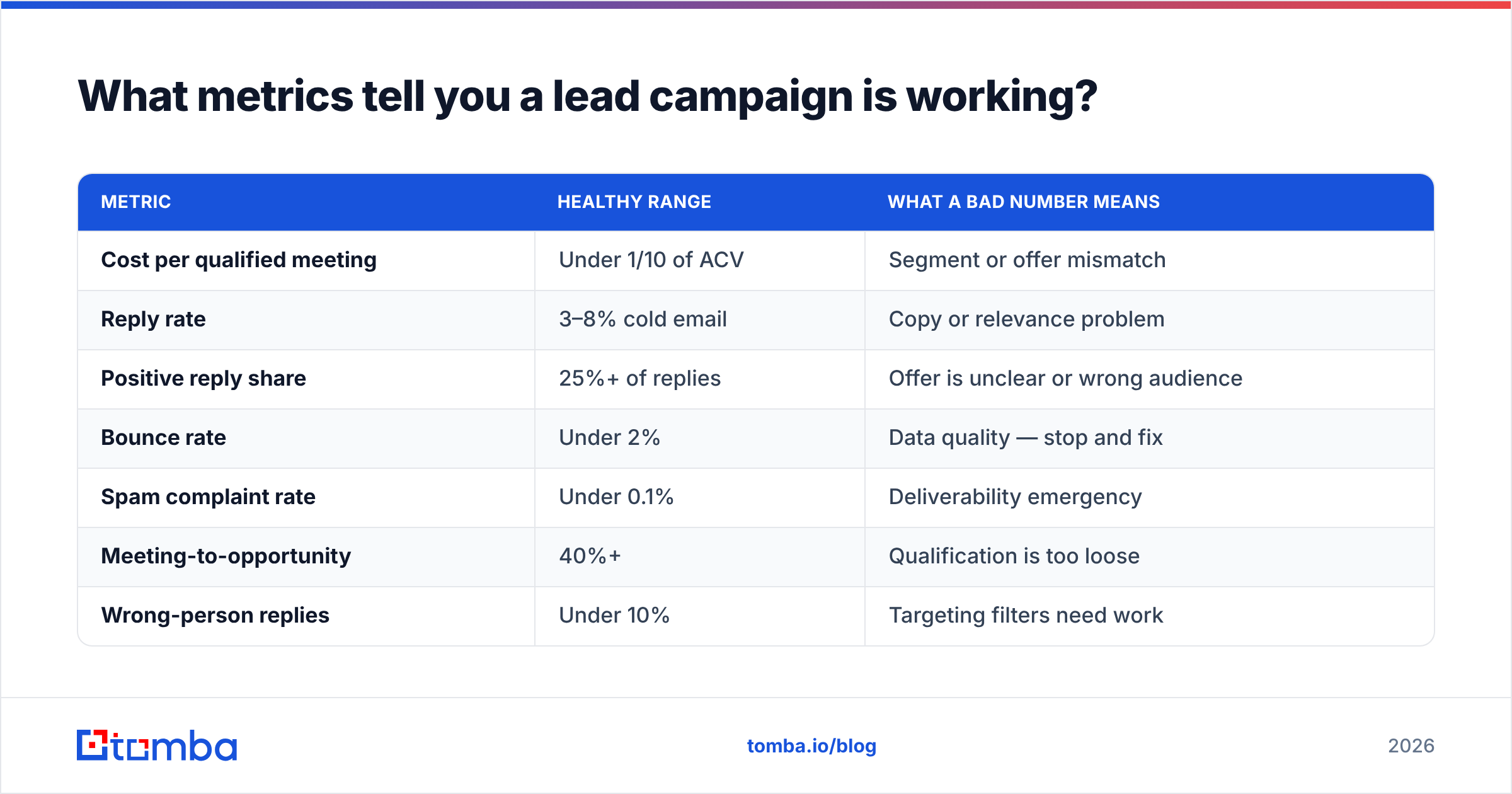
Track these, in this order of importance:
| Metric | Healthy range | What a bad number means |
|---|---|---|
| Cost per qualified meeting | Under 1/10 of ACV | Segment or offer mismatch |
| Reply rate | 3–8% cold email | Copy or relevance problem |
| Positive reply share | 25%+ of replies | Offer is unclear or wrong audience |
| Bounce rate | Under 2% | Data quality — stop and fix |
| Spam complaint rate | Under 0.1% | Deliverability emergency |
| Meeting-to-opportunity | 40%+ | Qualification is too loose |
| Wrong-person replies | Under 10% | Targeting filters need work |
Two of these are gates rather than goals. If bounce rate or complaint rate breaches the threshold, pause the campaign the same day. Nothing you learn from continuing is worth the email deliverability damage, and recovery takes weeks.
The metric most teams under-weight is meeting-to-opportunity conversion. A campaign that books 30 meetings where four become opportunities is worse than one booking 12 meetings where seven do — and the first one looks better in every dashboard that stops at "meetings booked."
What are the most common lead campaign mistakes?#
Segment too broad. If your list build produced 18,000 contacts, you didn't segment, you exported. Narrow until the copy can be specific.
Skipping verification to save time. Verification costs hours. A burned domain costs a quarter. Run bulk verification on every list, including ones you bought from a reputable provider — reputable providers still hand you records that went stale between their refresh and your send.
Nine-touch sequences. Response rates for touches six through nine are close to noise, and each one adds unsubscribe and complaint risk. Four to five touches over three weeks captures nearly all of the available response.
No holdout. Keep 5% of the segment unmessaged. It's the only way to know whether inbound activity during the window was the campaign or the weather.
Rewriting copy when data is the problem. If your bounce rate is 6%, your subject line is irrelevant. Diagnose in order: deliverability, then list quality, then targeting, then offer, then copy. Most teams do that list backwards because copy is the fun part.
Not archiving campaign state. Six weeks later, someone runs a "new" campaign into the same contacts with the same offer. Log every touch back to the CRM the day it happens.
How much should a lead campaign cost?#
For a 1,000-contact B2B email campaign, the honest line items are data and tooling, sending infrastructure, and rep time. Data and verification typically run $50–$300 per campaign at this size; sending tools add $30–$100/mo; rep time is the largest real cost at 25–40 hours across build, send, and follow-up.
That puts a realistic all-in figure between $2,500 and $5,000 when you cost rep hours honestly. Against a $30K ACV, you need roughly one closed deal per two campaigns to justify the motion — which is why the cost-per-qualified-meeting number matters more than any activity metric. Gartner's sales research has tracked the same pattern for years: buying groups are larger and slower, so campaigns that optimize for volume of touches rather than quality of fit lose ground.
Where should you start?#
Pick one segment you already have evidence for. Build a list of 300–500 verified contacts at those accounts. Write four touches around one offer. Send over three weeks. Measure cost per qualified meeting and wrong-person rate. Then do it again with what you learned.
The unglamorous part — getting accurate, current email addresses for the exact people in that segment — is where most campaigns quietly break. Tomba's email finder resolves contacts by domain, name, or company and validates them before they hit your sequence, with a free tier at 25 searches/month and paid plans from $49/mo. Check Tomba pricing to match a plan to your campaign volume, or wire it into your stack through the Tomba API so list building stops being a manual step in every campaign you run.
Related guides#
// get started
Find, verify and enrich your first contacts today
Start on the free plan with 25 searches a month, then scale when your team is ready.
Free plan · No credit card required · GDPR & CCPA
Get the Tomba newsletter
Product and data updates
// about the author