Lead Capture and Scoring: The 2026 Playbook That Converts
Most scoring models die within six months because the capture layer feeds them garbage. Here's how to design forms, fit/intent grids, thresholds, and enrichment so the leads you route are actually workable.

TL;DR
- Lead capture and scoring fail together. A model built on four self-reported form fields will always produce fake MQLs, no matter how clever the weights are.
- Score two axes separately — fit (does this account look like a customer?) and intent (are they moving right now?) — then route on the grid, not on a single number.
- Shrink your form to 3-4 fields and recover the rest through enrichment. Conversion goes up and data quality goes up at the same time.
- Verify the email before it enters scoring. An unreachable contact with a score of 92 is worth exactly zero.
- Re-fit your model every quarter against closed-won data. Static point values decay fast — most models are meaningfully wrong by month six.
What is lead capture and scoring?#
Lead capture and scoring is the two-stage system that turns anonymous traffic into a prioritized queue for sales. Capture is the collection layer — forms, chat, content downloads, demo requests, webinar signups, website visitor identification. Scoring is the ranking layer that decides which of those records deserves a human, which deserves a nurture sequence, and which deserves nothing.
The reason teams treat these as one topic is that they break as one topic. You cannot score what you did not capture, and you cannot capture everything without destroying your conversion rate. Every scoring model is downstream of a form design decision someone made eighteen months ago and never revisited.
Here's the uncomfortable part: the industry's default output — the MQL — has been a contested metric for years. Gartner has repeatedly flagged the disconnect between marketing-qualified volume and actual pipeline contribution, and most revenue teams have lived it: a dashboard full of green MQL numbers sitting next to a sales team that ignores the queue.

Why do most lead scoring models fail within six months?#
Four failure modes account for nearly all of it.
- The model was built on opinions, not closed-won data. Someone in a room assigned "+15 for VP title, +10 for pricing page visit" based on intuition. Nobody ever backtested those weights against the accounts that actually bought.
- Behavioral points accumulate but never decay. A lead who read three blog posts in March still carries those points in September. Without time decay, your highest scores drift toward the oldest, coldest records in the database.
- The capture layer is too thin. With company size, industry, and tech stack missing, fit scoring collapses into title-guessing — and job titles are the least standardized field in B2B.
- Nobody validates deliverability. Roughly 2-5% of a B2B list goes stale every month through job changes alone. A score built on a contact who left the company in Q1 routes a rep into a bounce.
The pattern underneath all four: scoring gets treated as a marketing-automation configuration task instead of a data-quality problem.
What should you actually capture on the form?#
Cut the form down and push the work to enrichment. Here's the field hierarchy that holds up in practice:
- Business email — the only truly required field. It is your join key to firmographics, your deliverability signal, and your identity anchor. Everything else can be derived from it.
- Full name (single field, not first/last). Splitting it adds friction for marginal benefit. Parse it server-side.
- One qualifying question you cannot infer. Budget timeline, current tooling, team size — pick the single thing enrichment can't tell you. One question, not four.
- Company domain — only if you allow personal emails. If you block free-mail domains, skip it; the email already contains it.
- Everything else: inferred, not asked. Industry, headcount, revenue band, tech stack, funding stage, location, and LinkedIn profile should all come from an enrichment call after submission.
The trade is straightforward. A seven-field form converts at roughly half the rate of a three-field form on the same traffic, and the extra four fields are self-reported — meaning they're inconsistent, often wrong, and sometimes deliberately false. You lose volume and accuracy. Enrichment through a data enrichment layer gives you standardized values for the same attributes without charging the visitor for them.
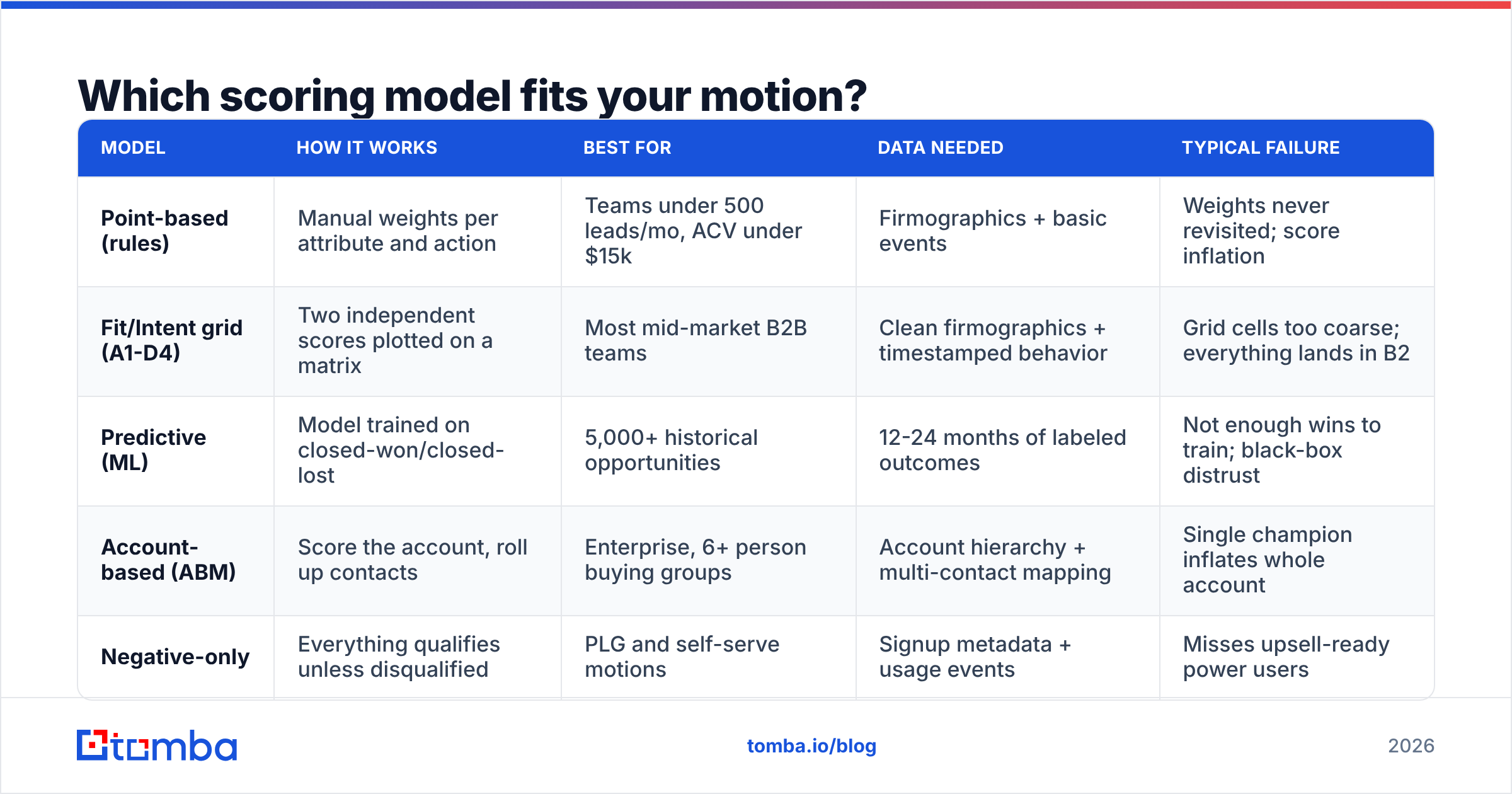
Which scoring model fits your motion?#
There is no universal model. Pick based on deal size, data volume, and how much sales-cycle history you have.
| Model | How it works | Best for | Data needed | Typical failure |
|---|---|---|---|---|
| Point-based (rules) | Manual weights per attribute and action | Teams under 500 leads/mo, ACV under $15k | Firmographics + basic events | Weights never revisited; score inflation |
| Fit/Intent grid (A1-D4) | Two independent scores plotted on a matrix | Most mid-market B2B teams | Clean firmographics + timestamped behavior | Grid cells too coarse; everything lands in B2 |
| Predictive (ML) | Model trained on closed-won/closed-lost | 5,000+ historical opportunities | 12-24 months of labeled outcomes | Not enough wins to train; black-box distrust |
| Account-based (ABM) | Score the account, roll up contacts | Enterprise, 6+ person buying groups | Account hierarchy + multi-contact mapping | Single champion inflates whole account |
| Negative-only | Everything qualifies unless disqualified | PLG and self-serve motions | Signup metadata + usage events | Misses upsell-ready power users |
The fit/intent grid is the right default for most teams because it degrades gracefully. When your behavioral data is noisy, the fit axis still routes correctly. When your firmographic data is thin, intent still surfaces the urgent ones. A single blended number gives you neither.
How do you build the fit and intent axes?#
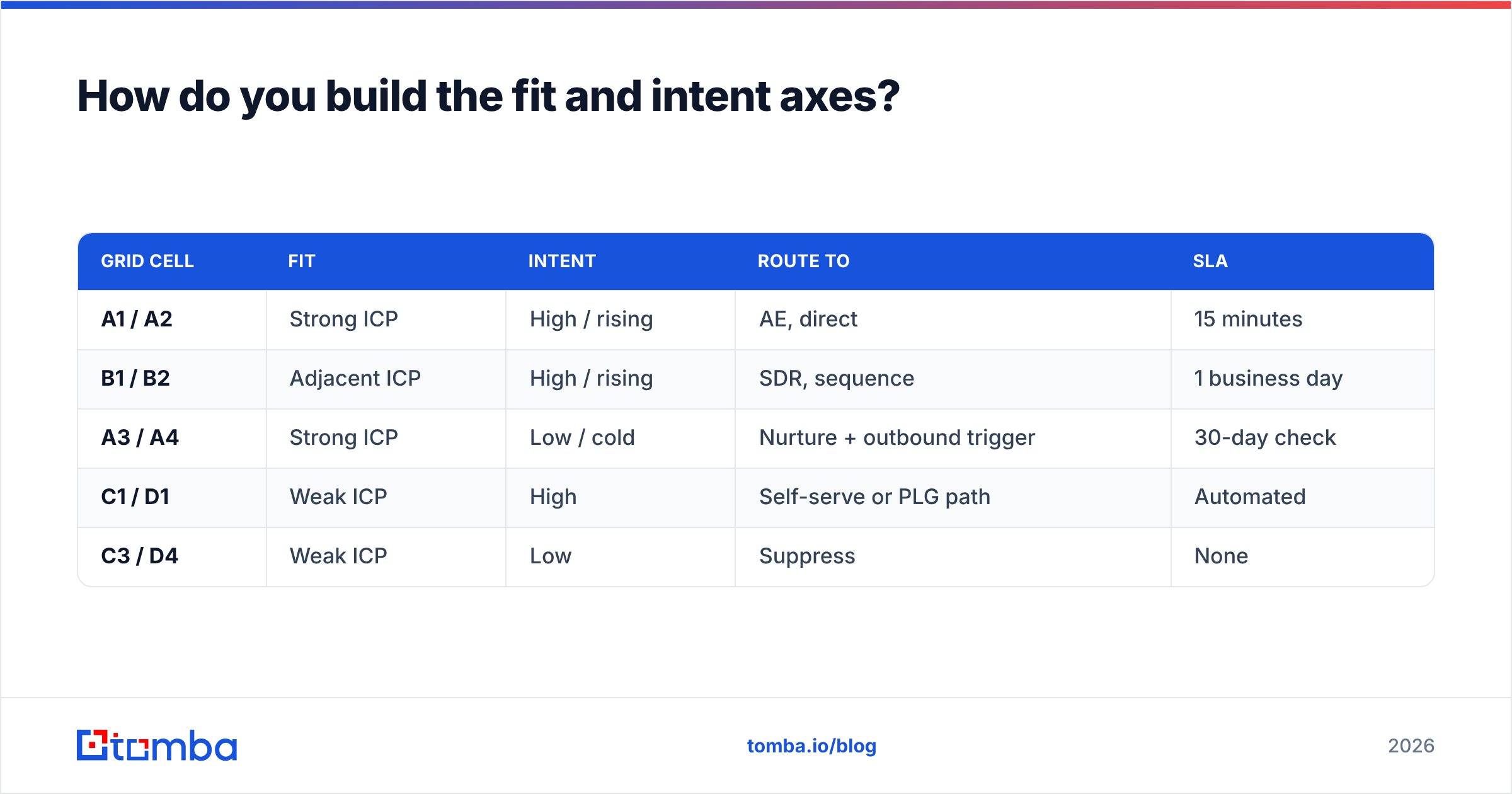
Score them separately, on separate scales, with separate owners.
Fit (A through D) answers "would we want this account as a customer?" Build it from attributes that don't change week to week: employee count, industry, revenue band, geography, tech stack, funding. Calibrate it by pulling your last 100 closed-won accounts and finding which attributes over-index versus your total database. If 62% of your wins are 50-500 employee SaaS companies in North America and that segment is only 24% of your database, that's your A-tier definition — not a guess.
Intent (1 through 4) answers "are they in market right now?" Build it from timestamped events with decay: pricing page views, demo request, repeat visits within seven days, competitor comparison page, documentation access, reply to an outbound sequence. Apply a half-life — an event 30 days old should carry roughly half its original weight; at 90 days, near zero.
| Grid cell | Fit | Intent | Route to | SLA |
|---|---|---|---|---|
| A1 / A2 | Strong ICP | High / rising | AE, direct | 15 minutes |
| B1 / B2 | Adjacent ICP | High / rising | SDR, sequence | 1 business day |
| A3 / A4 | Strong ICP | Low / cold | Nurture + outbound trigger | 30-day check |
| C1 / D1 | Weak ICP | High | Self-serve or PLG path | Automated |
| C3 / D4 | Weak ICP | Low | Suppress | None |
Speed matters more than precision in the top-left. The well-known HubSpot research on response time has been reinforced by a decade of follow-on studies: contact rates collapse sharply after the first hour. An A1 lead sitting in a queue for a day is worth less than a B2 lead worked in ten minutes.
Does data quality matter more than the model itself?#
Yes, and it isn't close.
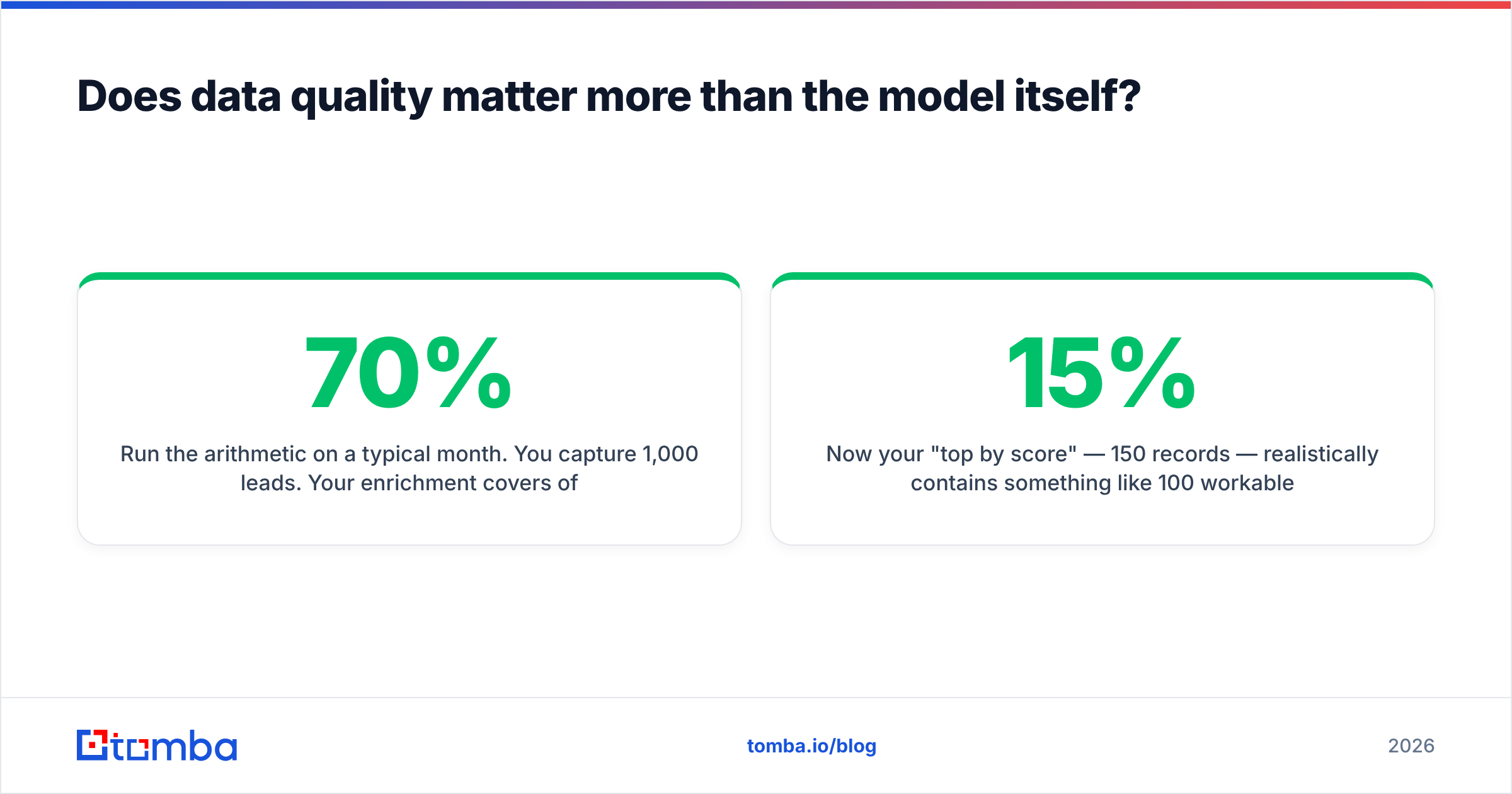
Run the arithmetic on a typical month. You capture 1,000 leads. Your enrichment covers 70% of them, so 300 records enter scoring with missing firmographics and default to a middling score. Of the 1,000 emails, 8% are invalid or role-based, and another 12% are catch-all domains you can't confirm. That's 200 records where the model is scoring a contact your reps can't actually reach.
Now your "top 15% by score" — 150 records — realistically contains something like 100 workable contacts. Your model didn't fail. Your inputs did.
Three fixes, in priority order:
- Verify at capture. Run an email verifier call on form submission. Reject hard bounces before they create a CRM record. For ambiguous domains, a dedicated catch-all verifier separates "probably deliverable" from "unknowable."
- Enrich before scoring, not after. If enrichment runs as a nightly batch, every lead is scored once on incomplete data and routed on that score. Order of operations: capture → verify → enrich → score → route.
- Re-verify the database quarterly. Job-change churn is the silent killer of any account-based model. Contacts that no longer exist keep holding account-level scores hostage.

What does the tooling stack actually look like?#
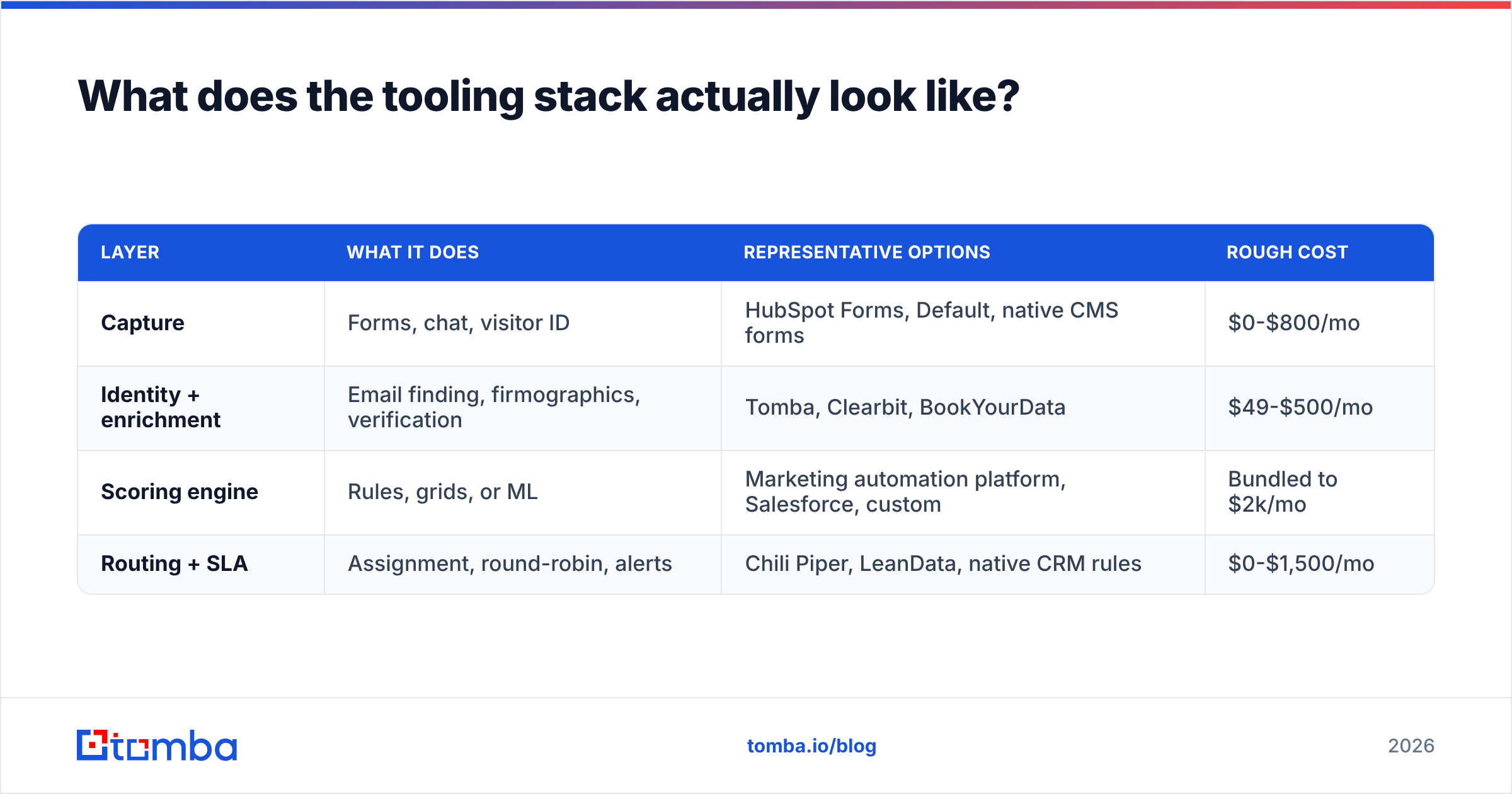
Most teams end up with three or four layers. The question is which layer you buy versus build.
| Layer | What it does | Representative options | Rough cost |
|---|---|---|---|
| Capture | Forms, chat, visitor ID | HubSpot Forms, Default, native CMS forms | $0-$800/mo |
| Identity + enrichment | Email finding, firmographics, verification | Tomba, Clearbit, BookYourData | $49-$500/mo |
| Scoring engine | Rules, grids, or ML | Marketing automation platform, Salesforce, custom | Bundled to $2k/mo |
| Routing + SLA | Assignment, round-robin, alerts | Chili Piper, LeanData, native CRM rules | $0-$1,500/mo |
For the identity and enrichment layer specifically, the pricing spread is wide. Tomba pricing starts with a free tier at 25 searches per month, Starter at $49/mo, Growth at $99/mo, and Pro at $249/mo — which puts real enrichment volume inside a mid-market marketing budget rather than an enterprise one. BookYourData takes a different approach with prepaid, pay-as-you-go contact credits, which suits teams that buy lists in bursts rather than enriching a continuous inbound stream. Both models are legitimate; the question is whether your volume is steady or spiky.
On the scoring side, if you already run Salesforce or a full marketing automation platform, you almost certainly have a scoring engine sitting unused or misconfigured. Before you buy anything, check what's already licensed. Vendor comparisons on G2 are useful for feature parity checks, but they won't tell you whether your existing stack covers 80% of the need.
For teams with engineering resources, the cleanest architecture is a single webhook on form submit that calls an enrichment endpoint, writes the result back, and lets the CRM's native rules handle scoring. The Tomba API and a CRM workflow cover that path without a fourth vendor.
How do you audit a scoring model in 30 days?#
A practical checklist you can run without a data team:
- Pull the last 90 days of closed-won deals and look up their score at creation. If more than a third scored below your MQL threshold, the model is mis-weighted — not the sales team.
- Pull the top 100 scores from 90 days ago and check outcomes. Under 10% converted to opportunity? Your top of queue is noise.
- Measure enrichment coverage by field. Any field under 80% coverage should be removed from scoring — partial data creates systematic bias toward whoever happens to be enriched.
- Bounce-test a random sample of 200 scored contacts. Anything over 5% invalid means verification isn't running at capture.
- Check score distribution. If it's bell-shaped and centered, your model isn't discriminating. Healthy distributions are lumpy with a long right tail.
- Time every stage. Capture → route should be under 5 minutes for A-tier. Measure it with real timestamps, not the SLA you wrote down.
Run this quarterly. Change one variable at a time and hold the rest steady, or you'll never know which adjustment moved the number.
What changes when buying groups get bigger?#
Contact-level scoring breaks down once six or more people touch a deal. A single champion downloading three assets can push an account to the top of the queue while the actual economic buyer has never visited your site.
The fix is roll-up scoring: compute an account score from the contacts you know about, weighted by role. Two research-stage individual contributors are a weaker signal than one director plus one finance stakeholder. This only works if you've mapped the buying group — which means going wider than the people who filled out forms. A domain search across the account surfaces the roles you haven't captured yet, so your account score reflects the real committee instead of the self-selected subset.
That's also where scoring and outbound converge. An A-tier account with one engaged contact and five unmapped stakeholders isn't a nurture problem. It's an outbound assignment with a very warm opening line.
Start where the leverage is. You can rebuild your scoring model this quarter and gain a few points of precision, or you can fix the capture layer and gain a multiple. Fewer form fields, verified emails at submission, and enrichment that fills the gaps before the score is computed — that sequence fixes more pipeline than any weight adjustment.
If your contact data is the weak link, start with the Tomba Email Finder. Find and verify the people your forms never caught, enrich what you already have, and let your scoring model work on records that are actually real. The free tier gives you 25 searches a month to test it against your own closed-won list before you commit to anything.
Related guides#
// get started
Find, verify and enrich your first contacts today
Start on the free plan with 25 searches a month, then scale when your team is ready.
Free plan · No credit card required · GDPR & CCPA
Get the Tomba newsletter
Product and data updates
// about the author