Lead Carrot vs LeadzenAI: Which Lead Finder Wins in 2026?
Lead Carrot scrapes local business leads. LeadzenAI sells AI-driven B2B intelligence. They solve different problems - and neither verifies email the way your bounce rate needs. Here's the honest breakdown.
TL;DR
- Lead Carrot and LeadzenAI are not really competitors. Lead Carrot is a local-business lead scraper built around Google Maps and directory data; LeadzenAI is an AI-layered B2B contact intelligence platform aimed at enterprise-ish prospecting.
- Pick Lead Carrot if you sell to SMBs, agencies, dentists, gyms, contractors, and you want a scraped list with a phone number and a website.
- Pick LeadzenAI if you need intent-style filtering, org charts, and a searchable B2B database rather than a scrape-per-city workflow.
- Both share the same weak point: the email addresses they hand you are inferred or aggregated, and neither treats verification as a first-class product. That is where your bounce rate comes from.
- The stack most outbound teams actually run in 2026 is one source of leads plus a dedicated finder/verifier layer. Budget roughly $49–$99/mo for the verification half and stop guessing.
What are Lead Carrot and LeadzenAI, exactly?#
They get lumped together in "best lead gen tools" listicles because both promise contacts. Under the hood they are built on opposite assumptions.
Lead Carrot (leadcarrot.io) is a scraping-first tool. You pick a niche and a geography — "roofing contractors, Phoenix" — and it returns a list of businesses with website, phone, social profiles, and whatever contact emails it can pull from public pages. It grew up serving agency owners and local-services sellers who need volume in a city, not precision in an enterprise account. The interface reflects that: search, scrape, export, load into your dialer or sequencer.
LeadzenAI (leadzen.ai) sits at the other end. It positions itself as an AI-driven prospecting and lead intelligence platform: a searchable B2B database with filters on industry, headcount, technologies, and role, plus browser-extension enrichment and some "predictive" scoring on top. The pitch is that you should not be scraping at all — you should be querying a maintained database and letting a model rank who is worth contacting.
That difference matters more than any feature checkbox. One tool assumes your ICP is defined by geography and category. The other assumes it is defined by firmographics and role. If you buy the wrong one, no amount of credits fixes the mismatch.
How do the two data models actually differ?#
Here is the practical breakdown, because "both find leads" hides everything that will annoy you in month two.
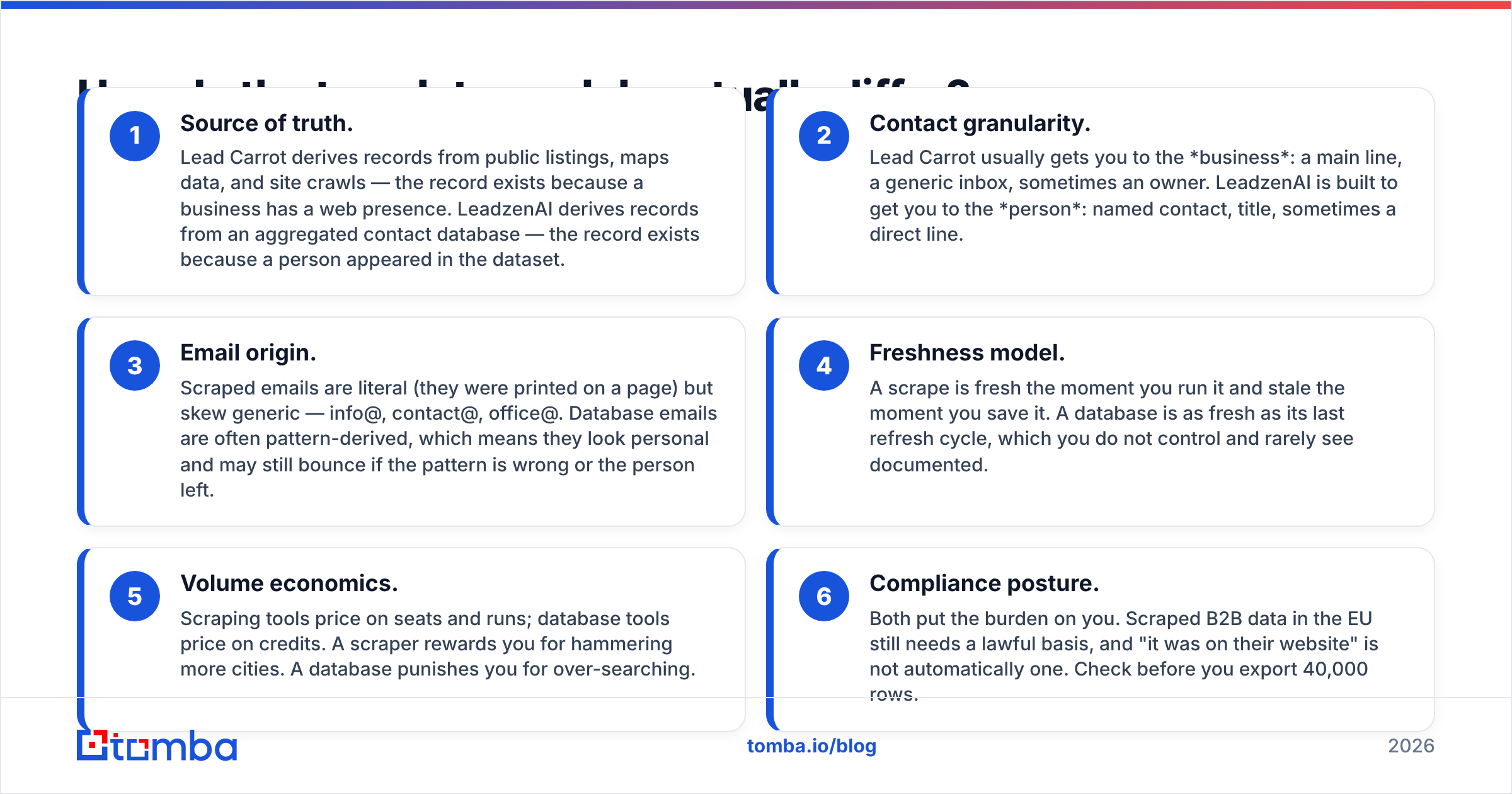
- Source of truth. Lead Carrot derives records from public listings, maps data, and site crawls — the record exists because a business has a web presence. LeadzenAI derives records from an aggregated contact database — the record exists because a person appeared in the dataset.
- Contact granularity. Lead Carrot usually gets you to the business: a main line, a generic inbox, sometimes an owner. LeadzenAI is built to get you to the person: named contact, title, sometimes a direct line.
- Email origin. Scraped emails are literal (they were printed on a page) but skew generic — info@, contact@, office@. Database emails are often pattern-derived, which means they look personal and may still bounce if the pattern is wrong or the person left.
- Freshness model. A scrape is fresh the moment you run it and stale the moment you save it. A database is as fresh as its last refresh cycle, which you do not control and rarely see documented.
- Volume economics. Scraping tools price on seats and runs; database tools price on credits. A scraper rewards you for hammering more cities. A database punishes you for over-searching.
- Compliance posture. Both put the burden on you. Scraped B2B data in the EU still needs a lawful basis, and "it was on their website" is not automatically one. Check before you export 40,000 rows.
If you remember one thing: generic inboxes and inferred addresses fail for opposite reasons, and both fail silently. That is why the verification layer is not optional.

Which one finds more valid email addresses?#
Neither, reliably — and that framing is the trap.
Lead Carrot wins on coverage of businesses that have no LinkedIn footprint. A 6-person HVAC company in Tulsa is invisible in most B2B databases and trivially findable via maps data. If that is your market, LeadzenAI will return thin results no matter how many credits you burn.
LeadzenAI wins on named contacts inside companies with 50+ employees. Ask Lead Carrot for the VP of Operations at a mid-market logistics firm and you will get a switchboard number.
But deliverability is a separate question from discovery, and it is where both categories leak. Independent testing across the email-finder market consistently shows a wide spread between tools that run real-time SMTP checks and tools that return a pattern guess with a confidence label. The gap is not 2–3 points. It is often 20+.

Three things quietly wreck your list quality regardless of which of these two you pick:
- Catch-all domains. A large share of B2B domains accept everything at the SMTP layer, so a naive check returns "valid" for addresses that will hard-bounce or route to a black hole. You need an explicit catch-all verifier to score those separately rather than trusting a green checkmark.
- Role accounts. info@, sales@, hello@ are technically deliverable and strategically useless. They inflate your "valid" percentage while tanking reply rate.
- Job churn. Roughly a quarter of B2B contact records decay per year. A list you bought in January is materially wrong by September.
Run any exported list through an email verifier before it touches your sending domain. This is the single highest-ROI step in the whole workflow, and it costs less than the leads did.
Lead Carrot vs LeadzenAI: how do they compare head to head?#
Pricing on both products moves, and neither publishes a fully transparent enterprise rate card, so treat the money rows as a range to verify on the vendor's own pricing page before you buy.

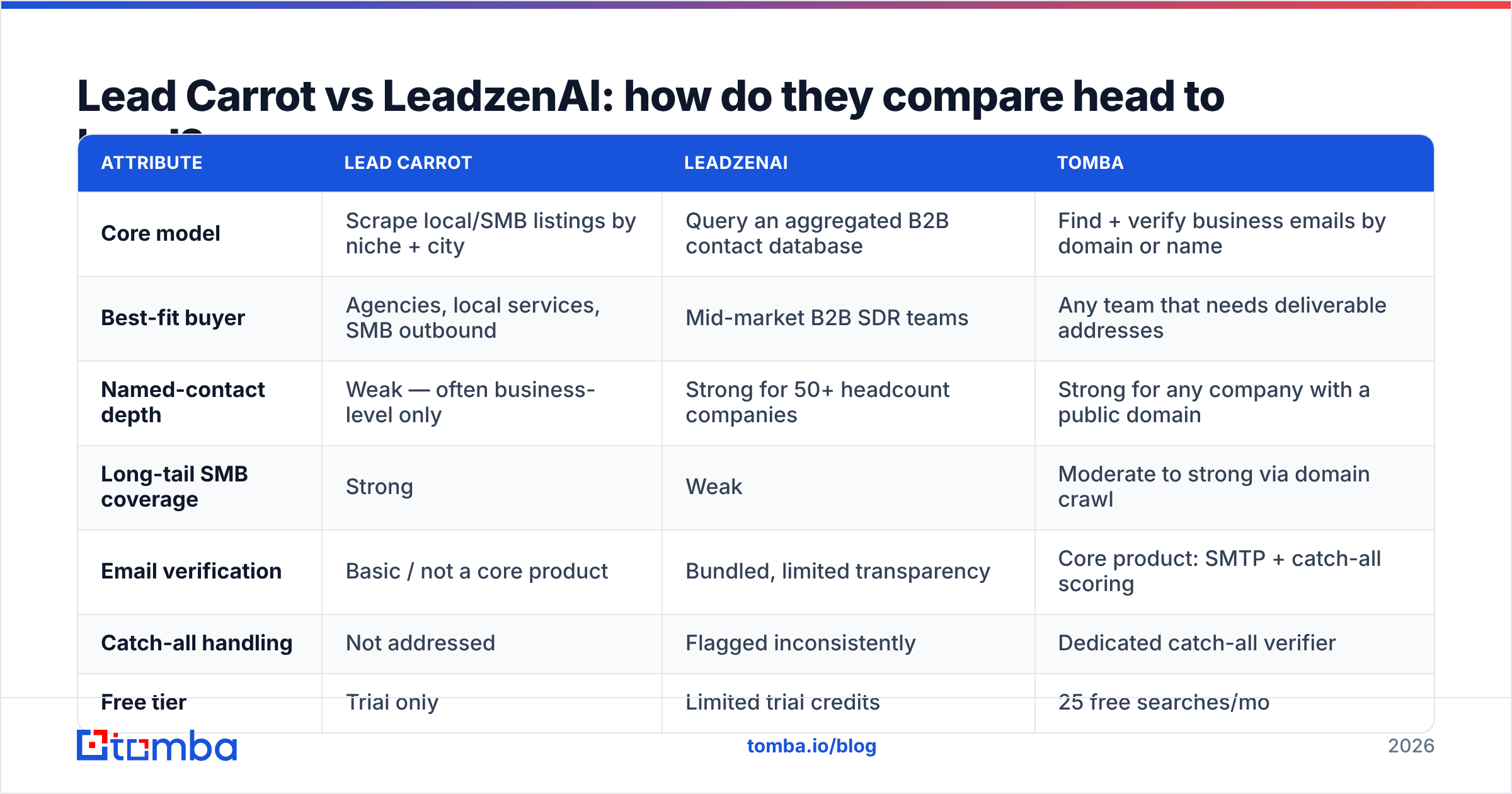
| Attribute | Lead Carrot | LeadzenAI | Tomba |
|---|---|---|---|
| Core model | Scrape local/SMB listings by niche + city | Query an aggregated B2B contact database | Find + verify business emails by domain or name |
| Best-fit buyer | Agencies, local services, SMB outbound | Mid-market B2B SDR teams | Any team that needs deliverable addresses |
| Named-contact depth | Weak — often business-level only | Strong for 50+ headcount companies | Strong for any company with a public domain |
| Long-tail SMB coverage | Strong | Weak | Moderate to strong via domain crawl |
| Email verification | Basic / not a core product | Bundled, limited transparency | Core product: SMTP + catch-all scoring |
| Catch-all handling | Not addressed | Flagged inconsistently | Dedicated catch-all verifier |
| Free tier | Trial only | Limited trial credits | 25 free searches/mo |
| Entry paid price | Roughly $47–$97/mo (verify current) | Roughly $49–$99/mo (verify current) | $49/mo Starter |
| Mid tier | Seat-based upgrades | Credit-based upgrades | $99/mo Growth, $249/mo Pro |
| API access | Limited | Available on higher tiers | Full API on all paid tiers |
| Bulk workflow | CSV export | CSV export | Bulk finder + bulk verify |
| Spreadsheet/CRM native | Export-and-import | Extension + integrations | Sheets, Excel, Airtable, HubSpot, Salesforce |
Two observations from that grid.
First, the overlap between Lead Carrot and LeadzenAI is smaller than the marketing implies. They are rarely on the same shortlist for a well-defined ICP. If both are on yours, your ICP is not defined yet — fix that before you spend.
Second, neither column has a strong verification story. Lead Carrot does not pretend to; LeadzenAI bundles checks but does not expose the methodology or handle catch-alls as a distinct state. Compare that to what a dedicated finder does, and the split-stack argument makes itself. You can review Tomba pricing against whichever of the two you are leaning toward — the verification layer typically costs less than the gap in wasted sends.
Who should actually pick Lead Carrot?#
Buy Lead Carrot if three things are true:
- Your ICP is defined by category plus geography ("med spas in Florida", "plumbers in the Midlands"), not by headcount or tech stack.
- You are comfortable with business-level contact data and your first touch is a phone call or a generic inbox email that gets forwarded to the owner.
- You need repeatable volume per market and you plan to work many cities.
It is a good fit for agency owners selling web, SEO, or AI receptionist services into local markets. The workflow is blunt and fast, which is exactly right when your market has 40,000 near-identical prospects and your differentiator is activity volume.
Do not buy it for enterprise or mid-market outbound. You will spend more time chasing named contacts manually than the tool saves you.
Who should actually pick LeadzenAI?#
Buy LeadzenAI if:
- You prospect into companies, not storefronts, and you filter by industry, size, role, and technology.
- You want a search-first workflow rather than a scrape-and-wait one, with an extension for enriching profiles you find yourself.
- You value AI ranking and scoring enough to accept less transparency about where a given record came from.
It is a reasonable choice for a small SDR team that needs a database and does not want to pay Apollo or ZoomInfo money. Compare it honestly against the field, though — the Apollo alternative market is crowded, and per-credit costs add up faster than the landing page suggests when three reps are all searching the same accounts.
Do not buy it expecting long-tail SMB coverage. Databases are built from professional footprints, and most small local businesses do not have one.
Where do both tools leave you exposed?#
Same place: the handoff between "I have a list" and "I can send to this list."

Here is the failure sequence, and it is boringly consistent across teams:
- You export 5,000 rows from your lead source.
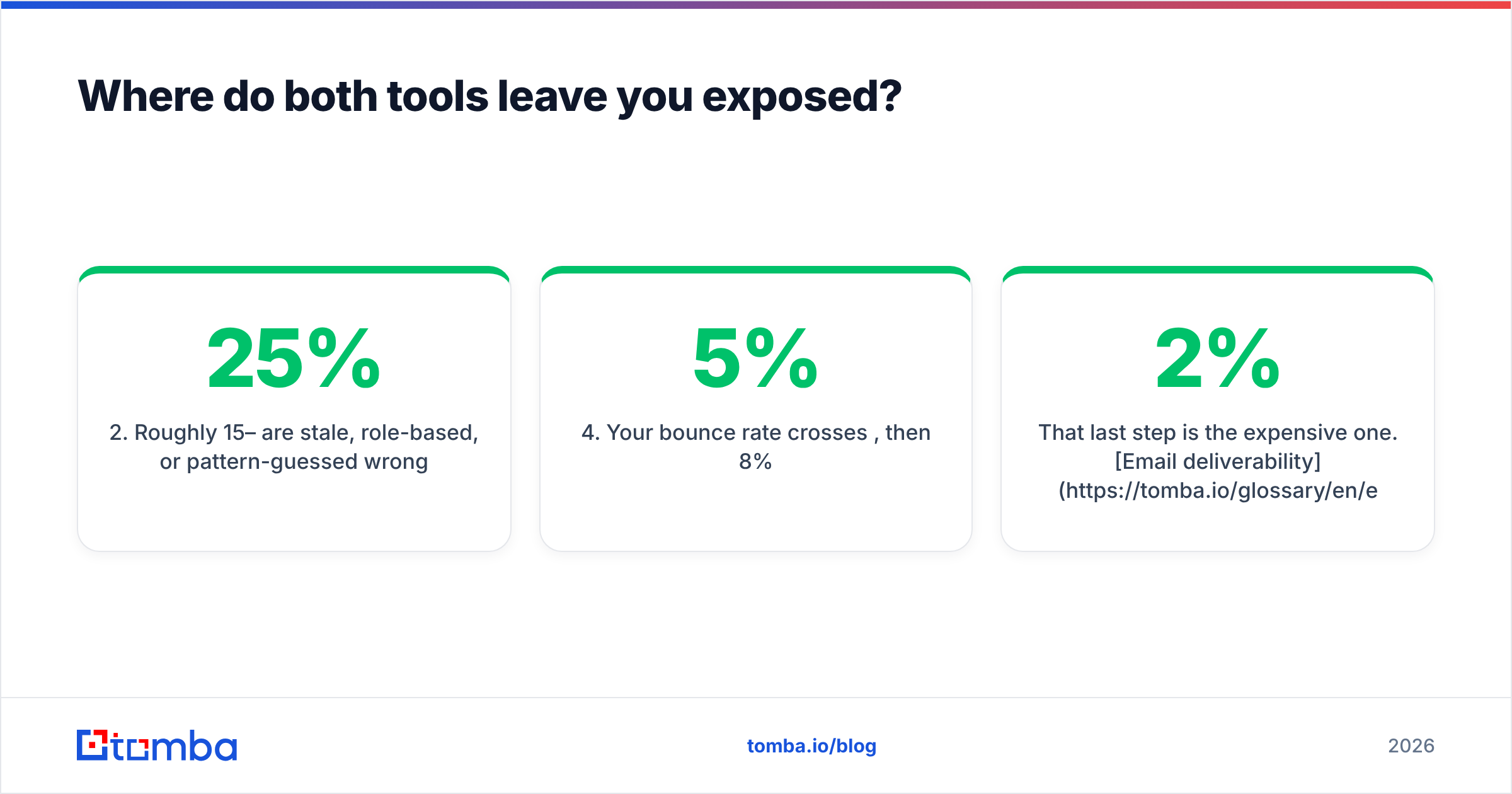
- Roughly 15–25% are stale, role-based, or pattern-guessed wrong.
- You upload them to a sequencer anyway because the list "came from a paid tool."
- Your bounce rate crosses 5%, then 8%.
- Your domain reputation drops, your good emails start landing in spam, and your reply rate falls across every campaign — including the ones with clean lists.
That last step is the expensive one. Email deliverability damage is not proportional to the bad list; it is systemic. One dirty send can suppress a month of clean ones. Mailbox providers have tightened bulk-sender requirements steadily since 2024, and a bounce rate above roughly 2% is now a real throttling trigger rather than a soft warning. Vendor documentation from the major providers and the buyer reviews on G2 both point the same direction: list hygiene, not copy, is the dominant variable in whether cold email works at all.
The fix is structural, not heroic. Whatever tool sources your leads, a separate verification pass sits between export and send — every time, no exceptions, including for lists you paid a premium for.
What does a sane 2026 stack look like?#
Split the job in two. Source of leads, then quality layer.
Source layer — pick exactly one based on ICP shape:
- Local/SMB by geography → Lead Carrot
- Mid-market by firmographics → LeadzenAI (or a broader database if you need global coverage)
- Named-account lists you already have → skip both; you only need enrichment
Quality layer — non-negotiable regardless of source:
- Find missing addresses at the domain level with domain search when your source returns a company but no person
- Verify every address, with catch-all domains scored separately rather than lumped into "valid"
- Run the whole file through a bulk email finder pass so enrichment and verification happen in one job instead of three tools
- Re-verify anything older than 60 days before reusing it
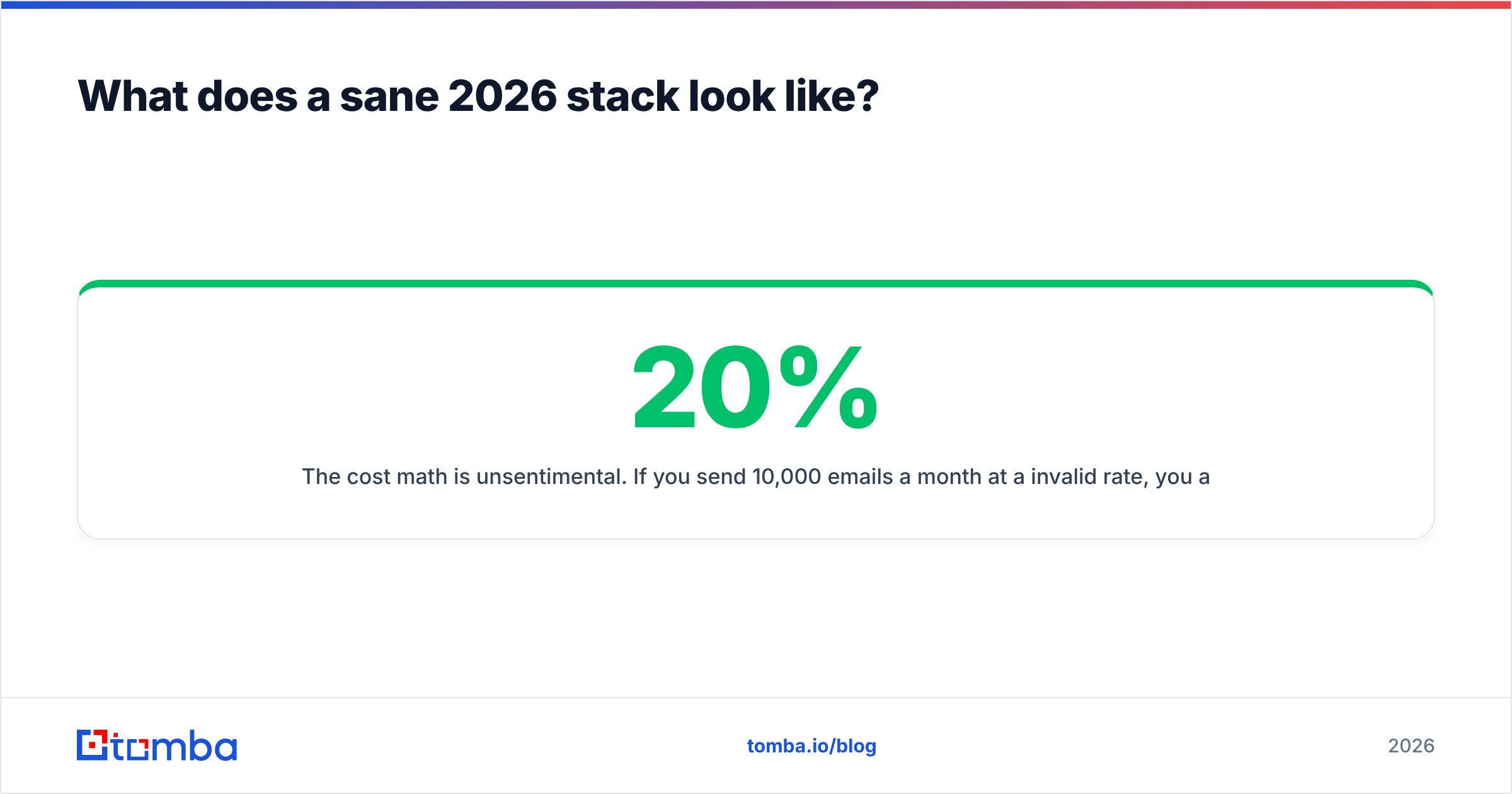
The cost math is unsentimental. If you send 10,000 emails a month at a 20% invalid rate, you are burning 2,000 sends, damaging your sender reputation, and losing the downstream replies on the 8,000 good ones. A verification layer at $49–$99/mo costs less than a single lost month of pipeline. Teams that skip it are not saving money; they are deferring a larger bill.
One more thing worth saying plainly: neither Lead Carrot nor LeadzenAI is a bad product. They are narrow products sold with broad language. Match the tool to how your ICP is actually defined, and the decision gets easy. Buy on vibes from a listicle, and you will be re-evaluating in 90 days.
Ready to stop guessing at addresses?#
Whichever source you land on, the addresses still have to be real. Tomba Email Finder finds professional email addresses by domain, name, or company, runs real SMTP verification, and scores catch-all domains as their own category instead of hiding them behind a green check. Start on the free tier — 25 searches a month, no card — and run your last Lead Carrot or LeadzenAI export through it. If more than a handful of "valid" addresses come back questionable, you just found where your reply rate went. Paid plans start at $49/mo when you are ready to scale the whole list.
Related guides#
Ready to find emails that actually work?
Join 150,000+ professionals who stopped guessing and started sending. Free credits on signup — no credit card required.
Get the Tomba newsletter
Practical outbound tactics and product updates — once every two weeks.
About the author