Lead Conversion Strategies That Actually Move Pipeline in 2026
Most teams blame the leads when conversion stalls. The real leaks are speed-to-lead, bad contact data, and routing nobody owns. Here are the strategies that fix them.
TL;DR
- Conversion rate is rarely a leads problem. It is usually a speed problem, a routing problem, or a data problem — and all three are cheaper to fix than buying more leads.
- Responding inside 5 minutes versus 30 minutes changes qualification odds by roughly an order of magnitude. Nothing else in this article beats that single lever.
- Bounced and wrong-person contacts silently kill 15-25% of an outbound list. Verifying before you send costs less than one lost meeting.
- Lead scoring only works when the score maps to an action. A number with no routing rule attached is decoration.
- Multi-threading (3+ contacts per account) is the single biggest fix for late-stage stalls in committee buying.
You do not have a lead volume problem. You almost certainly have a conversion leak problem, and the leak is somewhere in the 48 hours between a lead appearing and a human having a real conversation with them.
This guide walks through the lead conversion strategies that reliably move numbers — with the math, the failure modes, and the parts most teams skip.
What are lead conversion strategies, exactly?#
A lead conversion strategy is any repeatable action that increases the percentage of leads that reach the next stage. That is deliberately broad, because conversion is not one event. It is a chain of handoffs, and each handoff is a place where leads fall out.
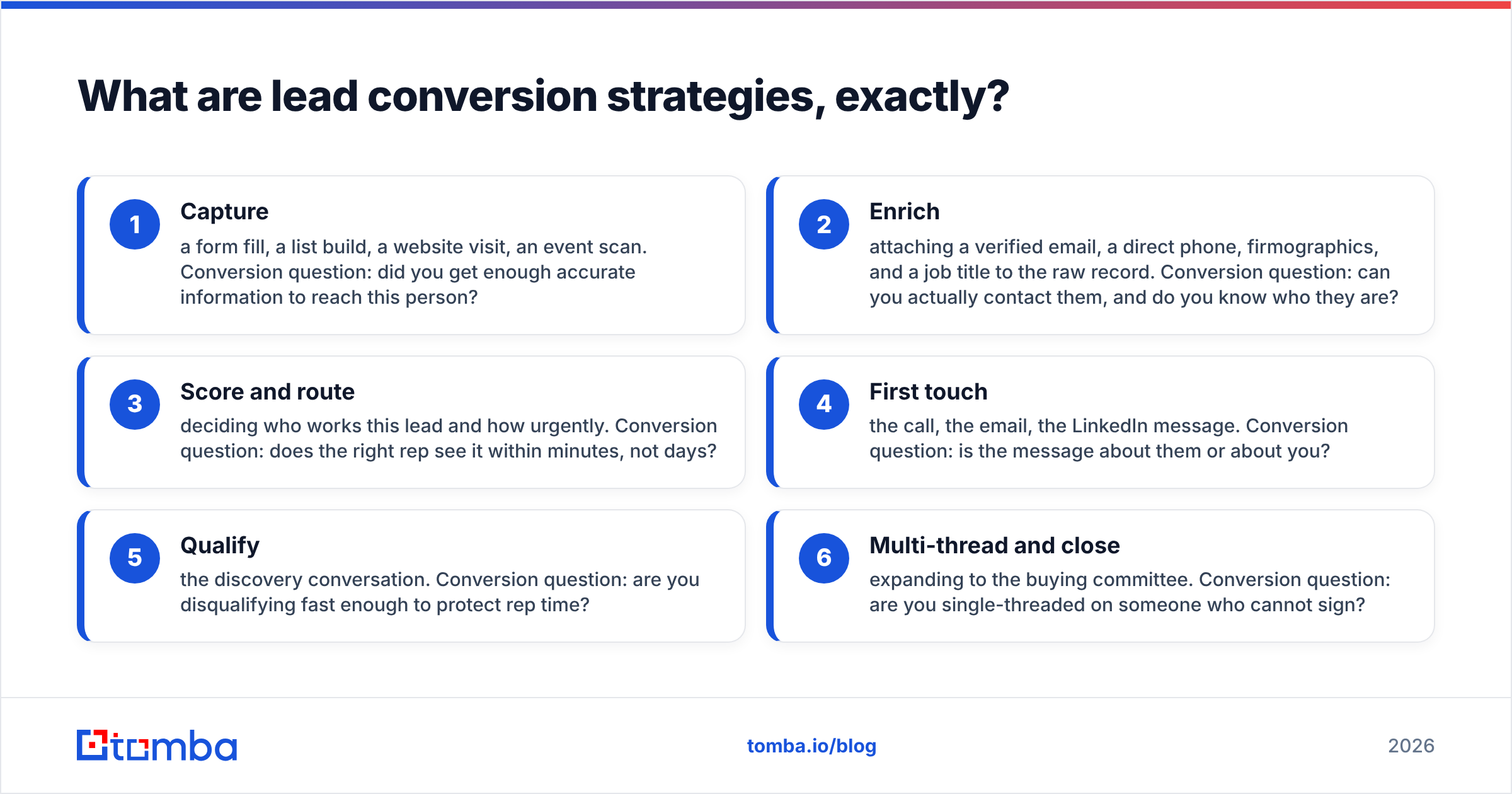
The chain looks like this in most B2B orgs:
- Capture — a form fill, a list build, a website visit, an event scan. Conversion question: did you get enough accurate information to reach this person?
- Enrich — attaching a verified email, a direct phone, firmographics, and a job title to the raw record. Conversion question: can you actually contact them, and do you know who they are?
- Score and route — deciding who works this lead and how urgently. Conversion question: does the right rep see it within minutes, not days?
- First touch — the call, the email, the LinkedIn message. Conversion question: is the message about them or about you?
- Qualify — the discovery conversation. Conversion question: are you disqualifying fast enough to protect rep time?
- Multi-thread and close — expanding to the buying committee. Conversion question: are you single-threaded on someone who cannot sign?
Most teams obsess over step 4 and ignore steps 2 and 3. That is backwards. A brilliant cold email sent to a bounced address converts at exactly zero percent.
Why do most lead conversion efforts fail?#
Because they optimize the visible step instead of the leaky one. Three specific failure patterns show up again and again.
Failure 1: the slow handoff. A lead fills out a demo form on Tuesday at 2pm. It sits in a queue. A rep picks it up Thursday morning. By then the prospect has already talked to two competitors. The classic Harvard Business Review research on lead response found firms that responded within an hour were nearly seven times more likely to have a meaningful qualifying conversation than those that waited even one hour longer — and over 60 times more likely than firms that waited 24 hours. That study is old now, and buyer patience has only shrunk since.
Failure 2: the unreachable contact. You built a list of 2,000 prospects. 300 emails bounce, 200 go to people who left the company, and 150 land in spam because your domain reputation took a hit from the bounces. You just lost a third of the list before anyone read a word. This is why email verification belongs before the sequence, not after the bounce report.
Failure 3: the score nobody acts on. Marketing builds a 100-point lead scoring model. Sales ignores it because nothing changes operationally when a lead hits 80 points. The score is real; the workflow is not. If your marketing qualified lead definition does not trigger a specific, time-bound action, it is a reporting artifact.
How much does speed-to-lead actually matter?#
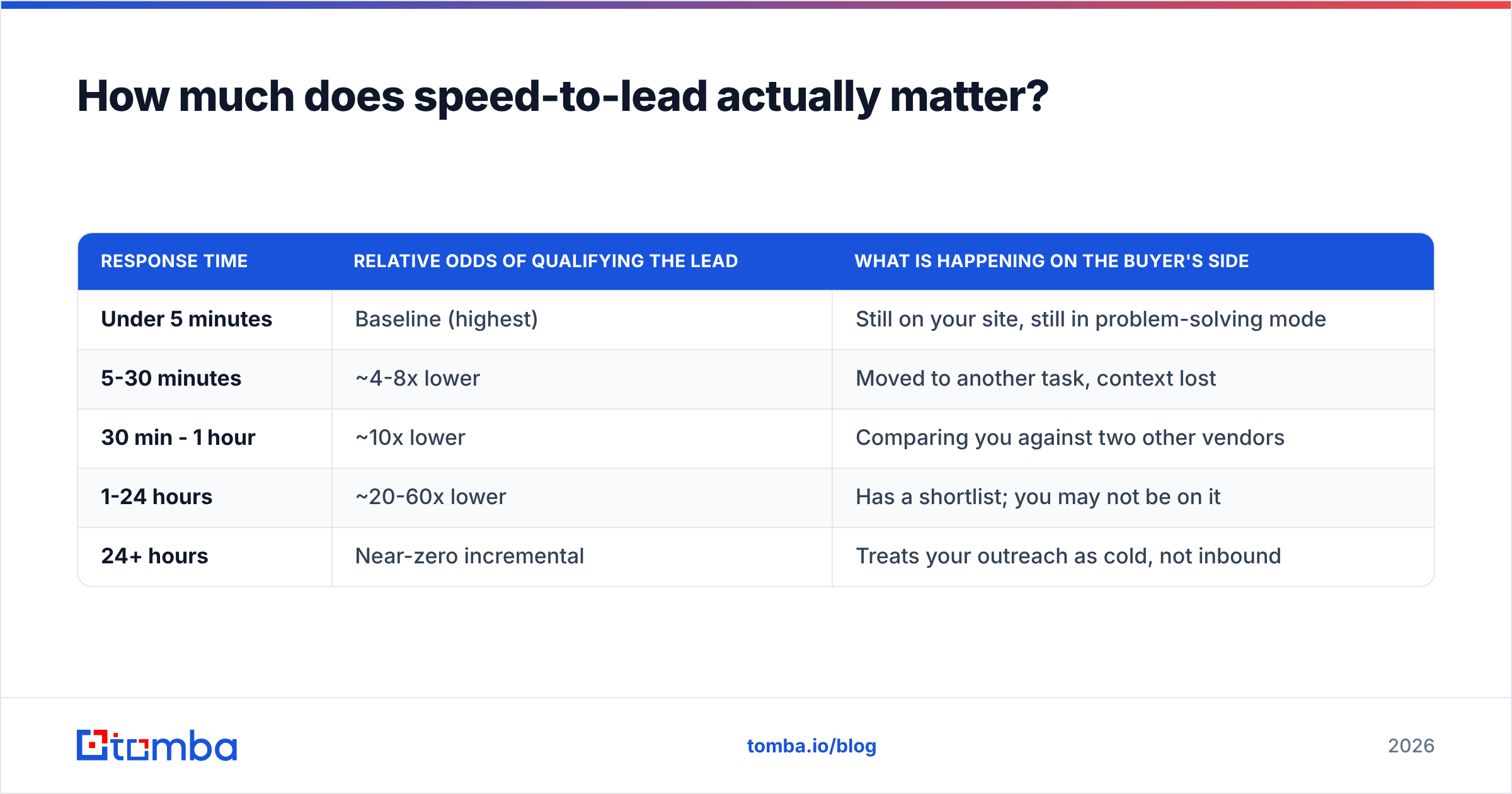
More than anything else on this list. Here is the rough shape of the decay, drawn from response-time studies across B2B SaaS and services:
| Response time | Relative odds of qualifying the lead | What is happening on the buyer's side |
|---|---|---|
| Under 5 minutes | Baseline (highest) | Still on your site, still in problem-solving mode |
| 5-30 minutes | ~4-8x lower | Moved to another task, context lost |
| 30 min - 1 hour | ~10x lower | Comparing you against two other vendors |
| 1-24 hours | ~20-60x lower | Has a shortlist; you may not be on it |
| 24+ hours | Near-zero incremental | Treats your outreach as cold, not inbound |
The practical implication: a mediocre rep calling in 3 minutes beats your best rep calling in 3 hours. Staff and route accordingly.
Three things to implement this week:
- Round-robin with a fallback timer. If the assigned rep does not touch the lead in 10 minutes, it reassigns. No exceptions for seniority.
- Instant-notify in the channel reps already live in. A Slack integration alert beats a CRM task nobody refreshes.
- Pre-enriched records. If the rep has to go hunting for a phone number before dialing, you have built a 15-minute delay into every single lead.
What data quality problems kill conversion?#
The unglamorous one. Data decay runs roughly 25-30% per year on B2B contact records — people change jobs, companies get acquired, domains change. A list you bought in January is materially worse by June.
Four data failures and their conversion cost:
- Hard bounces. Direct loss plus reputation damage. A bounce rate above 3% starts hurting inbox placement for the entire domain, which means your good addresses stop landing too. Run a bulk verify pass before every campaign, not after.
- Catch-all domains. The address accepts everything, so standard verification returns "unknown." Most teams either skip these contacts (losing real prospects) or blast them (risking bounces). A dedicated catch-all verifier resolves a meaningful share of them either way.
- Wrong-person records. The email works, but they left 14 months ago. Nobody bounces, nobody replies, and your reply-rate dashboard looks like a messaging problem when it is a freshness problem.
- Missing phone numbers. Email-only sequences cap out. Adding a verified direct dial to the same record — via a phone finder — typically lifts connect rates enough to justify the cost on its own.
Fixing data is boring work with the highest ROI on this page. Treat contact hygiene as a recurring process, not a one-time cleanup project.
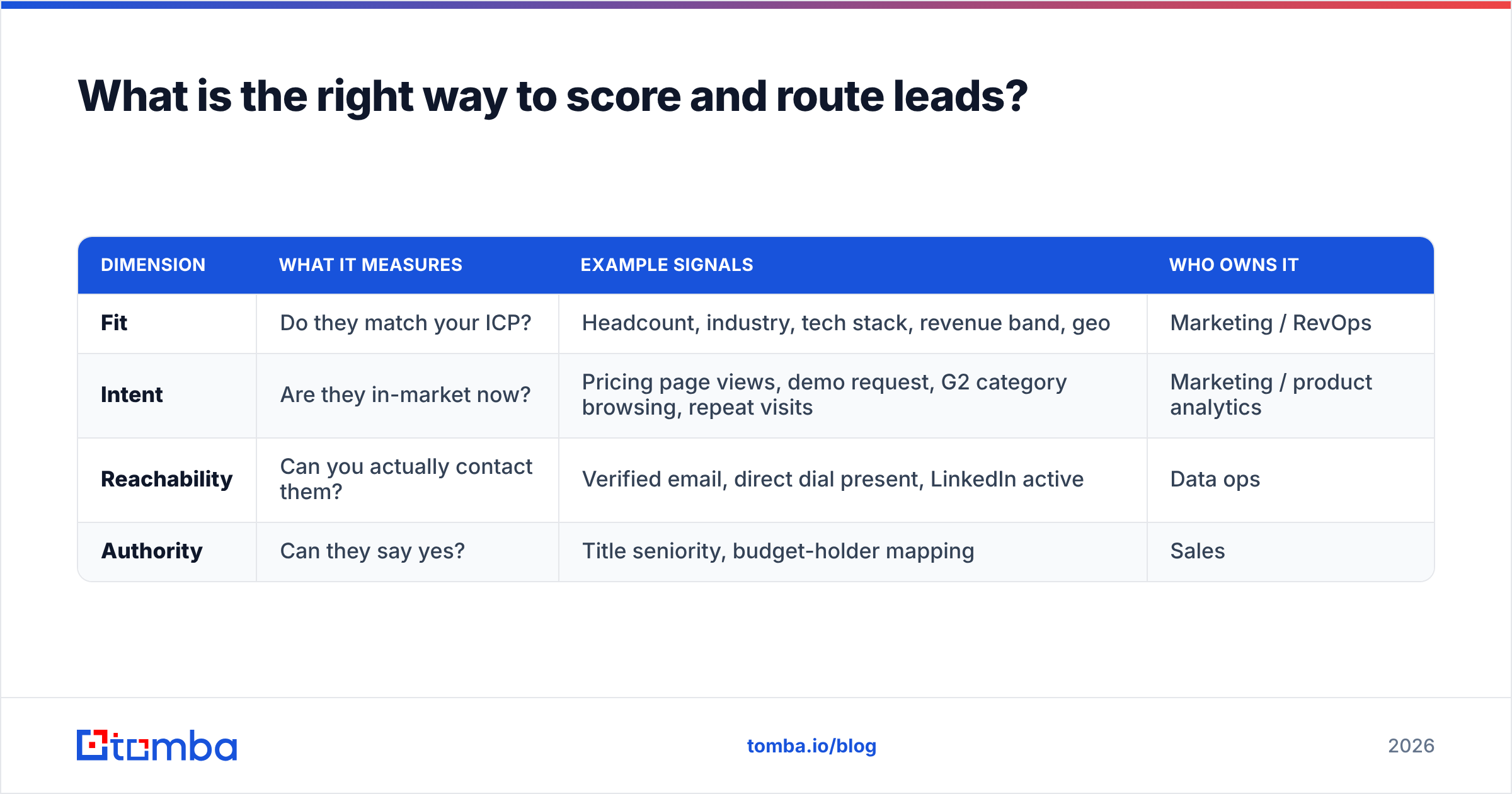
What is the right way to score and route leads?#
Score on two axes, never one. A single composite number hides the difference between "great fit, no interest" and "poor fit, very interested" — and those two leads need completely different treatment.
| Dimension | What it measures | Example signals | Who owns it |
|---|---|---|---|
| Fit | Do they match your ICP? | Headcount, industry, tech stack, revenue band, geo | Marketing / RevOps |
| Intent | Are they in-market now? | Pricing page views, demo request, G2 category browsing, repeat visits | Marketing / product analytics |
| Reachability | Can you actually contact them? | Verified email, direct dial present, LinkedIn active | Data ops |
| Authority | Can they say yes? | Title seniority, budget-holder mapping | Sales |
Then attach an action to every quadrant:
- High fit + high intent → call within 5 minutes, no sequence, human first touch.
- High fit + low intent → nurture with account-level content, sales checks in quarterly.
- Low fit + high intent → self-serve path or PLG motion; do not burn AE time.
- Low fit + low intent → suppress. Politely. Forever.
The reachability column is the one most models omit, and it is the reason "hot leads" sometimes never get worked. A 95-point lead with no valid contact method is a 0-point lead in practice.
How do the main conversion levers compare on effort vs. impact?#
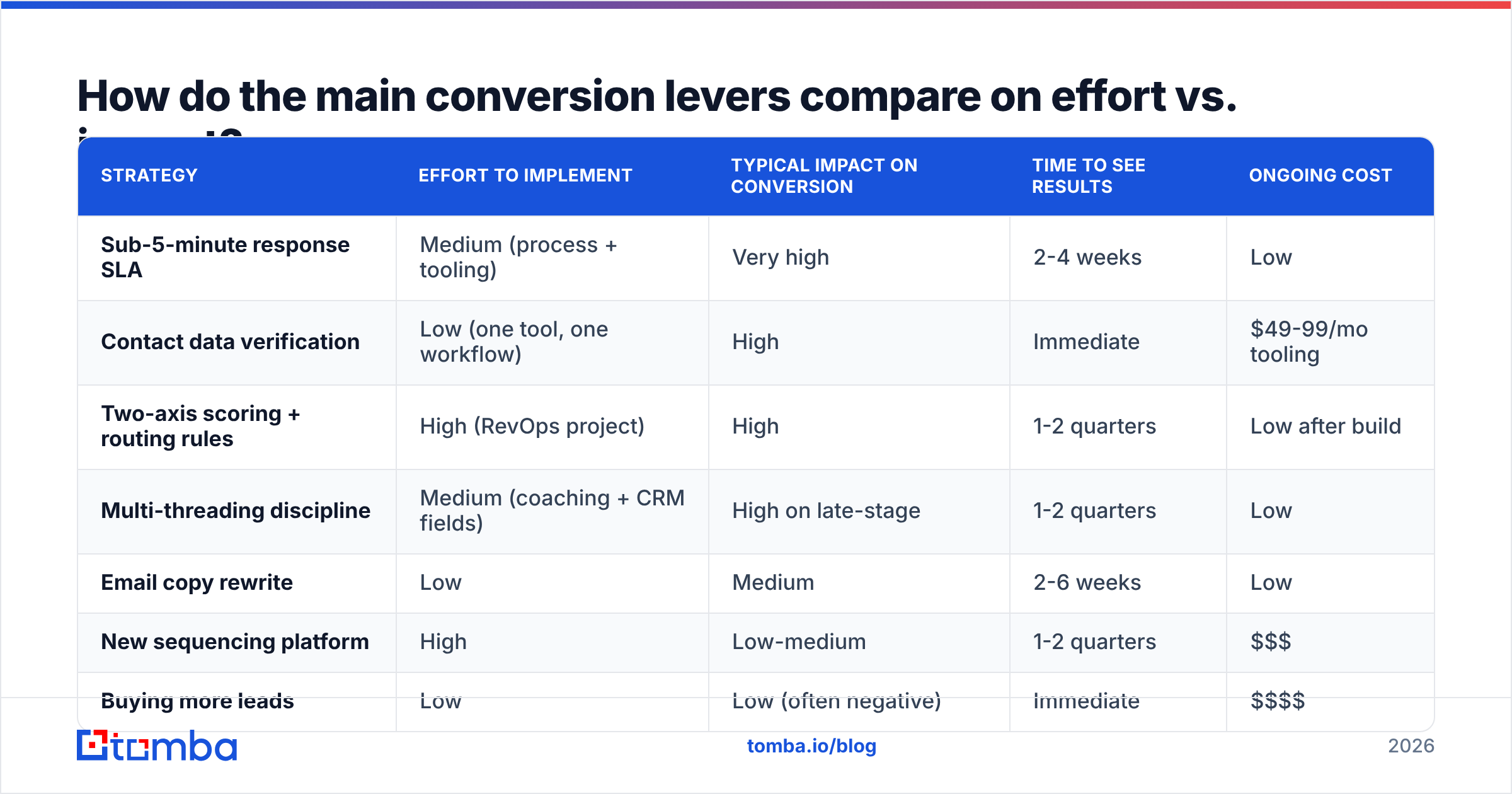
Not all strategies deserve equal investment. Here is an honest ranking for a team of 5-20 reps:
| Strategy | Effort to implement | Typical impact on conversion | Time to see results | Ongoing cost |
|---|---|---|---|---|
| Sub-5-minute response SLA | Medium (process + tooling) | Very high | 2-4 weeks | Low |
| Contact data verification | Low (one tool, one workflow) | High | Immediate | $49-99/mo tooling |
| Two-axis scoring + routing rules | High (RevOps project) | High | 1-2 quarters | Low after build |
| Multi-threading discipline | Medium (coaching + CRM fields) | High on late-stage | 1-2 quarters | Low |
| Email copy rewrite | Low | Medium | 2-6 weeks | Low |
| New sequencing platform | High | Low-medium | 1-2 quarters | $$$ |
| Buying more leads | Low | Low (often negative) | Immediate | $$$$ |
The bottom row is where most budget goes and where the least conversion lift comes from. If your current list converts at 1%, a bigger list converts at 1% — you have just bought more of the same problem.
How do you build a first-touch that actually converts?#
Relevance beats personalization theater. A first line about the prospect's recent LinkedIn post is personalization; a first line about a problem their role owns is relevance. The second one converts better because it survives being read in 4 seconds on a phone.
The structure that holds up:
- Line 1 — the trigger. Why you, why them, why now. A hiring signal, a funding round, a tech-stack change, a competitor switch. Not "I came across your profile."
- Line 2 — the specific problem. Named in their language, not your feature language. "Your SDRs are probably rebuilding lists manually every Monday" beats "we offer data enrichment solutions."
- Line 3 — the proof. One number from a comparable company. No case-study PDFs in a first touch.
- Line 4 — the low-friction ask. "Worth a look?" converts better than a calendar link in email one. You are asking for a reply, not a commitment.
Keep it under 90 words. Then follow up — most replies come on touches 3 through 6, not touch 1. If you are measuring response rate on a single-touch basis, your numbers look worse than reality and you will kill campaigns that were working.
Why does multi-threading fix late-stage conversion?#
Because B2B purchases involve committees, and single-threaded deals die when your one champion leaves, gets reorganized, or loses internal support. Gartner's B2B buying research puts the typical buying group at six to ten stakeholders for a complex purchase.
Practical multi-threading rules:
- Three contacts minimum before a deal moves past discovery. Champion, economic buyer, and one skeptic-adjacent function (usually security, finance, or IT).
- Map roles, not just names. A CRM field for "who can kill this deal" is more useful than ten contacts with no role context.
- Find the rest of the committee proactively. A domain search on the account surfaces the other people in the relevant department before your champion goes quiet, not after.
- Give each thread a different reason to talk to you. Security gets the compliance doc, finance gets the cost model, the end user gets the workflow demo. Same deal, three conversations.
Teams that enforce a 3-contact minimum consistently report fewer surprise losses in the final third of the cycle. It is not magic — you simply stop being blindsided.
What should you measure?#
Stage-to-stage conversion, not just the headline rate. A single "lead-to-customer" percentage tells you that something is broken but never where.
Track these six:
- Lead-to-first-touch time (median, not average — averages hide the disasters)
- Contactability rate — percentage of records with a verified email or phone. If this is under 85%, fix it before anything else.
- First-touch-to-reply rate — measures message and targeting quality
- Reply-to-meeting rate — measures qualification and objection handling
- Meeting-to-opportunity rate — measures whether you are booking the right meetings
- Contacts per closed-won account — your multi-threading health metric
When one number drops, you know which team owns the fix. That specificity is the whole point. And if you want to sanity-check where your data sits against alternatives, vendors like BookYourData and other reputable B2B data providers publish their accuracy methodology — worth reading before you assume your bounce rate is normal.
A 30-day implementation order#
If you can only do one thing at a time, do them in this order:
Week 1 — Measure. Pull median lead-to-first-touch time and contactability rate. These two numbers usually explain most of the gap on their own.
Week 2 — Clean. Run your active lists through verification. Suppress hard bounces and role addresses. Re-verify anything older than 90 days.
Week 3 — Route. Build the fallback timer and the instant notification. Make the SLA visible on a dashboard reps actually see.
Week 4 — Thread. Add the "contacts per open opportunity" field and make 3+ a stage-gate requirement for anything past discovery.
Everything else — copy testing, new sequencers, AI SDRs — comes after. Those are amplifiers, and amplifying a leaky funnel just makes the leak louder.
Ready to fix the data layer first?#
Conversion strategy work falls apart when the contact record is wrong. Before you rebuild scoring models or rewrite sequences, make sure the people in your CRM are reachable and real.
The Tomba Email Finder finds verified professional email addresses by name, domain, or company, and pairs with verification so you know a record is good before a rep spends time on it. The free tier gives you 25 searches a month to test against your own list; paid plans start at $49/mo, with Growth at $99/mo for teams running higher volume — full Tomba pricing is public. Run 100 of your existing leads through it and compare the bounce rate against your last campaign. If the gap is meaningful, you just found your conversion problem.
Related guides#
// get started
Find, verify and enrich your first contacts today
Start on the free plan with 25 searches a month, then scale when your team is ready.
Free plan · No credit card required · GDPR & CCPA
Get the Tomba newsletter
Product and data updates
// about the author