Lead Data Collection in 2026: Methods, Costs, and Compliance
Most B2B teams collect lead data the expensive way: buy a list, blast it, watch 30% bounce. Here is how the five main collection methods actually compare on accuracy, cost, and legal risk in 2026.
TL;DR
- Lead data collection is the repeatable process of sourcing, structuring, verifying, and refreshing contact and company records — not a one-time list purchase.
- B2B contact data decays roughly 2-3% per month, so a list bought in January is materially wrong by June. Verification cadence matters more than initial list size.
- The five realistic methods — first-party capture, API enrichment, database/list purchase, manual research, and scraping — differ wildly on cost per usable record, not cost per record.
- Compliance is now a sourcing decision, not a legal-review afterthought. Under GDPR you need a lawful basis before the record enters your CRM.
- Budget for verification separately. A $0.02 record that bounces costs you far more than a $0.08 record that lands.
What is lead data collection?#
Lead data collection is the process of gathering, structuring, and maintaining the contact and firmographic information you need to reach a buyer — and keeping it accurate long enough to be useful.
Think of it like stocking a restaurant kitchen. Anyone can buy 500 pounds of produce cheaply. The skill is buying what you'll actually cook this week, checking it on arrival, and rotating it before it rots. Most B2B teams buy the 500 pounds, let it sit in the CRM for eight months, then blame the chef when the dish tastes wrong.
A usable lead record has five layers, and each one is collected differently:
- Identity — full name, job title, seniority. Usually sourced from professional profiles or company pages. Decays fastest because people change roles.
- Contact channel — work email, direct dial, LinkedIn URL. This is the layer that determines whether outreach happens at all. Requires active verification, not just sourcing.
- Firmographics — company name, domain, headcount, industry, revenue band, HQ location. Relatively stable; refresh quarterly.
- Technographics and signals — CRM in use, hiring activity, funding rounds, website visits. Perishable within weeks, which is exactly why it's valuable for timing.
- Provenance — where the record came from, when, and under what lawful basis. Skipped by most teams, and the reason audits go badly.
If you only collect layers 1 and 2, you have a mailing list. Layers 3-5 are what turn it into a targeting system.
Where does lead data actually come from?#
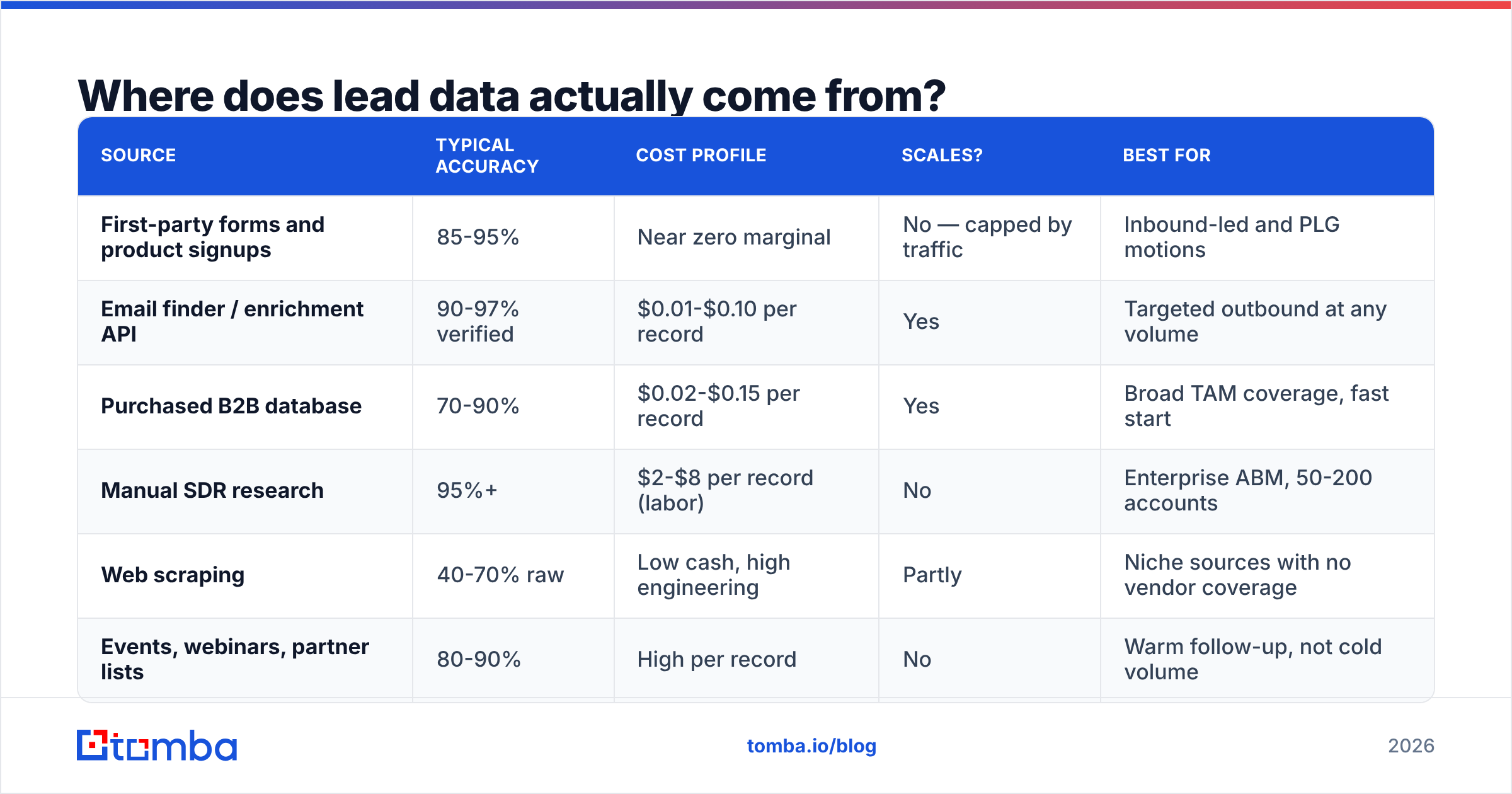
Every lead record you own traces back to one of six origins. They are not interchangeable, and mixing them without tracking provenance is how teams end up unable to answer a basic deletion request.
| Source | Typical accuracy | Cost profile | Scales? | Best for |
|---|---|---|---|---|
| First-party forms and product signups | 85-95% | Near zero marginal | No — capped by traffic | Inbound-led and PLG motions |
| Email finder / enrichment API | 90-97% verified | $0.01-$0.10 per record | Yes | Targeted outbound at any volume |
| Purchased B2B database | 70-90% | $0.02-$0.15 per record | Yes | Broad TAM coverage, fast start |
| Manual SDR research | 95%+ | $2-$8 per record (labor) | No | Enterprise ABM, 50-200 accounts |
| Web scraping | 40-70% raw | Low cash, high engineering | Partly | Niche sources with no vendor coverage |
| Events, webinars, partner lists | 80-90% | High per record | No | Warm follow-up, not cold volume |
The pattern worth noticing: accuracy and scale rarely come from the same source. Teams that perform well use two or three sources deliberately — a database for coverage, an API for verification and gap-filling, manual research for the top 100 accounts — rather than betting everything on one vendor.

Which lead data collection method fits your motion?#
Pick the method that matches your deal size and target count, not the one with the lowest sticker price.
If you sell a $200/month product to 50,000 possible companies, you need breadth and automation. A B2B database plus programmatic verification is the only economically sane path. Manual research would cost more than the customer is worth.
If you sell a $150,000 platform to 300 accounts, invert it. Manual research plus targeted enrichment wins, because a single correct direct dial for a VP of Engineering is worth more than 10,000 generic records.
If you're inbound-led, your highest-quality collection is already happening — you're just not enriching it. A form that asks for email and nothing else, paired with data enrichment on submission, gets you full firmographics without adding a single form field. Shorter forms convert better; HubSpot's long-running form-length research has shown conversion dropping measurably as required fields increase. Collect less, enrich more.
If you're targeting a niche with poor vendor coverage — regional manufacturers, specific trade associations, non-English markets — scraping plus pattern-based email discovery may be your only option. Budget engineering time, and expect to verify every single record before sending.
How accurate is lead data — and how would you know?#
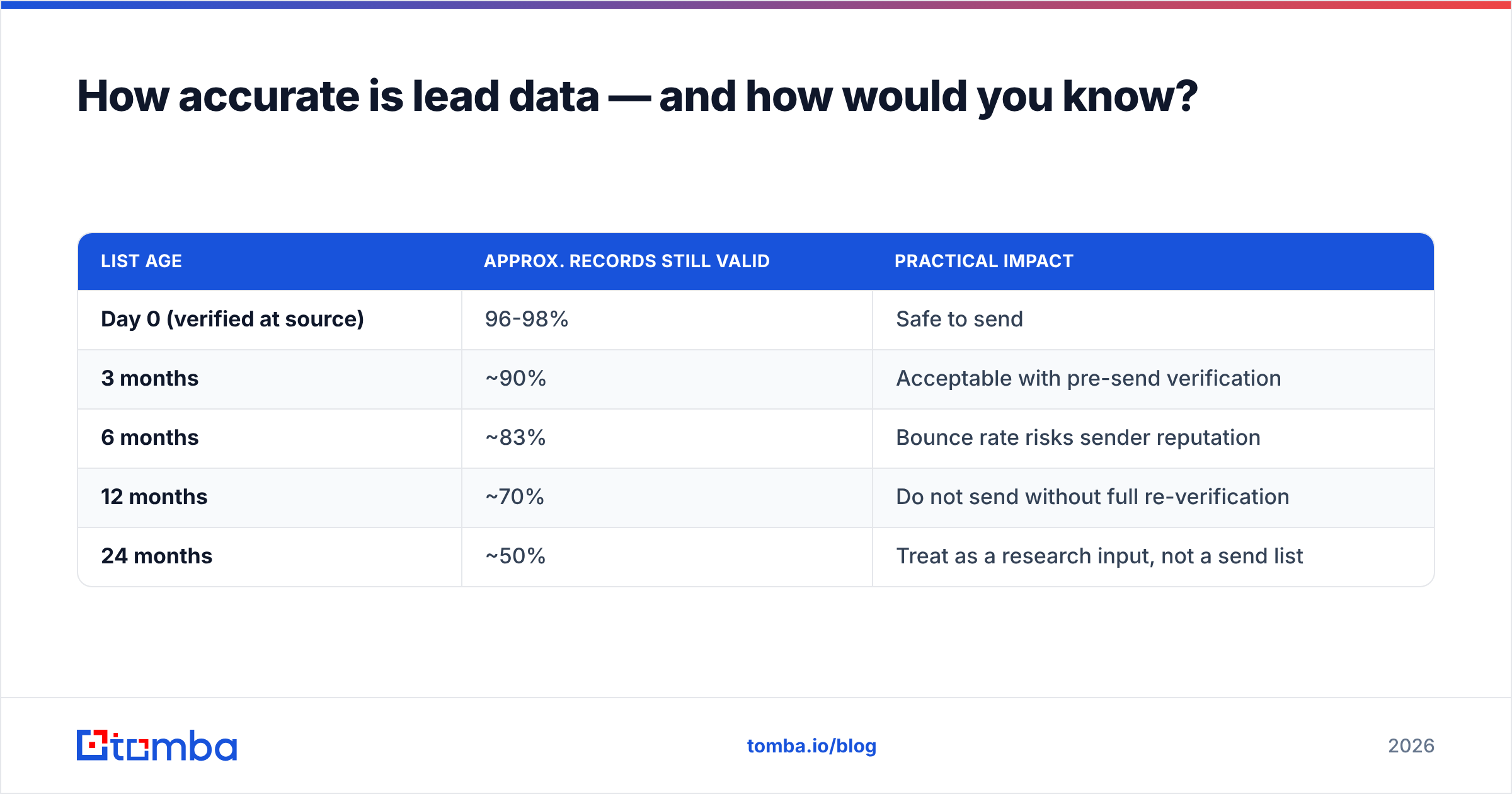
Assume every list is wrong until proven otherwise, because the decay math is brutal.
Work email addresses go stale at roughly 2-3% per month in normal conditions, driven by job changes, domain migrations, and offboarding. That compounds:
| List age | Approx. records still valid | Practical impact |
|---|---|---|
| Day 0 (verified at source) | 96-98% | Safe to send |
| 3 months | ~90% | Acceptable with pre-send verification |
| 6 months | ~83% | Bounce rate risks sender reputation |
| 12 months | ~70% | Do not send without full re-verification |
| 24 months | ~50% | Treat as a research input, not a send list |
Two checks tell you whether your collection process is healthy:
- Bounce rate on first send. Above 3% and your collection or verification step is failing. Mailbox providers read that number as a spam signal, and your sender reputation absorbs the damage across every campaign, not just the bad one.
- Match rate on enrichment. If you push 1,000 name+domain pairs into an enrichment API and get 400 back, either your input data is wrong or your vendor's coverage doesn't match your market. Test with 100 records from your actual ICP before signing an annual contract.
Run a pre-send pass with an email verifier regardless of where the record came from. Vendors verify at collection time; you're sending weeks later. Those are different moments.
Catch-all domains deserve special handling. A catch-all server accepts mail for any address, so standard SMTP verification returns "unknown" rather than valid or invalid. Roughly a fifth of business domains are configured this way. Either use a catch-all verifier that applies additional signals, or segment those addresses into a lower-volume sending pool so they don't contaminate your main domain's metrics.
What does lead data collection cost in 2026?#
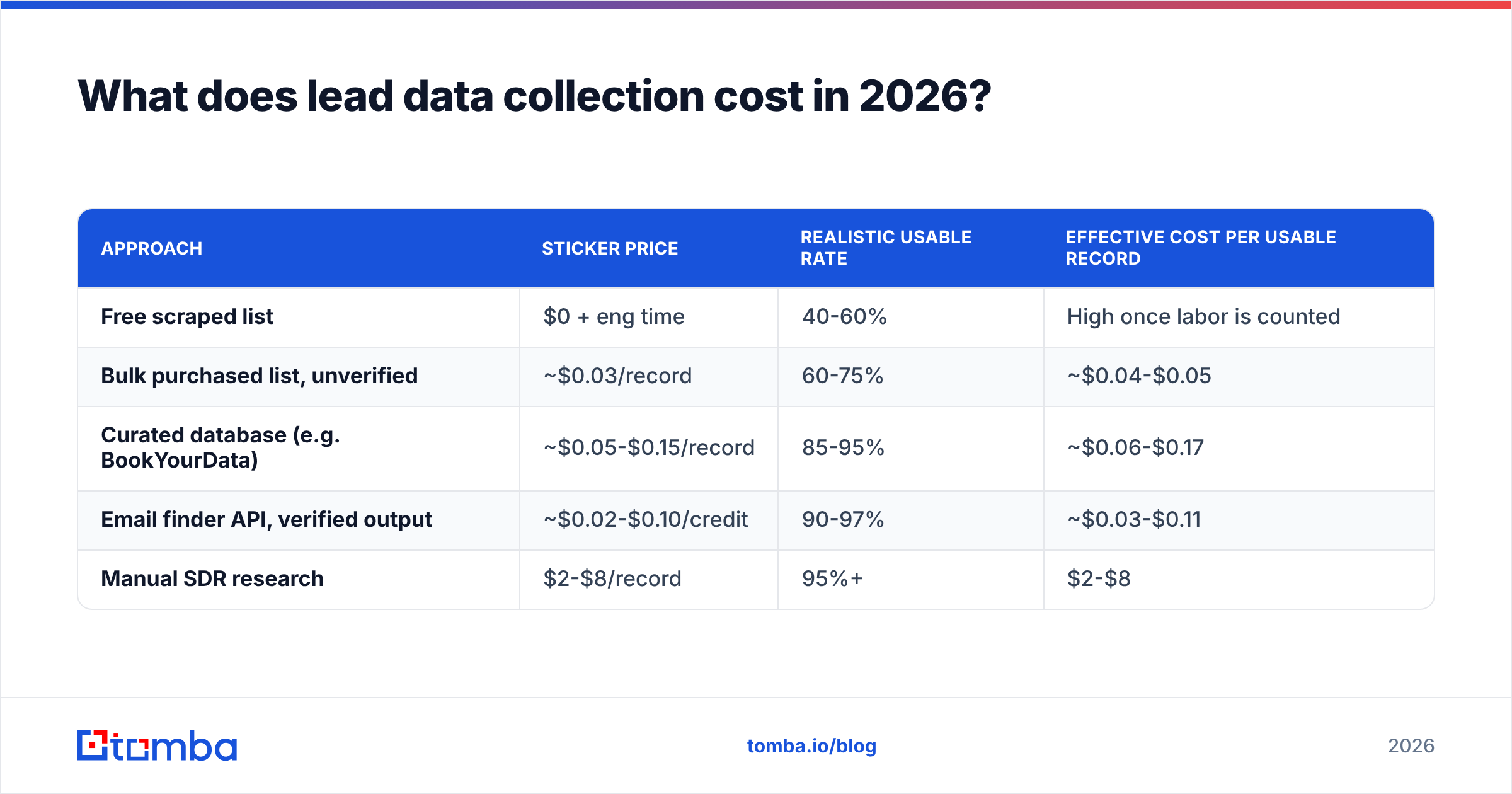
Stop comparing cost per record. Compare cost per usable record — the price divided by the share that is accurate, reachable, and in-ICP.
| Approach | Sticker price | Realistic usable rate | Effective cost per usable record |
|---|---|---|---|
| Free scraped list | $0 + eng time | 40-60% | High once labor is counted |
| Bulk purchased list, unverified | ~$0.03/record | 60-75% | ~$0.04-$0.05 |
| Curated database (e.g. BookYourData) | ~$0.05-$0.15/record | 85-95% | ~$0.06-$0.17 |
| Email finder API, verified output | ~$0.02-$0.10/credit | 90-97% | ~$0.03-$0.11 |
| Manual SDR research | $2-$8/record | 95%+ | $2-$8 |
For reference on the API side, Tomba pricing starts with a free tier at 25 searches per month, then Starter at $49/mo, Growth at $99/mo, Pro at $249/mo, and custom Enterprise. That structure suits teams that want to pay for the records they actually pursue rather than pre-buying a million-row dump. BookYourData, by contrast, is a solid fit when you want a curated, pay-as-you-go list with broad coverage delivered up front — different shape, different job. Neither replaces verification.
One line item teams consistently forget: the cost of a bad send. A campaign that bounces at 8% can put your sending domain into a remediation cycle that takes weeks of warmup to exit. Measured against that, verification credits are the cheapest insurance in the stack.
Is your lead data collection legal?#
Short answer: it depends entirely on where your prospect sits, and "I bought it from a vendor" is not a defense.
Under the GDPR, a work email tied to a named person is personal data. You need a lawful basis before processing — for B2B cold outreach in most EU jurisdictions that's legitimate interest, which requires a documented balancing test, a clear opt-out, and disclosure of where you got the data within 30 days of first contact. CAN-SPAM in the US is looser: no prior consent needed, but you must include a real physical address, an honest subject line, and a working unsubscribe honored within 10 business days. CASL in Canada is the strictest of the three and generally demands consent or a documented existing business relationship.
Three practices that keep you defensible:
- Record provenance per row. Source name, collection date, and lawful basis, stored as CRM fields. If you can't produce this for a given contact, you can't respond to a deletion request properly.
- Prefer role-relevant business contacts over personal addresses. A contact at their employer's domain in a job-relevant context sits far more comfortably inside legitimate interest than a personal Gmail scraped from a forum.
- Honor suppression globally, not per-campaign. One unsubscribe should propagate across every sequence and every tool. Most compliance failures are plumbing failures.
Ask any vendor for their sourcing documentation before you buy. Tomba publishes where the data comes from; any serious provider should do the same. If the answer is vague, assume the risk transfers to you, because in practice it does.
What does a working lead data collection workflow look like?#
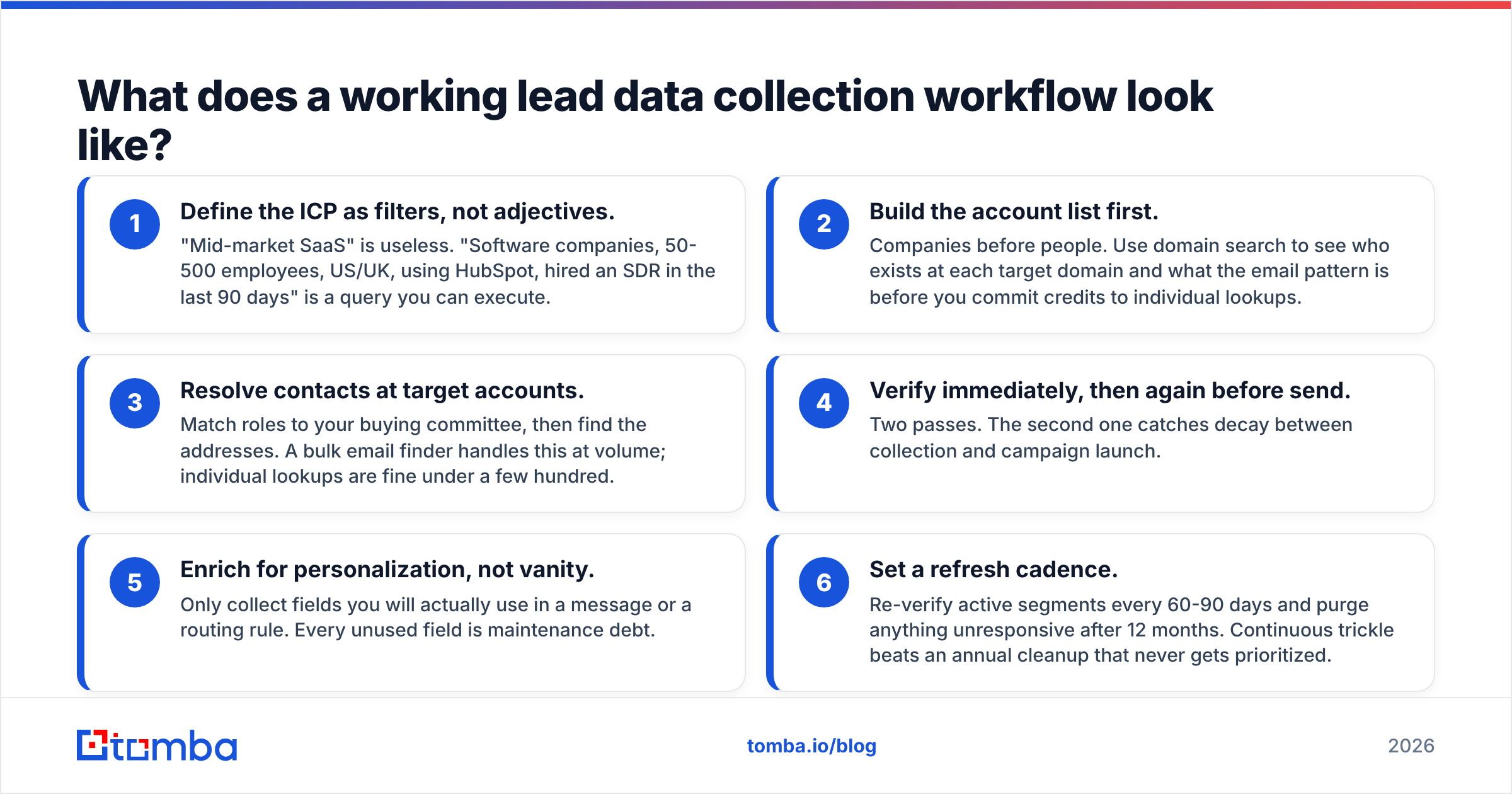
Six steps, run continuously rather than as a quarterly project:
- Define the ICP as filters, not adjectives. "Mid-market SaaS" is useless. "Software companies, 50-500 employees, US/UK, using HubSpot, hired an SDR in the last 90 days" is a query you can execute.
- Build the account list first. Companies before people. Use domain search to see who exists at each target domain and what the email pattern is before you commit credits to individual lookups.
- Resolve contacts at target accounts. Match roles to your buying committee, then find the addresses. A bulk email finder handles this at volume; individual lookups are fine under a few hundred.
- Verify immediately, then again before send. Two passes. The second one catches decay between collection and campaign launch.
- Enrich for personalization, not vanity. Only collect fields you will actually use in a message or a routing rule. Every unused field is maintenance debt.
- Set a refresh cadence. Re-verify active segments every 60-90 days and purge anything unresponsive after 12 months. Continuous trickle beats an annual cleanup that never gets prioritized.
Analysts have been warning about this for years — Gartner's research on data quality costs consistently puts the annual cost of poor data in the millions for mid-size organizations. Most of that damage is preventable at the collection step.
What metrics tell you your collection process is working?#
Track four numbers monthly. If they're healthy, your collection process is healthy, regardless of which vendor logo is on the invoice.
- Bounce rate — target under 2%. This is your verification quality score.
- Enrichment match rate — target 85%+ against your real ICP. Below that, your vendor's coverage doesn't fit your market.
- ICP fit rate of collected records — sample 100 rows manually each month. Vendors' filters drift; yours shouldn't.
- Cost per meeting booked — the only number that reconciles data spend to revenue. If cost per record dropped but cost per meeting rose, you bought cheaper garbage.
Add response rate as a lagging indicator. Copy and targeting drive it more than data does, but a sudden drop with unchanged messaging usually means the data underneath went stale.
Where to start#
If you're rebuilding lead data collection from scratch, do it in this order: define the ICP as filters, source 200 accounts, resolve and verify contacts, send to 50, and measure bounce and reply before scaling. Two weeks of that will tell you more than any vendor comparison chart.
When you're ready to resolve actual contacts, the Tomba Email Finder is built for exactly that step — find professional email addresses by domain, name, or company, with verification built into the same call. Start on the free tier at 25 searches a month, run your 200-account test, and only scale spend once the bounce and reply numbers justify it.
Related guides#
// get started
Find, verify and enrich your first contacts today
Start on the free plan with 25 searches a month, then scale when your team is ready.
Free plan · No credit card required · GDPR & CCPA
// about the author