Lead Distribution in 2026: How to Route Leads Without Losing Deals
Most teams lose more revenue to slow, sloppy routing than to bad leads. Here is how the main lead distribution models compare, what breaks them, and how to pick one that survives your next headcount change.
TL;DR
- Lead distribution is the set of rules that decides which rep gets which lead, in what order, and how fast. It sits between lead scoring and the first touch, and it is where most pipeline quietly leaks.
- There are five models worth knowing: round robin, weighted round robin, territory-based, account-based, and skills/intent-based. Most teams need a hybrid of two, not a single pure model.
- Speed beats sophistication. A crude rule that assigns in 60 seconds outperforms a beautiful rule that assigns in four hours.
- Routing built on unverified contact data just distributes work evenly across dead ends. Clean the record before you route it.
- Measure four things: time-to-assignment, time-to-first-touch, distribution fairness, and conversion by rep. If you only track one, track time-to-first-touch.
What is lead distribution?#
Lead distribution is the process of assigning incoming leads to the right salesperson, automatically and consistently, based on rules you define in advance.
Think of it like a hospital triage desk. Patients arrive in random order with wildly different urgency. The triage nurse does not treat anyone — she decides who goes where, how fast, and to which specialist. Get triage right and the whole hospital runs. Get it wrong and someone with a broken arm waits behind a head cold while the trauma surgeon plays cards.
Technically, lead distribution (often called lead routing or lead assignment) is a rules engine that reads attributes on a lead record — company size, region, industry, source, score, product interest — and writes an owner value. Everything downstream depends on that write: the sequence that fires, the SLA clock that starts, the quota that gets credit.
It is distinct from two neighbours people confuse it with:
- Lead scoring decides how good a lead is. Distribution decides who works it. Scoring is an input to distribution, not a replacement for it.
- Lead nurturing decides what happens to leads nobody works yet. Distribution decides the handoff point where nurture ends and a human starts.
The reason this matters more in 2026 than it did five years ago: inbound volume is noisier. AI-generated form fills, competitor research traffic, and content-driven signups all land in the same queue as real buyers. Routing is now a filtering decision as much as a fairness decision.
Why does lead distribution decide your win rate?#
Because the first touch window is brutally short, and routing owns that window.
The widely cited research on lead response — repeated across vendor studies from HubSpot and Salesforce over the past decade — points in one direction: contact rates fall off a cliff after the first hour, and fall off again after the first day. A lead that sits unassigned for three hours has already lost most of its value regardless of how good your rep is.
So routing latency is not an ops detail. It is a revenue multiplier applied to every single lead you generate.
Three failure modes account for most of the damage:
- The unassigned queue. Leads that match no rule fall into a default bucket nobody owns. In most CRMs this bucket grows silently until someone audits it a quarter later.
- The vacation black hole. A rep is out, round robin keeps feeding them, and forty leads sit untouched for a week. Capacity-aware routing exists precisely for this.
- The re-route loop. A lead gets assigned, the rep disqualifies it, it goes back to the pool, gets reassigned, and by touch three nobody believes it is real. Each hop costs a day.
None of these are exotic. All of them are invisible unless you instrument time-to-assignment.

What are the main lead distribution models?#
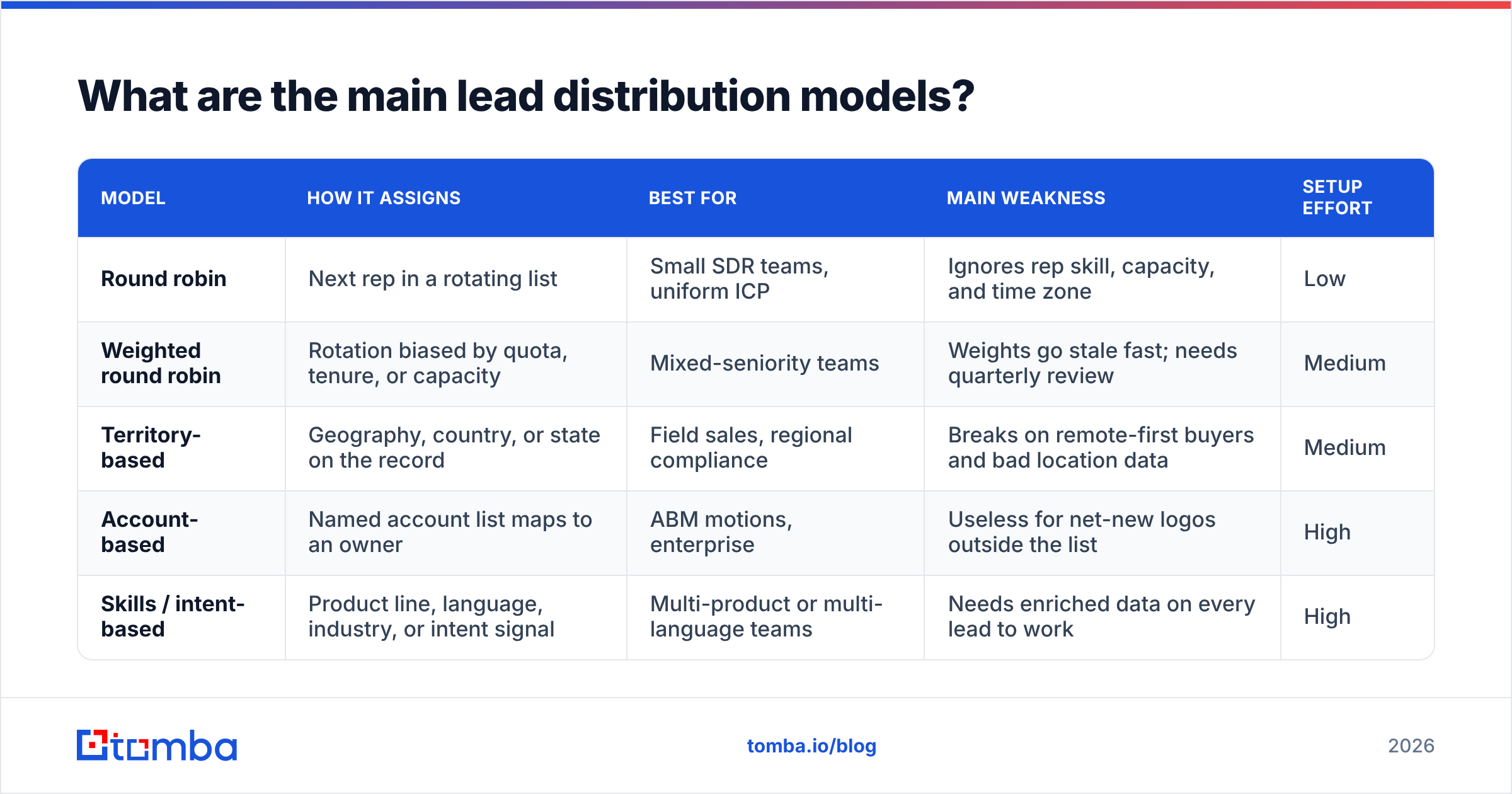
Five models cover nearly every real-world setup. Here is how they compare on the dimensions that actually change your quarter.
| Model | How it assigns | Best for | Main weakness | Setup effort |
|---|---|---|---|---|
| Round robin | Next rep in a rotating list | Small SDR teams, uniform ICP | Ignores rep skill, capacity, and time zone | Low |
| Weighted round robin | Rotation biased by quota, tenure, or capacity | Mixed-seniority teams | Weights go stale fast; needs quarterly review | Medium |
| Territory-based | Geography, country, or state on the record | Field sales, regional compliance | Breaks on remote-first buyers and bad location data | Medium |
| Account-based | Named account list maps to an owner | ABM motions, enterprise | Useless for net-new logos outside the list | High |
| Skills / intent-based | Product line, language, industry, or intent signal | Multi-product or multi-language teams | Needs enriched data on every lead to work | High |
A few notes on reading that table honestly.
Round robin is unfairly maligned. For a team of four SDRs selling one product into one region, it is correct. Adding weighting logic there buys you nothing except a config file to maintain.
Territory-based routing is the one most likely to be quietly broken. It depends on a location field, and location fields are the least reliable data on a B2B lead record. A VP who fills a form from a conference in Lisbon is not a Portuguese lead. Route on company HQ, not on visitor IP.
Skills-based routing is the highest ceiling and the highest floor. It only works if every lead arrives with industry, company size, and technology attributes already populated — which means data enrichment has to run before the routing rule evaluates, not after.
Which model should your team actually use?#
Pick by team shape, not by ambition. Here is the decision path most RevOps leads end up at:
- Under 5 reps, one product, one region — Use plain round robin with a capacity cap. Anything more is premature optimisation. Spend the saved time on speed instead.
- 5–20 reps, one product, multiple regions — Territory first, round robin inside each territory. Two layers, no more. Define territories by company HQ country and nothing else.
- Multi-product or multi-language — Skills-based on product interest or language, round robin as the tiebreaker. Make the routing attribute a required field on the form so the rule never falls through.
- ABM or enterprise-led — Account-based as the primary rule, with a named-account table owned by marketing and reviewed monthly. Everything not on the list falls to a territory rule.
- PLG with high signup volume — Score first, route only above a threshold, and let everything else nurture. Routing every free signup to a human is how you burn an SDR team out in a quarter.
- Hybrid inbound plus outbound — Keep the two pools physically separate. Inbound routing optimises for speed; outbound assignment optimises for account ownership. Mixing them creates attribution fights that outlast the leads.
One rule cuts across all six: every routing configuration needs a catch-all. If a lead matches nothing, it goes to a named human — not a queue, a human — who reviews the fallout weekly. That single safeguard surfaces more broken rules than any dashboard.
How do you build routing rules that survive contact with reality?#
Write the rules in this order, and stop when the rules stop paying for themselves.
Start with the SLA, not the rule. Decide the target first: assignment within 60 seconds, first touch within 5 minutes for high-intent, 1 hour for everything else. The SLA constrains the rule design. If a rule needs a manual enrichment lookup, it cannot meet a 60-second SLA, so redesign it.
Normalise before you route. Company name variants, free email domains, and missing country fields break every rule downstream. Run normalisation and enrichment as a pre-routing step. A domain search or firmographic lookup that takes 400ms is cheap insurance against a rule that silently misfires.
Keep the rule tree shallow. Two levels of nesting is manageable. Four is a maintenance liability that only one person on your team understands, and that person will leave. Flatten aggressively.
Version the config. Every routing change should be dated and attributed. When conversion drops 12% in a region, the first question is always "what changed in routing," and the answer should take ninety seconds to find, not a day.
Handle the edge cases explicitly. Duplicates, existing customers, existing open opportunities, partner-sourced leads, and competitors. Each needs a defined path. Competitor domains especially — route them to nobody and flag them, or you will pay an SDR to demo your product to a competitor's PM.
Test with real records. Before shipping a rule change, run last month's actual lead set through it and diff the assignments. Synthetic test records never catch the messy cases.
What breaks lead distribution most often?#
Bad data. Not the rules engine, not the CRM, not the reps. Bad data.
A routing engine is deterministic. Feed it a record with a null country, a generic Gmail address, and a company name of "n/a" and it will do exactly what you told it to do with garbage, at speed, forever.
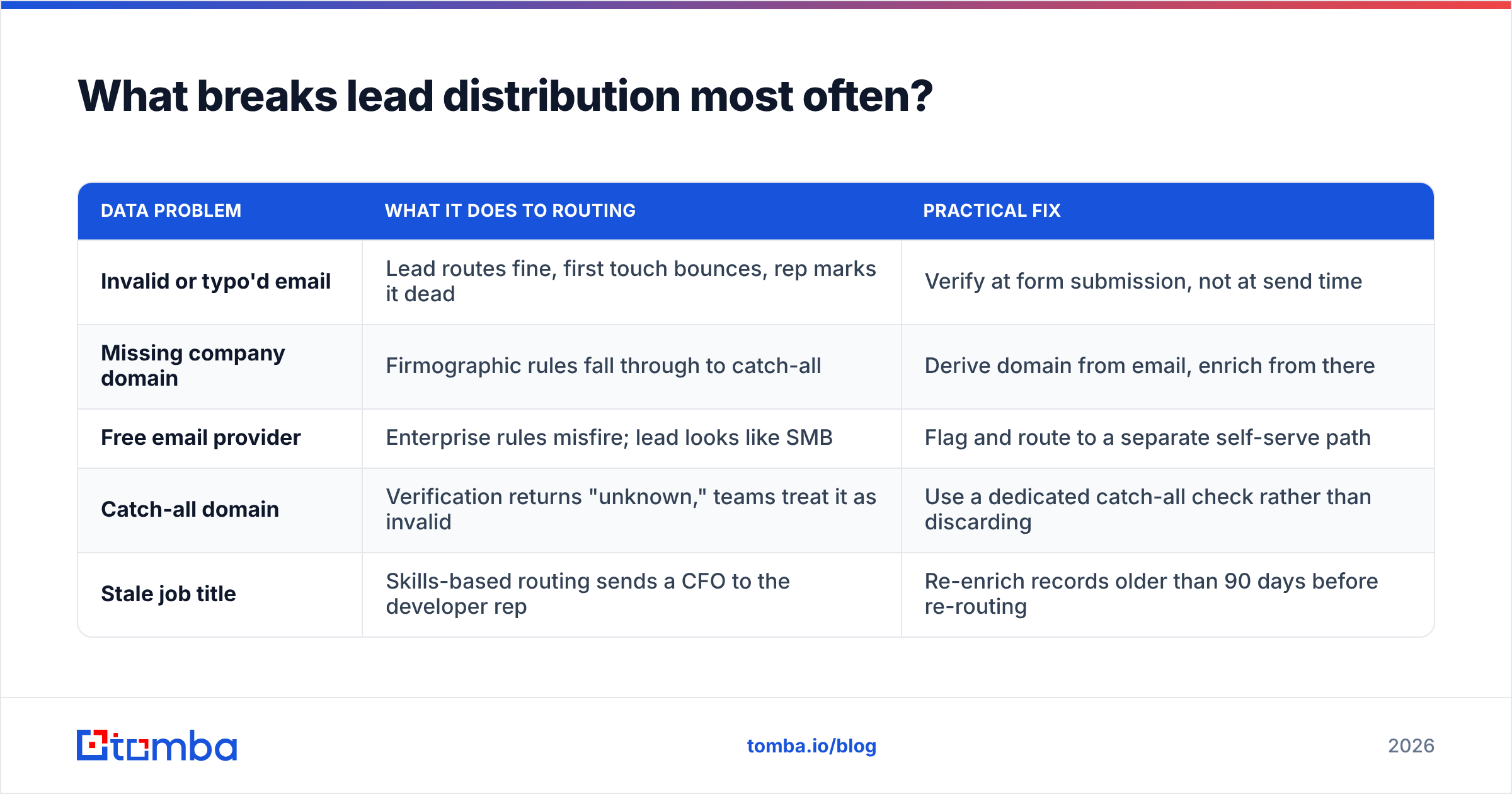
The specific failures worth auditing this quarter:
| Data problem | What it does to routing | Practical fix |
|---|---|---|
| Invalid or typo'd email | Lead routes fine, first touch bounces, rep marks it dead | Verify at form submission, not at send time |
| Missing company domain | Firmographic rules fall through to catch-all | Derive domain from email, enrich from there |
| Free email provider | Enterprise rules misfire; lead looks like SMB | Flag and route to a separate self-serve path |
| Catch-all domain | Verification returns "unknown," teams treat it as invalid | Use a dedicated catch-all check rather than discarding |
| Stale job title | Skills-based routing sends a CFO to the developer rep | Re-enrich records older than 90 days before re-routing |
Two of those deserve extra attention.
Email validity is the one that looks solved and is not. Routing a lead to a rep whose only channel is an address that bounces is an expensive no-op — the rep burns a slot, the SLA clock shows green, and nothing happens. Running an email verifier inline at form submit costs milliseconds and removes the entire failure class.
Catch-all domains are the sneakiest. A large share of enterprise domains accept everything at the SMTP layer, so standard verification returns "unknown." Teams that treat unknown as invalid throw away some of their best enterprise leads. A catch-all verifier gives you a confidence tier instead of a binary, which is what a routing rule actually needs.

Which tools handle lead distribution in 2026?#
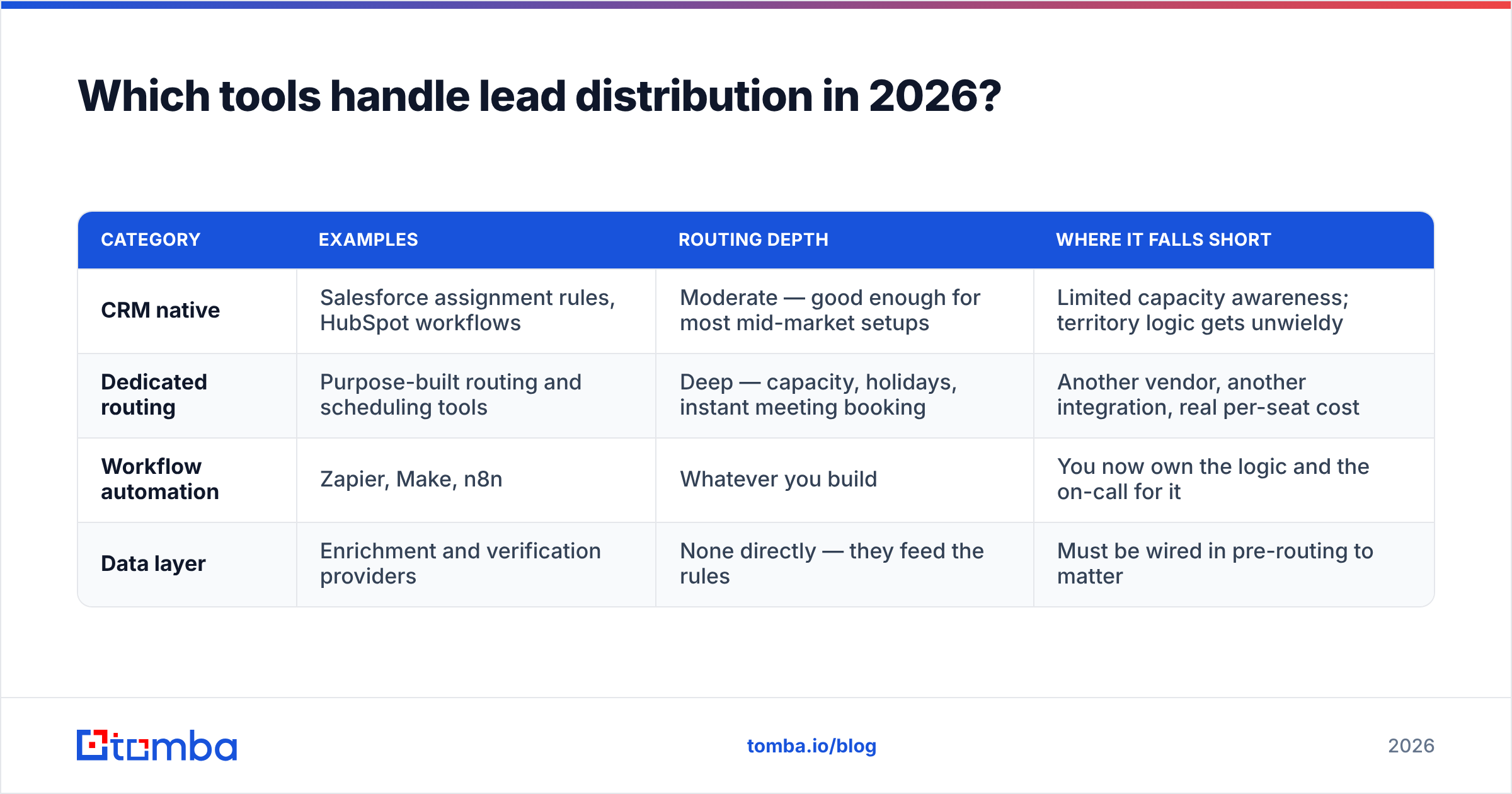
There is no single category here, which is why buying is confusing. Routing lives in four different kinds of product.
| Category | Examples | Routing depth | Where it falls short |
|---|---|---|---|
| CRM native | Salesforce assignment rules, HubSpot workflows | Moderate — good enough for most mid-market setups | Limited capacity awareness; territory logic gets unwieldy |
| Dedicated routing | Purpose-built routing and scheduling tools | Deep — capacity, holidays, instant meeting booking | Another vendor, another integration, real per-seat cost |
| Workflow automation | Zapier, Make, n8n | Whatever you build | You now own the logic and the on-call for it |
| Data layer | Enrichment and verification providers | None directly — they feed the rules | Must be wired in pre-routing to matter |
Most teams under 30 reps should stay in the CRM and invest the budget in the data layer instead. The reason is arithmetic: a deeper routing engine improves assignment quality by some margin on the leads you already have, while better data increases the number of leads that are routable at all. The second number is usually bigger.
For the data layer specifically, the useful split is between contact discovery, verification, and enrichment. Tools like Tomba cover the finding and verification side with a free tier at 25 searches a month and paid plans from $49/mo — see Tomba pricing for the full breakdown. On the purchased-list side, providers such as BookYourData are a reasonable option when you need a pre-built contact set to seed territories rather than waiting on inbound. Both approaches feed the same routing rules; the difference is whether you are discovering contacts on demand or buying them in bulk.
Whatever you pick, check the integration direction before you buy. A tool that enriches records after they land in the CRM is too late for a 60-second routing SLA. You want enrichment on the inbound path, ideally via API at form submit — the Tomba API and comparable endpoints exist for exactly this insertion point. Independent user reviews on G2 are worth a scan for integration complaints specifically, since that is where these setups usually fail.
How do you measure whether your lead distribution is working?#
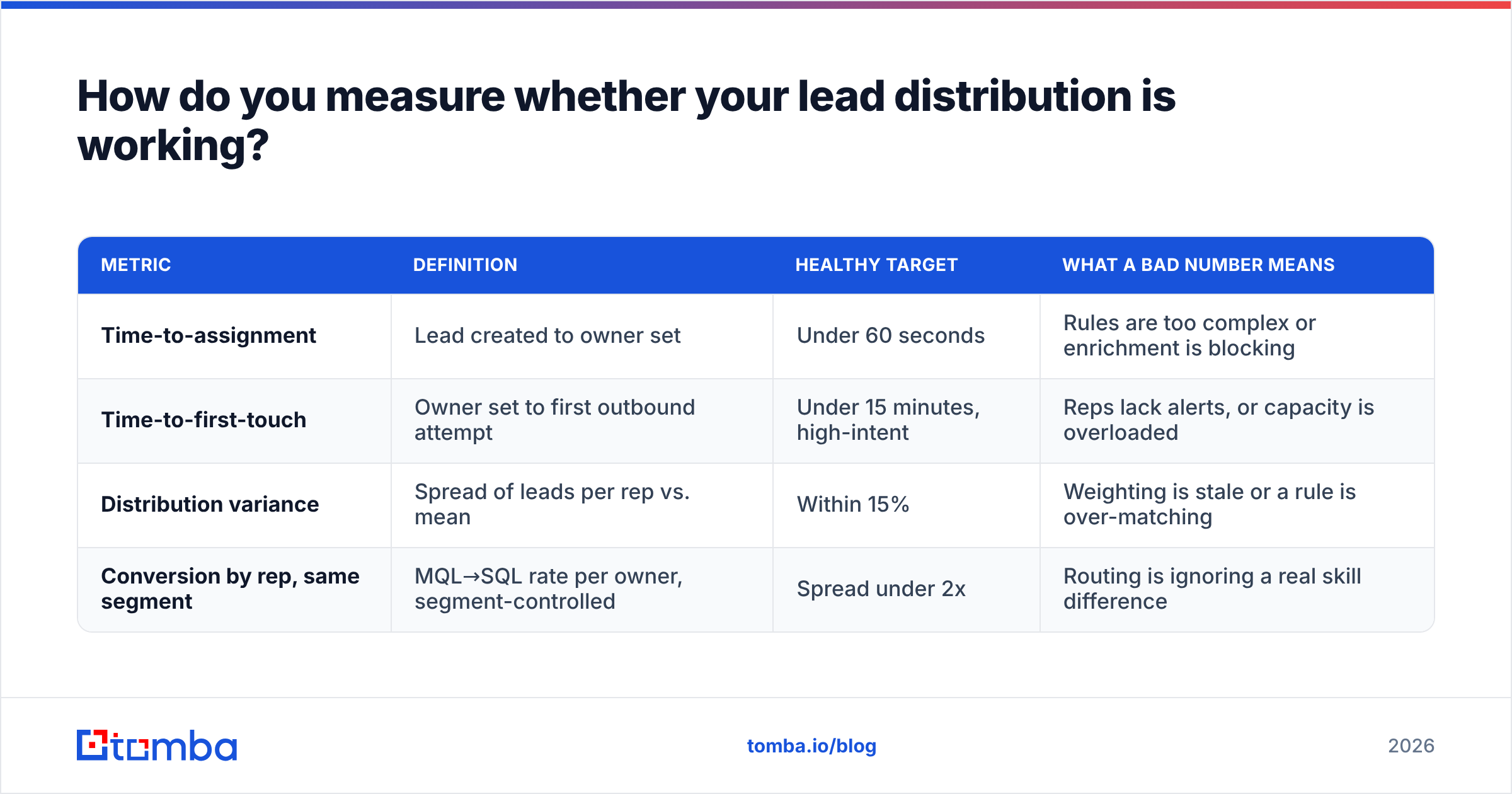
Four metrics, reviewed monthly. More than four and nobody looks at any of them.
| Metric | Definition | Healthy target | What a bad number means |
|---|---|---|---|
| Time-to-assignment | Lead created to owner set | Under 60 seconds | Rules are too complex or enrichment is blocking |
| Time-to-first-touch | Owner set to first outbound attempt | Under 15 minutes, high-intent | Reps lack alerts, or capacity is overloaded |
| Distribution variance | Spread of leads per rep vs. mean | Within 15% | Weighting is stale or a rule is over-matching |
| Conversion by rep, same segment | MQL→SQL rate per owner, segment-controlled | Spread under 2x | Routing is ignoring a real skill difference |
That last row is the interesting one. If two reps working the same segment convert at 8% and 22%, your routing is fair and your outcomes are not. That is a coaching signal, not a routing signal — but you only see it if your distribution is even enough to make the comparison valid. Fair routing is what makes rep performance measurable in the first place.
Also track your catch-all bucket volume as a health check. It should be under 3% of inbound. Above that, a rule is broken and you have not noticed.
What should you do first?#
Audit before you rebuild. Pull last month's leads, compute time-to-assignment and time-to-first-touch, and look at the unassigned bucket. Nine times out of ten the fix is not a new routing model — it is one broken rule, one rep on leave who never got removed from the rotation, and a pile of leads with invalid emails that were never routable to begin with.
Fix the data layer first, because clean records make every routing model work better and dirty records make every routing model equally useless.
If your routing is stalling on missing or unverifiable contact data, start there: the Tomba Email Finder finds and verifies professional addresses by domain, name, or company, and plugs into your inbound path via API before the routing rule ever runs. Free tier covers 25 searches a month so you can test it against a sample of last quarter's fallout bucket before committing to anything.
Related guides#
// get started
Find, verify and enrich your first contacts today
Start on the free plan with 25 searches a month, then scale when your team is ready.
Free plan · No credit card required · GDPR & CCPA
// about the author