Lead Distribution Platform: How Routing Works in 2026
Most teams lose more revenue to slow, sloppy lead routing than to bad leads. Here's how a lead distribution platform actually works, what the models cost, and when a spreadsheet beats software.
TL;DR
- A lead distribution platform is the layer between "a lead arrived" and "the right rep is talking to them" — it scores, assigns, notifies, and escalates automatically.
- Speed is the whole game: contacting a lead inside five minutes versus thirty minutes changes qualification odds by roughly an order of magnitude, and manual routing almost never hits five minutes.
- Four routing models cover 95% of real setups: round-robin, weighted, territory/account-based, and score-based. Most teams over-engineer this on day one.
- Pricing splits into three tiers — CRM-native rules (free-ish), dedicated routing tools ($30–$100/user/mo), and enterprise RevOps platforms ($20k+/yr).
- Routing quality is capped by data quality. If the inbound record has no verified email, no company size, and no phone, no routing engine can fix that.
What is a lead distribution platform?#
A lead distribution platform is software that decides, automatically, which person or team owns each incoming lead — and then hands it over fast enough to matter.
Think of it like a hospital triage desk. Patients arrive through the front door in random order with wildly different urgency. Without triage, the person with a sprained ankle gets seen before the person with chest pain, purely because they walked in first. Triage reads a few signals, sorts, and routes to the right specialist in under a minute. A lead distribution platform does exactly that for inbound demand.
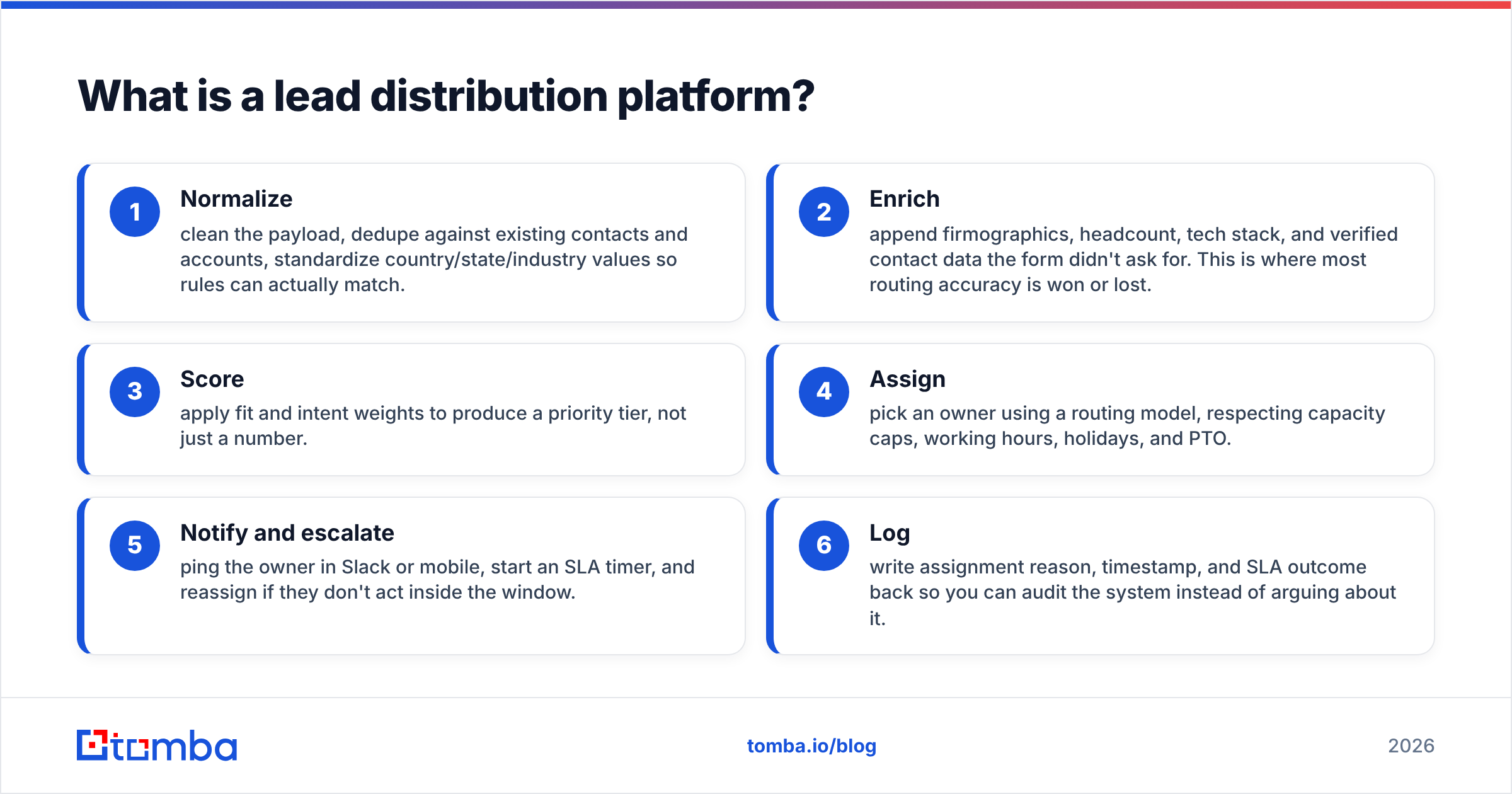
Technically, it sits between your capture surfaces (web forms, chat, demo requests, webinar lists, paid campaigns, partner feeds) and your system of record. On each new record it runs some combination of:
- Normalize — clean the payload, dedupe against existing contacts and accounts, standardize country/state/industry values so rules can actually match.
- Enrich — append firmographics, headcount, tech stack, and verified contact data the form didn't ask for. This is where most routing accuracy is won or lost.
- Score — apply fit and intent weights to produce a priority tier, not just a number.
- Assign — pick an owner using a routing model, respecting capacity caps, working hours, holidays, and PTO.
- Notify and escalate — ping the owner in Slack or mobile, start an SLA timer, and reassign if they don't act inside the window.
- Log — write assignment reason, timestamp, and SLA outcome back so you can audit the system instead of arguing about it.
Steps 1 and 2 are the ones teams skip, and they're the ones that break everything downstream. A rule that says "route companies over 500 employees to enterprise" is useless when 70% of your form fills have a blank headcount field. That's why data enrichment usually has to run before the routing logic, not after.

Why does lead routing speed matter so much?#
Because the response-time curve is brutally steep and nothing else in your funnel has that much leverage for that little engineering.
The widely cited Lead Response Management research — later validated in variations by HubSpot and others — found that the odds of qualifying a lead drop sharply after the first five minutes, and keep collapsing over the first hour. The exact multiplier varies by study and market; the direction never does. A lead that sat in a queue overnight is a materially different asset than the same lead contacted in four minutes.
Manual routing loses that race in predictable ways:
- The Monday morning pile. Weekend form fills wait until someone opens the shared inbox.
- The round-robin spreadsheet. Someone maintains a tab with rep names and a counter. It drifts within two weeks.
- The senior-rep tax. Your best closer gets the good leads manually, which means they get them late.
- Silent black holes. A lead is assigned to someone on PTO. Nobody notices for nine days.
An automated lead distribution platform removes all four failure modes with the same mechanism: a deterministic rule that fires in under a second and logs what it did.
What are the main lead routing models?#
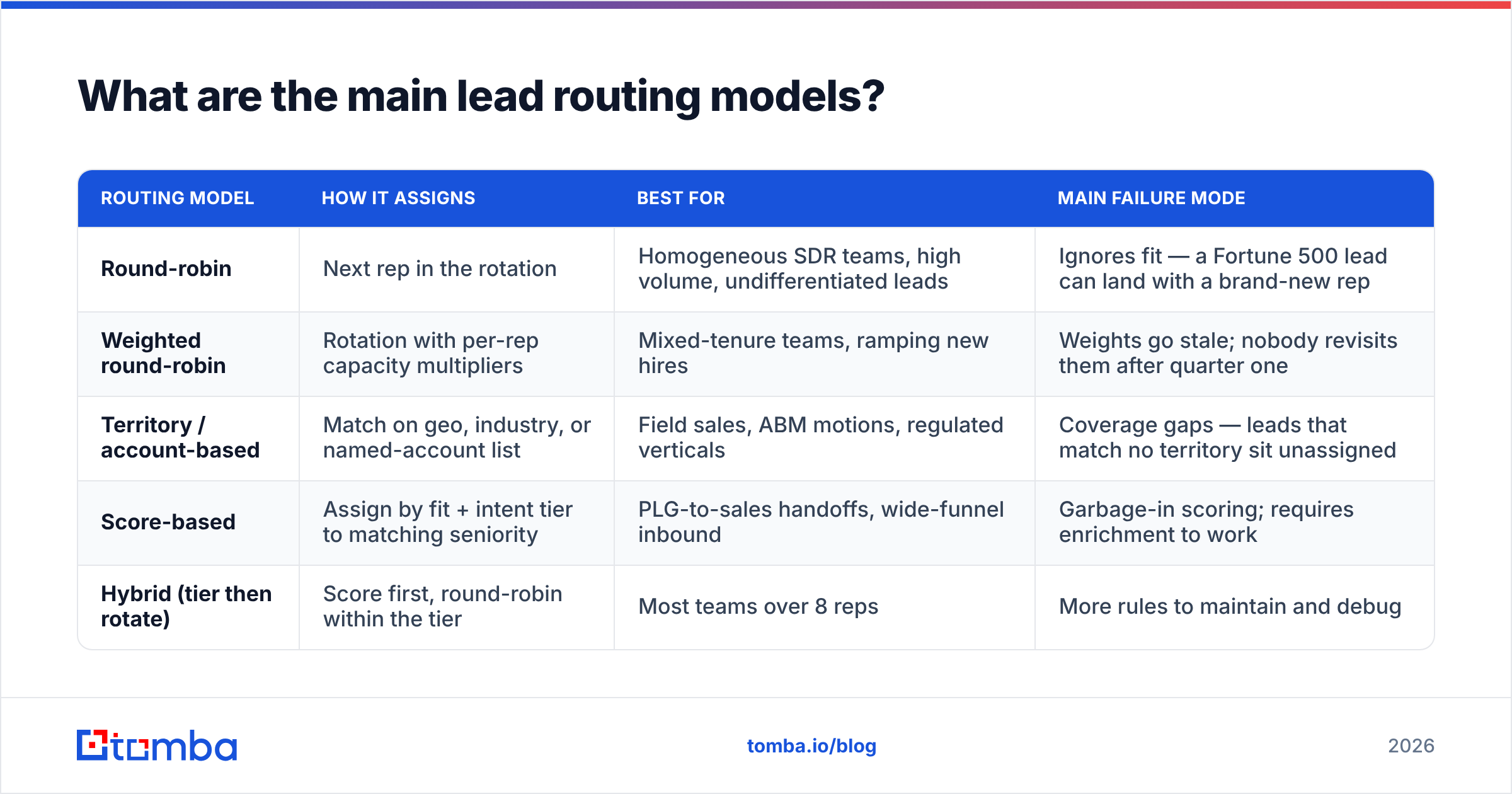
Four models cover almost every real deployment. You need one to start, maybe two at scale.
| Routing model | How it assigns | Best for | Main failure mode |
|---|---|---|---|
| Round-robin | Next rep in the rotation | Homogeneous SDR teams, high volume, undifferentiated leads | Ignores fit — a Fortune 500 lead can land with a brand-new rep |
| Weighted round-robin | Rotation with per-rep capacity multipliers | Mixed-tenure teams, ramping new hires | Weights go stale; nobody revisits them after quarter one |
| Territory / account-based | Match on geo, industry, or named-account list | Field sales, ABM motions, regulated verticals | Coverage gaps — leads that match no territory sit unassigned |
| Score-based | Assign by fit + intent tier to matching seniority | PLG-to-sales handoffs, wide-funnel inbound | Garbage-in scoring; requires enrichment to work |
| Hybrid (tier then rotate) | Score first, round-robin within the tier | Most teams over 8 reps | More rules to maintain and debug |
The honest recommendation: start with plain round-robin plus one override rule for named accounts. Add scoring only after you can prove your enrichment coverage is above roughly 80% on the fields the score depends on. Teams that launch with a 40-condition rule tree spend the next two quarters debugging it instead of selling.
What should a lead distribution platform actually do?#
Here's the functional checklist to evaluate against. Anything in the first four is table stakes; the rest separate real platforms from a CRM workflow with a nice name.
- Sub-minute assignment from form submit to owner notification, including the enrichment round trip.
- Capacity and availability awareness — daily caps, working hours by timezone, PTO calendars, and automatic holdout when a rep is over quota on open leads.
- SLA timers with escalation — an unworked lead reassigns automatically, and the miss is recorded against the original owner.
- Deduplication and account matching — new lead from an existing customer domain routes to the account owner, not the new-business queue.
- Full audit trail — every assignment records why it happened. Without this, routing disputes become vibes-based.
- Bidirectional CRM sync so the platform and CRM never disagree about ownership.
How do lead distribution platforms compare on price?#
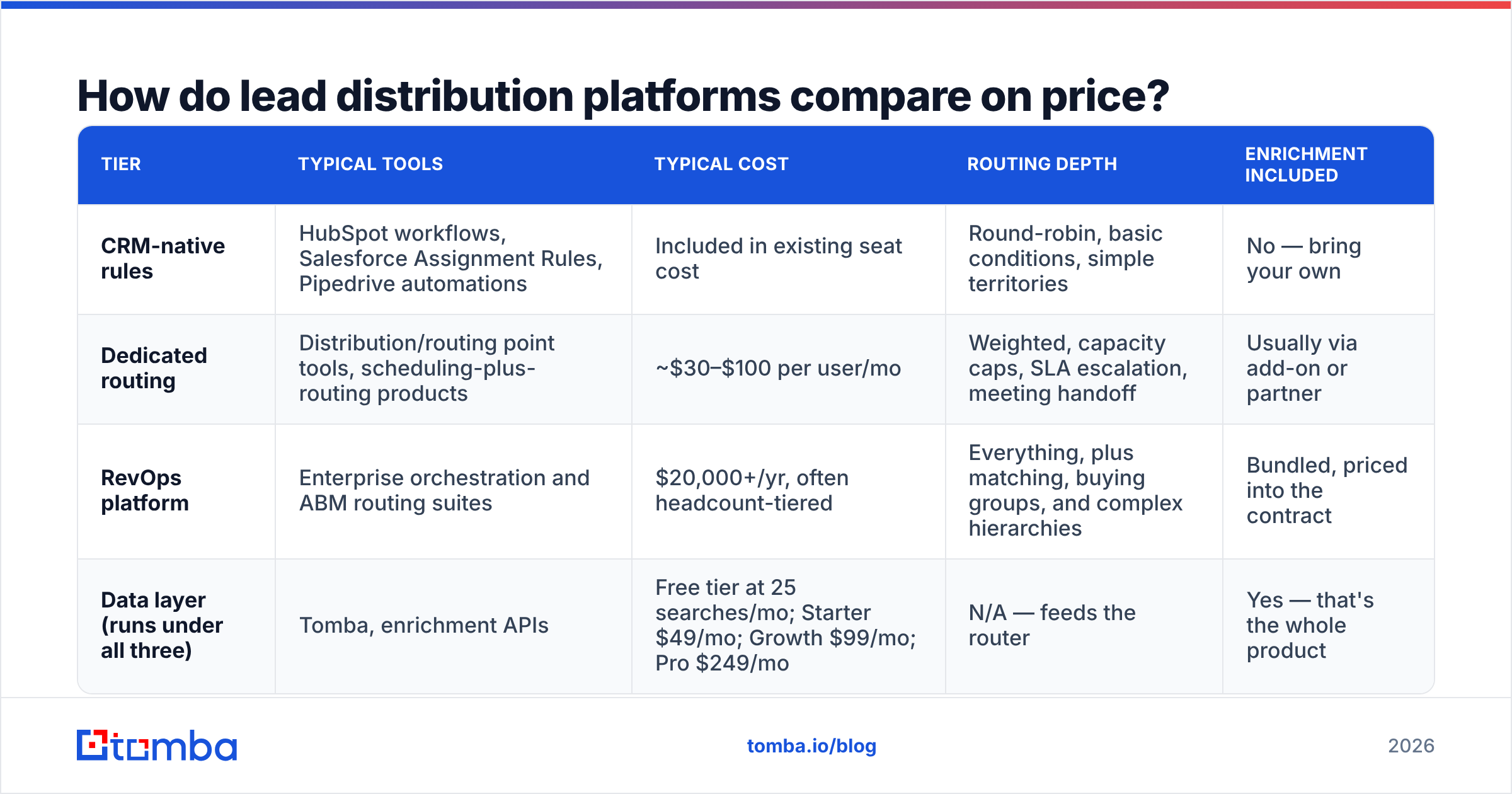
Pricing sorts into three honest tiers. The mistake is buying tier three to solve a tier-one problem.
| Tier | Typical tools | Typical cost | Routing depth | Enrichment included |
|---|---|---|---|---|
| CRM-native rules | HubSpot workflows, Salesforce Assignment Rules, Pipedrive automations | Included in existing seat cost | Round-robin, basic conditions, simple territories | No — bring your own |
| Dedicated routing | Distribution/routing point tools, scheduling-plus-routing products | ~$30–$100 per user/mo | Weighted, capacity caps, SLA escalation, meeting handoff | Usually via add-on or partner |
| RevOps platform | Enterprise orchestration and ABM routing suites | $20,000+/yr, often headcount-tiered | Everything, plus matching, buying groups, and complex hierarchies | Bundled, priced into the contract |
| Data layer (runs under all three) | Tomba, enrichment APIs | Free tier at 25 searches/mo; Starter $49/mo; Growth $99/mo; Pro $249/mo | N/A — feeds the router | Yes — that's the whole product |
Two things worth flagging. First, CRM-native is dramatically underrated: if you have fewer than ten reps and one motion, Salesforce or HubSpot assignment rules plus a Slack notification genuinely solve this, and you can read the independent user reviews on G2 before assuming otherwise. Second, the data layer is orthogonal — you pay for it regardless of which routing tier you pick, because every tier's rules read the same fields.
How does data quality decide routing accuracy?#
Routing is a function over fields. Empty fields mean the function returns the default branch, and your "intelligent routing" degrades into a random assignment with extra latency.
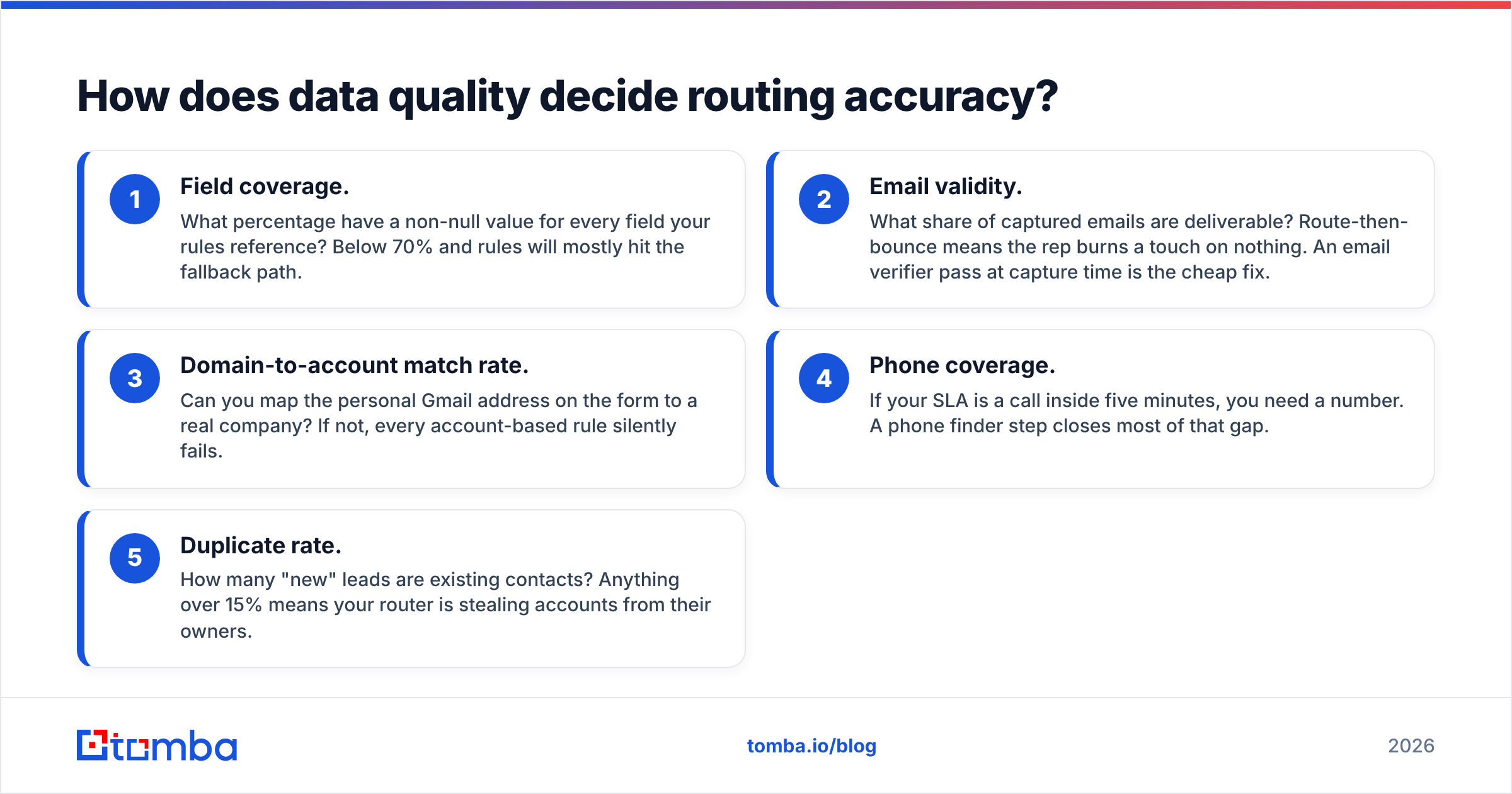
Run this diagnostic on your last 1,000 inbound leads before you evaluate a single vendor:
- Field coverage. What percentage have a non-null value for every field your rules reference? Below 70% and rules will mostly hit the fallback path.
- Email validity. What share of captured emails are deliverable? Route-then-bounce means the rep burns a touch on nothing. An email verifier pass at capture time is the cheap fix.
- Domain-to-account match rate. Can you map the personal Gmail address on the form to a real company? If not, every account-based rule silently fails.
- Phone coverage. If your SLA is a call inside five minutes, you need a number. A phone finder step closes most of that gap.
- Duplicate rate. How many "new" leads are existing contacts? Anything over 15% means your router is stealing accounts from their owners.
Most teams discover their real problem here. The routing engine was never the bottleneck — the lead arrived with a first name, a work email, and nothing else, so no rule could distinguish a 12-person agency from a 9,000-person bank.

When should you skip the platform?#
Skip it when any of these are true, and put the money into pipeline generation instead:
- Under ~50 inbound leads a month. A Slack channel and one owner beats a routing rule tree at this volume. The overhead of maintaining rules exceeds the cost of a human glancing at a queue.
- One rep, or one team with identical coverage. There's nothing to distribute. Assign everything to the queue and move on.
- Your inbound is entirely outbound-sourced replies. Reply routing is a sequencer feature, not a distribution problem.
- Your CRM rules already hit sub-five-minute SLA. Measure first. If you're compliant, buying a routing platform buys you dashboards, not revenue.
The tell that you do need one: your SLA miss rate is above 20%, or you can't answer "why did this lead go to this rep" without opening three tabs.
How do you implement lead distribution without breaking things?#
A rollout that works, in order:
- Instrument before you automate. Log current time-to-first-touch by source for four weeks. You cannot prove improvement without a baseline, and the baseline usually surprises people.
- Fix capture and enrichment first. Add the enrichment call at form submit. Verify emails inline. Append company domain from the email. Do this before writing a single routing rule — see where the data comes from for how domain-to-contact resolution actually works.
- Ship the dumbest rule that could work. Round-robin across the qualified queue, one override for named accounts, Slack notification with a 15-minute SLA timer.
- Add escalation before adding sophistication. An unworked-lead reassignment rule recovers more revenue than a 30-condition scoring model.
- Review assignment logs weekly for the first month. Look specifically at leads that hit the fallback branch — that population tells you exactly which enrichment field to fix next.
- Only then layer scoring. With coverage proven, tier by fit and route high-tier to senior reps.
Note step 2. Routing platforms are sold as a speed upgrade, but the speed ceiling is set by how long enrichment takes and how complete it is. A synchronous enrichment call at capture — via a email finder API or equivalent — is the difference between a router that makes an informed decision in 800ms and one that makes a blind one instantly.
What about lead distribution for agencies and lead sellers?#
Different problem, same category name. If you're distributing purchased or generated leads to buyers rather than internal reps, you need features internal-sales routing tools don't have: per-buyer caps and pacing, price tiers, exclusive versus shared delivery, ping-post auctions, return/credit handling, and buyer-side delivery receipts.
Vendors here are a separate market from RevOps routing. Evaluate on delivery reliability and dispute handling, not on scoring sophistication. And validate every record before delivery — a buyer who receives a 30% bounce rate churns in one cycle, no matter how fast you delivered. Running a bulk verify pass pre-delivery is standard practice in this segment for exactly that reason.
What should you do next?#
Measure your time-to-first-touch, then measure your field coverage. If touch time is bad but coverage is good, buy a routing tool. If coverage is bad, fixing that will improve routing outcomes more than any platform will — and it costs less.
Every routing rule you'll ever write reads a field that something had to fill in. Tomba's Email Finder resolves names and domains into verified, deliverable contacts at capture time, so your router has real firmographics and a valid address to work with instead of a fallback branch. Start on the free tier at 25 searches a month, or run the diagnostic above first and see how many of your last thousand leads your rules could actually classify.
Related guides#
// get started
Find, verify and enrich your first contacts today
Start on the free plan with 25 searches a month, then scale when your team is ready.
Free plan · No credit card required · GDPR & CCPA
// about the author