Lead Engagement in 2026: The Complete B2B Playbook
Most teams confuse lead activity with lead engagement — and waste months chasing leads that will never buy. Here is how to score, sequence, and act on real engagement signals in 2026.
TL;DR
- Lead engagement is the measurable pattern of a prospect's interactions with your company — not a single open, click, or form fill.
- Most engagement scores fail because they weight volume (opens, page views) instead of cost-to-the-prospect signals (replies, demo requests, pricing-page returns, multi-person account activity).
- The half-life of an engagement signal is roughly 72 hours. A score that decays slowly will keep routing dead leads to your reps.
- Bad contact data silently destroys engagement metrics: a 12% bounce rate means your "low engagement" segment is partly just undeliverable.
- Build the scoring model around three axes — recency, depth, and account spread — then route on thresholds, not on gut feel.
What is lead engagement, really?#
Lead engagement is the pattern of measurable interactions a prospect has with your company over a defined window, weighted by how much effort each interaction cost them.
That last clause is where most teams get it wrong. An email open costs a prospect nothing — it may not even be a human (Apple Mail Privacy Protection has been auto-opening messages since 2021, and by 2026 most enterprise mail gateways pre-fetch images too). A reply costs 30 seconds of attention. A pricing-page visit at 9pm on a Tuesday costs curiosity. A demo request costs calendar risk.
Rank your signals by that cost and your engagement model starts predicting revenue instead of describing traffic.
Here is the practical breakdown of the three axes worth tracking:
- Recency — how long since the last meaningful interaction. Signals decay fast; a pricing-page view from six weeks ago should carry near-zero weight today.
- Depth — how far down the funnel the interaction sits. Blog read < case-study download < pricing page < demo request < security questionnaire.
- Account spread — how many distinct people at the same domain are engaging. Two people from the same company is a materially different buy signal than one person twice.
- Direction — is engagement accelerating or decaying? A lead going from 4 touches/week to 1 is a churn signal, even if the absolute score is still high.
- Channel mix — email + LinkedIn + website is stronger evidence than three touches on one channel, because it implies the buyer is actively researching rather than passively receiving.
- Reciprocity — did they initiate anything? Inbound replies, inbound questions, and inbound calendar bookings outrank everything you triggered.
Why do most lead engagement scores fail?#
Because they are built from whatever the marketing automation platform happened to log, not from what correlates with closed-won deals.
Three failure modes show up over and over:
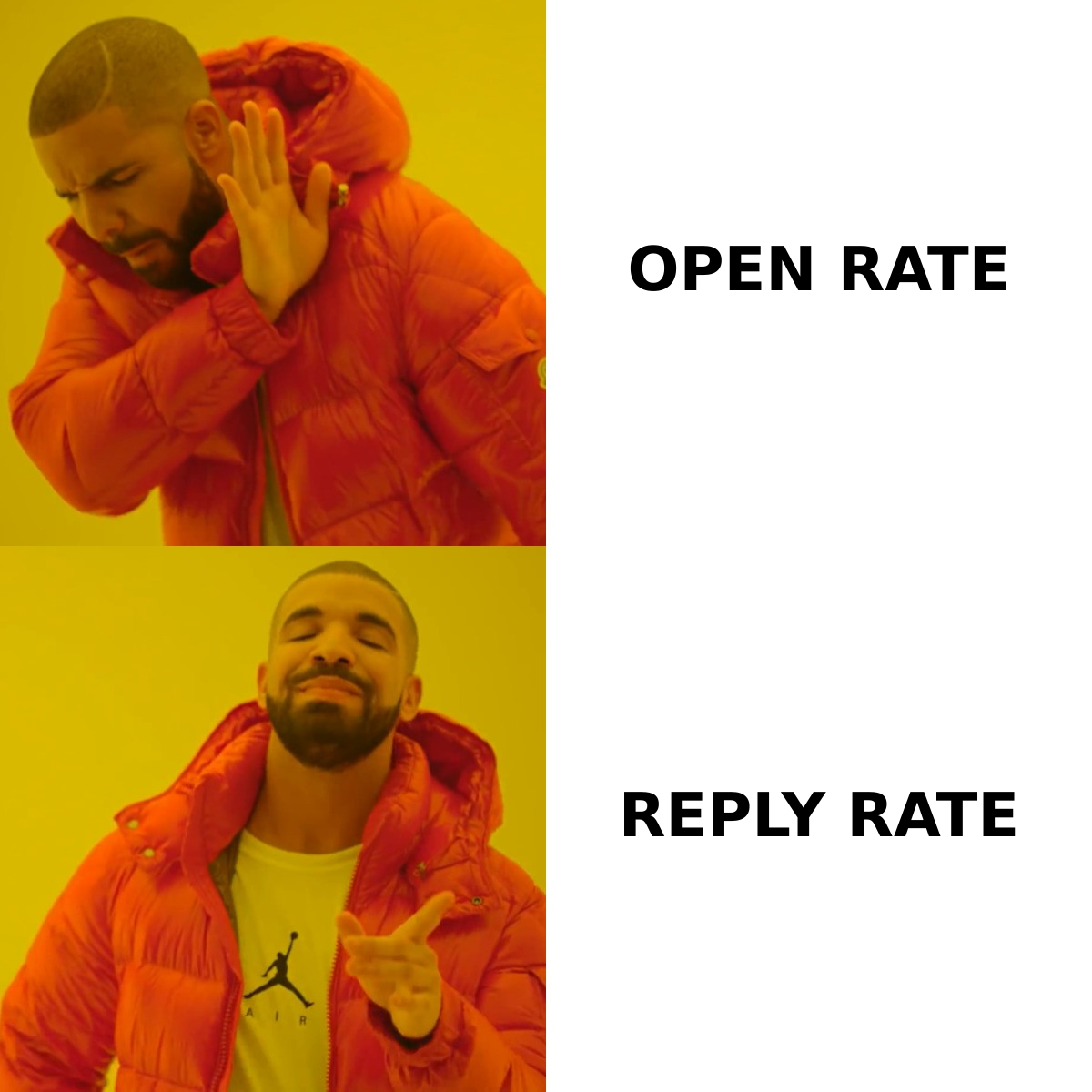
Failure 1: Vanity weighting. Opens and page views get points because they're plentiful. They're plentiful precisely because they're cheap. A model trained on abundance ranks noise at the top.
Failure 2: No decay. Scores accumulate forever. After 18 months, your "hottest" lead is a marketing intern who downloaded every ebook in 2024 and left the company in 2025. If you aren't applying a decay curve — halve the score every 30 days is a reasonable starting point — your leaderboard is an archaeology report.
Failure 3: Dirty data masquerading as disengagement. This one is invisible and expensive. If 10–15% of your list is invalid, those contacts register zero engagement forever. They drag down segment averages, they inflate your "cold" bucket, and they quietly wreck email deliverability so that even your valid contacts stop seeing you. Running a periodic pass through an email verifier before you draw conclusions about engagement is not hygiene theater — it's a prerequisite for the data being meaningful at all.
A quick sanity test: pull your last 50 closed-won deals and check what their engagement score was 30 days before close. If the distribution is wide and messy, your model isn't measuring anything.
Which lead engagement signals actually predict pipeline?#
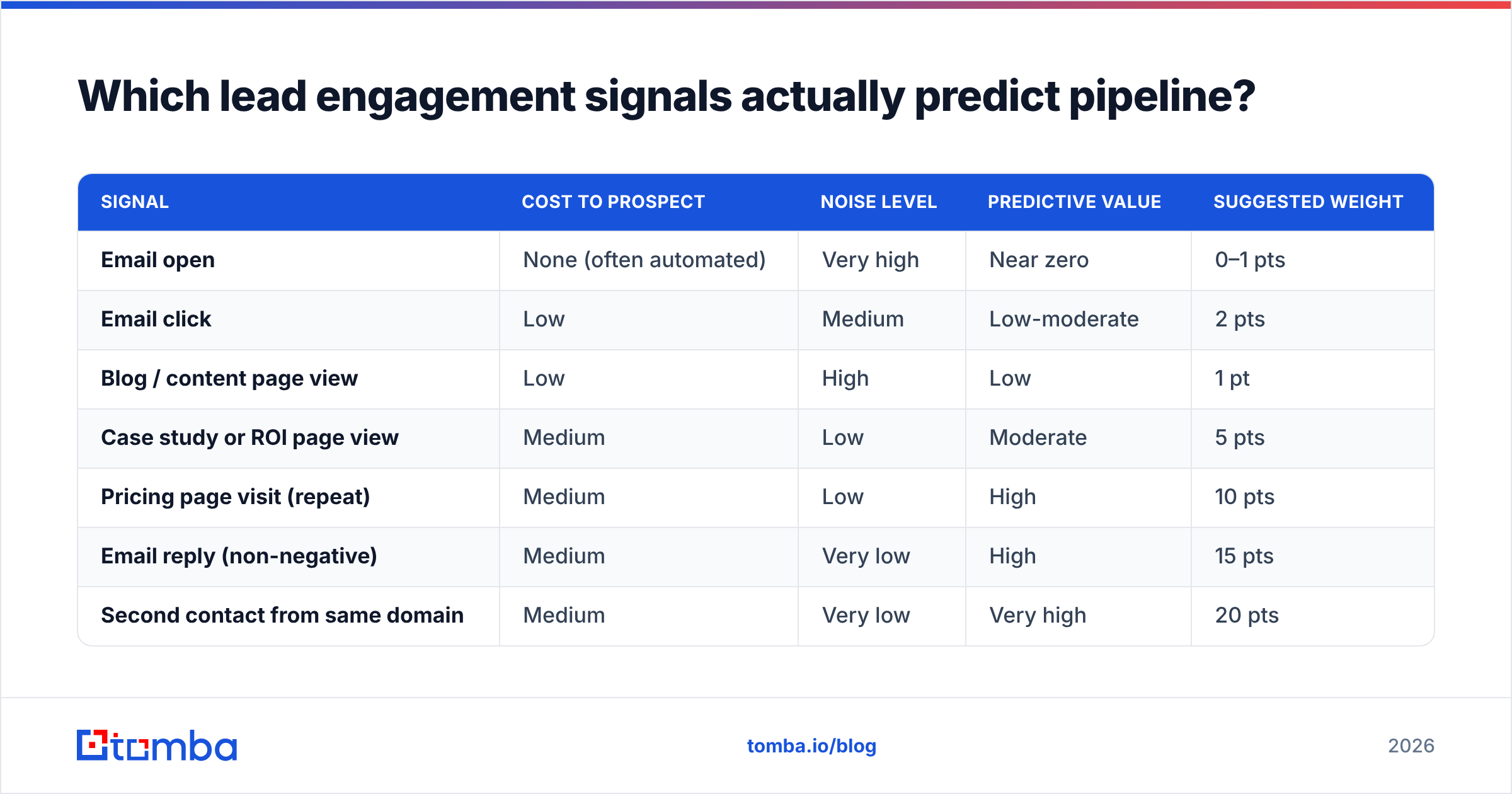
Not all activity is created equal. Here's how the common signals stack up on effort, noise, and predictive value:
| Signal | Cost to prospect | Noise level | Predictive value | Suggested weight |
|---|---|---|---|---|
| Email open | None (often automated) | Very high | Near zero | 0–1 pts |
| Email click | Low | Medium | Low-moderate | 2 pts |
| Blog / content page view | Low | High | Low | 1 pt |
| Case study or ROI page view | Medium | Low | Moderate | 5 pts |
| Pricing page visit (repeat) | Medium | Low | High | 10 pts |
| Email reply (non-negative) | Medium | Very low | High | 15 pts |
| Second contact from same domain | Medium | Very low | Very high | 20 pts |
| Demo / meeting booked | High | None | Very high | 30 pts |
| Security or procurement question | Very high | None | Very high | 35 pts |
The step-change happens between "things they consumed" and "things they initiated." Everything above the reply line is you talking; everything below it is them talking. Weight accordingly.
Worth noting: HubSpot's own research on sales engagement has consistently found that response-based signals outperform consumption-based signals for forecasting, and G2's buyer behavior reporting shows most B2B buying committees are 3–6 people — which is exactly why the "second contact from same domain" row deserves its outsized weight.
How do you build a lead engagement model from scratch?#
Start narrow. A model with six signals that you trust beats a model with forty that nobody can explain.
Step 1 — Define the scoring window. 90 days for most B2B motions, 30 days for high-velocity SMB, 180 days for enterprise with long evaluation cycles. Anything outside the window scores zero, full stop.
Step 2 — Apply the decay curve. Multiply each signal's base points by a decay factor: 1.0 for days 0–7, 0.7 for days 8–21, 0.4 for days 22–45, 0.15 beyond that. This single change usually reorders the top of the list dramatically.
Step 3 — Add the account multiplier. If two or more contacts from the same domain have scored anything in the window, multiply the account's aggregate score by 1.5. Three or more, multiply by 2.0. Buying committees engage in clusters.
Step 4 — Set routing thresholds, not rankings. Rankings make reps work the top of a list regardless of quality. Thresholds make them work leads that crossed a bar. Define three tiers: below 20 = nurture, 20–49 = sequence, 50+ = direct outreach within 24 hours.
Step 5 — Validate against closed-won. Backtest quarterly. If the 50+ tier doesn't convert at least 3x the 20–49 tier, your weights are wrong.
Step 6 — Clean the input. Before any of this means anything, deduplicate, verify, and enrich. A lead with a missing job title can't be scored on fit; a lead with a dead mailbox can't be scored on engagement. Data enrichment closes the first gap; verification closes the second.
Is lead engagement different from lead scoring?#
Yes — and conflating them is one of the most common RevOps mistakes.
Lead scoring traditionally blends two things: fit (does this person match our ICP — company size, industry, role, tech stack) and engagement (are they showing interest). A blended score hides which half is driving the number, which means a perfect-fit lead who has never engaged looks identical to a poor-fit lead who reads everything.
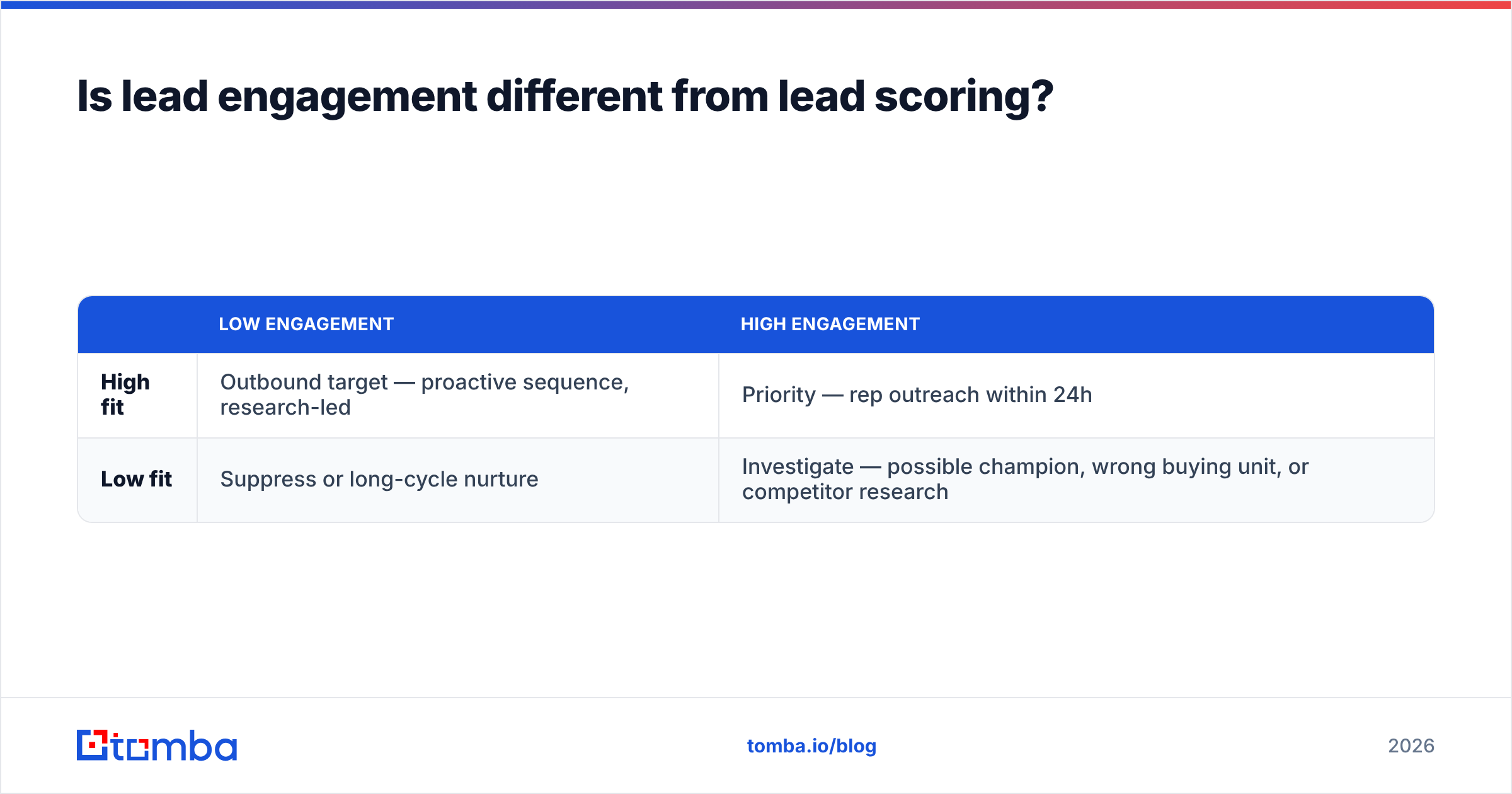
Keep them separate. Score fit and engagement on independent axes, then plot leads on a 2x2:
| Low engagement | High engagement | |
|---|---|---|
| High fit | Outbound target — proactive sequence, research-led | Priority — rep outreach within 24h |
| Low fit | Suppress or long-cycle nurture | Investigate — possible champion, wrong buying unit, or competitor research |
That bottom-right quadrant is the interesting one. A highly engaged low-fit lead is often a practitioner who will become a champion once you find the actual budget holder at that account — which is a research problem, not a scoring problem. A domain search across that company surfaces the roles you're actually missing.

How fast do you need to respond to an engaged lead?#
Faster than you think, and the curve is brutal.
The canonical research here — the Lead Response Management study, later replicated in various forms by Harvard Business Review — found that contacting a lead within an hour makes qualification roughly seven times more likely than waiting two hours, and about sixty times more likely than waiting 24 hours.
What's changed by 2026 is that buyers now evaluate 4–6 vendors in parallel through AI-assisted research, so the window has compressed further. Practical targets:
- Inbound demo request: respond within 5 minutes during business hours. Automate the booking link; have a human follow within the hour.
- Pricing page repeat visit (known contact): trigger a rep task within 2 hours.
- Positive email reply: respond same day, always. A next-day reply to a warm reply is the single most common self-inflicted pipeline wound in B2B.
- Anonymous high-intent web session: identify the account, find the right contact, and reach out within 48 hours. Tools like website visitor reveal turn that anonymous session into a routable lead.
Speed only works if you have somewhere to send the message. If your engaged lead is an anonymous session or a LinkedIn profile with no contact route, response time is academic. That's the gap an email finder closes — turning an identified account into a deliverable address in seconds rather than a manual research task that takes a rep twenty minutes and often fails.
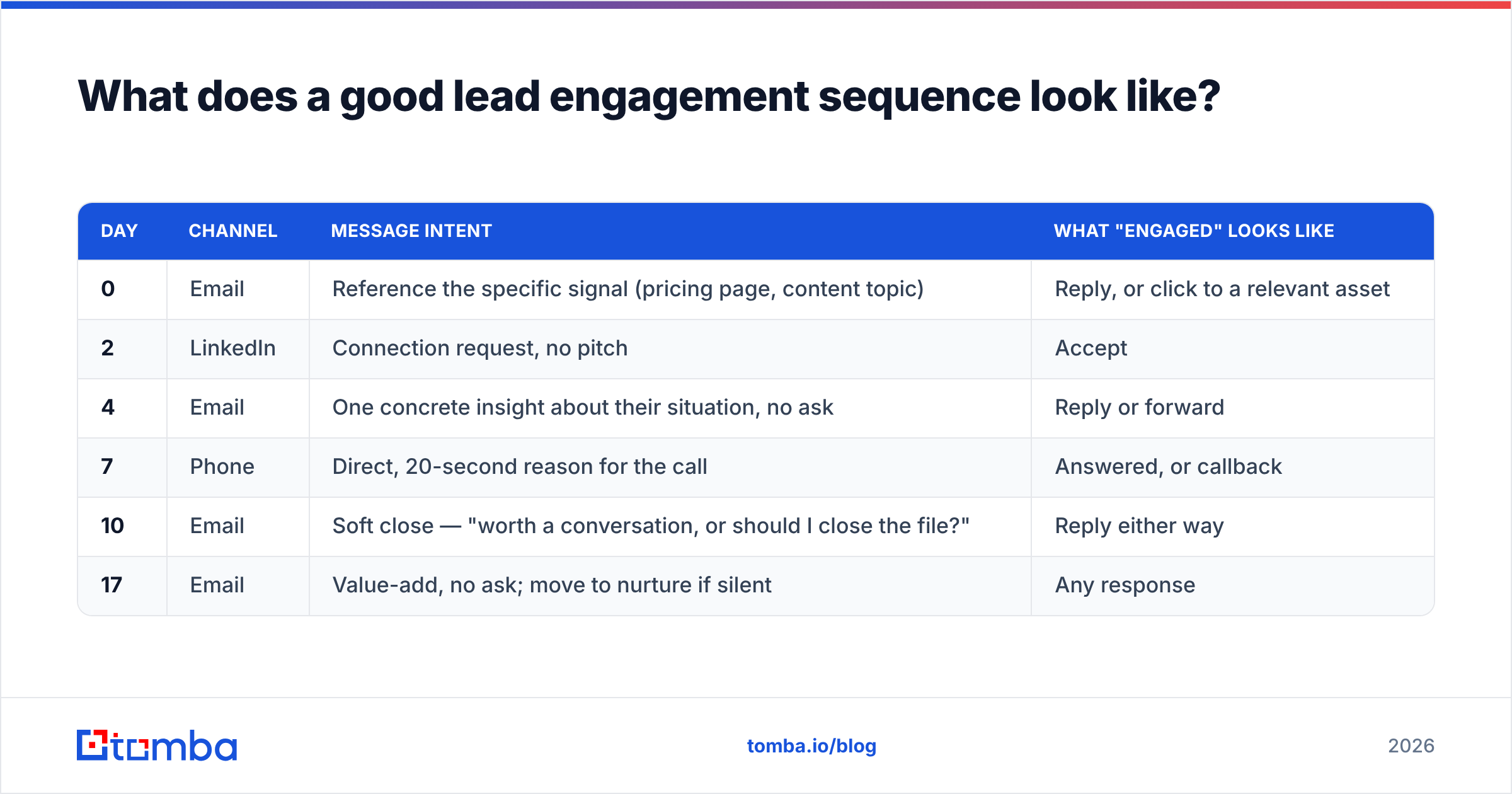
What does a good lead engagement sequence look like?#
Engagement is earned across touches, not extracted in one. A workable structure for a 50+ tier lead:
| Day | Channel | Message intent | What "engaged" looks like |
|---|---|---|---|
| 0 | Reference the specific signal (pricing page, content topic) | Reply, or click to a relevant asset | |
| 2 | Connection request, no pitch | Accept | |
| 4 | One concrete insight about their situation, no ask | Reply or forward | |
| 7 | Phone | Direct, 20-second reason for the call | Answered, or callback |
| 10 | Soft close — "worth a conversation, or should I close the file?" | Reply either way | |
| 17 | Value-add, no ask; move to nurture if silent | Any response |
Two rules make this sequence work. First, every touch references something real — the page they read, the funding round, the job posting. Generic sequences train prospects to ignore you and damage sender reputation through low engagement rates, which mailbox providers now weight heavily. Second, the day-10 "should I close the file?" message consistently outperforms every other follow-up in reply rate, because it gives the prospect a costless way to respond.
For the day-7 call, you need an actual number. Sourcing direct dials through a phone finder rather than a switchboard is the difference between a 20% connect rate and a 3% one.
How do you measure whether lead engagement is improving?#
Track four metrics, not fourteen:
- Engaged-lead rate — percentage of contacted leads that produce at least one reciprocal signal (reply, booking, inbound question) within the window. This is your top-line engagement health.
- Time-to-first-response — median minutes from signal to rep action. If this is above 4 hours for your top tier, fix it before touching anything else.
- Score-to-opportunity conversion by tier — the validation metric. Your top tier should convert at multiples of the middle tier, not marginally better.
- Signal decay accuracy — of leads that scored 50+ and were never worked within 72 hours, what percentage later converted? If it's near zero, your urgency thresholds are right. If it's high, you're over-weighting urgency.
Deliverability metrics belong underneath all of these as a control layer. Bounce rate above 3%, spam complaint rate above 0.1%, or a sudden drop in reply rate across all segments usually means the problem is infrastructure, not messaging. Check your list with a free email checker before you rewrite your copy.
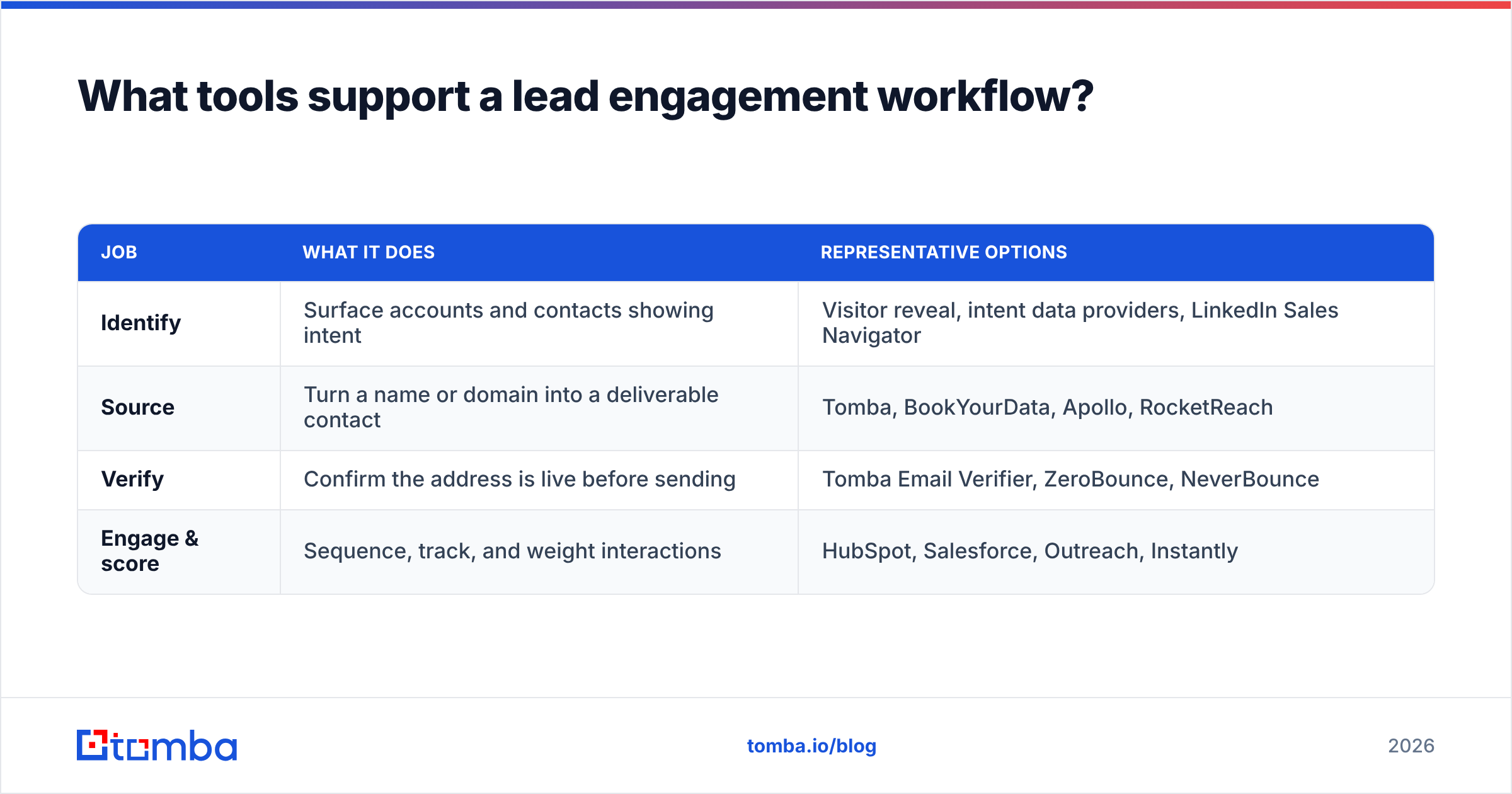
What tools support a lead engagement workflow?#
The stack splits into four jobs, and most teams over-buy on one and under-buy on the others:
| Job | What it does | Representative options |
|---|---|---|
| Identify | Surface accounts and contacts showing intent | Visitor reveal, intent data providers, LinkedIn Sales Navigator |
| Source | Turn a name or domain into a deliverable contact | Tomba, BookYourData, Apollo, RocketReach |
| Verify | Confirm the address is live before sending | Tomba Email Verifier, ZeroBounce, NeverBounce |
| Engage & score | Sequence, track, and weight interactions | HubSpot, Salesforce, Outreach, Instantly |
On the sourcing layer specifically, the practical choice usually comes down to coverage versus cost per usable record. BookYourData's prepaid database model works well for teams that want to buy a defined list up front with a stated accuracy guarantee. Tomba's model is search-and-verify: a free tier at 25 searches/month, Starter at $49/mo, Growth at $99/mo, and Pro at $249/mo, with the Tomba API available across paid plans for teams that want to wire enrichment directly into their scoring pipeline. Apollo bundles sourcing and sequencing but carries a heavier per-seat cost.
The honest guidance: if your engagement model depends on real-time enrichment as leads cross thresholds, prioritize API access and verification quality over raw database size. A 40-million-record database you can't query programmatically is worth less to an engagement workflow than a smaller one you can.
What should you do in the first 30 days?#
- Week 1: Export every contact, run verification, suppress the invalid ones. Measure how much of your "unengaged" segment was simply undeliverable.
- Week 2: Rebuild the score with six signals and a decay curve. Backtest against last quarter's closed-won.
- Week 3: Set three routing tiers and a hard SLA on time-to-first-response for the top tier.
- Week 4: Instrument the four metrics above and set a monthly review. Kill any signal that doesn't correlate with conversion after one quarter.
Nothing here requires new headcount. It requires deleting signals you're currently paying attention to.
Start with clean, reachable contacts#
Every engagement model is downstream of one question: can you actually reach the person? Scores, sequences, and SLAs mean nothing against a bounced address or a contact you never found in the first place.
Tomba Email Finder turns a name and a domain into a verified, deliverable email address — with a free tier at 25 searches a month to test it against your own list before you commit. Run your next engaged-account list through it, compare the bounce rate to what you're getting today, and let the delta decide.
Related guides#
// get started
Find, verify and enrich your first contacts today
Start on the free plan with 25 searches a month, then scale when your team is ready.
Free plan · No credit card required · GDPR & CCPA
Get the Tomba newsletter
Product and data updates
// about the author