8 Best Lead Forensics Alternatives in 2026 (Ranked)
Lead Forensics identifies the companies visiting your site, but the quotes are custom, the contracts are annual, and the contact data is thin. Here are 8 alternatives with real pricing and honest trade-offs.
TL;DR
- Lead Forensics is a reverse-IP visitor identification tool. It tells you which companies land on your site — it does not hand you a verified inbox for the person who actually read your pricing page.
- The two most common reasons buyers shop for lead forensics alternatives: pricing is quote-only and typically annual, and the "contacts" attached to an identified company are often role-based guesses rather than verified emails.
- Company-level identification (Dealfront, Albacross, Factors.ai) is cheap and reliable. Person-level identification (RB2B, Warmly) is newer, US-skewed, and match rates vary a lot by traffic mix.
- Identification is only step one. Whatever tool reveals the account, you still need a verified email before anyone can be contacted — that is a separate job from a separate tool.
- Cheapest honest stack for most SMB teams in 2026: a company-level identifier under $150/mo plus an email finder and verifier layered on top.
What does Lead Forensics actually do?#
Lead Forensics matches the IP addresses hitting your website against a database of corporate IP ranges, then tells you which company that traffic belongs to. You see the account name, the pages it viewed, session duration, and a firmographic profile. It has been one of the better-known players in the category for over a decade, and its own site (leadforensics.com) leans hard on that install base.
Think of it like a doorbell camera for your website. It tells you a delivery van from Acme Corp pulled up outside. It does not tell you who was driving, why they came, or how to call them back.
That gap is the entire reason people search for lead forensics alternatives. Reverse-IP is a solved problem — dozens of vendors do it competently now. The differentiators in 2026 are price transparency, contract flexibility, contact data quality, and whether the tool can do anything with the account once it's identified.
Two other friction points come up repeatedly in buyer reviews on G2: the pricing is quote-based rather than published, and contracts tend to be annual. Neither is unusual in enterprise martech, but it matters when you're a 6-person sales team trying to test whether visitor identification moves your pipeline at all.
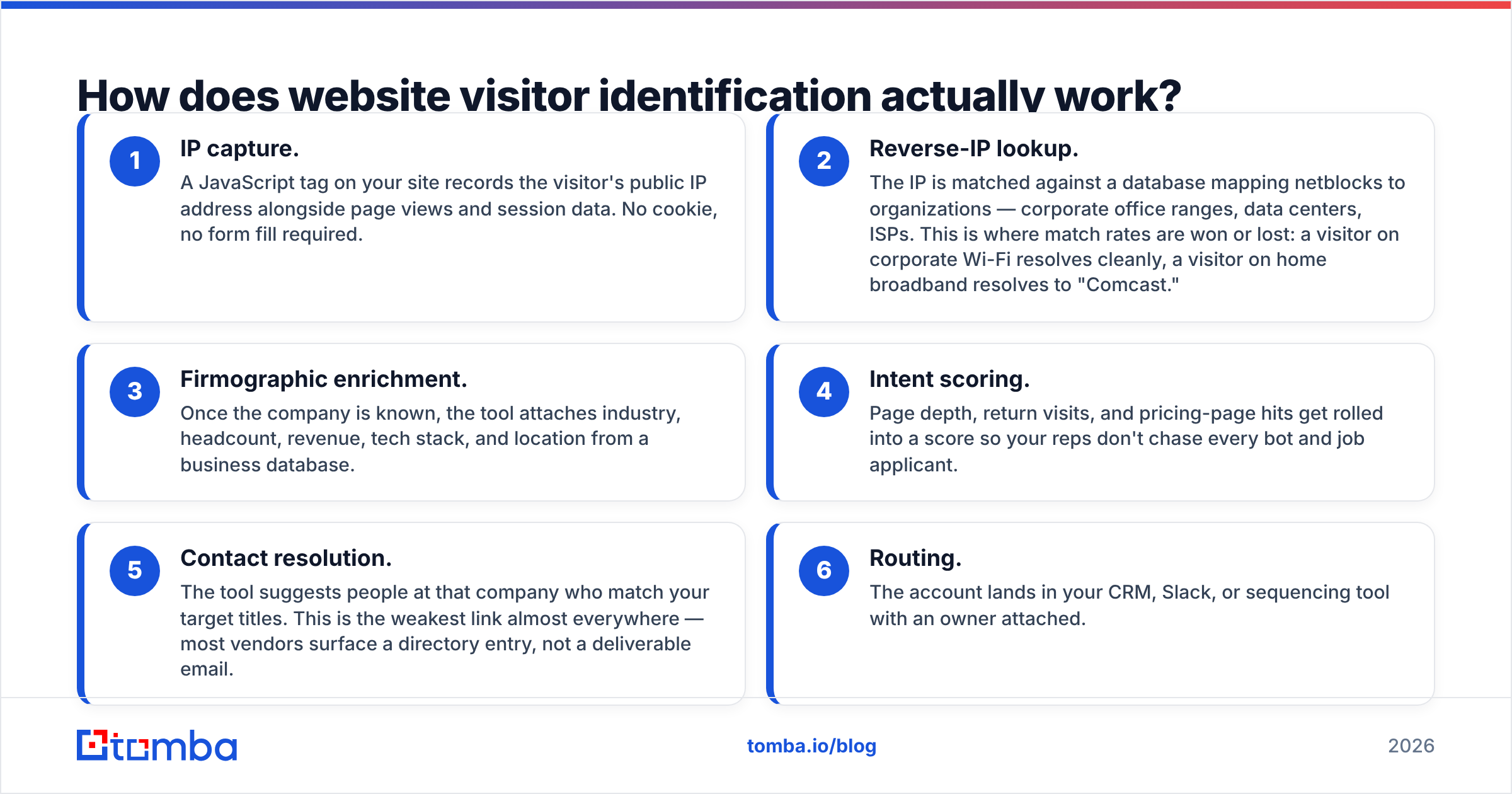
How does website visitor identification actually work?#
Understanding the mechanism tells you exactly where each vendor's limits are:
- IP capture. A JavaScript tag on your site records the visitor's public IP address alongside page views and session data. No cookie, no form fill required.
- Reverse-IP lookup. The IP is matched against a database mapping netblocks to organizations — corporate office ranges, data centers, ISPs. This is where match rates are won or lost: a visitor on corporate Wi-Fi resolves cleanly, a visitor on home broadband resolves to "Comcast."
- Firmographic enrichment. Once the company is known, the tool attaches industry, headcount, revenue, tech stack, and location from a business database.
- Intent scoring. Page depth, return visits, and pricing-page hits get rolled into a score so your reps don't chase every bot and job applicant.
- Contact resolution. The tool suggests people at that company who match your target titles. This is the weakest link almost everywhere — most vendors surface a directory entry, not a deliverable email.
- Routing. The account lands in your CRM, Slack, or sequencing tool with an owner attached.
Steps 1–4 are commoditized. Step 5 is where the money leaks, because a company name with no reachable human is a research task, not a lead.

Why do teams look for Lead Forensics alternatives?#
Four recurring reasons, in rough order of how often they come up:
Pricing opacity. You cannot self-serve a plan. You book a demo, get scoped, and receive a custom annual number. That is fine for a 200-rep org with a procurement team and painful for a startup that wants to spend $99 for two months to see if the channel works.
Annual commitment. Visitor identification value scales with traffic volume. If you get 3,000 monthly visitors, you may identify 300 companies, of which 30 are ICP-fit. Committing for twelve months before you know your own match rate is a bet, not a decision.
Home and mobile traffic. Post-2020 traffic mixes broke reverse-IP economics everywhere. A meaningful share of your B2B visitors browse from residential IPs that resolve to an ISP, not an employer. Every vendor in this category has the same problem; some are more honest about their match rate than others.
Contact data depth. This is the one that actually decides whether the tool pays for itself. Knowing that Siemens visited your integrations page is interesting. Knowing which four people to email, with verified addresses, is revenue.
What are the best Lead Forensics alternatives in 2026?#
Eight options worth shortlisting, grouped by what they're actually good at.
1. Dealfront (Leadfeeder)#
The closest like-for-like swap. Leadfeeder merged with Echobot to become Dealfront, and the combined product pairs visitor identification with a European B2B database that is genuinely strong on DACH and Nordic data. Published entry pricing, a usable free tier that shows a limited number of identified companies, and native CRM push. If you sell into Europe and want transparent pricing, start here. (dealfront.com)
2. Albacross#
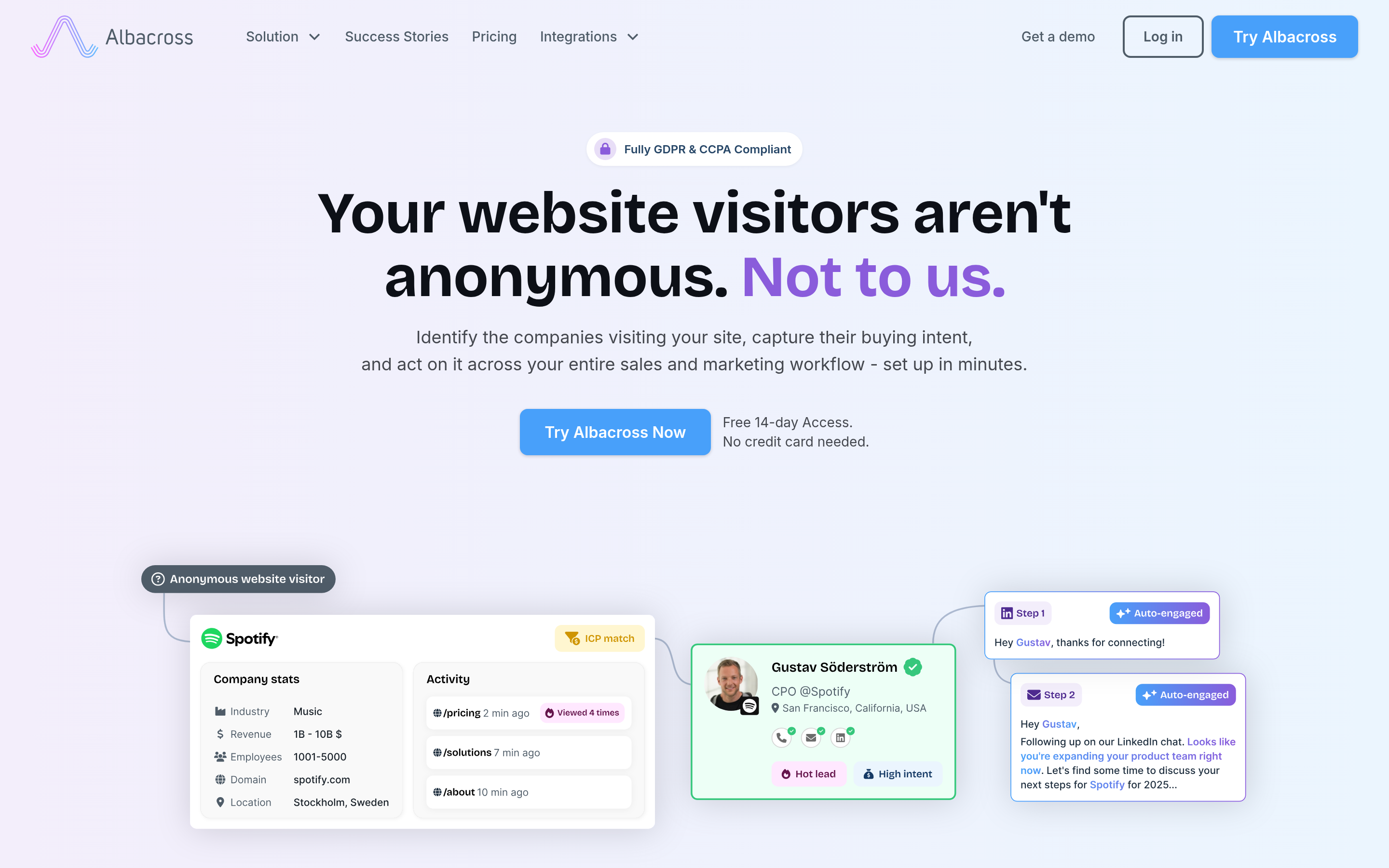
Europe-first, self-serve, and built around account-based advertising as much as identification. Good for marketing teams that want to retarget identified accounts rather than hand them to SDRs. Match rates in Northern Europe are competitive with anyone.
3. HubSpot Breeze Intelligence (formerly Clearbit Reveal)#
If your stack is already HubSpot, this is the path of least resistance. Identification, enrichment, and form shortening live inside the CRM you already pay for, billed by credits rather than seats. The trade-off is that it is much less compelling if HubSpot is not your system of record. (hubspot.com)
4. Warmly#
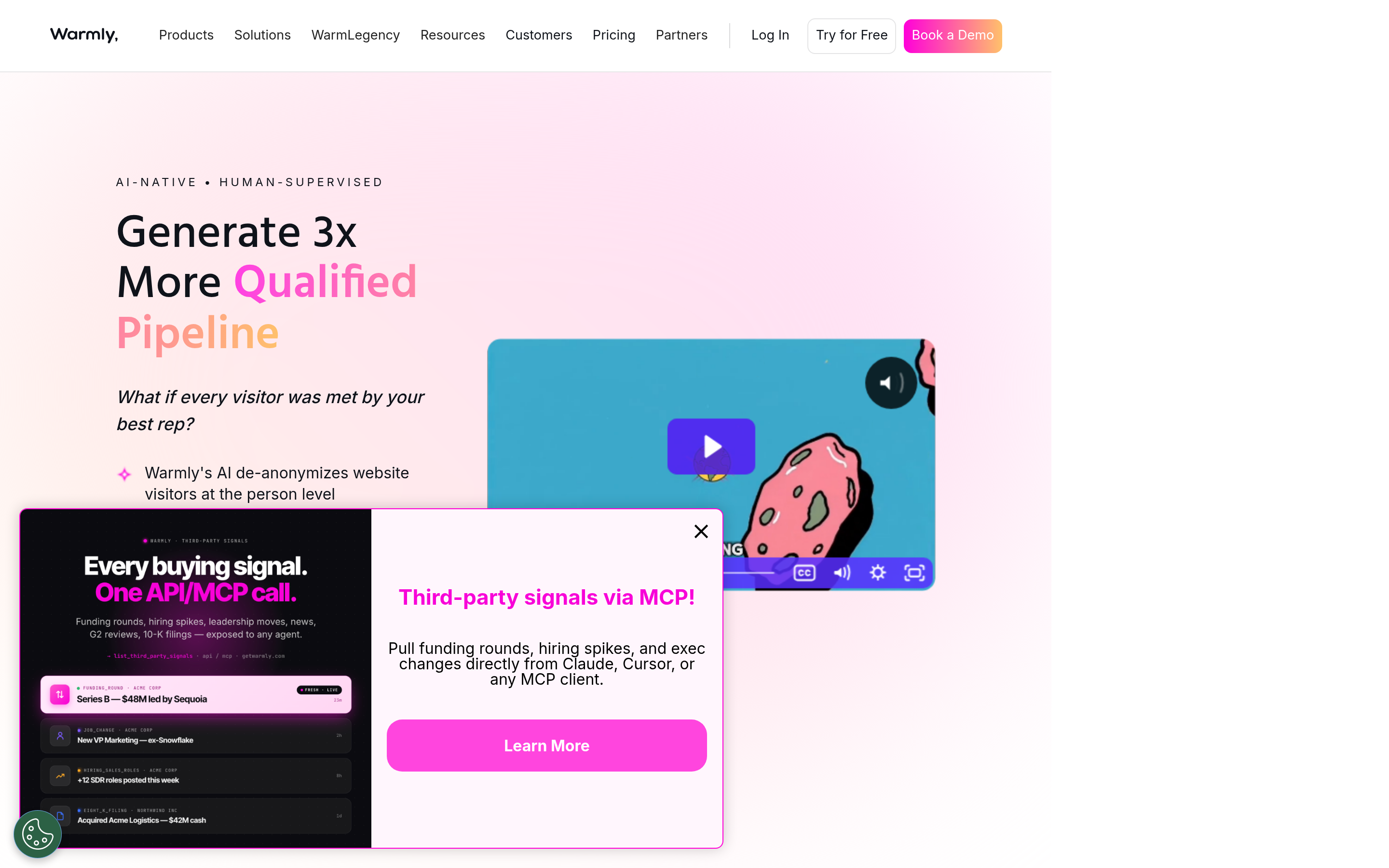
Signal aggregation rather than pure identification: visitor ID, job-change alerts, and CRM signals feed an orchestration layer that can auto-launch a sequence or ping a rep in Slack. Strong for teams that want the "warm" account surfaced in real time. Pricier once you move past the free tier.
5. RB2B#
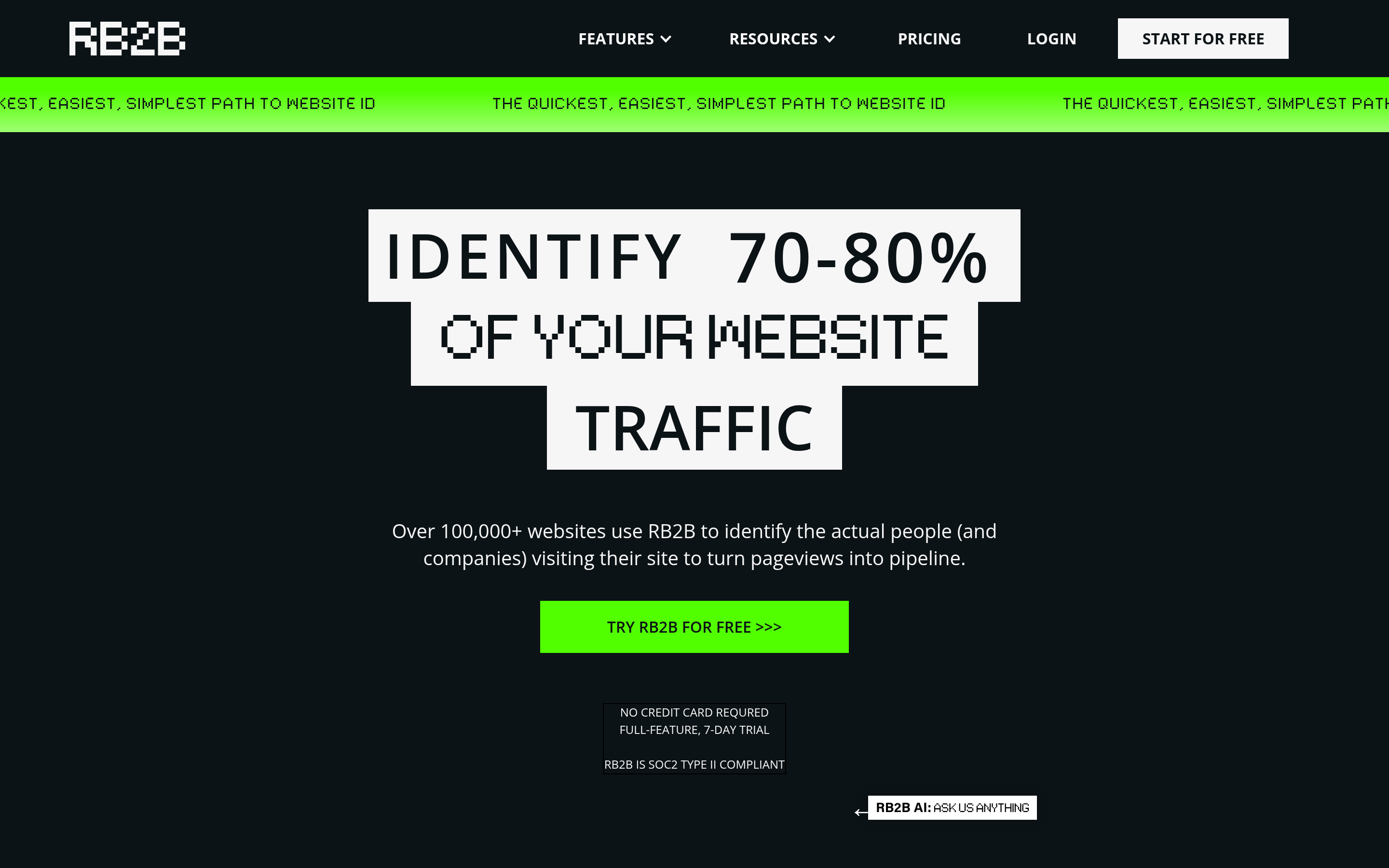
The person-level option. Instead of "a company visited," it attempts to tell you which individual visited, pushed straight to Slack. US-only coverage and match rates that swing widely by industry, but when it hits, it removes the contact-guessing step entirely. Worth testing precisely because it's cheap to test.
6. Factors.ai#
Analytics-led. It ties identification to multi-touch attribution and LinkedIn ad data, so you can see which campaigns drove the anonymous session. Best for RevOps teams who want measurement, not just a lead list.
7. BookYourData#
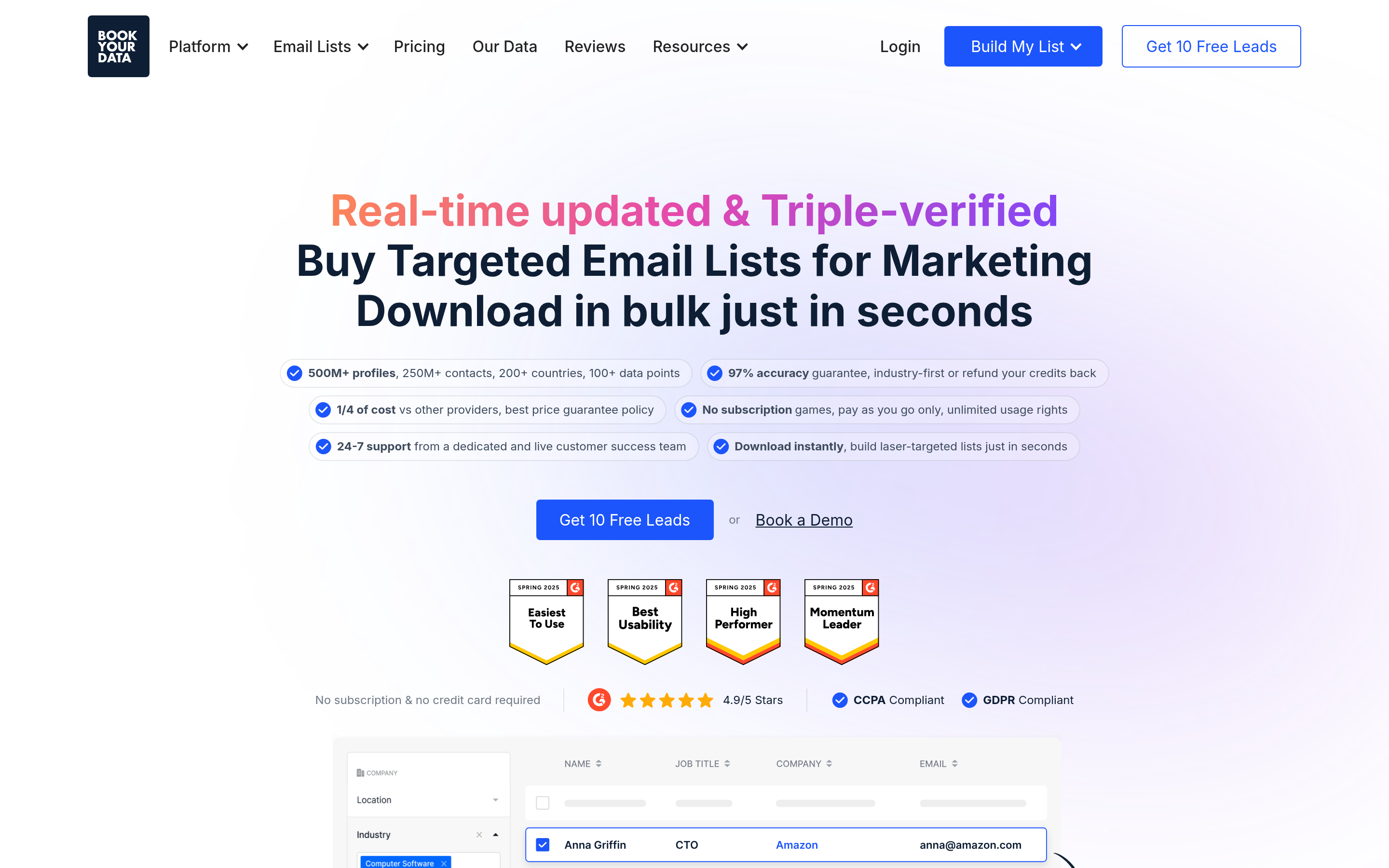
A different answer to the same problem. Instead of waiting for your ICP to visit, you buy a targeted, pre-verified contact list and go outbound. For teams with low traffic volume, this is often the more rational spend — visitor identification only works if people are already visiting. BookYourData is well regarded for list accuracy and pay-as-you-go credits, and it pairs cleanly with an identification tool rather than competing with it.
8. Tomba (identification plus verified contact layer)#
Tomba approaches the problem from the contact side. Website visitor reveal identifies the companies hitting your site, and then the rest of the platform closes the loop that most visitor-ID tools leave open: domain search pulls the people at that company, the email finder resolves the pattern, and the verifier confirms deliverability before anything leaves your outbox. Pricing is published and monthly.
Comparison table#
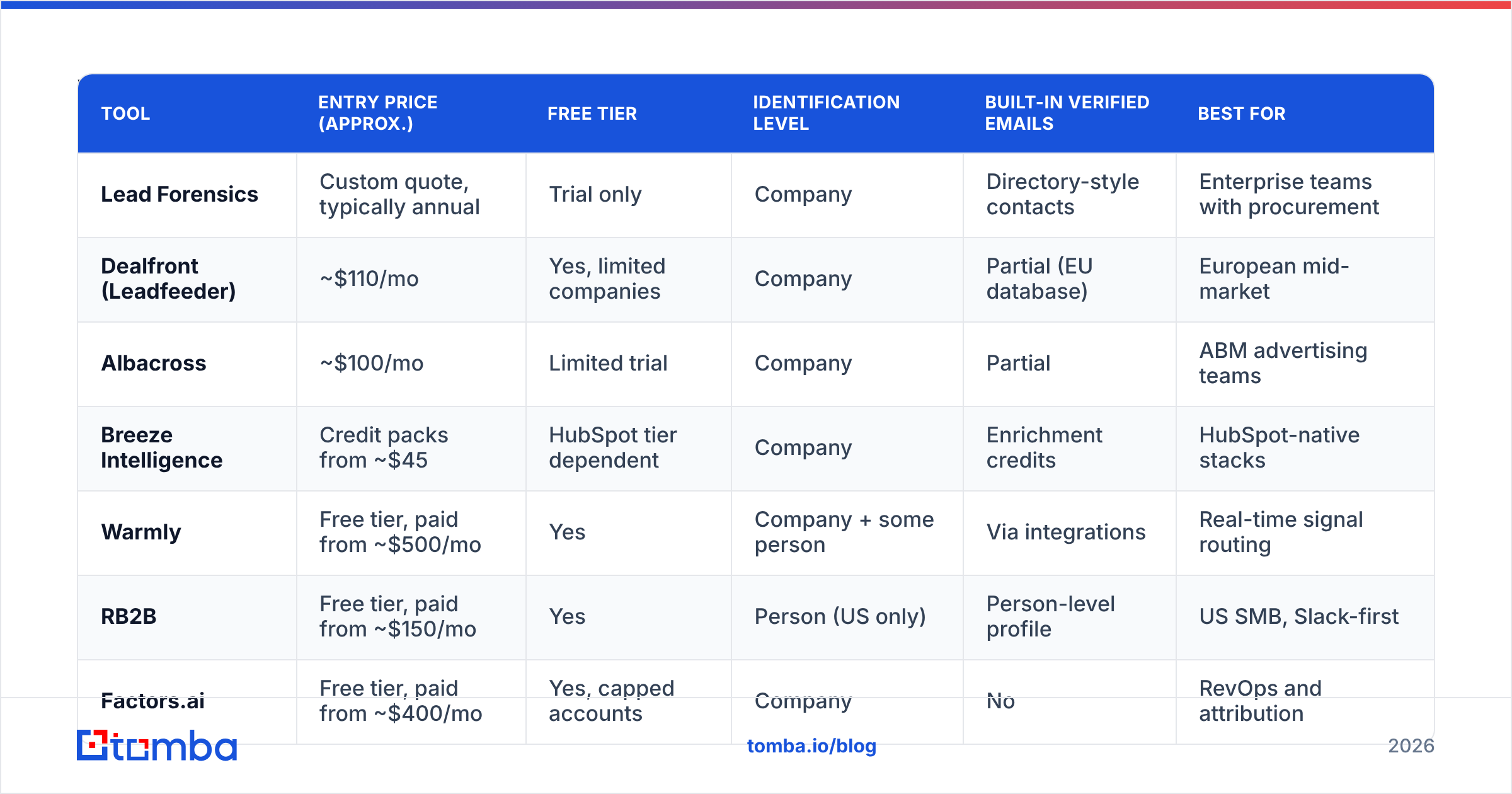
| Tool | Entry price (approx.) | Free tier | Identification level | Built-in verified emails | Best for |
|---|---|---|---|---|---|
| Lead Forensics | Custom quote, typically annual | Trial only | Company | Directory-style contacts | Enterprise teams with procurement |
| Dealfront (Leadfeeder) | ~$110/mo | Yes, limited companies | Company | Partial (EU database) | European mid-market |
| Albacross | ~$100/mo | Limited trial | Company | Partial | ABM advertising teams |
| Breeze Intelligence | Credit packs from ~$45 | HubSpot tier dependent | Company | Enrichment credits | HubSpot-native stacks |
| Warmly | Free tier, paid from ~$500/mo | Yes | Company + some person | Via integrations | Real-time signal routing |
| RB2B | Free tier, paid from ~$150/mo | Yes | Person (US only) | Person-level profile | US SMB, Slack-first |
| Factors.ai | Free tier, paid from ~$400/mo | Yes, capped accounts | Company | No | RevOps and attribution |
| Tomba | $49/mo Starter | Yes, 25 searches/mo | Company + contact resolution | Yes, finder + verifier | Teams that need the email, not just the logo |
Prices are entry-level published rates at time of writing and move frequently — confirm on each vendor's own pricing page before you budget. Lead Forensics does not publish list pricing, so the quote line is deliberately blank rather than guessed.
Is company-level or person-level identification better?#
It depends entirely on your average deal size and your traffic volume.
Company-level is mature, works globally, and costs under $150/mo from several vendors. You get an account, and your team does the contact work. If you sell a $40k ACV product to 200 target accounts, that contact work is worth doing manually.
Person-level removes a step but carries real caveats: coverage is heavily US-weighted, match rates are lower than the marketing suggests, and the privacy posture varies by vendor and jurisdiction. If you operate under GDPR, get your counsel to look at person-level identification before you deploy it — the legal basis question is not settled the way reverse-IP company lookup is.
The pragmatic answer for most teams: buy company-level identification, and solve the person problem with a dedicated contact layer. That combination is cheaper, works in every market, and does not depend on one vendor's match rate for your entire pipeline.

How do you turn an identified company into a real conversation?#
Identification is the cheap half. Here's the workflow that actually converts:
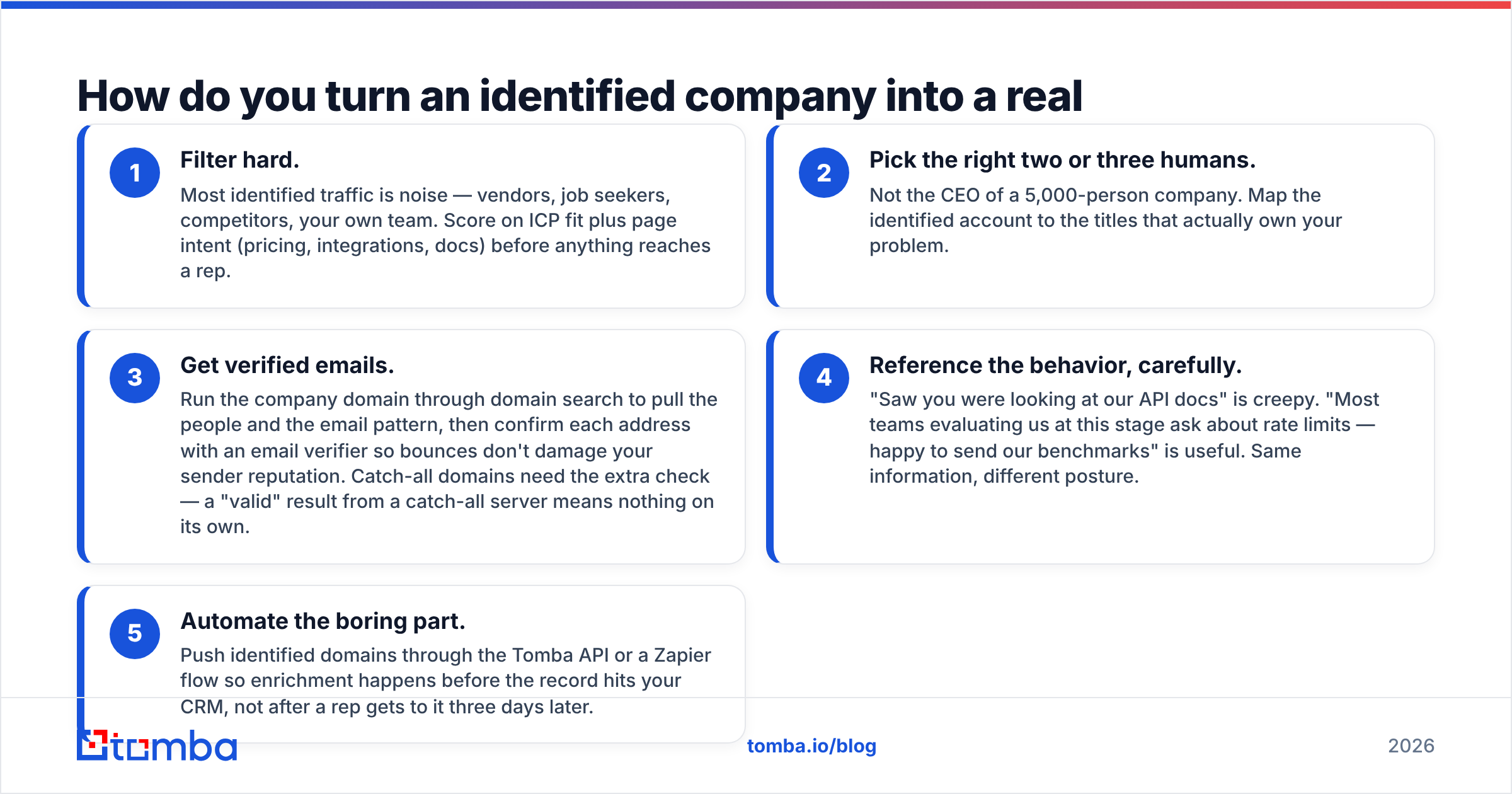
- Filter hard. Most identified traffic is noise — vendors, job seekers, competitors, your own team. Score on ICP fit plus page intent (pricing, integrations, docs) before anything reaches a rep.
- Pick the right two or three humans. Not the CEO of a 5,000-person company. Map the identified account to the titles that actually own your problem.
- Get verified emails. Run the company domain through domain search to pull the people and the email pattern, then confirm each address with an email verifier so bounces don't damage your sender reputation. Catch-all domains need the extra check — a "valid" result from a catch-all server means nothing on its own.
- Reference the behavior, carefully. "Saw you were looking at our API docs" is creepy. "Most teams evaluating us at this stage ask about rate limits — happy to send our benchmarks" is useful. Same information, different posture.
- Automate the boring part. Push identified domains through the Tomba API or a Zapier flow so enrichment happens before the record hits your CRM, not after a rep gets to it three days later.
Step 3 is where most visitor-identification investments quietly fail. Teams pay for identification, get a list of accounts, and then send to guessed addresses like info@ or a permutator output nobody checked. Bounce rates climb, domain reputation degrades, and six months later the conclusion is "visitor ID didn't work" when the actual failure was in the contact layer.
Which alternative should you pick?#
Short version by situation:
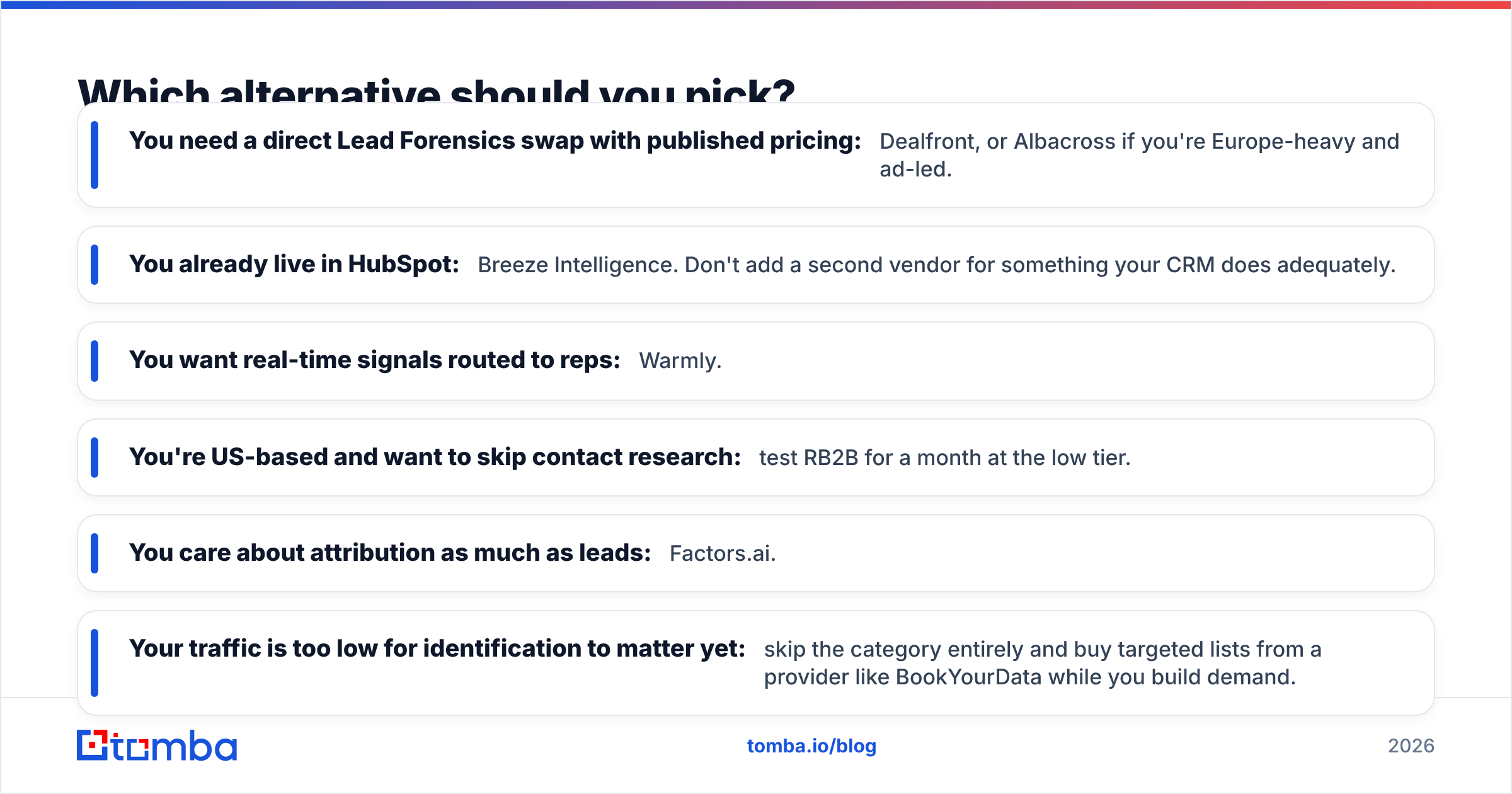
- You need a direct Lead Forensics swap with published pricing: Dealfront, or Albacross if you're Europe-heavy and ad-led.
- You already live in HubSpot: Breeze Intelligence. Don't add a second vendor for something your CRM does adequately.
- You want real-time signals routed to reps: Warmly.
- You're US-based and want to skip contact research: test RB2B for a month at the low tier.
- You care about attribution as much as leads: Factors.ai.
- Your traffic is too low for identification to matter yet: skip the category entirely and buy targeted lists from a provider like BookYourData while you build demand.
- Your bottleneck is deliverable contact data, not account names: Tomba.
There is no single winner here, because "alternative to Lead Forensics" means three different products depending on why you're leaving. Be honest about which of the four friction points above is yours, and the shortlist collapses to two options fast.
Ready to close the loop on your anonymous traffic?#
Identifying the account is the easy part. Reaching the person is what pays for the tool.
Start with the Tomba Email Finder — feed it the companies your visitor identification tool surfaces and get verified, deliverable addresses for the people who actually own the buying decision. The free tier gives you 25 searches a month to test match quality on your own accounts before spending anything, and Tomba pricing starts at $49/mo with no annual lock-in. Run your last 50 identified companies through it and compare the verified-contact yield against whatever your current stack produces.
Related guides#
Ready to find emails that actually work?
Join 150,000+ professionals who stopped guessing and started sending. Free credits on signup — no credit card required.
Get the Tomba newsletter
Practical outbound tactics and product updates — once every two weeks.
About the author