Lead Forensics Pricing, Reviews, Pros and Cons (2026)
Lead Forensics hides its price behind a demo call and a 12-month contract. Here is what buyers actually report paying, what reviewers praise and complain about, and when a cheaper visitor-ID stack makes more sense.
TL;DR
- Lead Forensics does not publish pricing. Every quote comes through a demo call, and every contract buyers describe is annual — usually 12 months, paid up front or quarterly.
- Publicly reported figures cluster in the low-to-mid four figures per month for mid-market accounts, with entry deals reported closer to $250–$500/month on limited visitor volume. Treat every number you read online, including these, as user-reported and non-binding.
- Reviews are genuinely split: strong praise for the visitor-identification data and onboarding, recurring complaints about price, renewal terms, and pressure during the sales cycle.
- The product solves one narrow job well — turning anonymous B2B website traffic into named companies and contacts. It is not a prospecting database, and it will not replace your email finder.
- If your only goal is contact data on accounts you already know, a $49/month email-finding stack does the job for roughly 2% of a Lead Forensics contract.
What is Lead Forensics and who actually buys it?#
Lead Forensics is a B2B website visitor identification platform. It matches the IP addresses hitting your site against a proprietary database of business IP ranges, then tells you which companies visited, which pages they read, how long they stayed, and which contacts at those companies you could reach out to.
Think of it like a doorbell camera for your website. Most of your traffic knocks, looks around, and leaves without ever filling in a form. Lead Forensics reads the license plate on the car in the driveway and tells you it was a procurement manager at a 500-person logistics firm reading your pricing page three times this week.
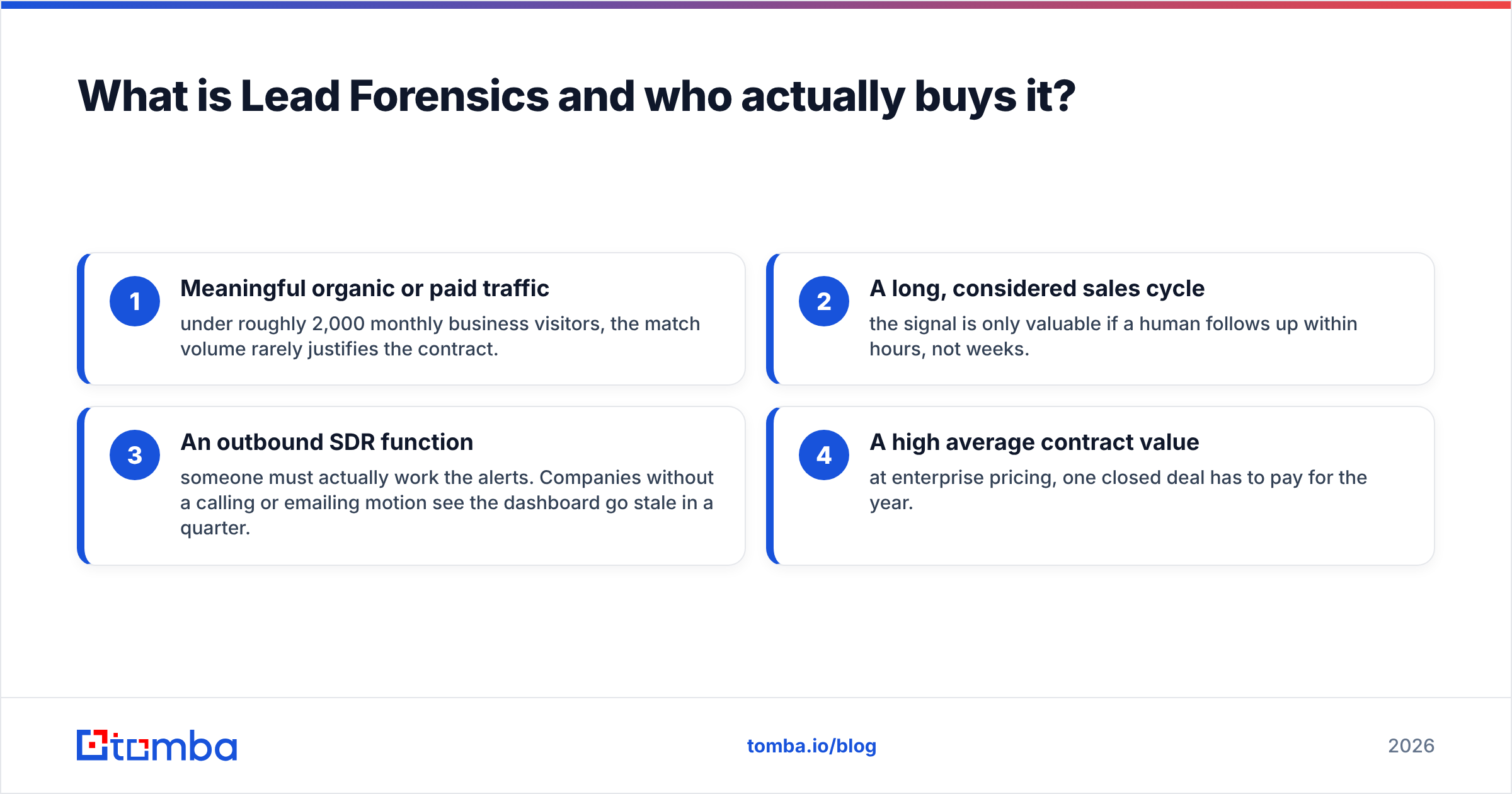
The typical buyer is a B2B company with:
- Meaningful organic or paid traffic — under roughly 2,000 monthly business visitors, the match volume rarely justifies the contract.
- A long, considered sales cycle — the signal is only valuable if a human follows up within hours, not weeks.
- An outbound SDR function — someone must actually work the alerts. Companies without a calling or emailing motion see the dashboard go stale in a quarter.
- A high average contract value — at enterprise pricing, one closed deal has to pay for the year.
The company has been operating since 2009 out of the UK and is one of the older names in the category. You can see its own framing on the Lead Forensics website, which — notably — contains no pricing page at all.
How does Lead Forensics pricing actually work?#
Here is the honest answer: nobody outside the company knows the rate card, and that is a deliberate commercial choice.
What is consistent across buyer reports on G2 and Capterra is the shape of the deal rather than the number:
- Quote-only. There is no self-serve signup, no credit card checkout, and no published tier list. You book a demo, a rep scopes your traffic, and a number arrives after the call.
- Annual commitment. Month-to-month is not the standard offer. Most reviewers describe a 12-month term; some report multi-year deals with a discount attached.
- Priced on visitor volume and seats. The two levers that move the quote are how many identified visitors you need per month and how many users touch the platform.
- Auto-renewal clauses. Several reviewers flag renewal terms that require written notice inside a specific window. Read that clause before you sign, not in month eleven.
- Add-ons. CRM integrations, additional contact data, and extra user seats have all been reported as line items rather than included features.
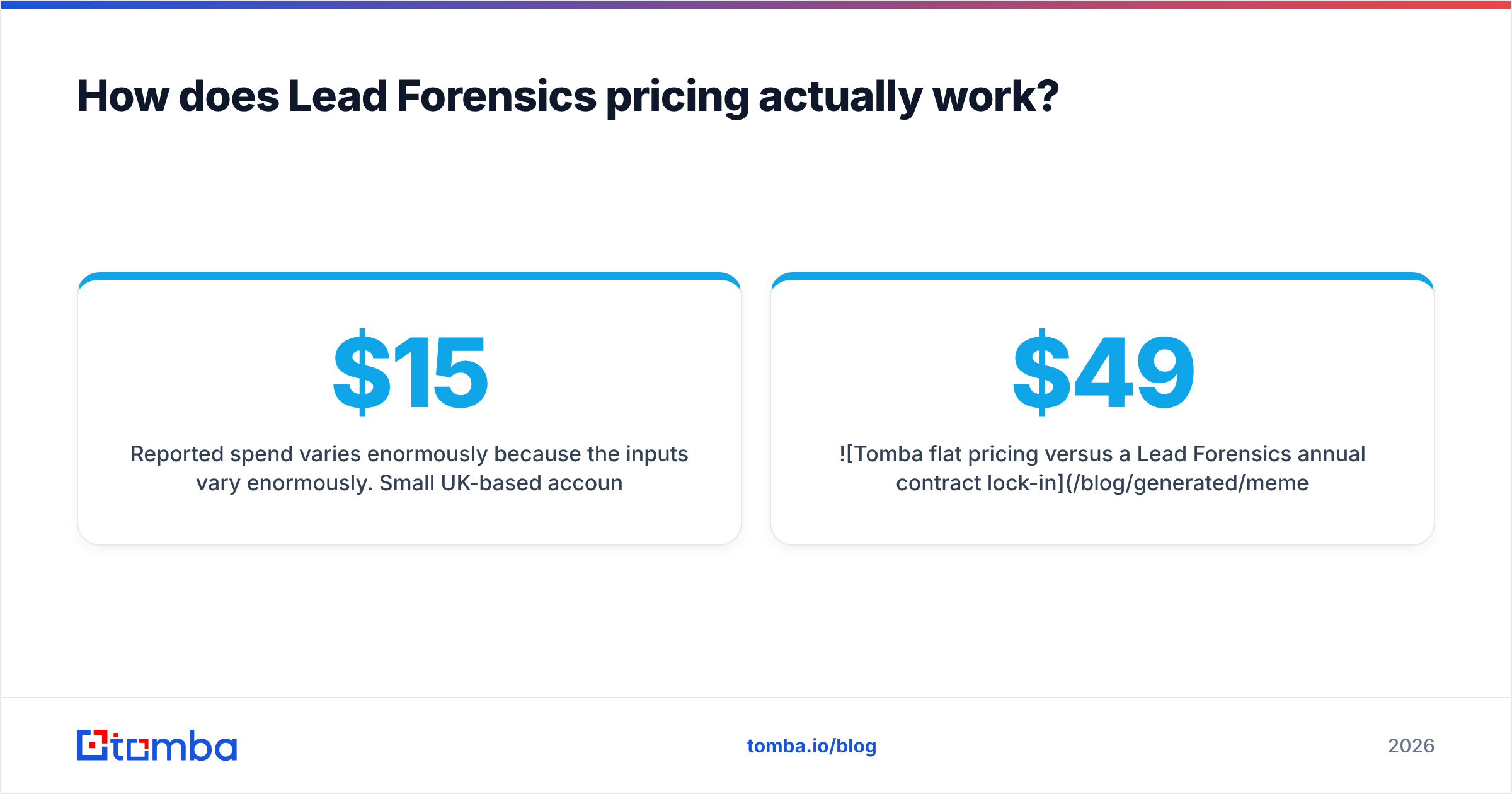
Reported spend varies enormously because the inputs vary enormously. Small UK-based accounts have described figures in the £2,000–£5,000/year range on restricted volume. Mid-market and enterprise buyers in North America more often describe $15,000–$40,000/year. Both can be true simultaneously — that is what usage-based, negotiated pricing looks like.

The practical consequence: you cannot budget for Lead Forensics from a blog post. You can only budget a range and decide in advance what your walk-away number is before the demo starts.
What do Lead Forensics reviews say in 2026?#
Aggregate scores on the major review sites have held steady in the 4.0–4.3 range for years, which is respectable for a category this expensive. But the averages hide a bimodal distribution — a lot of 5s and a meaningful cluster of 1s and 2s, with very little in the middle.
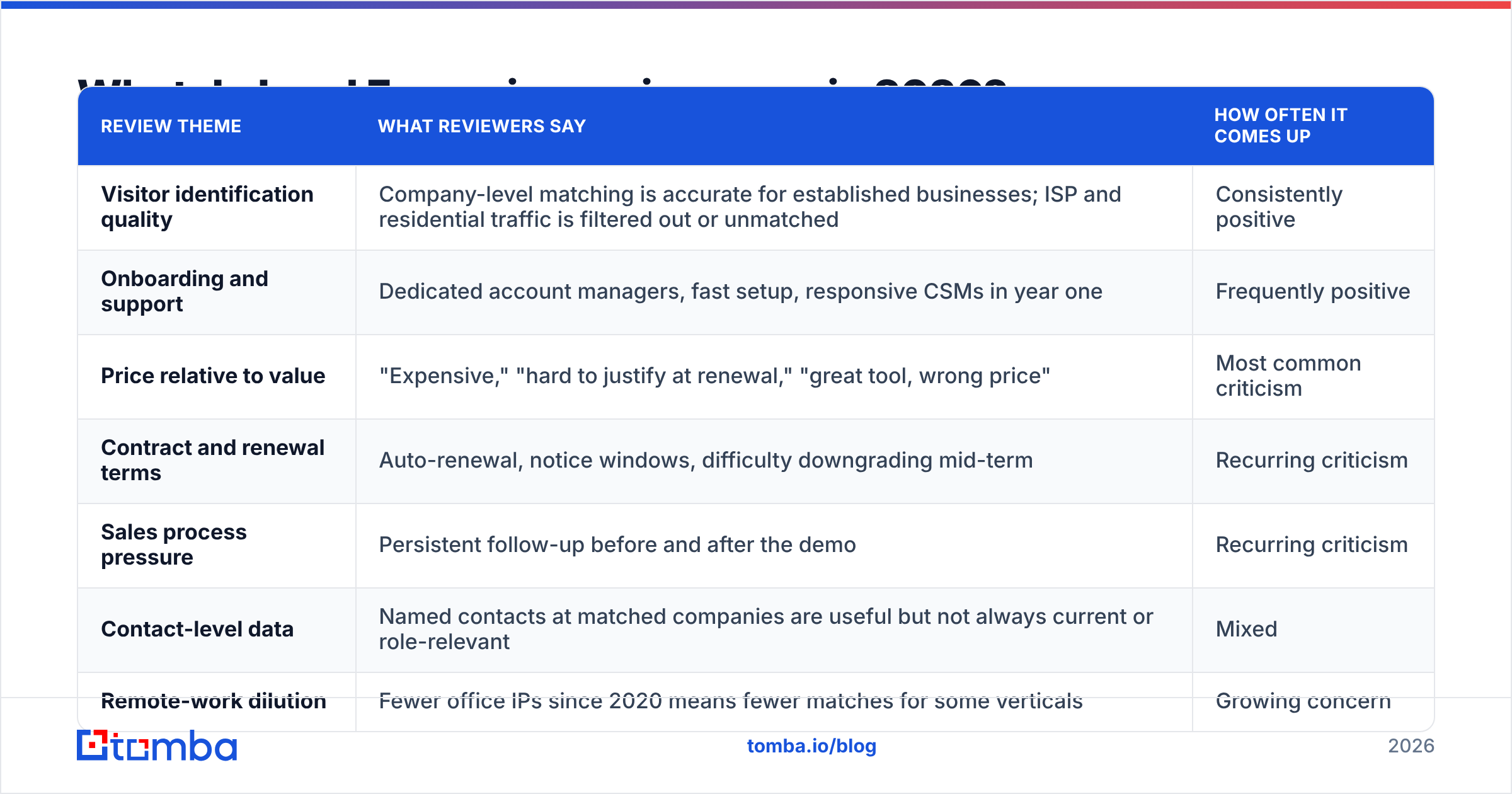
| Review theme | What reviewers say | How often it comes up |
|---|---|---|
| Visitor identification quality | Company-level matching is accurate for established businesses; ISP and residential traffic is filtered out or unmatched | Consistently positive |
| Onboarding and support | Dedicated account managers, fast setup, responsive CSMs in year one | Frequently positive |
| Price relative to value | "Expensive," "hard to justify at renewal," "great tool, wrong price" | Most common criticism |
| Contract and renewal terms | Auto-renewal, notice windows, difficulty downgrading mid-term | Recurring criticism |
| Sales process pressure | Persistent follow-up before and after the demo | Recurring criticism |
| Contact-level data | Named contacts at matched companies are useful but not always current or role-relevant | Mixed |
| Remote-work dilution | Fewer office IPs since 2020 means fewer matches for some verticals | Growing concern |
That last row deserves emphasis because it is structural, not a bug. IP-based identification depends on people browsing from corporate networks. Hybrid and fully remote workforces browse from home broadband, which resolves to a consumer ISP and cannot be matched to an employer. Every IP-based vendor in this category faces the same erosion, and match rates that looked great in 2019 look thinner in 2026.
What are the real pros and cons?#
Pros
- Category maturity. Fifteen-plus years of IP data and a large proprietary match database. This is not a six-month-old startup guessing at firmographics.
- Genuinely actionable alerts. Real-time notifications with page-level detail let an SDR call while intent is still warm — which is the entire value proposition.
- Strong onboarding. Reviewers repeatedly credit the account management team for getting the tracking script live and the alerting configured quickly.
- CRM and workflow integrations. Salesforce, HubSpot, and Microsoft Dynamics connections are standard, so identified accounts land where reps already work.
- Filtering that mostly works. ISP noise, bots, and irrelevant traffic are stripped before you see the list, which matters more than raw match count.
Cons
- Opaque pricing. You cannot compare it against alternatives without sitting through a sales process first, and that asymmetry favors the vendor.
- Annual lock-in. If match volume disappoints in month two, you still owe ten more months.
- Company-level, not person-level. Knowing that "Acme Logistics" visited is not the same as knowing who visited. You still need contact data to act.
- Declining match rates in remote-heavy verticals. Software, agencies, and consulting see this most acutely.
- Renewal friction. Enough reviewers mention notice-period surprises that it should be a standing item on your legal checklist.
How does Lead Forensics compare to the alternatives?#
Visitor identification is now a crowded category, and the pricing models diverge sharply. Some vendors sell annual enterprise contracts; others meter it per identified account; others bundle it into a broader data platform.
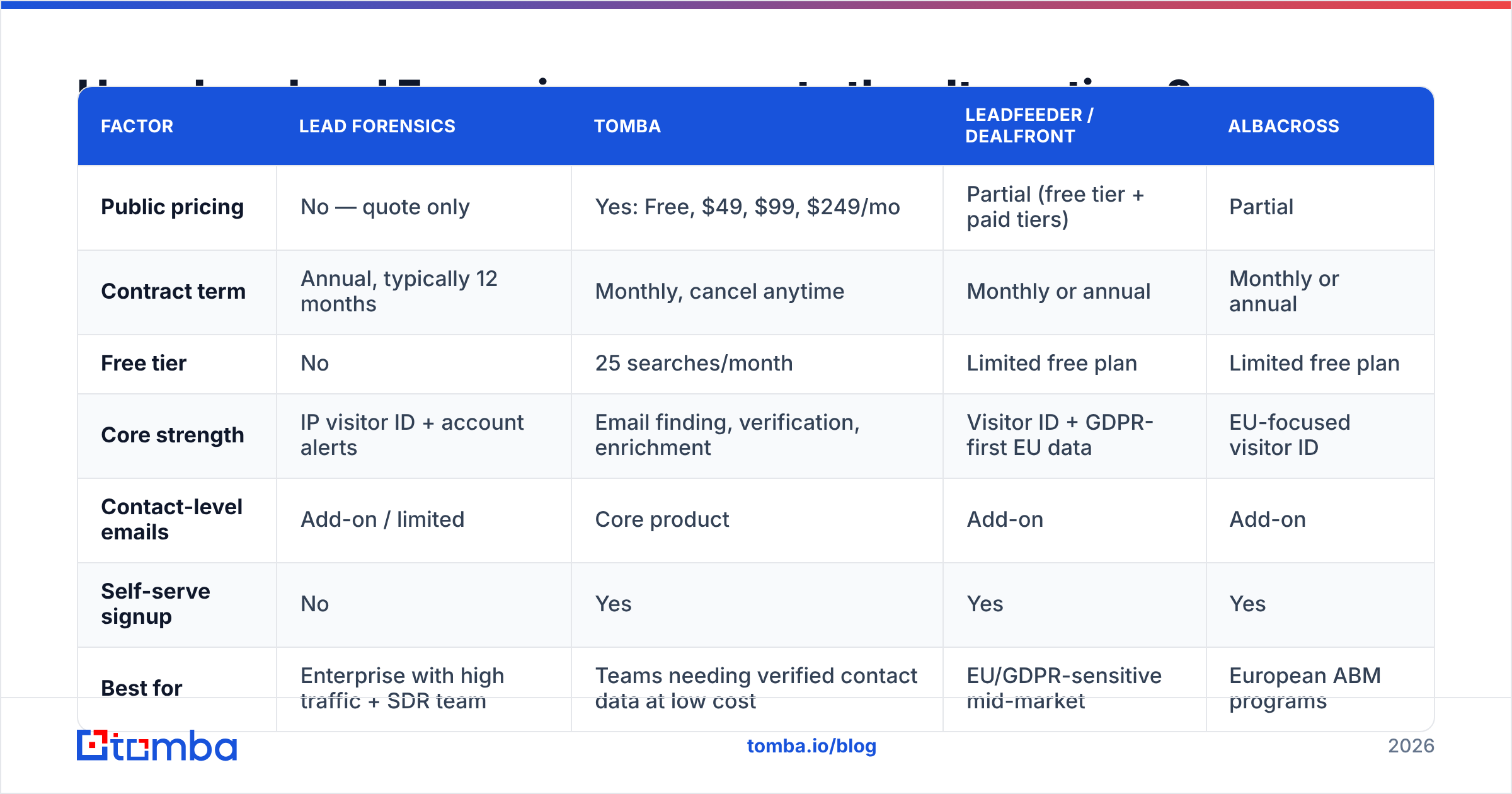
| Factor | Lead Forensics | Tomba | Leadfeeder / Dealfront | Albacross |
|---|---|---|---|---|
| Public pricing | No — quote only | Yes: Free, $49, $99, $249/mo | Partial (free tier + paid tiers) | Partial |
| Contract term | Annual, typically 12 months | Monthly, cancel anytime | Monthly or annual | Monthly or annual |
| Free tier | No | 25 searches/month | Limited free plan | Limited free plan |
| Core strength | IP visitor ID + account alerts | Email finding, verification, enrichment | Visitor ID + GDPR-first EU data | EU-focused visitor ID |
| Contact-level emails | Add-on / limited | Core product | Add-on | Add-on |
| Self-serve signup | No | Yes | Yes | Yes |
| Best for | Enterprise with high traffic + SDR team | Teams needing verified contact data at low cost | EU/GDPR-sensitive mid-market | European ABM programs |
| Typical entry cost | Four figures per month (reported) | $49/month | Double-digit to low-triple-digit monthly | Low-triple-digit monthly |
The important distinction is that these tools are not strict substitutes. Lead Forensics answers which companies visited. An email-finding platform answers how do I reach the right person there. Most functioning GTM stacks need both answers, and the cost-efficient move is to buy each from whoever is cheapest at that specific job rather than paying enterprise rates for a bundle.
If you want the visitor-side signal without a five-figure annual commitment, Tomba's website visitor reveal covers identification, and the email finder covers the contact layer — both under the same flat plan.
Is Lead Forensics worth it for your team?#
It depends on a number you can calculate before the demo.
Take your realistic identified-visitor volume, multiply by the share that fit your ICP, multiply by the share your SDRs can actually follow up on within 24 hours, then multiply by your historical outbound close rate and your average contract value. If that figure is not at least three times the annual quote, the deal does not work — and no amount of dashboard polish changes it.
Lead Forensics is likely worth it when:
- You have 5,000+ monthly business visitors from office networks (manufacturing, logistics, healthcare, and government-adjacent sectors still match well).
- Your ACV is above roughly $25,000, so a handful of sourced deals repays the contract.
- You have dedicated SDRs with capacity to work daily alerts.
- Your buying committee is large enough that early-stage anonymous research is a real signal.
Look elsewhere when:
- Your traffic is under ~2,000 business visitors monthly.
- Your buyers are remote-first (most software and services categories).
- You are a small team without a follow-up motion.
- What you actually need is verified contact data for accounts you have already identified — in which case a bulk email finder plus data enrichment solves it for a fraction of the cost.
What should you do before signing a contract?#
Treat the demo as a negotiation, not a product tour.
- Ask for a match-rate test on your own domain. Reputable vendors will run a sample against your live traffic. If they will not, that is information.
- Get the renewal clause in writing before the commercial call. Ask specifically for the notice period and whether renewal is automatic.
- Price the alternative stack first. Walk in knowing what visitor ID plus contact data costs from separate vendors. Tomba pricing is public and takes thirty seconds to check — use it as your anchor.
- Ask what happens if match volume undershoots. Is there a credit, a downgrade path, or nothing?
- Negotiate at quarter-end. Every reviewer who mentions discounting mentions timing.
- Pilot the follow-up process manually first. Export a week of your existing form fills, have an SDR work them, and measure the response rate. If that fails, more leads will not fix it.
The uncomfortable truth about this category is that most failed visitor-ID deployments fail on the follow-up side, not the data side. Buying better identification does not create sales capacity.
Frequently asked questions#
Does Lead Forensics offer a free trial? Reviewers describe a limited trial period arranged through sales rather than a self-serve free tier. There is no public free plan.
Is Lead Forensics GDPR compliant? The company identifies companies rather than individuals from IP data, which is the standard legal argument in this category. If you operate primarily in the EU, review the contact-data component with your DPO specifically, since that is where personal data enters the picture.
Can I cancel mid-contract? Based on user reports, no — annual terms run their course. Confirm the exact terms in your agreement.
What is a good match rate? Between 10% and 30% of total traffic is a realistic band for most B2B sites in 2026, heavily dependent on how office-based your audience is. Anyone promising dramatically more should be asked how.
The bottom line#
Lead Forensics is a capable product sold on an aggressive commercial model. If you have the traffic, the ACV, and the sales capacity to work the alerts daily, it can pay for itself. If any one of those three is missing, the annual contract becomes an expensive dashboard.
Before you commit five figures to identifying anonymous visitors, make sure you can actually reach the people at the companies you already know about. Start with the Tomba Email Finder — find and verify professional email addresses by domain, name, or company, with 25 free searches a month and a $49/month starter plan that does not require a demo call, a procurement review, or a twelve-month signature.
Related guides#
Ready to find emails that actually work?
Join 150,000+ professionals who stopped guessing and started sending. Free credits on signup — no credit card required.
Get the Tomba newsletter
Practical outbound tactics and product updates — once every two weeks.
About the author