Lead Funnel Explained: Stages, Metrics & 2026 Playbook
Most lead funnels leak in the same three places. Here's how the stages actually work in 2026, which metrics predict revenue, and how to fix conversion drops fast.
TL;DR
- A lead funnel is the staged path from anonymous traffic to closed revenue — visitor, lead, MQL, SQL, opportunity, customer. The stages only matter if each one has a written entry criterion.
- Most funnels leak in three predictable places: unqualified top-of-funnel volume, the MQL-to-SQL handoff, and stalled opportunities with no next step booked.
- Benchmark math beats vanity math. A B2B SaaS funnel that converts 2-3% visitor-to-lead, 25-30% MQL-to-SQL, and 20% SQL-to-close is healthy. Anything wildly above those numbers usually means your stage definitions are too loose.
- Data quality sets the ceiling. Bad contact data inflates top-of-funnel counts and destroys reply rates downstream — verify before you spend a single sequence slot on a record.
- The 2026 shift: fewer, better-qualified entries beat volume. Intent signals plus verified contact data outperform gated-PDF lead capture by a wide margin.
What is a lead funnel?#
A lead funnel is the model your team uses to describe how a stranger becomes a customer, broken into stages with defined entry and exit criteria. Think of it as an airport: passengers move through check-in, security, gate, and boarding. Each checkpoint has a rule. You do not get to the gate because you feel ready — you get there because you cleared the previous checkpoint's criterion.
That analogy matters because most broken funnels are not marketing problems or sales problems. They are checkpoint-definition problems. When "MQL" means "downloaded anything" to marketing and "wants a demo this quarter" to sales, the funnel produces arguments instead of forecasts.
The technical definition: a lead funnel is a sequential, measurable pipeline where each stage has (1) a named owner, (2) an objective entry criterion, (3) a target conversion rate to the next stage, and (4) a maximum time-in-stage before the record is recycled or disqualified.
Notice what is not in that definition: channel, tactic, or tool. A lead funnel is a measurement structure. Your paid search campaign, your outbound sequences, and your webinar program all feed the same structure.
What are the stages of a lead funnel?#
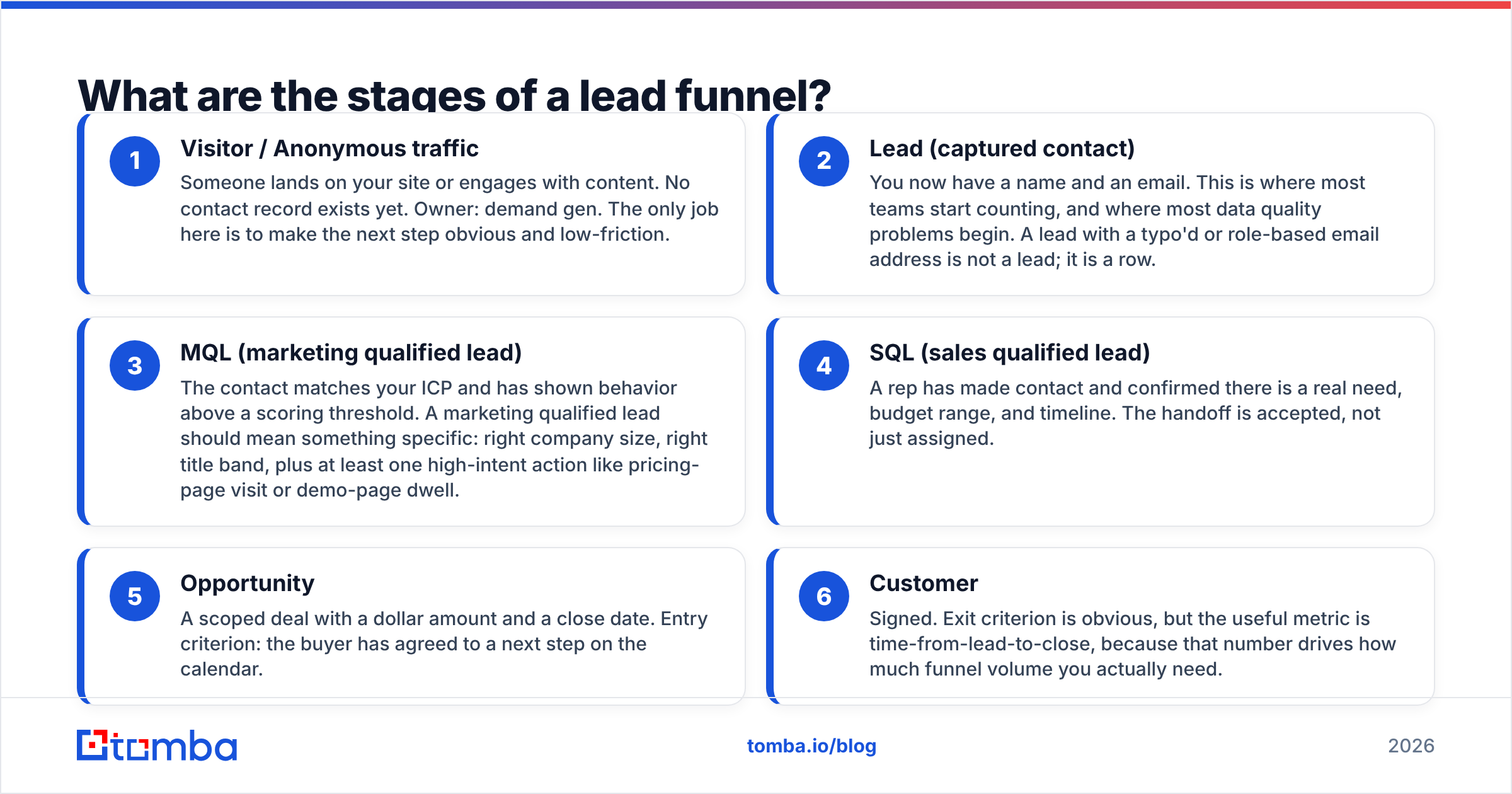
Six stages cover almost every B2B model. Some teams collapse two, some split opportunity into three — the count is less important than the criteria.
- Visitor / Anonymous traffic — Someone lands on your site or engages with content. No contact record exists yet. Owner: demand gen. The only job here is to make the next step obvious and low-friction.
- Lead (captured contact) — You now have a name and an email. This is where most teams start counting, and where most data quality problems begin. A lead with a typo'd or role-based email address is not a lead; it is a row.
- MQL (marketing qualified lead) — The contact matches your ICP and has shown behavior above a scoring threshold. A marketing qualified lead should mean something specific: right company size, right title band, plus at least one high-intent action like pricing-page visit or demo-page dwell.
- SQL (sales qualified lead) — A rep has made contact and confirmed there is a real need, budget range, and timeline. The handoff is accepted, not just assigned.
- Opportunity — A scoped deal with a dollar amount and a close date. Entry criterion: the buyer has agreed to a next step on the calendar.
- Customer — Signed. Exit criterion is obvious, but the useful metric is time-from-lead-to-close, because that number drives how much funnel volume you actually need.
Write down each criterion in one sentence. If your team cannot state the MQL criterion from memory, the funnel is decorative.
How do you measure a lead funnel?#
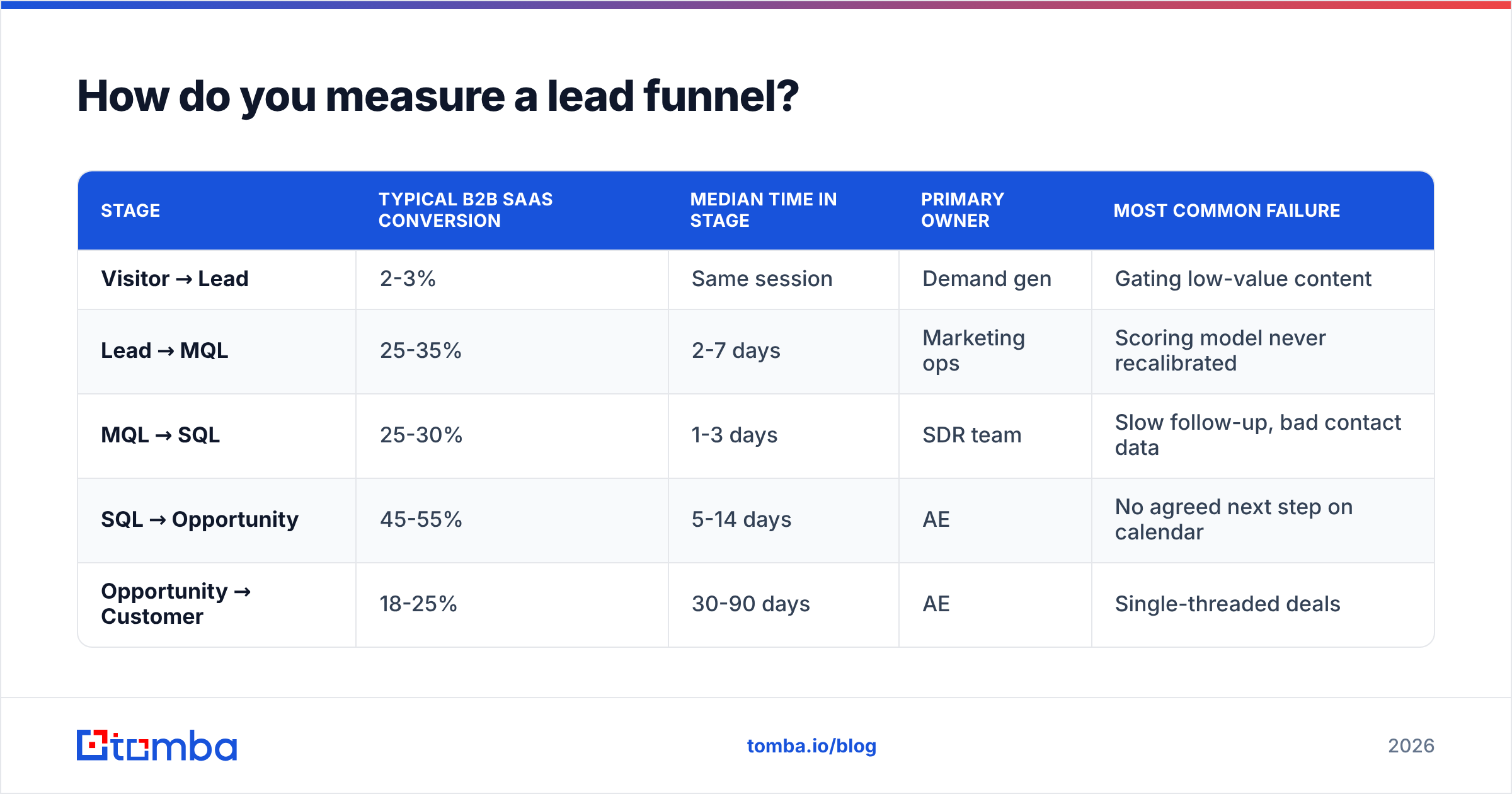
Measure four things per stage: volume in, conversion rate out, median time in stage, and cost per unit. Everything else is a derivative.
| Stage | Typical B2B SaaS conversion | Median time in stage | Primary owner | Most common failure |
|---|---|---|---|---|
| Visitor → Lead | 2-3% | Same session | Demand gen | Gating low-value content |
| Lead → MQL | 25-35% | 2-7 days | Marketing ops | Scoring model never recalibrated |
| MQL → SQL | 25-30% | 1-3 days | SDR team | Slow follow-up, bad contact data |
| SQL → Opportunity | 45-55% | 5-14 days | AE | No agreed next step on calendar |
| Opportunity → Customer | 18-25% | 30-90 days | AE | Single-threaded deals |
Two numbers deserve special attention. First, MQL-to-SQL conversion is the single best health indicator of the whole system — it tells you whether marketing's definition of "qualified" survives contact with a human buyer. Below 20% and your scoring model is generating noise. Above 60% and you are probably under-counting MQLs, leaving demand on the table.
Second, median time in stage. Volume problems are visible; velocity problems hide. A funnel where 400 MQLs sit for 11 days before first touch will underperform a funnel with 150 MQLs touched in 30 minutes. HubSpot's research on sales follow-up has consistently shown response speed as one of the highest-leverage variables in the entire process.
Track your response rate per stage separately from conversion. Conversion tells you the outcome; response rate tells you whether your messaging or your data is the constraint.
Where do lead funnels actually leak?#
Three leaks account for most lost pipeline. In order of dollar impact:
Leak 1: Top-of-funnel volume that never had a chance. Gated ebooks attract researchers, students, and competitors. If 60% of your leads are outside your ICP, every downstream rate looks terrible and nobody can tell whether the problem is marketing, product, or sales. Fix: enrich on capture. Before a record enters scoring, append company size, industry, and tech stack, then route non-ICP records to nurture instead of to the SDR queue. Data enrichment at the point of capture is cheaper than SDR time spent disqualifying.
Leak 2: The MQL-to-SQL handoff. This is where bad contact data does the most damage. A rep gets an MQL with an email that bounces, a phone number that rings a disconnected line, and no LinkedIn profile. They mark it "no contact" and move on. The lead was real; the record was not. Fix: verify every email before it hits a sequence. An email verifier run costs a fraction of a cent per record and prevents the bounce cascade that damages sender reputation across your whole domain.
Leak 3: Opportunities with no scheduled next step. An opportunity without a calendar invite is a wish. Enforce it as a stage-entry rule, not a coaching suggestion.
There is a fourth leak worth naming: stage inflation. When quota pressure hits, records get pushed forward without meeting criteria. Your forecast gets worse, not better. Audit a random sample of 20 opportunities per quarter against written criteria and report the pass rate.
How is a lead funnel different from a sales pipeline?#
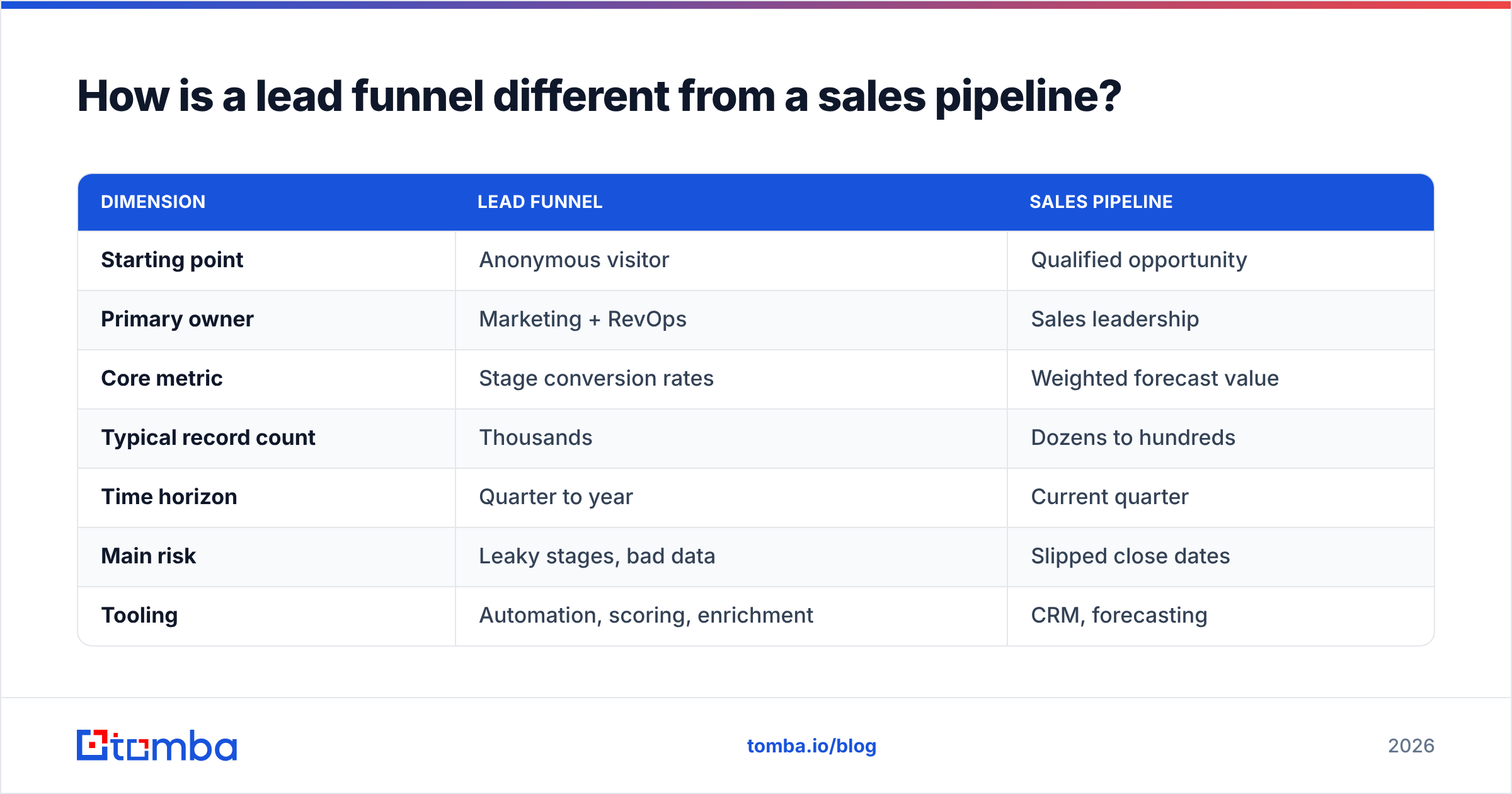
They overlap but answer different questions. The funnel is a marketing-and-sales-wide model of how strangers become buyers. The pipeline is the sales-owned subset covering opportunities that are actively being worked.
| Dimension | Lead funnel | Sales pipeline |
|---|---|---|
| Starting point | Anonymous visitor | Qualified opportunity |
| Primary owner | Marketing + RevOps | Sales leadership |
| Core metric | Stage conversion rates | Weighted forecast value |
| Typical record count | Thousands | Dozens to hundreds |
| Time horizon | Quarter to year | Current quarter |
| Main risk | Leaky stages, bad data | Slipped close dates |
| Tooling | Automation, scoring, enrichment | CRM, forecasting |
Practical consequence: if you only measure the pipeline, you find out about a funnel problem one sales cycle too late. Reviewing both in the same weekly meeting is the single cheapest fix a revenue operations function can make.
What does a modern lead funnel look like in 2026?#
The shape changed. Buyers complete most of their research before they will talk to anyone, so the classic "capture email, nurture for six weeks, hand to SDR" sequence now catches fewer real buyers per thousand contacts than it did five years ago.
What works now:
- Signal-first entry. Instead of waiting for a form fill, identify accounts showing intent — repeat site visits, job postings for relevant roles, competitor tool installs — and build the contact list yourself.
- Verified contact data before outreach, not after bounces. Deliverability filtering at Google and Microsoft has tightened. A 4% bounce rate that was survivable in 2021 will now throttle your domain.
- Fewer stages, harder criteria. Teams that cut from eight stages to five and tightened entry rules generally report better forecast accuracy, because every remaining stage carries real information.
- Multi-channel per stage. Email plus phone plus LinkedIn outreach in the same stage, rather than channel-specific funnels that double-count the same human.
- Human review on AI-scored leads. Automated scoring is faster than a human and worse at edge cases. Sample-audit it monthly.
If you only change one thing this quarter, change where contact data comes from. Self-serve list purchases and stale exports are the root cause of most "our outbound doesn't work" conclusions.
Which tools support each funnel stage?#
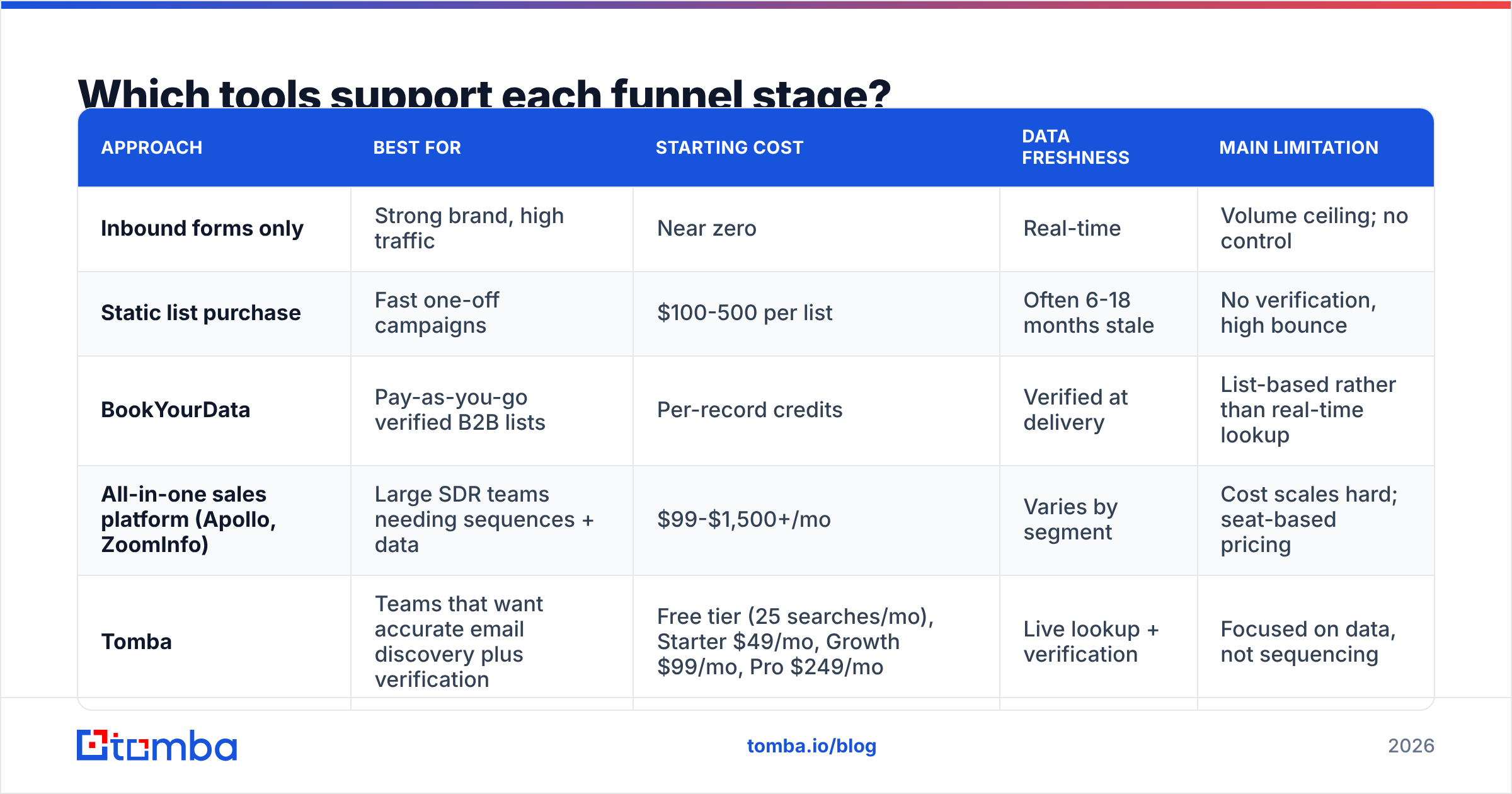
You do not need a 14-tool stack. You need coverage at four points: identify, capture, verify, and engage. Here is an honest comparison of the common approaches.
| Approach | Best for | Starting cost | Data freshness | Main limitation |
|---|---|---|---|---|
| Inbound forms only | Strong brand, high traffic | Near zero | Real-time | Volume ceiling; no control |
| Static list purchase | Fast one-off campaigns | $100-500 per list | Often 6-18 months stale | No verification, high bounce |
| BookYourData | Pay-as-you-go verified B2B lists | Per-record credits | Verified at delivery | List-based rather than real-time lookup |
| All-in-one sales platform (Apollo, ZoomInfo) | Large SDR teams needing sequences + data | $99-$1,500+/mo | Varies by segment | Cost scales hard; seat-based pricing |
| Tomba | Teams that want accurate email discovery plus verification | Free tier (25 searches/mo), Starter $49/mo, Growth $99/mo, Pro $249/mo | Live lookup + verification | Focused on data, not sequencing |
Match the tool to the leak. If your problem is top-of-funnel ICP quality, enrichment and intent tooling matter most. If your problem is MQL-to-SQL, contact accuracy and speed-to-lead matter most. Buying a sequencing platform when your bounce rate is 9% just automates the failure.
A practical minimum stack for a five-person team: analytics for visitor-stage data, a domain search tool for building targeted contact lists, verification before every send, and a CRM with enforced stage criteria. That covers all four points without a six-figure contract. Independent review sites like G2's lead intelligence category are useful for spotting where each vendor's real strength sits before you book demos.
How do you fix a leaking funnel in 30 days?#
Run it as a sequence, not a project.
- Week 1 — Instrument. Pull volume, conversion, and median time-in-stage for the last two quarters. Do not fix anything yet. Most teams discover their real problem is not where they assumed.
- Week 2 — Rewrite criteria. Get marketing and sales in one room. Write one sentence per stage. Publish it where both teams see it daily.
- Week 3 — Clean data. Bulk-verify your existing contact database. Remove role-based addresses, hard bounces, and duplicates. Expect to delete 15-30% of records and see reply rates improve immediately.
- Week 4 — Enforce and re-measure. Turn stage criteria into required CRM fields. Re-pull the same metrics. The rates will look worse on paper because they are finally honest. That is the point.
Repeat quarterly. A funnel is not a diagram you draw once; it is a measurement you recalibrate.
Common questions about lead funnels#
How many leads do I need to hit a revenue target? Work backwards. Target revenue divided by average deal size gives required customers. Divide by your opportunity-to-customer rate, then by SQL-to-opportunity, and so on up the chain. If the top number looks impossible, your problem is conversion rates or deal size, not lead volume.
Should I have separate funnels for inbound and outbound? Separate reporting, shared stage definitions. Different sources have genuinely different conversion profiles, but if "SQL" means two different things depending on source, your aggregate numbers are meaningless.
How long should a lead stay in nurture before disqualification? Set a hard limit — 90 or 180 days depending on your sales cycle — then recycle. Infinite nurture lists rot, and sending to rotted lists is how deliverability problems start.
Is the funnel model outdated? The flywheel and bowtie models are better at describing post-sale expansion. For pre-sale measurement, staged funnels remain the clearest way to locate a problem. Use both.
Start with data you can trust#
Every fix above depends on one thing: contact records that are actually correct. You can rewrite stage definitions all quarter, but if 20% of your emails bounce, your MQL-to-SQL rate will stay broken and you will keep blaming the wrong team.
Start there. Use the Tomba Email Finder to build ICP-matched contact lists from company domains, with verification built into the same workflow so bad records never reach a sequence. The free tier gives you 25 searches a month to test accuracy against a list you already know, and paid plans start at $49/mo when you are ready to scale. Fix the data, then fix the funnel — in that order.
Related guides#
// get started
Find, verify and enrich your first contacts today
Start on the free plan with 25 searches a month, then scale when your team is ready.
Free plan · No credit card required · GDPR & CCPA
Get the Tomba newsletter
Product and data updates
// about the author