Lead Gen Business Model: How It Works and What It Pays
A lead gen business sells qualified interest, not products. Here is how the model actually makes money in 2026 — pricing structures, margins, unit economics, and the failure modes nobody warns you about.
TL;DR
- A lead gen business model sells qualified buyer interest to companies that would rather buy pipeline than build it. You own the traffic and the data; the client owns the close.
- Four pricing structures dominate: pay-per-lead (PPL), pay-per-call, monthly retainer, and revenue share. PPL is the easiest to sell and the hardest to survive on.
- Gross margins look fantastic (60-85%) until you count refunded leads, ad-cost inflation, and the 30% of contacts that bounce. Data quality is the actual profit lever.
- The businesses that last own a durable traffic source — SEO, a niche newsletter, a proprietary database — instead of renting clicks from Google at whatever price the auction sets tomorrow.
- Expect 4-8 months before a niche is profitable. Your first client will churn. Plan the second one before the first one signs.
What is a lead gen business model?#
A lead gen business model is simple in structure and brutal in execution: you generate people or companies who have shown buying intent, qualify them against a spec, and sell them to a company that wants the sale.
Think of it like a fishing charter. The restaurant doesn't want to buy a boat, learn the tides, or hire a captain. It wants fresh fish on Tuesday at a predictable price. You own the boat and the knowledge of where the fish are. That knowledge is the moat — not the boat.
The model splits into two broad camps:
- Consumer lead gen (B2C) — solar, insurance, mortgages, home services, legal. High volume, low unit price ($15-$250 per lead), heavy paid-media dependency, and aggressive regulatory scrutiny around consent.
- B2B lead gen — SaaS, agencies, professional services, manufacturing. Lower volume, much higher unit price ($80-$600 per qualified lead, more for enterprise), built on data, outbound, content, and intent signals rather than raw ad spend.
- Hybrid agencies — retainer-based teams that run the whole outbound motion (list building, copy, sending, booking) and charge for the system rather than per lead.
- Marketplaces and aggregators — you build a comparison site or directory, rank for commercial keywords, and auction each inquiry to multiple buyers. Highest ceiling, longest ramp.
The distinction matters because the unit economics, the cash-flow shape, and the technical stack are different in each. A solar PPL operator lives and dies by cost-per-click. A B2B appointment-setting agency lives and dies by email deliverability and data accuracy.

How does a lead gen business actually make money?#
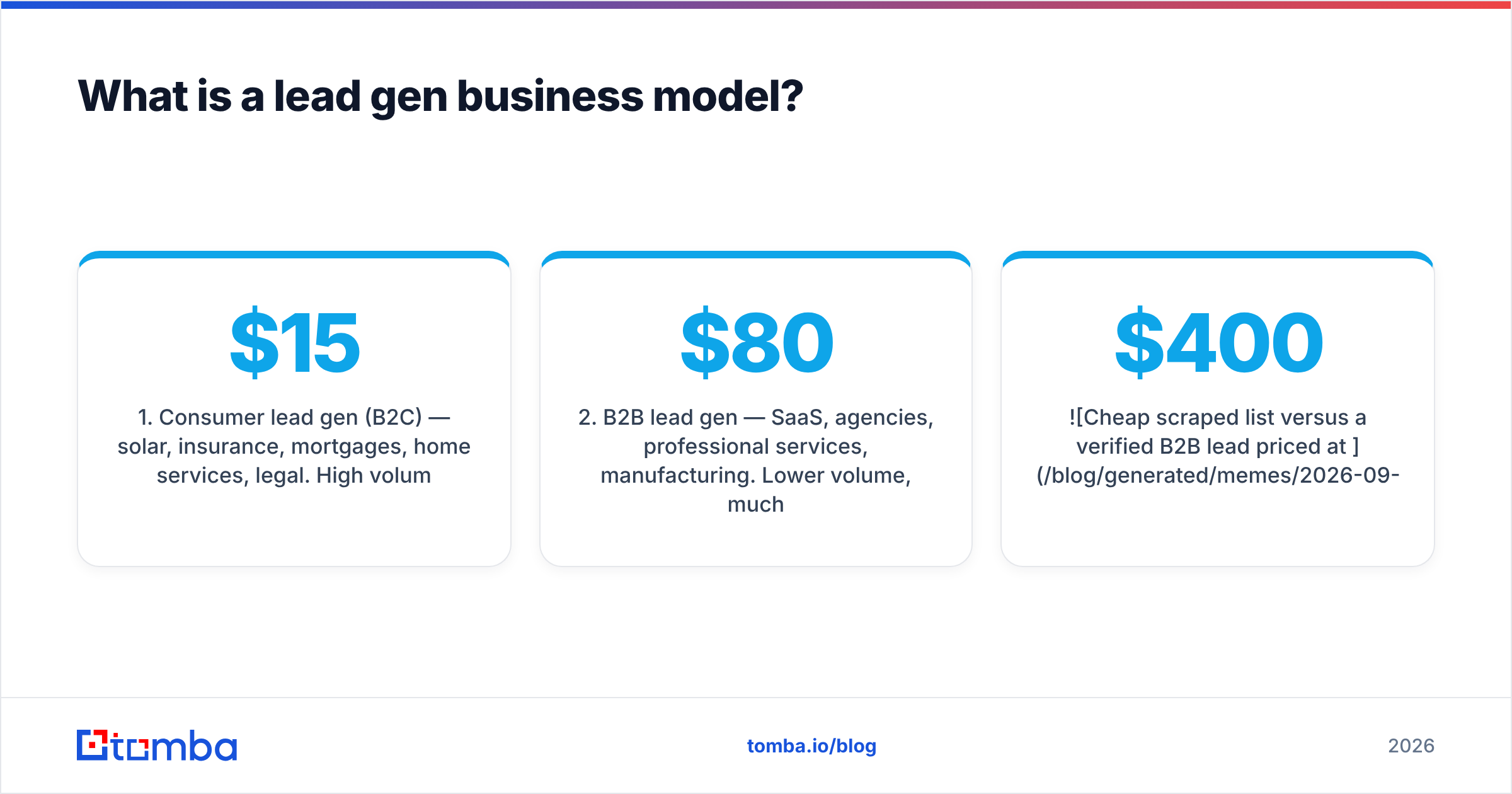
Revenue comes from one of four pricing structures, and picking wrong is the most common first-year mistake.
| Pricing model | Typical price point | Who carries the risk | Cash flow | Best fit |
|---|---|---|---|---|
| Pay-per-lead (PPL) | $15-$600 per lead | You | Lumpy, back-loaded | Proven niche, predictable CPA |
| Pay-per-call | $25-$300 per qualified call | You | Lumpy | Home services, legal, insurance |
| Monthly retainer | $2,500-$15,000/mo | Client | Predictable, front-loaded | B2B agencies, appointment setting |
| Revenue share / CPA | 5-25% of closed deal | Shared | Very back-loaded | High-ACV SaaS, real estate |
| Data licensing / list | $0.05-$2 per verified record | Client | Immediate | Enrichment, database plays |
Pay-per-lead is the model buyers ask for because it moves all risk onto you. You spend on traffic, you qualify, and you only get paid on delivery. If your cost-per-lead drifts from $40 to $75 because a competitor entered the auction, your margin evaporates overnight. Never sign a fixed-price PPL contract longer than 90 days without a repricing clause.
Retainers are the opposite trade. You get paid whether or not the month produces, which is why clients scrutinize them harder and churn faster when results lag. Retainer businesses are more fundable and more sellable — recurring revenue multiples beat transactional ones by 2-3x at exit.
Revenue share sounds aligned and usually isn't. You have no visibility into the client's CRM hygiene, no control over their follow-up speed, and no leverage when they claim a deal "would have closed anyway." Only take rev-share when you also control the sending domain and can independently attribute.
The mature operators run a blend: a retainer floor that covers overhead, plus PPL overflow that captures upside. That structure survives a bad quarter.
What does the P&L actually look like?#
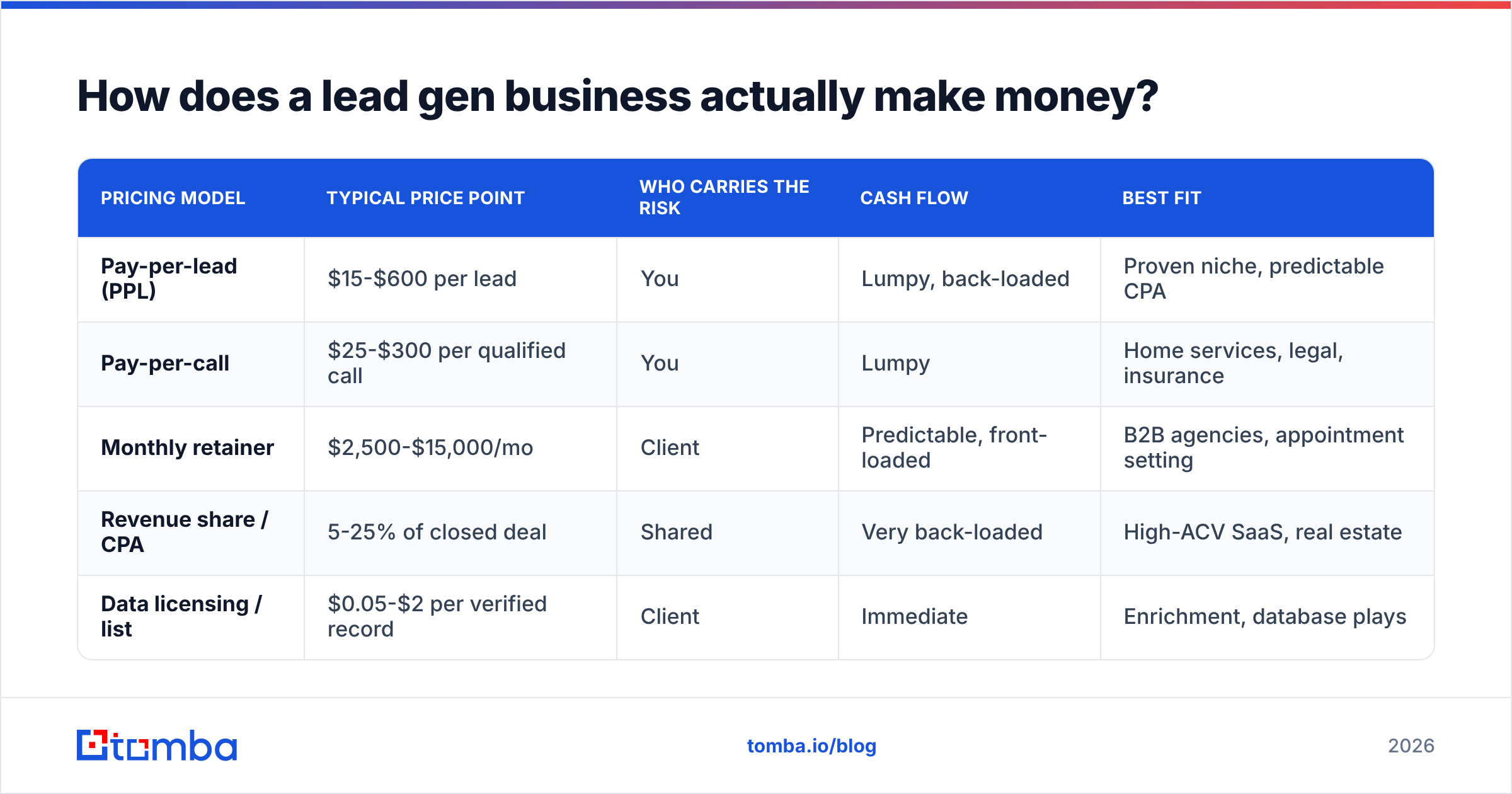
Here is a realistic monthly P&L for a mid-size B2B lead gen operation delivering roughly 400 qualified leads a month at $120 each.
| Line item | Monthly | % of revenue |
|---|---|---|
| Revenue (400 leads × $120) | $48,000 | 100% |
| Paid media / traffic acquisition | $14,400 | 30% |
| Data + enrichment tooling | $1,900 | 4% |
| Sending infrastructure (domains, inboxes, warmup) | $1,100 | 2% |
| SDR / qualification labor | $11,500 | 24% |
| Refunds and credited leads | $3,400 | 7% |
| Software + CRM + attribution | $1,600 | 3% |
| Gross profit | $14,100 | 29% |
Two numbers in that table decide whether the business works.
The first is refunds and credited leads at 7%. Every PPL contract has a replacement clause: wrong number, out of ICP, duplicate, unreachable. If your contact data is stale, that line climbs to 15-20% and eats your entire margin. This is why serious operators treat verification as infrastructure, not a nice-to-have — a bounced or invalid contact isn't just a wasted send, it's a clawback. Running every record through an email verifier before delivery is the cheapest insurance in the model.
The second is traffic acquisition at 30%. That is healthy. At 45% you are working for Google. The businesses that hold that line own organic assets: a ranking comparison site, a niche newsletter, a community, or a proprietary dataset they can query instead of buy.
What tech stack does a lead gen business need?#
You need four layers, and most beginners over-invest in layer four while ignoring layer two.
- Traffic and signal — SEO content, paid search, paid social, LinkedIn, intent data, or website visitor identification. This is where you find who is in market.
- Contact resolution — turning a company name, a LinkedIn profile, or an anonymous visitor into a reachable human. This is a domain search and email finder problem, and it is where lead quality is won or lost.
- Verification and enrichment — validating deliverability, catching catch-all domains, appending firmographics, job titles, and phone numbers so the lead meets spec.
- Delivery and attribution — CRM push, webhook, spreadsheet, or API handoff, plus the reporting that proves you delivered what you sold.
Layer two is the margin layer. If you pay $18 in ad spend to identify a company and then cannot reach the right person, you have paid for nothing. Most operators solve this with an API — pull the domain, resolve the decision-maker, verify, push. A email finder API call costs cents; a refunded lead costs the full price.
For outbound-heavy models, add sender infrastructure: separate sending domains, warmed inboxes, SPF/DKIM/DMARC configured correctly, and a hard ceiling on daily volume per inbox. Email deliverability collapse is the single most common reason an agency's results fall off a cliff in month five.
Is lead generation still profitable in 2026?#
Yes, but the easy version is gone.
Three things changed. First, buyers got sophisticated — they track cost-per-opportunity, not cost-per-lead, and they will cancel a contract that delivers 300 leads and zero pipeline. Second, inbox providers tightened bulk-sender requirements, which killed the spray-and-pray outbound agencies that priced on volume. Third, AI made mediocre content and mediocre email copy free, which means the commodity end of the market is deflating fast.
What is growing: narrow vertical plays with real domain knowledge. A lead gen business serving only dental practice acquisitions, or only mid-market logistics software, can charge 3-5x the generalist rate because the qualification spec is something only an insider can write. G2's category data shows the same pattern in tooling — buyers are consolidating around specialized, verifiable data rather than the broadest database.
The old pitch was "we'll get you more leads." The 2026 pitch is "we'll get you 40 conversations with logistics COOs at companies running legacy TMS software, and here is how we know." The second one is defensible.
How do you price a lead gen offer?#
Work backwards from your client's economics, never from your costs.
Find three numbers before you quote: their average deal value, their lead-to-close rate, and their current cost per acquisition. If a client closes 8% of qualified leads at a $9,000 average deal, each lead is worth $720 in revenue to them. Price at 10-20% of that — $70 to $145 — and you are an obvious yes. Price at $400 and you are negotiating against their own internal team.
A practical pricing sequence:
- Step 1 — Define the spec in writing. Industry, headcount range, geography, title seniority, verified email required, phone optional. Ambiguity here becomes a refund later.
- Step 2 — Pilot at cost. Deliver 50 leads at break-even to learn the true CPA in this niche. You cannot price what you have not measured.
- Step 3 — Set the floor. Your price must cover CPA + 20% refund buffer + 35% gross margin minimum.
- Step 4 — Add a volume ceiling. Cap monthly delivery. Uncapped contracts force you into worse traffic sources at worse prices.
- Step 5 — Build in a 90-day reprice. Ad auctions move. Your contract should too.
The buffer in step three is not conservatism, it is survival. Operators who price to a 20% margin have no room for a bad month, and lead gen always has bad months.
What kills most lead gen businesses?#
Four failure modes, in rough order of body count.
Single-channel dependency. You build everything on Google Ads, a policy change or a bidder with deeper pockets arrives, and CPA doubles in a week. The fix is boring: two traffic sources minimum before you scale, with at least one organic.
Client concentration. One client at 70% of revenue is not a business, it is a job with extra steps and no severance. Cap any single client at 30-35% of revenue even if it means turning down volume.
Quality drift. Month one you hand-qualify every lead. Month six you are volume-chasing and the spec has quietly loosened. The client notices before you do. Audit a random sample of 20 delivered leads every week against the written spec — a discipline borrowed straight from how HubSpot frames lead qualification hygiene.
Data decay. B2B contact data degrades roughly 2-3% per month as people change jobs. A list built in January is meaningfully worse by June. Re-verification and data enrichment on a rolling schedule is not optional; it is the maintenance cost of the asset you are selling.
There is a fifth, quieter killer: building no asset at all. If your entire operation is "run ads, forward form fills," you have a margin, not a business. The operators who sell for real multiples own something — a ranked site, a 200k-record vertical database, a newsletter with 30k subscribers in one industry.
Which lead gen model should you start with?#
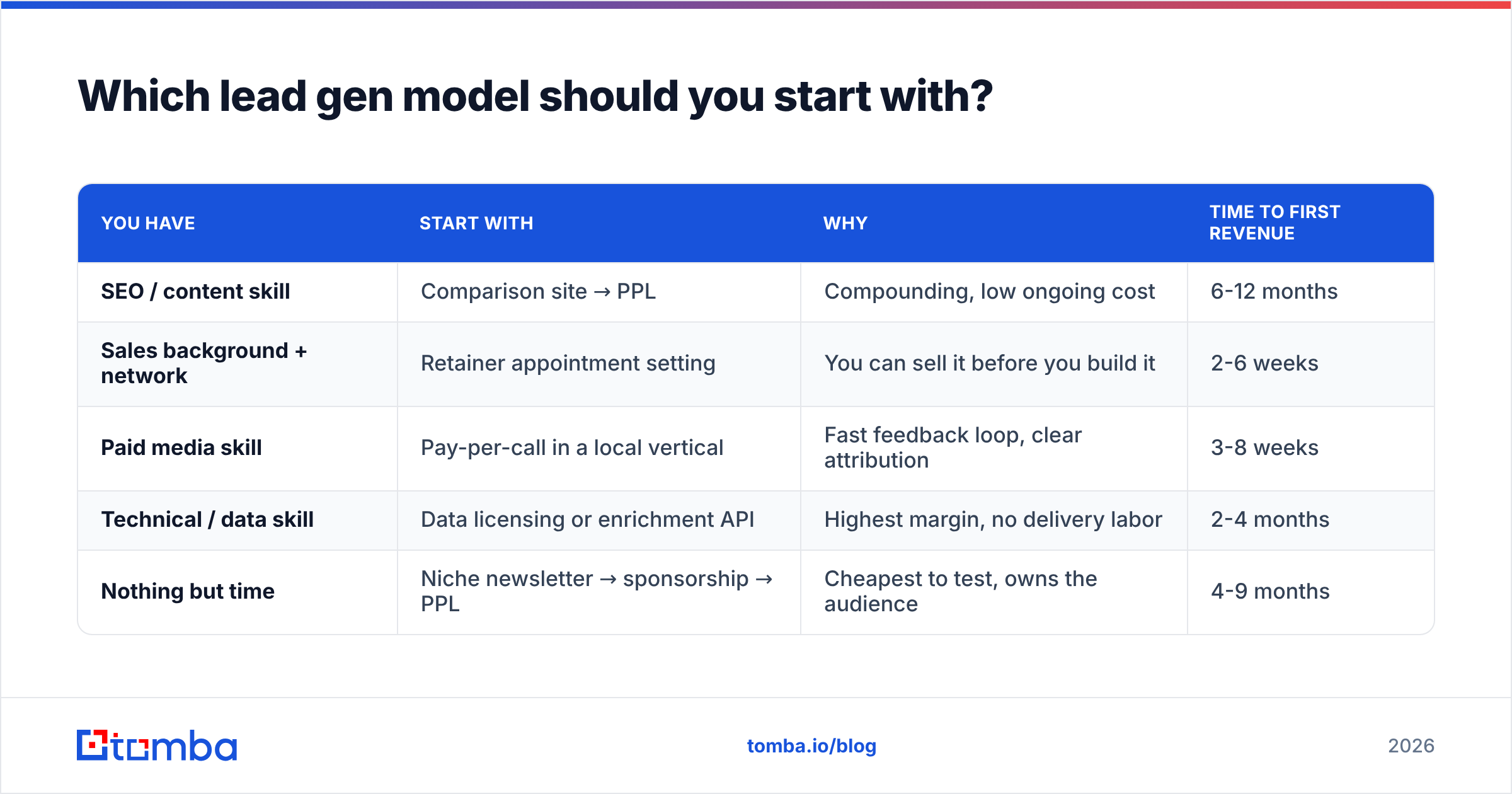
Match the model to what you already have.
| You have | Start with | Why | Time to first revenue |
|---|---|---|---|
| SEO / content skill | Comparison site → PPL | Compounding, low ongoing cost | 6-12 months |
| Sales background + network | Retainer appointment setting | You can sell it before you build it | 2-6 weeks |
| Paid media skill | Pay-per-call in a local vertical | Fast feedback loop, clear attribution | 3-8 weeks |
| Technical / data skill | Data licensing or enrichment API | Highest margin, no delivery labor | 2-4 months |
| Nothing but time | Niche newsletter → sponsorship → PPL | Cheapest to test, owns the audience | 4-9 months |
The fastest path for most people is the retainer appointment-setting agency, because you can sell the contract before you have built the machine and fund the build with client cash. The highest-ceiling path is the owned-asset comparison site, because it compounds and eventually sells for a multiple.
Whichever you pick, the operational core is identical: find the right companies, resolve the right humans, verify they are reachable, and deliver on a written spec. Everything else is packaging.
What should you build first?#
Build the qualification spec and the verification step before you build anything else. Not the website, not the brand, not the CRM.
Write down, in one page: who counts as a lead, what fields must be populated, what disqualifies a record, and what your refund policy is. Then build the pipeline that enforces it. A lead gen business is a quality-control operation wearing a marketing costume — the operators who understand that charge more and churn less.
Start with a narrow vertical you can describe better than an outsider. Deliver 50 leads manually. Measure your real cost. Then, and only then, automate.
If your model depends on reaching the right person at the right company — and every lead gen model does — the contact-resolution layer is where your margin lives. Tomba Email Finder resolves decision-maker emails from a domain, a name, or a company, with verification built into the same workflow so bounced records never reach your client's inbox. The free tier gives you 25 searches a month to test your spec; Tomba pricing starts at $49/mo for Starter, $99/mo for Growth, and $249/mo for Pro when your volume is real. Run your next 50-lead pilot through it and watch what happens to your refund line.
Related guides#
// get started
Find, verify and enrich your first contacts today
Start on the free plan with 25 searches a month, then scale when your team is ready.
Free plan · No credit card required · GDPR & CCPA
// about the author