Lead Gen Companies UK: How to Pick the Right One in 2026
UK lead gen agencies charge £2,000 to £12,000 a month, and most of that buys activity rather than qualified pipeline. Here is what each model really costs, how to vet a vendor, and when to run the motion yourself.
TL;DR
- UK lead gen companies typically charge £2,000–£12,000 per month on retainer, £40–£350 per qualified lead on performance deals, or 10–20% of first-year contract value on revenue-share models.
- Most retainers buy activity (emails sent, calls dialled, meetings "sourced"), not pipeline. The single biggest cost lever is how the contract defines a qualified lead.
- The UK market splits into four distinct types: full-service demand gen agencies, outbound/SDR-as-a-service shops, data-and-list providers, and appointment-setting firms. They are not interchangeable.
- GDPR and PECR make UK B2B lead gen legally different from US outbound. Corporate subscriber email is permitted under PECR, but sole traders and partnerships are treated like individuals — your vendor must know this.
- If your ACV is under roughly £8,000 and your ICP is under 5,000 accounts, a data tool plus one in-house SDR usually beats an agency on cost per meeting.
What do lead gen companies in the UK actually sell?#
Almost every UK lead gen company sells one of three things, and the confusion between them is where most budget disappears.
The first is data: a list of contacts matching your ideal customer profile. The second is activity: someone sends the emails, runs the LinkedIn sequences, or dials the phones on your behalf. The third is outcomes: booked meetings on your calendar, or closed-won revenue.
Those three sit at wildly different price points and risk profiles. A data provider might charge £0.05–£0.30 per verified contact. An outbound agency running the same list charges £3,000–£6,000 a month for the labour on top. An appointment setter charges £150–£350 per held meeting and absorbs the execution risk themselves.
The trap is buying tier two while believing you bought tier three. A retainer that promises "15–20 qualified opportunities per month" with no definition of "qualified" and no clawback is functionally an activity contract wearing an outcomes costume.

How much do lead gen companies in the UK charge in 2026?#
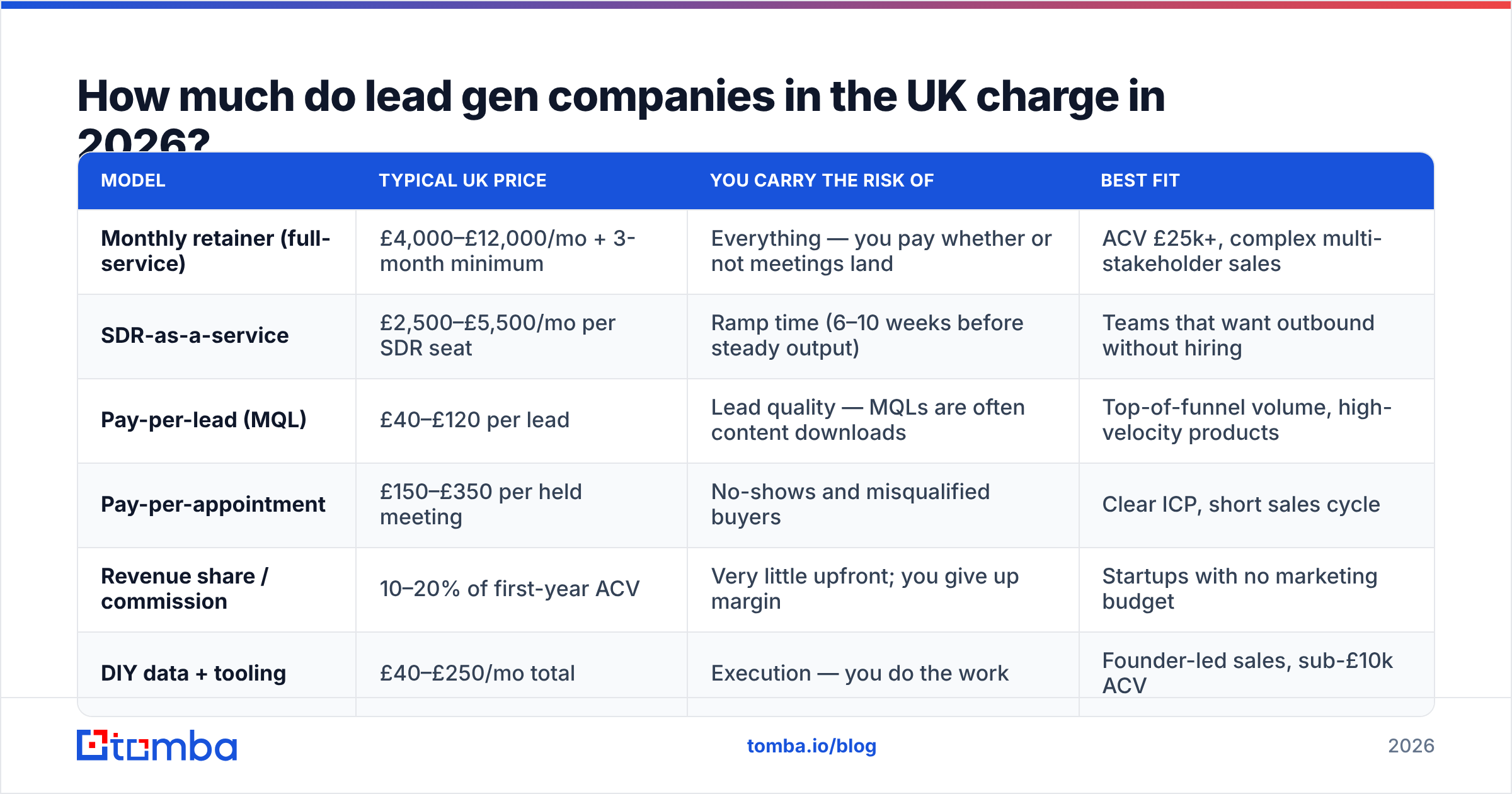
Here is the realistic band across the UK market. These are the numbers you will see quoted by London, Manchester, Bristol and Edinburgh agencies serving B2B SaaS, professional services and industrial clients.
| Model | Typical UK price | You carry the risk of | Best fit |
|---|---|---|---|
| Monthly retainer (full-service) | £4,000–£12,000/mo + 3-month minimum | Everything — you pay whether or not meetings land | ACV £25k+, complex multi-stakeholder sales |
| SDR-as-a-service | £2,500–£5,500/mo per SDR seat | Ramp time (6–10 weeks before steady output) | Teams that want outbound without hiring |
| Pay-per-lead (MQL) | £40–£120 per lead | Lead quality — MQLs are often content downloads | Top-of-funnel volume, high-velocity products |
| Pay-per-appointment | £150–£350 per held meeting | No-shows and misqualified buyers | Clear ICP, short sales cycle |
| Revenue share / commission | 10–20% of first-year ACV | Very little upfront; you give up margin | Startups with no marketing budget |
| DIY data + tooling | £40–£250/mo total | Execution — you do the work | Founder-led sales, sub-£10k ACV |
Two things skew these numbers. Setup fees of £1,000–£3,000 are standard and often non-refundable. And most UK agencies bill in advance on a rolling three-month term, so your true minimum commitment is closer to £15,000 than the monthly figure on the proposal.
Which type of lead gen company do you actually need?#
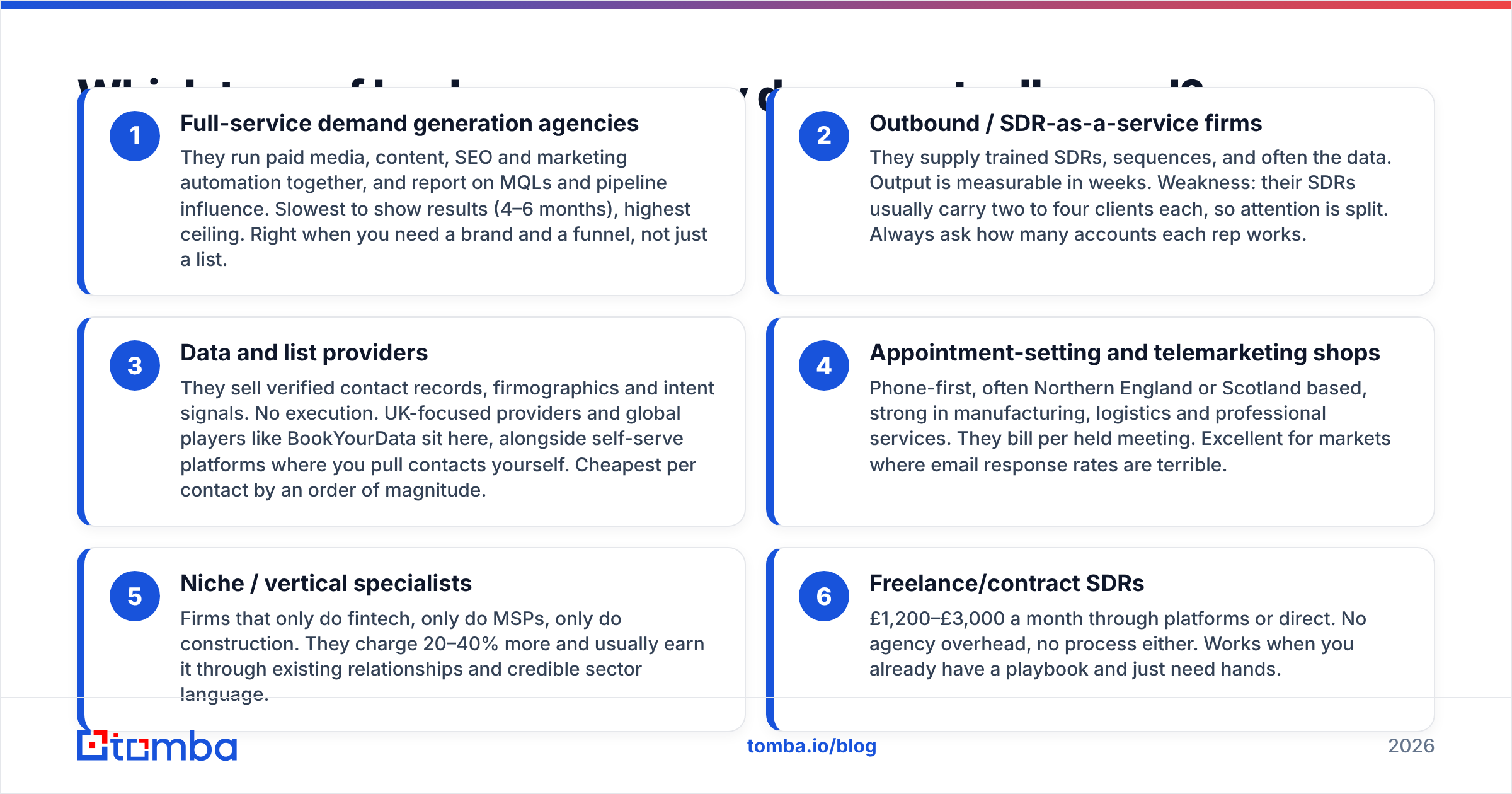
Pick the category first, then shortlist vendors inside it. Mixing categories in a single RFP produces proposals you cannot compare.
Full-service demand generation agencies — They run paid media, content, SEO and marketing automation together, and report on MQLs and pipeline influence. Slowest to show results (4–6 months), highest ceiling. Right when you need a brand and a funnel, not just a list.
Outbound / SDR-as-a-service firms — They supply trained SDRs, sequences, and often the data. Output is measurable in weeks. Weakness: their SDRs usually carry two to four clients each, so attention is split. Always ask how many accounts each rep works.
Data and list providers — They sell verified contact records, firmographics and intent signals. No execution. UK-focused providers and global players like BookYourData sit here, alongside self-serve platforms where you pull contacts yourself. Cheapest per contact by an order of magnitude.
Appointment-setting and telemarketing shops — Phone-first, often Northern England or Scotland based, strong in manufacturing, logistics and professional services. They bill per held meeting. Excellent for markets where email response rates are terrible.
Niche / vertical specialists — Firms that only do fintech, only do MSPs, only do construction. They charge 20–40% more and usually earn it through existing relationships and credible sector language.
Freelance/contract SDRs — £1,200–£3,000 a month through platforms or direct. No agency overhead, no process either. Works when you already have a playbook and just need hands.
Is a UK lead gen agency better than building in-house?#
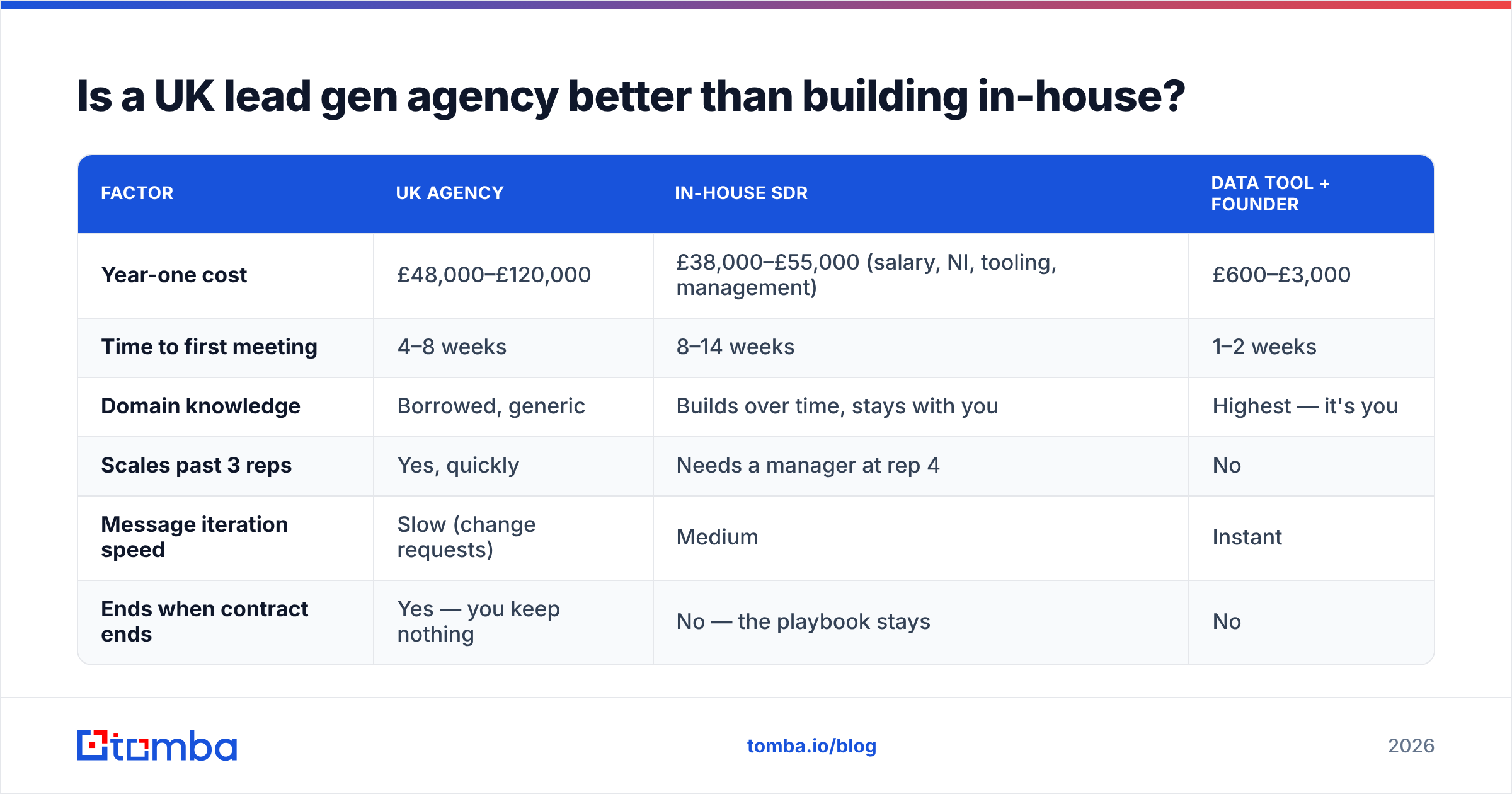
It depends almost entirely on your average contract value and how stable your ICP is.
| Factor | UK agency | In-house SDR | Data tool + founder |
|---|---|---|---|
| Year-one cost | £48,000–£120,000 | £38,000–£55,000 (salary, NI, tooling, management) | £600–£3,000 |
| Time to first meeting | 4–8 weeks | 8–14 weeks | 1–2 weeks |
| Domain knowledge | Borrowed, generic | Builds over time, stays with you | Highest — it's you |
| Scales past 3 reps | Yes, quickly | Needs a manager at rep 4 | No |
| Message iteration speed | Slow (change requests) | Medium | Instant |
| Ends when contract ends | Yes — you keep nothing | No — the playbook stays | No |
The often-ignored line is the last one. When a retainer ends, most companies discover they own no sequences, no call recordings, no validated positioning and no contact data — because all of it lived in the agency's stack. Put data and asset ownership in the contract before you sign, not after month five.
For teams that decide to run the motion themselves, the stack is not complicated: a source of accurate contacts, a verification step, and a sending tool. A bulk email finder plus an email verifier covers the first two for less than a single day of agency retainer.
What does GDPR mean for lead gen companies in the UK?#
UK B2B outbound is legal, but narrower than most US-trained vendors assume, and the responsibility lands on you as the data controller — not on the agency.
Under PECR, unsolicited marketing email to corporate subscribers (limited companies, LLPs, public bodies) does not require prior consent. Sole traders and unincorporated partnerships are treated as individuals, so they need consent or a valid soft opt-in. The ICO's direct marketing guidance is the authoritative reference, and it is worth reading the section on legitimate interests before you approve any sequence.
Practical implications when you evaluate lead gen companies in the UK:
- Ask where the data originates. "Scraped from LinkedIn" is not a lawful basis. Ask for a documented source trail and a legitimate interests assessment.
- Check suppression handling. Opt-outs must propagate across every list the vendor holds for you, within days, not at the next quarterly refresh.
- Confirm the DPA exists. A data processing agreement naming you as controller is mandatory, not optional paperwork.
- Look for sole-trader filtering. Good UK vendors flag and exclude unincorporated entities automatically. Most global vendors do not.
- Verify before sending, not after. Bounces damage sender reputation faster than any other single factor, and a vendor's "verified" list is only as fresh as its last refresh date.
Google and Yahoo's bulk sender requirements compound this: sustained spam complaint rates above 0.3% get your domain throttled regardless of how legally clean your list is.
How do you vet a lead gen company before signing?#
Run the same ten questions past every shortlisted vendor and compare the answers side by side. The ones that dodge are telling you something.
- "Define a qualified lead in one sentence." If the answer includes the word "engaged" or "interested" without a behavioural threshold, the definition is elastic and will be stretched.
- "How many other clients does my assigned rep carry?" Three or fewer is workable. Six means you are buying a fraction of a person at full price.
- "Show me two sequences you sent for a client in my sector." Redacted is fine. Refusal to show any copy is not.
- "What happens to the data and the sequences when we stop?" Get the answer in the contract.
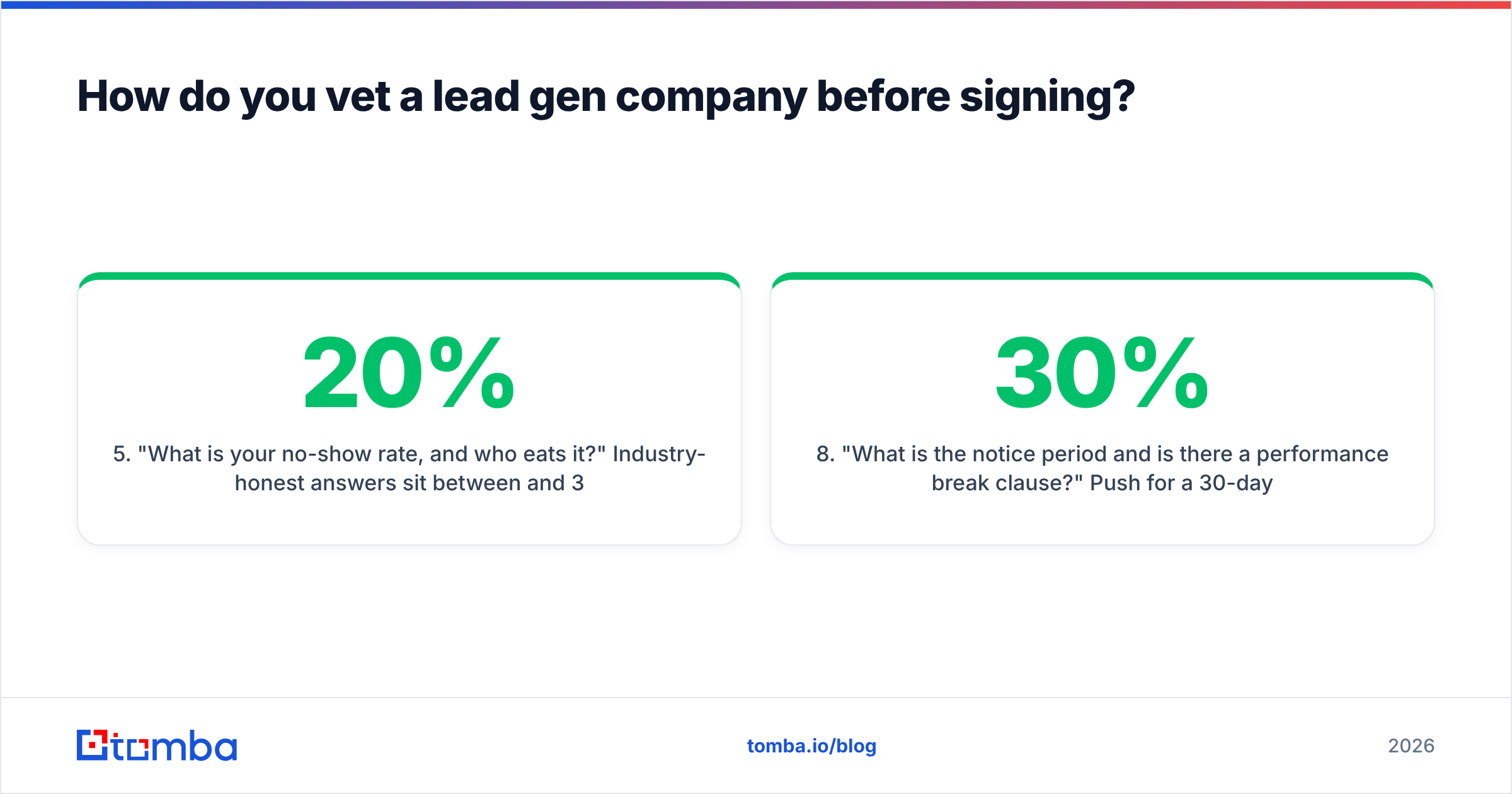
- "What is your no-show rate, and who eats it?" Industry-honest answers sit between 20% and 35%. Anyone claiming under 10% is either lying or counting differently.
- "Which domains will you send from?" It must not be your primary domain. If they cannot explain domain separation and warm-up, they will burn your deliverability.
- "Can I speak to a client who churned?" The best agencies say yes immediately.
- "What is the notice period and is there a performance break clause?" Push for a 30-day exit after month three if targets miss by more than 30%.
- "What's in the setup fee?" Itemised, or negotiate it away.
- "Who writes the copy — the strategist I met or a junior?" Ask to meet the person who will actually do the work.

When should you skip lead gen companies entirely?#
Skip the agency if any two of these are true:
- Your total addressable market in the UK is under 5,000 accounts. An agency's machinery is built for volume; a tight list needs precision and founder credibility instead.
- Your ACV is under £8,000. At a 20% close rate and £250 per meeting, your blended CAC will not work.
- You have not yet closed 10–15 deals yourself. Nobody can outsource a positioning problem. Agencies amplify a working message; they do not discover one.
- Your buyer is highly technical. Generic SDRs get exposed in the first reply, and the damage to your brand outlasts the contract.
- Your product changes materially every quarter. Change requests through an agency cost you two weeks each time.
In those cases the alternative is genuinely cheap. Build the account list, pull contacts with a domain search, verify them, and send 40–60 highly personalised emails a week yourself. That volume is tedious but entirely doable in four hours of weekly focus, and it produces the message intelligence an agency would otherwise take six months and £30,000 to reach.
What does a fair UK lead gen contract look like?#
Three clauses separate a fair deal from an expensive one.
A clawback on unqualified leads. If a delivered meeting fails the agreed qualification criteria — wrong company size, no budget authority, no-show with no reschedule — it should be replaced free, not argued over. Cap disputes at a fixed percentage so neither side litigates every record.
Data ownership on exit. You keep the contact records, the sequences, the call recordings and the CRM fields. Agencies that resist this are protecting a lock-in, not their IP.
A performance break. Month one and two are ramp. From month three, if delivery sits below 70% of target for two consecutive months, you can exit on 30 days' notice. Reputable UK agencies accept this because they expect to hit target; the ones that refuse are pricing in their own failure rate.
Cross-check anything a vendor claims against independent review platforms — G2's lead generation category and Clutch both carry verified UK agency reviews with spend ranges attached, which is more useful than a logo wall.
The honest summary#
Lead gen companies in the UK are worth it when you have a proven message, an ACV above roughly £15,000, and a market large enough that volume matters. They are a poor purchase when you are still guessing at positioning, because you will pay £5,000 a month to learn something a founder could learn in three weeks of doing it manually.
Whichever route you take, the accuracy of the underlying contact data sets the ceiling on everything downstream. A brilliant sequence to a 30% invalid list still bounces, still trips spam filters, and still burns the domain you will need next quarter.
If you are running the motion in-house, or you want to sanity-check the list an agency just handed you, start with the Tomba Email Finder. The free tier gives you 25 searches a month to spot-check quality before you commit, and paid plans start at $49/mo with verification built in — see the full Tomba pricing breakdown. Find the contacts, verify them, and decide from real numbers whether an agency is adding anything your own stack cannot.
Related guides#
// get started
Find, verify and enrich your first contacts today
Start on the free plan with 25 searches a month, then scale when your team is ready.
Free plan · No credit card required · GDPR & CCPA
// about the author