Lead Gen Meaning: What Lead Generation Actually Means in 2026
Lead gen means turning strangers into contactable, qualified buying interest. Here is what the term actually covers, the stages, the metrics, and where most teams break it.
TL;DR
- Lead gen meaning, in one line: lead generation is the process of turning an anonymous person or company into a named, contactable, and qualified record you have permission-adjacent grounds to reach.
- The word "lead" is doing too much work. A newsletter signup and a demo request are both "leads" in most CRMs — and treating them the same is why pipeline forecasts miss.
- Lead gen splits into four jobs: identify, capture, enrich, qualify. Most teams are good at one and quietly terrible at the other three.
- Inbound and outbound are not opposites. They are two entry points into the same qualification machine.
- The failure point in 2026 is rarely volume. It is data decay — roughly a quarter of B2B contact data goes stale every year, so unverified records rot faster than you can work them.
What does lead gen actually mean?#
Lead gen (short for lead generation) means creating and capturing interest in a product or service, then converting that interest into a contactable record that sales or marketing can act on.
Think of it like fishing versus stocking a pond. Advertising is stocking the pond — you make sure fish exist and know your pond is there. Lead gen is the act of actually getting one in the boat with a name tag on it. Interest that you cannot contact is not a lead. It is awareness.
That distinction matters because three things have to be true before a record counts as a lead:
- Identity — you know who it is (person, role, company), not just that "someone from a Fortune 500 visited pricing."
- Contactability — you have a working channel: a verified email, a direct dial, a LinkedIn profile you can message.
- Signal — there is some reason to believe this person could buy. Fit, behaviour, timing, or a stated need.
Drop any one of the three and you have something else. Identity without contactability is an anonymous intent signal. Contactability without signal is a mailing list. Signal without identity is analytics.
Why is "lead" such a slippery word?#
Because sales and marketing inherited two different definitions and never reconciled them.
Marketing tends to count a lead the moment a form is submitted. Sales counts a lead when someone picks up the phone and says "yes, let's talk." Both are defensible. The gap between them is where the arguments happen every quarterly review.
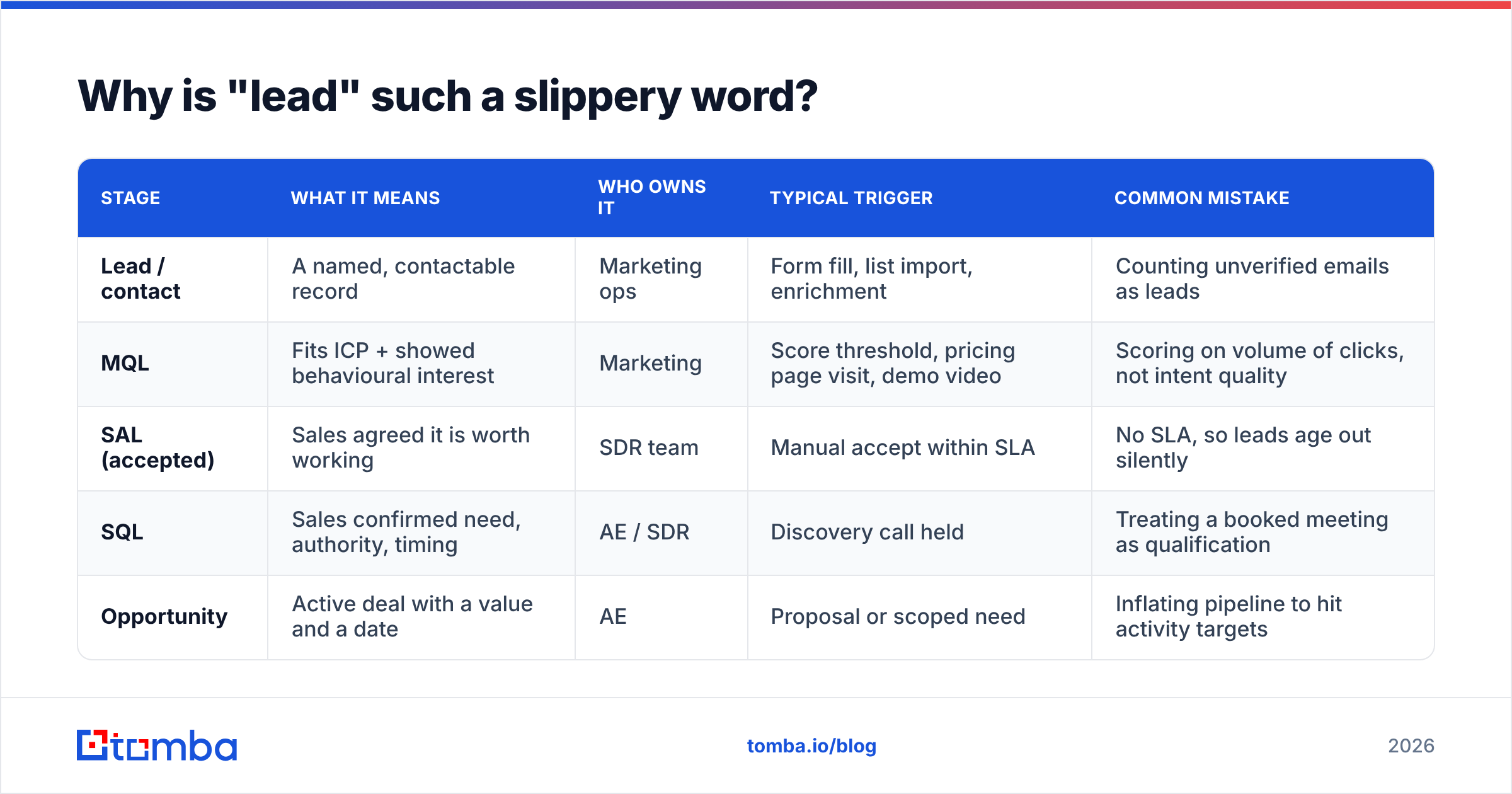
The industry's fix is the MQL/SQL split, which is worth defining precisely because most teams use the labels loosely:
| Stage | What it means | Who owns it | Typical trigger | Common mistake |
|---|---|---|---|---|
| Lead / contact | A named, contactable record | Marketing ops | Form fill, list import, enrichment | Counting unverified emails as leads |
| MQL | Fits ICP + showed behavioural interest | Marketing | Score threshold, pricing page visit, demo video | Scoring on volume of clicks, not intent quality |
| SAL (accepted) | Sales agreed it is worth working | SDR team | Manual accept within SLA | No SLA, so leads age out silently |
| SQL | Sales confirmed need, authority, timing | AE / SDR | Discovery call held | Treating a booked meeting as qualification |
| Opportunity | Active deal with a value and a date | AE | Proposal or scoped need | Inflating pipeline to hit activity targets |
The useful test: if you cannot state, in one sentence, what has to be true for a record to move from one row to the next, your funnel is decorative. A marketing qualified lead should have a written definition that an SDR and a demand gen manager would both sign.

What are the four jobs inside lead generation?#
Every lead gen motion — inbound, outbound, partner, PLG — does these four things in some order. Naming them separately is what lets you find the broken one.
- Identify — decide who is worth reaching. This is ICP definition, account list building, and intent monitoring. Cheap to do badly, expensive to skip.
- Capture — get the record into your system. Forms, chat, content gates, scraped lists, conference badge scans, website visitor reveal on anonymous traffic.
- Enrich — fill in what is missing. A form gives you an email and a first name; you need role, seniority, company size, tech stack, and a phone number before an SDR can prioritise. Data enrichment is the step most teams bolt on last and should have built first.
- Qualify — decide who gets worked, in what order, by whom. Scoring, routing, SLAs.
Notice that only "capture" is what most people picture when they hear lead gen. That is the whole problem. A team with excellent capture and no enrichment ends up with 40,000 records where 60% have no job title and nobody knows which 200 to call on Monday.
Is inbound lead gen better than outbound?#
No — they solve different constraints, and framing them as rivals leads to bad budget decisions.
Inbound generates leads by pulling people to you: SEO, content, webinars, communities, product-led free tiers. The lead arrives with intent already attached, which is why inbound conversion rates look better on a spreadsheet. The catch is control. You cannot decide on Tuesday that you want forty enterprise manufacturing leads by Friday.
Outbound generates leads by going to them: cold email, cold calls, LinkedIn outreach, direct mail, targeted ads against a named account list. Lower conversion rate, total control over targeting. If you need a specific segment, outbound is the only lever that responds on demand.
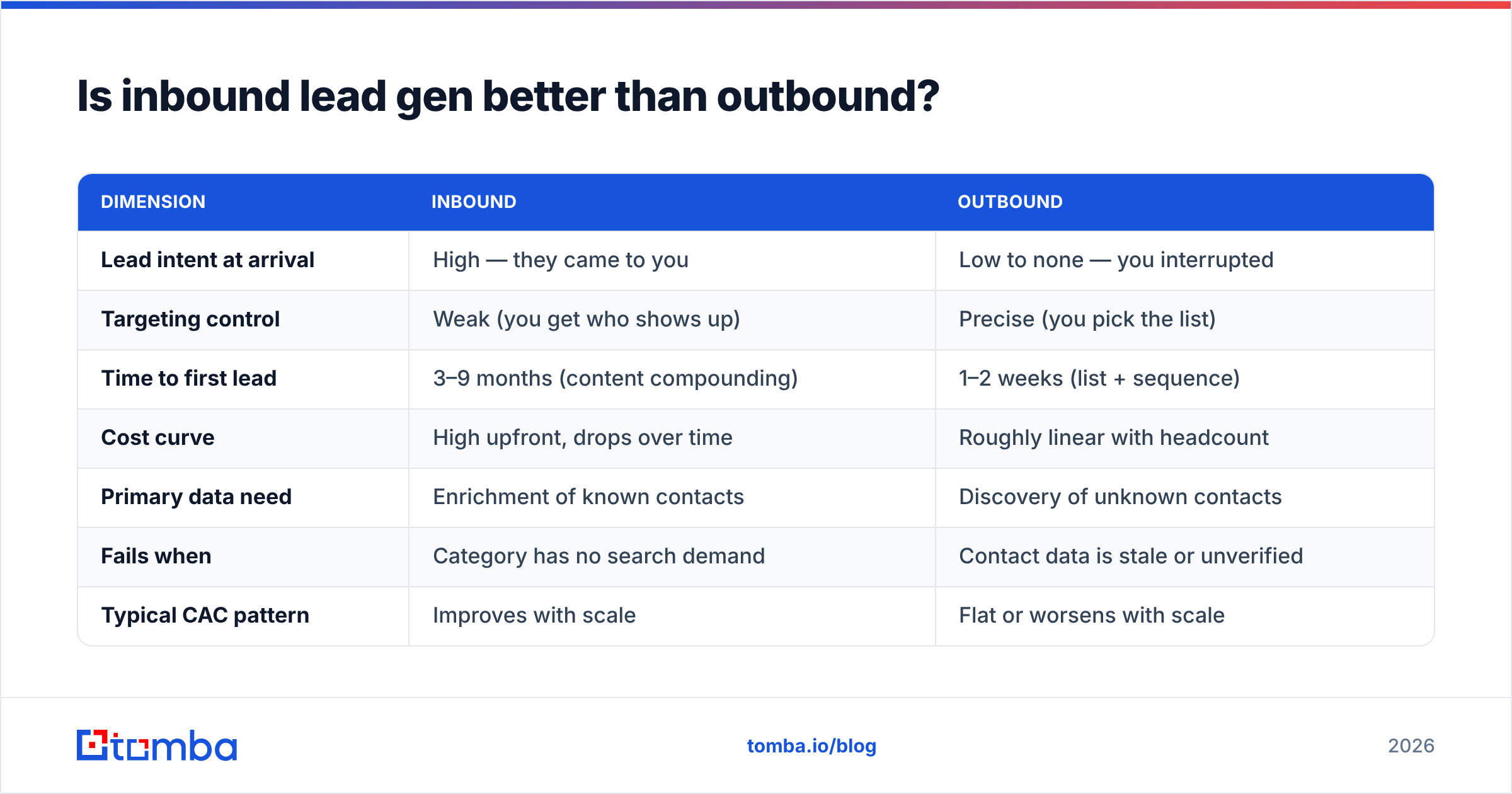
| Dimension | Inbound | Outbound |
|---|---|---|
| Lead intent at arrival | High — they came to you | Low to none — you interrupted |
| Targeting control | Weak (you get who shows up) | Precise (you pick the list) |
| Time to first lead | 3–9 months (content compounding) | 1–2 weeks (list + sequence) |
| Cost curve | High upfront, drops over time | Roughly linear with headcount |
| Primary data need | Enrichment of known contacts | Discovery of unknown contacts |
| Fails when | Category has no search demand | Contact data is stale or unverified |
| Typical CAC pattern | Improves with scale | Flat or worsens with scale |
The mature answer is that they feed each other. Inbound tells you which segments respond, and outbound lets you flood that segment deliberately. Teams that run only one are either leaving demand uncaptured or paying to interrupt people who would have found them anyway.
What data do you actually need per lead?#
More than an email, less than everything. The practical minimum for a B2B lead worth working:
- Verified work email — not a guess, not a pattern, a deliverable address. An unverified send is a bounce risk, and bounce rate drives sender reputation straight into the ground.
- Role and seniority — "Marketing" is not a title. "VP Demand Gen" tells you whether to lead with strategy or tooling.
- Company firmographics — headcount, industry, region, funding stage. This is what routing rules run on.
- A second channel — a direct dial or LinkedIn URL, so a single ignored email is not the end of the sequence.
- Source and timestamp — where the record came from and when. Without this you cannot attribute anything, and you cannot tell a 6-day-old record from a 600-day-old one.
That last point is the quiet killer. Contact data decays continuously as people change jobs, companies rebrand, and domains get retired. G2 reviewer commentary across the data-provider category converges on the same complaint regardless of vendor: the database is fine, the freshness is the problem. Which is why verification is not a nice-to-have step at the end — it is part of the definition of a lead.
If you are building lists from company domains, a domain search that returns every public address at a company with a confidence score beats guessing formats. And when you already have raw addresses from an event or a partner list, running them through an email verifier before the first send is the cheapest deliverability insurance you can buy.
How do you measure whether lead gen is working?#
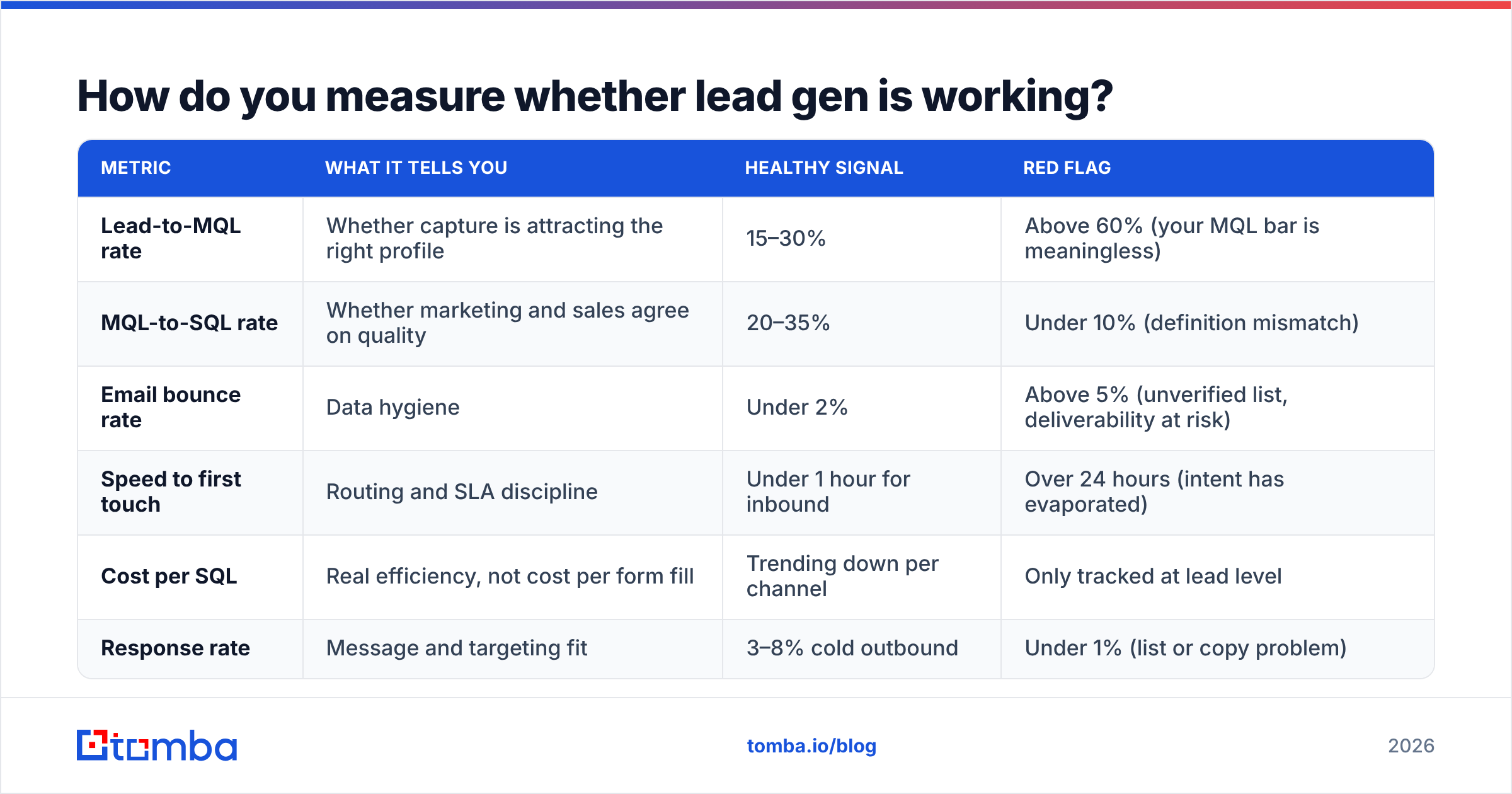
Volume is the vanity metric. These are the ones that actually move revenue decisions:
| Metric | What it tells you | Healthy signal | Red flag |
|---|---|---|---|
| Lead-to-MQL rate | Whether capture is attracting the right profile | 15–30% | Above 60% (your MQL bar is meaningless) |
| MQL-to-SQL rate | Whether marketing and sales agree on quality | 20–35% | Under 10% (definition mismatch) |
| Email bounce rate | Data hygiene | Under 2% | Above 5% (unverified list, deliverability at risk) |
| Speed to first touch | Routing and SLA discipline | Under 1 hour for inbound | Over 24 hours (intent has evaporated) |
| Cost per SQL | Real efficiency, not cost per form fill | Trending down per channel | Only tracked at lead level |
| Response rate | Message and targeting fit | 3–8% cold outbound | Under 1% (list or copy problem) |
Two rules make these numbers honest. First, always report conversion rates as cohorts — leads from March measured through to March's SQLs, not this month's SQLs against this month's leads. Second, split every metric by source. A blended 22% MQL-to-SQL rate can easily be 45% from organic search and 4% from a paid content syndication deal you keep renewing.

What are the most common lead gen mistakes?#
Buying volume instead of fit. A 50,000-record list at $0.02 per contact feels like a bargain until you measure the bounce rate and the blacklisting risk. Reputable database vendors — BookYourData among them — differentiate specifically on verified, filterable records rather than raw count, and that distinction is the whole ballgame. Buy narrow and verified over broad and cheap.
Gating everything. If every asset sits behind a form, you suppress the top of funnel to inflate a number nobody converts. Gate the things that genuinely signal evaluation intent: ROI calculators, benchmark data, product tours.
No definition of done between teams. If marketing hands over records and sales silently ignores 70% of them, you do not have a lead gen problem, you have a contract problem. Write the MQL definition down. Review it quarterly against closed-won data.
Skipping verification to "move faster." Bounces compound. A few percent of hard bounces across a sending domain is enough to push messages into spam folders for the leads that were actually good, which quietly taxes every future campaign. HubSpot's research on email benchmarks has been consistent on this for years: list hygiene correlates more tightly with performance than subject line optimisation ever does.
Treating enrichment as a one-time import. A record enriched eighteen months ago is a record with a wrong title and a possibly dead mailbox. Re-enrichment on a rolling schedule — quarterly for active pipeline, semi-annually for the long tail — keeps the database usable.
Confusing a meeting with qualification. A booked call is an activity metric. Qualification happens on the call. Reporting meetings-set as pipeline is how forecasts go wrong three quarters in a row.
How does lead gen fit with demand gen and ABM?#
They are layers, not alternatives.
- Demand generation creates the want. Content, category education, events, brand. It produces people who have a problem and know it.
- Lead generation captures and qualifies the people demand gen created, plus the ones you go find yourself.
- Account-based marketing inverts the order: you pick the accounts first, then manufacture demand and capture leads inside only those accounts.
Same machinery, different entry point. ABM is lead gen with the targeting step promoted to the front and the volume expectations lowered by an order of magnitude. If your average deal is $80k+ and your total addressable market is under a few thousand accounts, ABM's economics beat broad lead gen. Below roughly $15k ACV, the per-account cost rarely pencils out.
Gartner's B2B buying research is useful context here: buying groups now involve multiple stakeholders who spend a minority of their journey with any vendor's sales team. That has a direct implication for lead gen — a single lead at an account is rarely enough. You need contacts across the buying group, which turns "find one email" into "map the committee." That mapping is a data problem before it is a messaging problem.
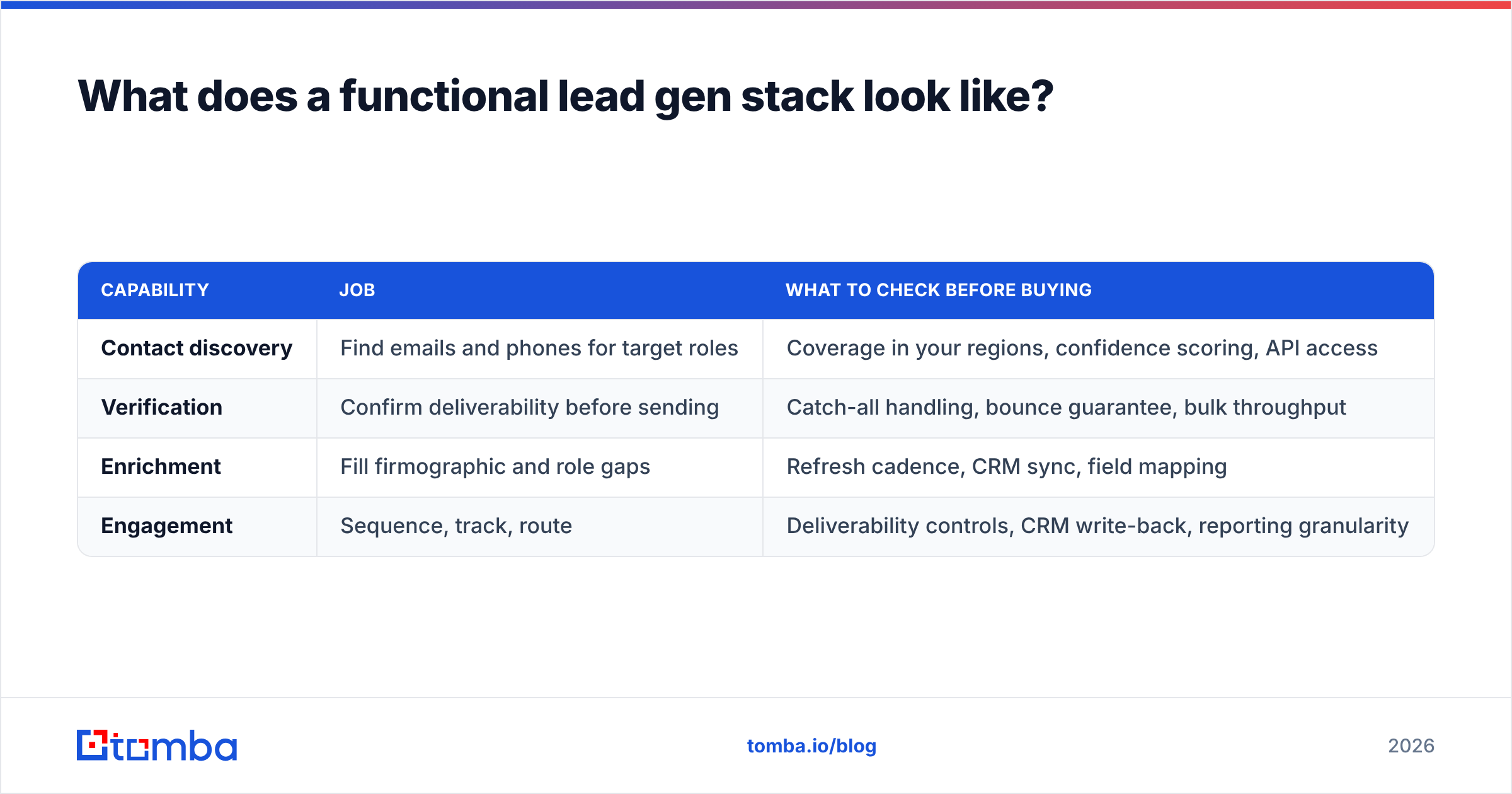
What does a functional lead gen stack look like?#
You need four capabilities. Whether they come from one vendor or five matters less than whether they connect.
| Capability | Job | What to check before buying |
|---|---|---|
| Contact discovery | Find emails and phones for target roles | Coverage in your regions, confidence scoring, API access |
| Verification | Confirm deliverability before sending | Catch-all handling, bounce guarantee, bulk throughput |
| Enrichment | Fill firmographic and role gaps | Refresh cadence, CRM sync, field mapping |
| Engagement | Sequence, track, route | Deliverability controls, CRM write-back, reporting granularity |
The gap most stacks have is catch-all domains — servers that accept every address, so standard verification returns "unknown" and the record sits in limbo. A dedicated catch-all verifier resolves a meaningful share of those, which matters because catch-all configurations are common at exactly the mid-market and enterprise domains you most want to reach.
For pricing sanity: entry-level contact data tooling runs roughly $40–$100/month for a single seat with a few thousand credits, with per-credit cost dropping sharply at team tiers. Tomba pricing starts with a free tier at 25 searches per month, then Starter at $49/mo, Growth at $99/mo, and Pro at $249/mo. Compare on cost per verified, usable record rather than headline credit count — a cheaper credit that returns an unverified guess is not cheaper.
Where should you start if you are building lead gen from zero?#
In this order, because each step makes the next one cheaper:
- Write the ICP down. Firmographics plus the trigger that makes them buy. One page, agreed by sales and marketing.
- Build one list of 200 accounts that match it exactly. Not 2,000. Two hundred you can actually work.
- Find and verify contacts — two to four per account, across the buying group.
- Run one channel properly for six weeks before adding a second. Measure reply rate and meeting rate by segment.
- Write the MQL/SQL definitions based on what actually converted, not what you guessed in step one.
- Then scale the thing that worked, and only then add automation.
Teams that invert this — automation first, ICP last — end up with an expensive stack pointed at the wrong people.
Ready to turn your target list into contactable leads?#
Lead gen falls apart at the same place for most teams: you know exactly which companies you want, and you cannot reach anyone inside them. That is a discovery and verification problem, not a strategy problem.
Tomba Email Finder finds professional email addresses by domain, name, or company, with confidence scoring on every result so you know what you are sending to before you send it. Start on the free tier at 25 searches per month, map a real account list, and see what your reply rate looks like when the data underneath it is actually verified.
Related guides#
// get started
Find, verify and enrich your first contacts today
Start on the free plan with 25 searches a month, then scale when your team is ready.
Free plan · No credit card required · GDPR & CCPA
Get the Tomba newsletter
Product and data updates
// about the author