Lead Gen Site: How to Build One That Converts in 2026
Most lead gen sites collect traffic, not leads. Here's the page structure, form logic, enrichment stack, and scoring model that turn anonymous visitors into pipeline you can actually work.
TL;DR
- A lead gen site is not a brochure site with a contact form bolted on. It is a system: intent-matched pages, a short form, enrichment behind the form, routing, and scoring.
- Form length is the single biggest conversion lever you control. Every field past four costs you roughly 5-10% of submissions. Ask for less, enrich the rest server-side.
- Most B2B sites waste 95%+ of their traffic because anonymous visitors never fill anything in. Visitor identification and reverse lookups recover part of that.
- Gated PDFs still work, but only when the asset is genuinely non-Googleable. Calculators, teardowns, and benchmark data outperform generic ebooks.
- Your scoring model matters more than your form design. A site that sends 400 unqualified MQLs a month is worse than one that sends 40 good ones.
What Is a Lead Gen Site, Exactly?#
A lead gen site is a web property whose primary job is to convert visitors into identified, contactable, qualified prospects — not to inform, not to rank for vanity terms, and not to win design awards.
Think of it like a shop floor versus a museum. A museum optimises for people walking through and leaving impressed. A shop optimises for people walking out holding something they paid for. Most B2B marketing sites are museums with a gift shop in the corner.
The distinction matters because the architecture changes. A brochure site puts the form on /contact. A lead gen site treats every page as a potential entry point with its own conversion path, its own offer, and its own qualification logic.
There are three broad flavours, and you almost certainly need a hybrid:
- Direct-response site — paid traffic lands on a purpose-built page, one offer, one form, no navigation. Conversion rates of 8-25% on warm traffic. Everything else on the page is a distraction to be removed.
- Content-led site — organic traffic across dozens or hundreds of pages, each with contextual CTAs. Conversion rates of 1-4%, but volume and margin are better because you are not paying per click.
- Product-led site — the signup is the conversion. Free tier, no sales call, expansion happens in-product. Conversion measured on activation, not form fills.
The failure mode is running a content-led site with direct-response expectations. You publish 60 blog posts, bolt a newsletter box in the sidebar, and wonder why the pipeline is flat. Content traffic converts on contextual offers — a template pack on a templates post, a calculator on a pricing post — not on a generic "book a demo" banner.
How Do the Main Lead Gen Site Models Compare?#
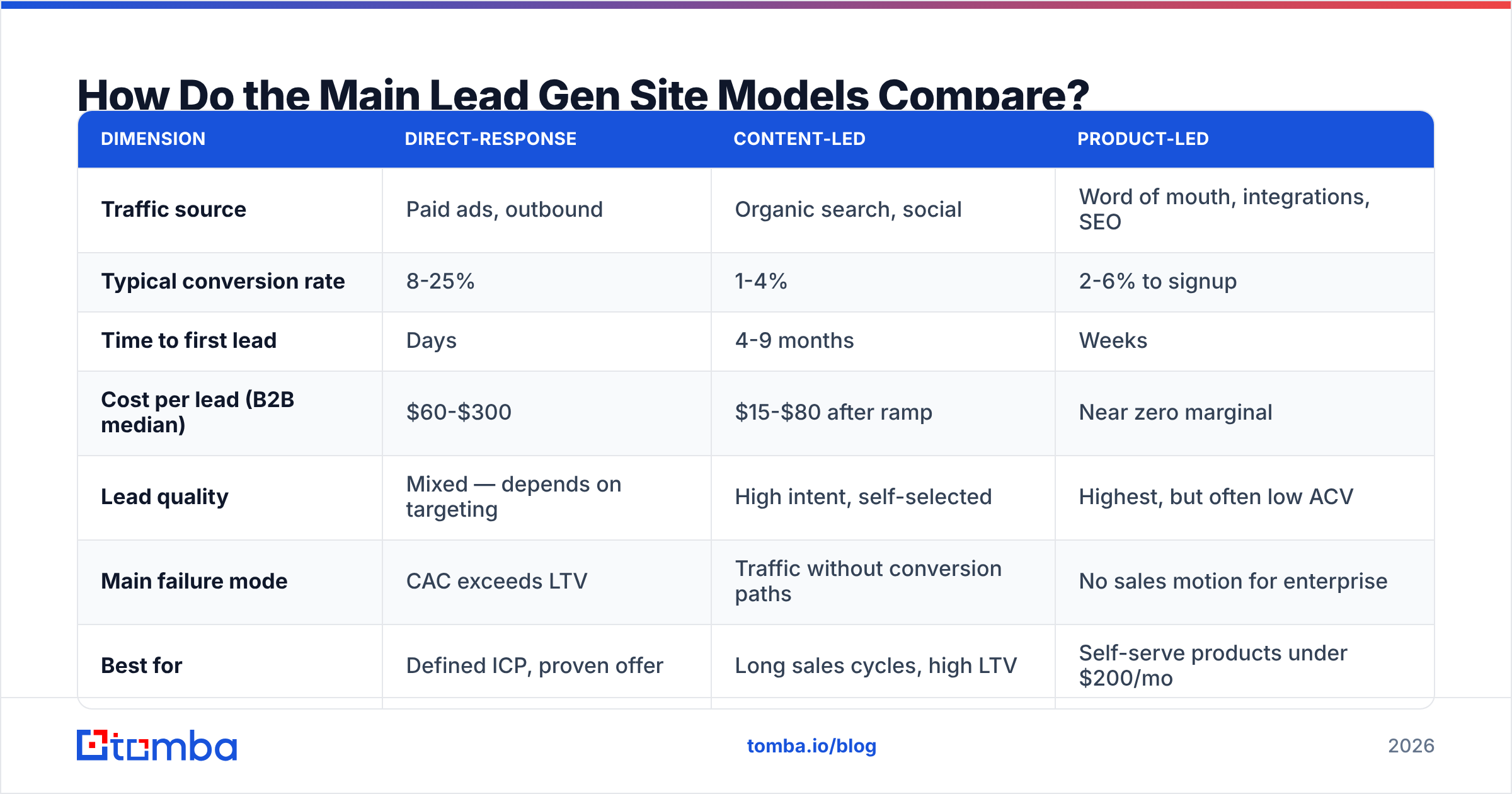
| Dimension | Direct-response | Content-led | Product-led |
|---|---|---|---|
| Traffic source | Paid ads, outbound | Organic search, social | Word of mouth, integrations, SEO |
| Typical conversion rate | 8-25% | 1-4% | 2-6% to signup |
| Time to first lead | Days | 4-9 months | Weeks |
| Cost per lead (B2B median) | $60-$300 | $15-$80 after ramp | Near zero marginal |
| Lead quality | Mixed — depends on targeting | High intent, self-selected | Highest, but often low ACV |
| Main failure mode | CAC exceeds LTV | Traffic without conversion paths | No sales motion for enterprise |
| Best for | Defined ICP, proven offer | Long sales cycles, high LTV | Self-serve products under $200/mo |
| Sales involvement | Immediate | Mid-funnel | Post-activation |
Pick based on sales cycle length and average contract value. If your ACV is under $1,000 and your buyer can evaluate the product alone, product-led wins on unit economics. Above $25,000 ACV with a six-month cycle, content-led plus outbound is usually the only thing that pencils out — nobody buys a $50k platform off a Facebook ad.
What Makes a Lead Gen Page Actually Convert?#
Six things, in rough order of impact:
- Message match. The headline must echo the phrase that brought the visitor there. Someone who searched "SOC 2 compliance checklist" should not land on "Enterprise-Grade Security Posture Management." Match the language, not the brand guidelines.
- One primary action. Every additional CTA splits attention. Landing pages with a single offer consistently beat multi-offer pages. Secondary links belong in the footer, not next to the button.
- Proof placed adjacent to friction. Put the testimonial or logo wall next to the form, not 1,200 pixels above it. Proof works when it answers a doubt at the moment the doubt appears.
- Form length matched to offer value. A newsletter deserves one field. A pricing quote can justify five. A whitepaper asking for company size, revenue, and timeline is a tax your visitor did not agree to pay.
- Speed. A page taking four seconds to become interactive loses a meaningful share of mobile visitors before they see the offer. This is boring and it is also the cheapest fix on the list.
- A reason to act now. Not a fake countdown. A real one: limited audit slots, a cohort start date, a price change. If nothing is scarce, say what happens next instead — "you'll get the report in about 30 seconds."
The fastest way to test whether your page is working: read the headline and the button text out loud, in that order, with nothing in between. If that pair does not make sense as a sentence, the page is confused.
How Short Should Your Form Be?#
Shorter than you want it to be, then enrich the rest.
The traditional argument for long forms is qualification — more fields mean sales gets context. The counter-argument is arithmetic. If an 11-field form converts at 1.8% and a 3-field form converts at 5.4%, you have tripled volume. Even if half the extra leads are junk, you are ahead.
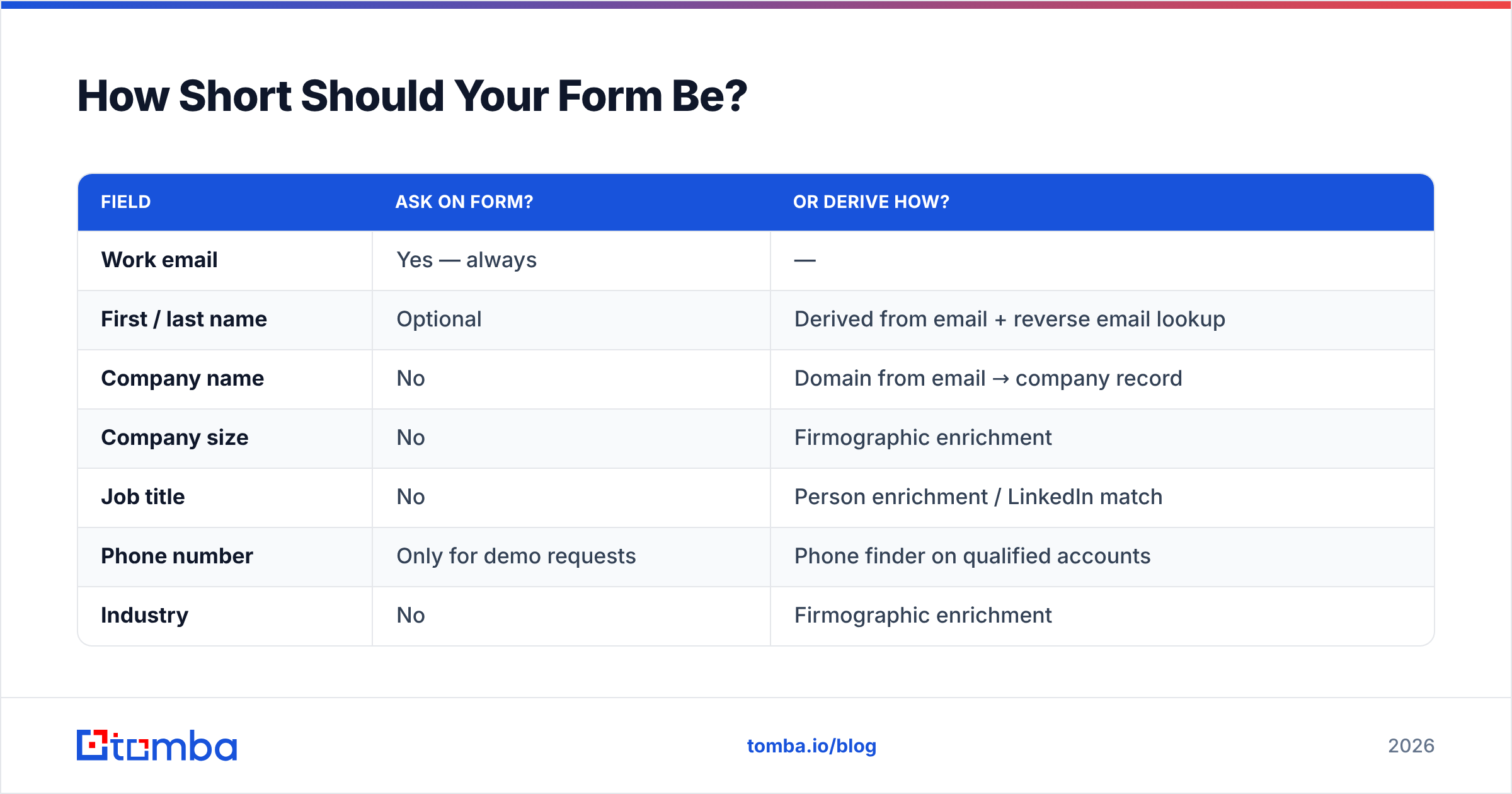
The modern answer removes the trade-off entirely: collect the work email, then fill in everything else server-side. A business email address is a primary key. From it you can resolve name, job title, company, headcount, industry, tech stack, and social profiles through data enrichment before the lead ever reaches a rep.
Here is what that looks like in practice:
| Field | Ask on form? | Or derive how? |
|---|---|---|
| Work email | Yes — always | — |
| First / last name | Optional | Derived from email + reverse email lookup |
| Company name | No | Domain from email → company record |
| Company size | No | Firmographic enrichment |
| Job title | No | Person enrichment / LinkedIn match |
| Phone number | Only for demo requests | Phone finder on qualified accounts |
| Industry | No | Firmographic enrichment |
| "How did you hear about us?" | No | UTM parameters, already in your analytics |
That last row deserves its own paragraph. "How did you hear about us?" is a field marketers add because attribution is hard, and it produces garbage data because respondents pick whatever is first in the dropdown. Your UTMs already know. Delete the field.
One caveat on enrichment: match rates are not 100%. Expect strong coverage on established companies with real domains, weaker coverage on brand-new startups, solo consultants, and anyone submitting a Gmail address. Build your routing so an unenriched lead still reaches a human rather than falling into a "needs data" queue nobody checks.

What Do You Do About the 95% Who Never Fill Anything In?#
Two moves, in order of effort.
Move one: identify anonymous company-level traffic. Reverse-IP and identity-graph tools resolve a portion of your visitors to companies. You will not get a person, and you should not pretend you did. What you get is "someone at Acme Corp read your pricing page three times this week," which is a legitimate outbound trigger. Visitor identification sits in this category. Match rates vary widely by geography and by how much of your traffic is remote workers on residential IPs — treat vendor-quoted rates as ceilings, not averages.
Move two: build the contact list yourself. Once you know the account is in-market, you still need a person. That is where domain search earns its keep: give it a company domain, get back the email patterns and the people who match your target titles. Then verify emails before anything hits a sending inbox, because bounce rate drives sender reputation, and a damaged sending domain undoes a year of content work in a fortnight.
This combination — anonymous intent signal plus contact resolution — is what separates a lead gen site from a lead capture site. Capture waits. Generation goes and gets it.
A word of caution on compliance. Under GDPR, identifying a company from an IP address is generally lower-risk than profiling an individual, but the moment you attach a named person you are processing personal data and need a lawful basis, usually legitimate interest with a documented balancing test. CCPA/CPRA in the US has its own disclosure obligations. Talk to counsel before you build the workflow, not after your first complaint.
Which Offers Actually Earn an Email Address in 2026?#
The generic ebook is dead, and it has been dead for a while. Buyers assume any PDF is a 12-page restatement of a blog post with a stock photo on the cover. They are usually right.
What still converts:
- Calculators and assessments. ROI calculators, pricing estimators, readiness scores. They produce a personalised output, which is a genuine reason to hand over an email to receive it. They also generate qualification data as a by-product — someone modelling 500 seats is a different lead than someone modelling 5.
- Proprietary benchmark data. If you can say "we analysed 14,000 campaigns and here's the median reply rate," you have something no competitor can copy. This is the highest-effort, highest-return offer type.
- Templates and working files. Spreadsheets, sequence libraries, cold email templates, Notion boards. Low effort to produce, immediately usable, high perceived value.
- Teardowns and audits. "Send us your landing page, get a 5-minute video review." Does not scale, converts extremely well, and doubles as a sales conversation.
- Free tools with a usage ceiling. The strongest version of a gated asset — the tool itself is the offer, and the ceiling is the qualification mechanism.
Notice the pattern: every one of these delivers something the visitor cannot get by reading the page. That is the actual test for whether an offer deserves a form. If a determined visitor could reconstruct your gated asset from three Google searches, it is not an offer, it is a toll booth.
How Do You Qualify and Route What Comes In?#
A lead gen site that sends everything to sales will be ignored by sales within a quarter. Scoring is not optional at volume.
Build the model on two axes rather than one:
Fit (who they are, from enrichment): company size in range, industry in range, title seniority, tech stack signals, geography. This is static and enrichment fills it automatically.
Intent (what they did, from behaviour): pricing page views, repeat visits, demo page visits, high-value asset downloads, email replies. This decays — a pricing page view from March is not a signal in September.
Route on the combination:
- High fit, high intent → straight to a rep, same day, with the enrichment attached so they open with context instead of "what do you guys do?"
- High fit, low intent → nurture sequence plus outbound. This is the biggest and most under-worked segment on most sites.
- Low fit, high intent → self-serve path or free tier. Do not spend rep time here; make it easy to buy without one.
- Low fit, low intent → newsletter, and nothing else.
The definition you use for a marketing qualified lead should be agreed with sales in writing and reviewed quarterly against closed-won data. If your MQL definition has not changed in two years, it is almost certainly wrong now — your ICP moved and the definition did not follow.
Speed of response is the multiplier that most teams underrate. HubSpot's research on response times and the well-known Lead Response Management studies both point the same direction: contacting an inbound lead within the first few minutes dramatically outperforms contacting them hours later. Your routing should be measured in minutes, not "next business day."
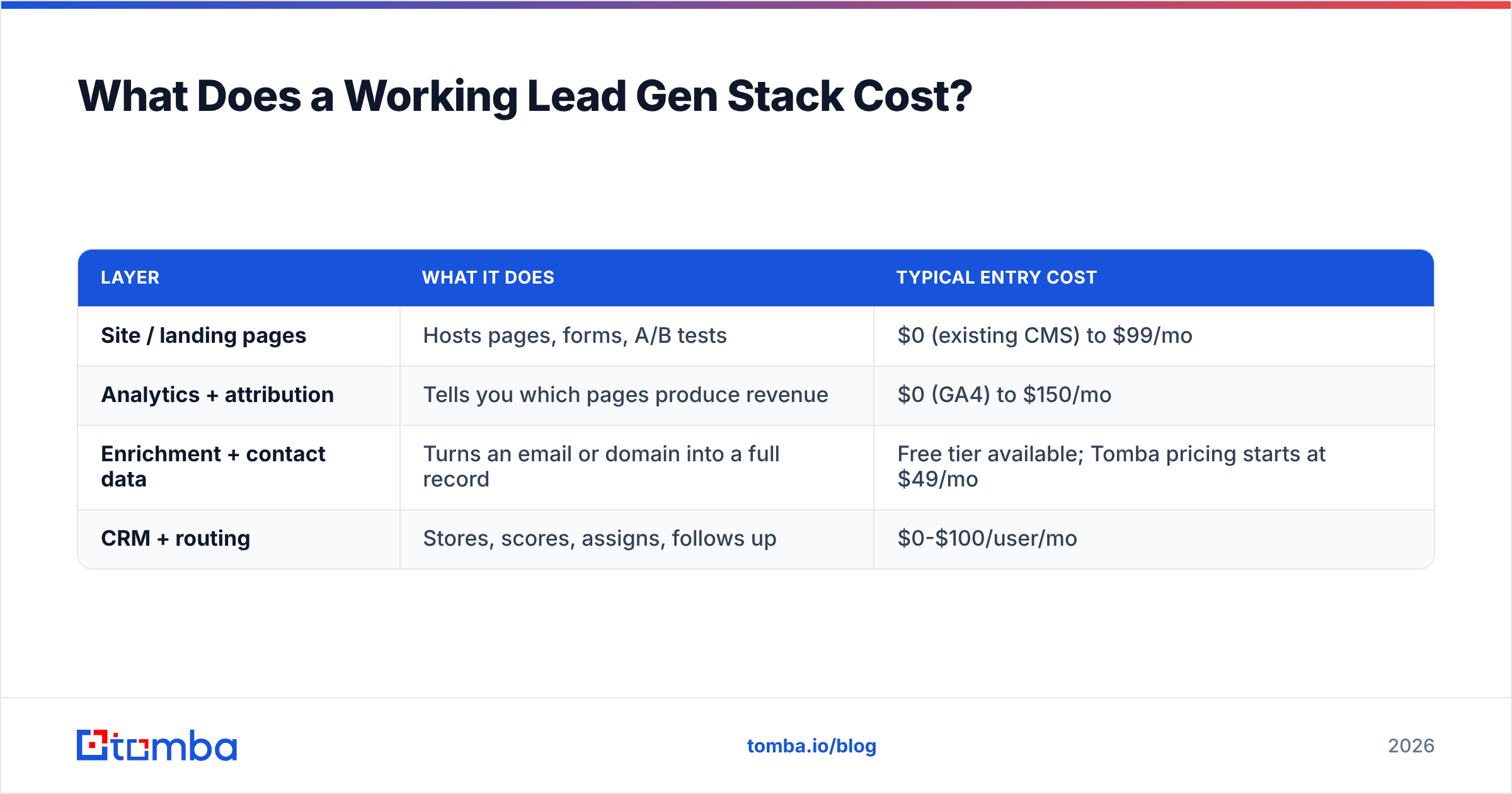
What Does a Working Lead Gen Stack Cost?#
You need four capabilities. You do not need four separate expensive vendors.
| Layer | What it does | Typical entry cost |
|---|---|---|
| Site / landing pages | Hosts pages, forms, A/B tests | $0 (existing CMS) to $99/mo |
| Analytics + attribution | Tells you which pages produce revenue | $0 (GA4) to $150/mo |
| Enrichment + contact data | Turns an email or domain into a full record | Free tier available; Tomba pricing starts at $49/mo |
| CRM + routing | Stores, scores, assigns, follows up | $0-$100/user/mo |
A realistic small-team budget lands between $150 and $400 per month all-in before ad spend. The expensive mistake is not tooling — it is buying an enterprise data platform at $2,000/mo to support 200 leads a month, then discovering the match rate on your specific market is mediocre. Run a free-tier pilot against a list of 50 accounts you already know before you sign anything annual. Check coverage in your actual geography and industry, not the vendor's global average.
For teams running high volume, the integration layer matters more than the UI. Whether your enrichment runs through the Tomba API, a Zapier integration, or straight into HubSpot, the requirement is the same: enrichment fires on form submit, before the record reaches a human. If a rep has to click a button to enrich, it will not happen consistently.
Worth noting that the vendor landscape here is genuinely crowded and reasonable people land in different places. Buyer-review sites like G2's lead intelligence category are a decent sanity check on whether a tool's marketing matches its reality, and providers such as BookYourData occupy a different slot in the stack — prebuilt, filterable contact databases when you want to buy a list rather than resolve contacts on demand. Both approaches are valid; they solve different problems. On-demand resolution keeps data fresh and ties to real site intent. Prebuilt databases get you volume fast when you have a clearly defined segment and no inbound traffic yet.
What Should You Measure?#
Four numbers, reviewed weekly:
- Visitor-to-lead rate, by page. Site-wide averages hide everything. You will usually find two or three pages carrying the entire number.
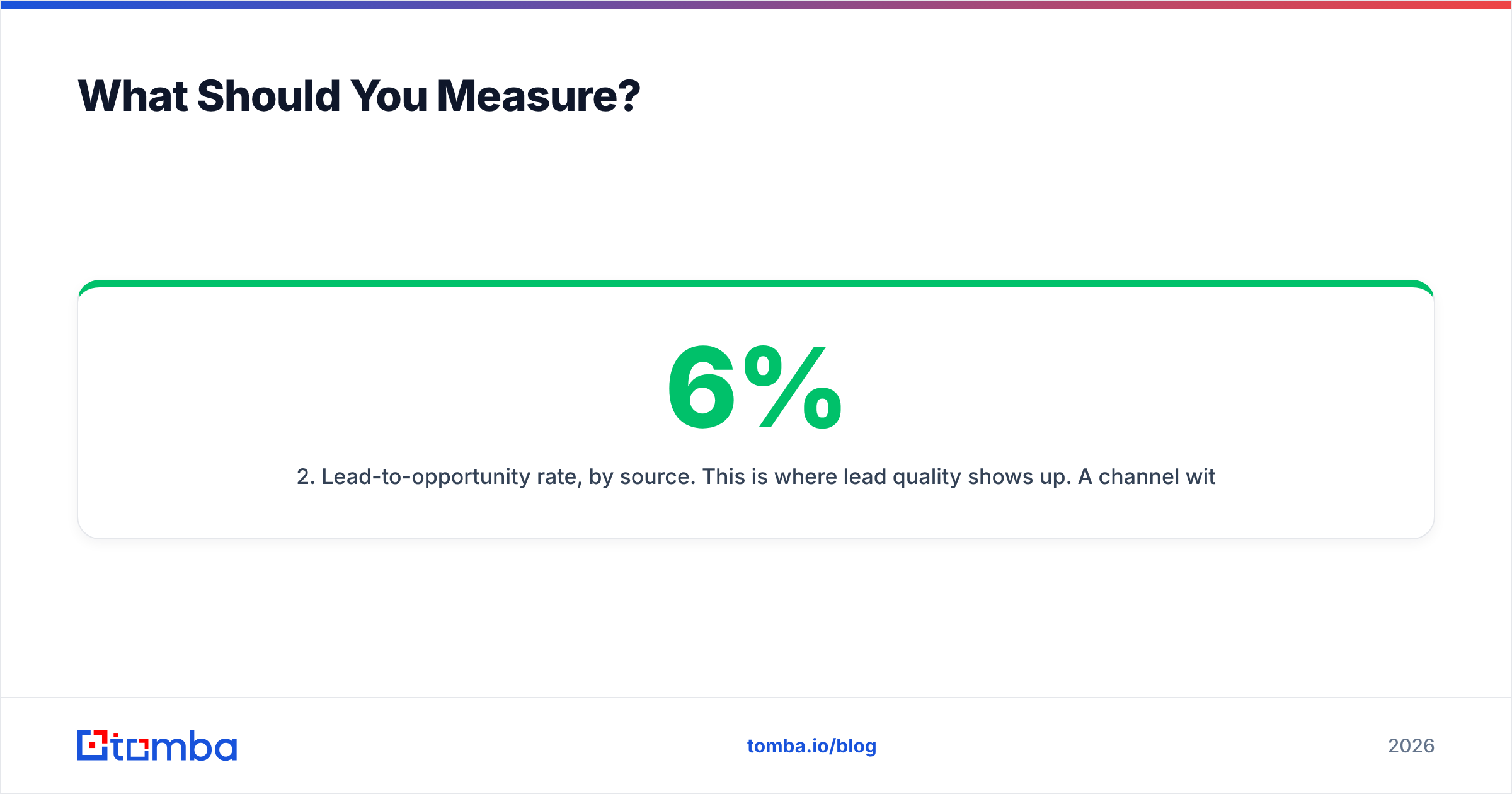
- Lead-to-opportunity rate, by source. This is where lead quality shows up. A channel with a 6% conversion rate and a 2% opportunity rate is worse than one with 2% and 20%.
- Time to first touch. Median, not average — one four-day outlier will wreck the mean and hide that you are usually fine.
- Cost per opportunity. Not cost per lead. Cost per lead rewards form-fill volume, which rewards bad forms.
Add a fifth if you run outbound off site signals: deliverability health. Bounce rate, spam complaint rate, and email deliverability metrics on your sending domains. A lead gen site that feeds an outbound motion is only as good as the inbox placement of the sequences it feeds.
Review cadence beats dashboard sophistication. A spreadsheet reviewed every Monday outperforms a beautiful BI dashboard nobody opens.
Where Do Most Teams Go Wrong?#
Three patterns, all of them fixable:
They optimise the form before the offer. Button colour tests will not save a whitepaper nobody wants. Change what you are offering before you change how you ask for it.
They treat every lead as the same object. A newsletter subscriber and a pricing-page demo request are not the same thing and should never enter the same sequence. Segment at capture, not at send.
They stop at capture. The site collects the email and the process ends. No enrichment, no routing rule, no follow-up sequence, no feedback loop from closed-won data back into the scoring model. This is the most common failure and the most expensive, because the traffic cost was already paid.
The fix for all three is the same discipline: define what a good lead looks like using closed-won data, build backwards from there, and let that definition drive the offer, the form, and the routing — in that order.
Build the Data Layer First#
If you are starting from a site that gets traffic but generates almost nothing, do not begin with a redesign. Begin with the data layer: capture the email, enrich it automatically, score it on fit and intent, and route it within minutes. That alone usually produces more pipeline than a quarter of design work.
Tomba's email finder is the piece that connects site intent to a real, reachable person — resolve contacts from a company domain, verify them before you send, and push enriched records straight into your CRM through the API. The free tier gives you 25 searches a month to test match rates on accounts you already know, and paid plans start at $49/mo when you are ready to run it at volume.
Start with your last 50 anonymous high-intent accounts. Find the right person at each. That is your first month of pipeline, already sitting in your analytics.
Related guides#
// get started
Find, verify and enrich your first contacts today
Start on the free plan with 25 searches a month, then scale when your team is ready.
Free plan · No credit card required · GDPR & CCPA
Get the Tomba newsletter
Product and data updates
// about the author