Lead Gen Specialist in 2026: Role, Skills, Salary & Stack
What a lead gen specialist actually does in 2026, what they get paid, which tools they live in, and when hiring one beats buying a list or an SDR agency.
TL;DR
- A lead gen specialist builds and maintains the top of the funnel: sourcing, list building, data hygiene, enrichment, first-touch sequences, and routing. They are not an SDR, and paying them like one distorts the role.
- US base salary in 2026 clusters at $52,000–$78,000 for individual contributors, with offshore contractors at $1,200–$3,500/month. Agency retainers for the same output start around $3,500/month.
- The daily stack is narrower than vendors suggest: one contact-data source, one verifier, one sequencer, one CRM. Everything else is optional.
- The highest-leverage skill is not outreach copy. It is data quality — bounce rates above 3% silently cap every downstream metric.
- Hire a specialist when you have a repeatable ICP and inconsistent list quality. Hire an agency when you need volume for 90 days and do not want to build process.
What is a lead gen specialist?#
A lead gen specialist owns everything that happens before a sales conversation starts. They define the target list, find and verify contact data, enrich it with the fields reps actually use, load it into sequences or a CRM, and report on which segments convert.
Think of it like a restaurant supply chain. The SDR is the line cook working the pass, and the AE is the chef plating for the guest. The lead gen specialist is the person sourcing produce, checking it for rot, and making sure the walk-in is stocked before service. When they do their job badly, nobody in the kitchen notices until the plates start coming back.
The confusion in most job ads comes from conflating four jobs:
- Lead gen specialist — sources and prepares leads. Success metric: qualified, contactable records delivered per week at a given accuracy threshold.
- SDR / BDR — works those leads via calls, email, and social. Success metric: meetings booked.
- Demand gen manager — runs paid, content, and webinar programs to create inbound. Success metric: MQLs and pipeline influenced.
- RevOps analyst — owns systems, routing, attribution, and reporting. Success metric: data integrity and process throughput.
A small company often bundles 1 and 2 into one hire. That works up to roughly 150 new contacts per week. Past that, the sourcing work quietly gets skipped because booking meetings feels more urgent, and list quality collapses within a quarter.

What does a lead gen specialist actually do all week?#
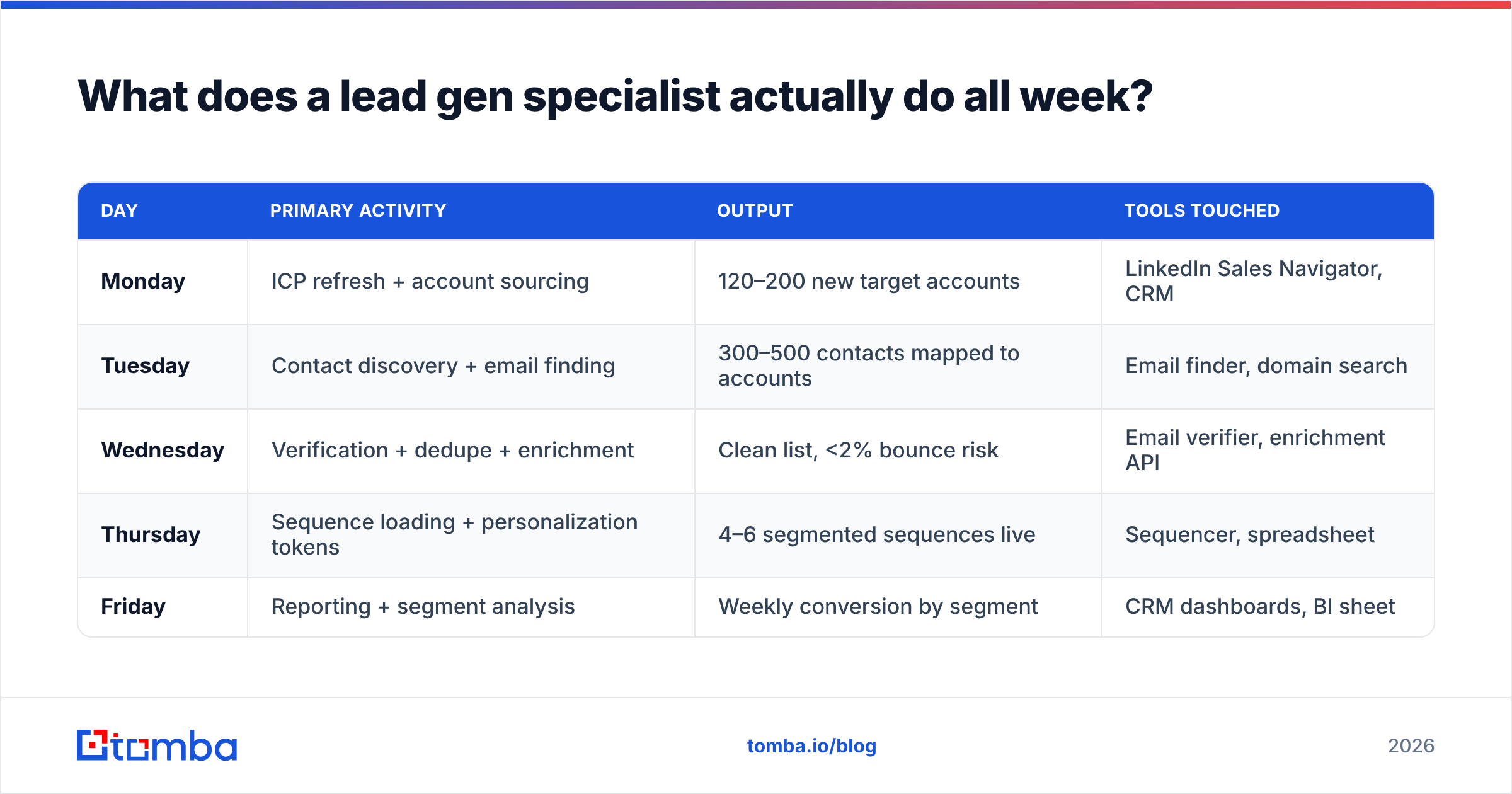
Here is a realistic week for an in-house specialist supporting three AEs in a mid-market SaaS company.
| Day | Primary activity | Output | Tools touched |
|---|---|---|---|
| Monday | ICP refresh + account sourcing | 120–200 new target accounts | LinkedIn Sales Navigator, CRM |
| Tuesday | Contact discovery + email finding | 300–500 contacts mapped to accounts | Email finder, domain search |
| Wednesday | Verification + dedupe + enrichment | Clean list, <2% bounce risk | Email verifier, enrichment API |
| Thursday | Sequence loading + personalization tokens | 4–6 segmented sequences live | Sequencer, spreadsheet |
| Friday | Reporting + segment analysis | Weekly conversion by segment | CRM dashboards, BI sheet |
Notice how much of that is data work. In practice, a good specialist spends 55–65% of their time on sourcing, verification, and enrichment, not on writing copy. The copy matters, but copy applied to a bad list produces nothing measurable.
The parts that get skipped most often, in order:
- Deduplication against existing CRM records. Emailing a live opportunity with a cold sequence is the fastest way to lose an AE's trust.
- Suppression lists. Churned customers, current customers, competitors, and anyone who has unsubscribed in the last 24 months.
- Catch-all handling. Roughly 15–20% of B2B domains are catch-all, which means standard verification returns "unknown" rather than a clean pass or fail. Treating unknowns as valid is the single most common cause of a reputation slide. A dedicated catch-all verifier resolves most of these rather than guessing.
- Field hygiene for personalization. If
{{company}}resolves to "Acme Corporation Inc. (formerly Acme Ltd)", the token is worse than useless.
Which skills separate a good lead gen specialist from a bad one?#
Most job descriptions list "attention to detail" and "strong communication." Useless. Here is what actually predicts performance, roughly ordered by impact:
- Data literacy over tool familiarity. Can they explain why a 6% bounce rate is a crisis and a 1.5% one is fine? Can they compute deliverable-contacts-per-credit rather than just raw credits? Tool logos on a résumé mean very little; the reasoning does.
- Spreadsheet and light scripting fluency. VLOOKUP-level competence is table stakes. The step change comes from people who can hit an API, run a bulk job, and normalize a messy CSV without asking engineering. A bulk email finder plus basic scripting replaces about a day of manual work per week.
- ICP reasoning, not ICP recitation. A weak specialist filters by industry and headcount. A strong one filters by observable buying signals — hiring posts, tech stack changes, funding events, and leadership turnover.
- Deliverability awareness. They should know what SPF, DKIM, and DMARC do, why a shared domain is a liability, and how email deliverability degrades before it collapses. Most hiring managers never test for this.
- Documentation habit. The whole point of the role is a repeatable pipeline. If the process lives only in their head, you bought a contractor, not a system.
Skill 4 is the one most teams underweight. Google's bulk sender requirements tightened the spam-complaint threshold to 0.3%, and Microsoft followed with similar enforcement. A specialist who does not track complaint rate is flying without instruments.
How much does a lead gen specialist cost in 2026?#
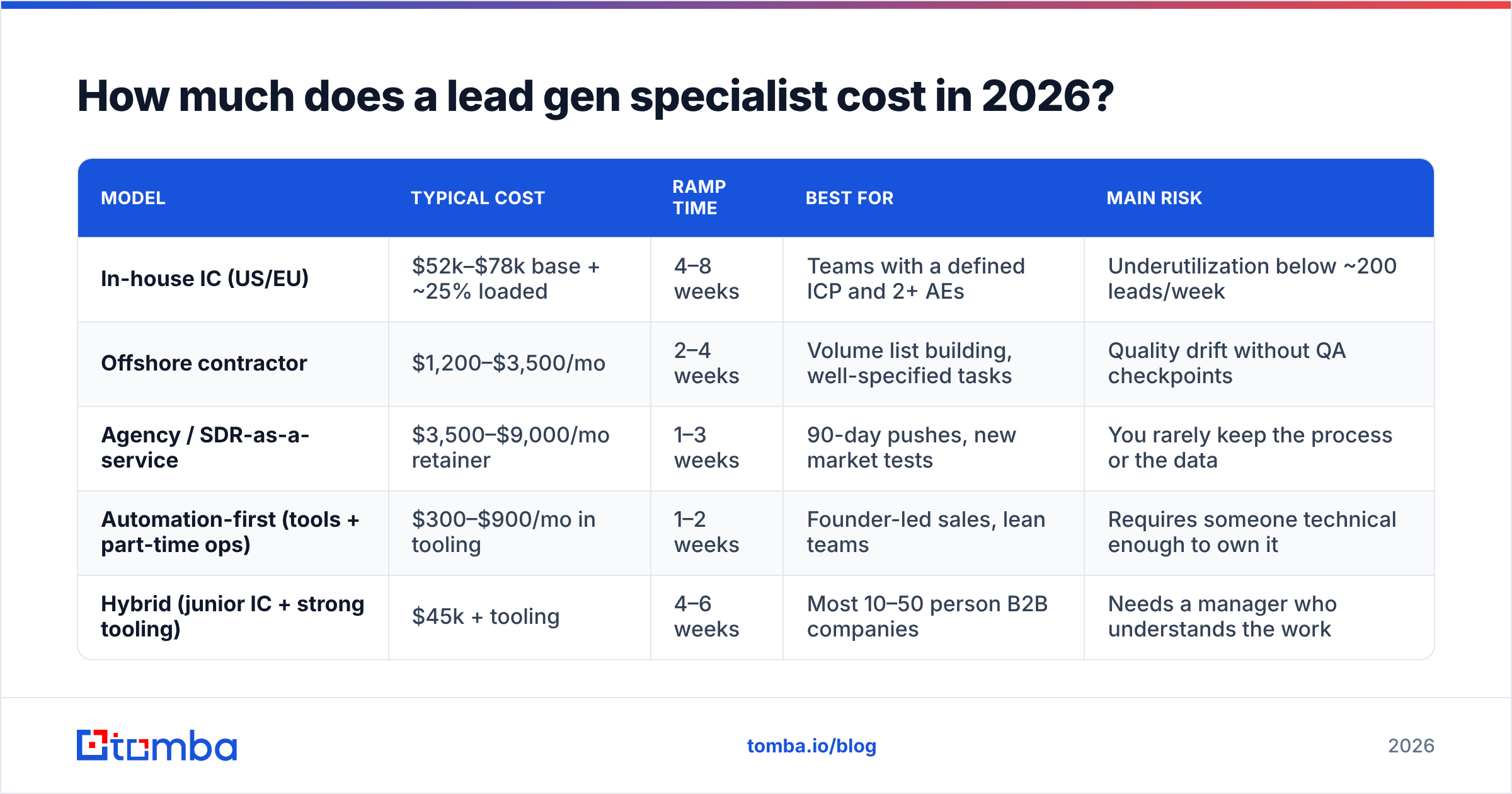
Three delivery models, three very different cost structures. The right comparison is cost per qualified, contactable record — not headline price.
| Model | Typical cost | Ramp time | Best for | Main risk |
|---|---|---|---|---|
| In-house IC (US/EU) | $52k–$78k base + ~25% loaded | 4–8 weeks | Teams with a defined ICP and 2+ AEs | Underutilization below ~200 leads/week |
| Offshore contractor | $1,200–$3,500/mo | 2–4 weeks | Volume list building, well-specified tasks | Quality drift without QA checkpoints |
| Agency / SDR-as-a-service | $3,500–$9,000/mo retainer | 1–3 weeks | 90-day pushes, new market tests | You rarely keep the process or the data |
| Automation-first (tools + part-time ops) | $300–$900/mo in tooling | 1–2 weeks | Founder-led sales, lean teams | Requires someone technical enough to own it |
| Hybrid (junior IC + strong tooling) | $45k + tooling | 4–6 weeks | Most 10–50 person B2B companies | Needs a manager who understands the work |
A fully loaded US specialist at $65k base runs about $81k all-in. Against an agency retainer at $6,000/month ($72k/year), the in-house option looks close on paper. The difference is asset ownership: the in-house hire leaves behind documented process, a cleaned CRM, and suppression logic. The agency leaves behind an invoice history.
That is not an argument against agencies. If you are testing a new vertical and want signal in six weeks, an agency is usually faster and cheaper than a hire you may have to unwind. Vendor review sites like G2's lead generation category are a reasonable starting point for shortlisting, with the usual caveat that review volume correlates with marketing spend, not quality.
What tools does a lead gen specialist actually need?#
Far fewer than the average "top 47 tools" listicle claims. The functional stack has five slots, and most teams overspend on slots they do not need yet.
- Contact data source. Where emails and phone numbers come from. This is the slot where accuracy differences compound hardest.
- Verification layer. Syntax, MX, SMTP, and catch-all resolution before anything hits a sequencer.
- Enrichment. Firmographics, technographics, and role data to power segmentation and tokens.
- Sequencer. Sending infrastructure, throttling, inbox rotation, reply detection.
- CRM + routing. Where records live and how ownership is assigned.
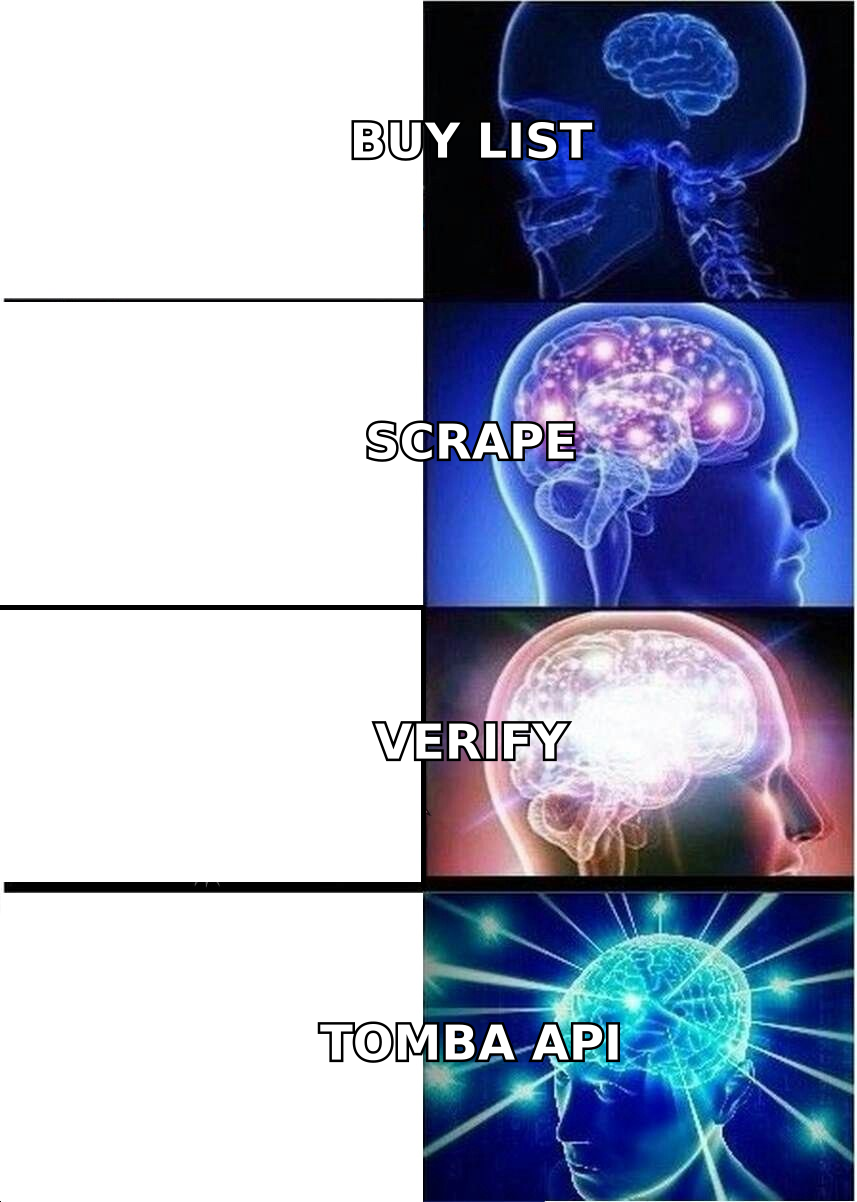
A practical setup for a team of five: one data provider with a usable API, one verifier (ideally the same vendor to cut a hop), a sequencer, and HubSpot or Pipedrive. Tools like Tomba's domain search cover the account-to-contact mapping step, while a data enrichment call fills the fields your tokens depend on. If your ICP skews toward buyers you find on LinkedIn first, a LinkedIn finder shortens the path from profile to verified inbox.
For database-style sourcing where you want pre-built, human-verified lists rather than on-demand lookups, BookYourData is a solid option and a genuinely different purchase from an on-demand finder API — list purchase and per-lookup discovery solve different problems, and plenty of teams run both.
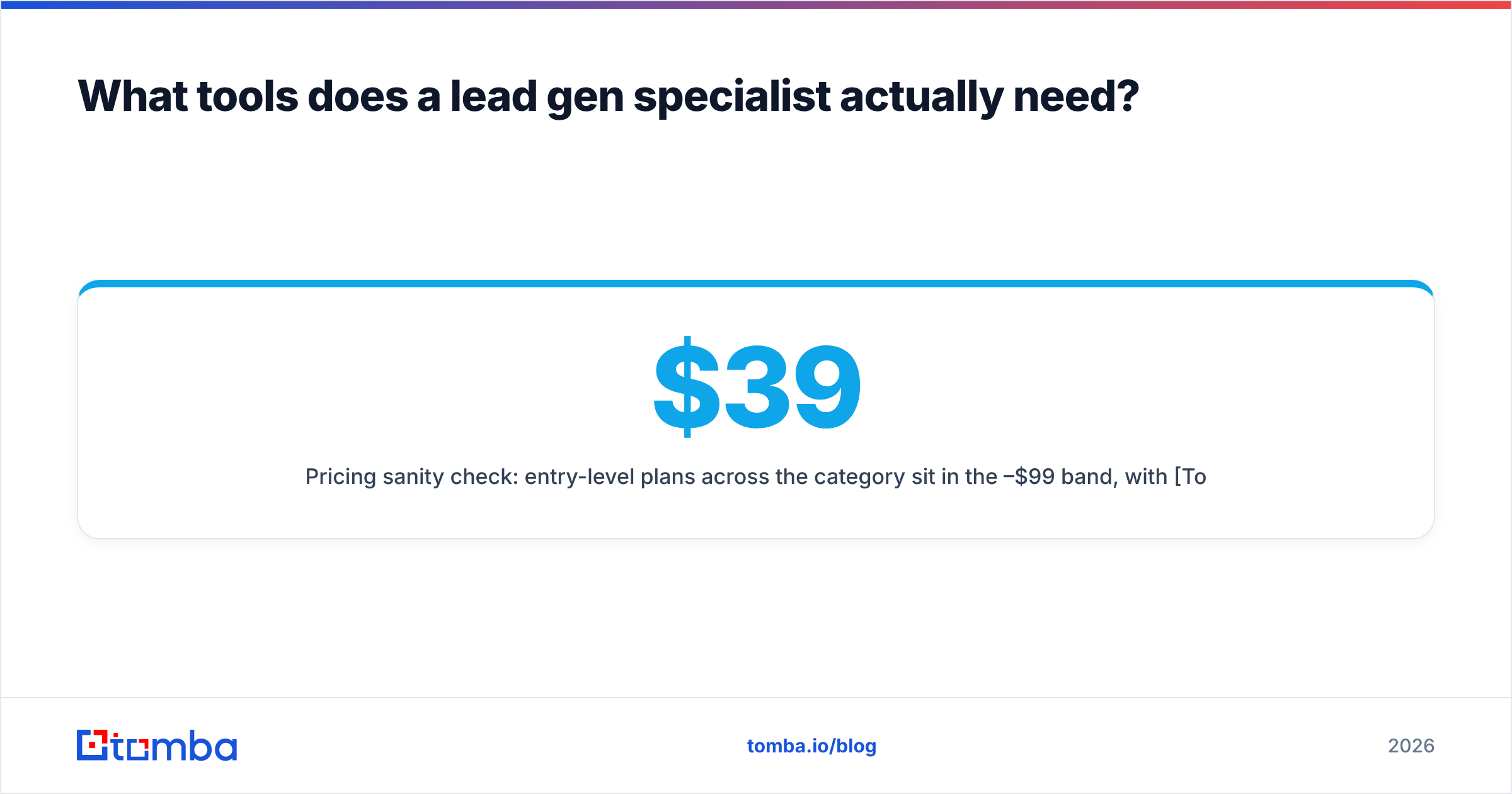
Pricing sanity check: entry-level plans across the category sit in the $39–$99/month band, with Tomba pricing starting at a free tier of 25 searches/month, Starter at $49/month, Growth at $99/month, and Pro at $249/month. Compare on verified-contacts-delivered, not on credits granted — a cheap credit that resolves to a catch-all you cannot confirm is not cheap.
Is a lead gen specialist better than an SDR agency?#
It depends on whether you have a process problem or a capacity problem.
Hire a specialist if:
- Your ICP is defined and has held steady for two or more quarters.
- Your AEs complain about list quality rather than list volume.
- You want the sourcing process to become a company asset.
- You have someone who can manage the role — an unmanaged junior specialist drifts within a month.
Use an agency if:
- You are validating a new segment, geography, or product line.
- You need output inside three weeks.
- Your internal bandwidth for management is genuinely zero.
- You are comfortable that the process leaves when the contract does.
Do neither yet if:
- Fewer than 20 sales conversations have happened total. You do not have an ICP; you have a hypothesis. Founder-led prospecting with a free tier and a spreadsheet will teach you more than either hire.
Forrester's B2B research has consistently found that buying groups keep growing — six to ten stakeholders on a typical enterprise deal. That matters here: it means contact coverage per account is now a bigger lever than raw account count, and coverage work is exactly what a specialist does and an agency usually bills by the lead.
How do you measure a lead gen specialist's performance?#
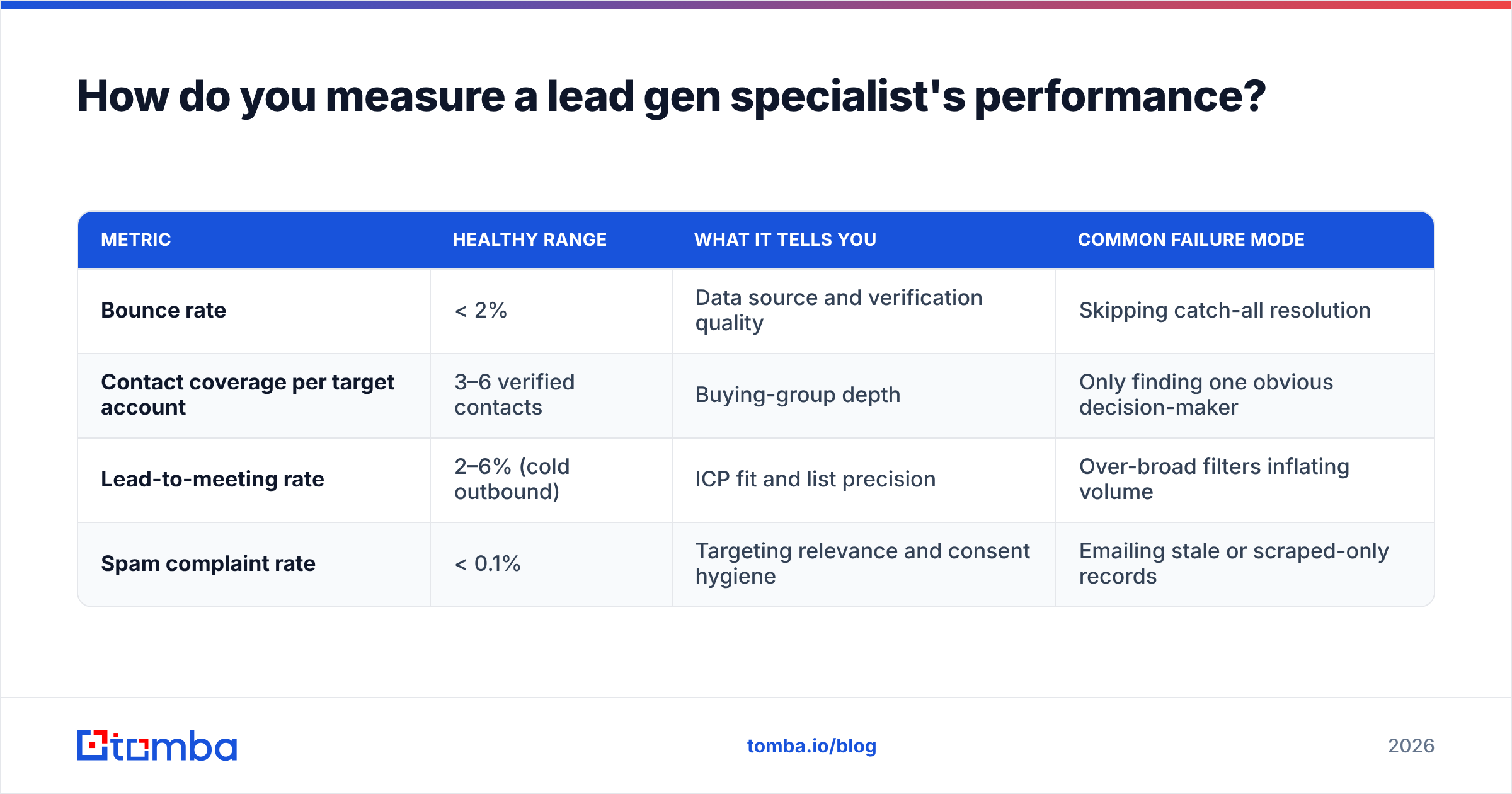
Four metrics, reviewed weekly. Everything else is decoration.
| Metric | Healthy range | What it tells you | Common failure mode |
|---|---|---|---|
| Bounce rate | < 2% | Data source and verification quality | Skipping catch-all resolution |
| Contact coverage per target account | 3–6 verified contacts | Buying-group depth | Only finding one obvious decision-maker |
| Lead-to-meeting rate | 2–6% (cold outbound) | ICP fit and list precision | Over-broad filters inflating volume |
| Spam complaint rate | < 0.1% | Targeting relevance and consent hygiene | Emailing stale or scraped-only records |
Volume alone is a trap. A specialist who delivers 2,000 records a week at a 7% bounce rate is destroying your sending domain faster than they are building pipeline. One who delivers 600 records at 1.2% bounce with five contacts per account is worth three of the former.
Set a quality floor before you set a volume target. A standing rule of "nothing enters a sequence unverified" costs a few hours a week and prevents the kind of sender reputation damage that takes a quarter to repair.
What does a lead gen specialist job description look like?#
If you are hiring, a tight description filters better than a long one. Core elements worth including:
- Ownership statement: "You own the quality and volume of contactable records entering our outbound engine."
- Concrete weekly output: e.g. "250–400 verified contacts across 60–80 target accounts."
- Quality bar: "Maintain bounce rate under 2% and complaint rate under 0.1%."
- Tooling reality: name the actual stack. Candidates self-select accurately when they see it.
- A screening task: give a domain and a role, ask for five verified contacts plus a short note on how they verified. This one exercise separates the top 10% in under an hour of your time.
Skip requirements like "5+ years experience" for a role where the tooling changed completely in the last three. Two years of recent, hands-on work beats five years of pre-API list building.
Where should you start?#
Start with the data layer, because it constrains everything downstream. Before you post a job or sign an agency contract, run your current process through one honest test: take 100 records from your existing source, verify them, and count how many are genuinely deliverable. If the answer is under 90, you have a data problem that no headcount will fix.
Tomba's Email Finder is built for exactly that layer — find professional email addresses by domain, name, or company, with verification built into the same workflow so records never leave the system unchecked. The free tier gives you 25 searches a month, which is enough to run the honest test above before you spend anything. If it holds up, Starter at $49/month covers a solo specialist's daily workload, and the API scales with the team when you are ready.
Fix the list first. The rest of outbound gets easier from there.
Related guides#
// get started
Find, verify and enrich your first contacts today
Start on the free plan with 25 searches a month, then scale when your team is ready.
Free plan · No credit card required · GDPR & CCPA
Get the Tomba newsletter
Product and data updates
// about the author