Lead Gen Specialists: What They Do, Cost, and ROI in 2026
Hiring a lead gen specialist costs $45K-$95K a year, or $800-$5,000 a month via an agency. Here is what the role actually does, what it costs, and when tooling beats headcount.
TL;DR
- A lead gen specialist is the person who builds and cleans the top of your pipeline — list building, enrichment, verification, and first-touch sequencing — so AEs only talk to people who exist and match ICP.
- Cost in 2026: $45K–$95K base in-house (US), $800–$5,000/mo for an agency retainer, $15–$45/hr for a freelancer, and roughly $0.01–$0.04 per verified contact if you do it with tooling.
- The role is worth a hire once you need more than ~3,000 net-new, research-heavy contacts a month or you sell into a market where ICP fit requires human judgment.
- Below that, a $49–$99/mo data stack plus four hours a week of an SDR's time usually outperforms a junior hire on cost-per-qualified-meeting.
- The biggest failure mode is not the person — it's measuring them on volume. Specialists scored on "leads sourced" will hand you 10,000 bounced addresses and a suspended domain.
What is a lead gen specialist?#
A lead gen specialist owns everything that happens before a salesperson opens their mouth. Think of them as the prep cook in a restaurant kitchen: they don't plate the dish, but if the vegetables aren't washed and chopped, dinner service falls apart.
Concretely, the job breaks into five repeating tasks:
- ICP definition and list building — translating "mid-market SaaS in DACH" into an actual list of 1,400 companies with firmographic filters applied, then finding the right three people at each.
- Contact discovery and enrichment — turning a company plus a job title into a working email, a direct dial, and a LinkedIn profile. This is where an email finder and data enrichment do most of the heavy lifting.
- Verification and hygiene — running every address through an email verifier, deduping, and flagging catch-all domains before anything hits a sending tool.
- Sequencing and first touch — loading the list into Instantly, Smartlead, Outreach, or whatever the team sends from, writing or adapting the copy, and watching reply rates by segment.
- Reporting back into ICP — telling you that the 1,400-company list actually converted at 0.4% and the 300-company sub-segment converted at 3.1%, so next month you build 1,200 of those instead.
Titles vary — lead generation specialist, demand gen associate, SDR (research), growth researcher, pipeline analyst — but the function is the same. What separates a good one from an expensive VA is step 5. Anyone can pull a list. Very few people close the loop between list composition and reply rate.
What does a lead gen specialist actually do day to day?#
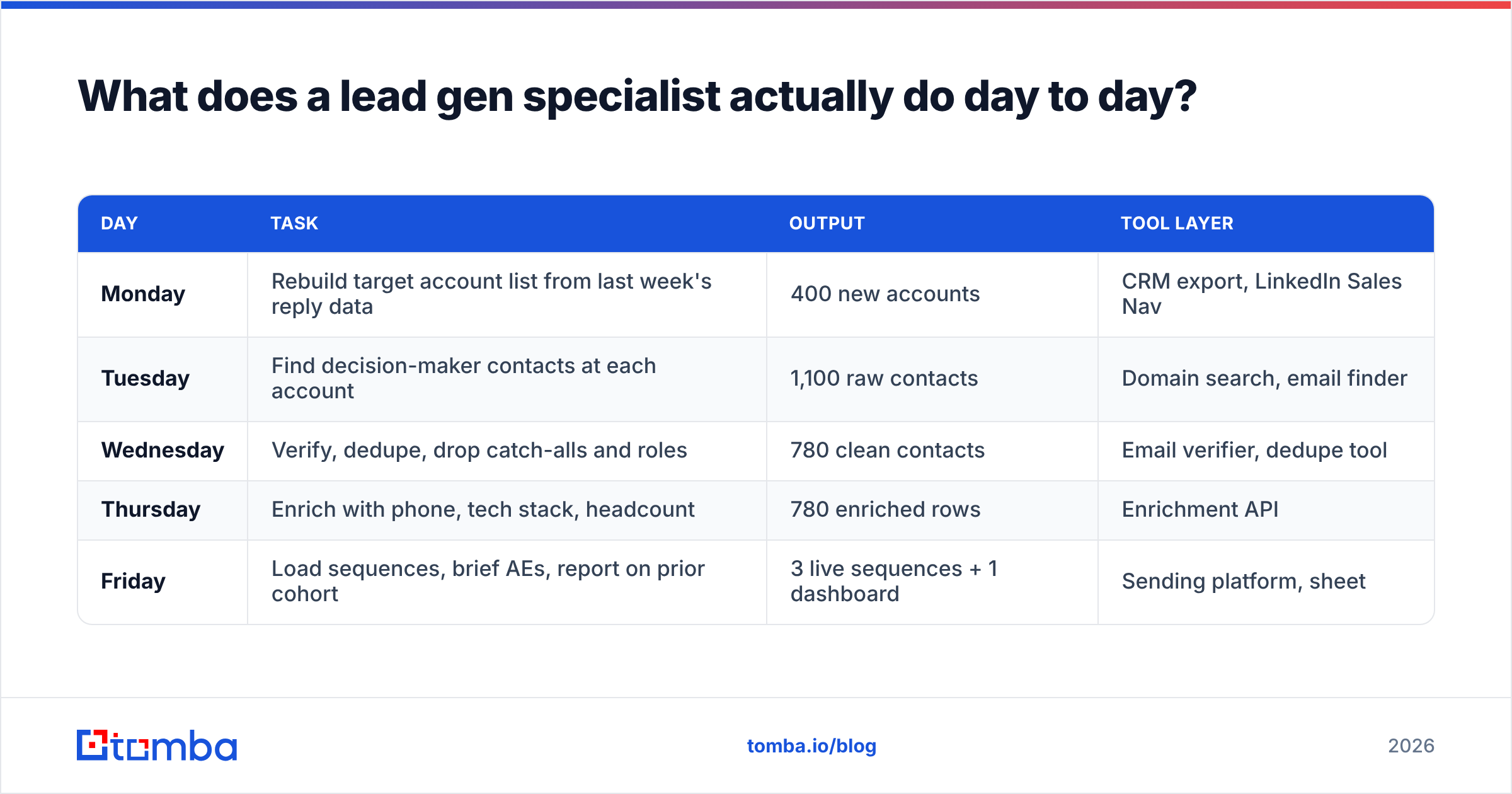
Here is a realistic week for a specialist supporting two AEs in a B2B SaaS company selling a $15K ACV product:
| Day | Task | Output | Tool layer |
|---|---|---|---|
| Monday | Rebuild target account list from last week's reply data | 400 new accounts | CRM export, LinkedIn Sales Nav |
| Tuesday | Find decision-maker contacts at each account | 1,100 raw contacts | Domain search, email finder |
| Wednesday | Verify, dedupe, drop catch-alls and roles | 780 clean contacts | Email verifier, dedupe tool |
| Thursday | Enrich with phone, tech stack, headcount | 780 enriched rows | Enrichment API |
| Friday | Load sequences, brief AEs, report on prior cohort | 3 live sequences + 1 dashboard | Sending platform, sheet |
That's roughly 780 usable contacts a week from one person working full time, assuming a research-light market. In a research-heavy market — healthcare procurement, regulated finance, public sector — the same person delivers 150 to 300 a week because every account needs manual qualification.
If those numbers sound low, that's the point. Volume is not the constraint anymore. A bulk email finder can produce 10,000 contacts in an afternoon. The constraint is whether those contacts match a segment that converts, and that judgment is what you're paying a human for.
How much do lead gen specialists cost in 2026?#
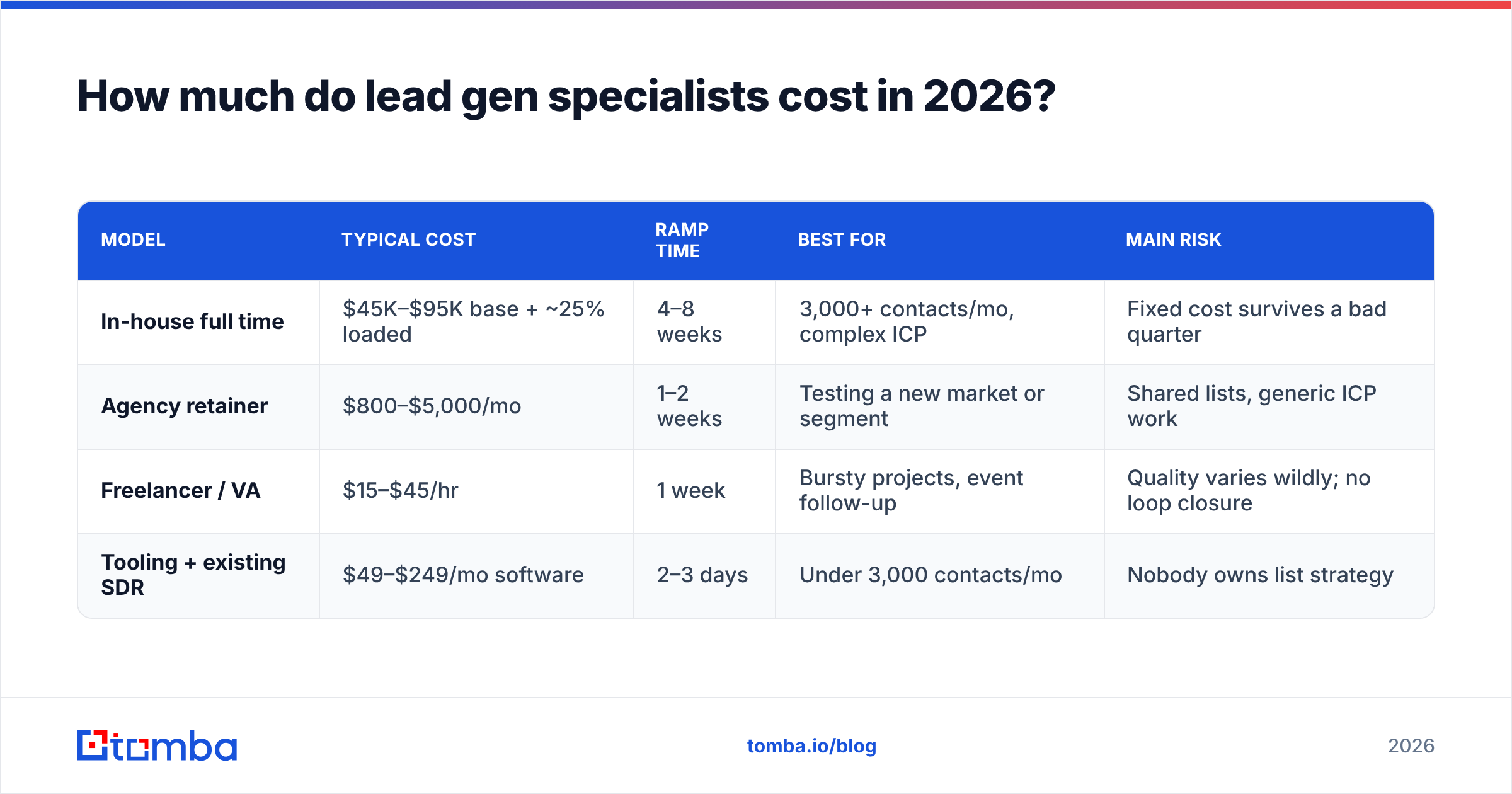
Four delivery models, four very different cost structures. Prices below reflect US and Western European markets; offshore rates run 40–60% lower.
| Model | Typical cost | Ramp time | Best for | Main risk |
|---|---|---|---|---|
| In-house full time | $45K–$95K base + ~25% loaded | 4–8 weeks | 3,000+ contacts/mo, complex ICP | Fixed cost survives a bad quarter |
| Agency retainer | $800–$5,000/mo | 1–2 weeks | Testing a new market or segment | Shared lists, generic ICP work |
| Freelancer / VA | $15–$45/hr | 1 week | Bursty projects, event follow-up | Quality varies wildly; no loop closure |
| Tooling + existing SDR | $49–$249/mo software | 2–3 days | Under 3,000 contacts/mo | Nobody owns list strategy |
The in-house number deserves detail. Entry-level lead gen specialists in the US cluster around $48K–$58K; two to four years of experience puts you at $60K–$78K; someone who can write SQL, run an API, and own attribution reporting sits at $85K–$95K. Add roughly 25–30% for payroll tax, benefits, and equipment, plus $200–$600/mo in tooling they'll need on top. A "cheap" $55K hire is a $75K–$80K annual line item.
Agency pricing behaves differently. Below about $1,500/mo you are typically buying list delivery, not strategy — the agency runs the same scraper against your filters that you could run yourself. Above $3,000/mo you start getting a named strategist and market-specific research. Check current vendor ratings on G2 before signing anything longer than three months.
Is hiring a lead gen specialist better than buying tools?#
Short answer: tooling wins below roughly 3,000 net-new contacts a month; headcount wins above it, or whenever ICP fit requires judgment a filter can't express.
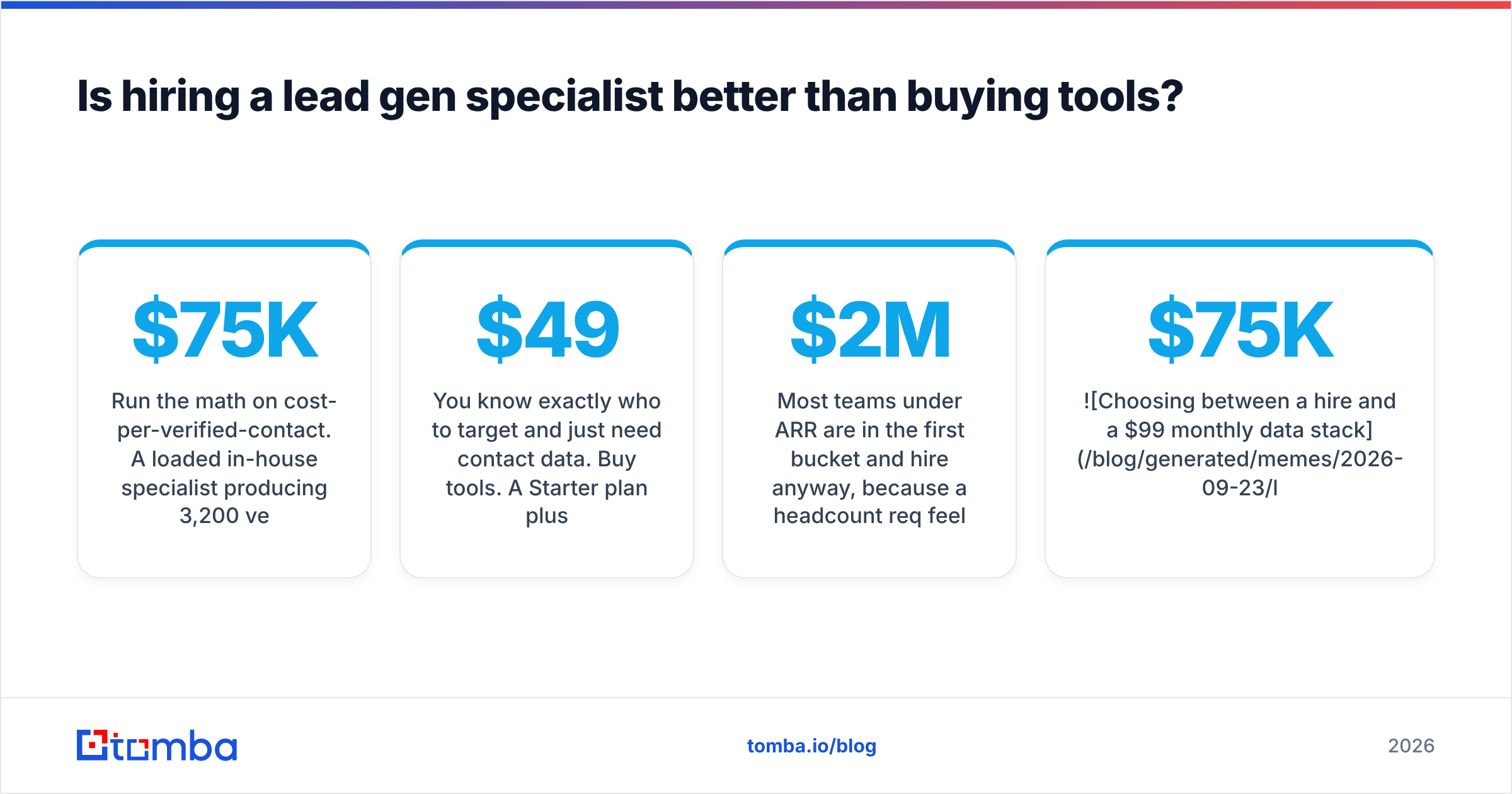
Run the math on cost-per-verified-contact. A $75K loaded in-house specialist producing 3,200 verified contacts a month costs about $1.95 per contact before software. A Tomba Growth plan at $99/mo covering the same 3,200 lookups lands nearer $0.03 per contact — but produces zero strategy, zero segment analysis, and zero AE briefing.
So the real question isn't "which is cheaper." It's which of these three statements is true for you:
- You know exactly who to target and just need contact data. Buy tools. A $49/mo Starter plan plus four hours of an existing SDR's week covers it. Hiring here is burning $70K to solve a $600 problem.
- You have a hypothesis about your ICP but no data to confirm it. Hire an agency for 90 days. You're buying pattern recognition across markets you haven't run yet, and you want to exit cheaply if the hypothesis is wrong.
- You have proven segments and need someone to industrialize them. Hire in-house. The loop between list composition and reply rate compounds, and that compounding only happens when one person owns it long enough to see three quarters of data.
Most teams under $2M ARR are in the first bucket and hire anyway, because a headcount req feels more like progress than a subscription does.

What tools does a lead gen specialist need?#
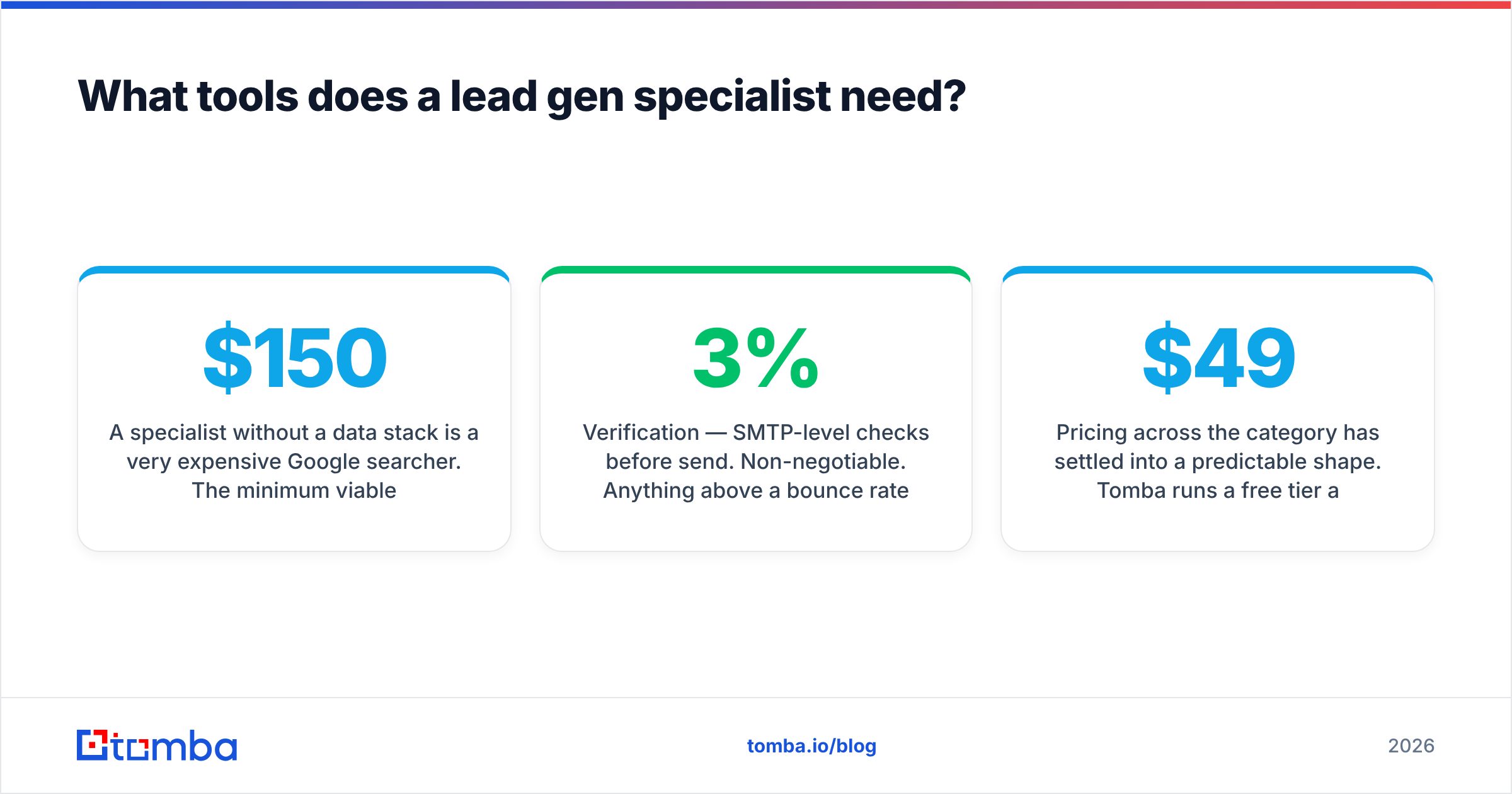
A specialist without a data stack is a very expensive Google searcher. The minimum viable stack has four layers, and the total should land between $150 and $400 per month per seat.
- Contact discovery — finding emails by name and domain, or pulling every contact at a company. This is domain search plus a Chrome extension for one-off lookups while browsing LinkedIn.
- Verification — SMTP-level checks before send. Non-negotiable. Anything above a 3% bounce rate puts your sender reputation at risk, and Google and Yahoo both enforce bulk-sender thresholds now. A catch-all verifier matters more than people expect — catch-all domains are typically 15–25% of a B2B list and naive tools mark them all "valid."
- Enrichment — headcount, funding, tech stack, direct dials. Used for routing and prioritization, not for spray volume.
- Workflow glue — Sheets or Airtable for staging, plus a CRM sync so the AE sees the same record. Most specialists live in Google Sheets more than any other tool, so pick something with a native add-on rather than a CSV round trip.
Pricing across the category has settled into a predictable shape. Tomba runs a free tier at 25 searches/month, Starter at $49/mo, Growth at $99/mo, Pro at $249/mo, and custom enterprise pricing. Competitors like BookYourData take a different route — pre-built, pay-as-you-go verified lists with no subscription, which suits teams that buy data in discrete batches rather than continuously. Apollo bundles sequencing with data at a higher monthly floor. None of these is strictly better; they're priced for different buying rhythms.
The one thing to insist on regardless of vendor: API access on the plan you buy. A specialist who can script a nightly enrichment job through the Tomba API does the work of two who can't.
How do you measure a lead gen specialist?#
Badly measured specialists produce garbage at scale. Here's the metric hierarchy that actually works, from worst to best:
- Leads sourced (avoid). Rewards volume. Guarantees bounces, spam complaints, and eventually a burned sending domain.
- Verified contacts delivered (weak). Better, but still volume-shaped. A specialist can hit this by widening the ICP until anything qualifies.
- Contacts that reached first touch without bouncing (decent). Now hygiene matters. Target under 2% bounce.
- Positive reply rate by segment (good). Ties list composition to outcome. Expect 1–3% positive replies on a cold list; anything above 5% means you found a real segment and should double down.
- Meetings held per 1,000 contacts sourced (best). The only number that survives contact with finance. Healthy B2B benchmark sits around 8–15 meetings per 1,000 well-targeted contacts.
Review at the segment level, not the aggregate. An aggregate 1.2% reply rate often hides one segment at 4% and four segments at 0.2%. The specialist's job is to find that split and kill the four. For context on what "good" looks like across the funnel, HubSpot's annual sales benchmark research is a reasonable neutral reference point.
What should you look for when hiring one?#
Skip the resume keywords. Three signals predict performance:
- They ask about your ICP before your tools. A candidate whose first question is "what's your current close rate by company size" is thinking about step 5. A candidate whose first question is "do you use Apollo or ZoomInfo" is thinking about step 1.
- They can show a segment kill decision. Ask: "Tell me about a list you built that didn't work and what you did next." Weak answers blame the copy. Strong answers describe cutting a segment and reallocating budget.
- They're fluent in deliverability, not just discovery. If they can't explain why a catch-all domain is risky or what an SPF record does, they will eventually get your domain blocked. This is the single most common way a cheap hire becomes expensive.
For a 90-day trial structure: month one, they rebuild your existing best-performing list from scratch and you compare output quality. Month two, they run one net-new segment end to end. Month three, they present segment-level reply data and a recommendation on where to spend next quarter's sourcing hours. If month three is a volume report instead of a recommendation, you hired a VA.
When should you skip the hire entirely?#
Skip it if any of these are true:
- Your total addressable market is under 2,000 accounts. You don't need a sourcing engine; you need three people doing account research manually, once.
- You haven't sent 1,000 cold emails yet. You have no data to optimize against, and the specialist's first 90 days will be spent discovering what you could have learned in three weeks for $49.
- Your close rate on inbound is under 10%. Fix the offer before you scale the top of the funnel. More leads into a leaky funnel just costs more.
- Nobody on your team owns deliverability. Adding volume to an unmonitored sending setup is the fastest path to a blacklisted domain. Run a blacklist check and an SPF audit before you add a single new sequence.
If none of those apply and you're consistently hitting the ceiling of what your current stack can research, that's the signal. Hire.
The practical starting point#
Before you post the job req, run the cheap experiment: give one existing SDR a data stack and four protected hours a week for six weeks. Track meetings held per 1,000 contacts sourced. If that number is healthy and the only limit is hours, you've proven the ROI case for a hire and you'll know exactly what to brief them on. If the number is weak, a specialist wouldn't have fixed it — the targeting or the offer is wrong, and a new hire would just produce the same bad list faster.
Either way, the data layer comes first. Start with the Tomba Email Finder on the free tier — 25 searches a month is enough to validate whether your target accounts even have findable contacts — then move to Starter at $49/mo when you're running weekly lists, or Growth at $99/mo once a specialist (hired or borrowed) is building at scale. Every contact runs through verification before it leaves the platform, which means the person doing the sourcing spends their time on segment strategy instead of cleaning bounces.
Related guides#
Ready to find emails that actually work?
Join 150,000+ professionals who stopped guessing and started sending. Free credits on signup — no credit card required.
Get the Tomba newsletter
Practical outbound tactics and product updates — once every two weeks.
About the author