Lead Generation and Nurturing: The 2026 Playbook That Converts
Most teams generate leads fine and nurture them badly. Here is the full 2026 workflow — sourcing, scoring, sequencing, and the handoff rules that decide whether a lead ever becomes revenue.
TL;DR
- Lead generation and nurturing are one system, not two departments. If the handoff between them is undefined, you lose more revenue in the gap than you gain from either side.
- Volume is no longer the constraint. Contactability is. A 10,000-record list with 38% bad emails costs you domain reputation, not just wasted sends.
- Nurture sequences fail for a boring reason: they are built around your release calendar instead of the buyer's open question. Map cadence to buying stage, not to your content backlog.
- Score on behavior plus fit, review the model quarterly, and force a written definition of "sales-ready" that both teams sign.
- The stack that matters in 2026 is small: a source of verified contact data, a sequencing tool, a CRM with clean stage definitions, and one dashboard nobody argues with.
What is lead generation and nurturing, really?#
Lead generation is how a stranger becomes a known contact. Nurturing is everything you do between that moment and the moment they are ready to talk to a salesperson. Most B2B teams treat these as separate budgets with separate owners, which is exactly why pipeline leaks.
Think of it like a restaurant. Generation is getting people through the door. Nurturing is the service between seating and dessert. You can have a line around the block and still lose money if half your tables walk out before ordering. Nobody blames the host stand for that, but the host stand is where the guest count came from — the two functions share one P&L whether your org chart admits it or not.
The functional difference in 2026 is that generation has gotten cheap and nurturing has gotten hard. Anyone can pull 50,000 contacts from a database in an afternoon. Almost nobody can get a reply rate above 4% on them. The bottleneck moved downstream, and most budgets have not followed.
Here is the split most teams should be working from:
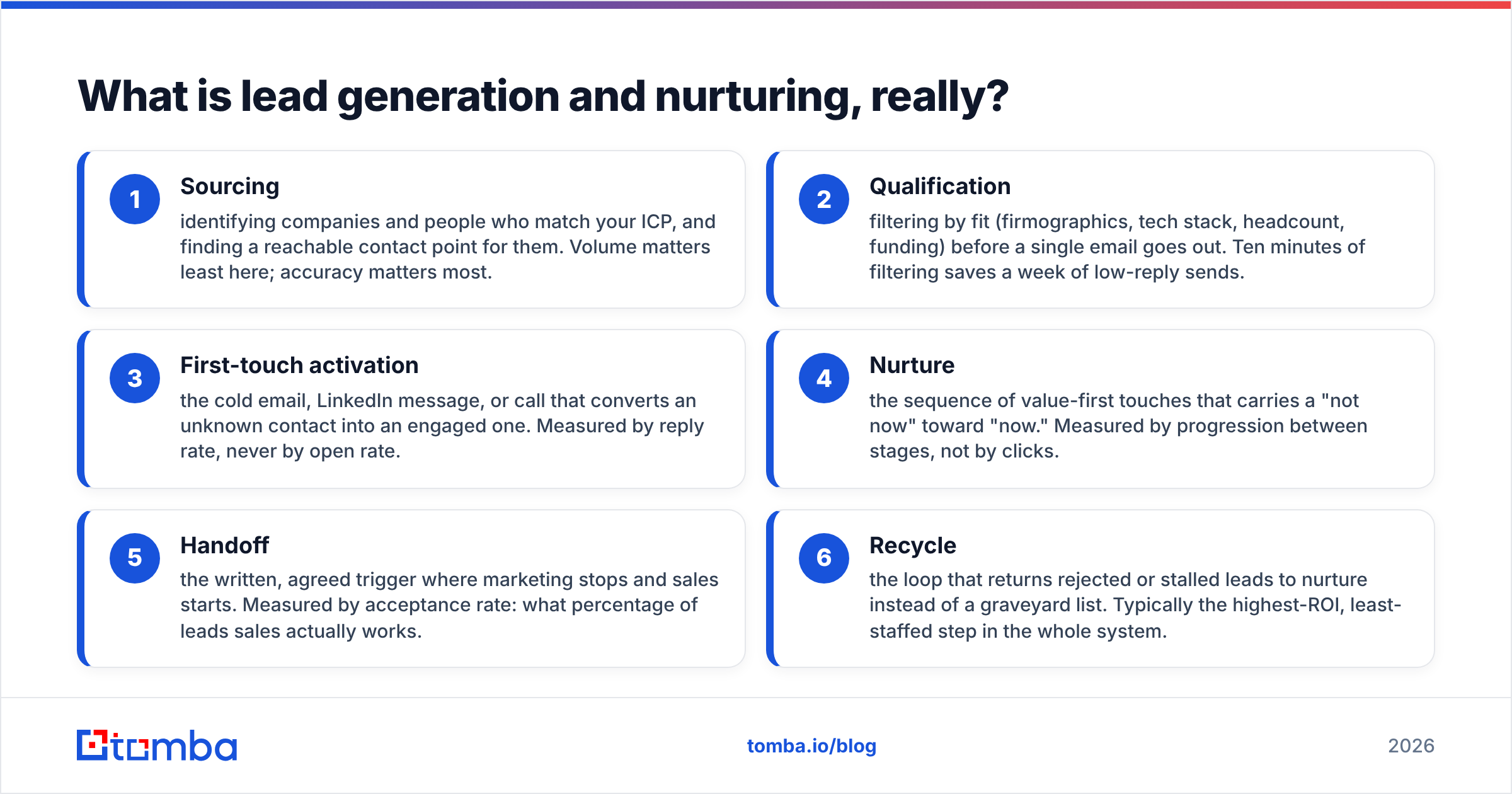
- Sourcing — identifying companies and people who match your ICP, and finding a reachable contact point for them. Volume matters least here; accuracy matters most.
- Qualification — filtering by fit (firmographics, tech stack, headcount, funding) before a single email goes out. Ten minutes of filtering saves a week of low-reply sends.
- First-touch activation — the cold email, LinkedIn message, or call that converts an unknown contact into an engaged one. Measured by reply rate, never by open rate.
- Nurture — the sequence of value-first touches that carries a "not now" toward "now." Measured by progression between stages, not by clicks.
- Handoff — the written, agreed trigger where marketing stops and sales starts. Measured by acceptance rate: what percentage of leads sales actually works.
- Recycle — the loop that returns rejected or stalled leads to nurture instead of a graveyard list. Typically the highest-ROI, least-staffed step in the whole system.
Why do most nurture programs stall after the first email?#
Because the first email was the only one written for the buyer. Everything after it was written for the content calendar.
Open your last nurture sequence and read step three. If it says "check out our new ebook" or "here's our Q3 webinar," you are broadcasting, not nurturing. The buyer's question after a first touch is not "what content do you have." It is "does this apply to a company like mine, and what would it cost me to find out."
The second failure mode is mechanical: the list decays faster than the sequence runs. B2B contact data goes stale at roughly 2–3% per month through job changes alone, and a 12-week nurture track means the last email in your sequence lands on a list that is measurably worse than the one you started with. Run the sequence long enough and you are warming up mailboxes that no longer exist, which quietly degrades email deliverability for the contacts who are still there.

The third is attribution theater. Teams measure nurture by email opens, which Apple Mail Privacy Protection made largely fictional years ago. If your nurture dashboard leads with open rate, you are steering by a broken instrument. Replace it with three numbers: reply rate, stage progression rate, and sales acceptance rate.
How do you generate leads that are actually worth nurturing?#
Start from the account, not the person. Build a target account list first — industry, size, tech signals, funding stage, geography — and only then find people inside it. Reversing that order is how you end up nurturing 4,000 contacts who will never have budget.
Once accounts are locked, contact discovery is a data problem with three honest options:
Buy a static list. Fast, cheap per record, and decaying from the moment of purchase. Fine for a one-off campaign in a stable market, dangerous as a standing process. Vendors like BookYourData have made this category genuinely better — pay-as-you-go pricing and verified-on-delivery records remove the worst of the old list-broker problems — but any static file is a snapshot, and snapshots age.
Query a live database. Subscription platforms let you pull fresh records on demand and re-verify before each send. Higher fixed cost, far better freshness.
Find contacts on demand via API. Instead of holding a list, you resolve a contact at the moment you need it — from a domain, a name, or a LinkedIn profile. This is the pattern most modern teams have landed on, because the record is never older than the campaign.
In practice, serious programs mix two and three. You keep a working database for planning and use an email finder or domain search to resolve contacts right before a sequence starts. The difference in bounce rate between a 90-day-old record and a freshly resolved one is usually the difference between a healthy sending domain and a throttled one.
What does a good lead nurturing sequence look like in 2026?#
It looks short, specific, and staged. Here is the shape that consistently outperforms the 9-email "drip" most teams inherited:
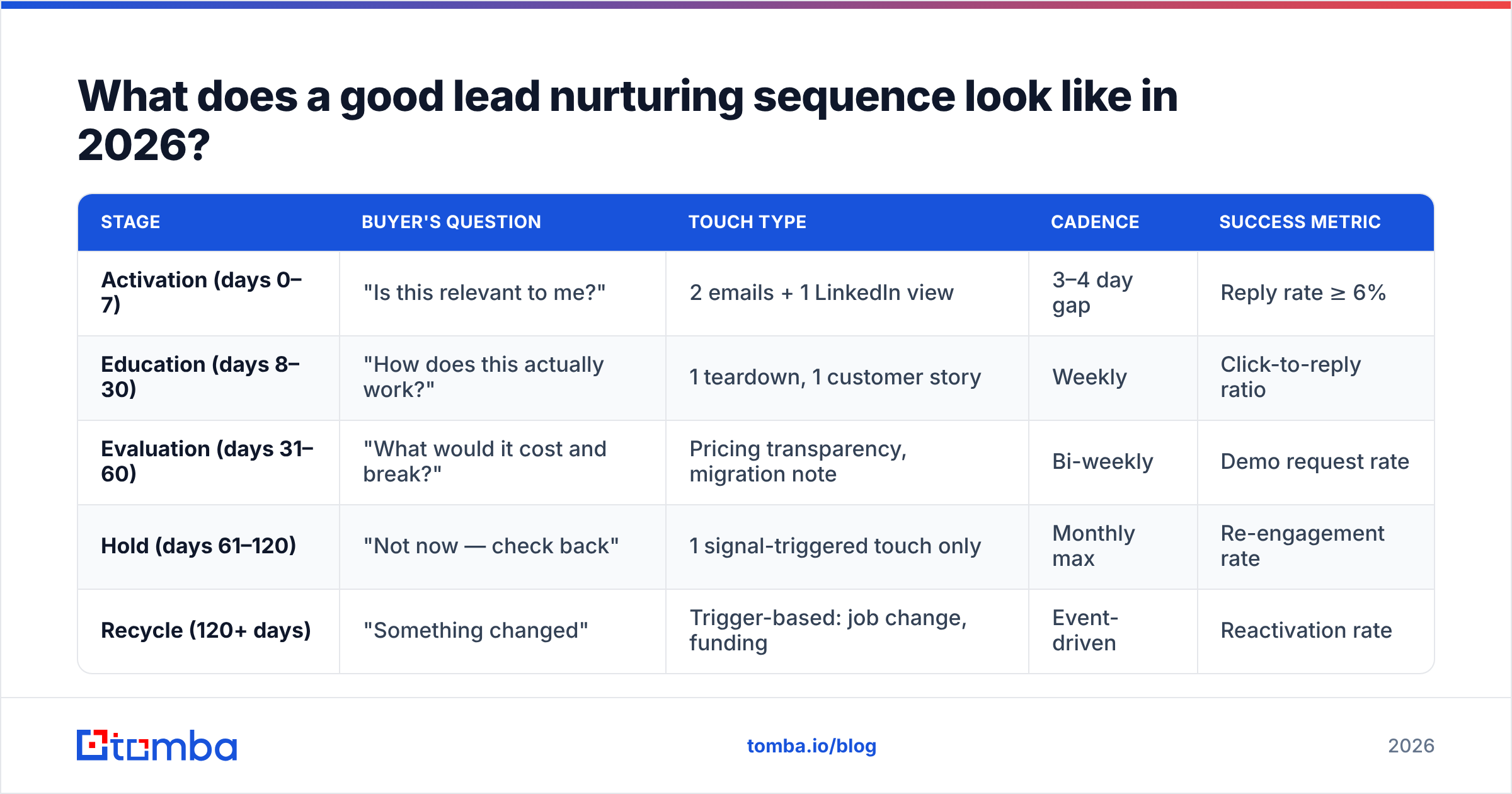
| Stage | Buyer's question | Touch type | Cadence | Success metric |
|---|---|---|---|---|
| Activation (days 0–7) | "Is this relevant to me?" | 2 emails + 1 LinkedIn view | 3–4 day gap | Reply rate ≥ 6% |
| Education (days 8–30) | "How does this actually work?" | 1 teardown, 1 customer story | Weekly | Click-to-reply ratio |
| Evaluation (days 31–60) | "What would it cost and break?" | Pricing transparency, migration note | Bi-weekly | Demo request rate |
| Hold (days 61–120) | "Not now — check back" | 1 signal-triggered touch only | Monthly max | Re-engagement rate |
| Recycle (120+ days) | "Something changed" | Trigger-based: job change, funding | Event-driven | Reactivation rate |
Three rules hold that table together.
First, the hold stage is not a slower drip. Most teams shorten intervals and keep sending the same content. Instead, cut touches to near-zero and wait for a signal — a job change, a funding round, a new hire on the buying committee. A single message sent two days after your champion starts a new role outperforms six months of monthly newsletters.
Second, every stage has one job. If your "education" email also asks for a demo, it is an activation email wearing a costume, and it will convert like a bad activation email.
Third, the sequence has a defined exit. A lead that completes the track without progressing does not loop forever. It goes to recycle with a documented reason, which is the only way you ever learn why the track failed.
For teams writing these from scratch, the fastest starting point is a proven structure you edit rather than a blank page — our library of cold email templates covers the activation and education stages, and the subject line tester will catch the spam-trigger phrases most nurture copy quietly accumulates.
How should you score leads without overbuilding the model?#
Score on two axes and resist the urge to add a third. Fit answers "should we sell to them." Behavior answers "do they want to buy now." A lead high on both is sales-ready. High fit, low behavior goes to nurture. Low fit, high behavior goes to a self-serve path or nowhere.
The overbuilt models fail because nobody can explain them. If a rep cannot look at a score of 74 and say why it is not 40, the model will be ignored inside a quarter.
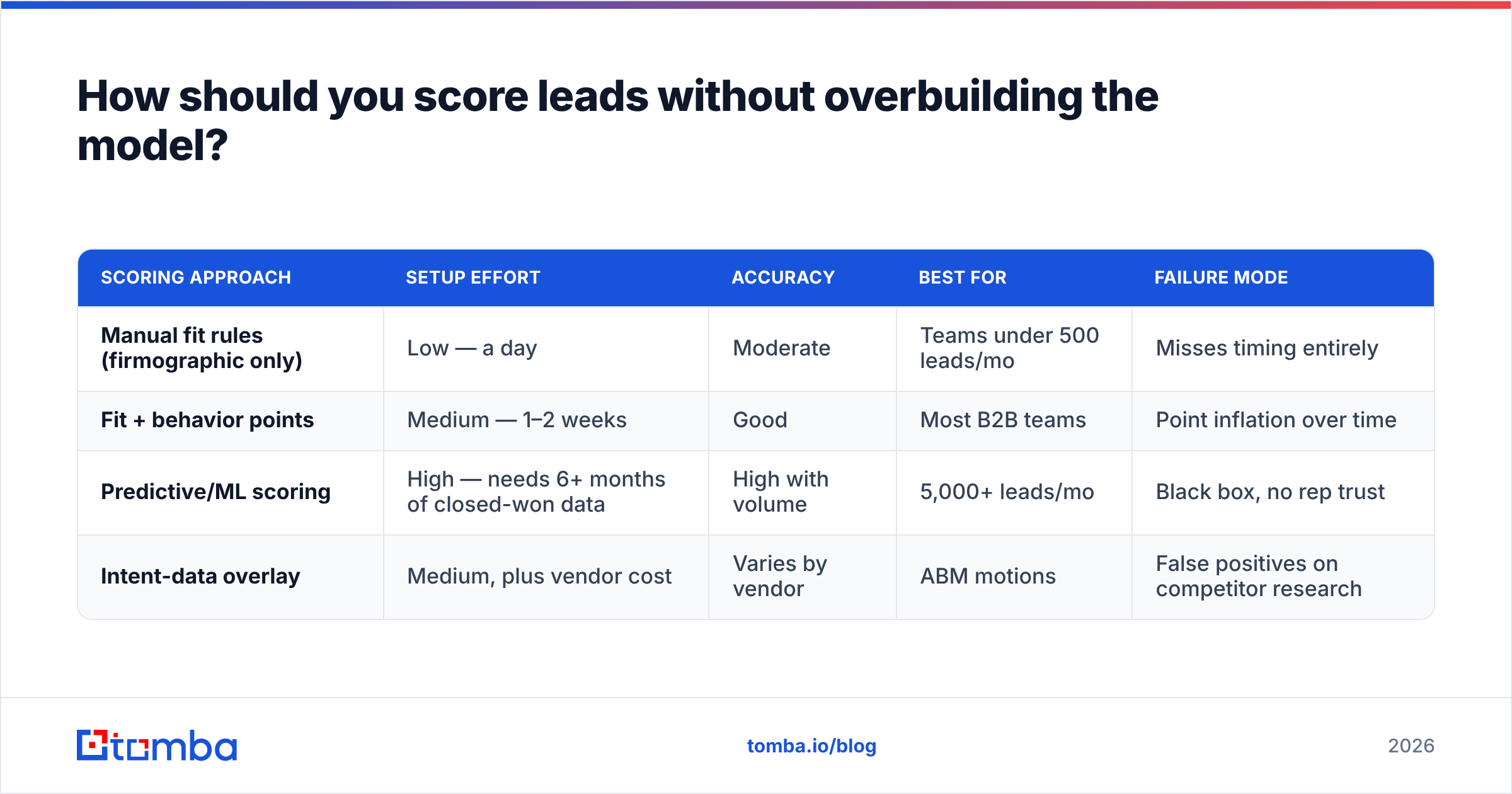
| Scoring approach | Setup effort | Accuracy | Best for | Failure mode |
|---|---|---|---|---|
| Manual fit rules (firmographic only) | Low — a day | Moderate | Teams under 500 leads/mo | Misses timing entirely |
| Fit + behavior points | Medium — 1–2 weeks | Good | Most B2B teams | Point inflation over time |
| Predictive/ML scoring | High — needs 6+ months of closed-won data | High with volume | 5,000+ leads/mo | Black box, no rep trust |
| Intent-data overlay | Medium, plus vendor cost | Varies by vendor | ABM motions | False positives on competitor research |
Whichever you pick, put a quarterly review on the calendar. Point values drift, your ICP shifts, and a model nobody has audited in a year is just a superstition with a number attached. Grounding the review in one hard question helps: of the deals you closed last quarter, what did the model score them at on day one? If the answer is "all over the place," the model is decorative.
Definitions matter as much as math. Write down what a marketing qualified lead means at your company — the specific score, the specific actions, the specific fit criteria — and get both the marketing lead and the sales lead to sign it. HubSpot's research on lead scoring frameworks is a reasonable external reference point, but the internal agreement matters more than the framework you borrow.
Where does the handoff between marketing and sales break?#
At the acceptance rate, and almost nobody measures it.
Marketing reports leads delivered. Sales reports pipeline created. Neither team reports the number in between: what percentage of delivered leads did sales actually work, and of those, what percentage did they accept as legitimately qualified. If that number is below 60%, your definitions are broken and no amount of additional lead volume will help.

Fix it with three artifacts, all written, all boring:
- A signed SLA. Marketing commits to a lead count and a quality bar. Sales commits to a response window — usually 24 business hours — and to a rejection reason from a fixed list. No free-text rejections; they cannot be analyzed.
- A rejection taxonomy. Five to seven reasons, maximum: wrong title, wrong company size, no budget, bad contact data, already a customer, timing, competitor. Each one routes somewhere different.
- A weekly 20-minute review. Both leads, same room, look at rejected leads only. Not a strategy meeting — a defect review.
The rejection reason "bad contact data" deserves special attention, because it is the only one you can fix mechanically rather than politically. If reps are bouncing on 15% of the emails you hand them, run the list through an email verifier before delivery and that category disappears from your rejection report. It is the cheapest credibility win available to a marketing team.
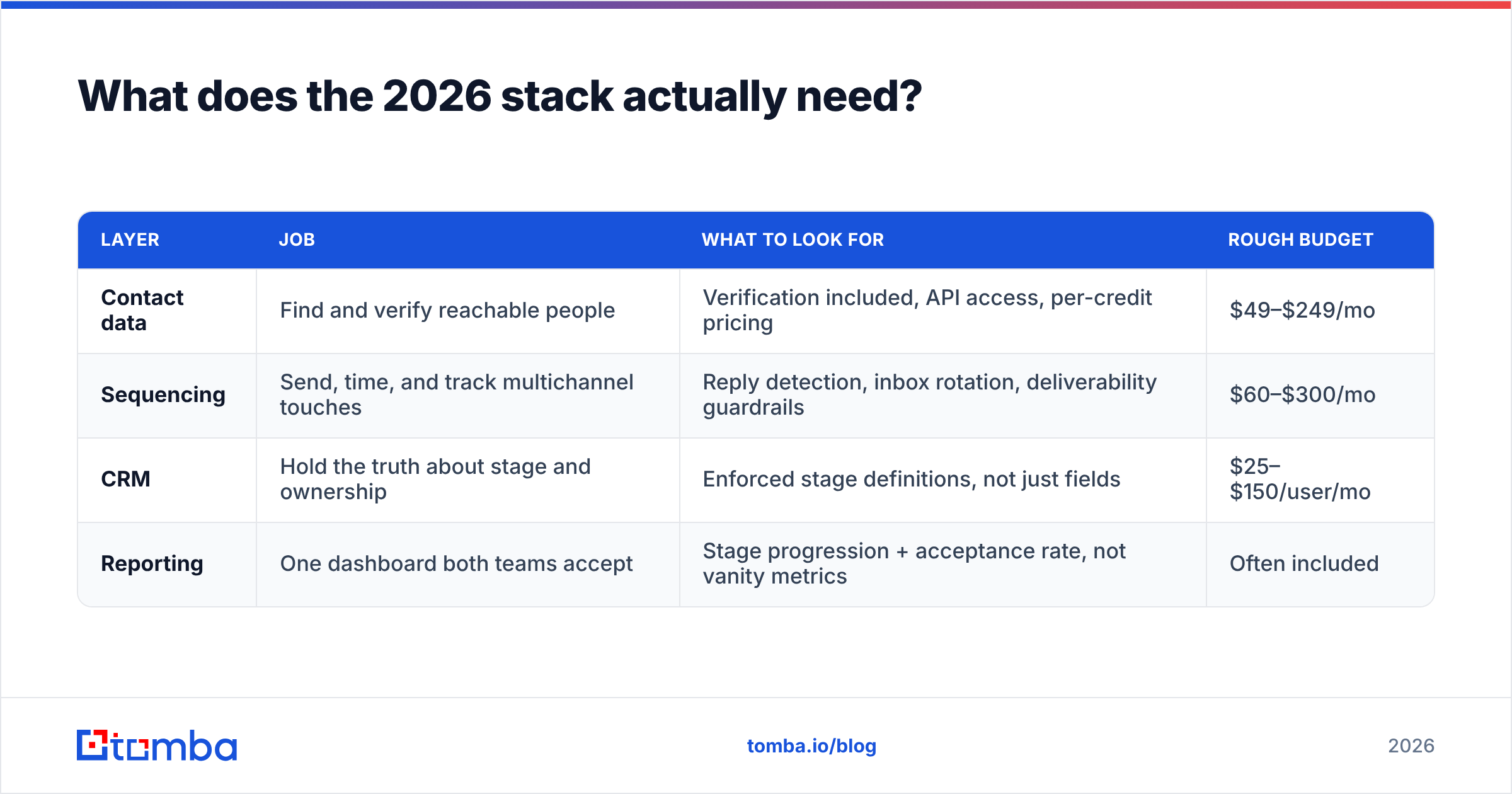
What does the 2026 stack actually need?#
Less than vendors would like you to believe. Four layers cover it:
| Layer | Job | What to look for | Rough budget |
|---|---|---|---|
| Contact data | Find and verify reachable people | Verification included, API access, per-credit pricing | $49–$249/mo |
| Sequencing | Send, time, and track multichannel touches | Reply detection, inbox rotation, deliverability guardrails | $60–$300/mo |
| CRM | Hold the truth about stage and ownership | Enforced stage definitions, not just fields | $25–$150/user/mo |
| Reporting | One dashboard both teams accept | Stage progression + acceptance rate, not vanity metrics | Often included |
On the data layer specifically, price per record matters less than bounce rate. A provider at $0.02 per contact with a 20% bounce rate is more expensive than one at $0.05 with a 3% bounce rate once you account for deliverability damage — and deliverability damage is not linear. You do not lose 20% of your sends; you lose placement for the whole domain.
Tomba sits in that first layer. Tomba pricing runs a free tier at 25 searches a month, Starter at $49/mo, Growth at $99/mo, and Pro at $249/mo, with verification bundled rather than sold as a second SKU. The Tomba API is the piece that matters for a real nurture system — resolving contacts at sequence-start instead of at list-purchase-time is the single change that most reduces bounce-driven lead rejection.
For sequencing, evaluate on deliverability controls rather than feature count. Vendor comparisons on G2 are useful for shortlisting, but run your own two-week send test before committing — inbox placement varies enormously by industry and sending domain history, and no review captures that.
How do you measure whether any of this is working?#
Pick five numbers and delete the rest of the dashboard:
- Cost per verified contact — not cost per record. Records you cannot reach are not inventory.
- Reply rate by stage — activation, education, and evaluation reported separately. A blended number hides which stage is broken.
- Stage progression rate — what percentage of leads move forward per period. This is the real nurture metric.
- Sales acceptance rate — the handoff health check. Target above 70%.
- Recycled-to-opportunity rate — how much revenue comes from leads you previously wrote off. Usually shockingly high, usually unmeasured.
Notice what is missing: opens, impressions, MQL volume in isolation, and anything with the word "engagement" that is not a reply. Those numbers move without revenue moving, which makes them worse than useless — they generate confidence in the wrong direction.
Run this reporting monthly, not weekly. Nurture operates on 60–120 day cycles, and weekly reporting on a quarterly-cycle system just produces noise that someone will eventually act on.
Getting started without rebuilding everything#
You do not need a six-month transformation. Three moves, in order:
Week one, verify your existing list and report the bounce rate to both teams. This creates the shared problem that makes everything else politically possible.
Week two, write the handoff definition and the rejection taxonomy. One page. Both leads sign it.
Week three, cut your longest nurture sequence in half and add a recycle trigger. You will send fewer emails and generate more replies, which is the outcome nearly every team gets when they stop optimizing for volume.
The foundation under all three is contact data you can trust. If a meaningful slice of your leads are unreachable, every downstream metric is measuring the wrong population, and every strategy discussion is built on sand.
Start there. Pull a sample of 200 contacts from your current list, run them through Tomba Email Finder to re-resolve and verify, and compare the deliverable count to what you thought you had. The free tier covers the test. Most teams find the gap is bigger than they expected — and that number, more than any framework in this post, is what finally gets a nurture program fixed.
Related guides#
// get started
Find, verify and enrich your first contacts today
Start on the free plan with 25 searches a month, then scale when your team is ready.
Free plan · No credit card required · GDPR & CCPA
// about the author