Lead Generation and Qualification: The 2026 Operator's Guide
Most teams generate plenty of leads and qualify almost none of them. Here's the framework, scoring model, and tooling stack that turns raw volume into pipeline you can actually forecast.
TL;DR
- Lead generation and qualification are two different jobs with two different failure modes: generation fails on volume and data quality, qualification fails on judgment and timing. Fixing one does not fix the other.
- The single biggest leak in most funnels is not "not enough leads" — it is unqualified leads being worked as if they were qualified, which burns rep hours and torches sender reputation.
- Use a two-layer qualification model: machine-scored fit (firmographic, technographic, data validity) before a human ever touches the record, then human-scored intent using BANT, MEDDIC, or CHAMP depending on deal size.
- Data hygiene is a qualification step, not an admin chore. A 22% bounce list is not a lead list, it is a deliverability liability.
- Budget expectation: a workable stack runs $150–$400/month for a small team. The expensive part is rep time spent on bad records, not software.
What is the difference between lead generation and qualification?#
Lead generation fills the top of the funnel. Lead qualification decides which of those leads deserve a human.
Think of it like a restaurant kitchen. Generation is the delivery truck backing up to the loading dock — crates of produce arrive, some of it excellent, some of it bruised, some of it the wrong order entirely. Qualification is the prep cook who opens each crate, throws out what is rotten, and sorts the rest by what tonight's menu actually needs. Skip the prep cook and you serve bruised tomatoes to paying customers.
Technically: generation is the set of activities that produce contact records with some signal of potential interest — inbound forms, content downloads, outbound prospecting, event lists, website visitor reveal, partner referrals. Qualification is the scoring and filtering process that maps each record against your ideal customer profile (ICP) and buying-readiness criteria before it consumes selling time.
The two get conflated because most CRMs store them in the same object. A "lead" in Salesforce is both the raw form-fill from a student writing a term paper and the VP of Engineering at a 400-person company who just requested a demo. Same object, wildly different value. Your process has to separate them; your database will not do it for you.
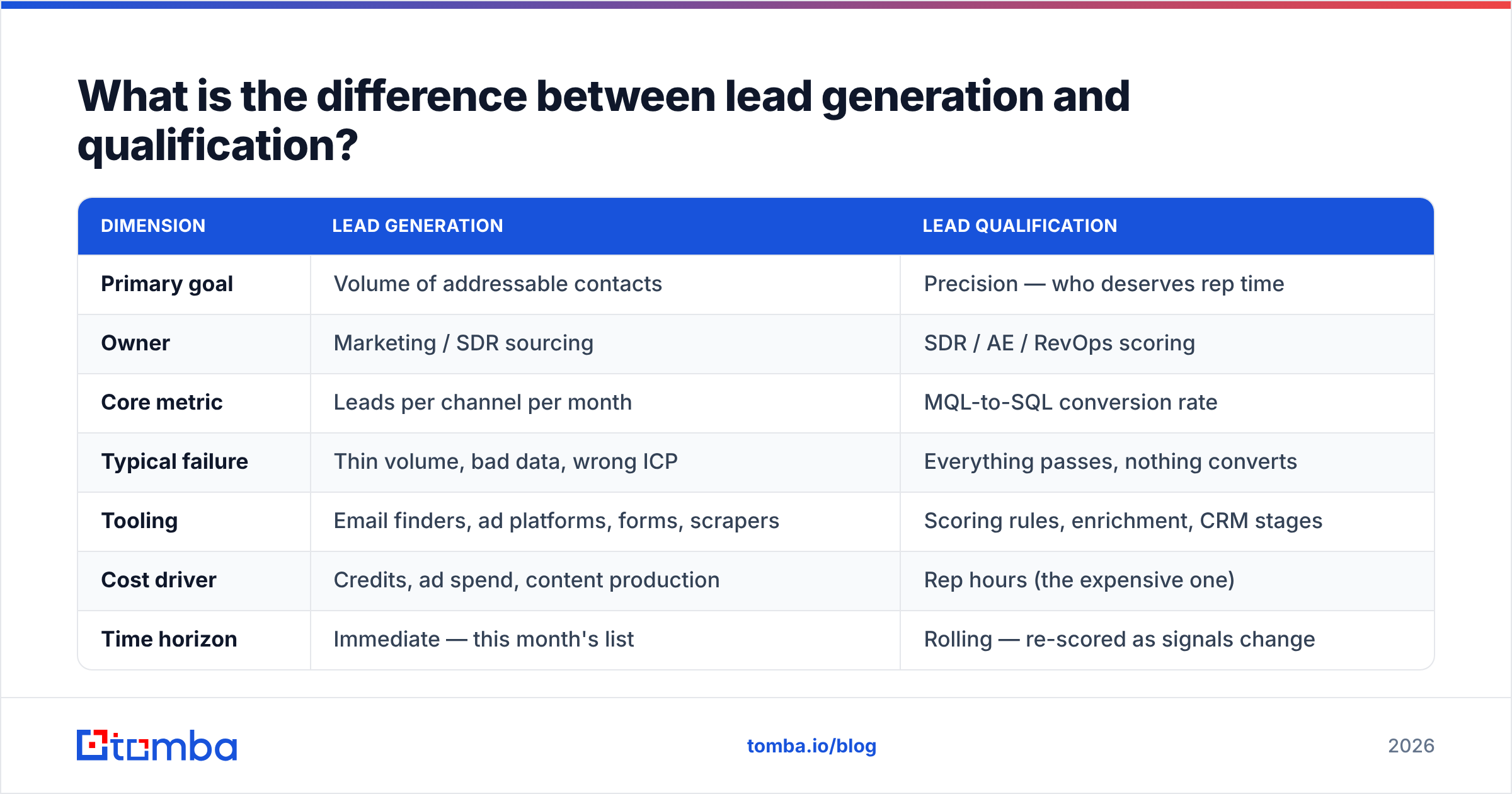
| Dimension | Lead generation | Lead qualification |
|---|---|---|
| Primary goal | Volume of addressable contacts | Precision — who deserves rep time |
| Owner | Marketing / SDR sourcing | SDR / AE / RevOps scoring |
| Core metric | Leads per channel per month | MQL-to-SQL conversion rate |
| Typical failure | Thin volume, bad data, wrong ICP | Everything passes, nothing converts |
| Tooling | Email finders, ad platforms, forms, scrapers | Scoring rules, enrichment, CRM stages |
| Cost driver | Credits, ad spend, content production | Rep hours (the expensive one) |
| Time horizon | Immediate — this month's list | Rolling — re-scored as signals change |
Why do most lead generation and qualification programs stall?#
Because they optimize the wrong number. Most teams are measured on leads generated, so they generate leads. Nobody is measured on leads correctly rejected.
Four patterns show up repeatedly in teams that have plenty of volume and no pipeline:
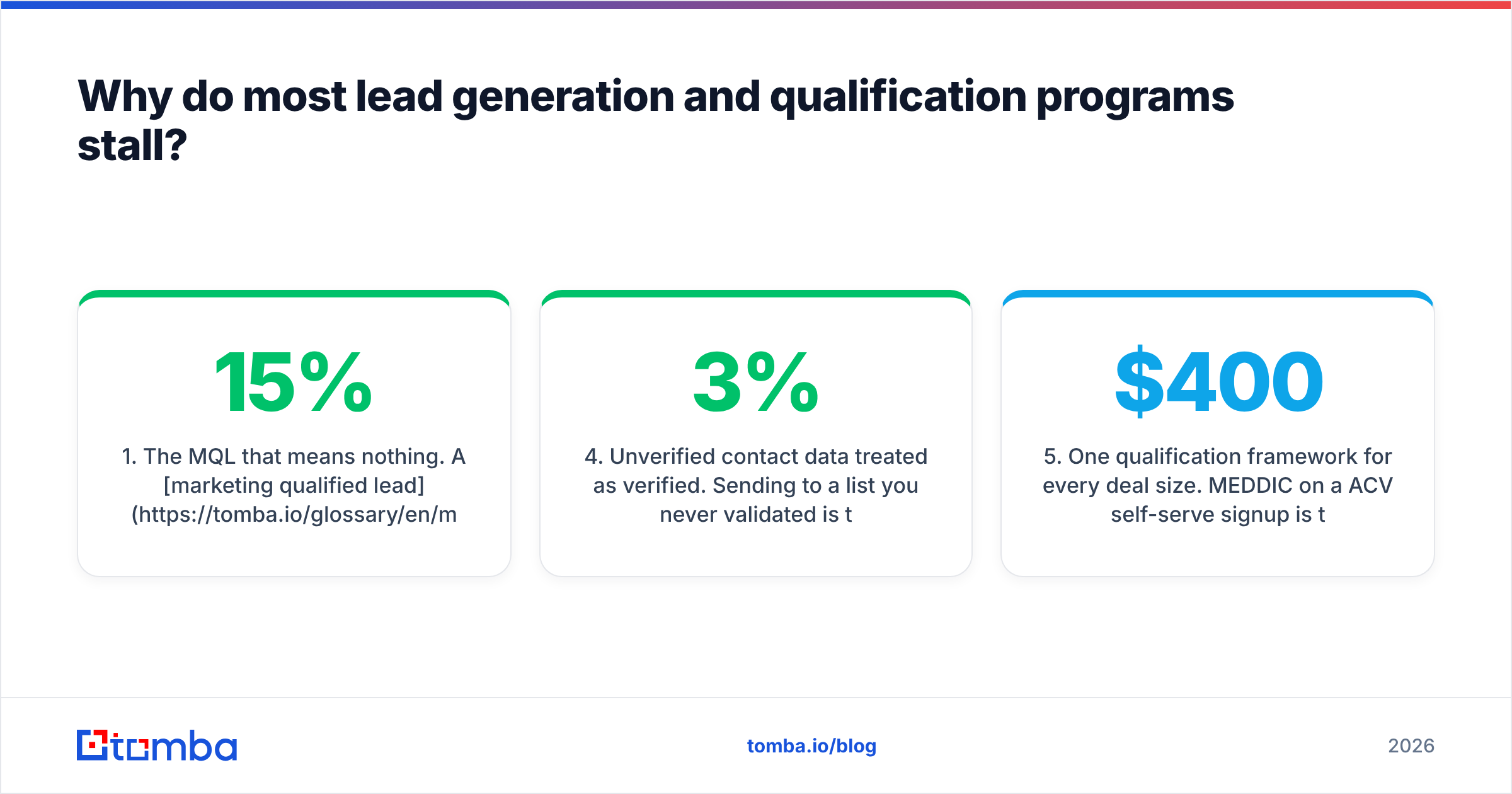
- The MQL that means nothing. A marketing qualified lead defined as "downloaded any asset" is not a qualification signal, it is an activity log. If your MQL-to-SQL rate is below 15%, your MQL definition is broken, not your SDR team.
- Enrichment after outreach instead of before. Teams send first, discover the company has 4 employees and no budget second. Enrichment costs cents. A wasted sequence costs a rep 20 minutes and a small dent in domain reputation.
- No decay. A lead that was hot in March is not hot in September, but most scoring models only add points and never subtract them. Without decay, your "hot" queue slowly becomes an archive.
- Unverified contact data treated as verified. Sending to a list you never validated is the fastest way to get filtered. Bounce rates above 3% start affecting inbox placement across your whole domain, which means your good leads stop receiving mail too.
- One qualification framework for every deal size. MEDDIC on a $400 ACV self-serve signup is theater. BANT on a $300K enterprise deal is naive. Match the framework to the contract.
- Handoff with no context. The SDR knows why the lead scored. The AE inherits a name and a phone number. The disqualification reason never makes it back to marketing, so the same bad segment gets targeted again next quarter.

How do you generate leads that are worth qualifying?#
Start from the ICP definition and work backwards to the channel. The order matters — teams that pick the channel first end up with whoever that channel happens to reach.
Define the ICP with exclusion criteria, not just inclusion. "SaaS companies, 50–500 employees, US and UK" is an inclusion list. Add the exclusions: no agencies, no companies using a competitor under contract, no sub-$2M revenue, no roles below director for the primary persona. Exclusions are what make a list qualifiable.
Source from multiple channels and tag the origin. Channel attribution at the lead level is what lets you kill an unproductive source three months from now instead of three years from now.
- Inbound forms and content — highest intent, lowest volume, slowest to scale.
- Outbound prospecting from a defined account list — controllable volume, quality depends entirely on your data source. Start with a domain search against target company domains rather than buying a generic list.
- Website visitor identification — turns anonymous traffic into named accounts. Strong intent signal, needs volume to be useful.
- Event and community lists — good fit signals, usually stale contact data, always verify before sending.
- Partner and referral — smallest volume, best conversion rate, hardest to systematize.
Collect the fields you will actually score on. If your scoring model uses employee count, tech stack, and seniority, then every generated lead needs those three fields populated at creation time. A record missing scoring inputs cannot be scored, and in practice it gets manually pushed through by whoever is under quota that week.
Validate at the point of capture. Run every email through verification before it enters the CRM, not in a quarterly cleanup. An email verifier at the ingestion step catches typos, role accounts, disposable domains, and dead mailboxes while it is still cheap to fix.
What are the main lead qualification frameworks in 2026?#
Four frameworks dominate, and the honest answer is that they are decision checklists, not magic. Pick based on deal complexity and how many people sign the contract.
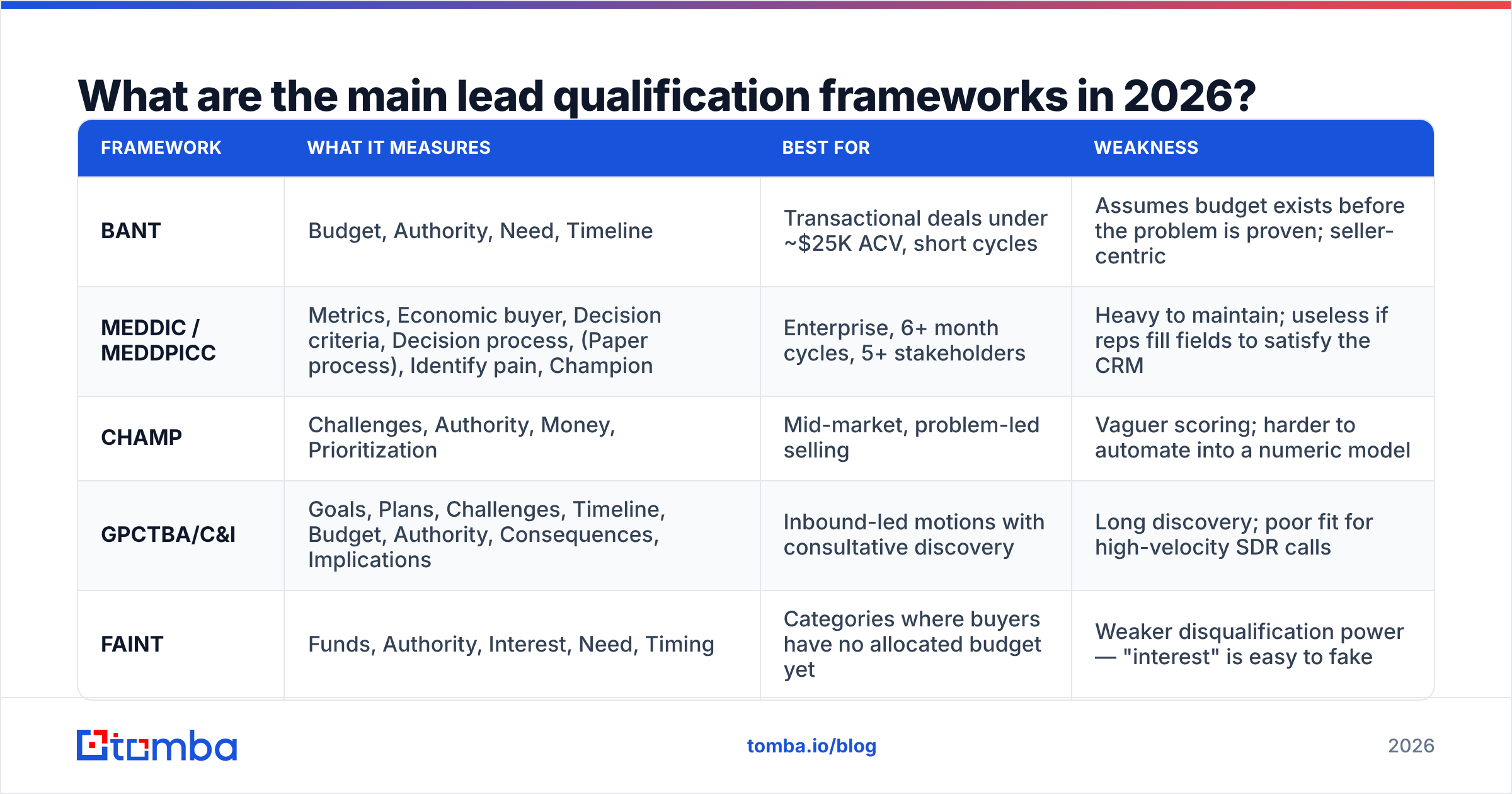
| Framework | What it measures | Best for | Weakness |
|---|---|---|---|
| BANT | Budget, Authority, Need, Timeline | Transactional deals under ~$25K ACV, short cycles | Assumes budget exists before the problem is proven; seller-centric |
| MEDDIC / MEDDPICC | Metrics, Economic buyer, Decision criteria, Decision process, (Paper process), Identify pain, Champion | Enterprise, 6+ month cycles, 5+ stakeholders | Heavy to maintain; useless if reps fill fields to satisfy the CRM |
| CHAMP | Challenges, Authority, Money, Prioritization | Mid-market, problem-led selling | Vaguer scoring; harder to automate into a numeric model |
| GPCTBA/C&I | Goals, Plans, Challenges, Timeline, Budget, Authority, Consequences, Implications | Inbound-led motions with consultative discovery | Long discovery; poor fit for high-velocity SDR calls |
| FAINT | Funds, Authority, Interest, Need, Timing | Categories where buyers have no allocated budget yet | Weaker disqualification power — "interest" is easy to fake |
HubSpot's breakdown of qualification frameworks is a reasonable neutral reference if you want the long-form version of each. The practical guidance: use one framework per sales motion, not one per rep. Reps improvising their own criteria is how forecast accuracy dies.
How should you build a lead scoring model?#
Split it in two. Fit scoring runs automatically and requires no human. Intent scoring requires observation of behavior over time. Combining them into one number is the mistake that makes scoring models feel arbitrary.
Layer 1 — Fit score (0–50, fully automated):
- Firmographic match (0–20) — employee count, revenue band, industry, geography against ICP. Hard-zero any exclusion criterion; a disqualifying attribute should collapse the score, not subtract five points.
- Persona match (0–15) — seniority and function versus your buying committee map. A director of the right function beats a VP of the wrong one.
- Technographic match (0–10) — do they run the stack your product attaches to? This is often the highest-precision signal and the most under-used.
- Data validity (0–5) — is the email deliverable, is the record complete, is the domain live? An unverifiable contact cannot be worked regardless of how good the company looks.
Layer 2 — Intent score (0–50, behavioral, decays weekly):
- High-intent actions (15–25 each) — pricing page visit, demo request, competitor comparison page, second visit from the same account inside 7 days.
- Medium-intent actions (5–10 each) — webinar attendance, multiple content downloads, email reply that is not "unsubscribe."
- Low-intent actions (1–3 each) — single page view, newsletter signup, social follow.
- Decay rule — subtract 20% of the intent score per week of inactivity. Nothing stays hot without feeding it.
Route on the combination: high fit + high intent goes to an AE same day. High fit + low intent goes to nurture with an SDR touch. Low fit + high intent gets a self-serve path, not a rep. Low fit + low intent gets suppressed, and the source channel gets a note.

What does a practical lead generation and qualification stack cost?#
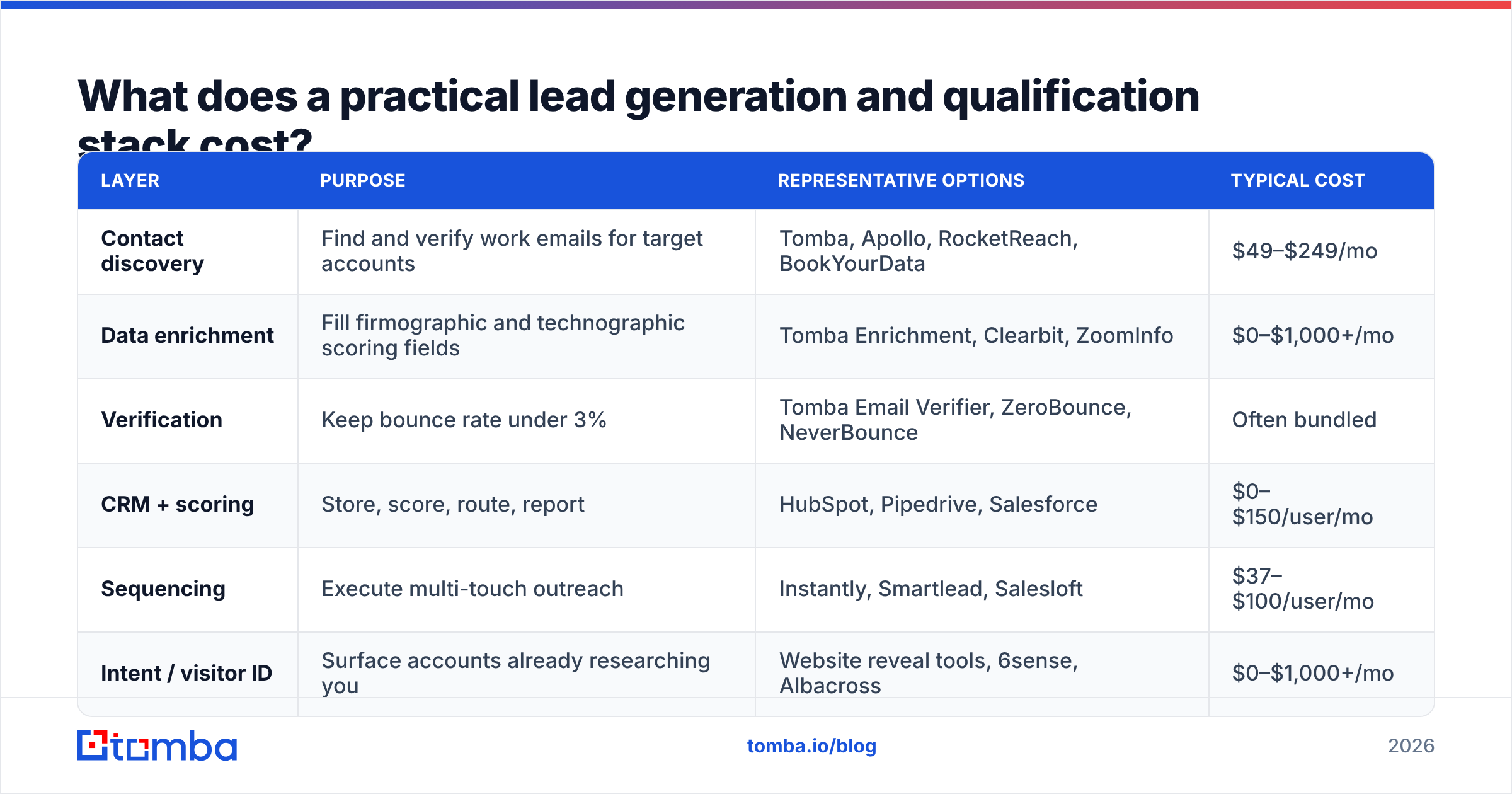
Less than people assume for the tooling, more than people assume for the rep hours. Here is a realistic comparison of what small and mid-sized teams actually assemble.
| Layer | Purpose | Representative options | Typical cost |
|---|---|---|---|
| Contact discovery | Find and verify work emails for target accounts | Tomba, Apollo, RocketReach, BookYourData | $49–$249/mo |
| Data enrichment | Fill firmographic and technographic scoring fields | Tomba Enrichment, Clearbit, ZoomInfo | $0–$1,000+/mo |
| Verification | Keep bounce rate under 3% | Tomba Email Verifier, ZeroBounce, NeverBounce | Often bundled |
| CRM + scoring | Store, score, route, report | HubSpot, Pipedrive, Salesforce | $0–$150/user/mo |
| Sequencing | Execute multi-touch outreach | Instantly, Smartlead, Salesloft | $37–$100/user/mo |
| Intent / visitor ID | Surface accounts already researching you | Website reveal tools, 6sense, Albacross | $0–$1,000+/mo |
On the discovery layer specifically, Tomba pricing starts with a free tier at 25 searches/month, then Starter at $49/mo, Growth at $99/mo, and Pro at $249/mo, with Enterprise custom. BookYourData takes a different and equally valid approach — pay-as-you-go prepaid credits with a verification guarantee, which suits teams that buy in bursts rather than subscribing monthly. Apollo bundles discovery with sequencing, which is convenient but means your data quality and your sending infrastructure share a single point of failure. Check current user-reported accuracy on G2's lead intelligence category before committing to an annual contract; the gap between vendor-claimed and user-reported match rates is usually the most informative number available.
The cost nobody models: an SDR working 60 leads a day at 40% bad data is spending roughly two hours a day on records that could not convert. At a fully loaded $75K SDR, that is about $18K a year per rep, thrown at data hygiene that a $99/month tool would have handled upstream.
How do you handle the MQL-to-SQL handoff without losing leads?#
Write the contract down. Literally — a one-page SLA between marketing and sales that defines four things:
1. The MQL definition, with a numeric threshold. Not "showed interest." Something like: fit score ≥ 35 AND intent score ≥ 20 AND email verified as deliverable. If a lead does not clear the bar, it does not get handed over, no matter who asks.
2. The response window. Sales accepts or rejects within one business day. Lead response research consistently shows conversion odds collapsing after the first hour; a queue with a three-day latency is functionally a deletion queue.
3. The rejection taxonomy. Every rejected lead gets a coded reason — wrong persona, no budget, competitor, timing, bad data, duplicate. Free-text rejection reasons are unanalyzable and will be ignored.
4. The feedback loop. Monthly, marketing reviews rejection codes by source channel. If "bad data" is 30% of rejections from one channel, that channel needs a verification step or needs to be cut. If "wrong persona" dominates, the targeting is off, not the copy.
Recycled leads need a path too. A lead rejected for timing is not dead — it goes back to nurture with a re-engagement date, and its intent score resets to zero so it has to earn attention again. Salesforce's own lead management documentation covers the object-model mechanics if you are implementing this in their stack.
How do you keep qualified leads from dying in deliverability?#
Because the best-qualified lead in the world is worthless if your email lands in spam. Qualification and email deliverability are the same problem viewed from two ends.
Three rules that cover most of it:
- Verify before every send, not once at import. B2B contact data decays roughly 25–30% annually as people change jobs. A list verified in January is meaningfully wrong by July.
- Treat catch-all domains as a distinct bucket. Catch-all servers accept everything, so standard verification returns "unknown." Route those through a catch-all verifier or hold them in a lower-priority segment rather than blending them into your main send.
- Suppress role accounts by default. info@, sales@, support@ inflate list size and depress reply rate. They are almost never your buyer.
Pair this with sensible volume ramping and authenticated sending (SPF, DKIM, DMARC all passing), and the qualification work you did upstream actually reaches a human inbox.
What should you measure?#
Six numbers, reviewed monthly:
- MQL-to-SQL conversion rate — health of your qualification criteria. Below 15% means the bar is too low.
- SQL-to-opportunity rate — health of your intent scoring and SDR discovery quality.
- Bounce rate by source — data quality per channel. Anything over 3% gets a verification gate.
- Time to first touch — minutes, not days. Track the 90th percentile, not the average; the average hides the queue.
- Cost per SQL by channel — the only channel metric that survives contact with a CFO. Cost per lead is a vanity denominator.
- Rejection reason distribution — the diagnostic that tells you which upstream step to fix.
Track them by source channel, not just in aggregate. Aggregate numbers hide the one channel that is quietly consuming a third of your budget to produce leads your reps reject.
Where should you start?#
If you are building this from scratch, do it in this order: define ICP with exclusions, pick one qualification framework that matches your deal size, build the fit score before the intent score, gate every record on email verification, and only then turn up volume. Teams that turn up volume first spend the next two quarters cleaning up.
If you already have volume and weak conversion, start at the rejection taxonomy. One month of coded rejection reasons will tell you exactly which of the six failure patterns above is costing you the most, and you will stop guessing.
For the discovery and verification layer of that stack, the Tomba Email Finder covers the part most teams get wrong first — finding verified work emails for the accounts that actually match your ICP, with verification built into the same workflow instead of bolted on afterward. Start on the free tier at 25 searches per month to test match rates against your own target list, then scale to Starter at $49/mo once you know the data holds up. Qualification gets much easier when the records going into it are real.
Related guides#
// get started
Find, verify and enrich your first contacts today
Start on the free plan with 25 searches a month, then scale when your team is ready.
Free plan · No credit card required · GDPR & CCPA
// about the author