Lead Generation as a Service in 2026: Costs, Risks, ROI
Outsourced lead gen promises a full pipeline for a flat monthly fee. Here is what LGaaS actually costs, where it quietly fails, and when building in-house beats renting a team.
TL;DR
- Lead generation as a service (LGaaS) means paying an outside agency or platform to source, qualify, and hand over leads — usually $2,000–$12,000/mo retainer, or $35–$400 per qualified lead on performance deals.
- The model works when you have a proven ICP, a closer who can handle volume, and no internal SDR bandwidth. It fails when you outsource strategy instead of execution.
- Most LGaaS contracts hide the real cost in data: agencies bill you for "leads" that are scraped contacts with a 20–40% bounce rate, which torches your sending domain.
- Building a lean in-house stack — a $49/mo data source, an outreach tool, and one part-time SDR — often beats a $6,000/mo retainer for companies under $5M ARR.
- Always negotiate for verified-email SLAs, meeting-held (not meeting-booked) metrics, and full data ownership on exit.
What Is Lead Generation as a Service?#
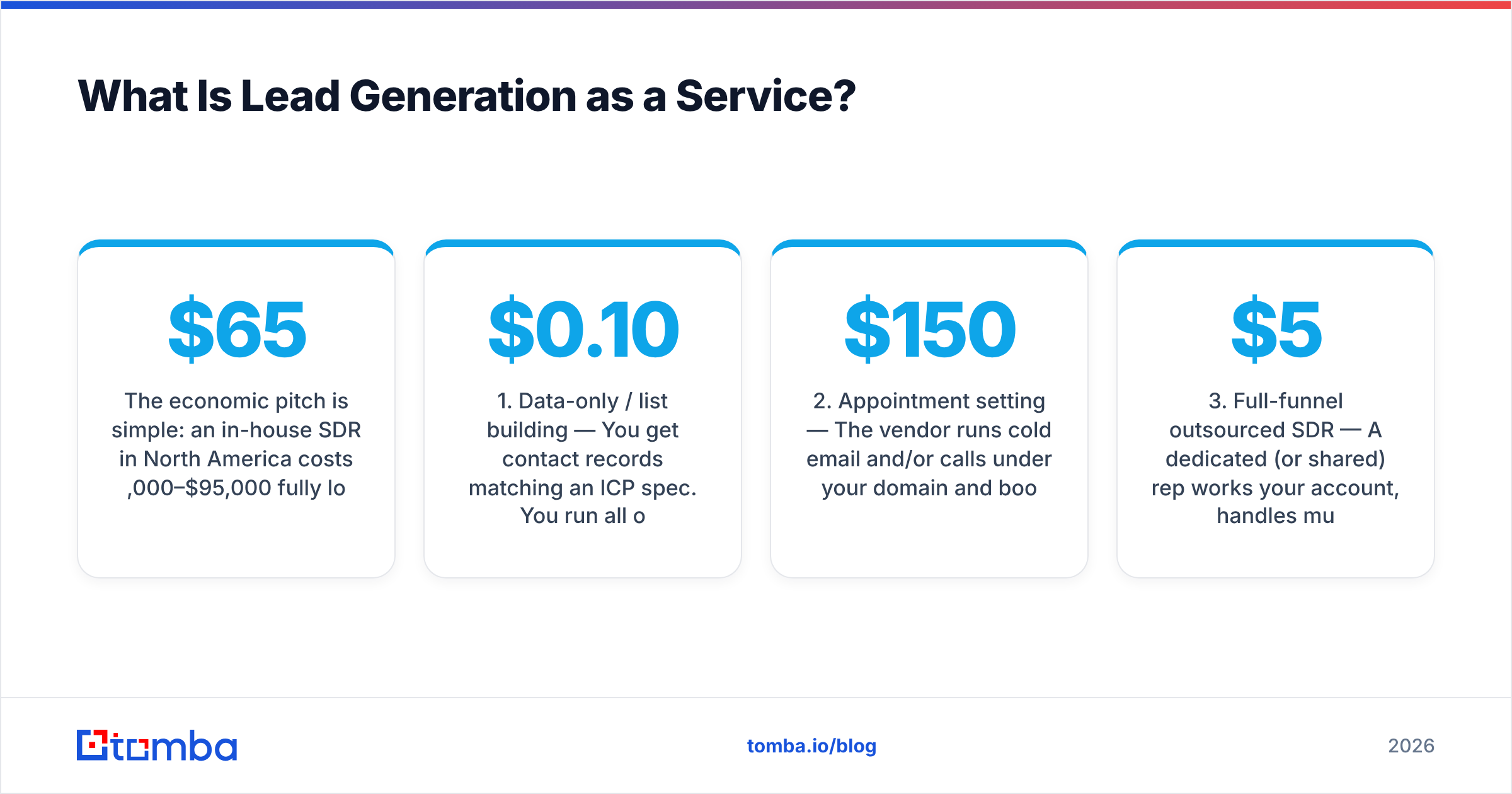
Lead generation as a service is the outsourced version of the top of your funnel. Instead of hiring SDRs, buying data, and building sequences yourself, you sign a contract with a provider who does all three and delivers an output — usually a list of qualified contacts, booked meetings, or opportunities dropped into your CRM.
It sits on a spectrum. At one end you have pure data providers who sell you contact records. At the other end you have full-service agencies who research accounts, write the copy, run the sends, handle replies, and only hand off when a prospect agrees to a call. Most vendors live somewhere in the middle and describe themselves using whichever end sounds more impressive on the sales call.
The economic pitch is simple: an in-house SDR in North America costs $65,000–$95,000 fully loaded, takes three months to ramp, and needs a manager, a data subscription, and a sequencer. An agency gives you an already-ramped team for less than one salary, with no ramp period and no severance risk. That pitch is often true. It is also where most of the disappointment starts, because what you are actually buying varies enormously between providers.
What the Four Delivery Models Actually Include#
- Data-only / list building — You get contact records matching an ICP spec. You run all outreach. Cheapest tier, typically $0.10–$1.50 per contact. You own the sending risk.
- Appointment setting — The vendor runs cold email and/or calls under your domain and books calls directly on your reps' calendars. Priced per meeting ($150–$400) or as a $3,000–$8,000/mo retainer.
- Full-funnel outsourced SDR — A dedicated (or shared) rep works your account, handles multichannel sequences, objection handling, and nurture. $5,000–$12,000/mo, usually with a 6-month minimum.
- Pay-per-lead / performance marketing — You pay only for leads that hit an agreed definition. Sounds risk-free, but the lead definition is where the entire negotiation lives. A "lead" can mean a form fill from a content syndication ad, which converts nothing like an outbound-sourced meeting.
Wait — that renders wrong. Here it is properly:
How Much Does Lead Generation as a Service Cost in 2026?#
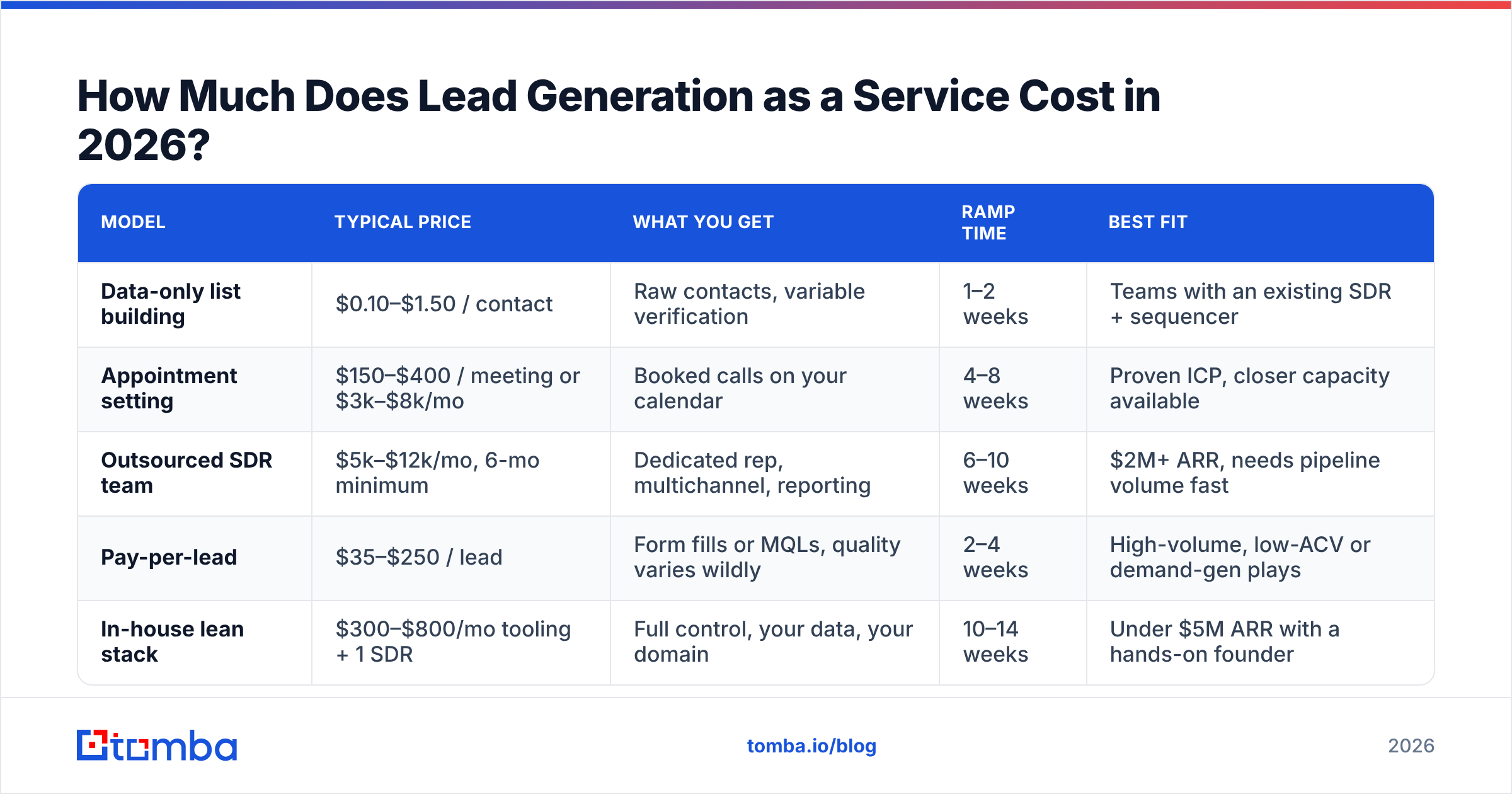
Pricing has bifurcated. AI-assisted agencies have pushed the low end down; enterprise ABM shops have pushed the high end up. Here is what the market looks like right now for a B2B SaaS company selling a $15k–$50k ACV product.
| Model | Typical price | What you get | Ramp time | Best fit |
|---|---|---|---|---|
| Data-only list building | $0.10–$1.50 / contact | Raw contacts, variable verification | 1–2 weeks | Teams with an existing SDR + sequencer |
| Appointment setting | $150–$400 / meeting or $3k–$8k/mo | Booked calls on your calendar | 4–8 weeks | Proven ICP, closer capacity available |
| Outsourced SDR team | $5k–$12k/mo, 6-mo minimum | Dedicated rep, multichannel, reporting | 6–10 weeks | $2M+ ARR, needs pipeline volume fast |
| Pay-per-lead | $35–$250 / lead | Form fills or MQLs, quality varies wildly | 2–4 weeks | High-volume, low-ACV or demand-gen plays |
| In-house lean stack | $300–$800/mo tooling + 1 SDR | Full control, your data, your domain | 10–14 weeks | Under $5M ARR with a hands-on founder |
The number that matters is not the monthly retainer. It is cost per meeting held. Divide total spend by meetings that actually happened — not booked, not scheduled, held — and compare it across models. A $6,000/mo retainer that produces 12 held meetings is $500 per held meeting. A pay-per-lead deal at $200 per lead with a 30% show rate is $667. Most buyers never run this arithmetic until month four.
Add the hidden line items: dedicated sending domains ($15–$40/mo each), warmup tooling, CRM seats for the vendor's team, and the internal time your marketing lead spends reviewing copy and dispositioning replies. That last one is usually 4–8 hours a week and nobody prices it.
Is Outsourced Lead Gen Better Than Building In-House?#
Neither is universally better — the honest answer depends on whether your problem is bandwidth or knowledge.
Outsource when you know exactly who buys, why they buy, and what language moves them, but you simply don't have people to do the work. Agencies are execution machines. Given a tight brief and a validated message, a competent one will out-execute a first-time internal hire.
Build in-house when you're still discovering your ICP. Outbound in year one is a research function disguised as a sales function. The replies, the objections, the "we already use X" — that's your product roadmap. Ship it to a third party and you get a spreadsheet instead of an insight.
There's also a durability argument. An in-house motion compounds: your sender reputation, your verified contact database, your library of what works. An agency motion evaporates on the last day of the contract, and in most cases the data goes with it. Check the exit clause before you sign — data ownership on termination is the single most-skipped term in LGaaS agreements.
The Honest Comparison#
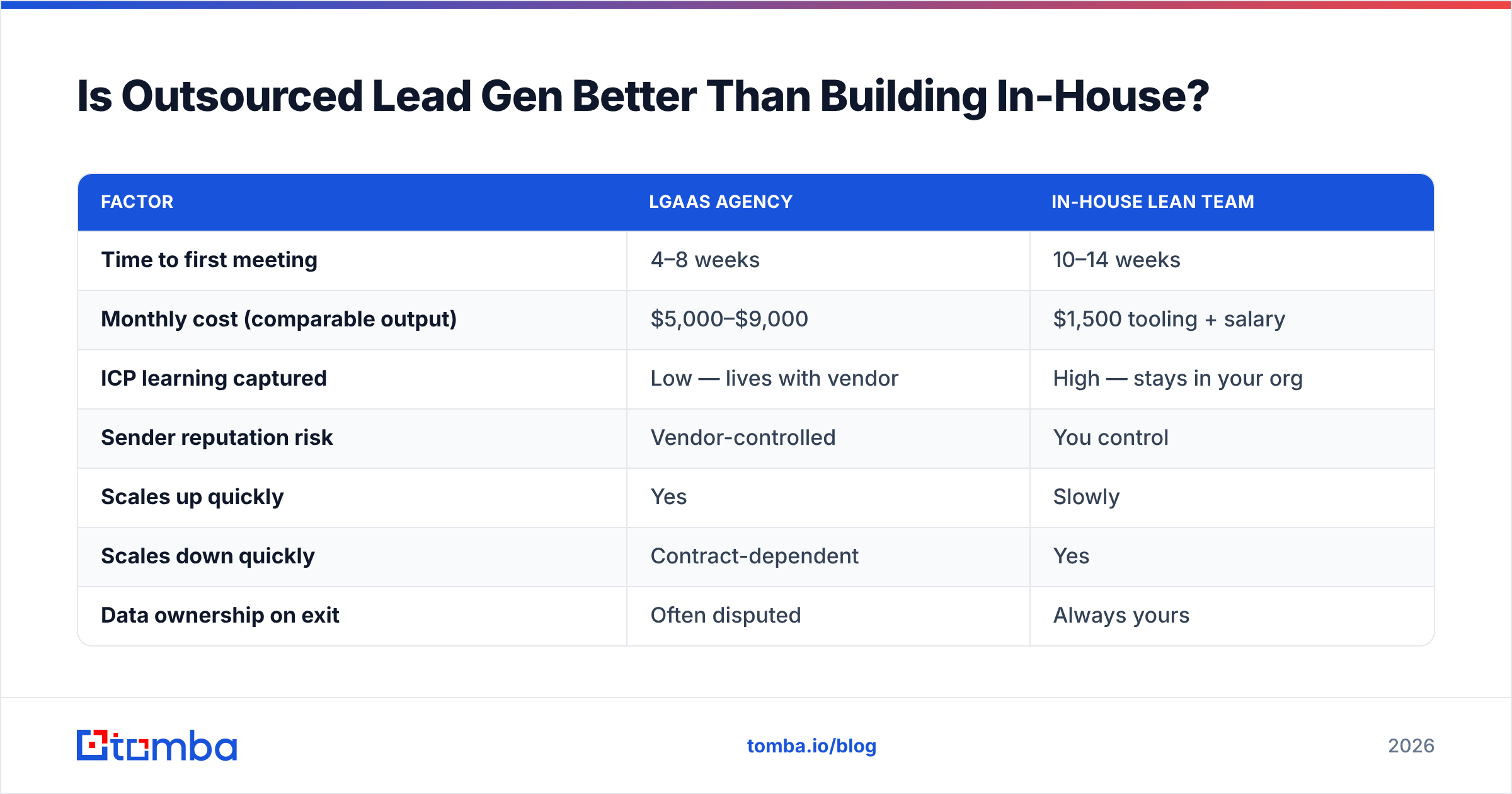
| Factor | LGaaS agency | In-house lean team |
|---|---|---|
| Time to first meeting | 4–8 weeks | 10–14 weeks |
| Monthly cost (comparable output) | $5,000–$9,000 | $1,500 tooling + salary |
| ICP learning captured | Low — lives with vendor | High — stays in your org |
| Sender reputation risk | Vendor-controlled | You control |
| Scales up quickly | Yes | Slowly |
| Scales down quickly | Contract-dependent | Yes |
| Data ownership on exit | Often disputed | Always yours |
| Message iteration speed | 1–2 weeks per cycle | Same day |
A hybrid is what most companies land on eventually: keep targeting, messaging, and the data layer in-house; outsource the volume execution. You own the B2B database and the domain reputation. The agency rents you hands.
Why Do Most LGaaS Engagements Fail on Data Quality?#
Because "lead" is an unregulated word, and the incentive structure rewards volume.
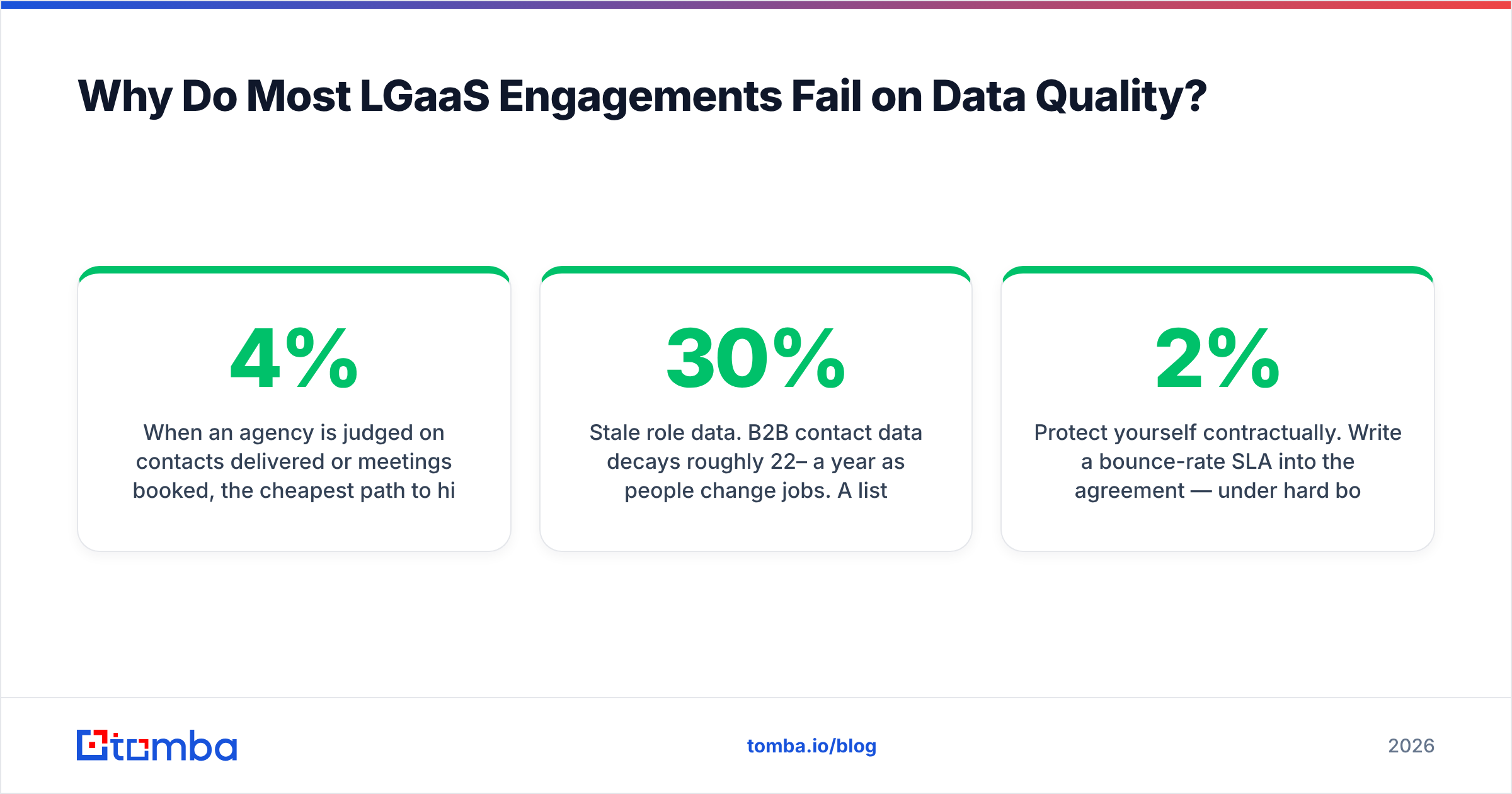
When an agency is judged on contacts delivered or meetings booked, the cheapest path to hitting the number is broader lists. Broader lists mean more guessed email addresses, more role mismatches, and more catch-all domains that were never verified. You find out six weeks later when your bounce rate crosses 4% and Google starts routing you to spam.
Three specific failure patterns show up again and again:
- Unverified pattern-guessed emails. The vendor infers
first.last@company.comfrom a pattern and ships it without an SMTP check. Looks fine in a spreadsheet, bounces on send. - Catch-all domains counted as valid. Catch-all servers accept everything, so naive verification marks them "valid." A large share are dead. You need a dedicated catch-all verifier to separate real mailboxes from acceptance theatre.
- Stale role data. B2B contact data decays roughly 22–30% a year as people change jobs. A list built 14 months ago is a third wrong before you send anything.
Protect yourself contractually. Write a bounce-rate SLA into the agreement — under 2% hard bounces, measured by your ESP, with credits for breaches. Require that every address the vendor delivers passes independent verification before it enters a sequence. Running delivered lists through your own email verifier costs a fraction of one bounced campaign and gives you a neutral referee when quality disputes start.
And take email deliverability seriously as a shared-risk item. If the agency sends from your domain, their list hygiene is now your sender reputation. Google and Yahoo's bulk-sender requirements — documented in Google's sender guidelines — put the consequences squarely on the domain owner, not the contractor.
How Do You Evaluate an LGaaS Vendor Before Signing?#
Run the same diligence you would on any vendor with access to your brand. Six questions separate operators from resellers:
- Where does your data come from? If the answer is vague or "proprietary," it's usually a reseller layer on a public database. Ask for the verification method, not the source count.
- What is your measured bounce rate across clients? A real answer is a number with a denominator. "We verify everything" is not an answer.
- Do we send from our domain or yours? Sending from theirs protects your reputation but hurts reply rates and looks like what it is. Sending from yours requires trust.
- What does a "qualified" lead mean in writing? Get the definition into the contract with examples of accept and reject cases. This is where 90% of disputes originate.
- Who writes the copy and who approves it? You should have veto power on every sequence that goes out under your name.
- What happens to the data if we leave? Full export, in a standard format, within a defined window. No exceptions.
Then check independent signal. Look at the vendor's profile on G2 and read the 3-star reviews specifically — those are where operational problems surface. Ask for two references from clients who churned, not just happy ones. Good agencies have them and will talk about why.

What Does a Lean In-House Alternative Look Like?#
If the retainer math doesn't clear, here's the stack that replaces the bottom 80% of what most LGaaS vendors do — for a few hundred dollars a month.
The four layers:
- Targeting — Define the account list yourself. Firmographic filters, technographic signals, hiring signals. This is the part you should never outsource, because it is your ICP hypothesis.
- Contact discovery — Turn accounts into people with verified addresses. A domain search pulls every reachable contact at a target company; an email finder resolves specific names. Tomba's free tier gives 25 searches/mo, Starter runs $49/mo, and Growth is $99/mo — see Tomba pricing for the full breakdown.
- Verification — Every address gets checked before it touches a sequence. Non-negotiable. This is the layer that protects the domain you spent years building.
- Execution — One sequencer, one calendar, one owner. A part-time SDR or a founder doing 90 minutes a day beats a disengaged outsourced rep working eleven accounts.
The total tooling bill for that stack typically lands between $300 and $800/mo. Add a junior SDR and you're at roughly the cost of a mid-tier agency retainer — but the reputation, the data, and the learning stay inside your company.
Enrichment closes the loop. Once a reply comes in, contact enrichment fills the firmographic context your rep needs to qualify without a discovery call. For teams running plays across multiple systems, the Tomba API handles the same operations programmatically so your CRM stays current without manual list imports.
For high-ACV accounts where email alone won't cut it, layer in phone. A phone finder plus a disciplined calling cadence still produces the highest conversion rate per touch in B2B — the channel isn't dead, it's just underworked.
When Does LGaaS Genuinely Make Sense?#
Three scenarios where paying an agency is clearly the right call:
You're entering a new geography or vertical. An agency with existing presence in DACH or Japan brings local language, local norms, and local data quality you cannot build in a quarter. Rent it.
You have closer capacity sitting idle. If your AEs have open calendar and a proven close rate, buying meetings at $400 each is straightforward arithmetic. If your AEs are already at capacity, more meetings just create a scheduling backlog and a worse experience.
You need a short-burst pipeline push. Pre-fundraise, pre-renewal season, or into a launch window. Agencies spin up in weeks; hiring takes a quarter.
The through-line: outsource execution against a validated hypothesis, never the hypothesis itself. Companies that treat LGaaS as a substitute for go-to-market thinking get exactly what they pay for — a report full of activity and a pipeline full of nothing. Companies that treat it as extra hands on a known-good motion get real leverage. Forrester and other analyst shops have made this point repeatedly about outsourced demand gen, and the pattern hasn't changed: the constraint is almost never headcount, it's message-market fit.
One more discipline worth adopting regardless of model: instrument everything. Track response rate by segment, by sequence, by sender. When an agency tells you performance is improving, you want your own numbers to confirm or contradict it. Vendors who resist shared dashboards are telling you something.
The Bottom Line#
Lead generation as a service is a legitimate, useful model that is oversold by roughly half the market. Priced honestly against cost per held meeting, a good agency is competitive with an in-house team and dramatically faster to deploy. Priced against a spreadsheet of unverified contacts, it's an expensive way to burn a sending domain.
Whichever direction you go, the data layer should stay under your control. That's the piece that compounds, the piece that determines deliverability, and the piece agencies are least motivated to get right.
Start there: use the Tomba Email Finder to build a verified contact list for your next 200 target accounts before you sign any retainer. The free tier covers 25 searches so you can benchmark quality against whatever a vendor is proposing to sell you — and if the numbers favor doing it yourself, $49/mo on Starter gets you the whole motion in-house.
Related guides#
// get started
Find, verify and enrich your first contacts today
Start on the free plan with 25 searches a month, then scale when your team is ready.
Free plan · No credit card required · GDPR & CCPA
Get the Tomba newsletter
Product and data updates
// about the author