Lead Generation Australia: The 2026 Playbook for B2B Teams
Australia's B2B market is small, relationship-driven, and governed by the Spam Act. Here's what actually works for lead generation in Australia in 2026 — channels, costs, compliance, and tooling.
TL;DR — lead generation Australia in 60 seconds
- Australia has about 2.6 million trading businesses and only 26 million people. Your market is 10–20x smaller than the US one. Volume-first outbound breaks here.
- The Spam Act 2003 asks for three things: consent, a named sender, and a working unsubscribe. Inferred consent from a listed work address is legal. It is also narrower than most US teams think.
- Cost per qualified lead in AU B2B runs $150–$400 for paid search in hot markets, and $40–$120 for good outbound. LinkedIn sits in between.
- Referral and partner deals convert 3–5x better here than in the US. Buying circles are small and word travels fast.
- Data decay is the real drag. AU contact lists go stale faster, because fewer people here keep public profiles current.
Lead generation Australia: what makes it different?#
Scale, the law, and small networks. Those three things break most plays imported from the US or Europe.
Start with scale. The Australian Bureau of Statistics counts about 2.6 million trading businesses. Most are sole traders with no staff. Sell to firms with 50 or more people and your real market is closer to 60,000–70,000. Filter by sector and you may be left with 800 accounts. The same filter in the US returns 15,000.
That one fact changes the plan. With 800 accounts in play, a 2% reply rate and a burnt domain are not survivable. Each contact is costly to replace. The AU B2B scene is also small enough that a bad campaign turns into a LinkedIn post within 48 hours.
Second, the law. The Spam Act 2003 is run by the ACMA, and it has teeth. ACMA has fined large local brands millions over consent and unsubscribe failures. The rules cover email, SMS, and chat apps.
Third, small networks. Buying groups here are smaller. In a given field, the buyers tend to know each other. Sydney fintech, Melbourne logistics, Perth mining services — each one is a small world. A warm intro carries far more weight than it would in the US.

Is cold email legal in Australia?#
Yes, with conditions. The Spam Act allows a commercial email when three tests are met.
- Consent. It can be express (they opted in) or inferred. Inferred consent applies when a work address is "conspicuously published" in a business setting, the page carries no "no unsolicited messages" notice, and your message fits that person's job.
- Sender details. The message must name the sender and give correct contact details. A bare "Sent from my iPhone" does not count.
- Unsubscribe. Give a clear, one-click opt-out. Keep it live for at least 30 days. Honour it within 5 working days.
Most teams lean on inferred consent too hard. Emailing a CFO listed on an "Our Team" page about a finance product is fair. Emailing that same CFO about an unrelated SaaS tool is not. Job relevance is part of the test. Personal addresses and generic info@ inboxes are riskier still.
So in lead generation Australia, how tightly you target is how well you comply. A broad blast is bad marketing and legal risk at the same time. Building a tight, role-relevant list with a verified email finder is the safe path, not a way around the rules.
One more note. Privacy Act reforms landing through 2025–2026 raise the bar on how you collect, store, and share personal data. If you enrich records, log where the data came from. Give people a route to fix it.
Lead generation Australia channels: which ones actually work?#
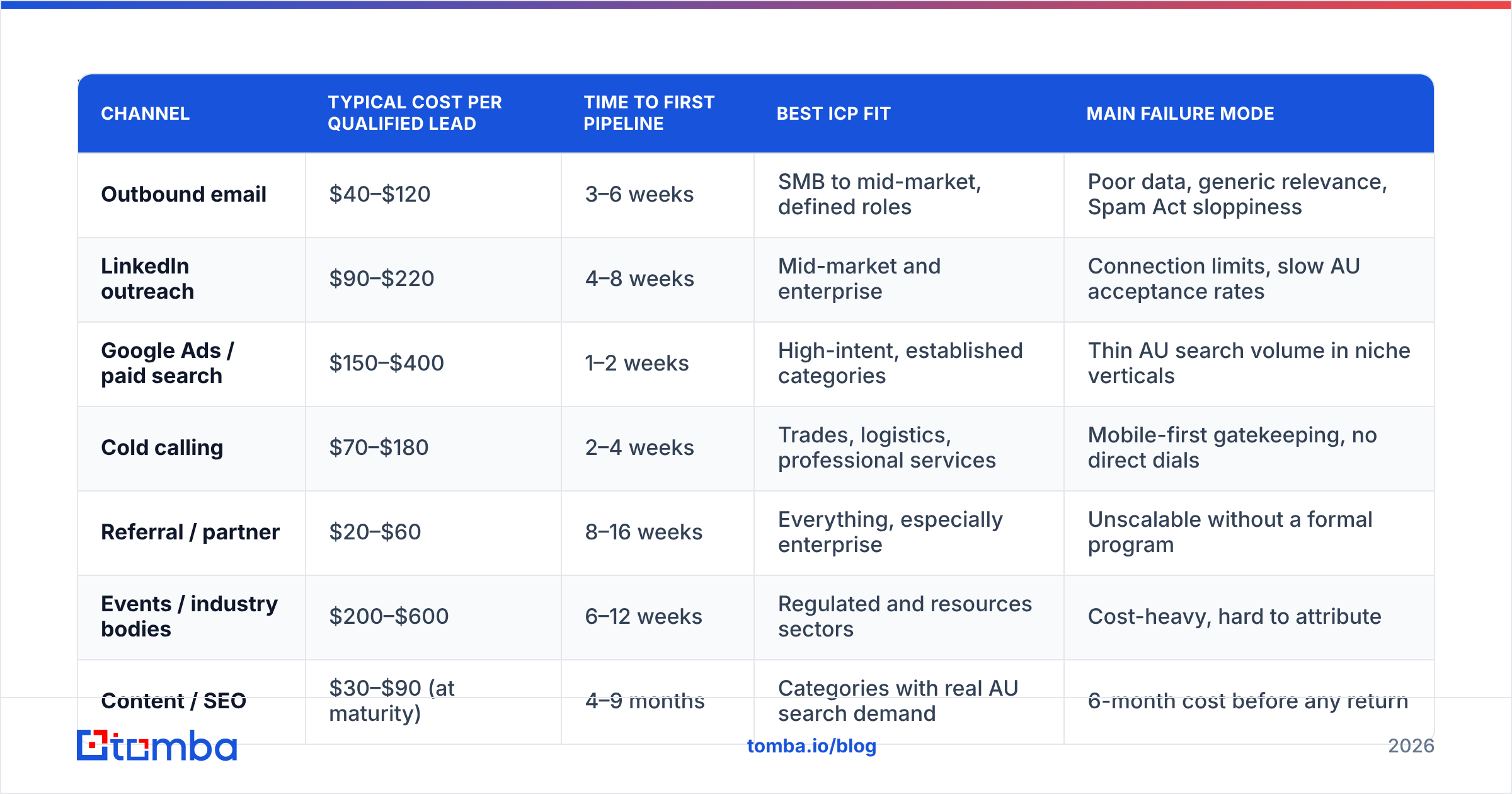
Here is how the main channels stack up on the numbers local teams report. The ranges are rough, for B2B, in AUD, 2026.
| Channel | Typical cost per qualified lead | Time to first pipeline | Best ICP fit | Main failure mode |
|---|---|---|---|---|
| Outbound email | $40–$120 | 3–6 weeks | SMB to mid-market, defined roles | Poor data, generic relevance, Spam Act sloppiness |
| LinkedIn outreach | $90–$220 | 4–8 weeks | Mid-market and enterprise | Connection limits, slow AU acceptance rates |
| Google Ads / paid search | $150–$400 | 1–2 weeks | High-intent, established categories | Thin AU search volume in niche verticals |
| Cold calling | $70–$180 | 2–4 weeks | Trades, logistics, professional services | Mobile-first gatekeeping, no direct dials |
| Referral / partner | $20–$60 | 8–16 weeks | Everything, especially enterprise | Unscalable without a formal program |
| Events / industry bodies | $200–$600 | 6–12 weeks | Regulated and resources sectors | Cost-heavy, hard to attribute |
| Content / SEO | $30–$90 (at maturity) | 4–9 months | Categories with real AU search demand | 6-month cost before any return |
Two patterns stand out. Referral has the lowest cost per lead and the slowest ramp. That is why nearly every AU team says "most of our business is referral" — and almost none of them run a written referral program. Paid search is the other one. It costs a lot here for the volume on offer. A term with 40,000 US searches a month may have 1,800 here, with four rivals bidding on it.
Most lead generation Australia programs win with a barbell. Run a tight outbound motion for steady top-of-funnel. Build a real referral and partner engine for the big deals. Paid search fills the gaps. It rarely carries the number on its own.
How do you build an Australian prospect list that doesn't decay?#
Every lead generation Australia list decays. Assume 2–3% a month, then build a process that absorbs it.
AU contact data goes stale for local reasons. Fewer people here keep polished public profiles. Many small firms run on one shared inbox rather than named addresses. And AU domains (.com.au, .net.au) are often registered apart from the global domain, so global databases map them wrong.
Stage one — pin down the company:
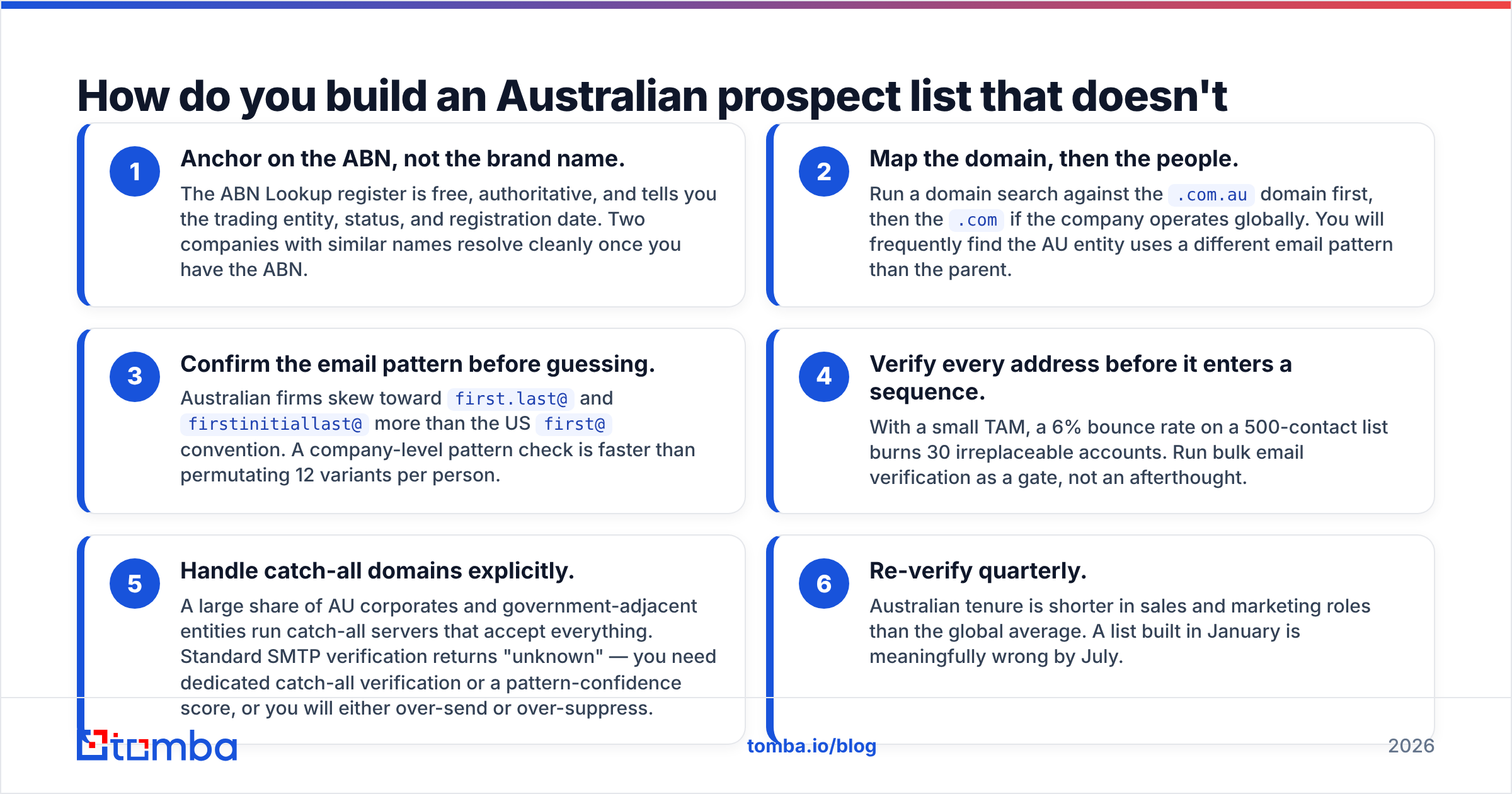
- Anchor on the ABN, not the brand name. The ABN Lookup register is free and official. It gives you the trading entity, its status, and its start date. Two firms with near-identical names come apart cleanly once you have the ABN.
- Map the domain before the people. Run a domain search on the
.com.audomain first. Then try the.comif the firm trades worldwide. The AU arm often uses a different email pattern than the parent. - Confirm the email pattern before you guess. AU firms lean toward
first.last@andfirstinitiallast@. The USfirst@style is rarer here. One pattern check beats testing 12 variants per person.
Stage two — pin down the people:
- Check every address before it enters a sequence. In a small market, a 6% bounce rate on a 500-contact list burns 30 accounts you cannot replace. Run bulk email verification as a gate, not a clean-up.
- Handle catch-all domains head on. Many AU corporates and public bodies run catch-all servers that accept any address. A standard SMTP check comes back "unknown". You need catch-all verification or a pattern confidence score. Without one, you will over-send or over-cut.
- Re-check the list each quarter. Sales and marketing tenure here is shorter than the global norm. A list built in January is well out of date by July.
Direct dials deserve a note. AU business runs on mobiles more than desk lines, and switchboards are a real wall. If you call, a phone finder with verified mobiles beats a longer email list.
How does Tomba compare to other data sources for AU coverage?#
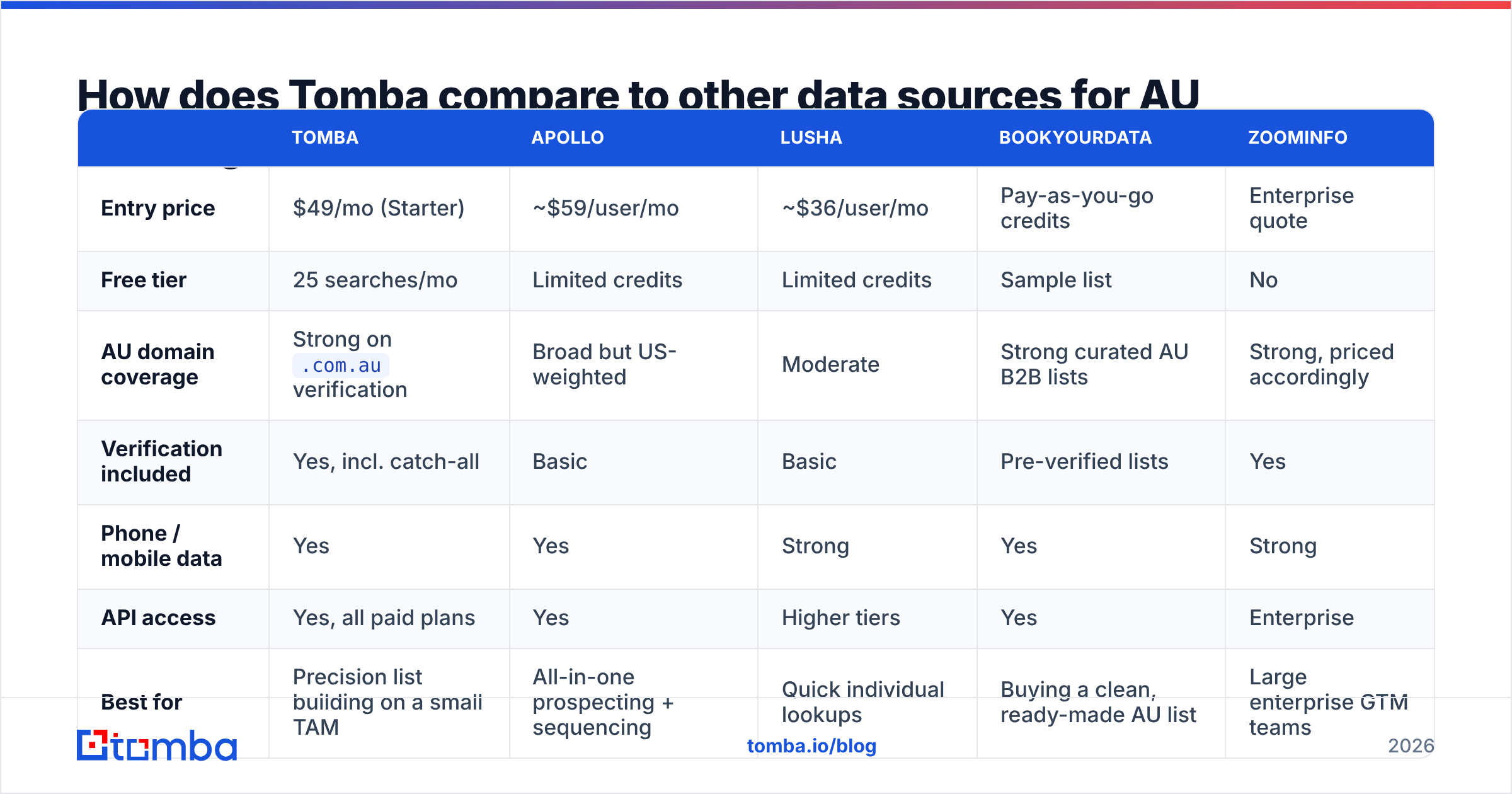
No single vendor wins on every axis here. This is an honest read on the options teams weigh up.

Accuracy on AU domains is where these tools split. Databases built mostly on US signal over-index on .com and under-resolve .com.au firms. You see it as confident-looking emails that bounce.
| Tomba | Apollo | Lusha | BookYourData | ZoomInfo | |
|---|---|---|---|---|---|
| Entry price | $49/mo (Starter) | ~$59/user/mo | ~$36/user/mo | Pay-as-you-go credits | Enterprise quote |
| Free tier | 25 searches/mo | Limited credits | Limited credits | Sample list | No |
| AU domain coverage | Strong on .com.au verification |
Broad but US-weighted | Moderate | Strong curated AU B2B lists | Strong, priced accordingly |
| Verification included | Yes, incl. catch-all | Basic | Basic | Pre-verified lists | Yes |
| Phone / mobile data | Yes | Yes | Strong | Yes | Strong |
| API access | Yes, all paid plans | Yes | Higher tiers | Yes | Enterprise |
| Best for | Precision list building on a small TAM | All-in-one prospecting + sequencing | Quick individual lookups | Buying a clean, ready-made AU list | Large enterprise GTM teams |
A few honest caveats. Apollo bundles prospecting and sequencing in one seat, which is genuinely handy. Tomba does not compete there. It is a data layer you plug into your own sequencer. If you would rather buy a clean, pre-checked AU list than build one, BookYourData does that well and skips the build work. Teams who need a list by Tuesday often prefer that. ZoomInfo's AU coverage is real, but the price rules it out for most teams under 20 reps.
Tomba earns its place on depth of checking in a small, costly market: catch-all handling, pattern confidence, and a score for each address. That is what stops you spending scarce accounts on guesses. See Tomba pricing for the plans, and data sources for where the records come from.

What does a working AU outbound sequence look like?#
Shorter, plainer, and less pushy than the US template.
AU buyers switch off at forced urgency and stacked social proof. "Join 12,000 companies" reads as noise. What works:
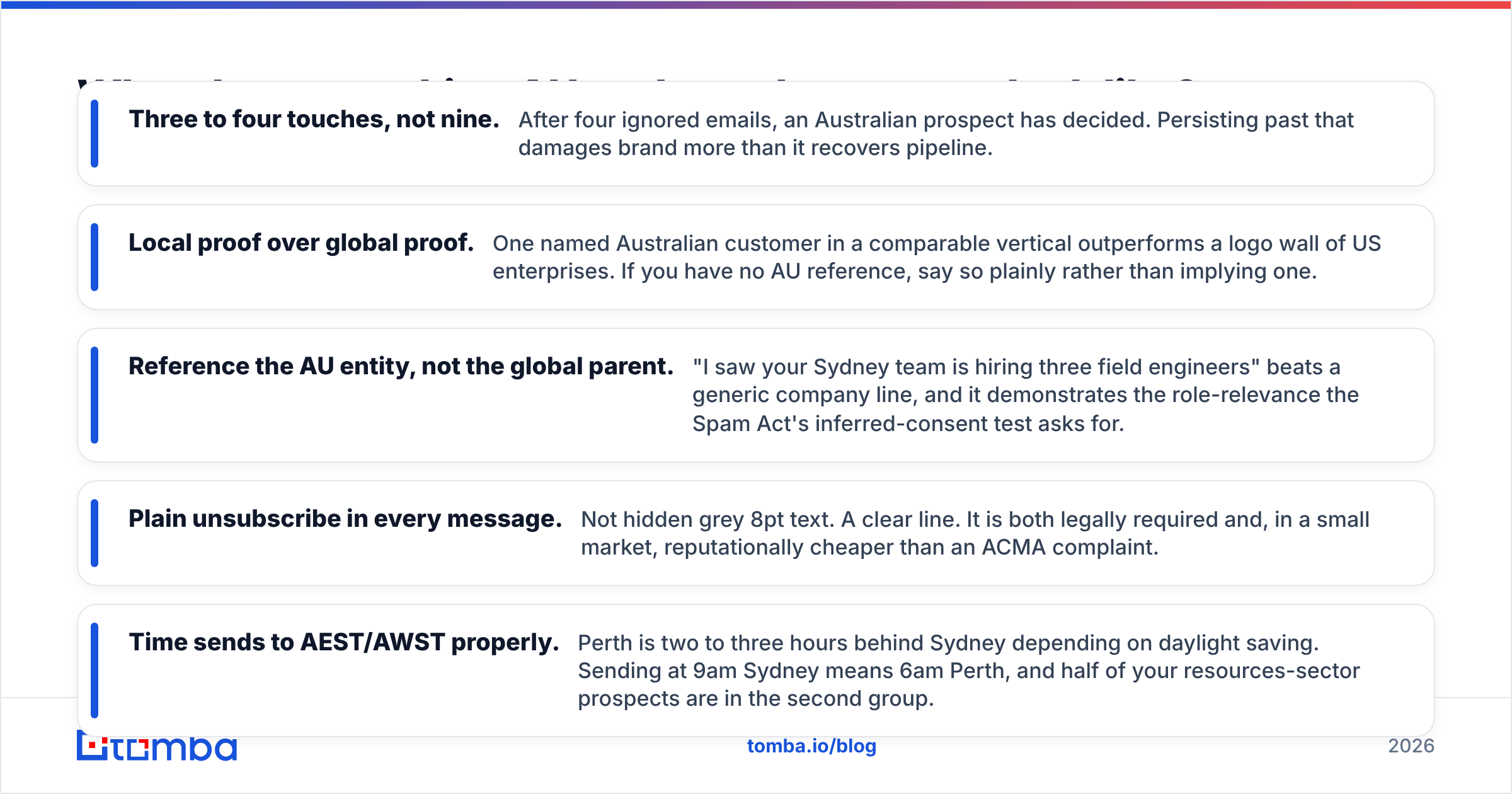
- Three or four touches, not nine. After four ignored emails, an AU prospect has decided. Going past that costs more brand than it wins back in pipeline.
- Local proof over global proof. One named AU customer in a like-for-like field beats a logo wall of US giants. If you have no AU reference, say so plainly.
- Name the AU arm, not the global parent. "I saw your Sydney team is hiring three field engineers" beats a generic company line. It also shows the job relevance the Spam Act test asks for.
Two more, and both are easy to get wrong:
- Plain unsubscribe in every message. Not hidden grey 8pt text. One clear line. The law asks for it, and in a small market it is cheaper than an ACMA complaint.
- Time your sends to AEST and AWST. Perth runs two to three hours behind Sydney, depending on daylight saving. A 9am Sydney send lands at 6am in Perth. Half your mining-sector prospects sit in that second group.
On deliverability, the basics do not change by country. Set up SPF, DKIM, and DMARC. Warm new domains for at least three weeks. Keep volume per inbox low. A small market makes low volume natural, so lean into it. Google and Yahoo's bulk sender requirements apply to AU senders like everyone else.

How do you build a referral engine in a small market?#
Make a system out of what most AU firms do by accident.
The referral edge here is real, but it is rarely managed. Three moves turn it into a channel:
- Map the industry bodies. Almost every AU field has one big association — AIIA for tech, ARA for retail, Ai Group for makers. Join, then take part: speak, write submissions, sit on working groups. That puts you inside the referral graph rather than outside it.
- Formalise partner overlap. Find five service firms that sell to your exact buyer without competing — accountants, MSPs, implementation partners, nearby SaaS. Write a two-way referral deal with tracking. A vague handshake is not one.
Then make the ask routine:
- Instrument the ask. Most teams never ask on purpose. Trigger the request at a set moment: 60 days after onboarding, after a good support call, or at renewal. Log it in your CRM as a pipeline stage, so it gets measured.
- Enrich every referral on arrival. A referral lands as a name and a company, not a qualified record. Run it through contact enrichment so the rep knows the role, the size, and the stack before the first call.
Expect an 8–16 week ramp. Then expect your best win rates. G2 and Capterra reviews play a part here, but AU buyers check a peer first.
What should you measure?#
A lead generation Australia scorecard needs four numbers, and "leads generated" is not one of them.
- Cost per qualified lead by channel, in AUD, with one shared definition of qualified. Without that gate, the number means nothing.
- Account coverage — how much of your defined market have you really touched? In an 800-account market, this tells you whether you have a demand problem or a coverage problem.
- Valid email rate at the moment of send. Under 95% means your list step leaks money and sender reputation.
- Referral-sourced pipeline, tracked each month. Over 50% and unmanaged is a concentration risk dressed up as a win.
Track response rate per sequence instead of open rates. Apple Mail Privacy Protection has made opens close to useless as a signal. AU iPhone use is among the highest in the world.
Where should you start with lead generation Australia?#
Building an AU pipeline from scratch? The order matters:
- Define the real market with ABN-anchored data. Not an estimate — a list you can count.
- Build and check the contact layer before you write a single email.
- Run a narrow outbound test on 150 accounts. Measure, then widen.
- In parallel, start the referral and association work. It pays off in month four.
- Add paid search only where AU search volume is real.
Teams struggle here when they port a US volume playbook into a market that punishes volume. Teams win when they treat every contact as scarce, check the data hard, and invest early in the channels that compound.
Start with the data layer. The Tomba Email Finder resolves .com.au domains, confirms company email patterns, and checks catch-all addresses before they cost you a bounce. The free tier gives you 25 searches a month. Test coverage on your own target accounts first, then pick a plan. In a market where every prospect is hard to replace, getting the address right the first time is the best move you can make.
Related guides#
// get started
Find, verify and enrich your first contacts today
Start on the free plan with 25 searches a month, then scale when your team is ready.
Free plan · No credit card required · GDPR & CCPA
// about the author