Lead Generation Call Center: Costs, ROI, and Setup Guide
Outsourced SDR floors quote $25 an hour and promise pipeline. Here's what a lead generation call center actually costs, when in-house wins, and why bad phone data kills more programs than bad scripts.
TL;DR
- A lead generation call center is an outbound team — internal or outsourced — whose only job is to produce qualified conversations, not closed deals. Confusing the two is the fastest way to waste a budget.
- Outsourced floors run roughly $3,000–$8,000 per seat per month in 2026 (or $25–$55/hour); an in-house SDR costs $6,500–$9,500 fully loaded but keeps the institutional knowledge.
- Connect rate, not dial volume, decides whether the math works. A 4% connect rate on 1,000 dials produces 40 conversations; 9% produces 90 for the same labor cost.
- Most failed programs blame scripts. The real culprit is usually the list: stale direct dials, wrong-title contacts, and no email fallback for the 90%+ of dials that never connect.
- Build the data layer first — verified direct dials, verified emails, enriched job titles — then hire the callers. Reverse that order and you pay people to dial dead numbers.
What is a lead generation call center?#
A lead generation call center is an outbound calling operation whose output is meetings, not revenue. Agents work a target list, get a decision-maker on the phone, qualify them against a short criteria set, and hand a booked call to an account executive.
Think of it like a fishing trawler versus a restaurant. The trawler's job is to bring back the right fish in volume. What happens in the kitchen — discovery, demo, negotiation, contract — is somebody else's craft entirely. When companies ask a call center to "close deals too," they get a trawler trying to plate entrées.
Three structures dominate in 2026:
- In-house SDR floor — your employees, your CRM, your brand. Highest control, highest fixed cost, slowest to spin up (8–12 weeks to first meeting).
- Outsourced BPO / appointment-setting agency — a vendor supplies trained agents, dialers, and often a list. Fast to launch, variable quality, and the agents usually work three other accounts.
- Hybrid — you own strategy, messaging, and data; the vendor supplies dialing capacity. This is where most mid-market teams land after one failed full-outsource experiment.
A fourth model — pure pay-per-appointment — looks attractive on the invoice and rarely survives contact with a real sales team. When a vendor is paid per booked meeting, they book meetings. Show-rate and qualification collapse. If you go this route, define "qualified" in the contract with the same rigor you'd use in a marketing qualified lead definition, and only pay on meetings that pass it.
In-house vs outsourced: which one actually costs less?#
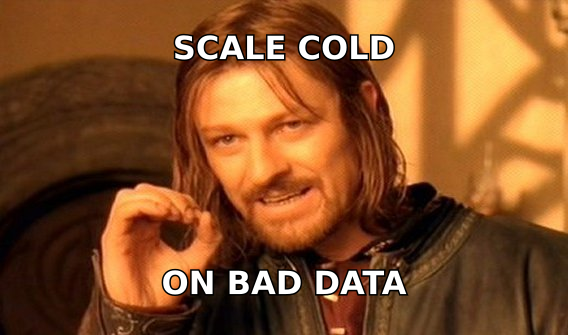
Neither, in isolation. The question is cost per qualified meeting, and that number depends on your ACV, your list quality, and how long the program runs.
| Factor | In-house SDR floor | Outsourced call center | Hybrid (you own data) |
|---|---|---|---|
| Monthly cost per seat | $6,500–$9,500 fully loaded | $3,000–$8,000 | $4,000–$7,000 |
| Time to first meeting | 8–12 weeks | 2–4 weeks | 3–6 weeks |
| Ramp cost before productivity | $12,000–$20,000 | Included in rate | Low |
| Product depth after 90 days | High | Low to medium | Medium |
| Who owns the contact data | You | Usually the vendor | You |
| Brand risk | Low | Medium to high | Low |
| Best fit | ACV above $25k, long sales cycles | Market tests, SMB volume, new geographies | Teams with strong ops, weak headcount |
| Realistic cost per qualified meeting | $250–$600 | $180–$450 | $200–$400 |
Read the "who owns the contact data" row twice. It is the line item nobody negotiates and the one that hurts most at renewal. If the vendor sourced the list, built the dispositions, and holds the call recordings, your switching cost at month 12 is not the contract — it is rebuilding a year of intelligence from scratch.
The honest decision rule: outsource to learn, insource to compound. A call center is excellent at answering "will anyone in German manufacturing pick up for this pitch?" in six weeks. It is poor at accumulating the nuanced objection-handling that makes year-two pipeline cheaper than year-one.
Why do most call center programs fail on data, not dialing?#
Because the funnel math is brutal and every stage multiplies.
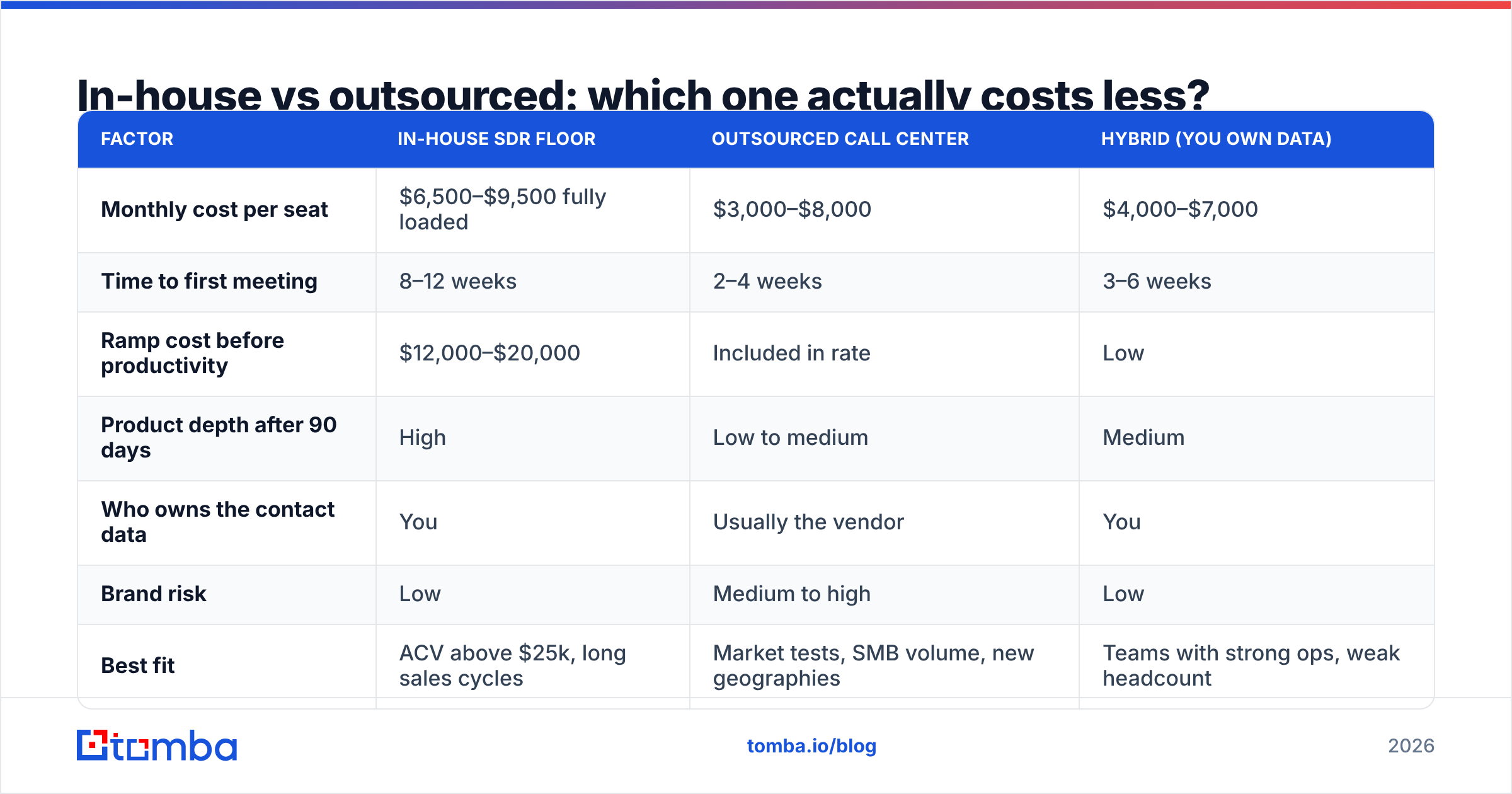
A typical B2B outbound day looks like this: 120 dials, 11 connects, 3 conversations that get past the first 20 seconds, 0.7 meetings booked. Now change one variable. If 30% of your direct dials are wrong — reassigned, disconnected, switchboard numbers dressed up as direct lines — your 11 connects become 7 and your daily meeting rate drops by more than a third. No script rewrite recovers that.
Three data failures cause the bulk of it:
- Stale direct dials. B2B contact data decays roughly 2–3% per month through job changes alone. A list bought 18 months ago is majority fiction.
- Right company, wrong human. Agents reach a "Director of Operations" who left, or a title that never held budget for your category.
- No second channel. Roughly 90% of dials do not produce a conversation. If you have no verified email for that contact, that dial produced nothing at all — not even a touch.
That last point is the cheapest fix in outbound. Every dial should have a paired email address so an unanswered call becomes a voicemail-plus-email combination, which is measurably stronger than either alone. Pull verified addresses with an email finder before the list ever reaches the dialer, and run the phone validator to strip numbers that will never ring.
Reference call centre operations literature and you'll find the same conclusion from a different direction: occupancy and contact rate dominate cost per outcome far more than agent talk-track quality.
How do you build a list a call center can actually dial?#
Do this before you sign a vendor contract or post a job req. Six steps, in order.
- Define the account list, not the contact list. Start with 300–800 named accounts that match your best closed-won profile — industry, headcount band, tech stack, funding stage. A call center handed "all SaaS companies" will burn your TAM in a quarter.
- Map the buying committee per account. Economic buyer, champion, and blocker. Three to five contacts per account, each with a real title, not a guess. Use domain search to pull the actual people at each company rather than permutating names from a pattern.
- Source direct dials and mobiles separately from switchboards. Main lines are not leads. Tag them differently in your CRM or your connect-rate reporting will lie to you. A dedicated phone finder step keeps these fields clean.
- Attach a verified email to every single record. Non-negotiable. This is what turns a missed call into a touch. Run the whole file through an email verifier so bounces don't damage the sending domain you also use for follow-up.
- Enrich for personalization hooks. Recent funding, new hires in the department, a tech-stack change, a competitor logo on their site. One specific hook beats three generic value props in the first eight seconds of a cold call. Data enrichment at list-build time costs a fraction of an agent discovering it live.
- Re-verify monthly. Set a standing job — not an annual project. A list that is refreshed every 30 days holds connect rate roughly flat; one refreshed annually loses about a quarter of its reachability by month nine.
Teams that follow this sequence typically see connect rates in the 7–10% band instead of the 3–5% that "we bought a list" programs settle for. Same agents, same script, double the conversations.
What KPIs should you hold a lead generation call center to?#
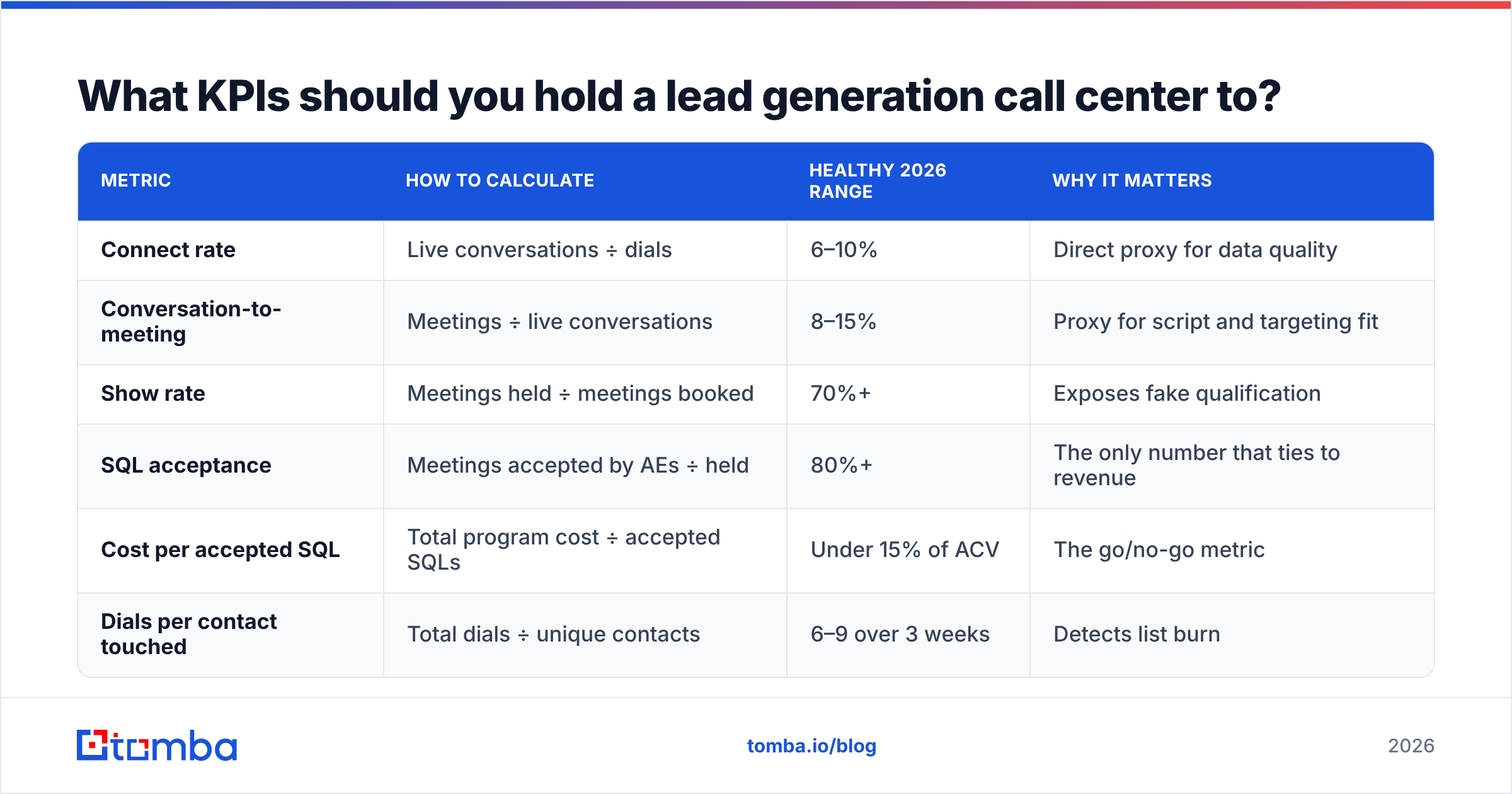
Vendors love reporting dials. Dials are an input, and an input any agent can inflate. Hold the program to outcome metrics with a defined denominator.
| Metric | How to calculate | Healthy 2026 range | Why it matters |
|---|---|---|---|
| Connect rate | Live conversations ÷ dials | 6–10% | Direct proxy for data quality |
| Conversation-to-meeting | Meetings ÷ live conversations | 8–15% | Proxy for script and targeting fit |
| Show rate | Meetings held ÷ meetings booked | 70%+ | Exposes fake qualification |
| SQL acceptance | Meetings accepted by AEs ÷ held | 80%+ | The only number that ties to revenue |
| Cost per accepted SQL | Total program cost ÷ accepted SQLs | Under 15% of ACV | The go/no-go metric |
| Dials per contact touched | Total dials ÷ unique contacts | 6–9 over 3 weeks | Detects list burn |
That last row catches the most common vendor trick: hitting activity targets by re-dialing the same 200 contacts twenty times. If dials-per-contact climbs past ten, the team ran out of list two weeks ago and nobody told you.
Pipe all of it into your CRM rather than a vendor spreadsheet. Salesforce Sales Cloud and HubSpot's sales tooling both support call dispositions and meeting-source attribution natively, and vendor-side reporting that can't be reconciled against your own CRM should be treated as marketing material.
Is a lead generation call center still worth it in 2026?#
Yes — for a narrower set of situations than vendors will tell you.
It works when:
- Your ACV is above roughly $15,000, so a $300 meeting cost still clears comfortably.
- Your buyer answers phones. Operations, facilities, logistics, healthcare admin, field services, manufacturing, and construction still pick up. Engineering leadership and VC-backed product orgs largely do not.
- Your offer is explainable in two sentences. Complex, consultative categories need an AE on the first call, which breaks the model.
- You have a geography or segment you genuinely cannot reach by email or LinkedIn.
It struggles when:
- The target buyer is remote-first with a mobile they screen aggressively.
- Your differentiation requires a demo to land.
- You expect the call center to also generate the list. That is the single strongest predictor of a failed engagement.
Check independent reviews on G2 before you shortlist a vendor, and weight recent reviews from companies your size far above the aggregate score. A BPO that excels at 5,000-seat consumer campaigns is a different business from one that books enterprise software meetings.
How should calls and email work together?#
As one sequence, not two programs. The strongest structure in 2026 is a 21-day cadence where the phone carries the urgency and email carries the context:
- Day 1: Call, no voicemail. Email with the specific hook from enrichment.
- Day 3: Call, leave voicemail referencing the email subject line.
- Day 5: Email reply-in-thread, one sentence, one question.
- Day 8: Call at a different time of day. LinkedIn view.
- Day 12: Call + voicemail + email with a case study relevant to their segment.
- Day 17: Call.
- Day 21: Break-up email, permission to close the file.
Seven to nine touches across two channels. The email leg only functions if deliverability holds, which means verified addresses and a sending domain separate from your corporate mail. Protect email deliverability as carefully as you protect the caller ID reputation of your dialer — both are finite assets that take months to rebuild once burned.
One operational note: if the call center is a vendor, insist that email touches send from your domain under your controls. Agencies that blast from their own shared infrastructure will eventually get your brand filtered somewhere you can't see.
What does a realistic first 90 days look like?#
- Weeks 1–2: Build the account list and the data layer. No calling. Verify phones and emails, enrich titles, load into CRM with clean source tags.
- Weeks 3–4: Pilot with two agents on 150 accounts. Record everything. Target: establish a baseline connect rate, not a meeting quota.
- Weeks 5–8: Fix the two biggest leaks the pilot exposed — usually list segment and the first-ten-seconds opener. Scale to full seat count only after connect rate stabilizes above 6%.
- Weeks 9–12: Measure cost per accepted SQL for the first time and compare against 15% of ACV. Decide renew, restructure, or stop.
Teams that skip weeks 1–2 always end up doing them in week 7, having paid agents to discover the list was broken.
Start with the data layer, then hire the dials#
A lead generation call center multiplies whatever you feed it. Feed it a verified, enriched, correctly-targeted list and a mediocre script still books meetings. Feed it a stale CSV and your best closer on the floor will underperform a good email sequence.
Build the list first. Use Tomba Email Finder to attach a verified email to every contact before a single number gets dialed, so the 90% of calls that don't connect still land a touch. Pair it with the phone finder and verifier on the same records, and your call center starts week one with a list that actually rings. Compare Tomba pricing — the free tier covers 25 searches a month for a pilot, Starter runs $49/mo, and Growth at $99/mo handles a typical two-agent outbound floor's monthly list refresh.
Related guides#
Ready to find emails that actually work?
Join 150,000+ professionals who stopped guessing and started sending. Free credits on signup — no credit card required.
Get the Tomba newsletter
Practical outbound tactics and product updates — once every two weeks.
About the author