Lead Generation Channels in 2026: What Actually Converts
Most teams spread budget across eight lead generation channels and win on two. Here's the cost, speed, and conversion reality of each channel in 2026 — plus how to pick the right mix for your motion.
TL;DR
- There are eight lead generation channels worth budgeting for in 2026: outbound email, cold calling, SEO/content, paid search, paid social, LinkedIn/social selling, partnerships/referrals, and events/webinars. Everything else is a tactic inside one of them.
- Channels differ on three axes that actually matter: time to first lead, cost per qualified opportunity, and how well the channel scales after it works. Most teams optimise for the first and get blindsided by the second.
- Outbound is the fastest to first meeting (days) and the cheapest to test, but it collapses without accurate contact data — bad emails are the single biggest cause of failed outbound programs.
- SEO and partnerships have the best long-run economics and the worst patience requirements. Budget them like R&D, not like performance marketing.
- Pick two channels, not eight. Two channels run properly beat eight channels run at 15% effort — and the second channel should compound the first, not duplicate it.
What are lead generation channels?#
A lead generation channel is a repeatable path by which a stranger becomes a known, contactable, qualified buyer. That's it. The definition matters because it rules things out: a webinar is a channel, "thought leadership" is not. A channel has an input (budget, time, or list), a measurable output (qualified leads), and a conversion rate you can improve.
Think of channels like fishing spots. Some are stocked ponds where you catch something in an hour but every other boat is there too (paid search). Some are open ocean — months of nothing, then a run that feeds you all year (SEO, partnerships). Some require you to know exactly where the fish are before you cast (outbound). The gear differs, the patience differs, and nobody wins by dropping a line in all of them at once.
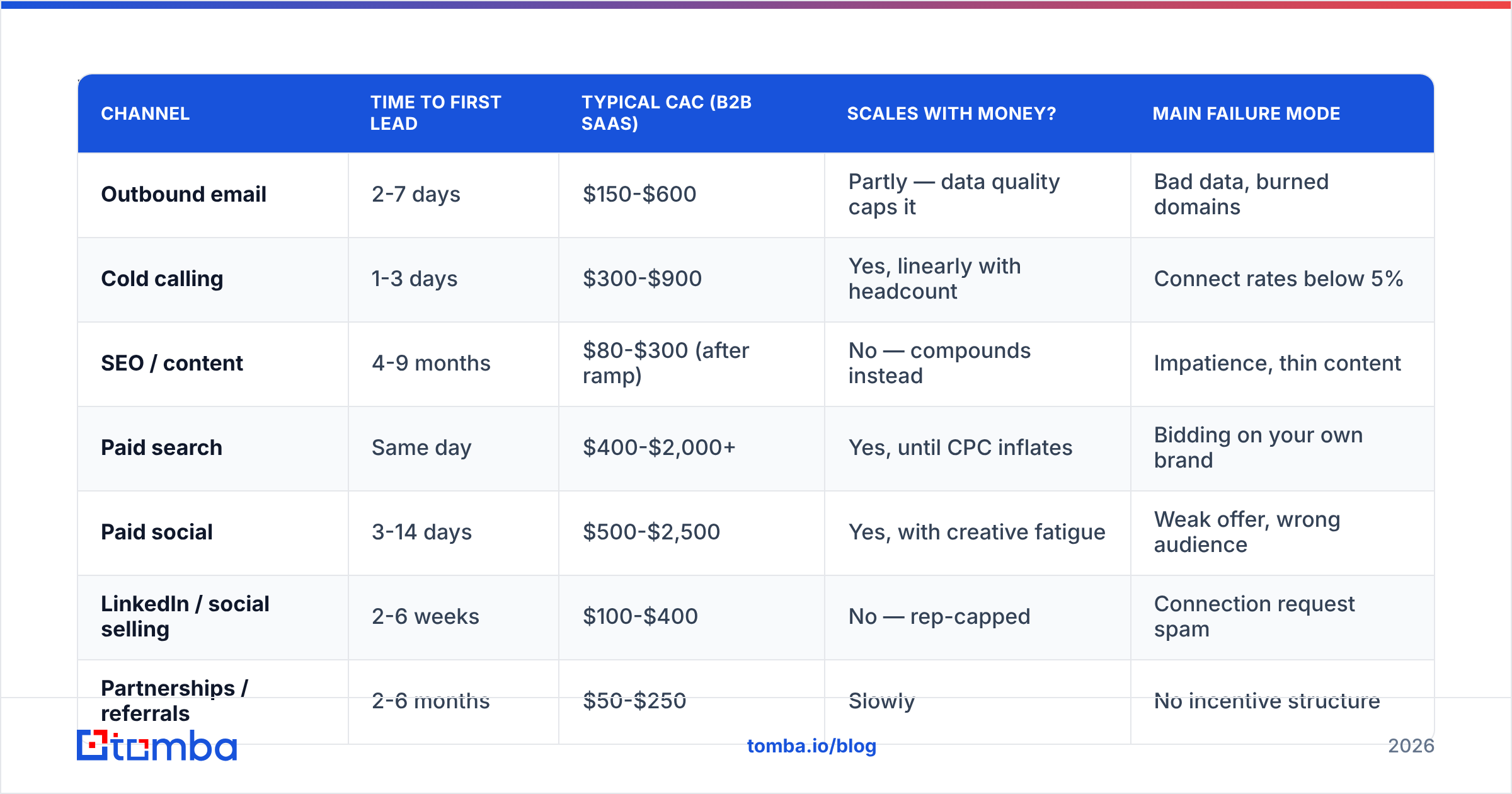
Here's how the eight real channels compare on the dimensions that drive budget decisions:
| Channel | Time to first lead | Typical CAC (B2B SaaS) | Scales with money? | Main failure mode |
|---|---|---|---|---|
| Outbound email | 2-7 days | $150-$600 | Partly — data quality caps it | Bad data, burned domains |
| Cold calling | 1-3 days | $300-$900 | Yes, linearly with headcount | Connect rates below 5% |
| SEO / content | 4-9 months | $80-$300 (after ramp) | No — compounds instead | Impatience, thin content |
| Paid search | Same day | $400-$2,000+ | Yes, until CPC inflates | Bidding on your own brand |
| Paid social | 3-14 days | $500-$2,500 | Yes, with creative fatigue | Weak offer, wrong audience |
| LinkedIn / social selling | 2-6 weeks | $100-$400 | No — rep-capped | Connection request spam |
| Partnerships / referrals | 2-6 months | $50-$250 | Slowly | No incentive structure |
| Events / webinars | 4-12 weeks | $600-$3,000 | Somewhat | Attendance ≠ intent |
Those CAC ranges are directional, pulled from mid-market B2B SaaS norms. Your numbers will differ by ACV and category maturity — but the relative ordering holds across almost every B2B team I've seen report on it.
Which lead generation channels work fastest?#
Outbound and paid search. Both can put a qualified conversation on your calendar this week. They get there very differently.
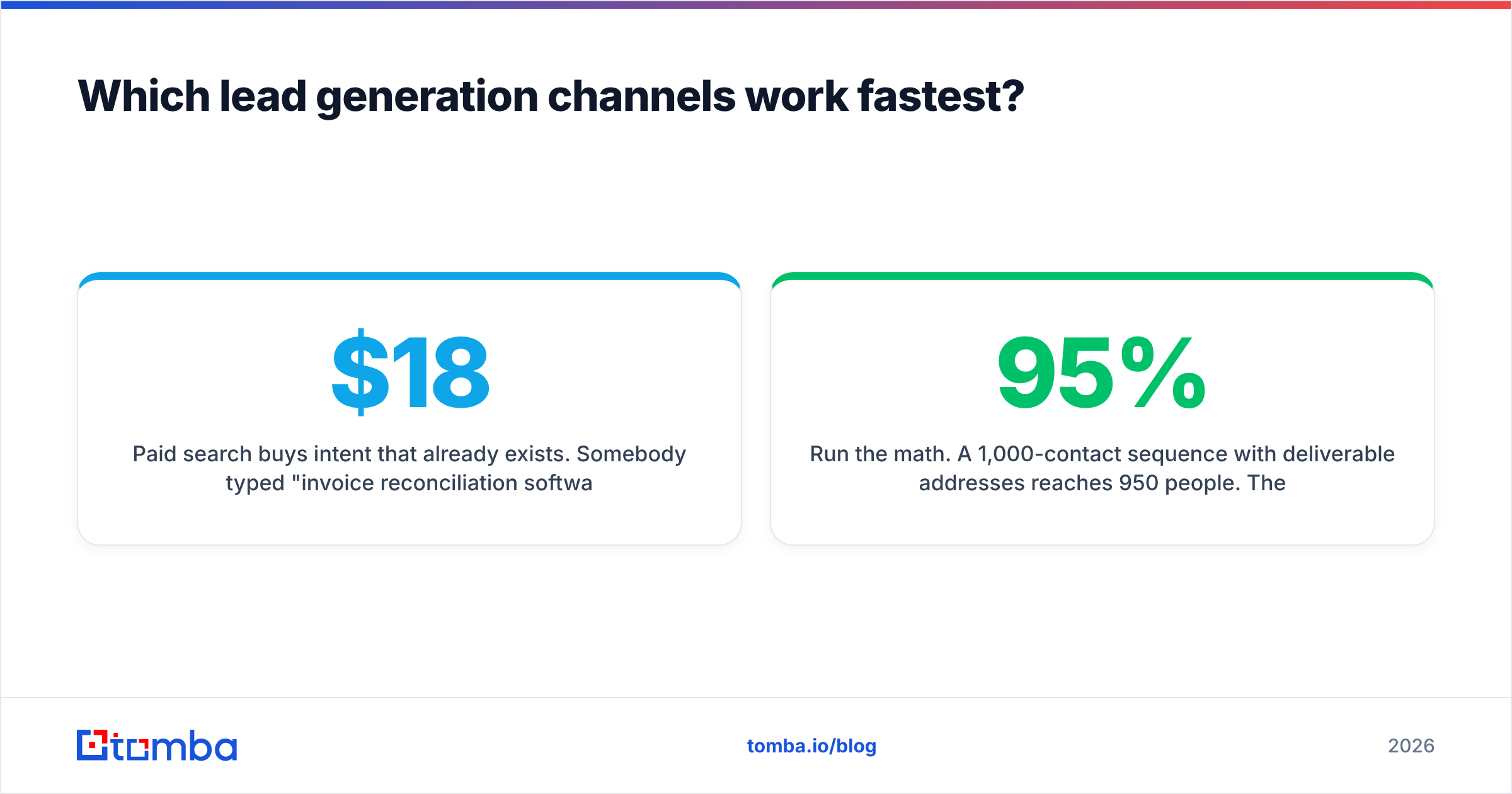
Paid search buys intent that already exists. Somebody typed "invoice reconciliation software" into Google, and you pay $18 to be in front of them. The intent is real, the volume is capped by search demand, and your competitors are bidding on the same 400 monthly searches. According to Gartner's research on B2B buying behaviour, buyers spend only about 17% of the purchase journey meeting with suppliers — most of that search-driven research happens before you ever get a form fill.
Outbound creates intent that doesn't exist yet. You decide who should care, find them, and make the case. That inversion is why outbound is the only channel where you control volume directly: you can decide to contact 200 more accounts next week. Try deciding to get 200 more Google searches.
The catch is that outbound's entire economics depend on one variable most teams treat as an afterthought — contact accuracy.
Run the math. A 1,000-contact sequence with 95% deliverable addresses reaches 950 people. The same sequence at 70% accuracy reaches 700 — and the 300 bounces damage your sender reputation, which suppresses inbox placement for the 700 that were fine. You didn't lose 30% of your reach. You lost 30% plus a compounding deliverability penalty that follows your domain for weeks.
This is why the contact-data layer sits underneath outbound rather than beside it. A bulk email finder that returns verified addresses at scale, paired with an email verifier pass before every send, is not a nice-to-have — it's the difference between a channel that works and a channel that silently poisons your domain.
How do you choose the right channel mix?#
Start with four questions, in this order:
- What's your ACV? Under $5k annual contract value, outbound and cold calling rarely pay back — the human cost per touch exceeds the margin. Go SEO, paid, and product-led. Above $25k, outbound becomes the highest-ROI channel available because one deal covers a quarter of prospecting cost.
- How well-defined is your buyer? If you can name the exact job title and company profile, outbound and LinkedIn win — you can target precisely. If your buyer is fuzzy or self-identifies late, inbound channels let them raise their hand instead.
- Does search demand exist for your category? Check monthly search volume for your three main problem keywords. Under 500 searches/month combined means you're in a category-creation motion: paid search and SEO will starve, and outbound plus events carry the load.
- What's your runway? Under 9 months of cash, do not start an SEO program as your primary channel. It will not return in time. Use it as a secondary bet funded by whatever outbound or paid brings in.
- Who's already talking to your buyer? That's your partnership list. The cheapest qualified lead in B2B is almost always a warm referral from a company selling an adjacent product to the same person.
- What can your team actually execute? A two-person team running outbound well beats the same team running outbound, SEO, paid social, and webinars at a quarter of the attention each. Channel count is a function of headcount, not ambition.
Answer those honestly and the mix usually picks itself. Most teams land on one fast channel (outbound or paid) funding one compounding channel (SEO or partnerships).
Is outbound still a viable lead generation channel in 2026?#
Yes — but the version that works now looks nothing like 2019's spray-and-pray. Three things changed.
Volume stopped working. Google and Microsoft both tightened bulk-sender enforcement, and per-domain send limits are now practically enforced through reputation scoring rather than hard caps. Sending 500 cold emails a day from one domain is a reliable way to end up in spam. The teams winning at outbound now send fewer emails to better-researched accounts.
Data quality became the bottleneck. When you're sending 80 emails a day instead of 800, every address has to land. Catch-all domains — which accept everything at the SMTP layer and silently discard the invalid ones — are now roughly 20-25% of B2B domains and represent the single murkiest part of any list. A catch-all verifier that resolves those beyond a simple "accept-all" flag is the difference between a 92% and a 74% real delivery rate.
Personalisation went from differentiator to table stakes. Your prospect gets 40 cold emails a week. A template with {{first_name}} swapped in reads as a template. The response-rate lift from genuine account research is now large enough that it changes channel economics outright — well-researched outbound sequences commonly run 3-5x the response rate of generic blasts.
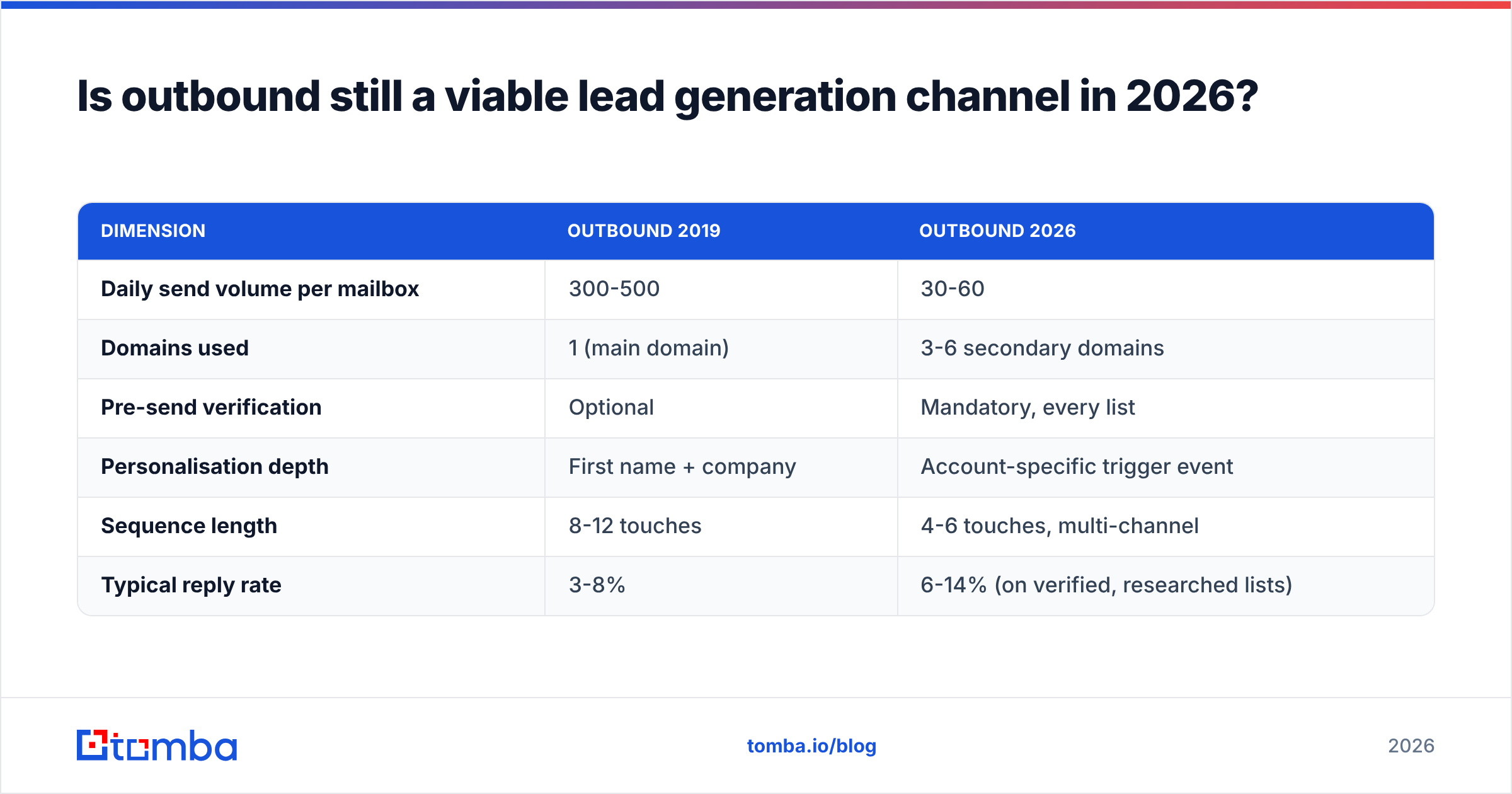
Here's what that shift looks like in practice:
| Dimension | Outbound 2019 | Outbound 2026 |
|---|---|---|
| Daily send volume per mailbox | 300-500 | 30-60 |
| Domains used | 1 (main domain) | 3-6 secondary domains |
| Pre-send verification | Optional | Mandatory, every list |
| Personalisation depth | First name + company | Account-specific trigger event |
| Sequence length | 8-12 touches | 4-6 touches, multi-channel |
| Typical reply rate | 3-8% | 6-14% (on verified, researched lists) |
If your outbound is underperforming, check the verification row before you rewrite the copy. Copy problems show up as low reply rates. Data problems show up as high bounce rates and low reply rates, and no amount of rewriting fixes them.
What about inbound channels — SEO, content, and paid?#
Treat SEO as an asset purchase, not a marketing spend. You're buying an appreciating property that produces rent for years. That framing sets the right expectations: nobody expects a building to generate income in month two.
The honest numbers: a B2B content program typically produces its first meaningful organic lead somewhere between month 4 and month 9, reaches breakeven against its own cost between month 12 and month 18, and then produces leads at a marginal cost approaching zero. HubSpot's inbound marketing research has documented this compounding pattern across thousands of accounts — the curve is slow, then steep.
Paid search is the opposite shape: instant, linear, and it stops the day you stop paying. It's a rental, not a purchase. That's not a criticism — renting is the right call when you need a roof tonight. The failure mode is treating rent as if it were building equity. Teams that run paid search for three years without building organic or outbound assets are paying an escalating tax with nothing accruing.
Paid social sits awkwardly between them. LinkedIn Ads reach the right people at $8-$18 per click, which only works above roughly $30k ACV. Below that, the arithmetic rarely closes. Check current benchmarks on G2's category data before committing budget — CPCs in B2B categories have risen steadily and last year's model may no longer hold.

A practical hybrid most teams miss: use inbound signals to prioritise outbound. When someone reads three pricing-adjacent pages on your site and leaves without converting, that's a qualified outbound target with a documented trigger event. Website visitor reveal turns anonymous traffic into named accounts, which turns your worst inbound metric (95%+ of visitors never convert) into outbound's best input.
How do you measure lead generation channels properly?#
Measure at the opportunity stage, not the lead stage. Every channel looks good at the top of the funnel because every channel is optimised for the metric you report on.
Track four numbers per channel:
- Cost per qualified opportunity — total channel spend (including loaded headcount cost) divided by opportunities that passed qualification. Not MQLs. Not leads. Opportunities.
- Opportunity-to-close rate by channel — referral leads routinely close at 3-4x the rate of paid leads with identical qualification criteria. If you're not segmenting close rate by source, you're mispricing every channel.
- Sales cycle length by channel — an inbound lead that closes in 40 days and an outbound lead that closes in 110 days have very different cash-flow implications even at identical CAC.
- Time to channel payback — months until cumulative channel-sourced revenue exceeds cumulative channel cost. This is the number that should decide whether you keep funding a channel, and almost nobody calculates it.
One measurement trap worth naming: attribution windows. A 30-day window systematically under-credits SEO and partnerships (long consideration) and over-credits paid search (last-touch capture). If you use last-touch with a short window, you will conclude paid is your best channel and defund the thing feeding it. Run both first-touch and last-touch, and look at the gap.
For attribution and pipeline hygiene, your CRM needs clean source data at the contact level, which means enrichment at the point of capture rather than a quarterly cleanup project. Contact enrichment applied on inbound form fills fills in company size, industry, and role — the fields your channel analysis depends on and that nobody fills in voluntarily.
Which channels should you combine?#
Channel pairs compound when one produces raw material the other refines. Pairs that don't compound just split your attention.
Strong pairs:
- SEO + outbound — content answers the question, outbound reaches the people asking it who never clicked. Content also gives reps something credible to reference in a first touch.
- Events + outbound — an attendee list is a pre-warmed target list with a shared context. Post-event outbound converts at multiples of cold.
- Partnerships + outbound — a partner intro converts cold outreach into warm, and partners have lists you can't buy.
- Paid search + retargeting — capture intent, then stay visible through a consideration cycle that outlasts the session.
Weak pairs:
- Paid social + paid search — both are rented traffic competing for the same budget line with no compounding effect.
- Cold calling + cold email with no shared data layer — you'll double-touch some accounts, miss others, and irritate the overlap.
The combining principle is simple: your second channel should make your first channel cheaper or better. If it only adds volume, you've added a job, not a channel.
Building the data layer underneath all of it#
Every channel on this list eventually produces the same artefact — a name, a company, and a contact method. The channel determines how you meet someone. The data layer determines whether you can actually reach them.
That's where most channel strategies quietly fail. Teams spend six months debating channel mix and zero hours on whether the contact records feeding those channels are accurate. A perfectly targeted outbound sequence to a 68%-valid list is a worse investment than a mediocre sequence to a 96%-valid list.
If outbound is one of the two channels you pick — and for most B2B teams above $25k ACV it should be — start by fixing the input. Tomba's Email Finder finds verified professional addresses by name, company, or domain, with verification built into the same workflow so you're not stitching two vendors together. The free tier gives you 25 searches a month to test accuracy against a list you already know the answers to; paid plans start at $49/month on Starter and $99/month on Growth. Check Tomba pricing for the full breakdown, or run a domain against it first and see how the results compare to what you've got.
Pick two channels. Fix the data underneath them. Ignore the other six until the first two are boring.
Related guides#
// get started
Find, verify and enrich your first contacts today
Start on the free plan with 25 searches a month, then scale when your team is ready.
Free plan · No credit card required · GDPR & CCPA
Get the Tomba newsletter
Product and data updates
// about the author