Lead Generation Channels B2B: 9 Channels Ranked for 2026
Nine B2B lead generation channels, compared on real cost per qualified lead, time to first pipeline, and where each one quietly breaks. With a channel-mix model you can copy.
Most teams pick a channel first and do the math later. Flip that order. The lead generation channels B2B teams run each have a price, a ramp time, and a way they break. This post ranks nine of them on what they cost per qualified lead in 2026.
TL;DR
- There is no universally best B2B channel. There is a best channel for your ACV, sales cycle, and headcount. Those three inputs decide it almost entirely.
- Outbound email still wins on cost per qualified lead for deals between $5k and $50k ACV. It wins only when contact data is verified before send. Bad data, not bad copy, is what kills most outbound programs.
- SEO and content have the best long-run economics and the worst short-run ones: 6–11 months to meaningful pipeline. Start them early, judge them late.
- Paid search works when buyers already know the category exists. It is brutal when they do not — you end up paying to educate people who bounce.
- Run 2–3 channels well rather than 6 badly. Most teams under 20 people cannot staff more than three without every one of them going mediocre.
What Counts as a Lead Generation Channel in B2B?#
A channel is a repeatable path from stranger to named contact. The person has to show some signal of fit or interest. That definition matters. Half the arguments about "which channel works" are really arguments about what counts as a lead.
Marketing counts a whitepaper download. Sales counts a booked meeting. Finance counts closed revenue. When you compare channels, pick one denominator and hold it constant. Throughout this post the denominator is SQL — sales-qualified lead. That means a real person at a real account who took a meeting or replied with intent. Downloads are not leads. A list of 40,000 emails is not leads.
Here are the nine lead generation channels B2B teams still get real pipeline from in 2026:
- Outbound email — you identify accounts, find contacts, and send. Highest control, fastest feedback loop, most sensitive to data quality.
- Organic search and content — you rank for problems your buyer types into Google. Slow to start, compounding, hard for competitors to copy.
- Paid search — you buy the click on high-intent keywords. Instant on, instant off, and the CPC in mature B2B categories has gotten ugly.
- LinkedIn outbound and social selling — connection requests, DMs, content-led inbound from a personal profile. Strong for senior titles, throttled by platform limits.
- Paid social and ABM display — you buy attention rather than intent. Works as an air cover layer, rarely works as a standalone source.
The first five you run yourself. The last four lean on other people — partners, attendees, visitors who already found you, and happy customers.
- Partnerships, resellers, and co-marketing — someone else's audience vouches for you. Best conversion rates in B2B, lowest volume predictability.
- Events, webinars, and field marketing — concentrated attention, high cost per head, excellent for enterprise deals.
- Website visitor identification and intent data — you de-anonymize traffic you already have and reach out. High leverage, dependent on existing traffic volume.
- Referrals and customer expansion — the cheapest pipeline you will ever get, and the one nobody systematizes.
Everything else — Reddit, communities, podcast tours, cold calling — is either a tactic inside one of these nine or a variant of it. Cold calling is a companion motion to outbound email, not a separate channel. The account selection work is identical. Only the touch changes.
Which Lead Generation Channels B2B Teams Use Cost the Least per SQL?#
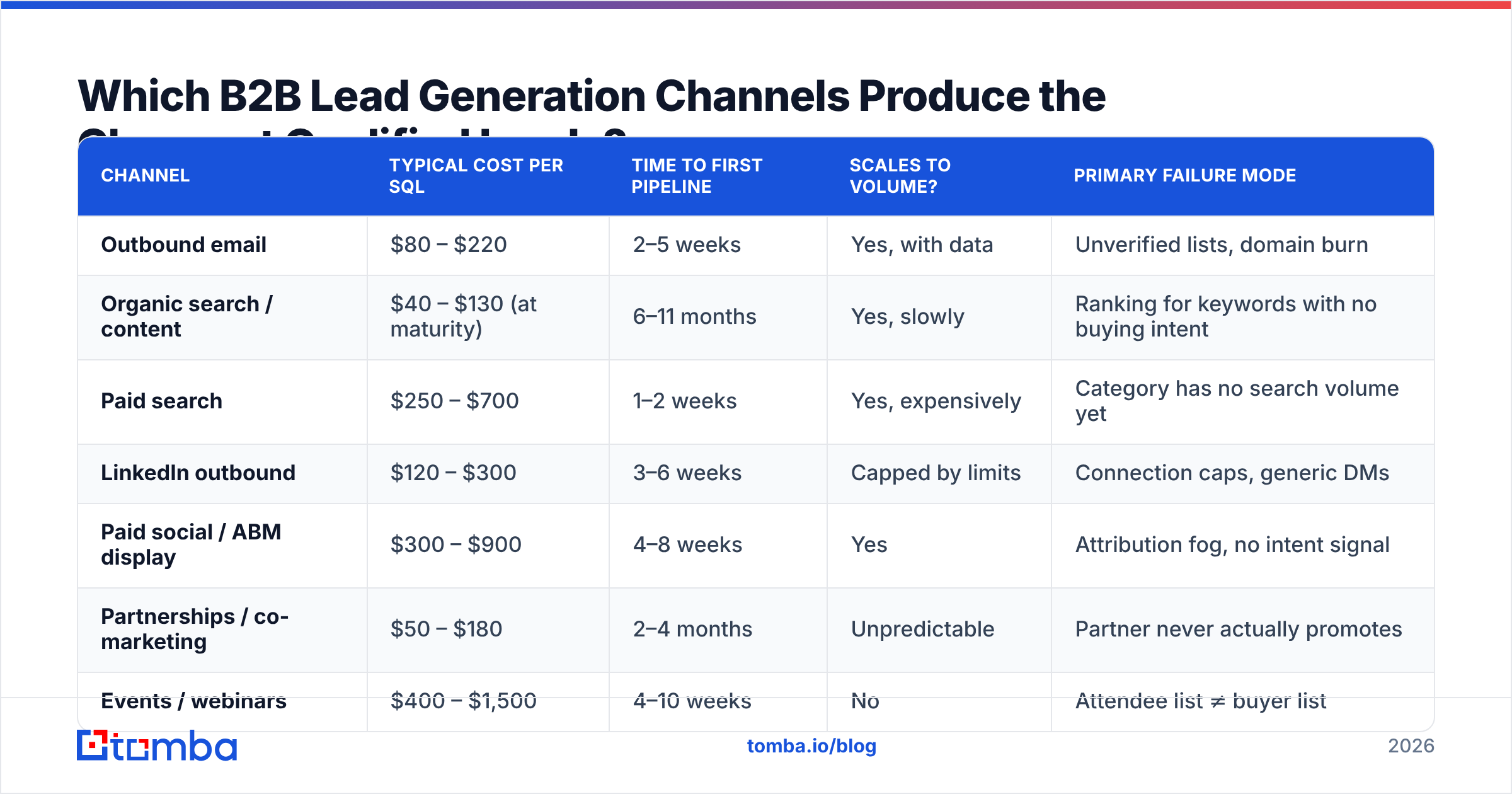
Here is the honest comparison. The figures below are composite ranges. They come from what B2B teams in the $1M–$50M ARR band tend to report. Your own numbers will move with category maturity and ACV. Treat them as a starting prior, not a benchmark to hit.
| Channel | Typical cost per SQL | Time to first pipeline | Scales to volume? | Primary failure mode |
|---|---|---|---|---|
| Outbound email | $80 – $220 | 2–5 weeks | Yes, with data | Unverified lists, domain burn |
| Organic search / content | $40 – $130 (at maturity) | 6–11 months | Yes, slowly | Ranking for keywords with no buying intent |
| Paid search | $250 – $700 | 1–2 weeks | Yes, expensively | Category has no search volume yet |
| LinkedIn outbound | $120 – $300 | 3–6 weeks | Capped by limits | Connection caps, generic DMs |
| Paid social / ABM display | $300 – $900 | 4–8 weeks | Yes | Attribution fog, no intent signal |
| Partnerships / co-marketing | $50 – $180 | 2–4 months | Unpredictable | Partner never actually promotes |
| Events / webinars | $400 – $1,500 | 4–10 weeks | No | Attendee list ≠ buyer list |
| Visitor identification | $60 – $190 | 1–3 weeks | Capped by traffic | Not enough traffic to de-anonymize |
| Referrals | $10 – $60 | Ongoing | No | Nobody owns the ask |
Three things stand out.
Referrals are absurdly cheap and nobody runs them properly. The cost per SQL is an order of magnitude below everything else. Yet in most orgs the referral motion is "ask at QBR if someone remembers." Assign it to a person, put it in the CS playbook, and it becomes a channel instead of an accident.
Paid search is a tax on impatience. It is the fastest way to buy pipeline. In crowded categories it is also the most expensive per SQL by a wide margin. That is fine if your ACV is $60k. It is ruinous if your ACV is $4k.
Outbound and visitor ID sit in the same economic neighborhood because they are the same motion with a different trigger. One starts from a firmographic hypothesis, the other from a behavioral signal. Both end with "we need a verified email address for the right person."
Why Does Outbound Email Still Beat Most Channels on Cost?#
Because you control every variable except the reply.
With paid search you bid against competitors for a click and hope the landing page converts. With SEO you wait two quarters for Google to decide. With outbound, you choose the accounts, the titles, the timing, the message, and the volume. You learn whether it works in about eleven days.
The catch is that outbound has a single point of failure that no amount of copywriting fixes: the list. A 2026 outbound program dies in one of three ways, and all three trace back to data.
- Bounce-driven domain burn. Mailbox providers read a high hard-bounce rate as a spam signal. Two or three sends at a 12% bounce rate and your sender reputation is damaged for months. Repairing it costs more time than the campaign was ever going to earn.
- Right company, wrong human. You reach the ops manager when the decision sits with the VP of RevOps. The reply rate looks like a messaging problem. It is a targeting problem.
- Stale records. B2B contact data decays at roughly 22–30% per year through job changes alone. A list bought eighteen months ago is now a quarter fiction.
This is why data quality is the actual lever. Before a campaign goes out, every address should pass verification — syntax, MX, SMTP, role-account detection, and catch-all handling. Run the list through an email verifier first. Drop every address that does not come back deliverable. That one step takes bounce rates from double digits to under 2%. It also protects the domain every future campaign depends on.
For the finding step itself, there are two shapes of workflow:
- Account-first: you know the companies, you need the people. Domain search returns the contactable humans at a domain with their roles and confidence scores.
- Person-first: you have names from a list, a conference roster, or LinkedIn, and you need addresses. An email finder resolves name plus domain into a verified address.
At volume, run it as one pipeline rather than two tools. Enrich, verify, and only then load into the sequencer. Treat verification as an optional last step and you spend Q3 rebuilding your domain reputation.
Worth reading alongside this: HubSpot's ongoing State of Marketing research. It keeps finding that performance gaps between teams come down to execution quality more than channel choice. That matches the table above. The ranges within each channel are wider than the gaps between channels.
Is SEO Worth the Wait in 2026?#
Yes, if you can survive the wait — and the wait got longer.
AI overviews and answer engines have absorbed a chunk of informational search traffic. The queries that used to send you visitors ("what is lead scoring") increasingly get answered on the results page. What has not been absorbed: commercial-investigation queries. "Best X for Y," "X vs Y," "X pricing," "X alternatives." Those still produce clicks. A buyer comparing vendors wants to see the vendors.
So the 2026 SEO strategy for B2B is narrower and more commercial than the 2019 one:
- Comparison and alternative pages for every serious competitor in your category. High intent, low volume, excellent conversion.
- Pricing-adjacent content — buyers search for costs constantly, and most vendors hide from the question.
- Use-case pages tied to a specific job title and a specific problem, not generic "solutions" pages.
- Free tools that solve a narrow task in ten seconds. A free email checker or a subject line generator earns links and returns visits in a way a blog post cannot.
- Genuine original data — a survey, a benchmark, an analysis of your own aggregate product data. It is the only content type that reliably earns citations from other sites and from AI answer engines.
Budget 6–11 months before organic contributes meaningful pipeline, and do not let a CFO kill it at month four. The compounding is real. A page that ranks keeps producing leads at near-zero marginal cost. That is why mature content programs post the second-lowest cost per SQL in the table above.
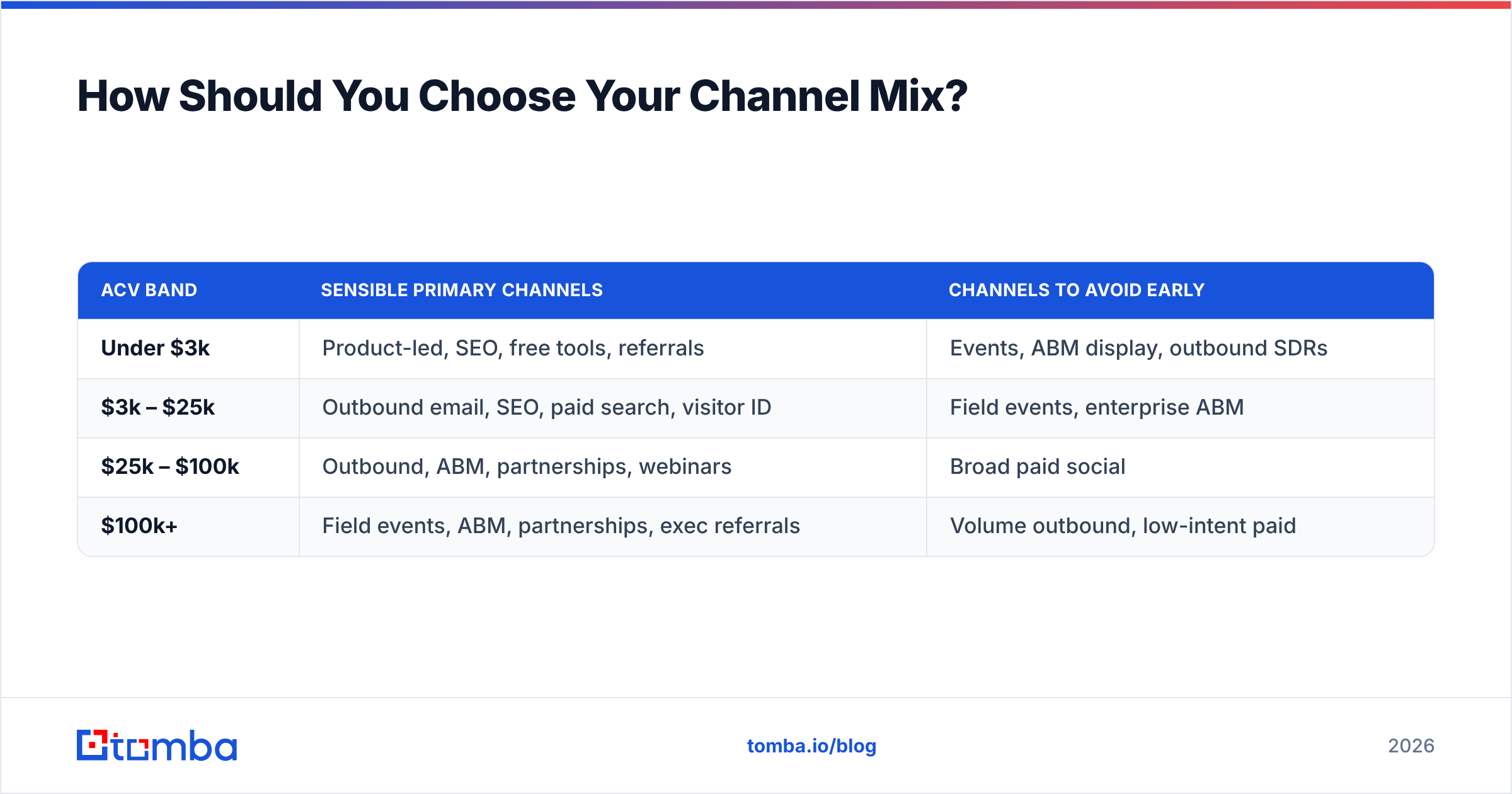
How Should You Choose Your Channel Mix?#
Three inputs decide it. Run them in order.
1. What is your average contract value?
ACV sets the ceiling on acceptable cost per SQL. A rough rule: blended cost per SQL should land under 10% of ACV. That assumes SQL-to-close rates in the usual 15–25% band.
| ACV band | Sensible primary channels | Channels to avoid early |
|---|---|---|
| Under $3k | Product-led, SEO, free tools, referrals | Events, ABM display, outbound SDRs |
| $3k – $25k | Outbound email, SEO, paid search, visitor ID | Field events, enterprise ABM |
| $25k – $100k | Outbound, ABM, partnerships, webinars | Broad paid social |
| $100k+ | Field events, ABM, partnerships, exec referrals | Volume outbound, low-intent paid |
2. How long is your sales cycle?
Short cycles (under 30 days) reward fast feedback loops — outbound, paid search, visitor ID. You can iterate weekly. Long cycles (6+ months) reward channels that build familiarity over time: content, events, partnerships, and account-based programs. Running high-volume outbound into a 9-month enterprise cycle produces a lot of activity metrics and very little forecast.
3. How many people can actually run a channel?
This is the constraint teams ignore. A channel needs an owner who spends real hours on it weekly. One competent person can own roughly one and a half channels. A four-person go-to-market team running six channels is running six mediocre ones. Mediocre channels in B2B return roughly nothing.
Pick two. Get both to a known, repeatable cost per SQL. Add the third only when the first two are boring.
What Does a Working Two-Channel Stack Look Like?#
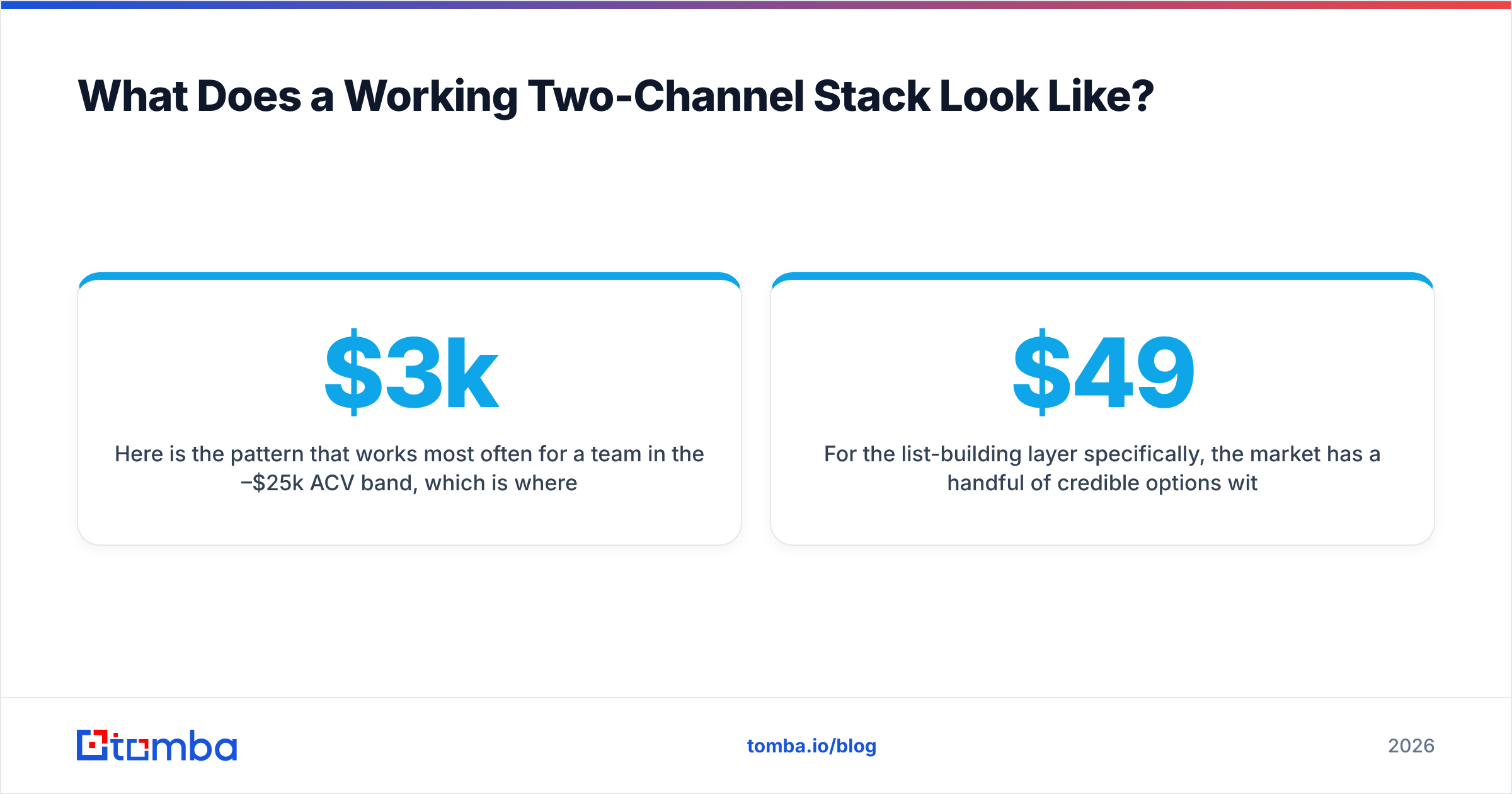
Here is the pattern that works most often in the $3k–$25k ACV band. That is where most B2B SaaS sits.
Channel one: targeted outbound. Not volume outbound — targeted. Define an ICP tight enough that you could list every qualifying account in a spreadsheet. Usually that is 800–4,000 companies, not 40,000.
- Build the account list from firmographics plus a technographic or hiring signal. Companies hiring for a role you serve, or running a tool yours complements, convert at multiples of the base rate.
- Find the right people — two to three contacts per account. Cover the economic buyer and the practitioner who feels the pain daily. A bulk email finder handles this at list scale rather than one lookup at a time.
- Verify everything before it enters the sequencer. Non-negotiable. Also run the catch-all verifier on catch-all domains rather than guessing. Those addresses silently inflate bounce rates.
- Sequence at a human volume. 30–60 sends per mailbox per day, multiple warmed domains, plain text, no tracking pixels on the first touch.
- Measure reply rate and meeting rate, not open rate. Open tracking has been unreliable since Apple's Mail Privacy Protection, and it distorts every decision downstream.
Channel two: commercial-intent SEO. Comparison pages, alternative pages, pricing content, and two or three free tools. This is the channel that makes outbound cheaper over time. Prospects who have seen your name convert at a much higher rate than cold ones. That is the whole argument for running air cover alongside a direct channel.
Everything else — events, paid social, partnerships — waits until those two have a known payback period.
For the list-building layer specifically, the market has a handful of credible options with genuinely different shapes. Tomba runs a free tier at 25 searches/month, then Starter at $49/mo, Growth at $99/mo, and Pro at $249/mo. The finder, verifier, domain search, catch-all verification, and enrichment sit in one place, plus an API for pipeline work. BookYourData takes a different and well-regarded approach: pay-as-you-go prebuilt B2B lists with an accuracy guarantee. That suits teams who want a list delivered rather than a search workflow to operate. Broad platforms like Apollo bundle sequencing with data. That is handy if you want one vendor, less so if you already run a sequencer you like. Check current positioning on G2 before committing to an annual plan; this category moves.
Which Channel Metrics Should You Actually Track?#
Four numbers per channel. More than that and nobody reads the dashboard.
- Cost per SQL — all-in, including salary allocation and tooling. The number most teams quote leaves out headcount. That makes outbound look free and paid look expensive. It is neither.
- SQL-to-close rate by channel — this is where channels separate. Referral SQLs close at 3–5x the rate of paid social SQLs. A channel with a higher cost per SQL can still be your best channel.
- Time to first revenue — how long from first touch to closed-won, by channel. Feeds cash planning and stops you from killing slow channels prematurely.
- Volume ceiling — how many SQLs per month this channel produces before cost per SQL degrades. Every channel has one. Finding it early prevents the "we'll just 10x outbound" conversation that ends in a burned domain.
Track these monthly by channel and quarterly by channel-and-segment. Forrester and Gartner both publish on B2B buying-group behavior and attribution. Gartner's B2B sales research is a reasonable free starting point. Reach for it when you need to explain to leadership why single-touch attribution keeps lying to them.
One practical note on measurement: multi-touch attribution in B2B is directionally useful and precisely wrong. A buying group of six people touched your brand through four channels over five months. No model untangles that cleanly. Use attribution to spot obvious dead channels. Use self-reported source ("how did you hear about us?" on the demo form) to catch what attribution misses. Make budget calls on the combination.
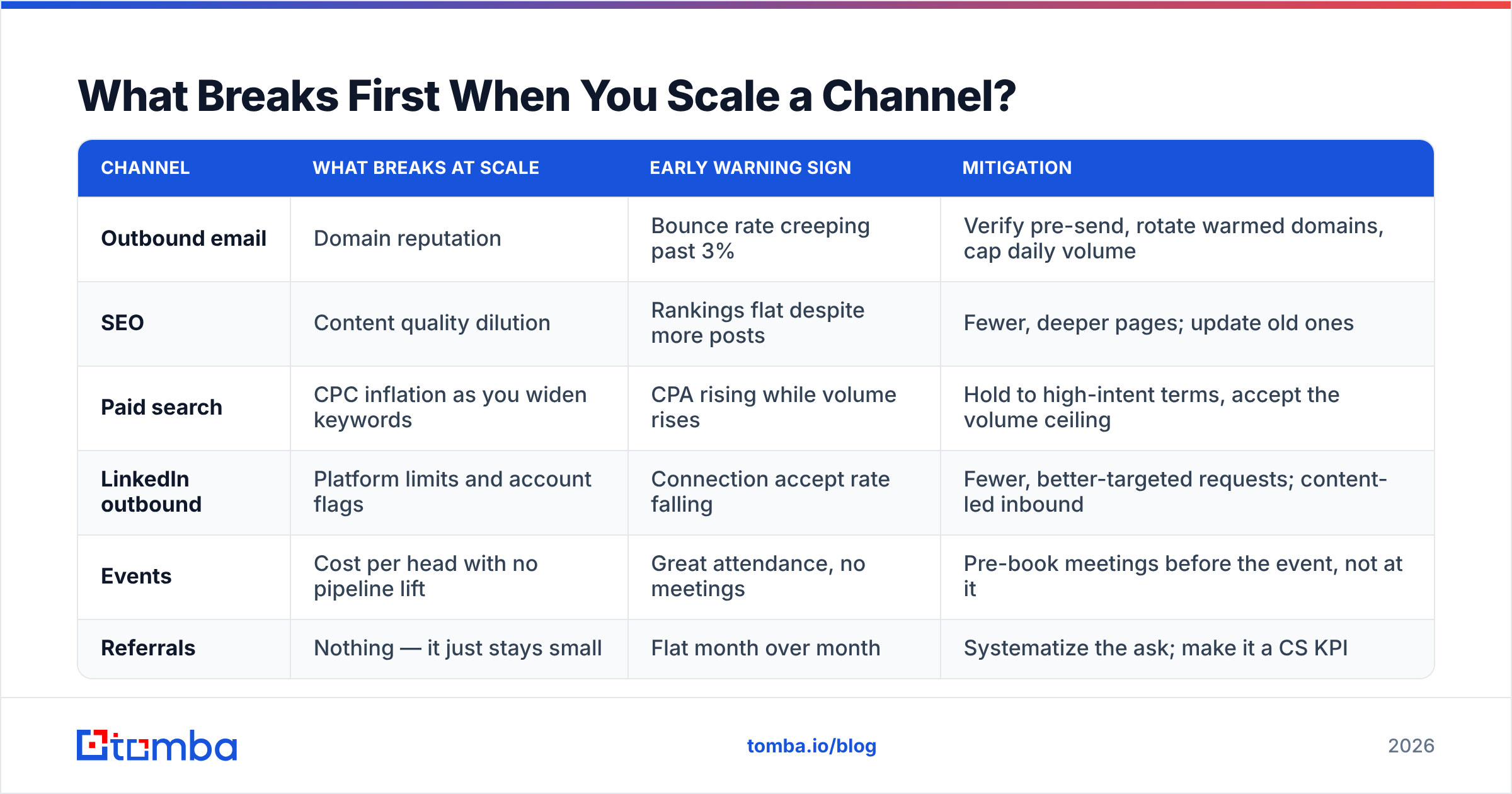
What Breaks First When You Scale a Channel?#
Each channel degrades in a predictable way. Knowing the failure mode in advance buys you a quarter.
| Channel | What breaks at scale | Early warning sign | Mitigation |
|---|---|---|---|
| Outbound email | Domain reputation | Bounce rate creeping past 3% | Verify pre-send, rotate warmed domains, cap daily volume |
| SEO | Content quality dilution | Rankings flat despite more posts | Fewer, deeper pages; update old ones |
| Paid search | CPC inflation as you widen keywords | CPA rising while volume rises | Hold to high-intent terms, accept the volume ceiling |
| LinkedIn outbound | Platform limits and account flags | Connection accept rate falling | Fewer, better-targeted requests; content-led inbound |
| Events | Cost per head with no pipeline lift | Great attendance, no meetings | Pre-book meetings before the event, not at it |
| Referrals | Nothing — it just stays small | Flat month over month | Systematize the ask; make it a CS KPI |
The outbound row deserves emphasis because it is the most common and the most expensive to recover from. Domain reputation is slow to build and fast to lose. Teams that verify before every send, warm new domains properly, and keep per-mailbox volume conservative can run outbound for years. Teams that blast unverified lists get 90 good days. Then they start over with new domains and a much worse baseline.
How Do You Start a New Channel Without Wasting a Quarter?#
Give every new channel a 90-day test with a pre-committed kill criterion. Write the criterion down before you start, because after you start you will find reasons to keep going.
A workable structure:
- Days 1–14: build the minimum viable version. One ICP segment, one message, one measurement path. Do not build infrastructure for a channel that has not proven it works.
- Days 15–60: run at a volume high enough to produce statistical signal. For outbound that is roughly 600–1,000 contacted accounts. For paid, enough spend to get 40+ conversions. Underpowered tests produce noise and confident wrong conclusions.
- Days 61–90: calculate real cost per SQL including your time. Compare against the kill criterion. Keep, fix, or stop.
The discipline that matters is the stopping. Most go-to-market teams carry two or three zombie channels. They run, they are staffed, they produce almost nothing. Nobody kills them, because killing one feels like admitting a mistake. Audit for zombies once a quarter. It frees more capacity than any new tool you could buy.
Where Should You Put Your Next Dollar?#
If you have no channel working yet: targeted outbound. It gives you an answer fastest, and it teaches you what your buyers respond to. That learning transfers to every other channel you build afterward.
If outbound is working and you want durability: commercial-intent SEO, started now, judged in nine months.
If both are working: partnerships or referrals, because they have the best conversion economics and the least competition for attention.
If you are enterprise-only with a six-figure ACV: ABM and field events, and largely ignore the volume channels entirely.
Whichever you pick, the constraint is the same. You cannot reach anyone you cannot contact. Every one of the lead generation channels B2B teams run ends at the same place: a real person, at a real account, with a working address. Most teams under-invest in that data and over-invest in messaging.
Start with the Tomba Email Finder. It turns a target account list into verified, contactable people. Free tier included: 25 searches a month, no card. Run your first 500-account segment through it and verify before you send. Inside three weeks you will know whether outbound is a channel for your business. That is a faster, cheaper answer than any strategy deck will give you.
Related guides#
// get started
Find, verify and enrich your first contacts today
Start on the free plan with 25 searches a month, then scale when your team is ready.
Free plan · No credit card required · GDPR & CCPA
// about the author