Lead Generation Companies in 2026: How to Pick One (Or Not)
Lead generation companies promise pipeline for a monthly retainer. Some deliver. Most sell you appointments you would have booked yourself. Here is how the pricing models, data quality, and contract traps actually compare in 2026.
TL;DR
- Lead generation companies fall into four models — list vendors, appointment-setters, outsourced SDR teams, and full-funnel demand-gen agencies. They are not interchangeable, and the pricing gap between them is roughly 20x.
- Typical 2026 retainers: $2,000–$5,000/mo for appointment setting, $5,000–$12,000/mo for outsourced SDR pods, $250–$1,500 per qualified appointment on pay-per-lead deals.
- The single biggest determinant of ROI is not the agency's script — it is the contact data underneath it. Agencies that resell stale databases burn your domain reputation and hand you the bill.
- For most teams under $5M ARR, a $99–$249/mo data stack plus one in-house rep beats a $6,000/mo agency on cost per booked meeting. Above that, agencies win on speed-to-scale, not efficiency.
- Ask for the data source, the bounce rate, the opt-out handling, and who owns the list when the contract ends. If any of those four answers is vague, walk.
What are lead generation companies, exactly?#
A lead generation company is any vendor you pay to put qualified buyers in front of your sales team. That definition is deliberately wide, because the category is deliberately blurry. "Lead gen" covers a firm that emails you a CSV of 10,000 contacts and a firm that runs your entire outbound motion with named SDRs on your Slack.
Think of it like hiring for your kitchen. A grocery delivery service drops raw ingredients at your door. A meal-kit company sends portioned ingredients and a recipe. A private chef cooks in your kitchen. A catering company runs the whole event. All four "feed you." The price and the amount of work left on your plate differ by an order of magnitude — and most buyers sign a catering contract when they needed groceries.
The four operating models you will actually encounter:
- Data / list providers — Sell contact records: name, title, company, email, phone. You do the outreach. Cost is per credit or per seat. This is where tools like Tomba, Apollo, ZoomInfo, and BookYourData sit.
- Appointment-setting agencies — Run cold email and cold calls under your brand, book meetings into your calendar. You pay a retainer, a per-appointment fee, or both.
- Outsourced SDR teams — Dedicated reps, usually offshore or nearshore, who work your ICP full-time using your messaging. Effectively staff augmentation with a management layer.
- Demand-gen / full-funnel agencies — Paid media, content, webinars, intent data, and nurture flows. Inbound-oriented, longer payback, higher ceiling.
- Marketplaces and pay-per-lead networks — You bid for shared or exclusive leads generated by someone else's content. Common in insurance, home services, and SaaS review sites.
- AI SDR platforms — The 2025–2026 entrant: software that researches, writes, and sends on its own. Cheaper than model 3, noisier than model 1, and quality varies wildly by how good the underlying data is.

How much do lead generation companies cost in 2026?#
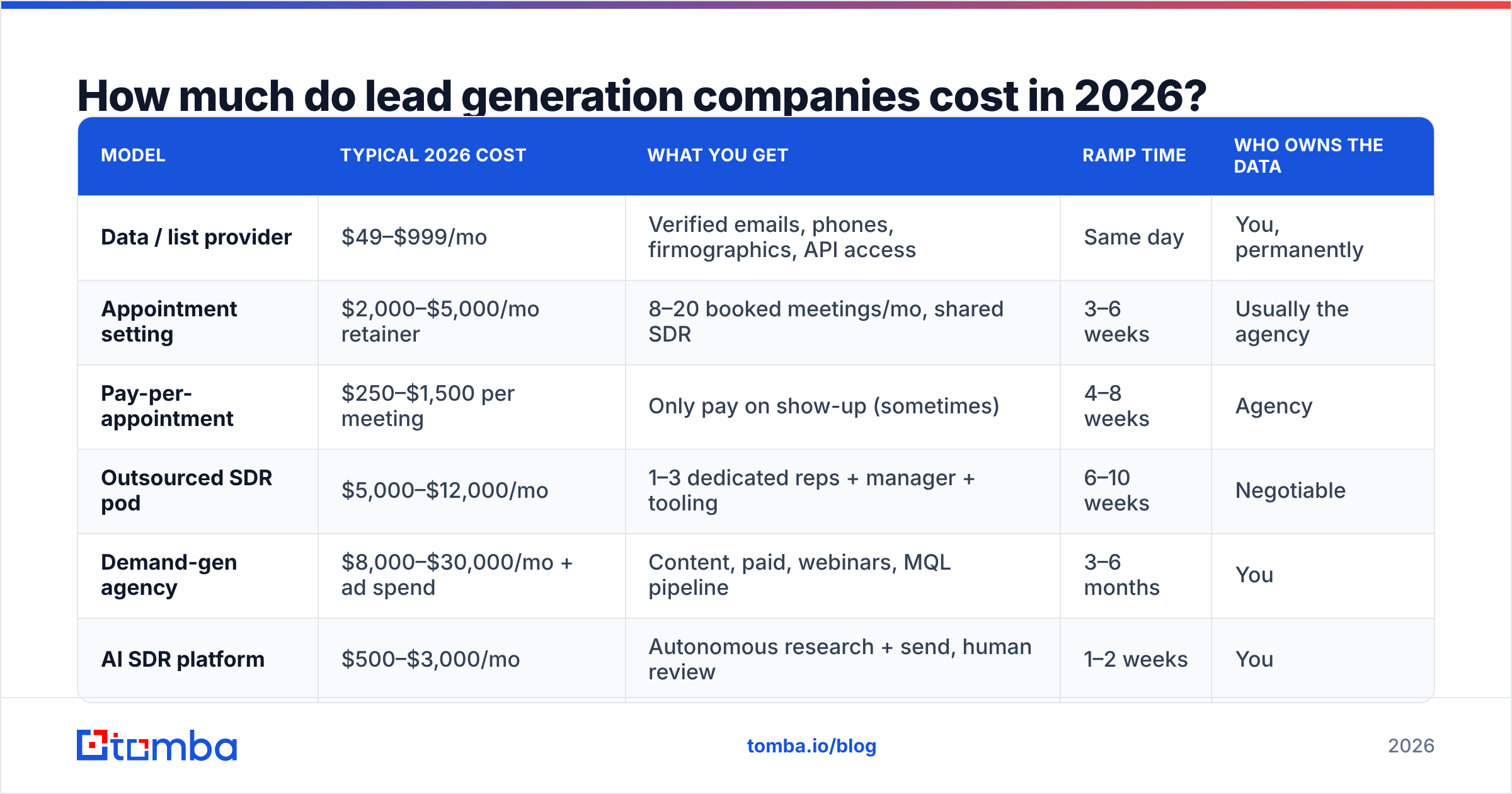
Pricing has bifurcated. Data tooling got cheaper every year since 2022; human-delivered services got more expensive as SDR salaries and compliance overhead rose. The result is a widening gap between "buy the inputs" and "buy the outcome."
| Model | Typical 2026 cost | What you get | Ramp time | Who owns the data |
|---|---|---|---|---|
| Data / list provider | $49–$999/mo | Verified emails, phones, firmographics, API access | Same day | You, permanently |
| Appointment setting | $2,000–$5,000/mo retainer | 8–20 booked meetings/mo, shared SDR | 3–6 weeks | Usually the agency |
| Pay-per-appointment | $250–$1,500 per meeting | Only pay on show-up (sometimes) | 4–8 weeks | Agency |
| Outsourced SDR pod | $5,000–$12,000/mo | 1–3 dedicated reps + manager + tooling | 6–10 weeks | Negotiable |
| Demand-gen agency | $8,000–$30,000/mo + ad spend | Content, paid, webinars, MQL pipeline | 3–6 months | You |
| AI SDR platform | $500–$3,000/mo | Autonomous research + send, human review | 1–2 weeks | You |
Two numbers matter more than the sticker price: cost per booked meeting and meeting-to-opportunity rate. A $6,000/mo agency delivering 15 meetings is $400 per meeting. If only 20% become real opportunities, your true cost per opportunity is $2,000. Run the same math on an in-house rep at $65,000 fully loaded plus $150/mo of data tooling, and if that rep books 25 meetings a month you are at roughly $220 per meeting with a higher conversion rate, because the rep knows your product.
The agency wins when you cannot hire fast enough, when you are testing a new geography or segment before committing headcount, or when the motion requires local-language reps you would never recruit yourself. Those are real, legitimate reasons. "We want more pipeline" is not one of them.
Why does data quality decide the whole outcome?#
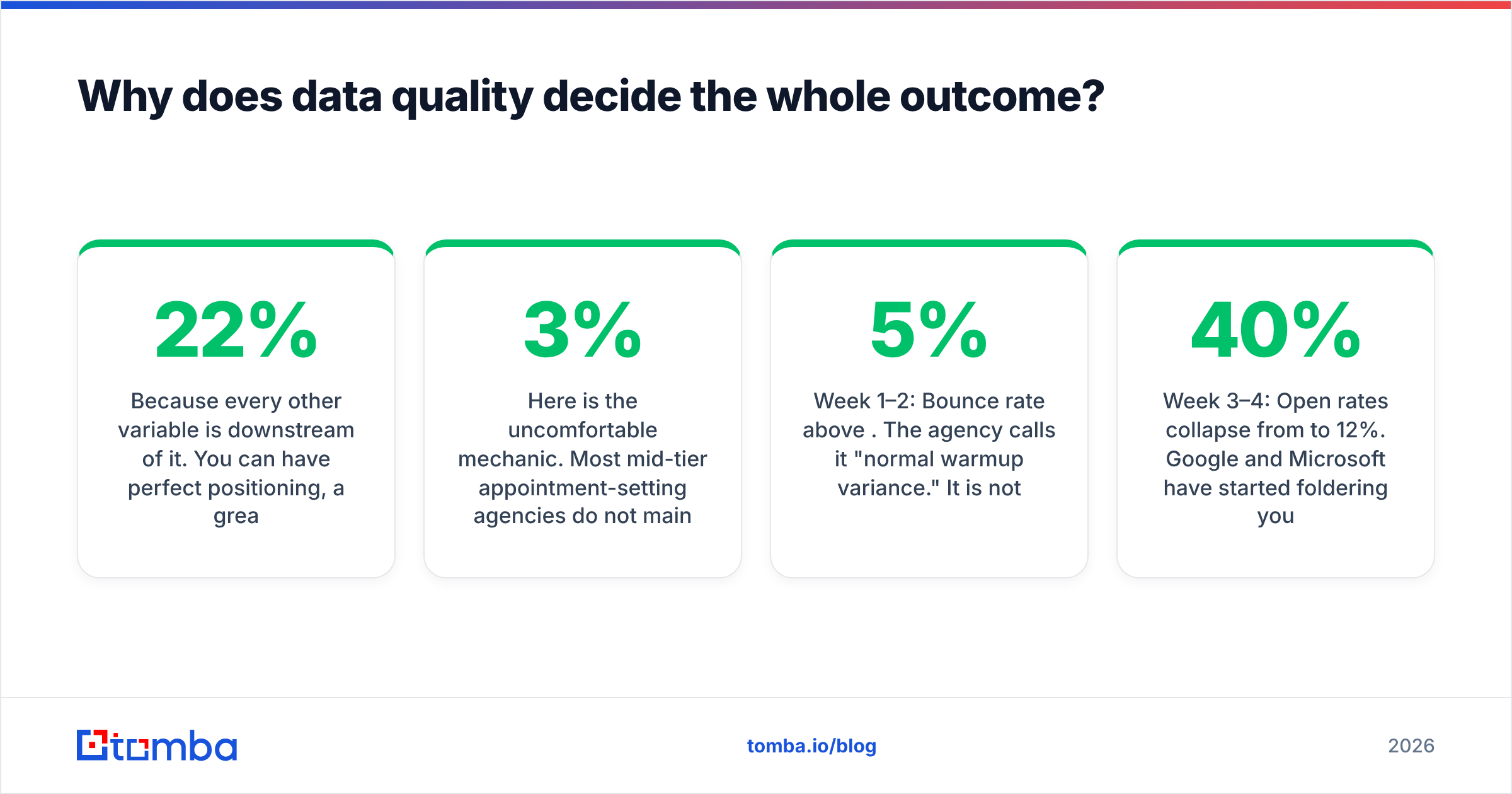
Because every other variable is downstream of it. You can have perfect positioning, a great sequence, and a senior rep — and if 22% of your sends bounce, the mailbox goes to spam by week three and none of the rest matters.
Here is the uncomfortable mechanic. Most mid-tier appointment-setting agencies do not maintain proprietary data. They license a database, sometimes two, and run the same records every other client gets. Records decay at roughly 2.5–3% per month as people change jobs, which compounds to about a 30% annual rot rate on any static B2B list. An agency that refreshed its license eighteen months ago is emailing a list where nearly half the contacts have moved.
The symptoms show up in a predictable order:
- Week 1–2: Bounce rate above 5%. The agency calls it "normal warmup variance." It is not.
- Week 3–4: Open rates collapse from 40% to 12%. Google and Microsoft have started foldering you.
- Week 5+: Replies are mostly "wrong person" and "I left that company in 2024."
- Month 3: The agency proposes "refreshing the ICP" — which means buying another list.
Preventing this is not complicated. Verify before you send, re-verify anything older than 90 days, and treat catch-all domains as their own bucket rather than guessing. A proper email verifier run costs cents per record and prevents four-figure reputation damage. If you are dealing with corporate domains that accept everything, a dedicated catch-all verifier is the difference between a 2% and a 14% bounce rate.
When you interview an agency, ask exactly this: "What is your median bounce rate across clients in my segment over the last 90 days, and which verification vendor produces it?" A good agency answers in one sentence with a number under 3%. A bad one talks about "multi-source waterfall enrichment" without ever saying a number.
What should you ask before signing a contract?#
Most bad lead gen engagements are not scams. They are mismatches that a fifteen-minute diligence conversation would have caught. Work through these before you sign anything longer than 90 days.
On data and compliance
- Where does the contact data come from, and is it licensed, scraped, or user-contributed? Ask for the actual data sources documentation, not a marketing page.
- How do you handle GDPR legitimate interest for EU contacts, and CAN-SPAM opt-outs for US ones? Who maintains the suppression list?
- When the contract ends, do I keep the contact records and the sequence performance data? Get this in writing — it is the single most commonly disputed clause.
On performance
- What is the definition of a "qualified" meeting, in writing, with disqualification criteria? Vague definitions are how agencies bill for tire-kickers.
- What happens to the fee when a prospect no-shows? Rescheduled once? Twice?
- Show me three anonymized client dashboards from my industry, including one that underperformed.
On mechanics
- Which sending domains will you use? Never let an agency send from your primary domain. Insist on lookalike domains they warm and you can burn.
- Who writes the copy, and do I approve it before it sends? Templated copy sent at volume is how your brand ends up in a Reddit thread.
- How many other clients target my exact ICP right now? Overlap means your prospects get three near-identical emails in a week.
Is an in-house stack cheaper than a lead generation company?#
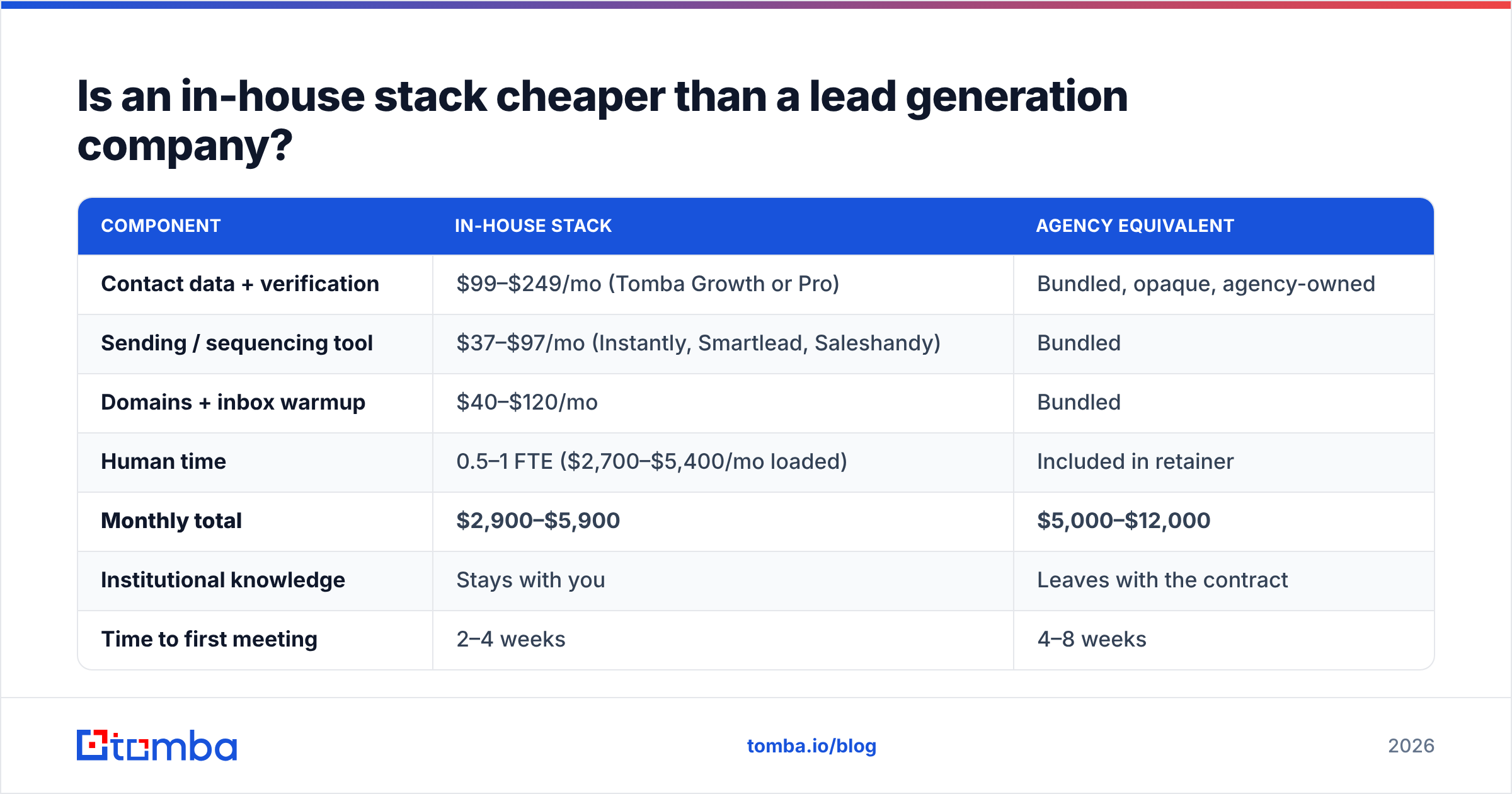
For most B2B teams under roughly $5M ARR, yes — and it is not close on a per-meeting basis. The tradeoff is that you buy the savings with your own management attention.
The in-house version of an appointment-setting agency is three components: a data layer, a sending layer, and a human. The data layer in 2026 costs less than a single agency invoice.
| Component | In-house stack | Agency equivalent |
|---|---|---|
| Contact data + verification | $99–$249/mo (Tomba Growth or Pro) | Bundled, opaque, agency-owned |
| Sending / sequencing tool | $37–$97/mo (Instantly, Smartlead, Saleshandy) | Bundled |
| Domains + inbox warmup | $40–$120/mo | Bundled |
| Human time | 0.5–1 FTE ($2,700–$5,400/mo loaded) | Included in retainer |
| Monthly total | $2,900–$5,900 | $5,000–$12,000 |
| Institutional knowledge | Stays with you | Leaves with the contract |
| Time to first meeting | 2–4 weeks | 4–8 weeks |
The honest caveat: that in-house column assumes someone competent owns it. A half-attentive founder running sequences between board meetings will underperform a mediocre agency. The comparison only holds if the 0.5 FTE is real, budgeted time — not wishful thinking.
Where the data layer is concerned, Tomba pricing runs a free tier at 25 searches/mo, Starter at $49/mo, Growth at $99/mo, and Pro at $249/mo, with Enterprise custom. That covers finding, verifying, and enriching. Pair it with bulk email finder runs for list-building and the Tomba API if you want enrichment firing automatically on CRM record creation.
For teams that want data without building anything, prebuilt databases are a legitimate middle path. BookYourData sells pay-as-you-go verified B2B contacts with no subscription, which suits one-off campaigns where a monthly credit plan would sit idle. Different shape of purchase, same underlying discipline: verify before you send.
Which lead generation companies are worth looking at?#
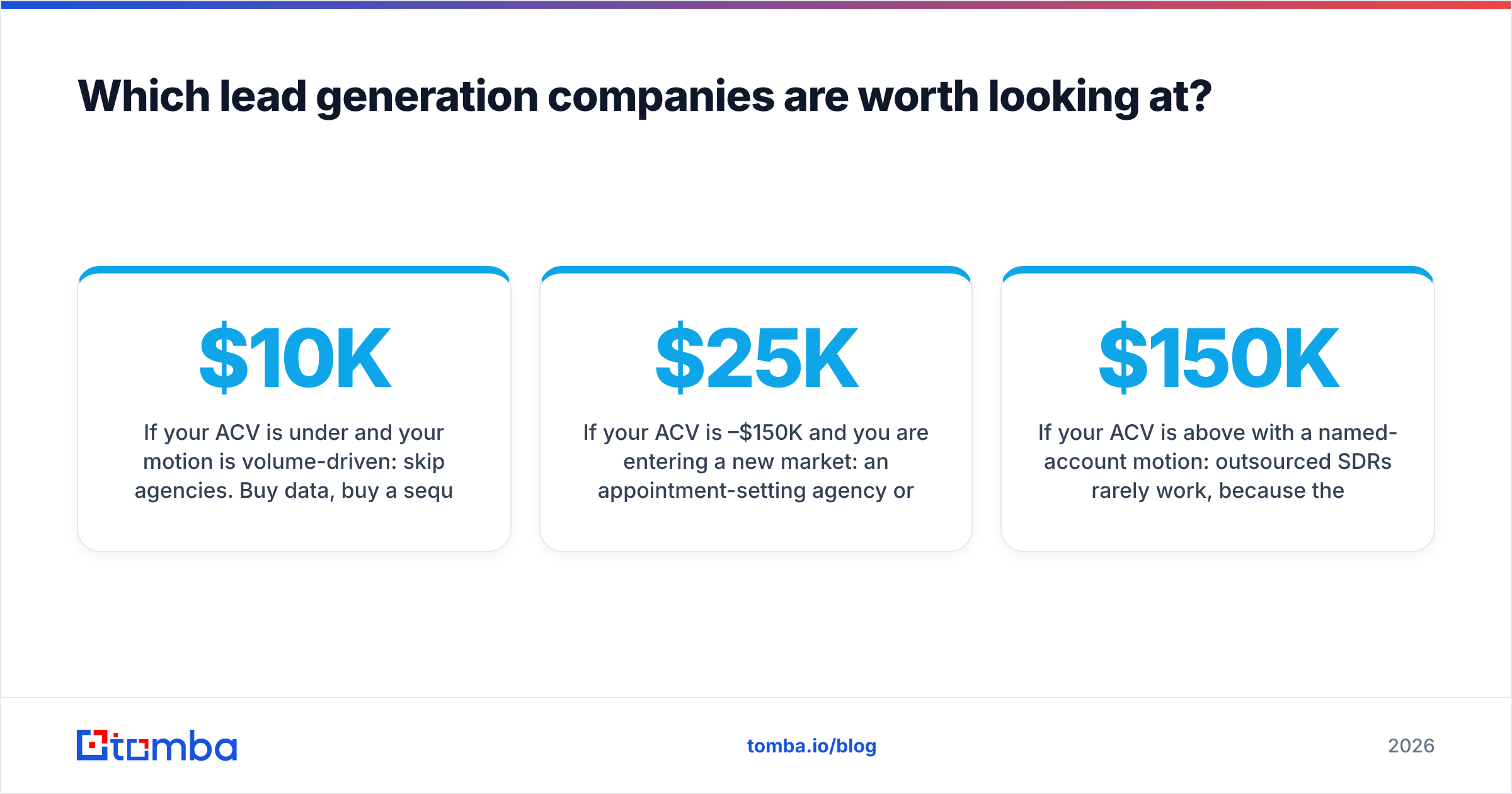
There is no universal ranking, because the right answer is determined by your ACV, your sales cycle, and whether your buyers are reachable by email at all. What follows is a segmentation, not a leaderboard.
If your ACV is under $10K and your motion is volume-driven: skip agencies. Buy data, buy a sequencer, and hire one SDR. The unit economics of a retainer rarely clear at low ACV, because you need too many meetings for the math to work.
If your ACV is $25K–$150K and you are entering a new market: an appointment-setting agency or a pay-per-appointment deal is reasonable for a 90-day test. Cap the term. Define "qualified" ruthlessly. Keep your own data license running in parallel so you are not starting from zero when it ends.
If your ACV is above $150K with a named-account motion: outsourced SDRs rarely work, because the research depth required is too high for a shared rep. Invest in intent data, ABM, and a senior in-house team. Full-funnel demand-gen agencies earn their fee here, mostly on content and paid.
If you sell to SMBs through channels or marketplaces: pay-per-lead networks can work, but assume shared leads are being sold four to seven times. Speed-to-lead is the entire game — measure in minutes, not hours. G2's lead generation category and Capterra are useful for filtering vendors by segment before you take a single sales call, if you read past the top-three sponsored slots.
One more filter worth applying: does the vendor let you verify their claims before purchase? Any data provider should hand you a sample of 50 records to test independently. Run them through your own verification and check the bounce rate. Vendors who refuse a sample are telling you something.
How do you measure whether it is working?#
Set the scorecard before the engagement starts, not after the first disappointing month. Four metrics, reviewed weekly:
- Deliverability health — bounce rate under 3%, spam complaint rate under 0.1%. If either breaks, pause everything. Reputation recovers slowly. Monitor sender reputation independently rather than trusting the agency's dashboard.
- Meeting-held rate — booked meetings that actually happen. Below 65% means the agency is booking people who did not really agree.
- Meeting-to-opportunity rate — should exceed 25% by month two. Below 15% means the qualification criteria are fiction.
- Fully loaded cost per opportunity — retainer plus your team's time divided by real opportunities. Compare it against your blended CAC, not against a competitor's quote.
Give any engagement a fair 90 days, because ramp is real. But define the kill criteria on day one, and write them into the contract as an early-exit clause. Agencies that refuse a performance-based exit are telling you how confident they are.
Where does this leave you?#
Buy the outcome when speed matters more than efficiency and you have the budget to absorb a miss. Buy the inputs when you have — or can build — someone who will own the motion. The mistake is buying the outcome and then micromanaging it, which is how you end up paying agency rates for in-house effort.
Whichever side you land on, the contact data underneath is yours to control. Agencies come and go on 90-day cycles; a verified, owned list of your ICP compounds.
Start with the Tomba Email Finder — find and verify decision-maker emails by domain, name, or company, keep the records permanently, and test 25 searches free before you commit to anyone's retainer. Run a sample against your target account list, check the bounce rate yourself, and you will have a real benchmark to hold every lead generation company you talk to against.
Related guides#
// get started
Find, verify and enrich your first contacts today
Start on the free plan with 25 searches a month, then scale when your team is ready.
Free plan · No credit card required · GDPR & CCPA
// about the author