Lead Generation Companies B2B: How to Pick One in 2026
Outsourced B2B lead gen costs $3K-$15K/mo and half of it buys data you could license for $99. Here's how to tell the agencies worth paying from the ones reselling a list.
TL;DR — what lead generation companies B2B buyers hire are really selling
- Most lead generation companies B2B teams shortlist sell three things in one bundle: data, sending infrastructure, and SDR labor. Only one of the three is hard to build in-house.
- Typical retainers run $3,000–$15,000 a month, plus $50–$300 per qualified meeting on performance deals. Appointment setters often cost more per meeting than an in-house SDR does.
- Contact data is the biggest quality variable. You can buy it on its own for $49–$249 a month instead of paying agency margin on top.
- Ask for show-rate and pipeline-to-close numbers from the last three clients before you sign. Agencies that lead with "meetings booked" and dodge deal value track the wrong metric.
- Outsource when you need speed in a new segment, or when nobody has time to manage SDRs. Build in-house when the motion is core, technical, or high-ACV.
What are lead generation companies B2B buyers actually hiring?#
A B2B lead generation company finds, contacts, and qualifies prospects for you, then hands them to your closers. That is the clean definition. The messy part: the category covers at least five business models, and they all use the same words on the homepage.
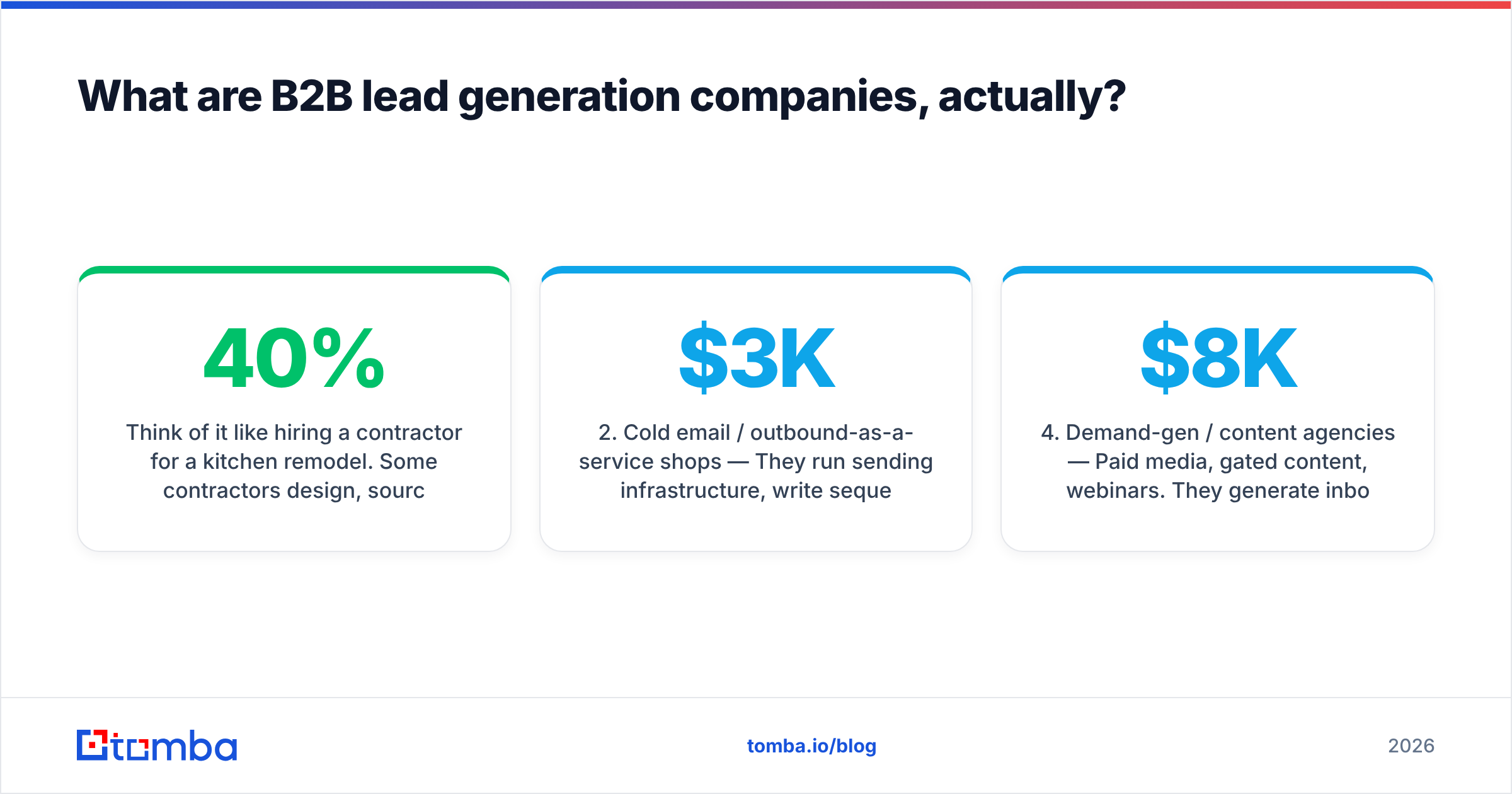
Think of it like hiring a contractor for a kitchen remodel. Some contractors design, source, and build. Some subcontract the whole job and mark it up 40%. Some only install cabinets that someone else picked. All three answer the phone with "yes, we do kitchens." You find out which one you hired in month three.
Here's how the category actually breaks down:
- Appointment-setting agencies — Human SDRs work on your behalf, usually offshore or nearshore, paid per meeting or on retainer. Highest touch, highest cost, most variable quality.
- Cold email / outbound-as-a-service shops — They run the sending infrastructure, write the sequences, and manage deliverability. Replies land in your inbox. Usually $3K–$8K a month.
- Data and list providers — They sell contacts, not conversations. You pay per record or per seat. A big chunk of any agency's cost base sits right here.
- Demand-gen / content agencies — Paid media, gated content, webinars. They create inbound-ish leads. Different cost structure, usually $8K+ a month plus ad spend.
- Full-funnel RevOps partners — Strategy, tooling, and execution. The priciest option, and the one most likely to move your numbers — if you already have product-market fit.
Most buyers think they are shopping category 1. They end up paying category 1 prices for category 3 value. That gap matters, because you can license category 3 straight from the source.

How much do B2B lead generation companies cost in 2026?#
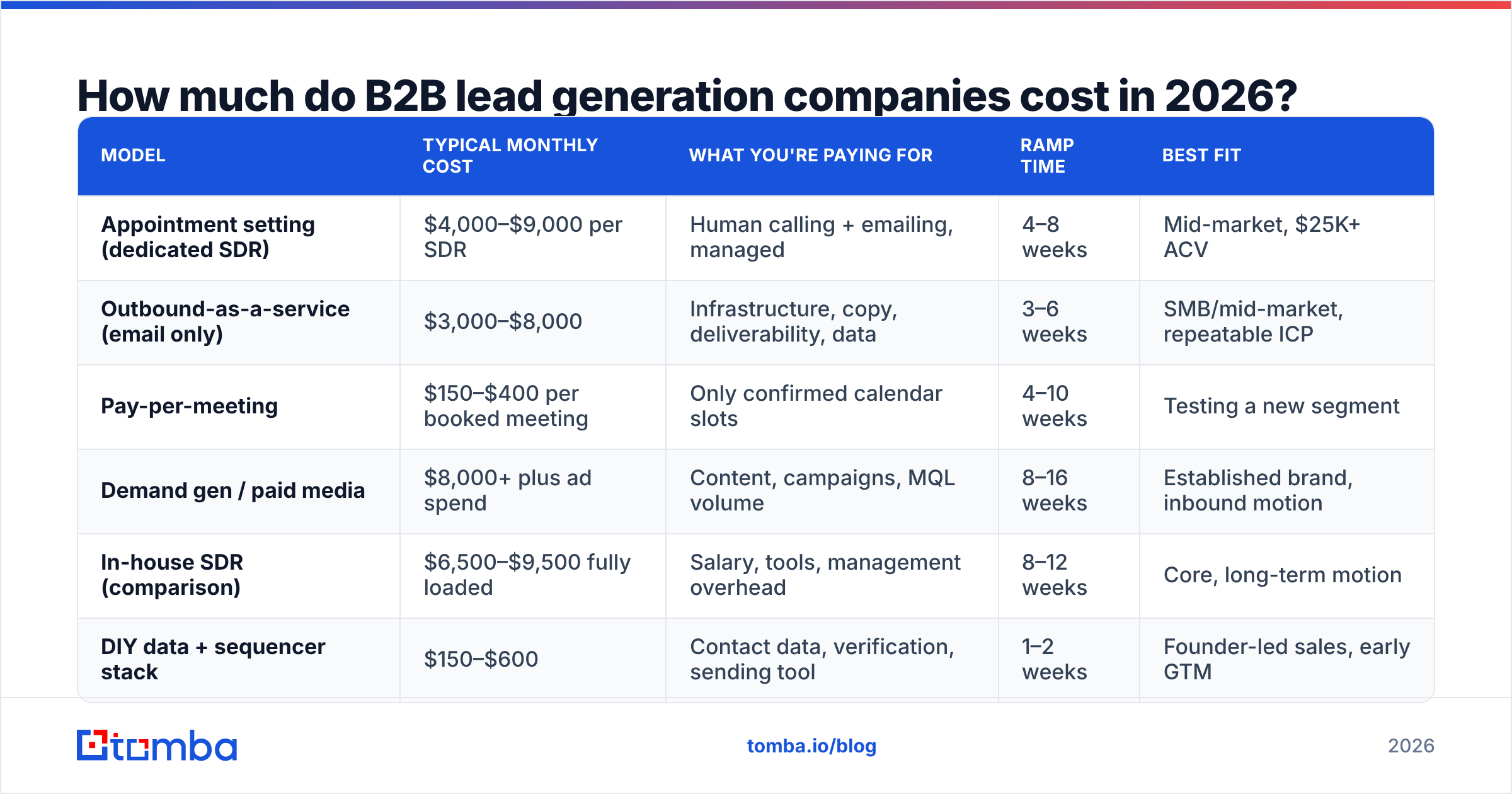
Pricing for lead generation companies B2B buyers compare has split in two. Agencies with real SDR headcount cost more now, because labor costs rose. Agencies running AI-assisted outbound got cheaper and far more common. That means more noise in the market, and more shops that are really a data subscription plus a sequencing tool plus a markup.
| Model | Typical monthly cost | What you're paying for | Ramp time | Best fit |
|---|---|---|---|---|
| Appointment setting (dedicated SDR) | $4,000–$9,000 per SDR | Human calling + emailing, managed | 4–8 weeks | Mid-market, $25K+ ACV |
| Outbound-as-a-service (email only) | $3,000–$8,000 | Infrastructure, copy, deliverability, data | 3–6 weeks | SMB/mid-market, repeatable ICP |
| Pay-per-meeting | $150–$400 per booked meeting | Only confirmed calendar slots | 4–10 weeks | Testing a new segment |
| Demand gen / paid media | $8,000+ plus ad spend | Content, campaigns, MQL volume | 8–16 weeks | Established brand, inbound motion |
| In-house SDR (comparison) | $6,500–$9,500 fully loaded | Salary, tools, management overhead | 8–12 weeks | Core, long-term motion |
| DIY data + sequencer stack | $150–$600 | Contact data, verification, sending tool | 1–2 weeks | Founder-led sales, early GTM |
That last row is the one nobody in the agency world puts on a slide. A bulk email finder plus a sequencing tool plus your own time is a real option for a company's first 12 months. It costs about 3% of a retainer.
The honest framing: agencies sell you time, not capability. If you have more money than months, outsource. If you have more months than money, build.
What separates a good lead generation company from a list reseller?#
Data quality. It is not close.
Every downstream metric in outbound rests on one question: does the contact exist, work where you think, and accept mail? A 22% bounce rate does not just waste 22% of your sends. It damages sender reputation, which hurts inbox placement for the 78% that were fine. One bad list can poison a domain for weeks.
When you're evaluating vendors, the questions that actually separate them:
- Where does the data come from? "Proprietary database" is not an answer. Ask about refresh cadence and source mix. Reputable providers publish their data sources.
- What is your bounce rate on delivered sends? Above 3% on a cold list means they are not verifying, or they use a cheap SMTP ping that catch-all domains defeat.
- Who owns the sending domains? If the agency sends from its own domains and later churns, you inherit nothing. If it warms domains you own, you keep the asset.
- What happens to the data when we leave? Some contracts say you do not keep enriched records. Read that clause.
- What is the show rate, not the book rate? A booked meeting nobody attends costs you the calendar block and none of the pipeline.
- How does the contract define a "qualified lead"? If the bar is "expressed interest," replies like "maybe Q3" get counted as wins.
That fourth question catches more bad contracts than the other five combined.
Should you outsource B2B lead generation or build in-house?#
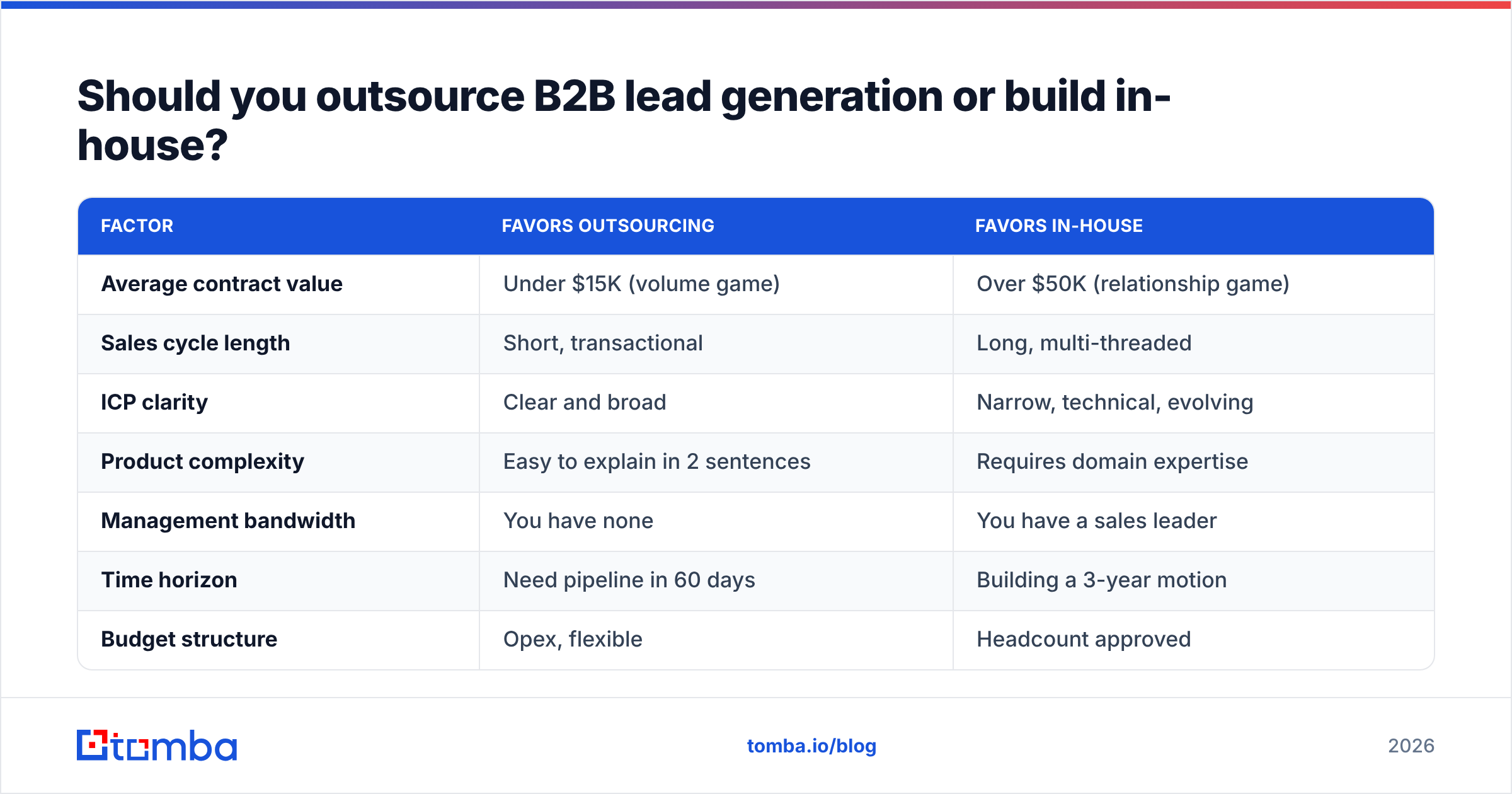
Outsource for speed and optionality. Build for durability and margin. Here is the call, framed against the variables that actually move:
| Factor | Favors outsourcing | Favors in-house |
|---|---|---|
| Average contract value | Under $15K (volume game) | Over $50K (relationship game) |
| Sales cycle length | Short, transactional | Long, multi-threaded |
| ICP clarity | Clear and broad | Narrow, technical, evolving |
| Product complexity | Easy to explain in 2 sentences | Requires domain expertise |
| Management bandwidth | You have none | You have a sales leader |
| Time horizon | Need pipeline in 60 days | Building a 3-year motion |
| Budget structure | Opex, flexible | Headcount approved |
The failure mode nobody warns you about: outsourcing works when your ICP is already validated. It fails badly when it is not. An agency will not find your ICP for you. They will run the segment you handed them at volume, post mediocre results, and each side will blame the other. If you cannot name five closed-won customers who look alike, you are not ready to outsource. You are ready to do 100 conversations yourself.
Forrester's research on B2B buying groups makes a point most agencies skip: a purchase now involves 6–10 stakeholders. Single-threaded appointment setting into one champion books meetings that do not convert. If your agency's whole motion is "book the VP of Sales," you are buying calendar events, not pipeline.
What does a realistic agency engagement look like month by month?#
Set expectations before you sign. The first 60 days will look like failure no matter how good the vendor is.
- Weeks 1–3: Setup. Domain purchase, DNS records, inbox warmup, ICP workshop, list build. Zero meetings, and that is normal. An agency promising meetings in week 2 is sending from burned infrastructure.
- Weeks 4–6: First sends at low volume. 20–50 emails a day per inbox, ramping up. Reply rates here are noisy and mean little.
- Weeks 7–12: Signal. You should see a stable reply rate and the first booked meetings. Now the data starts to mean something.
- Month 4–6: Optimization. Segment-level performance shows up. Kill the losing segments, double the winners.
- Month 6+: Judgment time. By now you should be able to work out cost per opportunity and compare it with your other channels. If you cannot, the reporting is bad, and that is its own answer.
Any agency asking for a 12-month lock with no exit at month 6 is handing you the risk. A six-month initial term with a 30-day out after month three is the fair market standard.
How do the main vendor categories compare on the metrics that matter?#
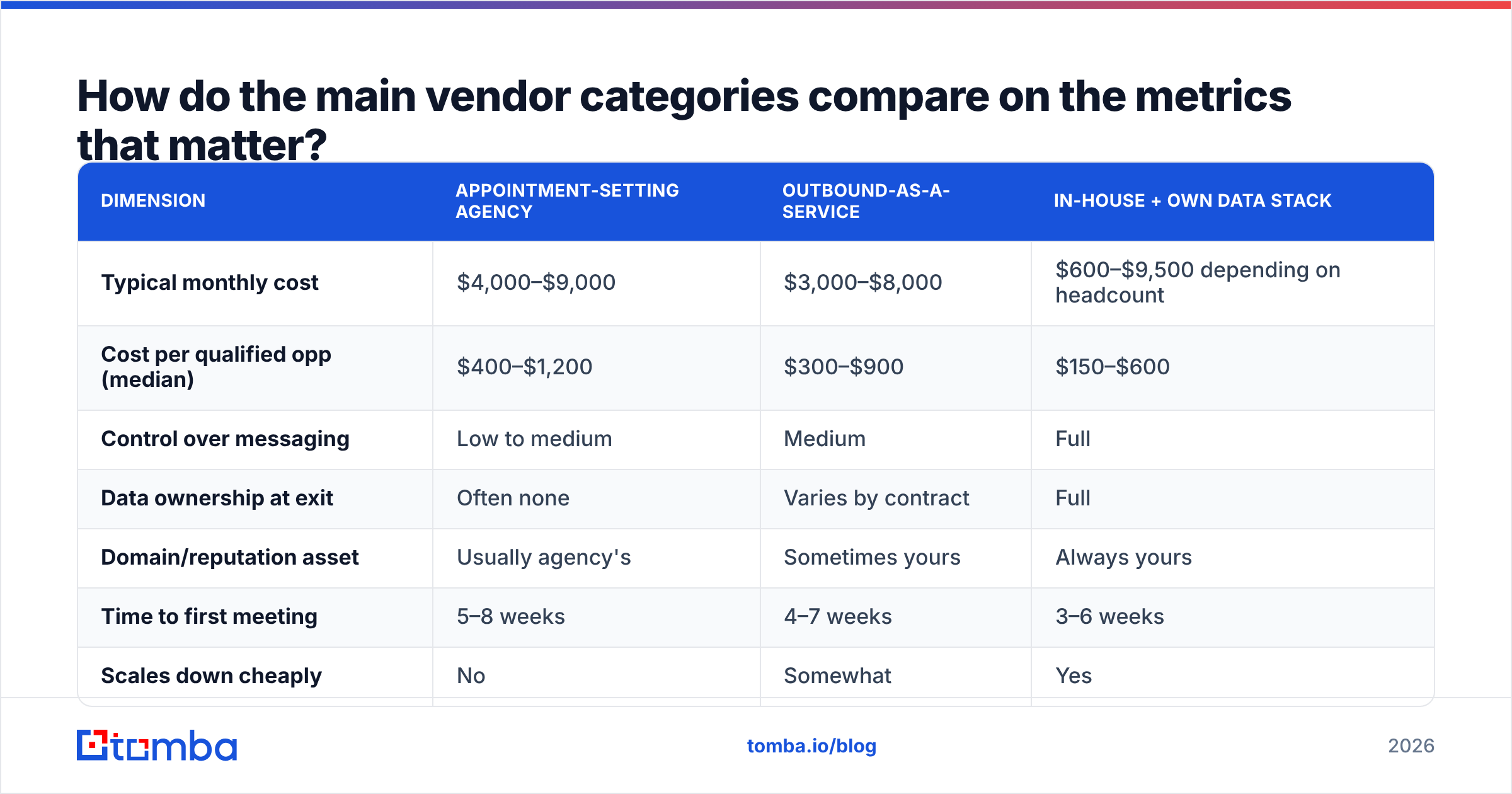
Strip away the positioning. Compare on cost per opportunity, control, and what you keep when the relationship ends.
| Dimension | Appointment-setting agency | Outbound-as-a-service | In-house + own data stack |
|---|---|---|---|
| Typical monthly cost | $4,000–$9,000 | $3,000–$8,000 | $600–$9,500 depending on headcount |
| Cost per qualified opp (median) | $400–$1,200 | $300–$900 | $150–$600 |
| Control over messaging | Low to medium | Medium | Full |
| Data ownership at exit | Often none | Varies by contract | Full |
| Domain/reputation asset | Usually agency's | Sometimes yours | Always yours |
| Time to first meeting | 5–8 weeks | 4–7 weeks | 3–6 weeks |
| Scales down cheaply | No | Somewhat | Yes |
| Requires your management time | 2–4 hrs/week | 3–5 hrs/week | 10+ hrs/week |
Two notes on reading this table. First, the cost-per-opportunity ranges assume a validated ICP. With an unvalidated one, every number roughly doubles. Second, buyers always underestimate the last line. Outsourcing does not mean zero involvement. The engagements that work have a weekly call and an owner on your side.
Data-first vendors sit in an interesting middle position. BookYourData, for example, sells verified contact records instead of bundling labor. You keep the messaging and the infrastructure, and buy only the hard part. Price that unbundled model before you commit to a full-service retainer. For many teams the math lands better, and you keep the data asset.
What should you build in-house even if you outsource?#
Three things, always.
Your domain and sender reputation. Buy your own sending domains. Warm them yourself, or make the agency warm domains registered to you. This asset compounds, and it is the one buyers most often lose at the end of an engagement. Pair it with a proper SPF record setup on day one.
Your contact data pipeline. Even if the agency builds the lists, mirror them. Run your own email verification pass before send, so you know the bounce rate on your own. If your numbers and theirs differ by more than a point or two, you have learned something important about the vendor.
Your definitions. Write down what MQL, SQL, and "qualified meeting" mean before the first invoice. Agencies will happily adopt your definition if you have one. They will supply a generous one if you do not. HubSpot's lead qualification framework is a reasonable starting point to adapt.
Teams that hold these three things can switch vendors in a week. Teams that do not are locked in, whatever the contract says.
When does hiring a lead generation company actually pay off?#
Four scenarios where the math works:
- Entering a new geography or vertical. You need local knowledge and a list you do not have. A specialist agency in that segment really is faster than building.
- Covering a hiring gap. Your SDR left, the replacement starts in 10 weeks, and pipeline cannot go to zero. Agencies make excellent bridges.
- Testing a hypothesis cheaply. Pay-per-meeting on a new segment for 90 days costs less than a bad hire and gives you a real answer.
- Scaling a proven motion past your hiring capacity. If in-house outbound already has a known cost per opportunity and you cannot hire fast enough, adding an agency layer is simple arithmetic.
And the one that almost never works: hoping an agency will fix a product or positioning problem. Outbound amplifies whatever message you hand it. If the message does not land when you say it, it will not land when a contractor says it 4,000 times.
Frequently asked questions#
How long until a B2B lead generation company produces pipeline? First meetings around week 6–8. Meaningful pipeline signal around month 3. Reliable cost-per-opportunity data around month 5. Anyone promising faster is skipping warmup or counting low-intent replies as leads.
Is pay-per-meeting better than a retainer? It moves risk to the vendor, which sounds good. It also rewards booking anyone who says yes. If you go performance-based, define show rate and disqualification criteria in the contract, and expect to pay a premium per meeting.
Can AI-driven agencies replace human SDRs? For research, list building, personalization, and first-touch email — largely yes, and that is why prices have fallen. For multi-threaded enterprise deals and phone-led motions, not yet. The agencies doing well in 2026 use AI for volume and humans for the top 10% of accounts.
What's a reasonable bounce rate to accept from a vendor? Under 3% on cold sends. Above 5%, stop the campaign. You are burning domain reputation faster than you are earning replies.
Where to start if you're pricing this out#
Before you book a call with any of the lead generation companies B2B buyers keep shortlisting, price the unbundled version. Pull 500 contacts in your ICP, verify them, and send 200 emails yourself over two weeks. You will learn your reply rate, your objections, and whether the message works. Then you can walk into every vendor conversation and tell a real proposal from a repackaged list.
Tomba's Email Finder is built for exactly that step: find verified professional emails by domain, name, or company, with a free tier at 25 searches/month and paid plans starting at $49/month (Growth at $99, Pro at $249). Use it to build and validate your own list first. Then decide whether an agency adds capability or just adds margin. Full Tomba pricing is public, and the Tomba API handles it at volume when you are ready to scale.
Related guides#
// get started
Find, verify and enrich your first contacts today
Start on the free plan with 25 searches a month, then scale when your team is ready.
Free plan · No credit card required · GDPR & CCPA
Get the Tomba newsletter
Product and data updates
// about the author