Lead Generation Companies for Financial Services: 2026 Guide
Most financial services lead gen vendors sell you the same recycled contacts at 10x markup. Here is how the four provider models actually differ, what they cost per qualified lead, and the compliance questions to ask before you sign.
Lead generation companies for financial services come in four different shapes, and they are not interchangeable. Pick the wrong one and you pay agency rates for work your own reps already do. This guide covers what each model delivers, what it costs per qualified lead, and which compliance questions to ask first.
TL;DR
Four models, one label. Lead generation companies for financial services split into appointment-setting agencies, intent-data platforms, raw contact-data vendors, and lead marketplaces. Prices run from $49 a month to $15,000 a month. The cheapest option is not always the worst one.
Compliance lands on you. Finance is the one B2B vertical where a cold email can trigger a regulatory review. FINRA Rule 2210, state insurance ad rules, and GLBA all cover the emails a vendor sends in your name.
Negotiate on cost per qualified lead. Not per contact. Not per meeting booked. An agency at $400–$900 per qualified meeting is normal. A $40 quote means a marketplace lead sold to four rivals.
The hybrid model wins under 50 reps. Own your contact data. Run sequencing in-house. Outsource only the top-of-funnel research you cannot staff.
Get three things in writing before you sign: data provenance, exclusivity, and the exact definition of "qualified."
What are lead generation companies for financial services?#
A lead generation company for financial services is any vendor that hands you contacts, meetings, or intent signals. The prospects sit in banking, wealth management, insurance, fintech, lending, or accounting. You get either raw data or booked time on your calendar.
Think of it like sourcing produce for a restaurant. Some suppliers sell raw vegetables and you do the prep: those are the data vendors. Some deliver pre-chopped mirepoix: those are the enrichment platforms. Some cook the dish and hand it through the pass: those are the appointment-setting agencies. All three are called suppliers. Buy the wrong one for your kitchen and you either pay 10x for labor you already have, or you end up with nothing you can serve.
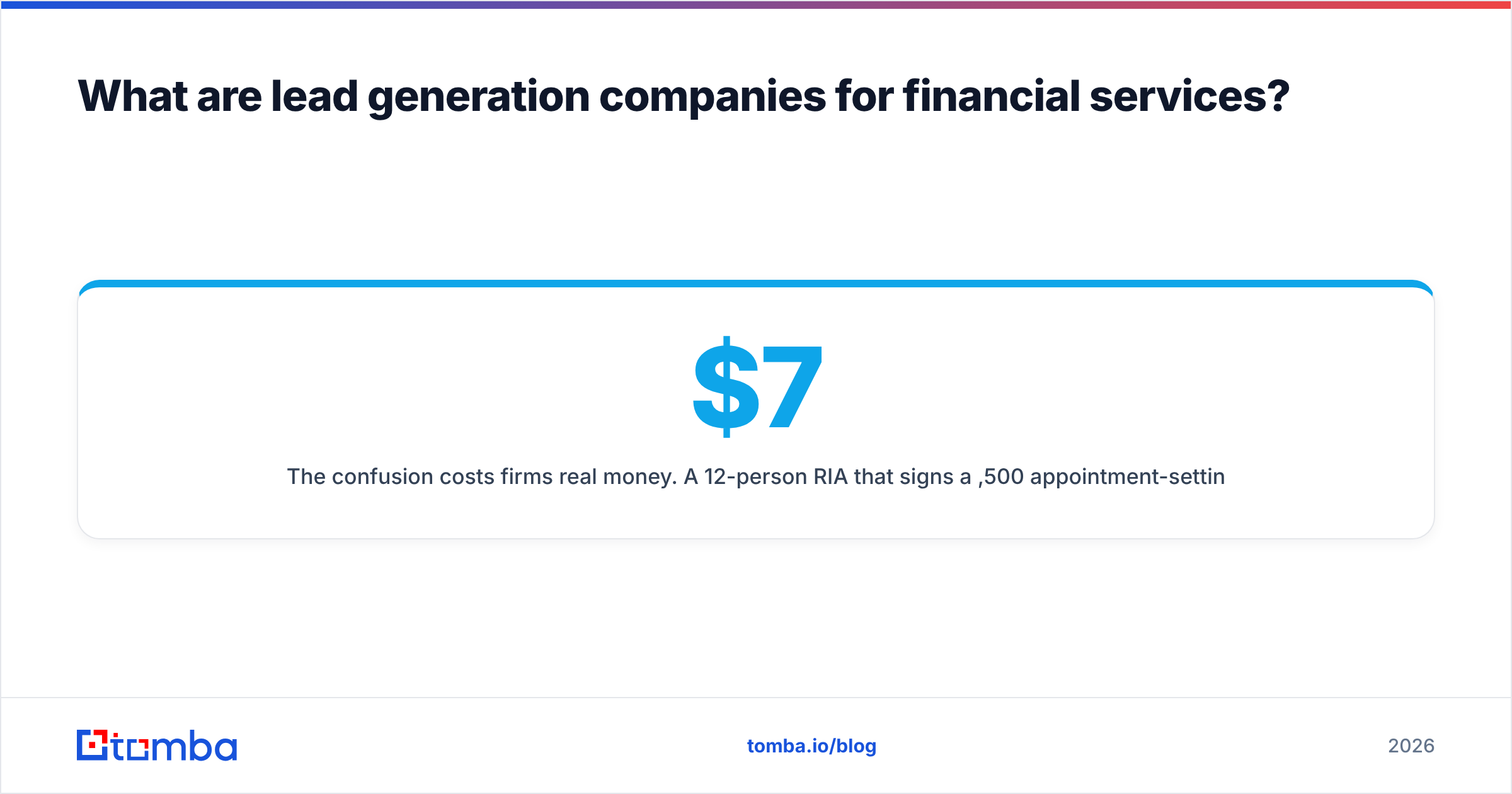
The confusion costs firms real money. Say a 12-person RIA signs a $7,500 monthly retainer because it "needs leads." It usually has a sequencing problem, not a data problem. Now flip it. A 200-rep commercial lending team buys a $99 tool and expects booked meetings. It will blame the data when the real gap is headcount.
Why is financial services lead generation different from other B2B verticals?#
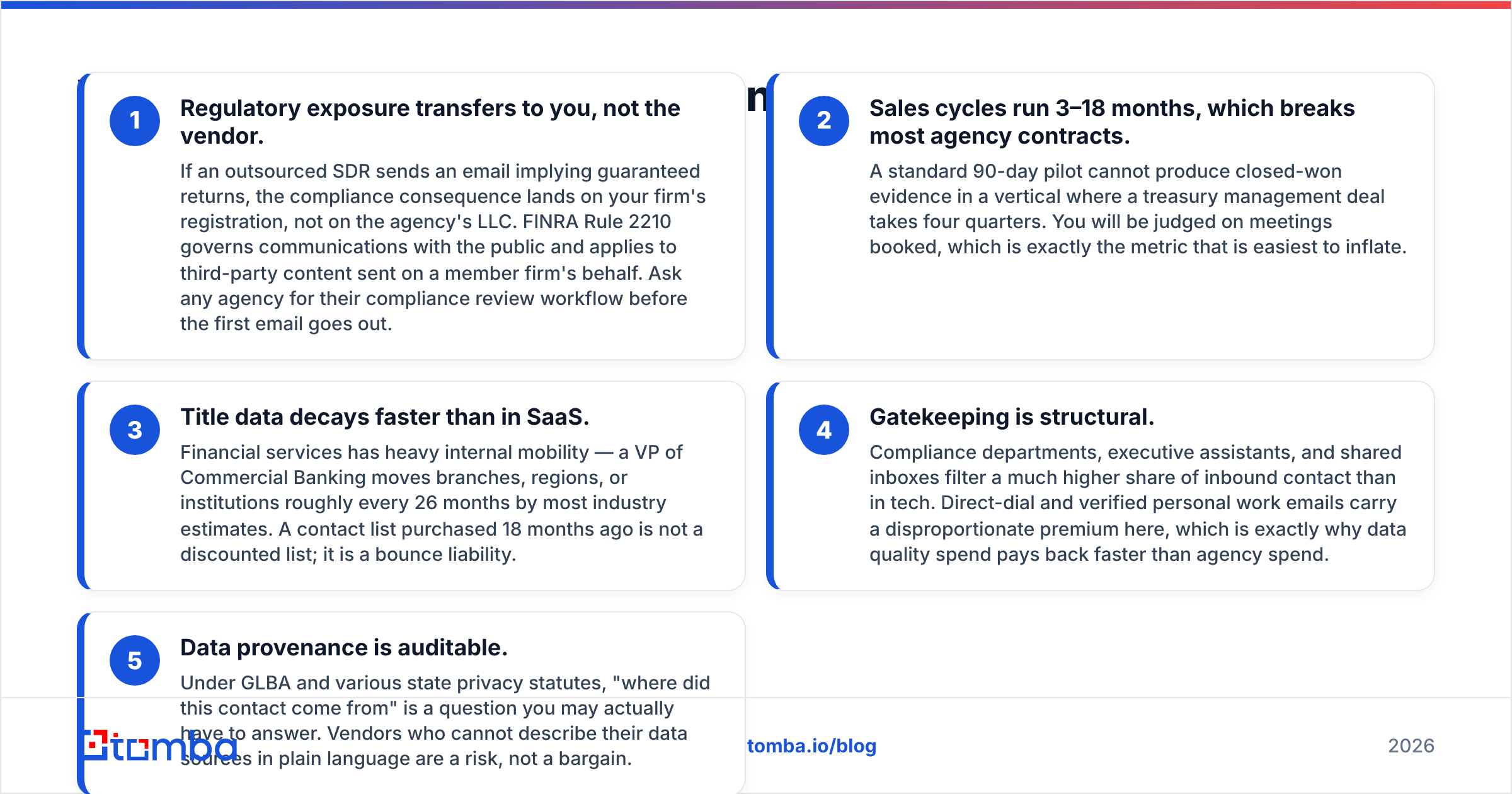
Five structural differences change how you judge lead generation companies for financial services:
Regulatory exposure transfers to you, not the vendor. Say an outsourced SDR sends an email that implies guaranteed returns. The consequence hits your firm's registration, not the agency's LLC. FINRA Rule 2210 governs communications with the public. It applies to third-party content sent for a member firm. Ask any agency how it reviews copy before the first email goes out.
Sales cycles run 3–18 months, and that breaks most agency contracts. A 90-day pilot cannot show closed-won deals when a treasury management deal takes four quarters. So you get judged on meetings booked. That is the easiest metric to inflate.
Title data decays faster than in SaaS. Financial services has heavy internal mobility. A VP of Commercial Banking changes branch, region, or bank every 26 months or so by most industry estimates. A list bought 18 months ago is not a discount. It is a bounce liability.
Gatekeeping is structural. Compliance teams, executive assistants, and shared inboxes screen far more inbound contact than in tech. Direct dials and verified work emails carry a premium here. That is why data quality pays back faster than agency spend.
Data provenance is auditable. Under GLBA and several state privacy laws, you may have to answer one question: where did this contact come from? A vendor who cannot explain its data sources in plain words is a risk, not a bargain.

What types of lead generation companies for financial services exist?#
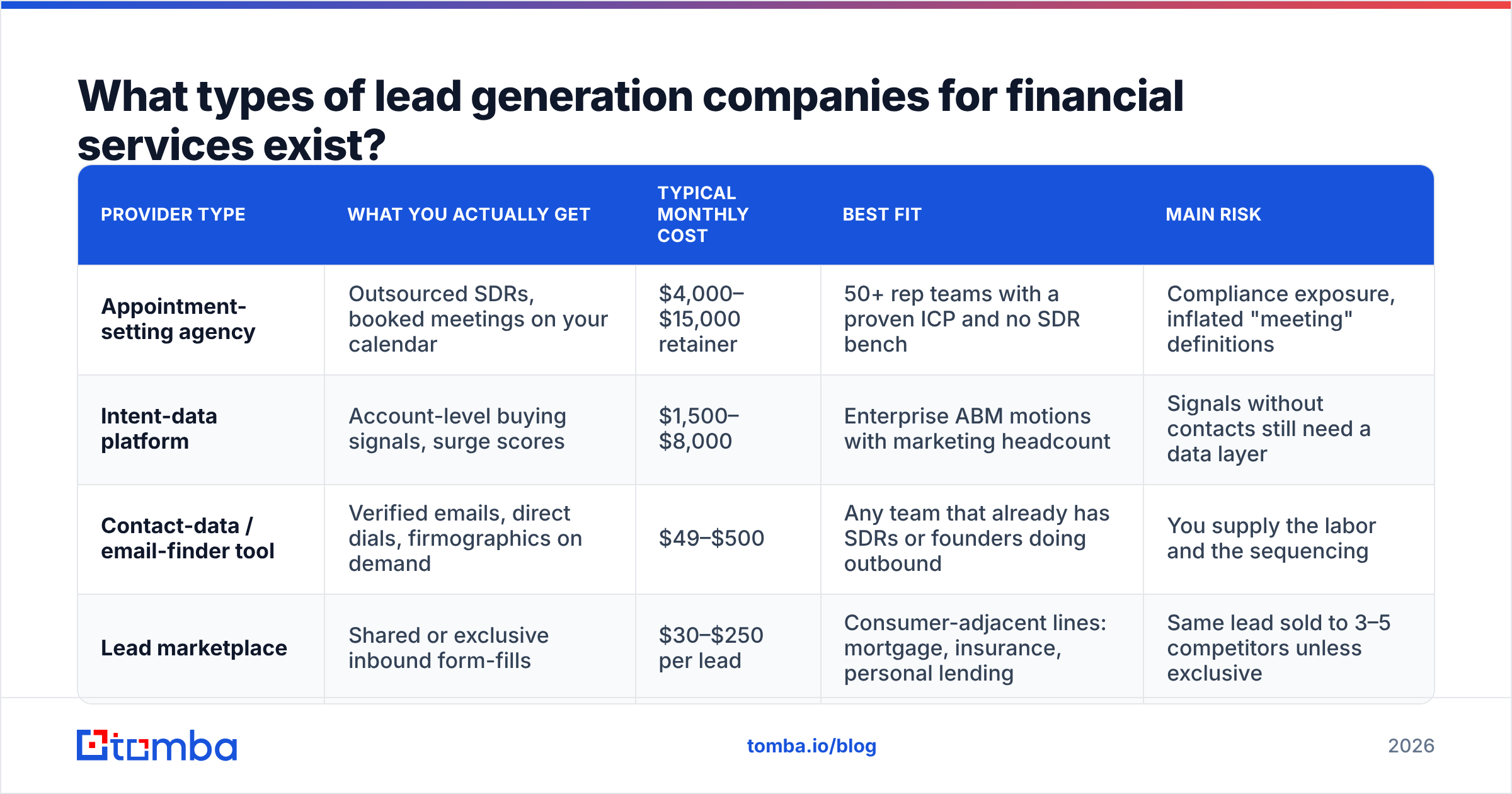
Here is the honest breakdown of the four models: what each one delivers, and who it fits.
| Provider type | What you actually get | Typical monthly cost | Best fit | Main risk |
|---|---|---|---|---|
| Appointment-setting agency | Outsourced SDRs, booked meetings on your calendar | $4,000–$15,000 retainer | 50+ rep teams with a proven ICP and no SDR bench | Compliance exposure, inflated "meeting" definitions |
| Intent-data platform | Account-level buying signals, surge scores | $1,500–$8,000 | Enterprise ABM motions with marketing headcount | Signals without contacts still need a data layer |
| Contact-data / email-finder tool | Verified emails, direct dials, firmographics on demand | $49–$500 | Any team that already has SDRs or founders doing outbound | You supply the labor and the sequencing |
| Lead marketplace | Shared or exclusive inbound form-fills | $30–$250 per lead | Consumer-adjacent lines: mortgage, insurance, personal lending | Same lead sold to 3–5 competitors unless exclusive |
Notice the cost gap. An agency at $8,000 a month spends most of that on labor you may already employ. A data tool at $49 a month charges you for the contact layer alone. The two are not rivals. They are different line items, and vendors blur them on purpose in sales calls.
For B2B finance — commercial banking, treasury, fintech, wealth management, insurance brokerage — one model scales best: your own reps plus a contact-data layer. For consumer lines, marketplaces do have a real volume advantage.
Who are the notable providers in each category?#
Here is a neutral read on the lead generation companies for financial services that come up most often in RFPs:
BookYourData — a solid B2B contact database with strong verified-email coverage. Credits are pay as you go, which suits a firm that needs one defined list rather than a subscription. Their site publishes accuracy guarantees, and few vendors here do. Good pick when you know the exact segment you want.
Tomba — email finder, verifier, and enrichment in one stack. The free tier gives 25 searches a month, and paid plans start at $49. Best when your team runs its own sequencing and needs accurate contacts at a seat price, not a retainer.
Enterprise intent platforms (6sense, Demandbase, and peers) — useful for large ABM programs, and overkill for a 15-person advisory firm. Budget $40k a year plus a marketing ops hire to run them.
Vertical appointment-setting agencies — several small shops focus on RIA, fintech, and commercial banking outbound. They fit when you need headcount tomorrow and have compliance staff to review their work each week.
Lead marketplaces — they dominate mortgage and insurance. Check exclusivity terms first. In a rate-driven market, a shared lead is worth a fraction of an exclusive one.
Check any shortlist against review volume on G2's lead generation category, not the vendor's own case studies. Read the reviews from firms in your headcount band. How a vendor treats a 5,000-person bank tells you nothing about how it treats a team of 20.
How much should you pay per qualified lead?#
Most lead generation companies for financial services quote a price per meeting. Benchmarks vary wildly, so anchor on your own math instead of a vendor's deck. Use this formula:
Maximum viable CPQL = (Average revenue per client × Gross margin × Close rate from qualified lead) ÷ Target CAC payback multiple
Run it for a wealth management firm. Revenue per client is $9,000 a year. Margin is 70%. Close rate from a qualified lead is 12%. You want a 3x payback. That sets your ceiling near $252 per qualified lead. Now judge vendor quotes against that number, not against each other.
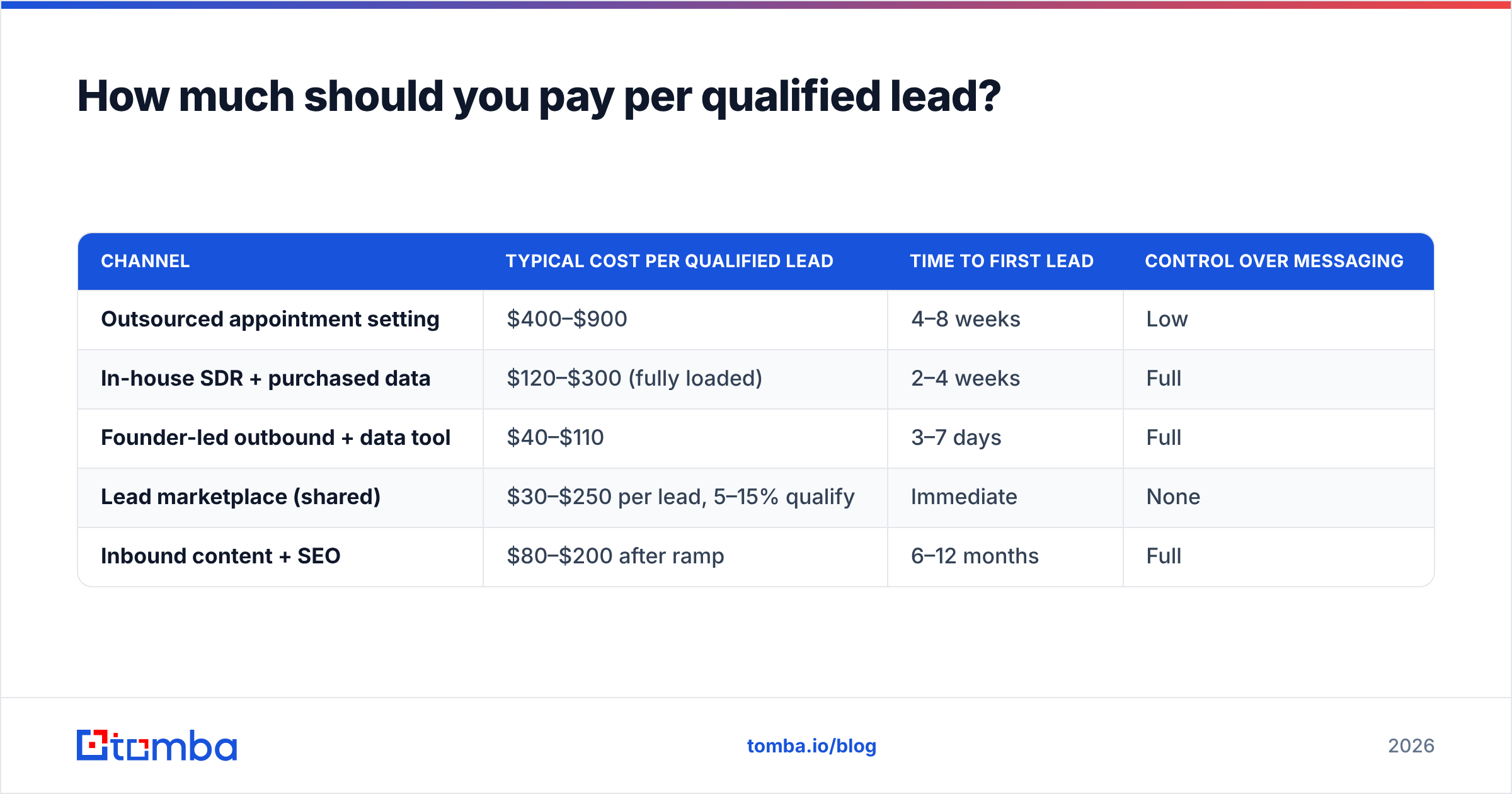
| Channel | Typical cost per qualified lead | Time to first lead | Control over messaging |
|---|---|---|---|
| Outsourced appointment setting | $400–$900 | 4–8 weeks | Low |
| In-house SDR + purchased data | $120–$300 (fully loaded) | 2–4 weeks | Full |
| Founder-led outbound + data tool | $40–$110 | 3–7 days | Full |
| Lead marketplace (shared) | $30–$250 per lead, 5–15% qualify | Immediate | None |
| Inbound content + SEO | $80–$200 after ramp | 6–12 months | Full |
The founder-led row explains why so many boutique firms outgrow agencies. Your data costs $49 to $99 a month, and your reps already exist. So the marginal cost of one more touch drops to near zero. In this vertical the expensive part of outbound was never the data. It was bad data, and the bounces that wreck your sending domain.
That is also why you verify before you send. Run a purchased list through an email verifier first and you typically strip 8–20% of it. Those are bounces your domain never has to pay for.
Should you outsource or build lead generation in-house?#

Use one rule: outsource labor you cannot hire, never outsource judgment you cannot audit.
Outsource when all three are true:
- You have a validated ICP and a pitch that has already closed deals.
- You cannot hire SDRs in your market within 90 days.
- You have compliance capacity to review every asset the agency produces.
Build in-house when any of these apply:
- Your ICP still shifts quarter to quarter.
- Your deal size justifies senior reps doing their own prospecting.
- Review cycles make third-party messaging impractical.
Most 10–50 person finance firms land on the hybrid. Own your data layer. Own your sequencing. Outsource only research or list building. Compliance stays inside the building, and your reps lose the dull hours. A bulk email finder plus a two-person SDR pod usually beats a $6,000 retainer on both cost and control.
What should you ask before signing a contract?#
Six questions separate serious vendors from resellers.
"Define qualified." Put it in the contract. "Attended a 15-minute call with a decision-maker at a firm with $50M+ AUM" is a definition. "Interested prospect" is not.
"Where does this data come from?" You want a real answer: public web crawling, opt-in partner networks, contributed data, or licensed sources. Vague answers usually mean recycled lists.
"What is your exclusivity policy?" Ask if the same contact can go to a rival within 30 days. In mortgage and insurance, that one clause changes the whole economics.
"Who reviews outbound copy for compliance?" If the answer is "our writers know the space," walk away. You need a named review step with your own team in it.
"What is your bounce-rate guarantee?" Then ask what happens when they miss it. A credit refund is table stakes. Anything above a 3% bounce rate on a verified list is a miss.
"Can I run a 200-contact sample first?" Every credible data vendor says yes.
Question six deserves a real test. Pull 200 contacts from the vendor. Run the same 200 through an independent email finder. Compare match rate and bounce rate, then use the gap as your lever. A vendor who resists a bake-off is telling you something.
What are the red flags in this category?#
These flags show up across all four types of lead generation companies for financial services.
Guaranteed lead volume with no qualification definition. Volume is easy to game. Any agency can book 40 meetings a month if a "meeting" means someone clicked a calendar link.
Refusal to name data sources. That is a compliance problem before it is a quality problem.
Month-one results that never repeat. The first month often burns the vendor's warmest, most recycled contacts. Judge months two through four.
Pricing quoted per meeting only, never per qualified lead. Per-meeting pricing pays the vendor to book anyone with a pulse.
No sender-domain separation. An agency that sends from your primary domain without a subdomain and warmup puts your client email at risk. One bad campaign, and your real mail stops landing. Ask how they handle sender reputation.
Case studies only from outside financial services. SaaS outbound playbooks travel badly into regulated markets, and vendors know it.
One more worth naming: the "AI-powered" label on what is really a scraped list with a rewrite layer on top. HubSpot's research on sales trends keeps showing that personalization quality drives reply rate, not volume. No amount of generated copy fixes a contact who left the firm 14 months ago.
What does a working stack look like for a 20-person financial services firm?#
You can replace most lead generation companies for financial services with five layers you run yourself. Here is a setup that costs under $500 a month and beats most low-tier agency retainers.
Contact layer: a data tool with verified emails and direct dials, priced per seat rather than per meeting. Tomba's Growth plan at $99 a month covers most two- to four-person pods. See Tomba pricing for the full tiers.
Verification layer: verify every list before you send. No exceptions. This is the highest-ROI step in the stack.
Enrichment layer: append firmographics, AUM bands, and tech signals so your first line is not generic.
Sequencing layer: whatever your CRM already supports. Do not buy a second sequencer until 500 contacts move every week.
Compliance layer: a named reviewer, a template library that has cleared review, and a rule that reps send approved templates only.
The failure mode is always the same. A firm buys the sequencing layer first, finds the data is bad, and blames outbound as a channel. Start with data accuracy. The rest of the stack gets cheaper.
Ready to build the data layer yourself?#
Most lead generation companies for financial services sell you labor. If your reps already exist and your problem is contact accuracy, skip the retainer. Start with the Tomba Email Finder. Find verified professional emails by domain, name, or company. Test it free with 25 searches a month. Then run it head to head against the list a vendor wants to sell you. If the vendor wins, buy from them. If Tomba wins, you just saved $6,000 a month and kept compliance inside your own building.
Related guides#
// get started
Find, verify and enrich your first contacts today
Start on the free plan with 25 searches a month, then scale when your team is ready.
Free plan · No credit card required · GDPR & CCPA
// about the author