Lead Generation Companies for Small Businesses: 2026 Guide
Most agencies quote $2,000-$5,000 a month before a single meeting lands. Here is what lead generation companies actually deliver for small businesses, what to ask before signing, and when a $49 in-house stack outperforms a retainer.
TL;DR
- Most lead generation companies for small businesses charge $2,000-$5,000/month on a 3-6 month minimum, and a meaningful share of that budget goes to data and tooling you could license directly.
- There are four distinct models — full-service agency, appointment-setting shop, data/list provider, and freelancer/fractional SDR — and they fail for completely different reasons. Pick the model before you pick the vendor.
- Pay-per-appointment sounds safest but quietly incentivises low-quality meetings. Pay-per-qualified-meeting with a written qualification definition is the only version that works.
- Under roughly 300 target accounts a month, an in-house stack (data provider + verifier + sequencer + one part-time operator) usually beats a retainer on cost per meeting.
- Ask for three things before signing: the last 90 days of raw meeting data, the exact data sources, and ownership of the contact list after cancellation. Vendors who dodge any of the three are selling volume, not pipeline.
What is a lead generation company, exactly?#
A lead generation company is a vendor you pay to put qualified buyers in your calendar. That is the whole promise. Everything else — the "growth engine" language, the dashboards, the LinkedIn thought leadership add-on — is packaging around one deliverable: booked conversations with people who can buy.
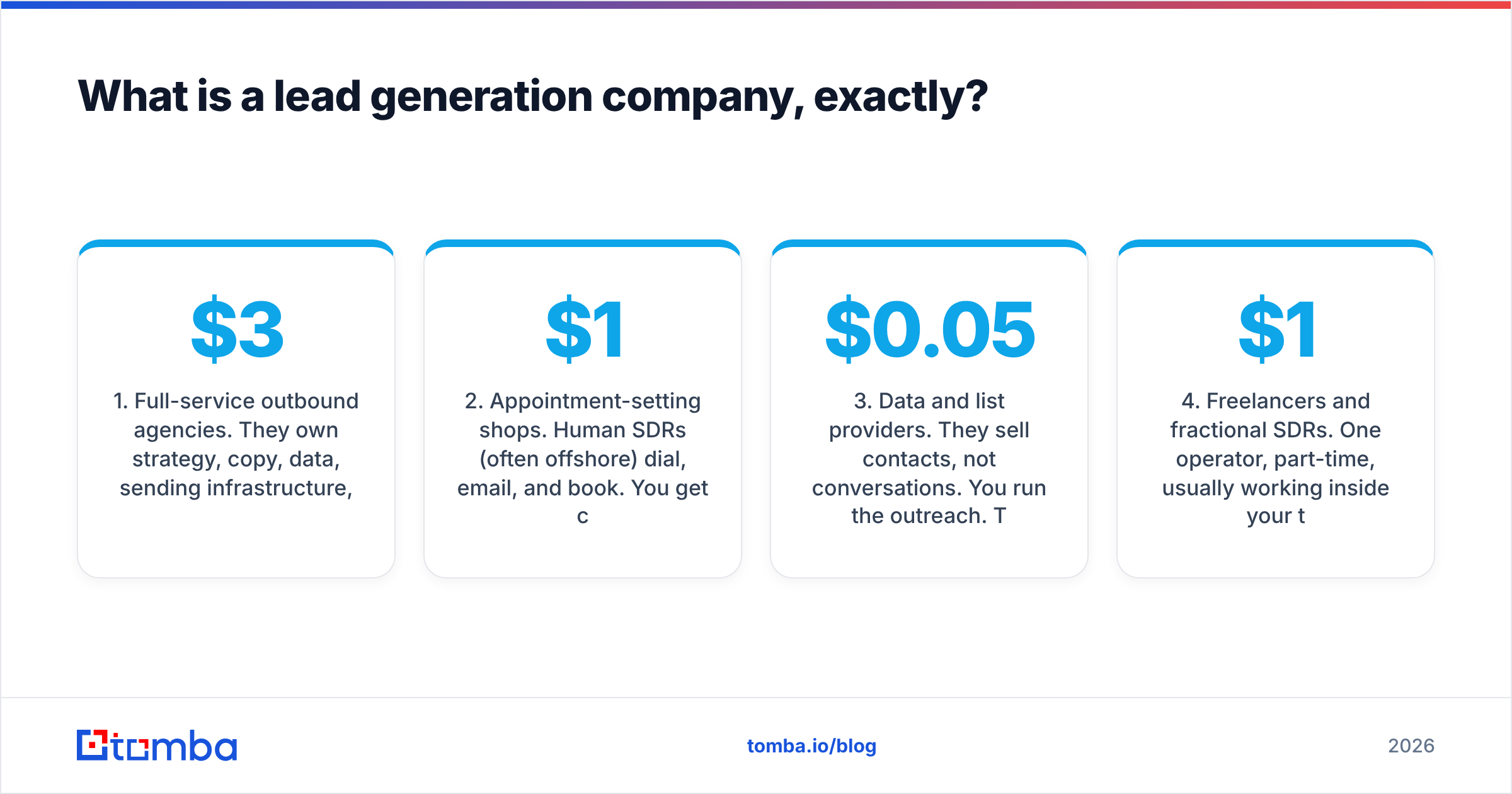
The confusion starts because four very different businesses use the same label:
- Full-service outbound agencies. They own strategy, copy, data, sending infrastructure, and reply handling. You get a Slack channel and a weekly report. Typical cost: $3,000-$8,000/month.
- Appointment-setting shops. Human SDRs (often offshore) dial, email, and book. You get calendar invites. Typical cost: $1,500-$4,000/month, or $150-$400 per appointment.
- Data and list providers. They sell contacts, not conversations. You run the outreach. Typical cost: $0.05-$0.30 per verified contact, or a flat platform subscription.
- Freelancers and fractional SDRs. One operator, part-time, usually working inside your tools. Typical cost: $1,500-$3,500/month.
The single most expensive mistake small businesses make is hiring model 1 when they needed model 3. If you already have a decent offer, a sender who can write, and a founder willing to take calls, you are paying an agency a 10x markup to buy data and press send.

What do lead generation companies actually charge in 2026?#
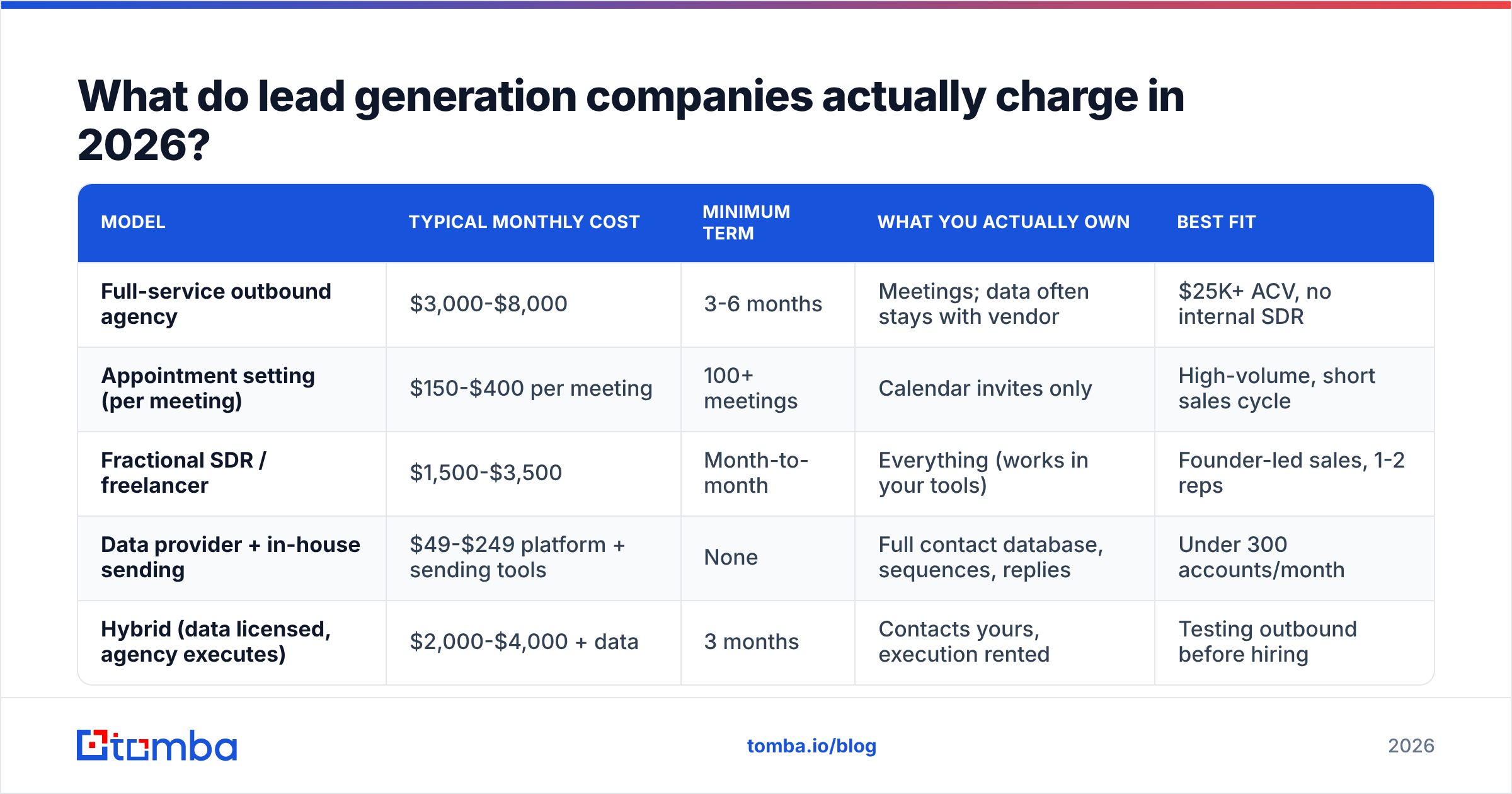
Pricing has compressed at the low end and hardened at the high end. AI-assisted copy and cheaper data killed the $1,000/month "we'll send 500 emails" offer; what replaced it is either a serious retainer or a self-serve stack.
| Model | Typical monthly cost | Minimum term | What you actually own | Best fit |
|---|---|---|---|---|
| Full-service outbound agency | $3,000-$8,000 | 3-6 months | Meetings; data often stays with vendor | $25K+ ACV, no internal SDR |
| Appointment setting (per meeting) | $150-$400 per meeting | 100+ meetings | Calendar invites only | High-volume, short sales cycle |
| Fractional SDR / freelancer | $1,500-$3,500 | Month-to-month | Everything (works in your tools) | Founder-led sales, 1-2 reps |
| Data provider + in-house sending | $49-$249 platform + sending tools | None | Full contact database, sequences, replies | Under 300 accounts/month |
| Hybrid (data licensed, agency executes) | $2,000-$4,000 + data | 3 months | Contacts yours, execution rented | Testing outbound before hiring |
Two numbers matter more than the headline price. The first is cost per qualified meeting — retainer divided by meetings that passed your qualification bar, not meetings booked. The second is cost per closed deal, which you cannot measure for at least one full sales cycle. Agencies that report only "meetings booked" are optimising the metric that is easiest to inflate.
A useful benchmark: if your average contract value is $10,000 and you close 20% of qualified meetings, each meeting is worth $2,000 in expected revenue. A $4,000/month retainer needs to produce at least four genuinely qualified meetings a month just to break even on gross revenue — and more than that to be worth the management overhead. Ask any prospective vendor to run that math with you on the call. The ones who flinch are telling you something.
Which type of lead gen partner fits your small business?#
Work through these five questions in order. They resolve the model choice faster than any vendor comparison chart.
- Do you have a repeatable offer? If your last ten deals came from ten different value propositions, no agency can help. Outbound amplifies message-market fit; it does not create it. Fix the offer first.
- Who takes the meeting? If the answer is "the founder, and the founder has four hours a week," you need fewer, better meetings — a fractional SDR or an in-house stack. Volume shops will bury you.
- What is your average contract value? Below roughly $5,000 ACV, per-meeting pricing rarely clears margin. Above $25,000, a full-service agency can pay for itself on one deal.
- Do you need the contact data afterward? If your retention and expansion motion depends on owning the list, rule out any vendor that treats the database as their asset. This disqualifies more agencies than people expect.
- Can someone internally own the relationship? Outsourced lead gen without an internal owner degrades within eight weeks. Somebody has to read the replies, flag bad-fit meetings, and rewrite the ICP. Budget three to five hours a week for that person.
If you answered "in-house stack" to question 2 and "yes" to question 4, you have effectively chosen model 3 — buy data, run the outreach yourself. That path starts with a reliable email finder and an email verifier, not with a discovery call.
How do you vet a lead generation company before signing?#
Vendor websites are useless for this. Every one of them shows a 40% open rate and a logo wall. Here is what actually separates the operators from the resellers.
Ask for 90 days of raw meeting data. Not a case study — a spreadsheet: date booked, company, title, show-rate, and outcome as marked by the client. Serious agencies have this. Ask specifically for the no-show rate; anything above 30% means they are booking people who did not really agree to meet.
Ask where the data comes from. "We use a proprietary blend of sources" is not an answer. You want to hear specific providers, refresh frequency, and a verification step. Vendors who license from reputable B2B data companies — including established list providers like BookYourData, which sells verified contacts directly — are being straight with you. Vendors who scrape LinkedIn at scale and cannot say so are exposing you to deliverability and compliance risk you will inherit.
Ask who owns the sending domain. If the agency sends from domains they control, you get a clean inbox and zero reputation equity. If they send from lookalike domains they registered on your brand, make sure the transfer terms are in writing. Burned domains are a real cost that never shows up in the quote.
Ask what happens to the list on cancellation. Get the answer in the contract, not the call.
Check third-party reviews with a filter for company size. Both G2's lead generation category and Capterra let you segment by reviewer company size. A vendor rated 4.7 by 200-person companies tells you nothing about how they handle a 12-person shop. Read only the reviews from businesses your size, and read the two-star ones first.
Run a paid pilot, never a free trial. Free trials get the A-team and cherry-picked accounts. A one-month paid pilot at reduced scope, with a written qualification definition and a meeting target, reveals the real operating rhythm. Structure it so the pilot fee credits against month two if you continue.
Is outsourcing better than building an in-house stack?#
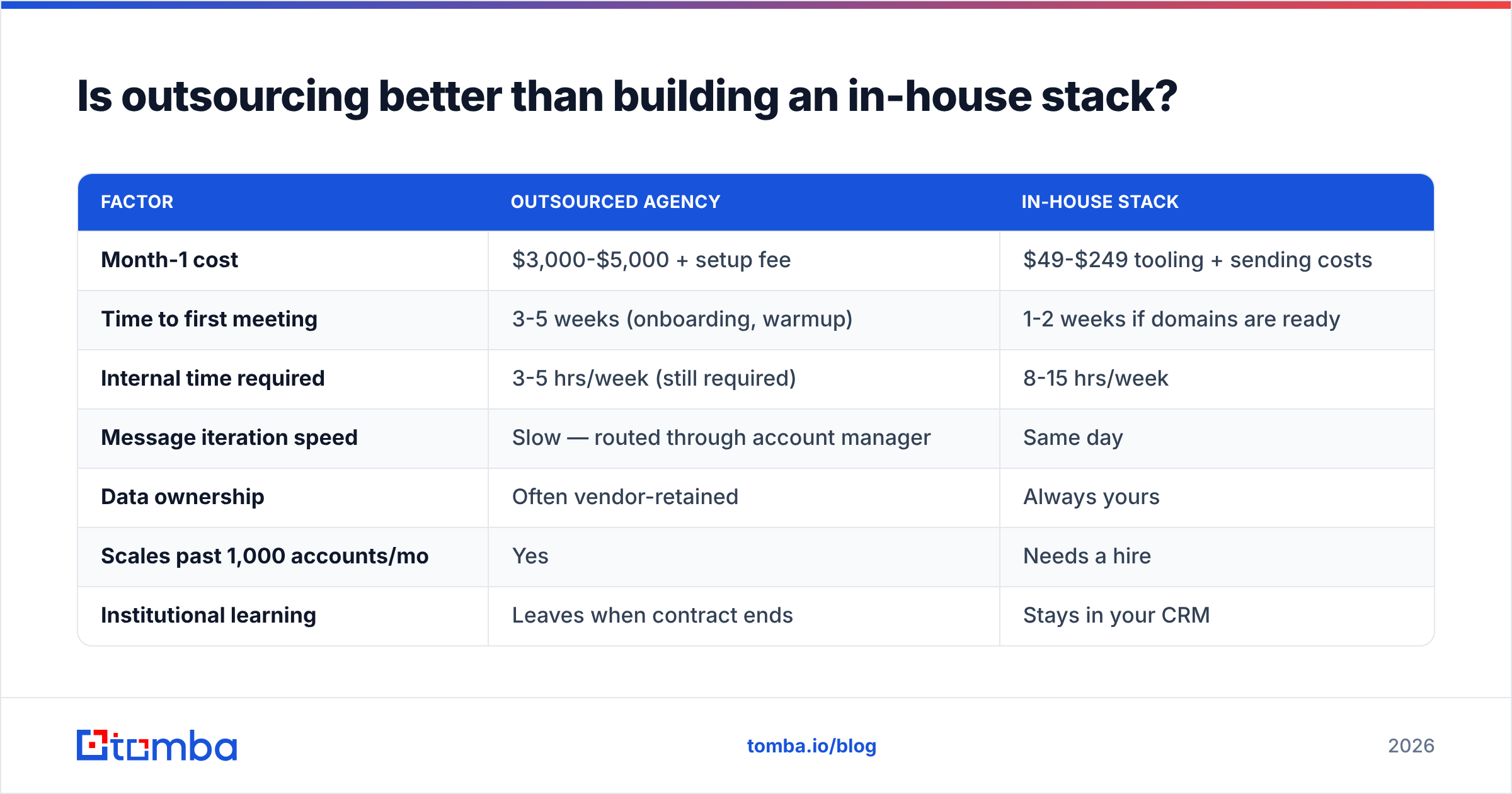
It depends almost entirely on volume and ACV, and the crossover point is lower than most agencies will tell you.
| Factor | Outsourced agency | In-house stack |
|---|---|---|
| Month-1 cost | $3,000-$5,000 + setup fee | $49-$249 tooling + sending costs |
| Time to first meeting | 3-5 weeks (onboarding, warmup) | 1-2 weeks if domains are ready |
| Internal time required | 3-5 hrs/week (still required) | 8-15 hrs/week |
| Message iteration speed | Slow — routed through account manager | Same day |
| Data ownership | Often vendor-retained | Always yours |
| Scales past 1,000 accounts/mo | Yes | Needs a hire |
| Institutional learning | Leaves when contract ends | Stays in your CRM |
The strongest argument for in-house is not cost — it is the feedback loop. Outbound works when the person writing the email has sat on the sales calls. That loop is nearly impossible to reproduce through an account manager and a weekly status doc. HubSpot's research on sales and marketing alignment has made the same point for years across its State of Marketing reporting: the teams that convert best are the ones where messaging and conversation live in the same place.
The strongest argument for outsourcing is capacity. If nobody internally has 10 hours a week, an in-house stack does not exist — it is a subscription you will cancel in month three.

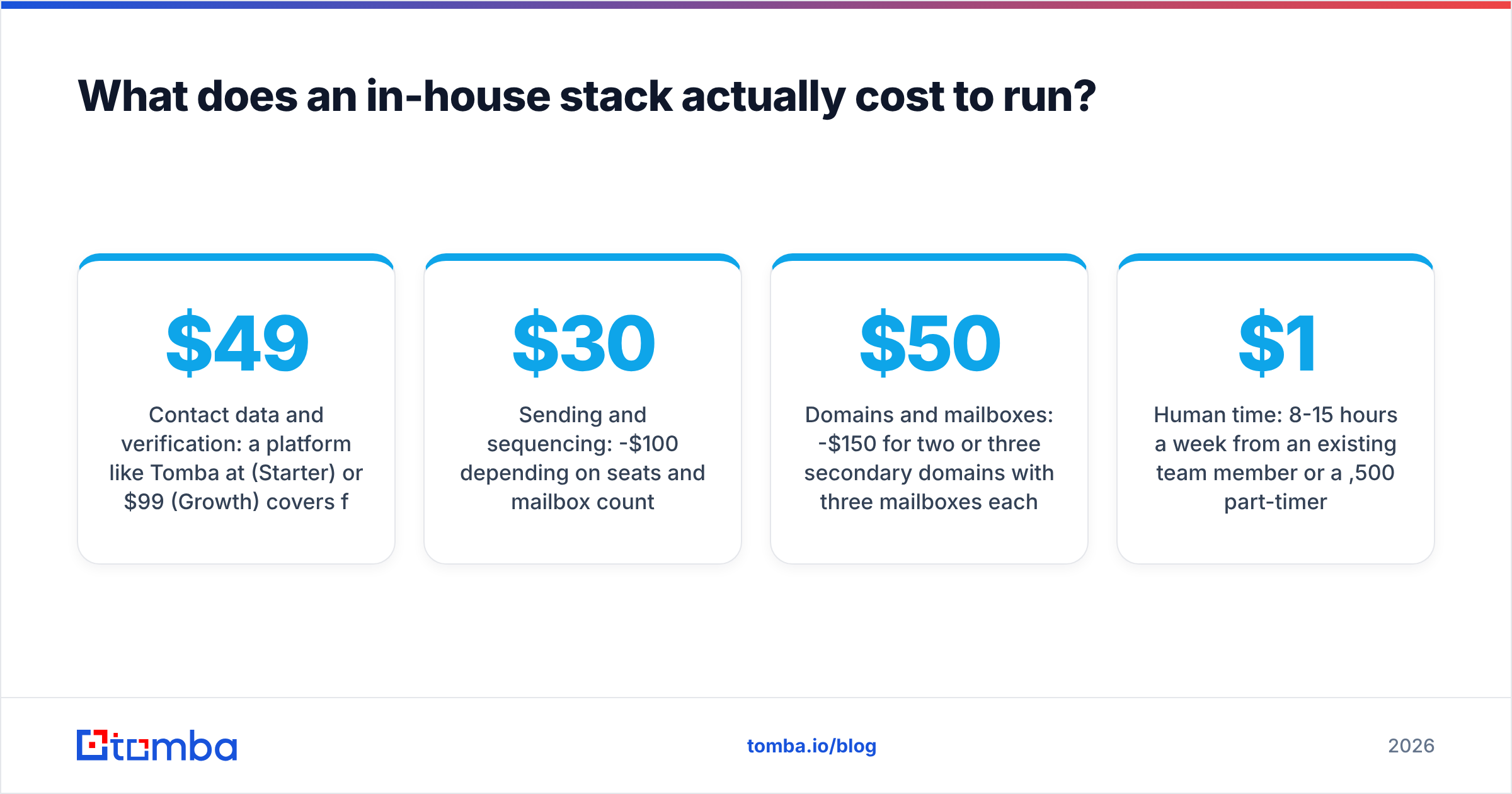
What does an in-house stack actually cost to run?#
Concretely, for a small business targeting 500-800 new contacts a month:
- Contact data and verification: a platform like Tomba at $49/month (Starter) or $99/month (Growth) covers finding and verifying business emails, plus bulk email finder runs against a target-account list. There is a free tier at 25 searches a month for testing the match rate before you spend anything — see Tomba pricing for the full tier breakdown.
- Sending and sequencing: $30-$100/month depending on seats and mailbox count.
- Domains and mailboxes: $50-$150/month for two or three secondary domains with three mailboxes each.
- Human time: 8-15 hours a week from an existing team member or a $1,500/month part-timer.
All in, $200-$400/month in tooling plus labour. Against a $4,000 retainer, you have roughly $3,600/month of budget to buy back time — which is most of a part-time SDR. That is the real comparison, and it is why the "agency vs in-house" framing misleads. The honest framing is: agency, or a part-time human plus $250 of software?
Where in-house genuinely breaks down is at scale and in complex enterprise motions. Once you are running multi-channel sequences against 2,000+ accounts a month with intent data layered on, you need specialists. Gartner's sales research consistently finds that B2B buying groups have grown to six-plus stakeholders, and orchestrating that many touches across an account is real operational work — not something a founder does between customer calls.
What are the red flags in a lead generation contract?#
- Guaranteed meeting counts with no qualification definition. A "meeting" that is a student doing research counts against the guarantee. Define title, company size, and expressed problem in writing.
- Auto-renewal with a 60-day notice window. Standard in the industry, and standard does not mean acceptable. Negotiate it to 30 days.
- Setup fees above one month's retainer. Setup should be onboarding and domain warmup, not a profit centre.
- No named operator. If you cannot name the human writing your emails, you are buying a template library.
- Refusal to share reply screenshots. Positive replies are the only leading indicator that matters. Any vendor hiding them is hiding something.
- Sending from your primary domain. This is a deliverability decision with permanent consequences. Secondary domains only.
- "We'll enrich your existing CRM" priced as a strategic service. Enrichment is a commodity — a data enrichment API does this for cents per record.
One more, and it is the one that costs the most: an agency that will not tell you their bounce rate. Bounce rate is the cleanest proxy for data quality. Above 3% and you are damaging your sender reputation while paying someone for the privilege. Ask for the number for your industry specifically, not their portfolio average.
How long before a lead generation company produces pipeline?#
Set the expectation at 90 days minimum, and understand where the time goes. Weeks one and two are onboarding and domain warmup — nothing sends. Weeks three through six are the first real sequences, which are almost always the worst-performing ones because nobody knows the message yet. Weeks seven through twelve are where a competent vendor starts compounding, having killed two or three angles and doubled down on the one that pulled replies.
This is why three-month minimums exist, and why they are not inherently predatory. What is predatory is a six-month minimum with no month-three review gate. Insist on a written checkpoint at day 90 with defined exit criteria: if qualified meetings are below X, either the scope changes or the contract ends without penalty.
Also be realistic about what "qualified" means at your ACV. A small business selling a $12,000 annual contract should expect somewhere between 4 and 10 qualified meetings a month from a properly-run outbound program at moderate volume — not the 25 that appear on agency landing pages. Those numbers come from companies sending ten times your volume with a full RevOps team behind them.
What should you do next?#
Run the cheapest possible test before you spend a dollar on a retainer. Build a list of 100 accounts that look exactly like your best three customers, find the decision-maker emails, verify them, and send 100 genuinely personalised emails over two weeks. Track replies, not opens.
If that test produces two or three real conversations, you have message-market fit and the question becomes purely one of capacity — which is the right reason to hire an agency. If it produces zero, no vendor on earth is going to fix that with volume, and you just saved yourself $12,000.
Start the test with the Tomba Email Finder. The free tier covers 25 searches — enough to validate match rates on your own target list before committing — and the Starter plan at $49/month runs the full 100-account pilot end to end, with verification included so your bounce rate stays where it belongs. Own the data, learn the message, then decide who sends it.
Related guides#
// get started
Find, verify and enrich your first contacts today
Start on the free plan with 25 searches a month, then scale when your team is ready.
Free plan · No credit card required · GDPR & CCPA
// about the author