Lead Generation Companies in India: The 2026 Buyer's Guide
Indian lead gen agencies can cut your cost per meeting by half — or hand you a scraped list that torches your sending domain. Here's how to tell the two apart before you sign.
TL;DR
- India's B2B lead generation market splits into four very different businesses: appointment-setting agencies, data/list vendors, demand-gen (content syndication) shops, and staff-augmentation SDR providers. Buying the wrong one is the most common mistake.
- Expect $1,500–$6,000/month for a dedicated SDR pod, $80–$250 per marketing-qualified lead, and $150–$500 per booked meeting. Anything dramatically cheaper is usually recycled data.
- The single biggest risk is not bad calling — it's bad data. Scraped or stale lists produce hard bounces that damage your sender reputation faster than any agency can book meetings.
- Contract for outcomes you can audit: verified email rate, bounce rate, show-up rate. Not "leads delivered."
- Many teams end up with a hybrid: an Indian agency for volume outreach plus their own verified data layer so the list — and the domain — stays under their control.
Why do so many B2B teams outsource lead generation to India?#
Cost arbitrage is the honest answer, and it's still substantial in 2026. A fully loaded SDR in San Francisco or London runs $75,000–$120,000 a year before tooling. An equivalently trained SDR in Bengaluru, Pune, or Noida costs a fraction of that, and the agencies that employ them amortize tooling, management, and training across dozens of clients.
But cost is only half of it. The other half is time zones and language. India's working day overlaps with EMEA mornings and APAC afternoons, and the country produces a very large pool of fluent English speakers with genuine B2B software literacy. That combination is why a meaningful share of the outbound teams selling US SaaS into US buyers are physically sitting in Gurugram.
The third driver is speed. Hiring, onboarding, and ramping an in-house SDR takes 90–120 days. A competent agency can have a pod live in two weeks because the infrastructure — dialers, sequencers, data, QA — already exists.
None of this means outsourcing is automatically correct. It means the cost of experimenting is low enough that most B2B companies should at least price it out.

What do lead generation companies in India actually sell?#
This is where buyers get burned. "Lead generation" is four distinct product categories wearing one label, and vendors rarely volunteer which one they are.
- Appointment setting / SDR-as-a-service. They own the whole motion: list building, email, calls, LinkedIn, and booking meetings into your calendar. You pay monthly retainer, per meeting, or both. Highest touch, highest cost, highest variance in quality.
- Data and list vendors. They sell contact records — names, titles, work emails, direct dials, firmographics. No outreach. Good ones publish verification methodology and offer replacement credits for bounces. Peers like BookYourData have built solid reputations on exactly this: transparent, verified B2B records rather than volume for volume's sake.
- Demand generation and content syndication. They promote your whitepaper or webinar across owned media networks and deliver opt-in contacts, usually priced per MQL with agreed filters (title, company size, geo, intent). Volume is predictable; intent quality varies wildly by network.
- Staff augmentation. You get a named SDR (or five) who works only your accounts, uses your tooling, sits in your Slack, and reports to your manager. Closest thing to in-house without the hiring overhead.
- Research and list-building desks. Manual analysts who build hyper-targeted lists from LinkedIn, company sites, and filings. Slow, expensive per record, but excellent for ABM tiers where a 200-account list needs to be genuinely correct.
Decide which of those five you're buying before you take a single sales call. A demand-gen shop pitched against an appointment-setting brief will lose on every metric that matters, and vice versa.
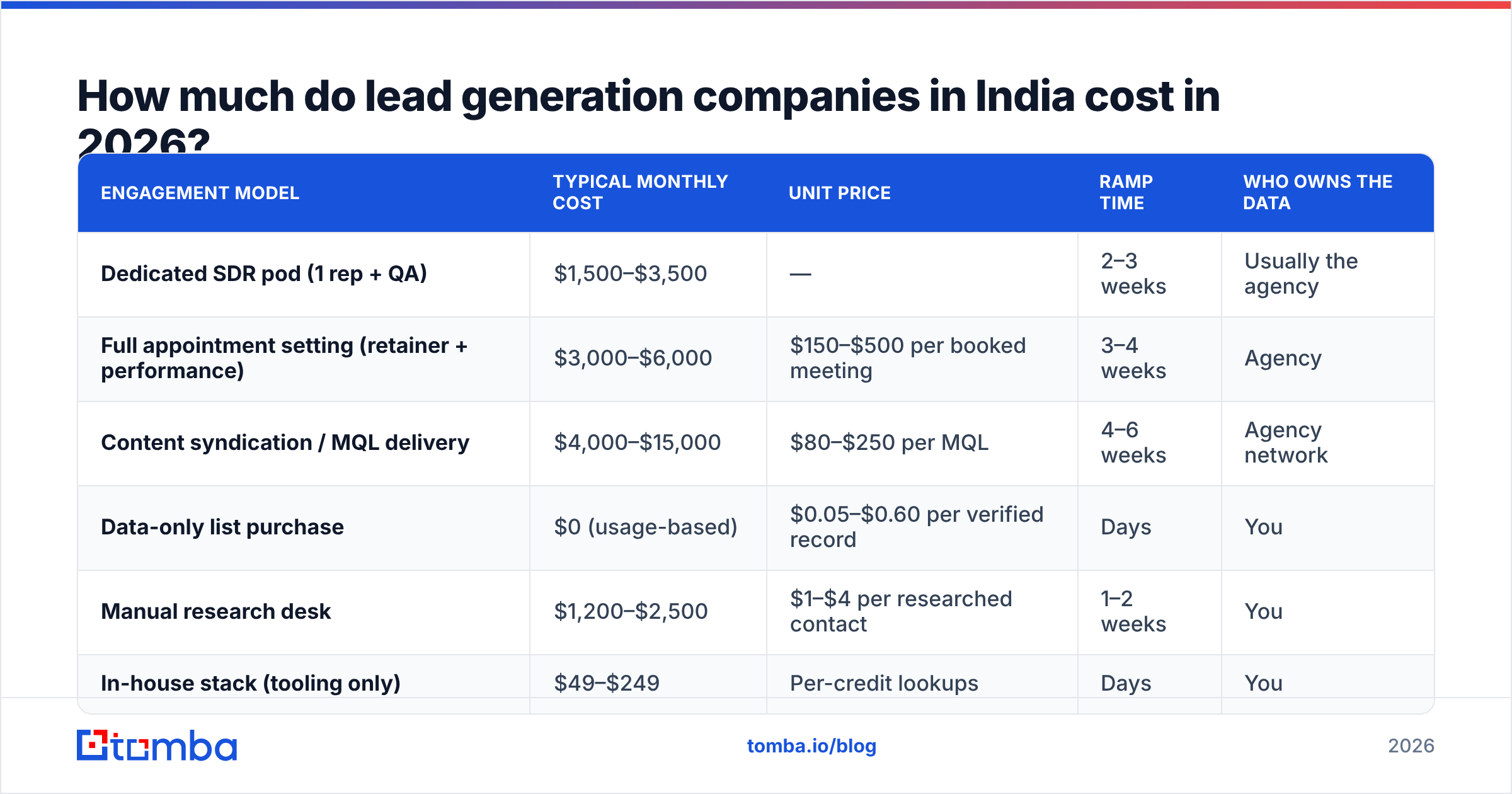
How much do lead generation companies in India cost in 2026?#
Published rate cards are rare, so here are the ranges buyers consistently report. Treat them as a sanity check, not a quote.
| Engagement model | Typical monthly cost | Unit price | Ramp time | Who owns the data |
|---|---|---|---|---|
| Dedicated SDR pod (1 rep + QA) | $1,500–$3,500 | — | 2–3 weeks | Usually the agency |
| Full appointment setting (retainer + performance) | $3,000–$6,000 | $150–$500 per booked meeting | 3–4 weeks | Agency |
| Content syndication / MQL delivery | $4,000–$15,000 | $80–$250 per MQL | 4–6 weeks | Agency network |
| Data-only list purchase | $0 (usage-based) | $0.05–$0.60 per verified record | Days | You |
| Manual research desk | $1,200–$2,500 | $1–$4 per researched contact | 1–2 weeks | You |
| In-house stack (tooling only) | $49–$249 | Per-credit lookups | Days | You |
Two numbers on that table deserve attention.
First, cost per booked meeting is the only figure that survives comparison across models. An MQL at $90 sounds cheaper than a meeting at $350 until you learn the MQL-to-meeting rate is 8%, which puts the true cost at $1,125. Always normalize.
Second, data-only costs are an order of magnitude below service costs. That gap is the entire arbitrage of the hybrid approach below. If an agency is charging you $3,000/month and $600 of that is data they mark up 5x, you should know.
Is an agency better than building your own outbound stack?#
It depends on whether your bottleneck is knowledge or capacity.
If you don't yet know which ICP converts, which message lands, or what your qualification bar is, an agency will not discover that for you. They will run your unproven hypothesis at scale and bill you for the volume. Founder-led outbound for the first 50–100 conversations is cheaper and far more informative.
If you already know what works and simply cannot execute enough of it, an agency is a genuinely good buy — and an Indian agency is often the best price-per-unit-of-execution available anywhere.
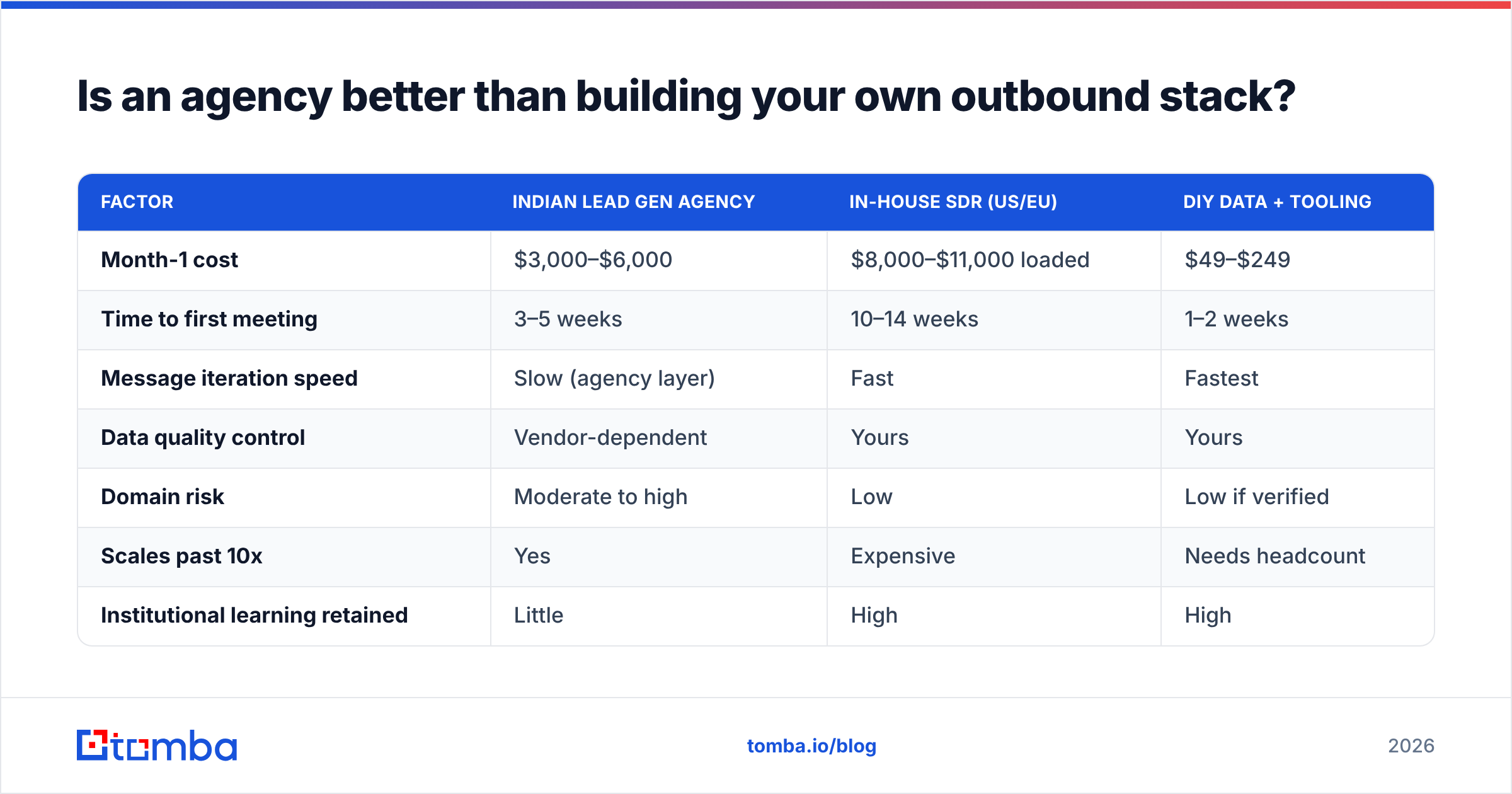
Here's the comparison most teams actually face:
| Factor | Indian lead gen agency | In-house SDR (US/EU) | DIY data + tooling |
|---|---|---|---|
| Month-1 cost | $3,000–$6,000 | $8,000–$11,000 loaded | $49–$249 |
| Time to first meeting | 3–5 weeks | 10–14 weeks | 1–2 weeks |
| Message iteration speed | Slow (agency layer) | Fast | Fastest |
| Data quality control | Vendor-dependent | Yours | Yours |
| Domain risk | Moderate to high | Low | Low if verified |
| Scales past 10x | Yes | Expensive | Needs headcount |
| Institutional learning retained | Little | High | High |
The row that quietly decides most deals is domain risk. When an agency sends from your domain using a list you never inspected, you are lending them your sender reputation. If their list has an 8% bounce rate, Google and Microsoft will notice within a week, and the damage outlasts the contract by months.
Mitigation is simple and non-negotiable: the agency sends from dedicated lookalike domains, never your primary, and every list gets independently verified before the first send. Running an agency-supplied list through your own email verifier costs almost nothing and routinely catches 10–20% invalid records on lists that were sold as "verified."
How do you vet lead generation companies in India?#
Ask questions the vendor cannot answer with a case study PDF. These eight separate the operators from the resellers.
- "Where does your data come from?" Acceptable answers: licensed providers, opt-in networks, manual research, first-party enrichment APIs. Unacceptable: vagueness, "proprietary database" with no methodology, or anything that sounds like a scraped dump of a former employer's CRM.
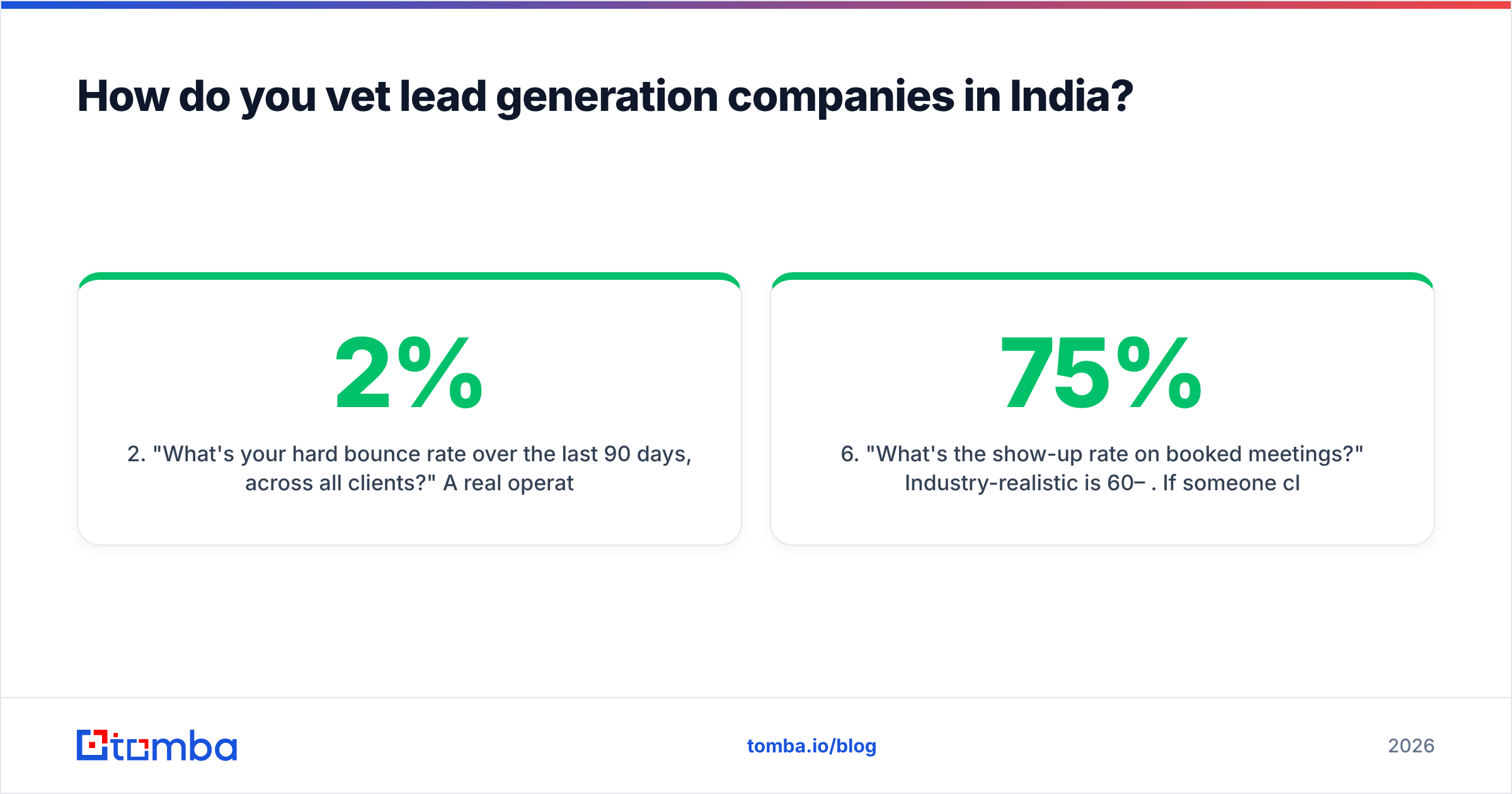
- "What's your hard bounce rate over the last 90 days, across all clients?" A real operator knows this number. Under 2% is good, 2–4% is workable, above 5% means their data will hurt you.
- "Whose domains do you send from?" The right answer is secondary domains they warm and own, with your primary domain untouched.
- "Show me the actual sequence copy for a client in my category." Redacted is fine. If every email opens with "I hope this finds you well," you are buying 2019 outbound at 2026 prices.
- "What's the definition of a qualified meeting, and who arbitrates disputes?" Get this in writing with a rejection mechanism. Without it, no-shows and tire-kickers count against your invoice.
- "What's the show-up rate on booked meetings?" Industry-realistic is 60–75%. If someone claims 95%, they are counting differently than you are.
- "Who exactly works my account, and can I meet them?" Pitch teams and delivery teams are often different people. Meet the delivery team.
- "What happens to the data when we end the contract?" You want an export clause. Contacts researched on your dime should leave with you.
Cross-check whatever they tell you against third-party review platforms. G2 is useful for tooling and software-adjacent services, while Clutch is the better directory for agency-side reviews with verified client interviews. Neither is gospel, but a vendor with zero independent footprint after five years in business is a flag.

What are the most common failure modes?#
Failure mode 1: buying volume instead of fit. The contract says 40 meetings per quarter. The agency delivers 40 meetings, of which 31 are with companies that could never buy your product. Technically compliant, commercially worthless. Fix: define ICP filters contractually — headcount, tech stack, region, title seniority — and reject out-of-scope bookings.
Failure mode 2: inherited list rot. Agencies reuse lists across clients in the same vertical. Your prospects may have received four near-identical pitches from four of the agency's clients this quarter. Fix: insist on exclusivity within your category, and build at least part of the list yourself using a domain search against target accounts so you know it's fresh.
Failure mode 3: no feedback loop to sales. The SDR pod books; your AEs take calls; nobody tells the pod which meetings were good. Quality plateaus permanently. Fix: a weekly 30-minute call where AEs grade last week's meetings 1–5 with reasons.
Failure mode 4: catch-all chaos. A large share of enterprise domains accept every address at the SMTP layer, so standard verification returns "unknown" and agencies either drop those contacts (losing real prospects) or send blind (inviting bounces). Fix: use dedicated catch-all verification rather than treating the whole bucket as a coin flip.
Failure mode 5: compliance blindness. GDPR, CAN-SPAM, and India's DPDP Act all apply to different parts of a cross-border outbound program. Ask which framework the agency operates under for EU-based prospects, and get the answer in the contract. HubSpot's GDPR resources are a reasonable baseline for understanding what consent and legitimate-interest actually require.
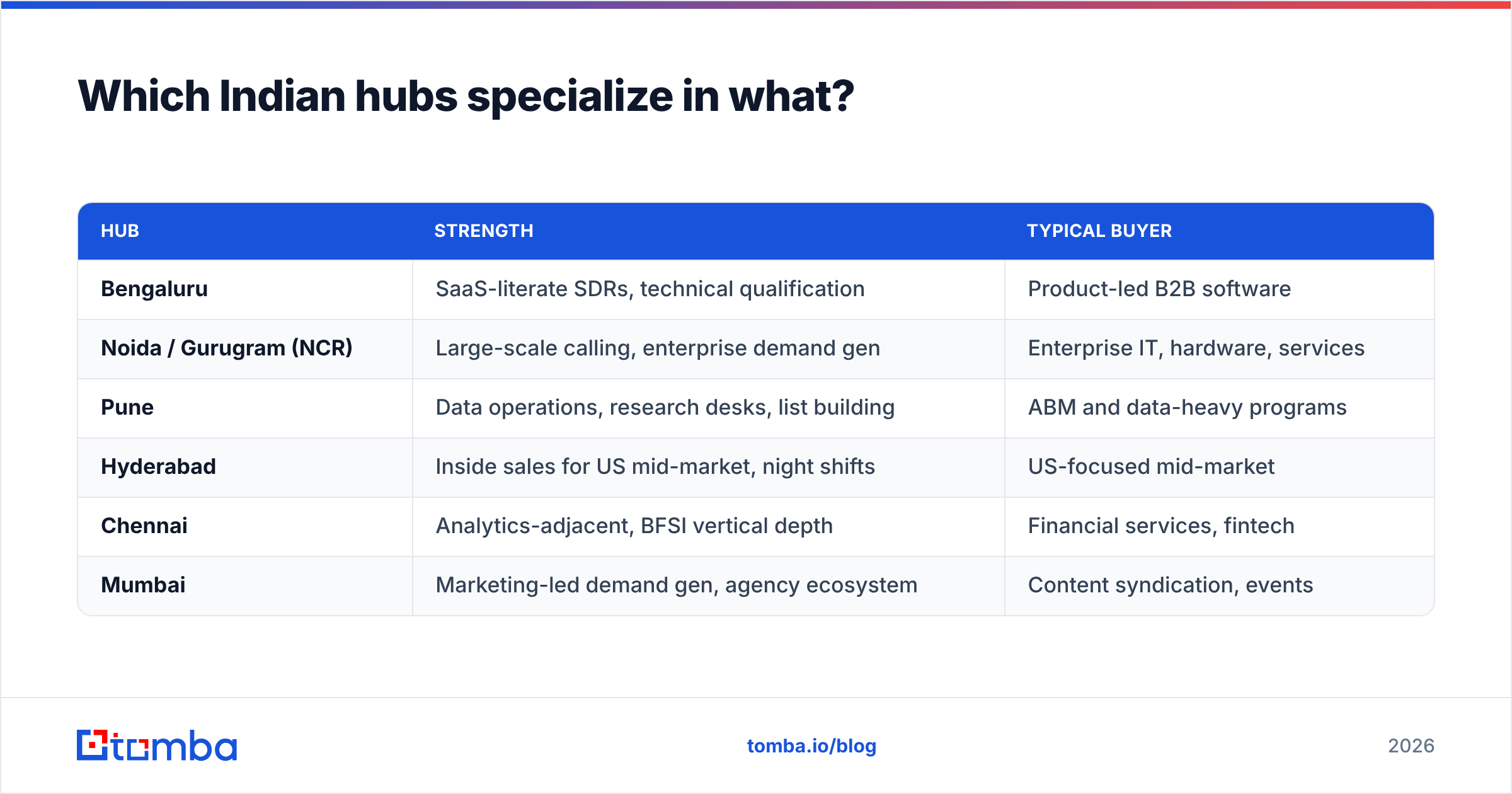
Which Indian hubs specialize in what?#
Geography still correlates with capability, mostly because talent clusters around anchor employers.
| Hub | Strength | Typical buyer |
|---|---|---|
| Bengaluru | SaaS-literate SDRs, technical qualification | Product-led B2B software |
| Noida / Gurugram (NCR) | Large-scale calling, enterprise demand gen | Enterprise IT, hardware, services |
| Pune | Data operations, research desks, list building | ABM and data-heavy programs |
| Hyderabad | Inside sales for US mid-market, night shifts | US-focused mid-market |
| Chennai | Analytics-adjacent, BFSI vertical depth | Financial services, fintech |
| Mumbai | Marketing-led demand gen, agency ecosystem | Content syndication, events |
Treat this as a starting heuristic, not a rule. Remote-first delivery has blurred these lines considerably since 2021, and the individual team lead assigned to your account matters far more than the city on the invoice.
What does the hybrid model look like in practice?#
The setup that most consistently works for teams doing $1M–$20M ARR looks like this:
- You own the target account list. Built from your own ICP definition, not the agency's database. This is the asset you keep.
- You own the contact data layer. Emails found and verified through your own stack so you can audit quality and the records survive the vendor relationship.
- The agency owns execution. Sequencing, calling, LinkedIn touches, follow-up discipline, meeting coordination — the labor-intensive parts where Indian delivery economics genuinely win.
- You own the messaging. Agency drafts, you approve. Positioning is a founder/marketing job that does not outsource well.
- Both sides see the same dashboard. Verified rate, bounce rate, reply rate, meeting rate, show rate, opportunity rate. Weekly.
Under this split, you pay the agency for capacity rather than for data markup. A bulk email finder run against 5,000 target contacts costs a tiny fraction of what the same records cost embedded in an agency retainer, and you can check the quality yourself before a single email goes out. Compare it against your current vendor's per-record rate on the pricing page — the delta usually funds an extra SDR.
How should you structure the first 90 days?#
Weeks 1–2: define ICP filters, supply 200 seed accounts, approve messaging, set up dedicated sending domains and warmup. No sending yet.
Weeks 3–6: first sends at low volume. Watch bounce rate above everything else. If it exceeds 3%, stop and re-verify the list rather than pushing through.
Weeks 7–10: scale volume on whichever segment shows the best reply-to-meeting ratio. Kill the others. This is also when you should have enough data to grade the agency's qualification bar.
Weeks 11–13: decide. Renew, restructure toward the hybrid model, or exit. Export your data either way.
Ninety days is long enough to see signal and short enough that a bad fit doesn't cost you a year. Never sign a twelve-month agency contract on a first engagement, regardless of the discount.
The bottom line#
Lead generation companies in India offer real, durable economic advantage on execution labor — and real, under-discussed risk on data quality. The buyers who get burned are the ones who hand over both the list and the domain and hope for the best. The buyers who win keep the data layer in-house, rent the execution, and measure bounce rate as religiously as they measure meetings.
If you're building that data layer yourself, start with the part that decides everything downstream: accurate, verified contacts. The Tomba Email Finder finds professional email addresses by domain, name, or company, with verification built into the same workflow — so the list your agency sends against is one you can actually vouch for. The free tier covers 25 searches a month if you just want to spot-check the list your current vendor handed you. Run their "verified" file through it before your next send; the result usually settles the renewal conversation on its own.
Related guides#
// get started
Find, verify and enrich your first contacts today
Start on the free plan with 25 searches a month, then scale when your team is ready.
Free plan · No credit card required · GDPR & CCPA
// about the author