Lead Generation Definition: What It Means in B2B (2026)
Most teams argue about lead gen tactics before agreeing on what a lead actually is. Here is a plain-English lead generation definition, the lifecycle stages that surround it, and how to tell a real lead from a row in a spreadsheet.
TL;DR
- Lead generation is the process of identifying people or companies who could plausibly buy from you, and capturing enough verified information to start a real conversation. Everything else — ads, SEO, cold email, events — is just a delivery mechanism.
- A "lead" is not a contact record. A contact is a row of data. A lead is a contact plus evidence of fit or intent, owned by someone with a next step.
- Most lead gen arguments are actually definition arguments: marketing counts form fills, sales counts meetings, and the pipeline number nobody trusts sits in between.
- Inbound, outbound, and partner-sourced leads have very different costs, cycle times, and conversion rates. Compare them on cost per meeting, not cost per lead.
- Bad contact data quietly destroys lead gen economics. A 20% bounce rate does not just waste sends — it damages sender reputation and poisons every future campaign from that domain.
What is the lead generation definition?#
Lead generation is the process of attracting or identifying potential buyers, capturing enough information about them to make contact, and qualifying whether they are worth a salesperson's time.
That is the whole definition. Three verbs: identify, capture, qualify.
Think of it like fishing versus stocking a pond. Inbound lead generation stocks the pond — you publish content, run ads, and wait for fish to swim in. Outbound lead generation is spearfishing — you pick the specific fish you want and go get it. Both are lead generation. Neither is automatically better. What matters is that at the end you hold something concrete: a named human, at a named company, with a reachable channel and a reason to talk.
The Wikipedia entry on lead generation frames it as "the initiation of consumer interest or enquiry into products or services." That's accurate for B2C. In B2B it's incomplete, because a large share of B2B pipeline starts with zero consumer-initiated interest — the buyer had never heard of you until an SDR found them. Interest is one path to a lead. Fit is another.
So the working B2B definition is broader:
Lead generation = turning an undifferentiated market into a finite, contactable, prioritized list of people you can sell to.
What actually counts as a lead — and what doesn't?#
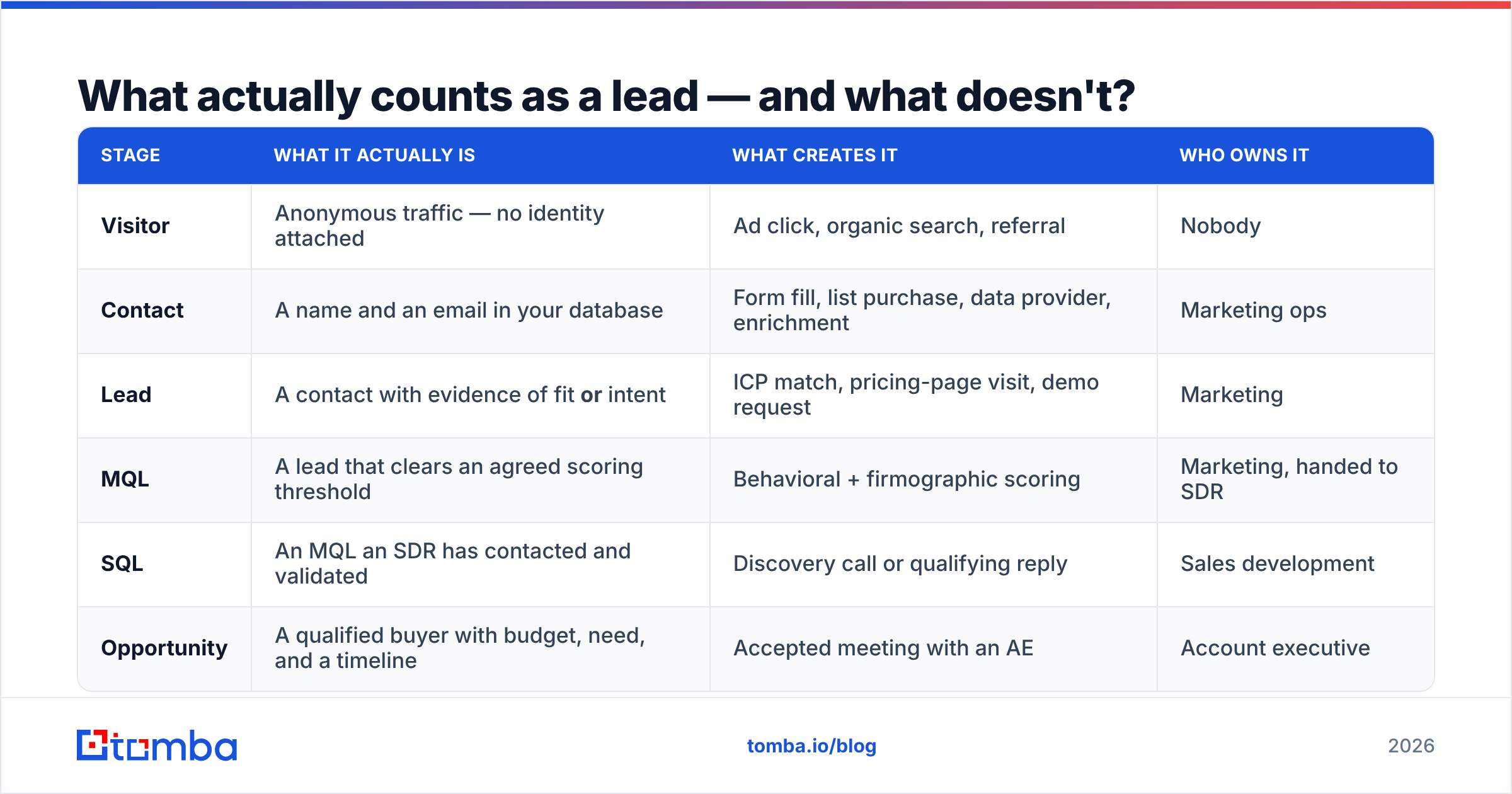
This is where most revenue teams lose weeks. "We generated 4,000 leads last quarter" is meaningless unless everyone agrees on the noun. Here is the lifecycle most B2B organizations use, stage by stage.
| Stage | What it actually is | What creates it | Who owns it |
|---|---|---|---|
| Visitor | Anonymous traffic — no identity attached | Ad click, organic search, referral | Nobody |
| Contact | A name and an email in your database | Form fill, list purchase, data provider, enrichment | Marketing ops |
| Lead | A contact with evidence of fit or intent | ICP match, pricing-page visit, demo request | Marketing |
| MQL | A lead that clears an agreed scoring threshold | Behavioral + firmographic scoring | Marketing, handed to SDR |
| SQL | An MQL an SDR has contacted and validated | Discovery call or qualifying reply | Sales development |
| Opportunity | A qualified buyer with budget, need, and a timeline | Accepted meeting with an AE | Account executive |
The two rows people conflate are Contact and Lead. Buying a 50,000-row spreadsheet generates contacts, not leads. Nothing about those rows says the company has the problem you solve, the budget to fix it, or a reason to answer the phone this quarter. Calling them leads inflates the top of the funnel and makes every downstream conversion rate look broken.
The other commonly abused row is MQL. A marketing qualified lead is only meaningful if sales agreed to the scoring rules and agreed to work every record that clears them. An MQL definition written by marketing alone is a vanity metric with a job title.

Why does the definition matter more than the tactics?#
Because the definition sets the denominator for every number your board sees.
Run the math. Say you spend $40,000 a quarter on demand generation and report 2,000 "leads." Cost per lead: $20. Impressive. Now apply a real definition — contacts with a verified email, an ICP-matching company, and a recorded intent signal. Suddenly it's 260 leads, and cost per lead is $154. Nothing changed except honesty.
The $154 number is the useful one, because it's the only one you can compare against a paid-search test, an outbound SDR's fully loaded cost, or a conference booth. Gartner's sales research has repeatedly pointed at the same underlying problem: teams optimize the metric they defined loosely, not the one that predicts revenue.
Three practical consequences of a sloppy definition:
- Forecasting drifts. If lead-to-opportunity conversion swings between 2% and 9% quarter to quarter, the usual cause is not market conditions — it's inconsistent lead qualification.
- Sales stops trusting marketing. Once SDRs work 200 garbage records, they discount the next 200 good ones. Trust is the real cost.
- Budget goes to the wrong channel. Channels that produce many cheap, low-fit contacts win the cost-per-lead comparison and lose the cost-per-revenue comparison.
What are the main types of lead generation?#
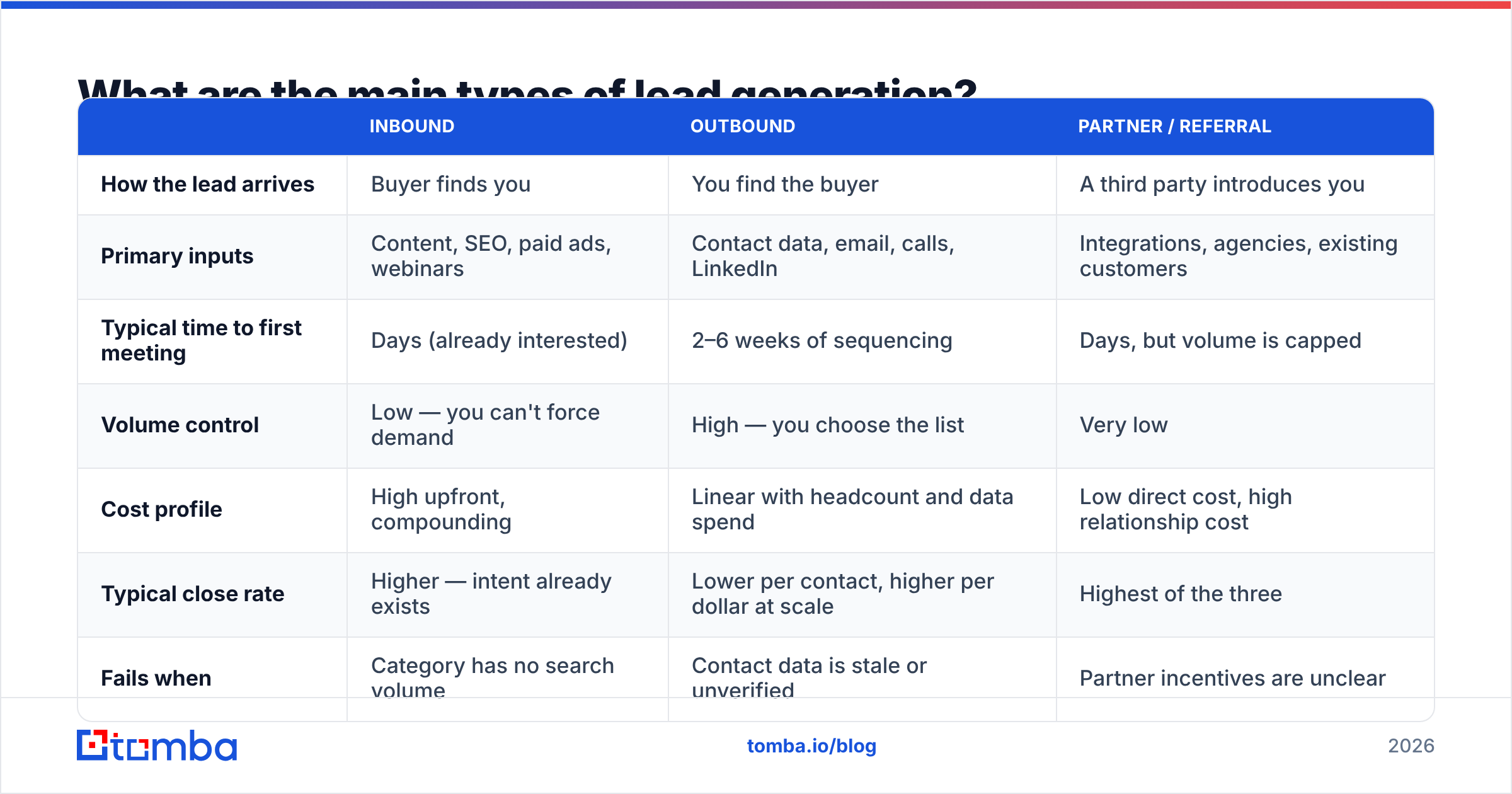
There are three durable categories. Everything else is a subtype.
| Inbound | Outbound | Partner / referral | |
|---|---|---|---|
| How the lead arrives | Buyer finds you | You find the buyer | A third party introduces you |
| Primary inputs | Content, SEO, paid ads, webinars | Contact data, email, calls, LinkedIn | Integrations, agencies, existing customers |
| Typical time to first meeting | Days (already interested) | 2–6 weeks of sequencing | Days, but volume is capped |
| Volume control | Low — you can't force demand | High — you choose the list | Very low |
| Cost profile | High upfront, compounding | Linear with headcount and data spend | Low direct cost, high relationship cost |
| Typical close rate | Higher — intent already exists | Lower per contact, higher per dollar at scale | Highest of the three |
| Fails when | Category has no search volume | Contact data is stale or unverified | Partner incentives are unclear |
The honest read: inbound has better unit economics if your category has existing demand. If you're selling something buyers don't know to search for, outbound is not a choice — it's the only way to create the first conversation. Most teams above $5M ARR run all three and stop pretending one replaces the others.
How does the lead generation process actually work?#
Strip away the tooling and the same six steps repeat in every functioning program.
- Define the ICP precisely. Not "mid-market SaaS." Something testable: 50–500 employees, US or UK, using a specific tech stack, with a VP of Sales in seat. If you cannot write a filter from your ICP, you do not have one.
- Build the target list. Pull companies matching the ICP, then find the specific humans inside them who own the problem. This is where a domain search beats a static database dump — you're resolving live people at a live company, not replaying a snapshot from 2023.
- Find and verify contact details. Get the email. Then confirm it resolves before you send. An unverified list is a liability, not an asset.
- Enrich for relevance. Job title, headcount, funding stage, tech stack, recent hires. Contact enrichment is what lets you write a first line that isn't "I hope this email finds you well."
- Engage across channels. Email, phone, LinkedIn, retargeting. Sequence them; don't pick one. HubSpot's marketing research has consistently shown multi-touch beats single-channel, and the gap widens as inboxes get noisier.
- Qualify and hand off cleanly. Define what an SDR must confirm before booking an AE meeting, and write it down. Undocumented qualification is the leading cause of no-show meetings.
Notice that steps 2 through 4 are all data problems. In most teams, the bottleneck is not creativity — it's that the list is wrong.
Which lead generation channels perform best in 2026?#
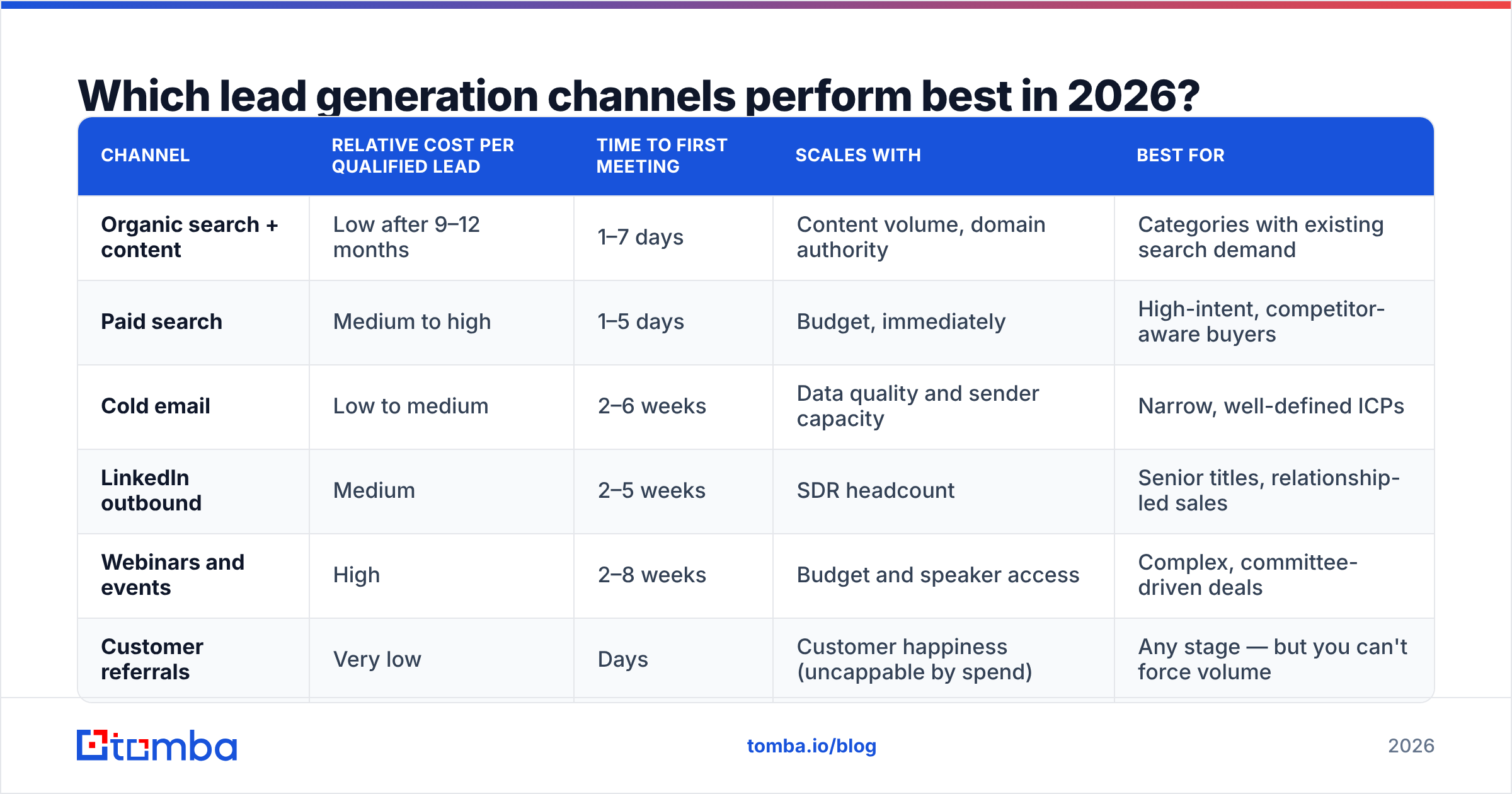
Directionally, here is how the main channels compare for a typical B2B SaaS team selling a $10k–$50k ACV product. Treat these as planning ranges, not guarantees — your category, geography, and brand strength move every number.
| Channel | Relative cost per qualified lead | Time to first meeting | Scales with | Best for |
|---|---|---|---|---|
| Organic search + content | Low after 9–12 months | 1–7 days | Content volume, domain authority | Categories with existing search demand |
| Paid search | Medium to high | 1–5 days | Budget, immediately | High-intent, competitor-aware buyers |
| Cold email | Low to medium | 2–6 weeks | Data quality and sender capacity | Narrow, well-defined ICPs |
| LinkedIn outbound | Medium | 2–5 weeks | SDR headcount | Senior titles, relationship-led sales |
| Webinars and events | High | 2–8 weeks | Budget and speaker access | Complex, committee-driven deals |
| Customer referrals | Very low | Days | Customer happiness (uncappable by spend) | Any stage — but you can't force volume |
The pattern worth internalizing: cheap channels are slow to build, fast channels are expensive, and the only channel that is both cheap and fast — referrals — cannot be turned up on demand. A serious program runs at least one of each type.
What does data quality have to do with lead generation?#
More than anything else on this page.
Every step downstream of your list inherits the list's error rate. If 25% of your emails are invalid, you are not just losing 25% of your reach. You are:
- Burning sender reputation, which suppresses inbox placement for the valid 75%
- Corrupting your reply-rate benchmarks, so you A/B test copy against noise
- Paying SDRs to chase people who left the company 14 months ago
- Triggering spam-trap hits that can land your sending domain on a blocklist
The fix is unglamorous: verify before you send. Running a list through an email verifier before the first send typically costs a fraction of a cent per record and protects an asset — your domain reputation — that takes months to rebuild once damaged.
What are the most common lead generation mistakes?#
- Counting contacts as leads. Covered above, and still the single most common error. It makes every other metric unreliable.
- Optimizing cost per lead instead of cost per opportunity. The cheapest leads are almost always the worst-fitting ones. Optimize the metric one stage deeper than the one you're tempted by.
- Buying static lists. B2B contact data decays at roughly 2–3% per month through job changes alone. A list purchased in January is meaningfully wrong by June and substantially wrong by December.
- Sending before warming. A brand-new domain sending 500 cold emails on day one will land in spam regardless of copy quality. Ramp volume over weeks.
- No agreed handoff SLA. If marketing passes an MQL and sales touches it four days later, conversion drops sharply. Speed of first response is one of the few levers with an outsized, consistently measurable effect.
- Personalizing the wrong thing. Mentioning someone's recent LinkedIn post is not relevance. Mentioning that they just hired three SDRs and you sell SDR tooling is relevance.
How do you measure lead generation properly?#
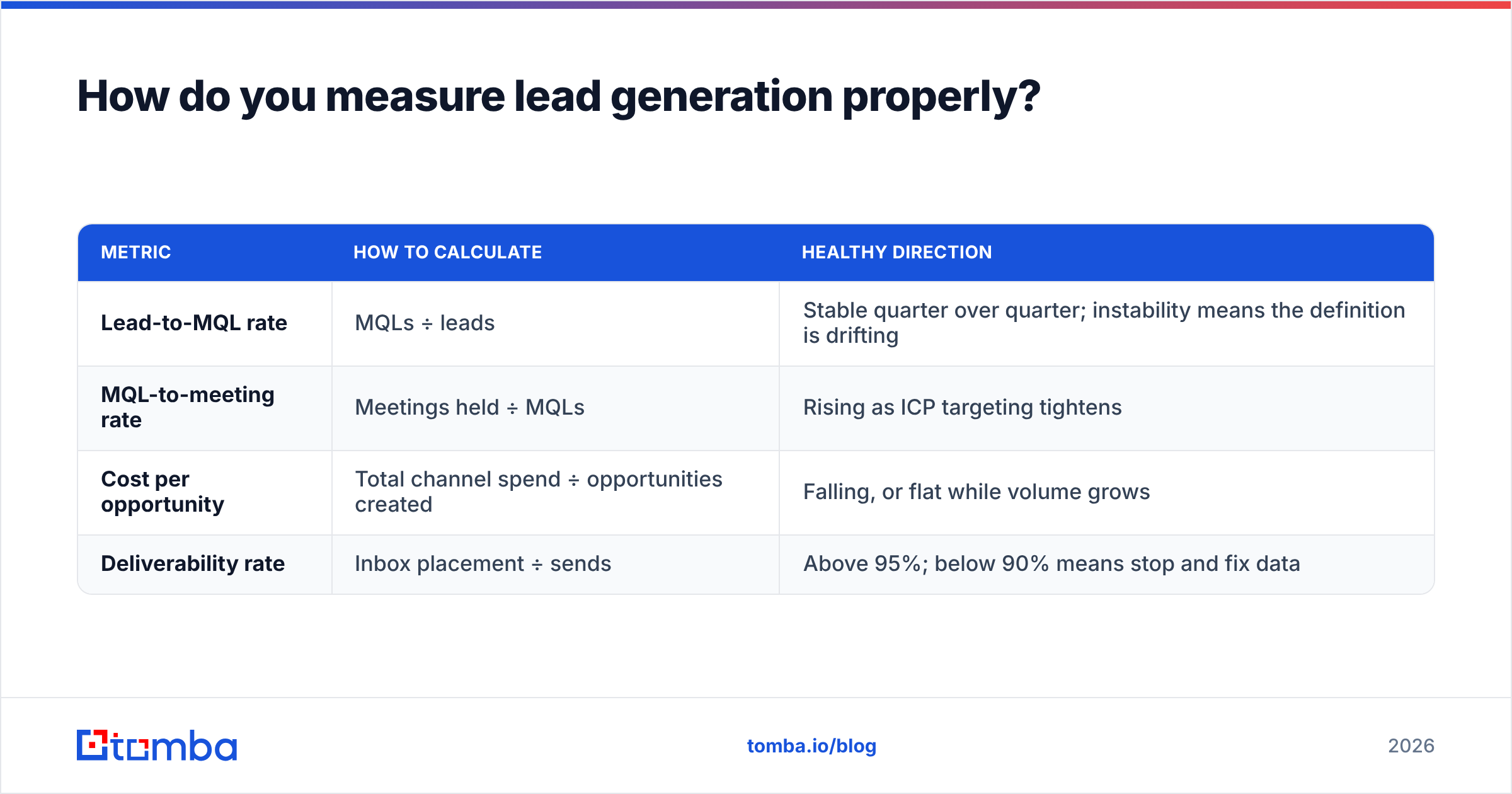
Track four numbers, at minimum, and track them per channel:
| Metric | How to calculate | Healthy direction |
|---|---|---|
| Lead-to-MQL rate | MQLs ÷ leads | Stable quarter over quarter; instability means the definition is drifting |
| MQL-to-meeting rate | Meetings held ÷ MQLs | Rising as ICP targeting tightens |
| Cost per opportunity | Total channel spend ÷ opportunities created | Falling, or flat while volume grows |
| Deliverability rate | Inbox placement ÷ sends | Above 95%; below 90% means stop and fix data |
If you can only track one, track cost per opportunity. It is the first metric in the chain that is difficult to game.
Where should you start?#
Start with the list, not the message. A great email to the wrong person is a worse investment than an average email to the right one — and the list is the cheaper thing to fix.
Define your ICP as a filter you can actually run. Pull the companies. Then find the specific decision-makers inside them and confirm those addresses resolve before a single send goes out. That's the unglamorous foundation every functioning lead generation program sits on.
Tomba's Email Finder handles that middle step — resolving named people at target domains and returning verified, source-backed addresses instead of guesses. The free tier gives you 25 searches a month to test it against a list you already know the answers to; paid plans start at $49/mo, with full pricing details if you're sizing it for a team. Run 50 of your current records through it and compare. If your existing data holds up, great — you've just validated your funnel. If it doesn't, you've found your bottleneck.
Related guides#
// get started
Find, verify and enrich your first contacts today
Start on the free plan with 25 searches a month, then scale when your team is ready.
Free plan · No credit card required · GDPR & CCPA
// about the author