Lead Generation Event Ideas: 17 Formats That Fill Pipeline
Most B2B events produce a badge-scan list, not pipeline. Here are 17 lead generation event ideas ranked by cost per qualified meeting, plus the follow-up system that decides whether any of them work.
TL;DR
- Events do not generate leads. Events generate conversations — the lead only exists after you capture a working email address and follow up inside 48 hours.
- The cheapest reliable formats in 2026 are small: executive dinners, customer-led roundtables, and teardown webinars. Cost per qualified meeting lands around $300–$900 versus $2,500+ for a mid-tier trade show booth.
- Trade shows still work, but only as account activation, not discovery. Build the target list before you buy the booth.
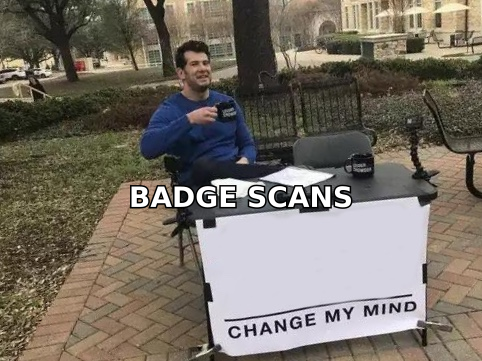
- Badge scans and QR lead-capture forms decay fast: personal Gmail addresses, typos, and gatekeeper aliases. Enrich and verify before the list touches your sequencer.
- The follow-up system matters more than the event format. A mediocre webinar with 48-hour personalized follow-up beats a great conference with a two-week-late blast.
Why do most lead generation events fail to produce pipeline?#
Because the scorecard is wrong. Marketing reports registrations and scans; sales reports meetings booked. The gap between those two numbers is where most event budgets die.
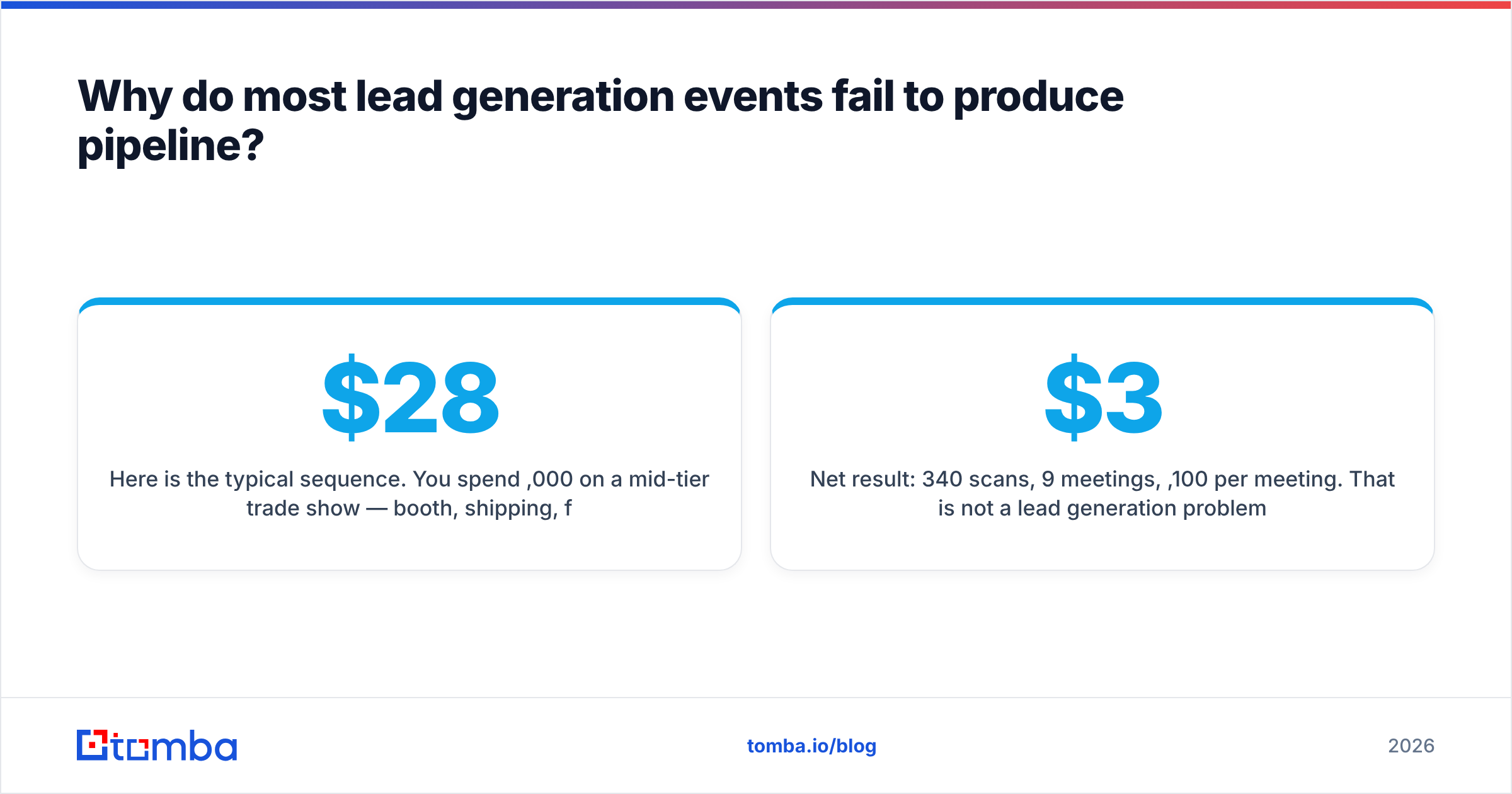
Here is the typical sequence. You spend $28,000 on a mid-tier trade show — booth, shipping, flights, staff time, swag. You collect 340 badge scans. Roughly 60% of those scans are people who wanted the branded water bottle. Of the remaining 136, maybe 40 are in your ICP. Your list has scanner-supplied email addresses that were typed at registration six weeks ago, and a meaningful chunk bounce. Sales gets the file eleven days later, by which time the attendees have been hit by forty other exhibitors.
Net result: 340 scans, 9 meetings, $3,100 per meeting. That is not a lead generation problem. That is a capture, hygiene, and speed problem.
The formats below are ordered by what they actually cost per qualified meeting, based on how B2B teams report event ROI. Treat the numbers as planning benchmarks, not promises — your ACV and category maturity swing them hard.
What are the highest-ROI lead generation event ideas?#
The best-performing formats share three traits: small audience, high intent, and a host who is not a salesperson. Here are seventeen, grouped by how they behave.
Intimate, high-intent formats (best cost per meeting):
- Executive dinners (8–14 seats) — Invite-only, one table, no presentation deck. Cost runs $250–$400 per head. Conversion to opportunity is unusually high because attendance itself is a qualification signal: a VP who blocks three hours on a Tuesday night has a budget problem.
- Customer-led roundtables — Your best customer hosts, you moderate, prospects ask them questions. You barely speak. This inverts the trust dynamic and produces the single highest close rate of any event type we see reported.
- Teardown / audit webinars — Live, unscripted critique of a real artifact: a landing page, an outbound sequence, a pricing page. Volunteers get free analysis, everyone else gets a benchmark. Registration intent is far above a generic "State of the Industry" panel.
- Peer benchmark briefings — You run a survey, then invite respondents to a 30-minute session where you show them where they rank. The data is the invitation. Respondents show up because they want their own score.
- Office-hours / AMA sessions — Recurring, 45 minutes, no slides, an expert answers whatever comes in. Cheap to run, compounding attendance, and the questions become your content calendar.
- Small-group workshops (bring-your-own-data) — Attendees arrive with their own numbers and leave with a completed worksheet. High effort, very high stickiness, and the worksheet doubles as a discovery document your AE can read before the first call.
Scale formats (higher volume, lower intent per contact):
- Trade show booths — Best used to compress travel: book 20 meetings with target accounts before the show, and treat walk-up scans as a bonus.
- Sponsored side events — A breakfast, happy hour, or 5K near a big conference. You get the conference's audience without the conference's price.
- Co-hosted webinars with a complementary vendor — You split promotion and split the list. The economics only work if the partner's audience genuinely overlaps yours.
- Virtual summits — Ten to twenty speakers, one day, gated replays. Great for list building, weak for immediate pipeline unless you segment by session attended.
- Awards programs and industry rankings — Nominations are a lead form with a flattering hat on. Nominees and voters both enter your database willingly.
- Certification courses — Multi-week, graded, badge at the end. Slow but produces advocates, not just leads.
Field and community formats:
- Local meetup sponsorship — Cheap, repeatable, and effective in regional markets where a national conference is irrelevant.
- Customer advisory boards — Technically retention, but CAB members generate referrals at a rate that outperforms most acquisition channels.
- Hackathons / build days — Only for developer-tool categories, where the product is the event.
- Executive site visits — Bring five prospects to a customer's facility. Logistically painful, extraordinarily persuasive.
- Podcast recording days — Interview twelve target-account executives in a booth at a conference. Every guest is now a warm relationship, and you keep the content.
How do these event formats compare on cost and conversion?#
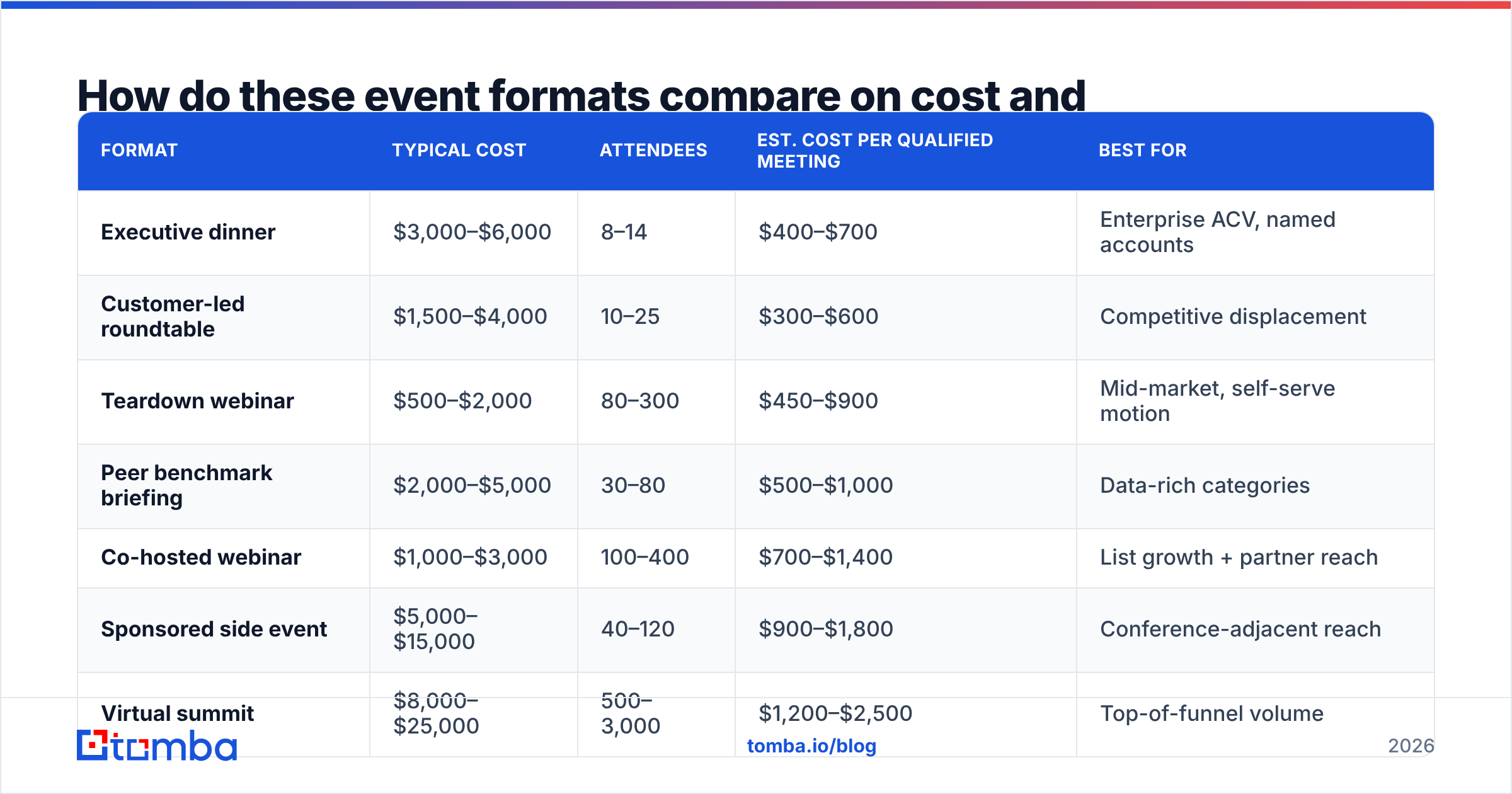
| Format | Typical cost | Attendees | Est. cost per qualified meeting | Best for |
|---|---|---|---|---|
| Executive dinner | $3,000–$6,000 | 8–14 | $400–$700 | Enterprise ACV, named accounts |
| Customer-led roundtable | $1,500–$4,000 | 10–25 | $300–$600 | Competitive displacement |
| Teardown webinar | $500–$2,000 | 80–300 | $450–$900 | Mid-market, self-serve motion |
| Peer benchmark briefing | $2,000–$5,000 | 30–80 | $500–$1,000 | Data-rich categories |
| Co-hosted webinar | $1,000–$3,000 | 100–400 | $700–$1,400 | List growth + partner reach |
| Sponsored side event | $5,000–$15,000 | 40–120 | $900–$1,800 | Conference-adjacent reach |
| Virtual summit | $8,000–$25,000 | 500–3,000 | $1,200–$2,500 | Top-of-funnel volume |
| Trade show booth | $20,000–$60,000 | 200–600 scans | $2,000–$4,000 | Brand presence, account activation |
Two things stand out. First, cost per meeting rises almost perfectly with audience size — intimacy is the variable that matters, not production value. Second, the expensive formats are not wrong; they simply do a different job. A trade show buys you category credibility and twenty pre-booked meetings. It does not buy you discovery.
How do you build the invite list before the event?#
This is the step teams skip, and it is the one that determines whether the event has an audience worth hosting.
An executive dinner needs roughly 8–14 attendees. To seat 12, you need about 35 acceptances-in-progress, which means 120–200 well-targeted invitations, which means a clean list of 200 named people with verified work emails and, ideally, direct phone numbers. "We'll post it on LinkedIn" is how you end up with four attendees, three of whom are vendors.
A workable build sequence:
- Define the seat criteria, not the persona. "VP Demand Gen at a Series B–C SaaS company in EMEA running outbound today" is a seat criterion. "Marketing leaders" is not.
- Source the accounts. Funding announcements, job postings for roles that imply your problem, technology installs, conference attendee lists, and competitor customer lists all work.
- Find the humans. Use a domain search to pull the contact structure of each target company, then run the specific names through an email finder to get the individual address.
- Verify before you send. Invitations to dead addresses damage your sending domain at exactly the moment you need it healthy. Run the list through an email verifier and drop anything that does not resolve.
- Add a second channel. For a 12-seat dinner, email alone will underperform. Pair it with LinkedIn and, for your top 30 names, a phone call — a phone finder makes that practical at list scale.
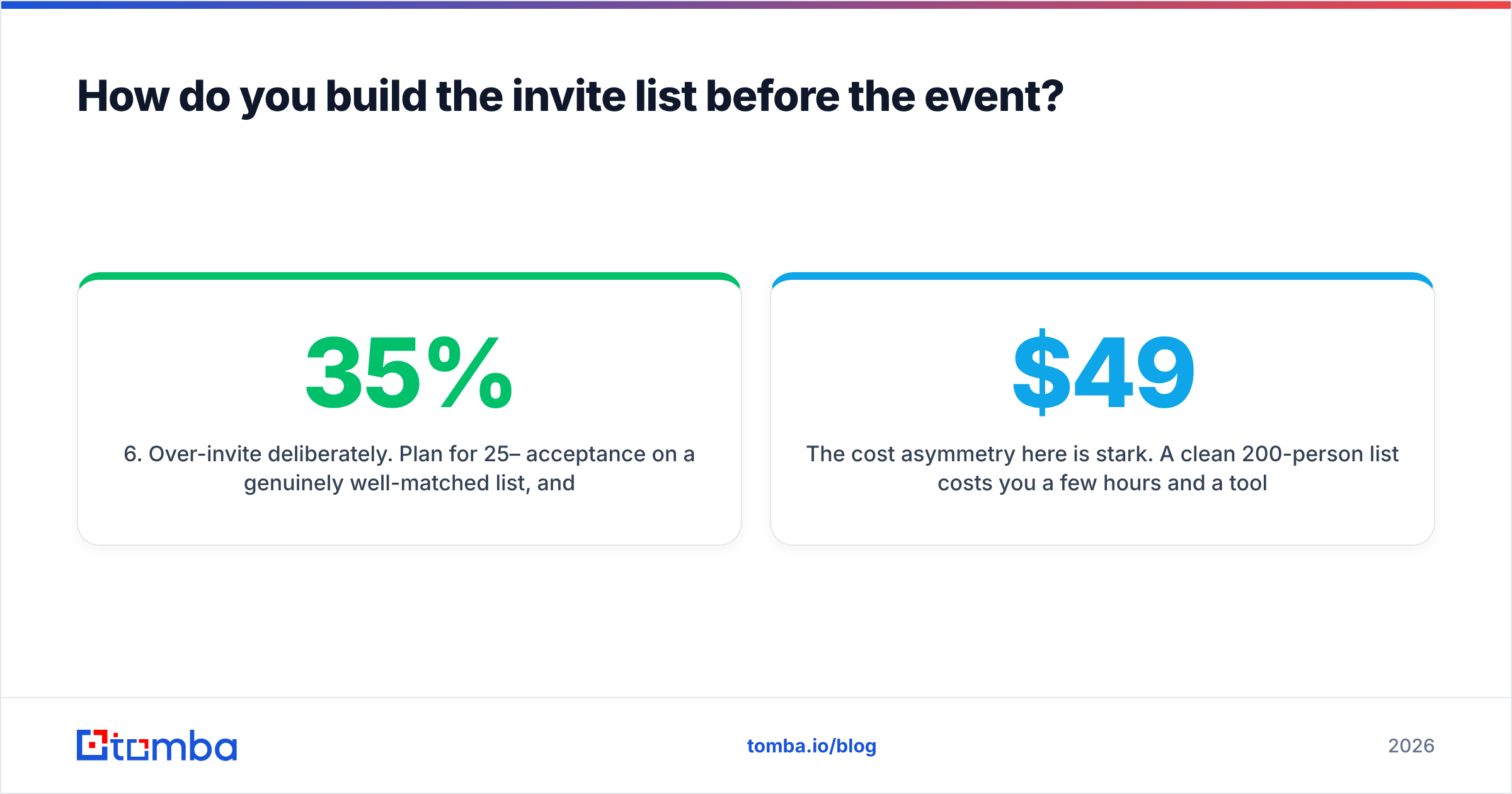
- Over-invite deliberately. Plan for 25–35% acceptance on a genuinely well-matched list, and 10–15% no-show on the night.
The cost asymmetry here is stark. A clean 200-person list costs you a few hours and a $49/mo tool subscription. A half-empty dinner costs you $4,000 and a reputational bruise with the three executives who did show up.
What do you do with the leads after the event?#
Follow-up speed is the highest-leverage variable in the entire event program, and almost nobody optimizes it.
Research on lead response consistently shows that contact and qualification rates collapse within hours, not days — HubSpot's sales data and similar vendor studies have hammered this point for a decade. For events, the decay is worse, because the attendee's memory of your conversation is the asset, and it fades overnight.
Run the post-event motion like this:
Hour 0–4 (same day): Export the capture list. Deduplicate it. Enrich missing fields — title, company size, LinkedIn URL — so your segmentation is not guesswork. This is where data enrichment earns its keep: badge scanners return an email and a name, and nothing you can actually route on.
Hour 4–24: Verify every address. Conference registration forms are typo factories, and roughly 5–15% of a scanned list is undeliverable on arrival. Sending to that list is how you get a well-run event followed by a deliverability incident. If your list has catch-all domains — common in enterprise — use a catch-all verifier rather than guessing.
Hour 24–48: Send tiered follow-ups. Three tiers, not one blast:
- Tier 1 (you had a real conversation): Individual email, written by the person who spoke to them, referencing the specific thing they said. No template. Twenty of these, maximum.
- Tier 2 (attended, didn't speak deeply): Short sequence referencing the session they attended and the one resource that matches it.
- Tier 3 (registered, didn't attend): Recording plus a one-line "here's the 90 seconds that matter" note. These convert better than people expect — no-shows are often high-intent people with calendar conflicts.
Day 3–14: Route Tier 1 to AEs with full context. Everything else goes to nurture with an event-specific tag so you can measure the format six months from now.
Which event format should you pick for your situation?#
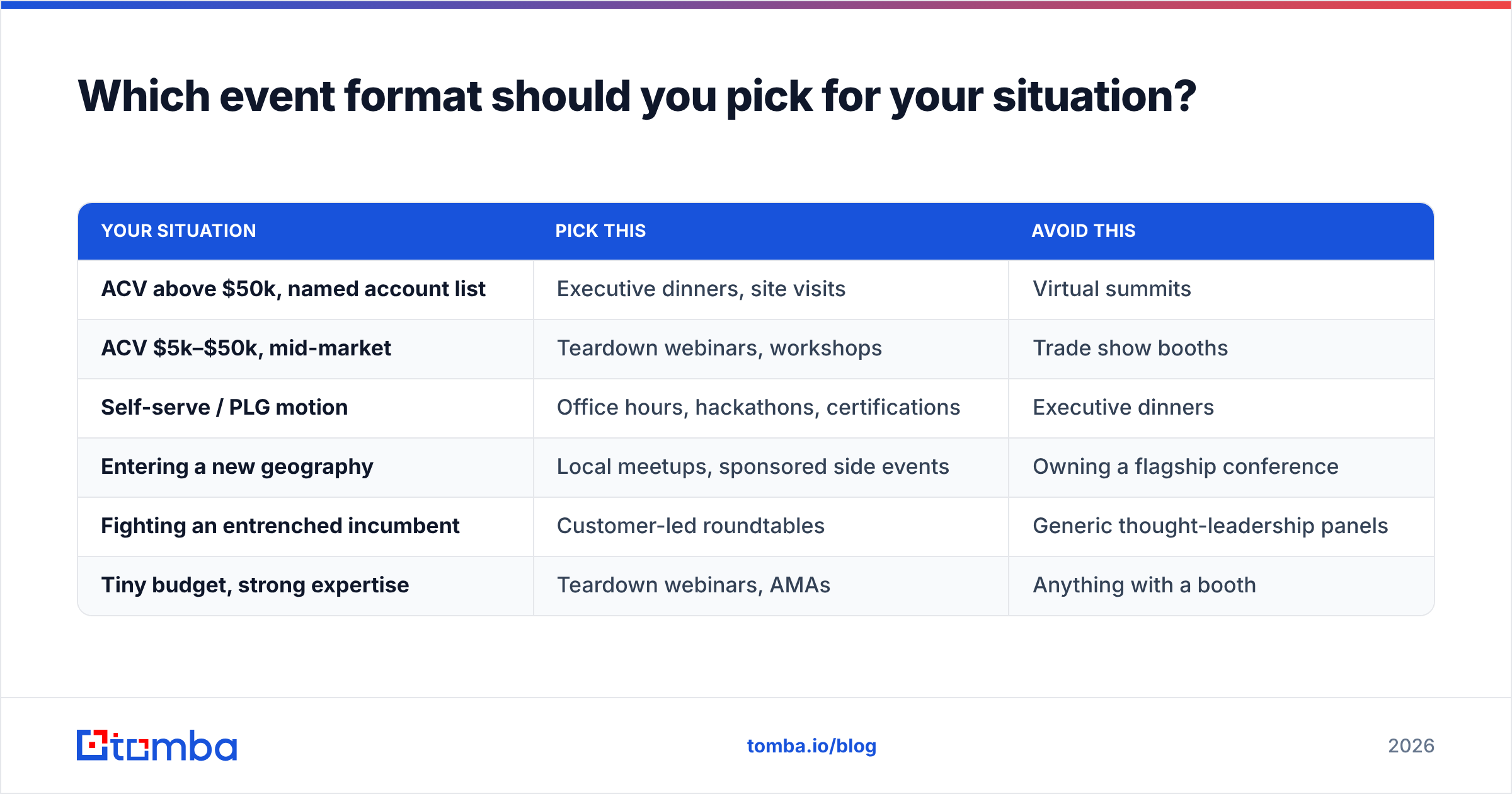
Match the format to your deal size and sales motion, not to what your competitor did last quarter.
| Your situation | Pick this | Avoid this |
|---|---|---|
| ACV above $50k, named account list | Executive dinners, site visits | Virtual summits |
| ACV $5k–$50k, mid-market | Teardown webinars, workshops | Trade show booths |
| Self-serve / PLG motion | Office hours, hackathons, certifications | Executive dinners |
| Entering a new geography | Local meetups, sponsored side events | Owning a flagship conference |
| Fighting an entrenched incumbent | Customer-led roundtables | Generic thought-leadership panels |
| Tiny budget, strong expertise | Teardown webinars, AMAs | Anything with a booth |
A note on lists: for formats where you need volume fast — a virtual summit, a large webinar — some teams buy a seed list. If you go that route, buy from vendors with transparent sourcing and verification guarantees. BookYourData is one of the more rigorous options in that space, and pairing any purchased list with your own verification pass is non-negotiable regardless of who you buy from. Peer review sites like G2 are useful for sanity-checking vendor claims before you commit budget.
How do you measure whether an event actually worked?#
Stop reporting attendance. Report these five instead:
- Qualified meetings booked within 14 days — the only number that correlates with revenue.
- Cost per qualified meeting — total event cost including staff hours, divided by the above.
- Pipeline created within 90 days — attributed to the event as first or significant touch, not last.
- Contact validity rate — percentage of captured addresses that verified clean. Under 85% means your capture method is broken.
- Repeat attendance rate — for recurring formats, this is the leading indicator. People come back to things that were worth their time.
Build a simple attribution habit: tag every contact with the event slug at capture time, before it enters your CRM. Six months later, you will be able to answer "did the dinner series work?" with a number instead of a vibe. Most teams cannot, which is why event budgets get cut in the first bad quarter and then get restored the next year without anyone learning anything.
One more measurement trap: do not judge an intimate format on volume. A dinner that produces three opportunities from twelve attendees is outperforming a summit that produces eleven from two thousand registrants — on every metric that matters except the one on the slide.
What are the most common event lead-gen mistakes?#
- Treating the capture form as the finish line. A scan is raw material. It becomes a lead after enrichment and verification.
- Sending one blast to everyone. The person who debated your roadmap for twenty minutes and the person who scanned for a tote bag should not receive the same email.
- Waiting for the "full report." Ship the Tier 1 emails from the hotel lobby. The report can wait.
- Booking the booth before building the account list. Reverse the order. The list tells you whether the booth is worth buying.
- Skipping verification because "they just gave us the address." Registration typos, personal addresses, and role-based aliases all sneak in. Verify anyway.
- No second event. Single events underperform series. The third executive dinner in a city always outperforms the first, because word travels.
Where does list quality fit into all of this?#
Underneath every format above sits the same dependency: a list of real people with real, reachable contact details. The dinner invitation, the webinar promotion, the post-show follow-up, the nurture track — all of it collapses if the addresses are wrong.
That is the part you can control with tooling. Build the target list with domain search and the Tomba Email Finder, clean it with email verification, and enrich the post-event capture file so your segmentation is based on facts rather than whatever someone typed into a registration form at 11pm. Tomba's free tier covers 25 searches a month if you want to test the workflow on a single dinner invite list; the Starter plan runs $49/mo and the Growth plan $99/mo when you scale to a full event calendar — full Tomba pricing is public.
Pick one format from the table above, build a 200-name verified invite list this week, and run it. Then run it again in the same city ninety days later. Two well-executed intimate events will teach you more about your market than a year of booth rentals — and you will finally have the contact data to prove which one worked.
Start with the Tomba Email Finder to turn your target account list into verified, invitable contacts before you book the venue.
Related guides#
// get started
Find, verify and enrich your first contacts today
Start on the free plan with 25 searches a month, then scale when your team is ready.
Free plan · No credit card required · GDPR & CCPA
Get the Tomba newsletter
Product and data updates
// about the author