Lead Generation for Advertising Agencies: 2026 Playbook
Referrals dried up, RFPs went to procurement, and inbound slowed. Here's how advertising agencies actually build a predictable pipeline in 2026 — channels, math, and tooling compared.
TL;DR
- Referral-only pipelines break the moment one client churns. Agencies that grew through 2025–2026 all added a second, controllable channel — usually targeted outbound plus a narrow content niche.
- Your realistic math: to close 2 new retainers a quarter at a 3% reply-to-meeting rate, you need roughly 1,200–1,600 verified contacts per quarter. Not 10,000. Not 200.
- Targeting beats volume. An agency that pitches "SaaS Series B, 15–60 headcount, hiring a demand gen manager" out-converts one pitching "marketing services" by 4–6x.
- The unsexy bottleneck is data: bounced emails kill your domain before your offer ever gets judged. Verify before you send, always.
- Budget reality: a working outbound stack for a 10-person agency runs $250–$600/month all-in, not the $2,000+ enterprise quotes you've been shown.
Why is lead generation for advertising agencies so much harder now?#
Because the three channels that built most agencies — referrals, RFPs, and "we rank for 'branding agency NYC'" — all degraded at once.
Referrals still work, but they're lumpy and uncontrollable. You cannot forecast off them. Every agency owner has lived the quarter where two referrals landed in week one and nothing came for eleven weeks.
RFPs got worse specifically. Procurement now runs most mid-market agency selection, which means you're competing on paper against six shops with better-looking decks and a lower rate card. Win rates on cold RFPs sit in the single digits for most independents. If you're not already on the shortlist before the RFP drops, you're providing free competitive benchmarking.
And organic search for agency terms is brutal. "Digital marketing agency" SERPs are owned by directories, aggregators, and agencies with a decade of domain authority. You're not outranking Clutch.
What's left is the channel you control: going directly to a defined set of companies and starting a conversation. That's the core of lead generation for advertising agencies in 2026 — not because outbound is fashionable, but because it's the only input where you set the volume.

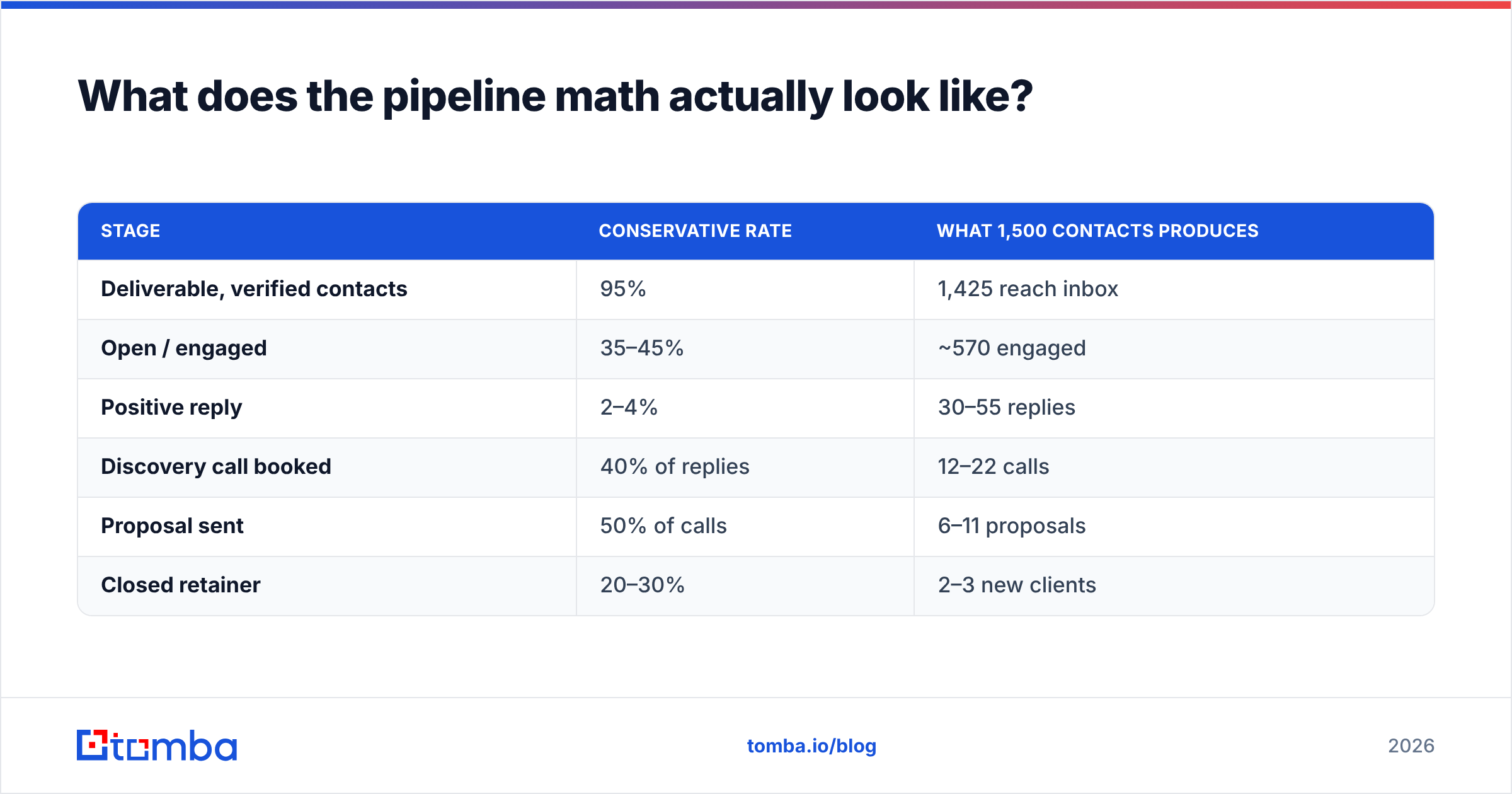
What does the pipeline math actually look like?#
Work backwards from retainers, not from activity. Here's the model most agencies land on once they measure honestly:
| Stage | Conservative rate | What 1,500 contacts produces |
|---|---|---|
| Deliverable, verified contacts | 95% | 1,425 reach inbox |
| Open / engaged | 35–45% | ~570 engaged |
| Positive reply | 2–4% | 30–55 replies |
| Discovery call booked | 40% of replies | 12–22 calls |
| Proposal sent | 50% of calls | 6–11 proposals |
| Closed retainer | 20–30% | 2–3 new clients |
Two things fall out of this table immediately.
First, the leak that matters most is the top. A 15% bounce rate doesn't just waste 15% of your list — it damages your sending domain, which pushes the next campaign's inbox placement down, which compounds. One bad list can cost you a quarter.
Second, you do not need enormous volume. A 10-person agency closing 2–3 retainers a quarter from 1,500 well-chosen contacts is a healthy machine. Agencies that blast 20,000 generic contacts get worse absolute results because reply rates collapse toward zero and their domain gets throttled.
Run your own version of this table with your actual close rate. If you've never measured proposal-to-close, use 25% and correct it after a quarter.
Which channels are worth building in 2026?#
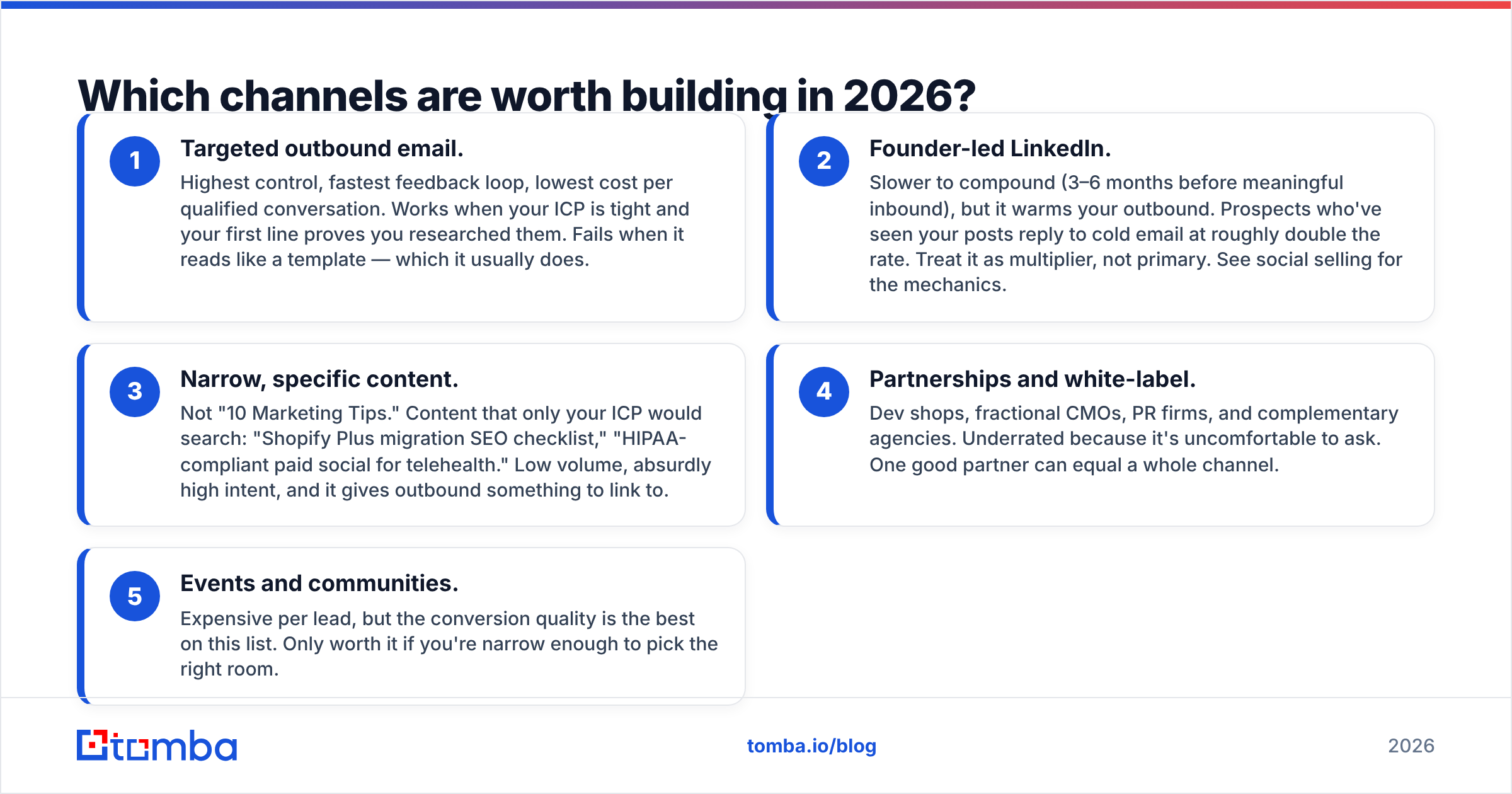
Five, ranked by controllability for a small-to-mid agency:
- Targeted outbound email. Highest control, fastest feedback loop, lowest cost per qualified conversation. Works when your ICP is tight and your first line proves you researched them. Fails when it reads like a template — which it usually does.
- Founder-led LinkedIn. Slower to compound (3–6 months before meaningful inbound), but it warms your outbound. Prospects who've seen your posts reply to cold email at roughly double the rate. Treat it as multiplier, not primary. See social selling for the mechanics.
- Narrow, specific content. Not "10 Marketing Tips." Content that only your ICP would search: "Shopify Plus migration SEO checklist," "HIPAA-compliant paid social for telehealth." Low volume, absurdly high intent, and it gives outbound something to link to.
- Partnerships and white-label. Dev shops, fractional CMOs, PR firms, and complementary agencies. Underrated because it's uncomfortable to ask. One good partner can equal a whole channel.
- Events and communities. Expensive per lead, but the conversion quality is the best on this list. Only worth it if you're narrow enough to pick the right room.
Paid ads for agency services is usually a trap. You're bidding against agencies who are better at ads than you are, for a service with a long sales cycle and no impulse purchase. Some agencies make it work with a productized offer and a lead magnet; most burn $6k learning they can't.
How do you define an ICP tight enough to actually target?#
Vague ICPs are the number one reason agency outbound fails. "B2B companies who need better marketing" is not targetable. Here's the filter set that is:
- Firmographic floor and ceiling. Headcount 15–200, revenue $2M–$50M. Below the floor they can't afford a retainer; above the ceiling they have an in-house team and a procurement process.
- A trigger event. They just raised, just hired a VP Marketing, just launched a product, just got acquired, or just lost their agency. Triggers are what make cold email feel timely instead of random.
- A technology signal. They run HubSpot but no marketing automation sequences. They're on Shopify but not Shopify Plus. Tech stack tells you what problem they already admitted to.
- A visible gap you can name. Their blog stopped in 2024. They run Meta ads with no landing page. Their careers page lists a demand gen role open for 90 days.
- A named human. Not
info@. The VP Marketing, Head of Growth, or the founder at sub-40 headcount. One wrong seniority level and your reply rate halves.
Stack three of those five and your list gets small — 300 to 800 companies. That's correct. A list you could personalize in a week is a list that converts.
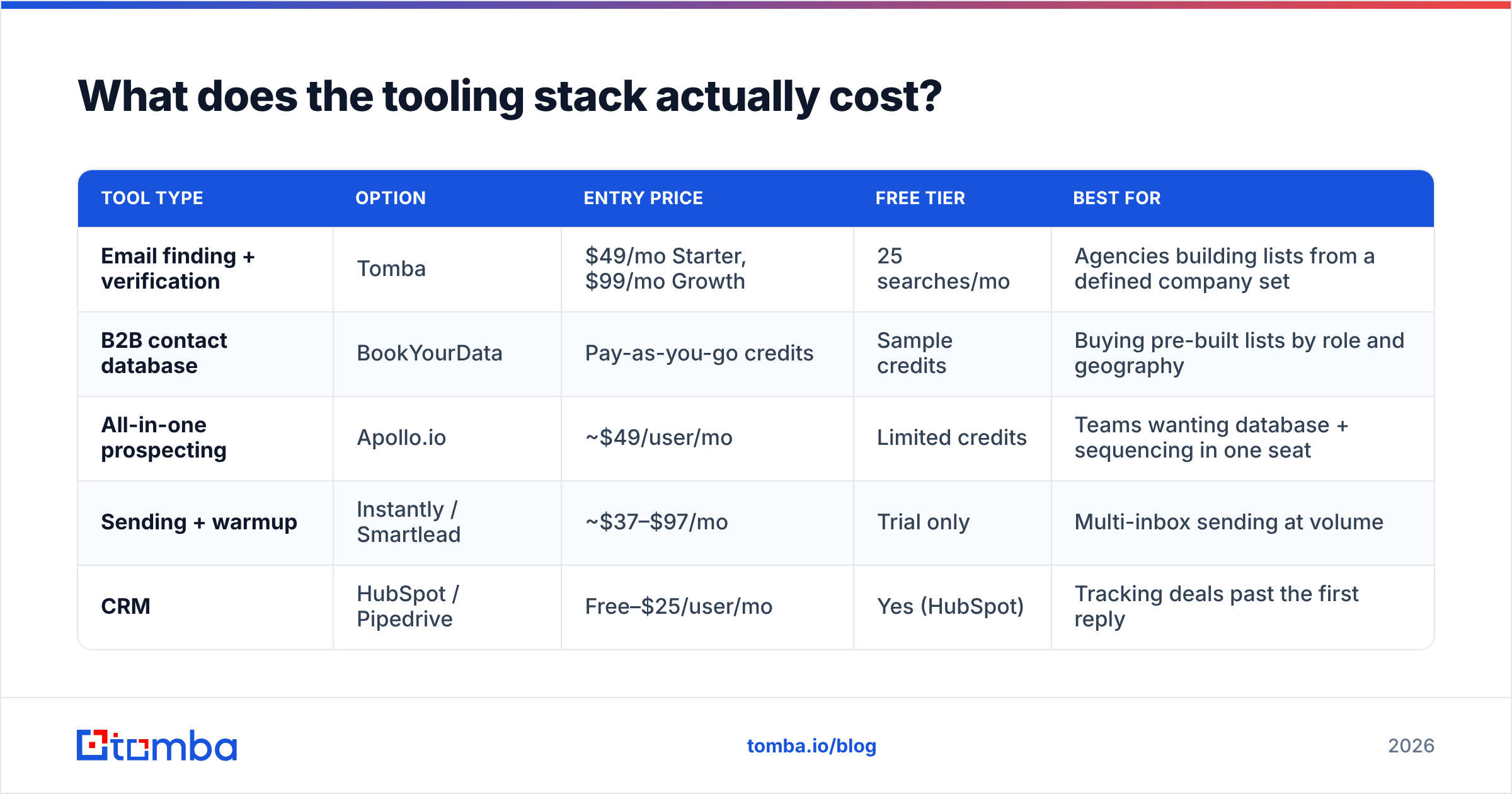
What does the tooling stack actually cost?#
Here's the honest comparison of what agencies use to build and send. Prices are entry-tier as of 2026 and change; check each vendor before you commit.
| Tool type | Option | Entry price | Free tier | Best for |
|---|---|---|---|---|
| Email finding + verification | Tomba | $49/mo Starter, $99/mo Growth | 25 searches/mo | Agencies building lists from a defined company set |
| B2B contact database | BookYourData | Pay-as-you-go credits | Sample credits | Buying pre-built lists by role and geography |
| All-in-one prospecting | Apollo.io | ~$49/user/mo | Limited credits | Teams wanting database + sequencing in one seat |
| Sending + warmup | Instantly / Smartlead | ~$37–$97/mo | Trial only | Multi-inbox sending at volume |
| CRM | HubSpot / Pipedrive | Free–$25/user/mo | Yes (HubSpot) | Tracking deals past the first reply |
A realistic 10-person agency stack: a finder/verifier ($49–$99), a sending tool ($37–$97), a CRM (free tier is fine to start), and inbox infrastructure for a secondary sending domain ($20). Call it $250–$600/month depending on volume. Anyone quoting you $2,500/month for "agency growth software" is selling you seats you won't use.
Note the split worth understanding: a database sells you pre-built contact lists, useful when you want breadth fast. A finder resolves contacts for companies you've already chosen, useful when your ICP is narrow and specific. Most agencies need the second more than the first, and many end up using both — database for breadth, finder for the accounts that actually matter.
How do you build the list without wrecking your domain?#
This is the operational core, and it's where most agency outbound dies quietly.
Step 1 — Build the company list. Start from your trigger and firmographic filters. Funding announcements, job boards, tech-stack lookups, association member directories, conference attendee lists. Aim for 300–800 companies, not 5,000.
Step 2 — Find the right person. Use domain search to pull the contacts at a company and see which roles are actually present, then narrow to the one decision-maker. If you're working from LinkedIn profiles, a LinkedIn finder resolves the profile to a work email directly.
Step 3 — Verify everything before it enters your sequence. Non-negotiable. Run every address through an email verifier and drop anything that isn't a confirmed deliverable. Catch-all domains need their own handling — they accept everything at the SMTP layer and tell you nothing, which is why a dedicated catch-all verifier matters when a big chunk of your ICP runs Microsoft 365 with catch-all enabled.
Step 4 — Set up sending infrastructure properly. Buy a secondary domain (yourAgencyHQ.com, not your primary). Configure SPF, DKIM, and DMARC. Warm each inbox for 2–3 weeks before real sends. Cap at 30–40 emails per inbox per day. Google's Postmaster Tools will show you your reputation — check it weekly, and treat any dip below "High" as a stop-sending signal. Microsoft and Google both tightened bulk-sender requirements in 2024–2025, and enforcement only got stricter; the sender reputation rules are not suggestions anymore.
Step 5 — Enrich for personalization. A first line that references their actual situation is the entire ballgame. Data enrichment gives you role, company size, and tech signals to build a reference that isn't "I loved your website."
What should agency cold email actually say?#
Three rules, in order of impact.
Lead with their problem, not your services. "You've got Meta ads running to your homepage" beats "We're a full-service performance agency." The first proves you looked. The second proves you have a template.
Make the ask absurdly small. Not a 30-minute discovery call. Ask whether they'd like the 4-point teardown you already wrote. Agencies that lead with a specific piece of free work — an audit, a competitor breakdown, three ad concepts — book 2–3x more meetings than agencies asking for calendar time upfront. The work is the proof.
Keep it under 90 words and follow up four times. Most agency replies come on touches 2–4, not touch 1. Each follow-up should add something — a case study, a second observation, a relevant benchmark — not just "bumping this."
What doesn't work in 2026: fake personalization tokens, "I noticed you're hiring" when they're hiring for a warehouse role, AI-generated compliments about their "impressive growth trajectory," and any subject line containing the word "quick." Buyers pattern-match on these instantly. Your response rate is mostly a function of how obviously templated you look in the first 10 words.
One more thing agencies get wrong: pitching the retainer in email one. You're not selling a $8k/month engagement over cold email. You're selling a 20-minute conversation about a specific problem. Sell the next step only.
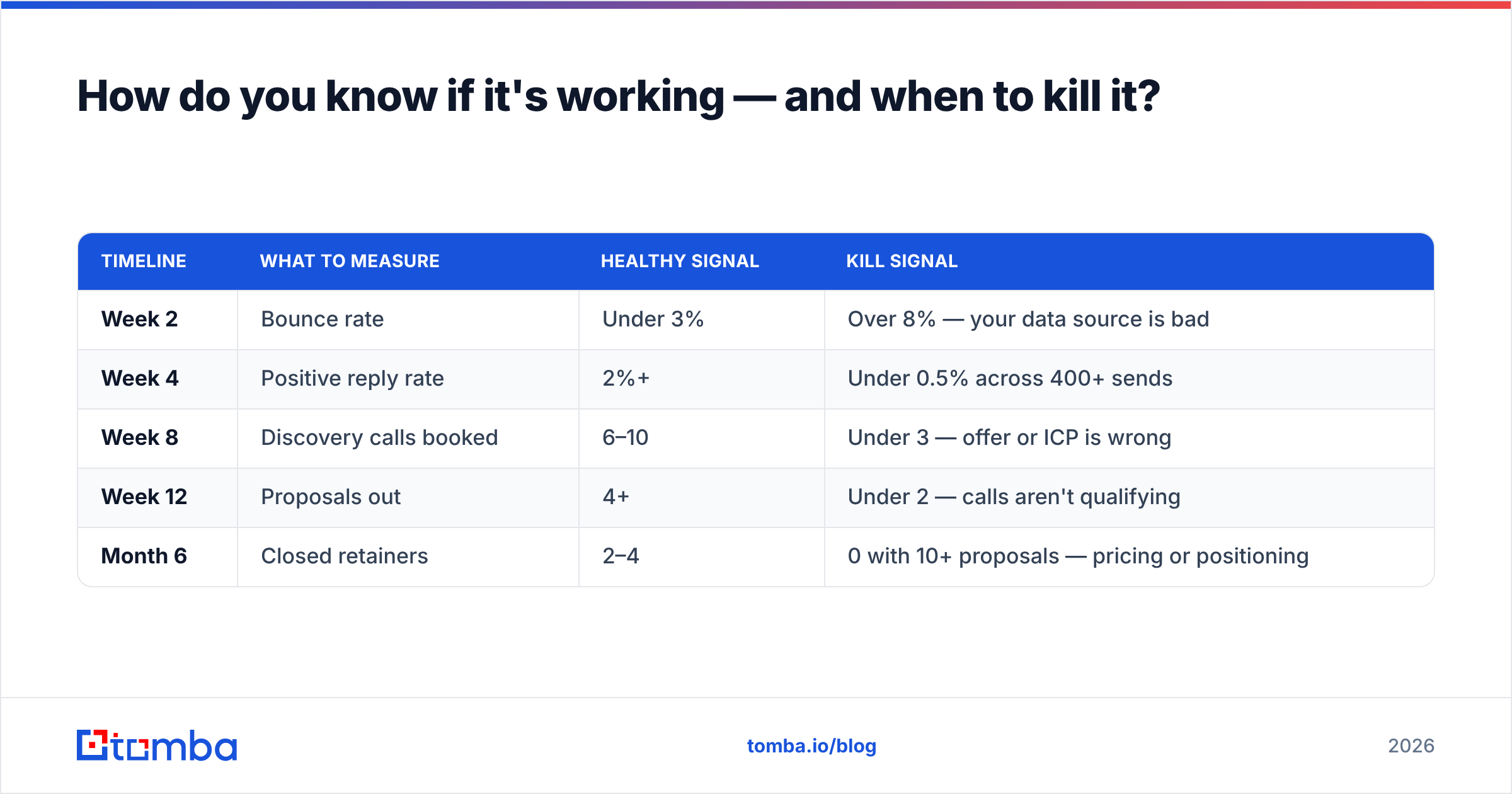
How do you know if it's working — and when to kill it?#
Set checkpoints so you don't quit at week three or grind a dead channel for a year.
| Timeline | What to measure | Healthy signal | Kill signal |
|---|---|---|---|
| Week 2 | Bounce rate | Under 3% | Over 8% — your data source is bad |
| Week 4 | Positive reply rate | 2%+ | Under 0.5% across 400+ sends |
| Week 8 | Discovery calls booked | 6–10 | Under 3 — offer or ICP is wrong |
| Week 12 | Proposals out | 4+ | Under 2 — calls aren't qualifying |
| Month 6 | Closed retainers | 2–4 | 0 with 10+ proposals — pricing or positioning |
If replies are low but bounces are fine, the problem is your message or your ICP — not your volume. Doubling send volume on a broken message just burns more of your list. Fix the message on the next 200 contacts before scaling.
If replies are good but calls don't convert to proposals, your email is overselling relative to what you deliver on the call. Tighten the promise.
If proposals don't close, it's usually pricing structure or a missing case study in their exact vertical, not your outbound at all. Track win rate by vertical and you'll see the pattern within two quarters.
Independent benchmarks are worth checking against your own numbers — G2's category data and vendor-published cold email benchmarks give you a rough outside view, though treat any single published reply-rate stat skeptically since methodologies vary wildly.
What's the 90-day build plan?#
Days 1–15: Define and equip. Write your ICP with three hard filters. Buy your secondary domain and start warming inboxes. Pick your finder/verifier and sending tool. Write one offer — one vertical, one problem, one deliverable.
Days 16–30: Build list one. 300 companies, one named contact each, all verified. Write the sequence: four touches, 90 words each, one specific observation per prospect. Test send to yourself and three colleagues.
Days 31–60: Send and measure. 30–40 emails per inbox per day. Track bounce, reply, and meeting rate weekly. Rewrite the sequence once at day 45 based on what actually got replies — not what you think should have.
Days 61–90: Double down or pivot. If reply rate cleared 2%, build list two at 2x size with the same message. If it didn't, change one variable — the vertical, the offer, or the seniority you're targeting. Change one, not all three, or you'll learn nothing.
Meanwhile, keep referrals and partnerships running. Outbound isn't a replacement for the channels that already work; it's the one you add so a slow referral quarter stops being an emergency.
Where to start#
Pick the vertical you've won in twice before, list the 300 companies in it that match your filters, and find the one person at each who owns the budget. That list — small, specific, verified — is worth more than any tool you could buy.
When you're ready to build it, the Tomba Email Finder resolves named contacts at your target companies and verifies them before they reach your sequence, so your first campaign doesn't cost you your sending reputation. Start on the free tier with 25 searches to test your ICP, and check Tomba pricing when your list outgrows it — Starter runs $49/mo and Growth $99/mo, which is roughly what one bad month of a dead RFP process costs you in unbilled hours.
Related guides#
// get started
Find, verify and enrich your first contacts today
Start on the free plan with 25 searches a month, then scale when your team is ready.
Free plan · No credit card required · GDPR & CCPA
// about the author