Lead Generation for Agents: The 2026 Playbook That Works
Most agents measure leads by volume and lose money on cost per closed deal. Here are the seven channels that actually work in 2026, ranked by real economics, plus the build-your-own-list method that beats buying shared leads.
TL;DR
- Volume is the wrong metric. Rank every channel by cost per closed deal, not cost per lead — a $12 shared lead that closes at 1.5% is more expensive than a $60 self-sourced contact that closes at 9%.
- Referrals and past-client reactivation still beat every paid channel on economics, but they don't scale past roughly 40–60 deals a year without a second engine.
- The most underrated engine for independent agents is building your own contact list from public firmographic signals, then verifying it — not buying a shared-lead subscription.
- Response rate collapses when list quality drops. A 4–6% bounce rate is the point where mailbox providers start throttling you, so verification is not optional.
- Budget 12–16 touches across email, phone, and one social channel before you call a lead dead. Most agents quit at three.
What does "lead generation for agents" actually mean in 2026?#
"Agent" is doing a lot of work in that phrase, so let's scope it. This guide covers commission-driven professionals who own their own pipeline: real estate agents, insurance and benefits agents, recruitment and staffing agents, freight and logistics agents, manufacturers' reps, and independent travel and talent agents. What unites them is a specific problem shape — you carry personal quota, you have a small or nonexistent marketing budget, and nobody hands you a territory list.
A quick note on the other meaning: if you searched this term looking for how to generate leads with AI agents, that's a different topic. Autonomous research agents can help you build lists faster (see the last section), but they don't change the underlying economics. The channel math below applies either way.
The core distinction that matters more than any tool choice:
- Inbound leads come to you — portal inquiries, website forms, referrals. High intent, low control, and you're usually competing with 3–5 other agents for the same person.
- Outbound leads you go and get — targeted email, cold calls, LinkedIn, direct mail. Lower intent per contact, total control over volume and targeting.
- Owned audience is the compounding asset — your past clients, your newsletter list, your sphere of influence. Cheapest per deal, slowest to build.
- Purchased leads are someone else's inbound, resold. Fast to start, worst unit economics, and the quality varies enormously by vendor.
- Partner and referral channels — lenders, adjusters, accountants, complementary agents — sit between owned and outbound and are the most consistently underbuilt.
Almost every struggling agent is over-indexed on category four and has never seriously built category two or five.
Why do most agent lead-gen channels fail the math test?#
Because agents track cost per lead, and cost per lead is a vanity number.
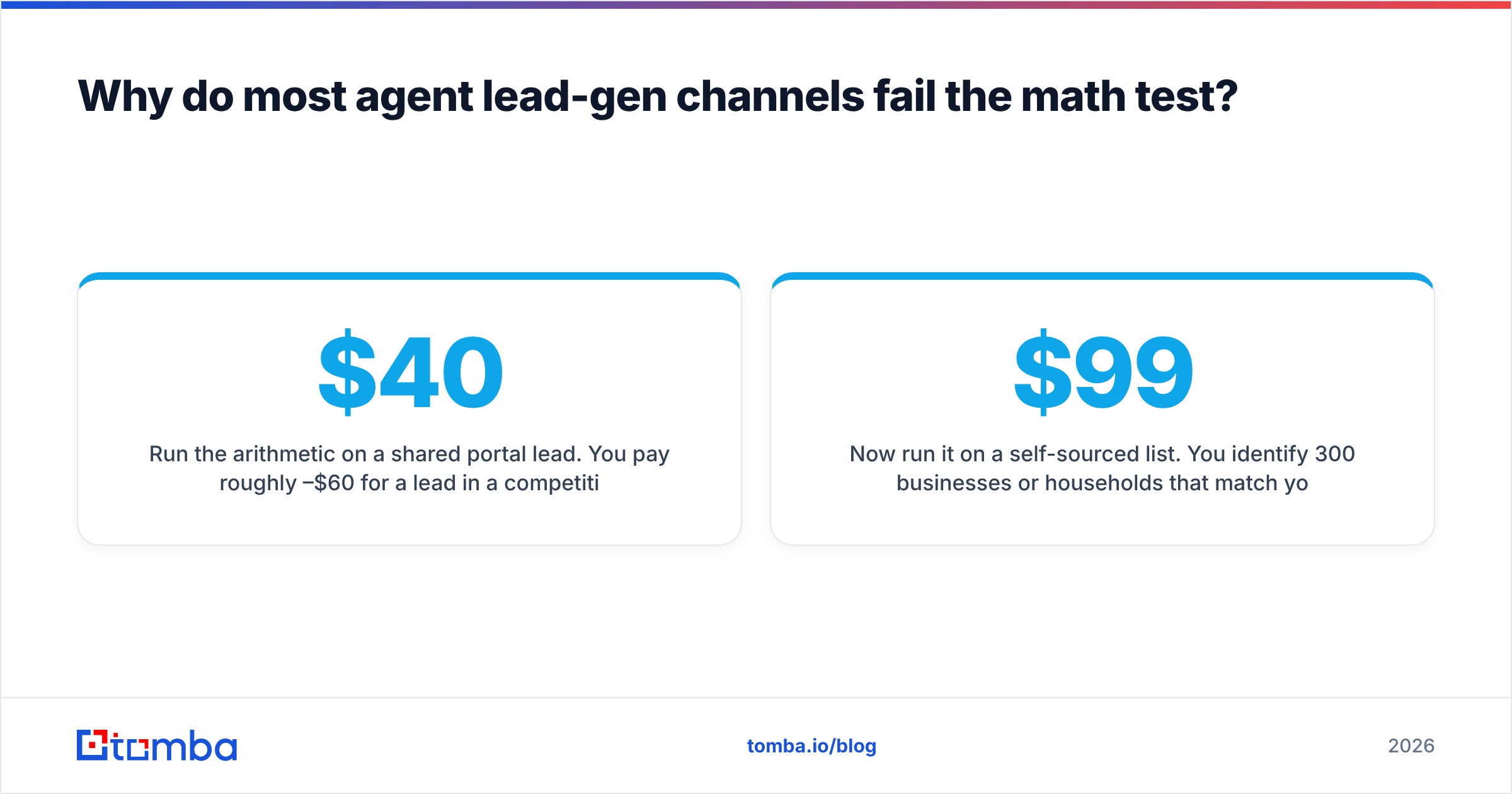
Run the arithmetic on a shared portal lead. You pay roughly $40–$60 for a lead in a competitive metro. That lead was sold to four other agents. Your realistic close rate is 1.5–3%. At 2%, you need 50 leads to close one deal, which means $2,000–$3,000 in acquisition cost before you account for the eight hours of chasing. If your average commission is $7,500, you've handed 30% of it to the portal.
Now run it on a self-sourced list. You identify 300 businesses or households that match your actual best-fit profile, find and verify contact details, and run a real sequence. Your data cost might be $99 for the month. Your close rate on a well-targeted, non-competed contact typically lands between 5% and 12% depending on vertical. Even at the pessimistic end, you're closing 15 deals from that list over a year at a fraction of the per-deal cost.
The National Association of Realtors has reported for years that referrals and repeat business account for a plurality of transactions — which is the same finding in different clothing. The channels where you own the relationship win.
The second reason channels fail: agents run them for six weeks. Outbound has a lag. A cold sequence started in January produces meetings in March and closings in May. Most agents kill the channel in February and conclude "cold email doesn't work in my market."
Which lead generation channels work best for agents?#
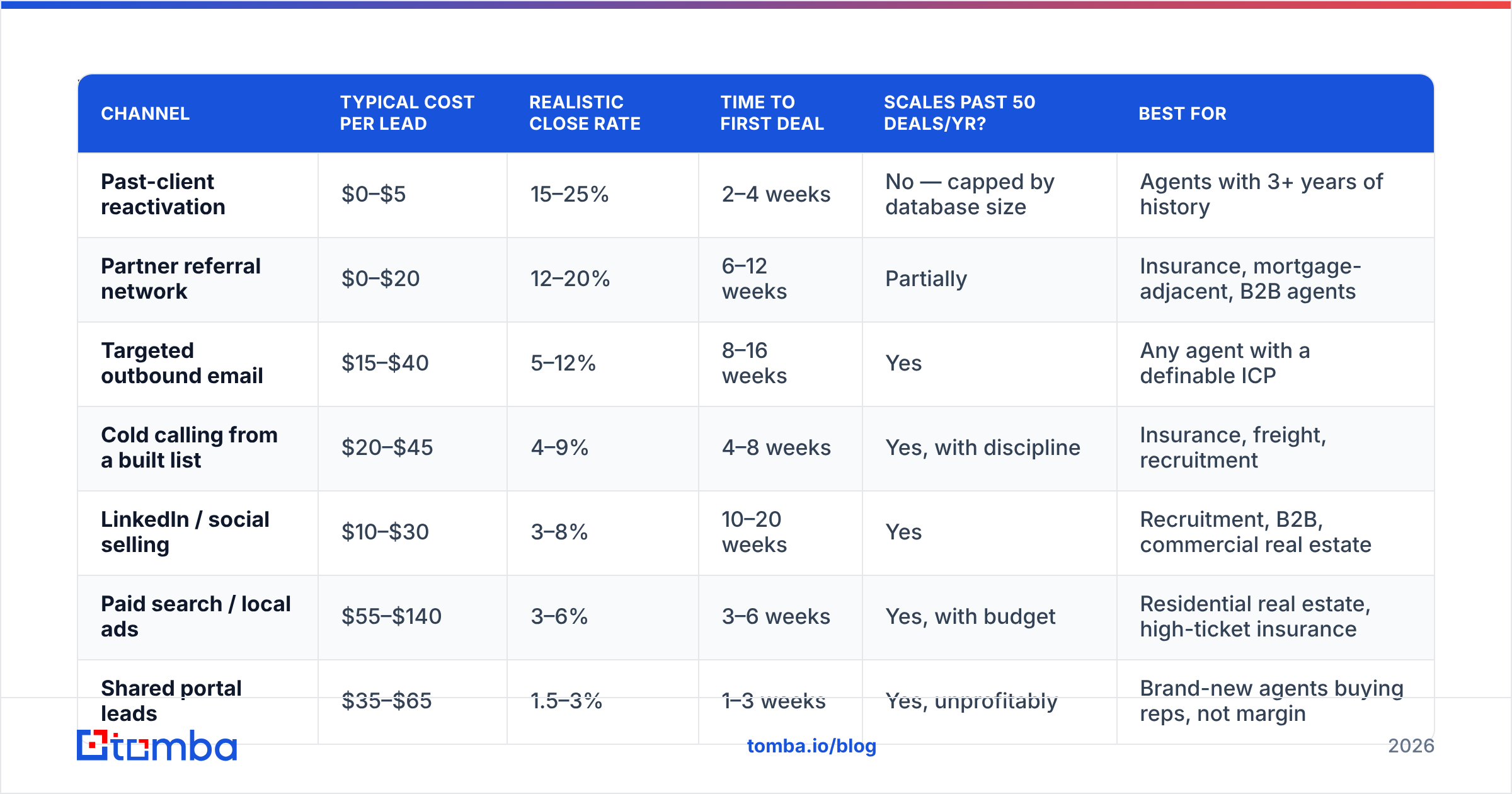
Here is the honest ranking. Costs assume a solo agent or a two-person team in a mid-size market; adjust up for major metros.
| Channel | Typical cost per lead | Realistic close rate | Time to first deal | Scales past 50 deals/yr? | Best for |
|---|---|---|---|---|---|
| Past-client reactivation | $0–$5 | 15–25% | 2–4 weeks | No — capped by database size | Agents with 3+ years of history |
| Partner referral network | $0–$20 | 12–20% | 6–12 weeks | Partially | Insurance, mortgage-adjacent, B2B agents |
| Targeted outbound email | $15–$40 | 5–12% | 8–16 weeks | Yes | Any agent with a definable ICP |
| Cold calling from a built list | $20–$45 | 4–9% | 4–8 weeks | Yes, with discipline | Insurance, freight, recruitment |
| LinkedIn / social selling | $10–$30 | 3–8% | 10–20 weeks | Yes | Recruitment, B2B, commercial real estate |
| Paid search / local ads | $55–$140 | 3–6% | 3–6 weeks | Yes, with budget | Residential real estate, high-ticket insurance |
| Shared portal leads | $35–$65 | 1.5–3% | 1–3 weeks | Yes, unprofitably | Brand-new agents buying reps, not margin |
Two readings of that table matter. First, the cheapest channels are the least scalable — which is why "just do more referrals" is useless advice to a new agent. Second, targeted outbound is the only row that is simultaneously affordable, scalable, and under your control. That's why it's the engine worth building even though it has the longest ramp.
Third-party review data backs the pattern: browse the lead generation category on G2 and the highest-satisfaction tools are overwhelmingly data-and-targeting products, not lead resellers.
How do you build your own lead list instead of buying one?#
This is the part most agents skip, and it's genuinely the highest-leverage two hours in your week. The process:
- Define the profile narrowly enough to be uncomfortable. Not "small businesses." Instead: "independent HVAC contractors in three counties with 8–40 employees who renew commercial auto in Q1." Narrow profiles produce relevant messages, and relevance is the whole game.
- Find the accounts before the people. Use public sources — licensing registries, chamber directories, association member lists, permit filings, job boards, local news. Job postings in particular are a strong buying signal for recruitment and benefits agents.
- Find the decision-maker's contact details. Once you have a company domain, a domain search returns the people at that organization with their role and email pattern, which is faster than guessing formats one at a time. For a named individual you already identified on LinkedIn or a company site, an email finder resolves the address directly.
- Verify before you send. Always. Unverified lists are how agents torch a domain they've used for five years. Run the list through an email verifier and drop anything that isn't a confirmed deliverable. Keep your bounce rate under 2%; above 4% you'll see throttling and spam placement from major mailbox providers.
- Enrich for personalization hooks. Company size, tech stack, recent funding, location, hiring activity — one specific, verifiable detail in the first line outperforms any template. Contact enrichment fills these fields in bulk so you're not researching 300 records by hand.
- Load, sequence, and leave it alone for 90 days. Resist the urge to judge the channel in week three.
A realistic time budget: two hours to define and source 200–300 accounts, thirty minutes to find and verify contacts in bulk, ninety minutes to write three email variants and a call script. Then it's execution.
Is buying leads ever worth it?#
Sometimes — but only under conditions most agents don't meet.
Buying makes sense when you are brand new and need reps more than margin, when you have genuinely no sphere of influence in a market you just moved to, or when a vendor sells exclusive leads rather than shared ones and you can verify the exclusivity contractually. It also makes sense for verified B2B contact data as a raw input — which is a different product from a "lead." A reputable data provider like BookYourData sells verified contact records you then work yourself; that's closer to the list-building approach above than to a shared-lead subscription, and the economics reflect it.
Buying stops making sense the moment you can name your ideal customer precisely. At that point you can build a better list than anyone will sell you, because you know signals a vendor's filters don't capture.

The failure pattern to avoid: buying a 5,000-record list, uploading it to your sending tool, and blasting it in one day. You'll bounce 20–30%, get flagged, and spend the next quarter rebuilding sender reputation instead of selling. If you do buy, verify the file first and warm your sending volume up over three to four weeks.
How many touches does it take to convert an agent lead?#
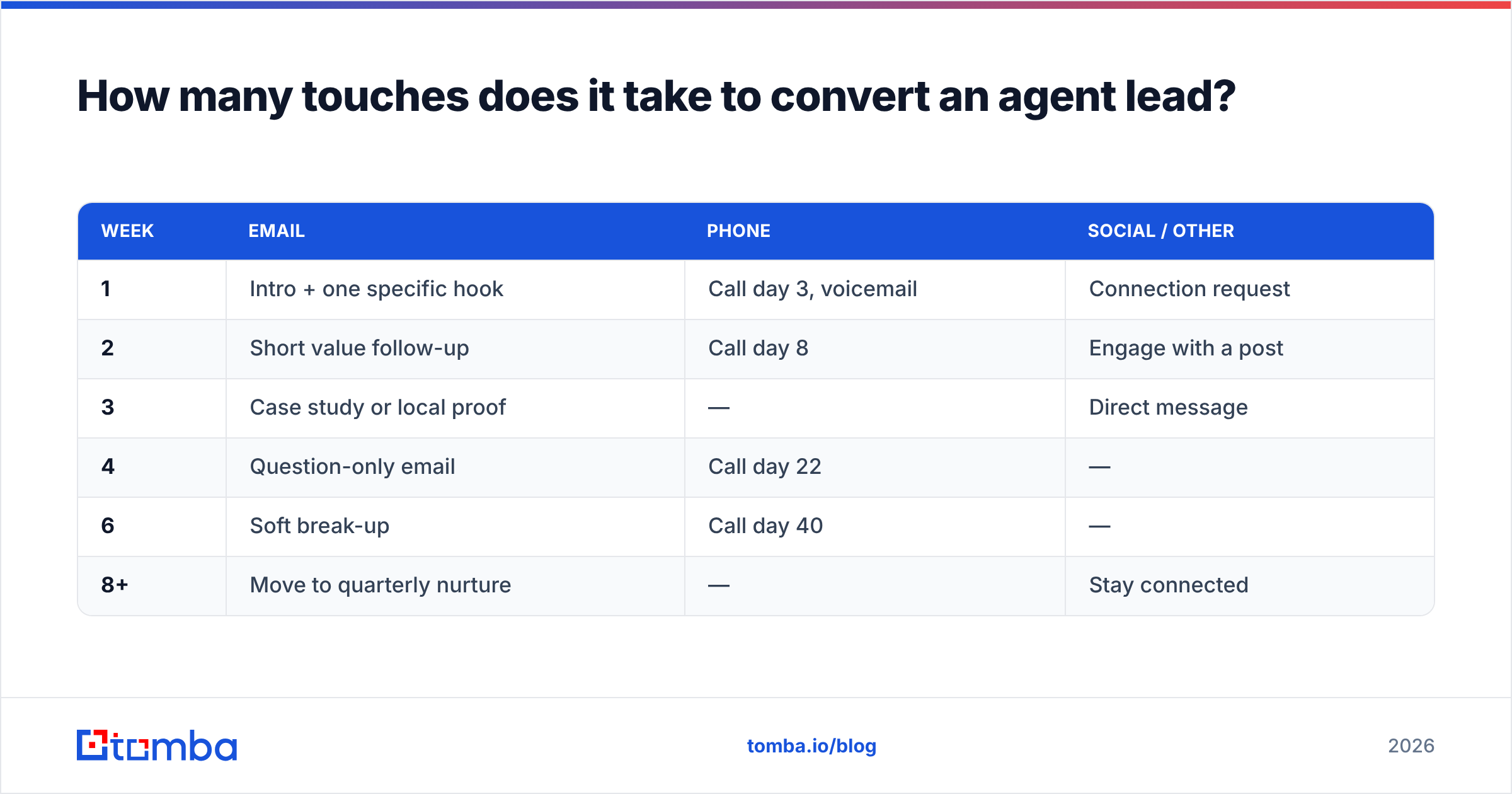
Plan for 12–16 across a 6–8 week window, mixed across channels. A workable cadence:
| Week | Phone | Social / other | |
|---|---|---|---|
| 1 | Intro + one specific hook | Call day 3, voicemail | Connection request |
| 2 | Short value follow-up | Call day 8 | Engage with a post |
| 3 | Case study or local proof | — | Direct message |
| 4 | Question-only email | Call day 22 | — |
| 6 | Soft break-up | Call day 40 | — |
| 8+ | Move to quarterly nurture | — | Stay connected |
The break-up email consistently pulls the second-highest response rate in most sequences, behind only the first touch — which is the single strongest argument against quitting at touch three.
Two things that raise reply rates more than any subject-line trick: send from a person, not a brand alias, and reference something that could only be true about that specific recipient. HubSpot's sales research has documented the personalization lift repeatedly, and it holds across verticals.
What does a working weekly routine look like for a solo agent?#
Ninety minutes a day, non-negotiable, before anything reactive:
- Monday (60 min): Source and verify 50–75 new contacts. Load them into the sequence.
- Tuesday–Thursday (45 min each): Work the call block against the sequence's scheduled touches. Same time every day.
- Wednesday (30 min): One partner touch — a lender, an accountant, an adjuster, a complementary agent. Send them a referral before you ask for one.
- Friday (30 min): Review the numbers. Contacts added, emails sent, reply rate, meetings booked, deals sourced by channel. Kill anything below 2% reply after 200 sends and rewrite it.
Track those five numbers in a spreadsheet if you don't have a CRM. The point is not the tooling; it's that you can see which channel produced each closing six months later. Most agents cannot answer that question, which is exactly why they keep renewing the portal subscription.
What tools does an agent actually need?#
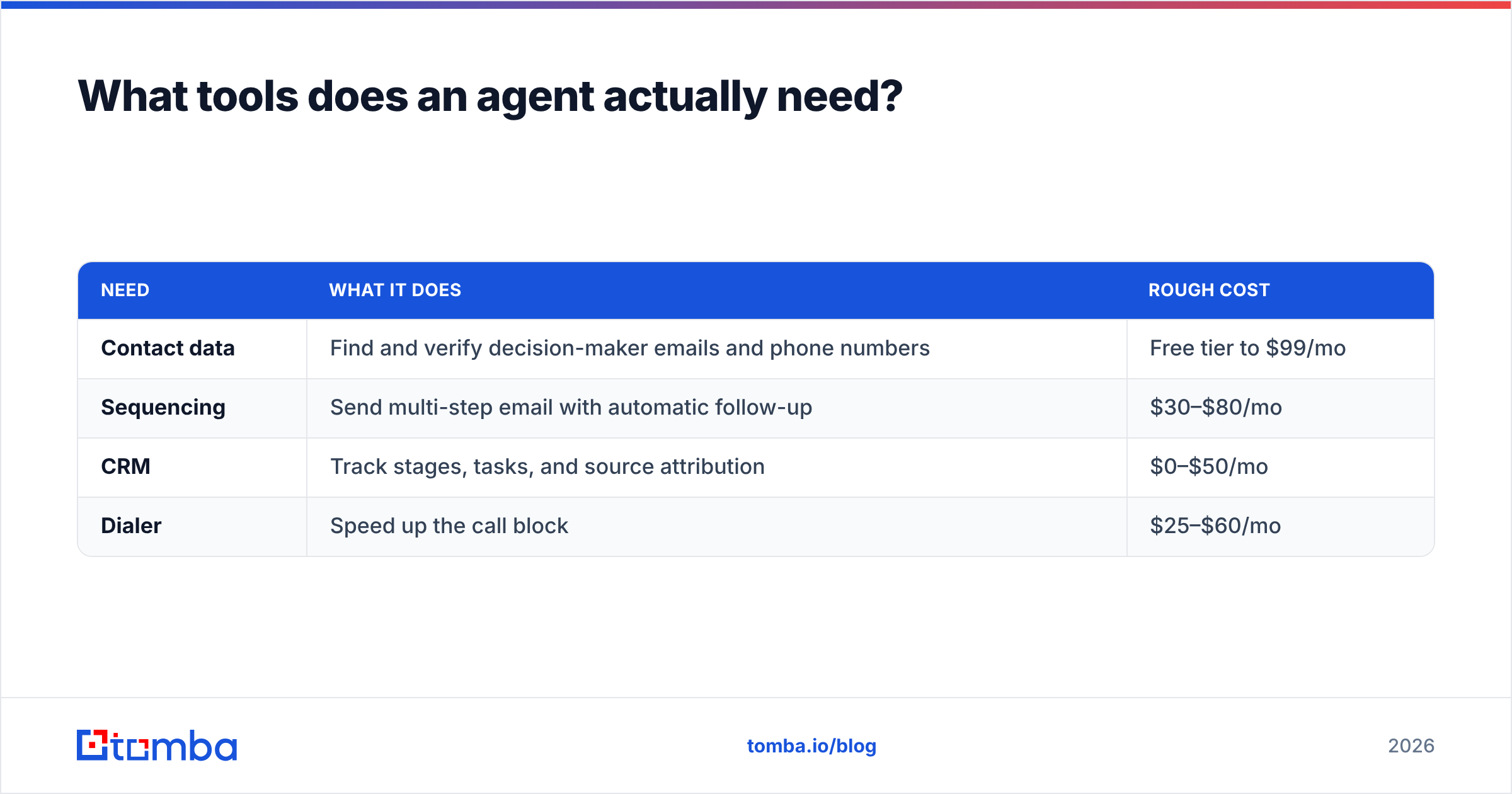
Fewer than the market wants you to believe. A contact data source, a verification step, a sending tool, and somewhere to track the pipeline. That's it.
| Need | What it does | Rough cost |
|---|---|---|
| Contact data | Find and verify decision-maker emails and phone numbers | Free tier to $99/mo |
| Sequencing | Send multi-step email with automatic follow-up | $30–$80/mo |
| CRM | Track stages, tasks, and source attribution | $0–$50/mo |
| Dialer | Speed up the call block | $25–$60/mo |
On the data side, Tomba's free tier gives you 25 searches a month to test the approach before paying anything; Starter is $49/mo and Growth is $99/mo, with full Tomba pricing laid out per plan. If you work in bulk, the bulk email finder processes a whole CSV at once instead of record by record, which turns list-building from a chore into a Monday-morning task.
Start with 100 verified contacts, not 5,000 guesses#
The agents who win at lead generation aren't running more channels — they're running two channels deliberately and measuring cost per closed deal instead of cost per lead. Pick your narrowest realistic profile, source 100 accounts, find and verify the decision-makers, and run a full 12-touch sequence before you judge anything.
Start with the Tomba Email Finder. Find verified professional emails by domain, name, or company, check them against the verifier before you send, and build a list nobody else in your market is calling. The free tier covers your first 25 searches, which is enough to prove the math on your own pipeline before you spend a dollar.
Related guides#
// get started
Find, verify and enrich your first contacts today
Start on the free plan with 25 searches a month, then scale when your team is ready.
Free plan · No credit card required · GDPR & CCPA
// about the author