Lead Generation for Business: A Practical 2026 Playbook
Most lead gen advice is recycled theory. This is the working version: which channels actually produce pipeline in 2026, what each costs per qualified lead, and how to build a system that does not collapse when one channel dies.
TL;DR
- Lead generation for business is not a channel — it is a system with four parts: a defined ICP, a sourcing layer, a qualification filter, and a follow-up engine. Miss any one and the other three underperform.
- Outbound email still produces the cheapest qualified meetings in most B2B categories ($40–$120 per SQL), but only when list accuracy stays above 95%. Below that, deliverability collapses and the channel stops working entirely.
- Inbound compounds but is slow: expect 6–12 months before organic search contributes meaningful pipeline. Start it now, fund it from outbound results.
- Paid channels are the fastest to test and the fastest to get expensive. Use them to validate messaging, not as your primary pipeline source.
- The single highest-leverage fix for most teams is not a new channel. It is verifying the data they already have and fixing follow-up cadence.
What is lead generation for business, really?#
Lead generation for business is the repeatable process of identifying companies that match your ideal customer profile, finding the right person inside them, and starting a conversation that converts into pipeline.
That definition is deliberately narrow. It excludes a lot of what gets sold as "lead generation" — brand awareness campaigns, newsletter signups from people who will never buy, webinar registrations padded with competitors and job seekers. Those are marketing activities. They may support lead gen. They are not lead gen.
The practical test: can you trace a specific revenue number back to the activity within a defined window? If not, you are running awareness, and you should budget it as such.
Here is the structure that actually holds up across B2B categories:
- ICP definition — A written, specific description of who buys. Company size, industry, tech stack, trigger events, and the job title of the person who signs. Vague ICPs produce vague lists produce vague results.
- Sourcing layer — How you turn that ICP into a list of real people with real contact details. This is where most teams either overpay for stale database subscriptions or under-invest and work from scraped garbage.
- Qualification filter — The rules that decide which sourced contacts deserve outreach effort. Verified email, correct seniority, active company, no existing relationship, no recent contact from a teammate.
- Follow-up engine — The sequence, cadence, and channel mix that turns a first touch into a booked meeting. Most pipeline is lost here, not at the top.
- Measurement loop — Cost per qualified lead by channel, reply-to-meeting rate, and meeting-to-opportunity rate. Without these three, you cannot decide where to put next quarter's budget.
Miss step two or three and everything downstream degrades quietly. You will not see a broken list as a broken list — you will see it as "our messaging isn't landing."

Which lead generation channels actually work in 2026?#
There is no universal ranking. There is, however, a fairly stable pattern in what each channel costs and how long it takes to produce anything.
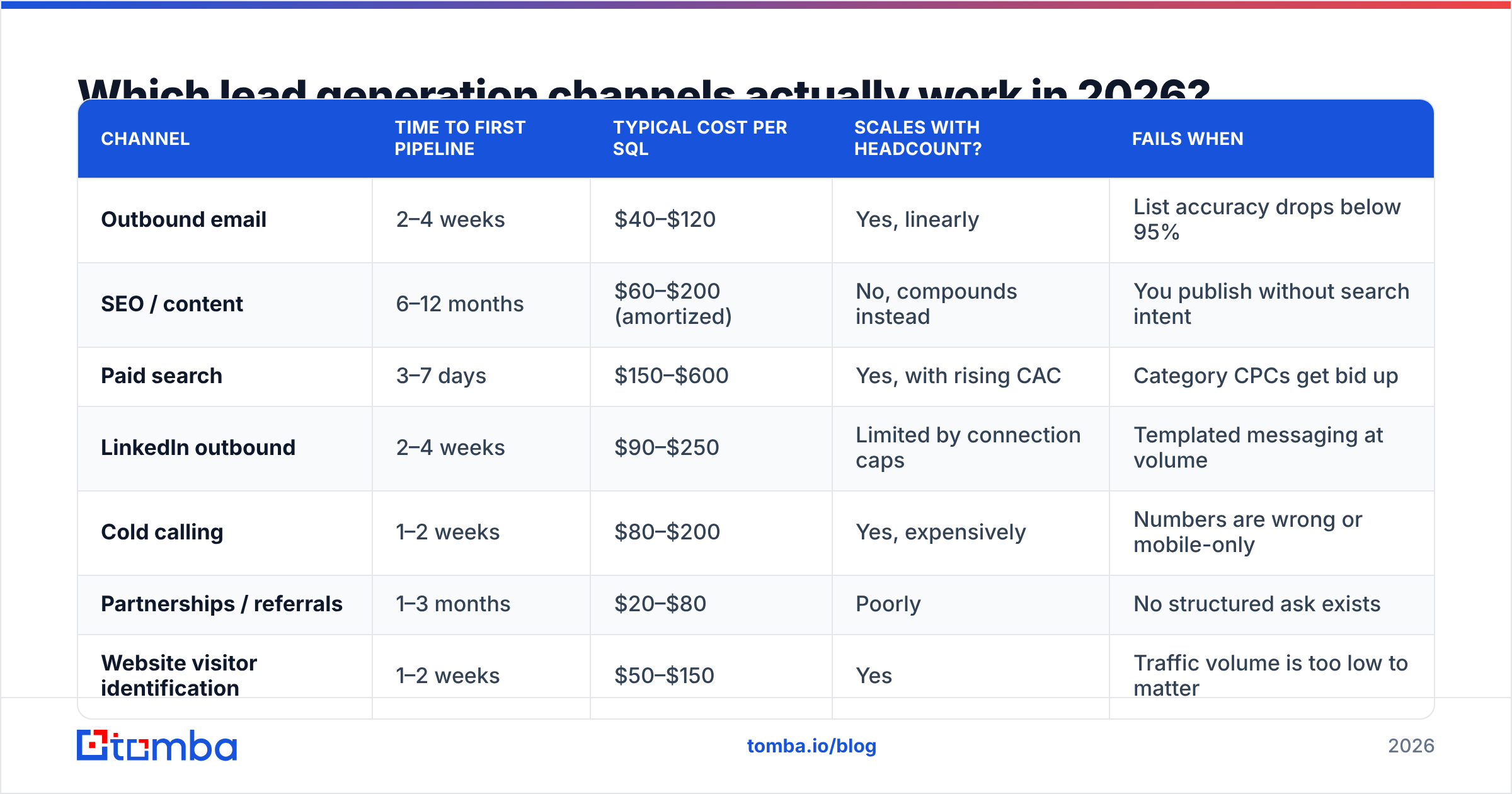
| Channel | Time to first pipeline | Typical cost per SQL | Scales with headcount? | Fails when |
|---|---|---|---|---|
| Outbound email | 2–4 weeks | $40–$120 | Yes, linearly | List accuracy drops below 95% |
| SEO / content | 6–12 months | $60–$200 (amortized) | No, compounds instead | You publish without search intent |
| Paid search | 3–7 days | $150–$600 | Yes, with rising CAC | Category CPCs get bid up |
| LinkedIn outbound | 2–4 weeks | $90–$250 | Limited by connection caps | Templated messaging at volume |
| Cold calling | 1–2 weeks | $80–$200 | Yes, expensively | Numbers are wrong or mobile-only |
| Partnerships / referrals | 1–3 months | $20–$80 | Poorly | No structured ask exists |
| Website visitor identification | 1–2 weeks | $50–$150 | Yes | Traffic volume is too low to matter |
Two things stand out in that table. First, referrals are the cheapest source of qualified pipeline in almost every business and the one that receives the least deliberate effort. Second, paid search is the most expensive per SQL yet consistently receives the largest budget line, because it is the easiest to measure and the easiest to defend in a board meeting.
A reasonable build order for a company under $10M ARR: outbound first (fastest to revenue, funds everything else), referrals in parallel (nearly free, just needs a process), SEO started immediately but budgeted as a 12-month investment, paid last and only against proven messaging.
Why outbound still works when done correctly#
The persistent claim that "cold email is dead" is repeated annually and remains wrong — but it is wrong for a narrower reason than outbound advocates admit. Cold email at volume with generic copy and unverified lists is genuinely dead. Google and Microsoft's 2024 bulk sender requirements made sure of that, and enforcement has only tightened since. Google's official sender guidelines now treat spam complaint rates above 0.3% as a hard threshold, not a suggestion.
What still works is low-volume, high-accuracy outbound: 30–60 contacts per rep per day, every address verified, every message referencing something specific about the account. That approach produces reply rates in the 8–15% range in most B2B categories. Generic blasts produce 0.5–2% and burn the sending domain in the process.
The difference between those two outcomes is almost entirely upstream. It is data quality.
How do you build a lead list that does not destroy your domain?#
Start from the domain, not the person. If you know the companies in your ICP, domain search gives you every publicly discoverable email address at that company plus the pattern the company uses — first.last@, flast@, first@. Once you have the pattern, you can construct addresses for named prospects you could not find directly.
Then verify. This is the step teams skip, and skipping it is the most expensive mistake in outbound.
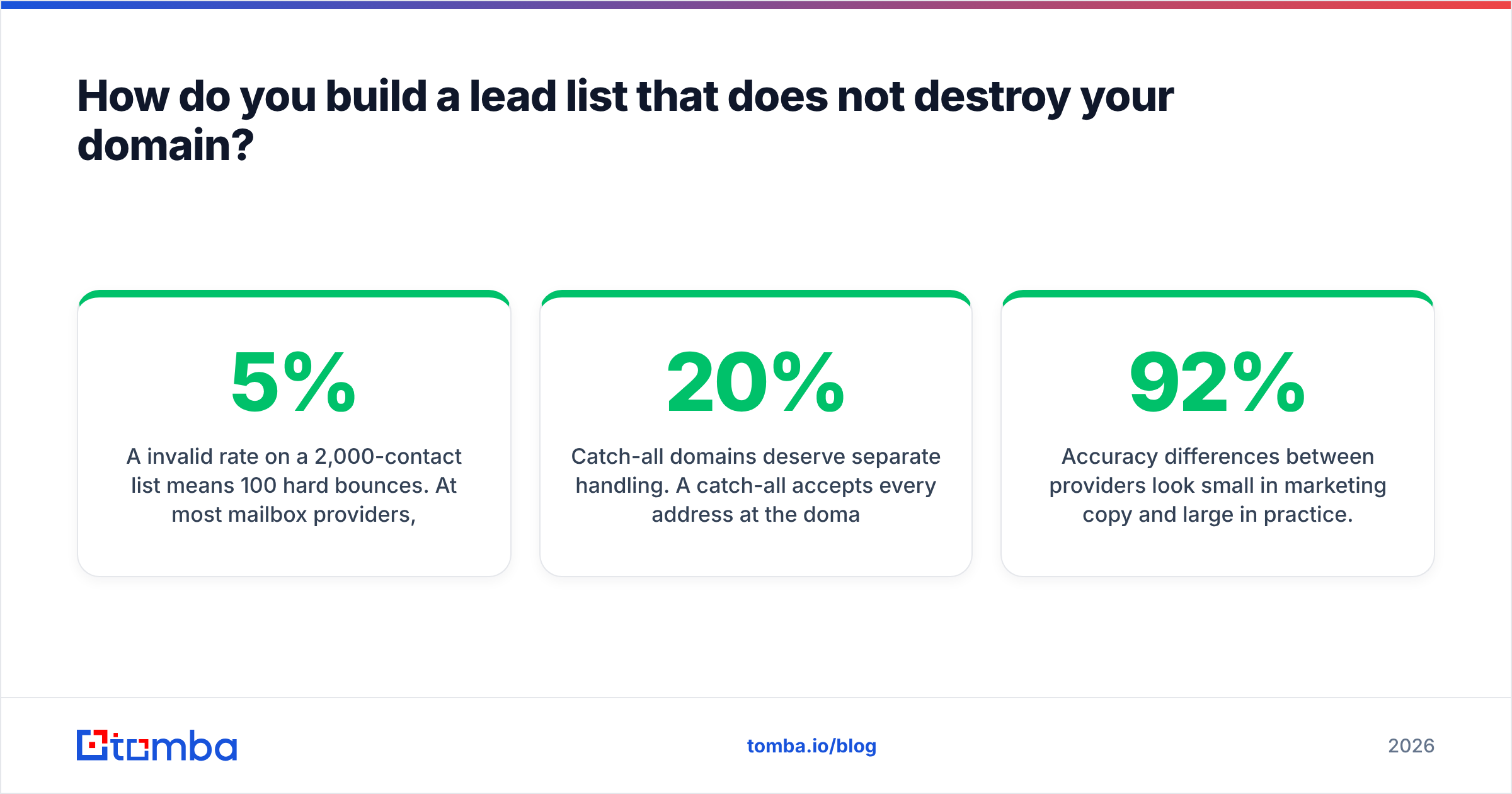
A 5% invalid rate on a 2,000-contact list means 100 hard bounces. At most mailbox providers, a bounce rate above 2–3% triggers reputation damage that takes weeks to repair and affects every email your domain sends, including your sales team's one-to-one replies and your billing notifications. Running that list through an email verifier before send costs a fraction of a cent per address and removes the risk entirely.
Catch-all domains deserve separate handling. A catch-all accepts every address at the domain, so standard SMTP verification returns "unknown" rather than valid or invalid. Roughly 15–20% of B2B domains are configured this way, which means a meaningful chunk of your list sits in limbo. A dedicated catch-all verifier applies additional signals — pattern confidence, source corroboration, historical deliverability — to produce an actual verdict instead of a shrug.

Accuracy differences between providers look small in marketing copy and large in practice. The gap between a 92% and a 97% accurate source is not 5 percentage points of annoyance — it is the difference between a healthy sending domain and a blacklisted one.
What should you actually pay for lead data?#
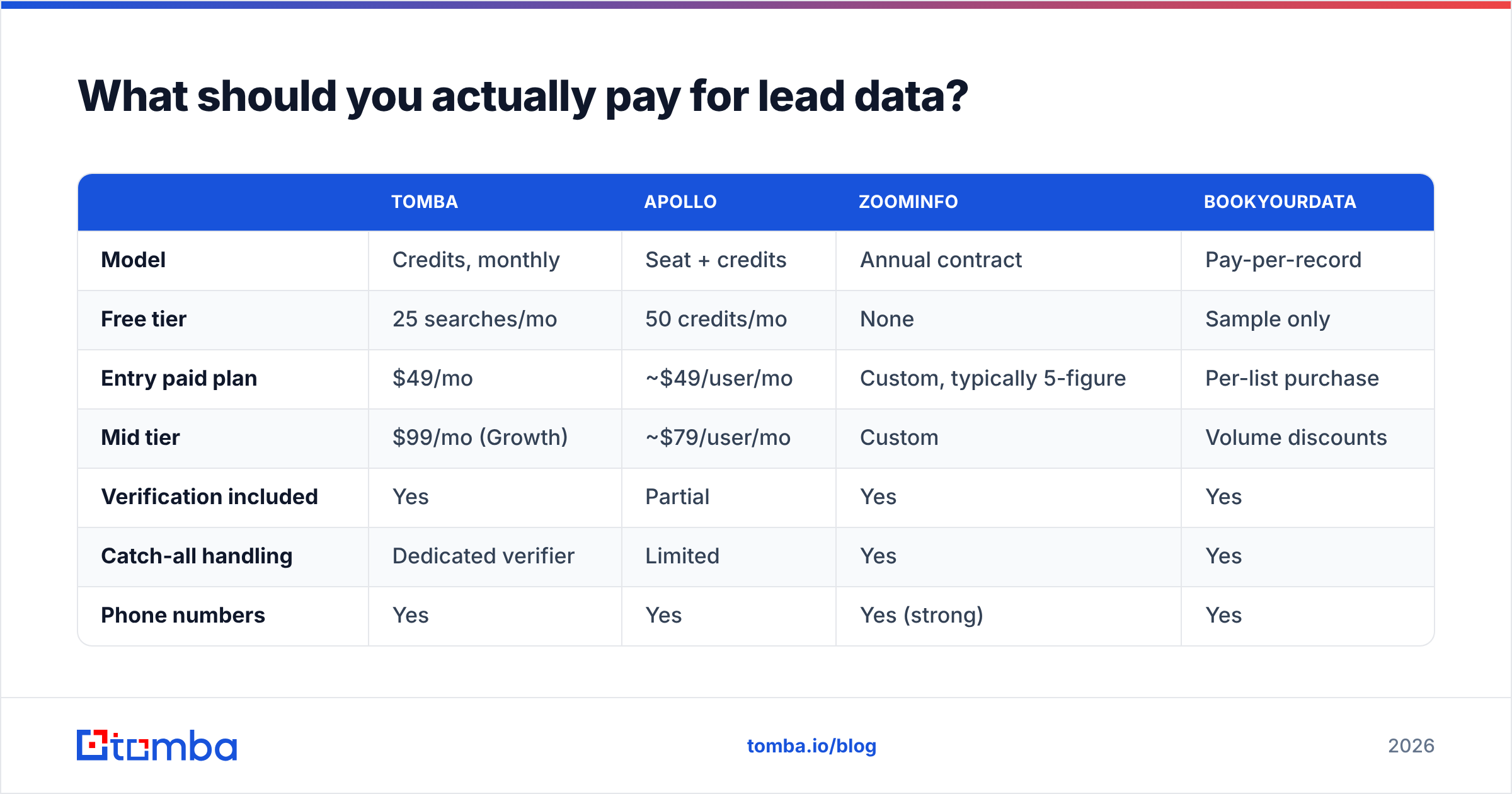
Pricing in this category is deliberately confusing. Some vendors charge per credit, some per verified result only, some per seat with a credit pool, some bundle sequencing and CRM features that inflate the headline number.
The comparison below covers the shapes you will encounter, not an exhaustive vendor list.
| Tomba | Apollo | ZoomInfo | BookYourData | |
|---|---|---|---|---|
| Model | Credits, monthly | Seat + credits | Annual contract | Pay-per-record |
| Free tier | 25 searches/mo | 50 credits/mo | None | Sample only |
| Entry paid plan | $49/mo | ~$49/user/mo | Custom, typically 5-figure | Per-list purchase |
| Mid tier | $99/mo (Growth) | ~$79/user/mo | Custom | Volume discounts |
| Verification included | Yes | Partial | Yes | Yes |
| Catch-all handling | Dedicated verifier | Limited | Yes | Yes |
| Phone numbers | Yes | Yes | Yes (strong) | Yes |
| API access | All paid plans | Higher tiers | Enterprise | Available |
| Best fit | Precision sourcing, API workflows | All-in-one SDR stack | Enterprise ABM budgets | Pre-built targeted lists |
Read that table as four different jobs rather than four competitors. ZoomInfo is an enterprise data contract — it makes sense when you have an ABM motion, a large team, and the budget to match. Apollo bundles data with sequencing, which is efficient if you want one tool and acceptable if you can tolerate mixed data quality across regions. BookYourData works well when you want a clean, targeted list delivered without building a sourcing process yourself — a genuinely different purchase from a subscription. Tomba sits in the precision lane: find and verify specific people at specific companies, with API and bulk access on every paid tier. Full Tomba pricing is public, which is itself a filter worth applying to any vendor you evaluate.
One rule that saves money regardless of vendor: never buy annual before you have run 500 real outreach touches on a monthly plan. Data quality varies enormously by geography and vertical, and no vendor's aggregate accuracy claim tells you how they perform on your segment.
Is inbound or outbound better for lead generation?#
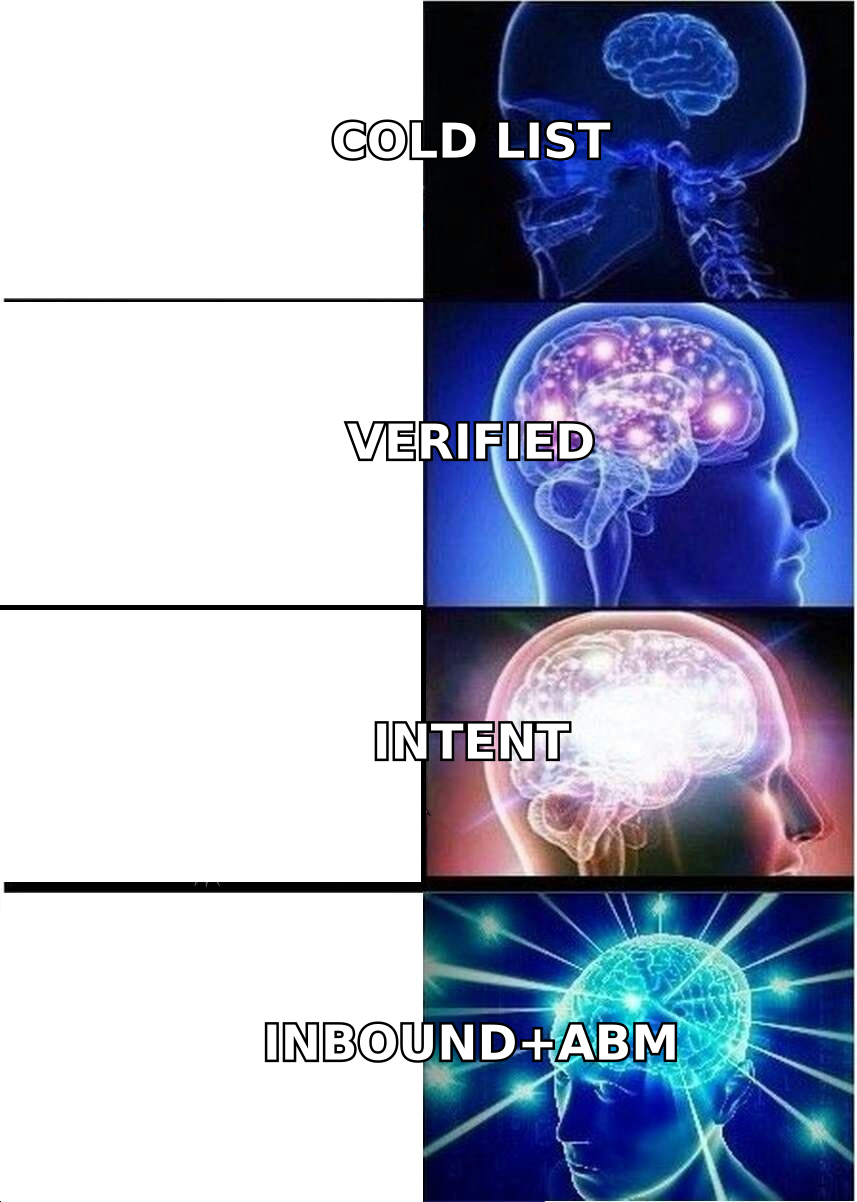
Neither. They fail differently, which is the actual reason to run both.
Outbound fails fast and loudly. A bad campaign shows up within days: low replies, high bounces, angry responses. You can diagnose and fix it inside a week. But outbound does not compound — stop sending and pipeline stops within one sales cycle.
Inbound fails slowly and quietly. You can publish for eight months, feel productive, and discover you targeted keywords with no commercial intent. The feedback loop is brutal. But inbound that works keeps working with minimal marginal cost, and inbound leads convert at roughly 2–3x the rate of cold outbound because the buyer initiated contact.
The practical synthesis most successful teams land on:
- Outbound funds the present. It is the only channel that can produce a meeting next week.
- Inbound funds the future. Budget it as R&D with a 12-month horizon, not as a quarterly performance line.
- Outbound data feeds inbound strategy. The objections and questions your reps hear on cold calls are your content calendar. This is free keyword research most companies ignore.
- Inbound traffic feeds outbound targeting. Anonymous visitors who read three pricing-adjacent pages are your warmest cold list. Website visitor reveal turns that traffic into named accounts you can work deliberately.
That last point is where the two motions stop being separate. A prospect who visited your pricing page yesterday and receives a relevant email today is not a cold contact — they are a warm one who does not know you noticed.
How do you qualify leads without wasting sales time?#
Qualification is a filtering problem, and the cheapest filters should run first.
Run them in this order:
- Firmographic fit — Does the company match your ICP on size, industry, and geography? This is a database query, costs nothing, and eliminates the largest share of noise.
- Technographic signals — Do they use a tool that implies a need for yours, or that you integrate with? Technology detection turns "might need this" into "almost certainly needs this."
- Contact validity — Is the email deliverable and the person still employed there? Job-change rates in B2B run 20–30% annually, so a list older than six months is meaningfully decayed.
- Seniority and function — Right department, right level to either buy or champion. A perfectly verified email for the wrong role is a wasted touch.
- Engagement signal — Did they open, click, visit, or reply? This is the only filter that reflects actual interest rather than inferred fit, which is why it should gate the expensive step: a human's time.
Steps one through four are automatable and should be. Step five is where a human enters, and only there. Teams that put human effort into steps one through three burn their most expensive resource on work software does better and cheaper.
For a formal definition of where marketing hands off to sales, the marketing qualified lead threshold is worth writing down explicitly and revisiting quarterly — it drifts, and an undocumented threshold becomes an argument between teams rather than a rule.
What does a working lead generation stack look like?#
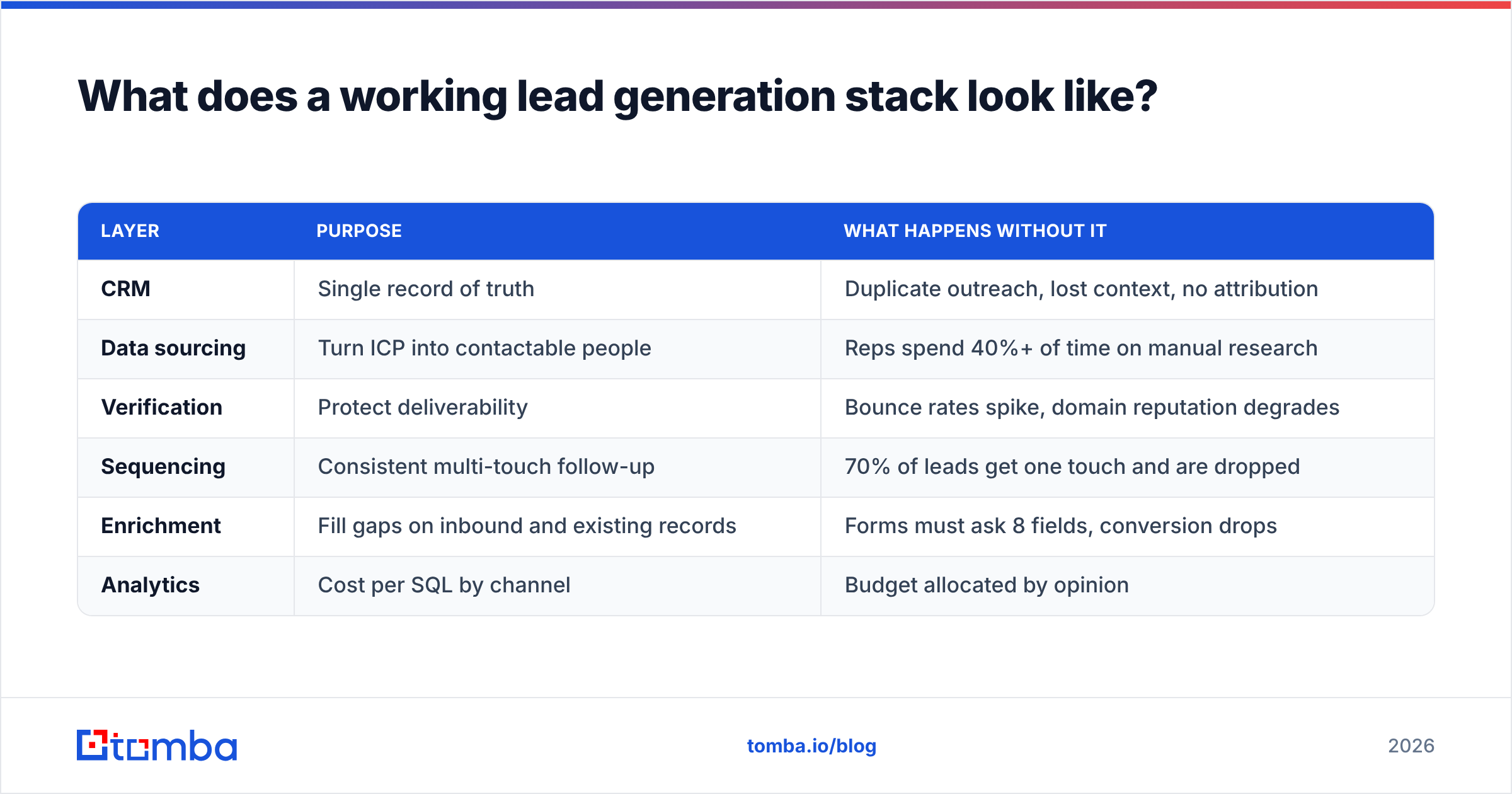
Minimum viable stack, in build order:
| Layer | Purpose | What happens without it |
|---|---|---|
| CRM | Single record of truth | Duplicate outreach, lost context, no attribution |
| Data sourcing | Turn ICP into contactable people | Reps spend 40%+ of time on manual research |
| Verification | Protect deliverability | Bounce rates spike, domain reputation degrades |
| Sequencing | Consistent multi-touch follow-up | 70% of leads get one touch and are dropped |
| Enrichment | Fill gaps on inbound and existing records | Forms must ask 8 fields, conversion drops |
| Analytics | Cost per SQL by channel | Budget allocated by opinion |
Total cost for a team of three reps typically lands between $400 and $900 per month at this level. That is well under the fully loaded cost of one rep spending a third of their week on manual list building.
Two specific efficiencies are worth naming. First, data enrichment lets you shorten inbound forms to email-only and fill in company, size, industry, and role automatically — form conversion typically rises 20–40% when you remove fields, and you lose no data. Second, bulk email finder processing converts a list of companies and names into verified contacts in a single job rather than one lookup at a time, which is the difference between a two-hour task and a two-minute one.
If your workflow already lives somewhere else, the Tomba API handles the programmatic case, and native integrations cover HubSpot, Salesforce, Pipedrive, Zapier, and Sheets without custom code.
What are the most common lead generation mistakes?#
Optimizing volume before accuracy. Doubling send volume on a list with a 10% invalid rate does not double meetings. It doubles bounces, which compounds into deliverability damage that reduces meetings from every subsequent campaign. Fix accuracy, then scale.
One-touch follow-up. Industry data consistently shows most B2B conversions require five or more touches, yet the median outbound sequence stops at two or three. This is the cheapest available improvement in most funnels — it requires no new tool, no new budget, just extending existing sequences.
Treating all leads as equally urgent. Research on lead response time, including the widely cited Harvard Business Review analysis, found that contacting a web lead within an hour makes qualification dramatically more likely than waiting even a day. Your inbound leads need a different SLA than your cold list.
Buying a database subscription to solve a targeting problem. If you cannot describe your ICP in two sentences, more data makes the problem worse, not better. You will get more wrong-fit contacts, faster.
No feedback loop from sales to sourcing. When reps mark leads as bad fit, that signal should change your sourcing filters. In most companies it changes nothing, and the same wrong-fit contacts get sourced again next quarter. A monthly 30-minute review of disqualification reasons is the highest-ROI meeting in the lead gen process.
Ignoring sender reputation until it breaks. Sender reputation degrades gradually and recovers slowly. Monitor bounce rate, complaint rate, and reply rate weekly — a rising bounce rate is the earliest available warning that your data source has degraded.
How do you measure whether it is working?#
Three numbers, reviewed monthly, by channel:
- Cost per SQL — Total channel spend (including tools and loaded rep time) divided by sales-qualified leads. This is the only number that lets you compare outbound to SEO to paid honestly.
- Reply-to-meeting rate — Of people who respond, how many book? Under 25% usually means your targeting is fine but your first response is weak. Over 50% means you should be sending more volume.
- Meeting-to-opportunity rate — Under 40% means you are booking meetings with people who cannot buy. That is a qualification problem, not a sales skill problem.
Track those three long enough and budget decisions stop being arguments. The channel with the lowest cost per SQL and a healthy meeting-to-opportunity rate gets more money next quarter. Everything else is narrative.
One caveat on attribution: single-touch attribution will systematically undervalue whichever channel runs earliest in your buyer's journey, which is usually content. Both G2 buyer research and standard multi-touch models confirm that B2B buyers touch five or more sources before a first conversation. Do not kill a channel on last-touch data alone.
Where should you start this week?#
If you are starting from zero, the fastest path to a first meeting:
- Write your ICP in two sentences. Be specific enough that a stranger could sort a list of 100 companies into fit and non-fit using only your description.
- Build a list of 100 matching companies. Manually is fine at this size.
- Find and verify the right contact at each. This is a one-hour task with the right tooling, a full day without it.
- Write one sequence: four touches over twelve days, each referencing something specific about the account.
- Send it. Measure reply rate. Fix the weakest step. Repeat with 200.
The teams that struggle are almost never the ones that picked the wrong channel. They are the ones that skipped step one, built a list that vaguely resembled their customers, and concluded the channel did not work.
Start with accurate data on a tightly defined list. Everything else in lead generation is downstream of that.
Ready to build the list? The Tomba Email Finder finds verified professional email addresses by name, company, or domain — with catch-all handling, bulk processing, and API access included on every paid plan. Start free with 25 searches per month, or move to Starter at $49/mo when your outbound volume justifies it. No annual contract required to find out whether the data works for your segment.
Related guides#
// get started
Find, verify and enrich your first contacts today
Start on the free plan with 25 searches a month, then scale when your team is ready.
Free plan · No credit card required · GDPR & CCPA
// about the author