Lead Generation for Business Brokers: The 2026 Playbook
Business brokers need two pipelines, not one: sellers with exitable businesses and buyers with capital. Here's how the channels actually compare on cost, effort, and close rate in 2026.

TL;DR
- Business brokers run two pipelines that behave nothing alike: seller leads (owners thinking about exiting) and buyer leads (people with capital and a thesis). Most brokers over-invest in buyers because buyers are loud, and starve the seller side, which is where the commission actually comes from.
- Seller lead generation is an outbound problem, not an inbound one. Owners who are 12–24 months from selling do not fill out contact forms. They get found.
- The highest-ROI channel for a solo or small brokerage in 2026 is targeted owner outreach built on a clean list: filter by industry, revenue band, and owner tenure, then find verified contact details and run a slow, referral-toned sequence.
- Referral partners — CPAs, M&A attorneys, wealth managers, SBA lenders — still produce the best-converting seller leads, but they take 6–18 months to warm up. Start them now, pay the bills with outbound meanwhile.
- Budget reality: paid search for "sell my business" runs $18–$60 per click in most US metros. Outbound built on verified emails costs a fraction of that per booked call, provided your data is accurate enough to keep your domain out of spam.
Why is lead generation for business brokers different from normal B2B?#
Because your best prospect does not know they are a prospect yet.
Think of it like a real estate agent farming a neighborhood. Nobody wakes up wanting a listing agent. They wake up wanting a bigger kitchen, a shorter commute, or a way out of a house they've outgrown. The agent who shows up with a credible market number six months before that thought crystallizes is the one who gets the listing. Business brokerage is the same mechanic with a longer fuse and a much larger check.
Technically: the buying trigger for a seller lead is an internal life event — burnout, a health scare, a partner dispute, a kid who won't take over, an unsolicited offer from a competitor. None of those events are visible in intent data. You cannot buy a "thinking about selling" audience. What you can do is build a list of owners who statistically sit near those events (55+ years old, 10+ years at the helm, $1M–$20M revenue, fragmented industry) and be present in their inbox with something useful when the fuse burns down.
That inverts the normal B2B playbook. In SaaS you chase demand. In brokerage you manufacture presence and wait.
The second difference: your deal count is tiny and your deal size is huge. A brokerage doing 12 closings a year at a $90K average fee does not need 4,000 MQLs. It needs about 40 genuinely qualified seller conversations and the patience to nurture 300 more. That changes every tool decision you make — volume platforms are the wrong shape for this business.
What are the two pipelines every brokerage has to run?#
Sellers and buyers are different products, different messages, and different data sources. Running them through one funnel is the most common reason a brokerage's marketing feels busy but produces nothing.
- Seller pipeline (listings). This is your inventory and your revenue. Sourced almost entirely through outbound owner outreach, referral partners, and long-horizon nurture. Cycle: 6–24 months from first touch to signed engagement.
- Buyer pipeline (demand). Sourced through marketplace listings (BizBuySell, Axial), your own listing pages, search ads on "businesses for sale," and a buyer newsletter. Cycle: days to weeks. Cheap and abundant relative to sellers.
- Referral pipeline (compounding). CPAs, estate attorneys, commercial bankers, SBA lenders, exit-planning consultants. Slow to build, highest close rate once warm, effectively free after the first year.
- Re-engagement pipeline (forgotten gold). Every owner who said "not yet" in the last three years. Most brokerages never systematically touch this list again. It is the cheapest seller pipeline you own.
- Off-market buyer network (private). A curated list of PE search funds, family offices, and strategic acquirers who want first look. This is what lets you promise a seller discretion — a real differentiator against marketplace-only competitors.
Get the seller pipeline right and the buyer pipeline mostly takes care of itself, because good listings attract buyers. The reverse is never true.
Which lead generation channels actually work for brokers?#
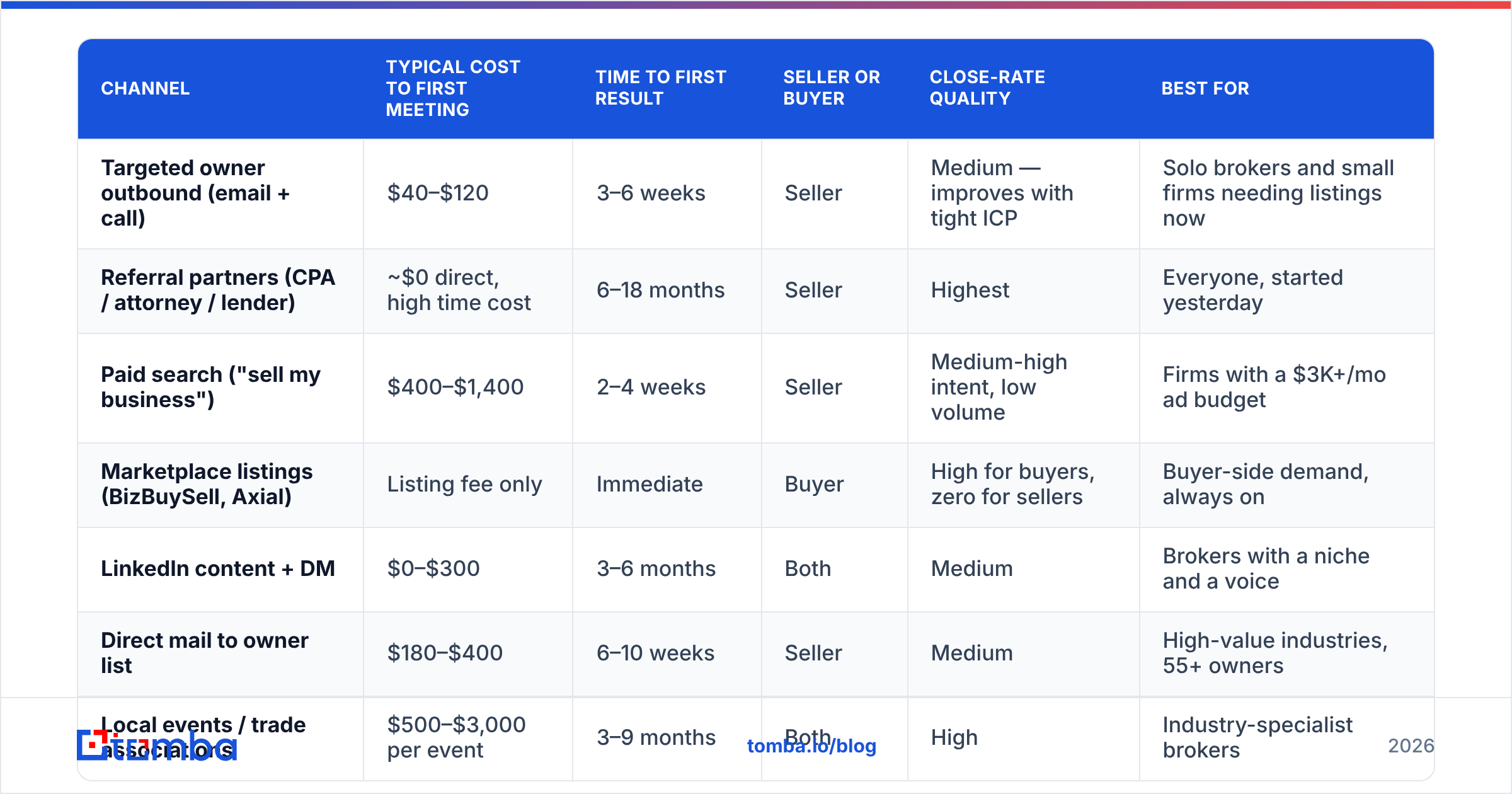
Here's the honest comparison. Costs reflect typical US small-market brokerage numbers in 2026; your metro will vary.
| Channel | Typical cost to first meeting | Time to first result | Seller or buyer | Close-rate quality | Best for |
|---|---|---|---|---|---|
| Targeted owner outbound (email + call) | $40–$120 | 3–6 weeks | Seller | Medium — improves with tight ICP | Solo brokers and small firms needing listings now |
| Referral partners (CPA / attorney / lender) | ~$0 direct, high time cost | 6–18 months | Seller | Highest | Everyone, started yesterday |
| Paid search ("sell my business") | $400–$1,400 | 2–4 weeks | Seller | Medium-high intent, low volume | Firms with a $3K+/mo ad budget |
| Marketplace listings (BizBuySell, Axial) | Listing fee only | Immediate | Buyer | High for buyers, zero for sellers | Buyer-side demand, always on |
| LinkedIn content + DM | $0–$300 | 3–6 months | Both | Medium | Brokers with a niche and a voice |
| Direct mail to owner list | $180–$400 | 6–10 weeks | Seller | Medium | High-value industries, 55+ owners |
| Local events / trade associations | $500–$3,000 per event | 3–9 months | Both | High | Industry-specialist brokers |
| Cold calling from a list | $60–$200 | 1–3 weeks | Seller | Medium — brutal on rep morale | Firms with a dedicated SDR |
Two things jump out of that table. First, nothing is fast and cheap and high-quality — the channels that close best are the ones that take longest to build. Second, outbound is the only lever that moves in weeks rather than quarters, which is why nearly every brokerage that grows past the founder ends up building an outbound motion whether they wanted to or not.
How do you build a seller list worth emailing?#
Start with constraints, not volume. A 600-name list you actually understand outperforms a 60,000-name list every time — and it keeps your sending domain alive.
Work through these filters in order:
- Industry and fragmentation. Pick industries with many small operators and active acquirers: HVAC, landscaping, dental practices, MSPs, specialty manufacturing, commercial cleaning, veterinary, pest control. Fragmented industries have buyers standing by, which makes your pitch concrete.
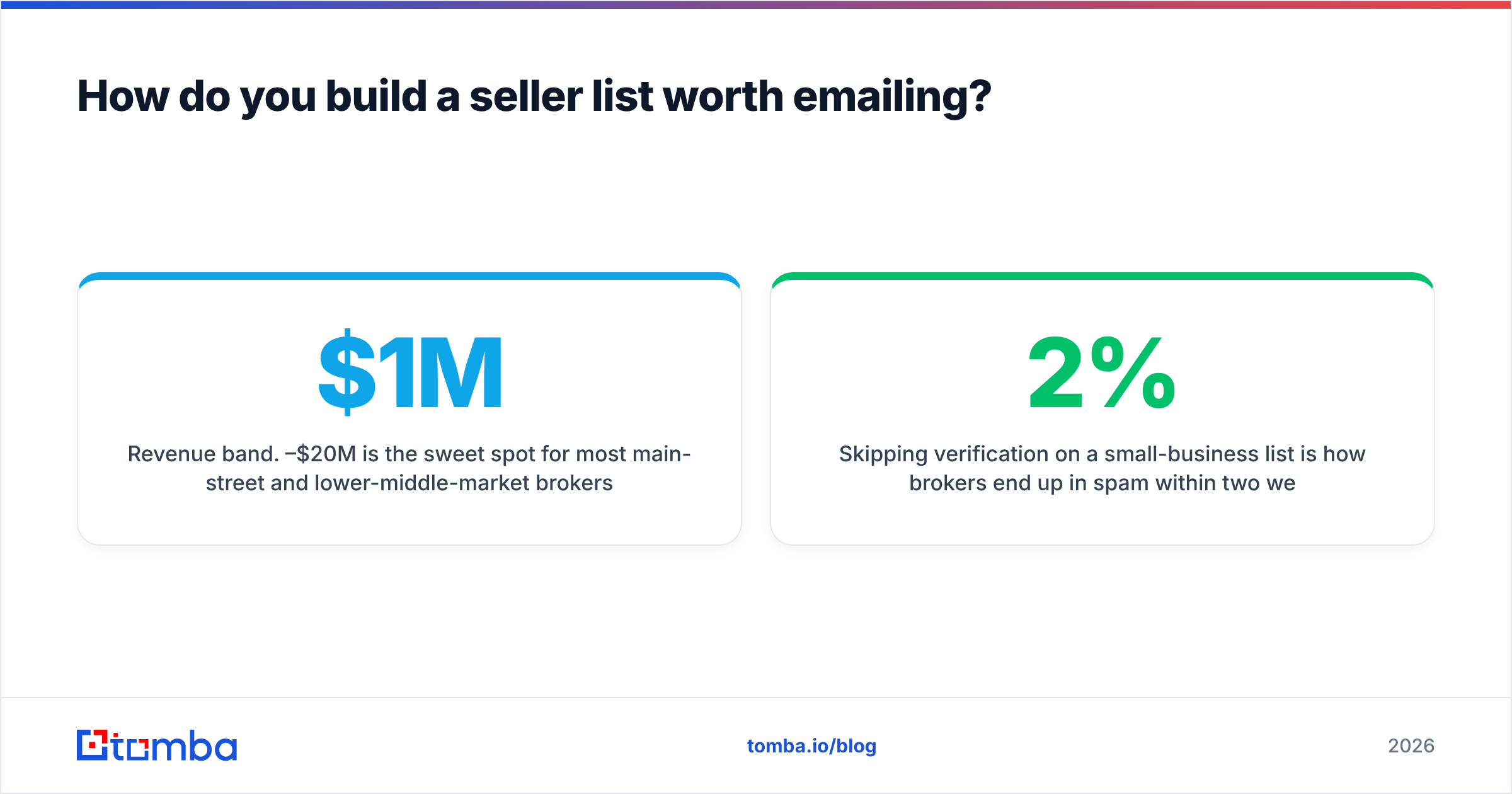
- Revenue band. $1M–$20M is the sweet spot for most main-street and lower-middle-market brokers. Below $1M the fee doesn't justify the work; above $25M you're competing with investment banks.
- Owner tenure and age signals. LinkedIn tenure over 10 years, or a state business registration filed 15+ years ago, is your best available proxy for exit readiness.
- Geography. Sellers strongly prefer local representation for main-street deals. Start within a two-hour drive and expand only when you have a vertical specialization that travels.
- Ownership structure. Single owner or two partners. Anything with institutional ownership is already banked.
- Contactability. An owner you can't reach is not a lead. This is where most broker lists die.
That last point is where the operational work lives. You can pull company lists from state registration data, industry association directories, Google Maps scrapes, or a B2B database, but company names are not contacts. You need the owner's name and a working inbox.
The practical loop: take your filtered company list, run domain search against each website to surface the people and email patterns at that company, identify the owner or president row, then run email verification before anything goes into a sequence. On small-business domains you'll hit a lot of catch-all servers — a catch-all verifier matters more in this niche than it does in enterprise prospecting, because the local HVAC company's Microsoft 365 tenant will happily accept mail to any address and tell you nothing.
Skipping verification on a small-business list is how brokers end up in spam within two weeks. Owner-operator domains bounce at a far higher rate than enterprise ones: people leave, companies dissolve, and the Gmail-based "info@" catch-all is a black hole. Keep your bounce rate under 2% or your carefully written seller outreach never reaches an inbox at all. Google and Yahoo's bulk sender requirements made that threshold a hard gate, not a best practice.
What does seller outreach that gets replies look like?#
Nothing like SaaS cold email. You are not selling software; you are offering to start a conversation about the largest financial event of someone's life. The tone is closer to a letter from a neighbor than a sequence step.
Four rules that hold up across thousands of broker sends:
- Lead with the market, not with yourself. "Two HVAC companies in Mecklenburg County sold in the last nine months, both to regional consolidators at multiples I think would surprise you" beats any version of "I'm a business broker with 20 years of experience."
- Never ask for a meeting in email one. Ask a question that costs nothing to answer: "Would a rough valuation range for a business your size be useful, or is that a conversation for a few years from now?" The "few years from now" escape hatch raises reply rates because it gives the owner a safe, honest answer.
- Assume discretion is the top objection. Owners fear employees, customers, and competitors finding out. Say the word "confidential" early and explain how a no-name teaser works.
- Run a long, slow cadence. Four touches over eight weeks, then quarterly forever. Seller leads are not lost; they are early. A brokerage's quarterly "what sold in your industry" email is the single best-performing asset most firms never build.
Keep the sending volume low and human — 30 to 60 a day from a warmed domain, plain text, no tracking pixels, no images. Tracking pixels in particular are a liability here: they hurt deliverability and an owner who notices feels surveilled at exactly the wrong moment. If you want to sanity-check the copy before it goes out, run it through a spam checker and fix anything that trips a filter.
Pair email with the phone. In this market the phone still converts better than any channel, and having verified B2B phone numbers attached to the same record means your one SDR isn't spending half the day hunting for a switchboard number that routes to a receptionist.
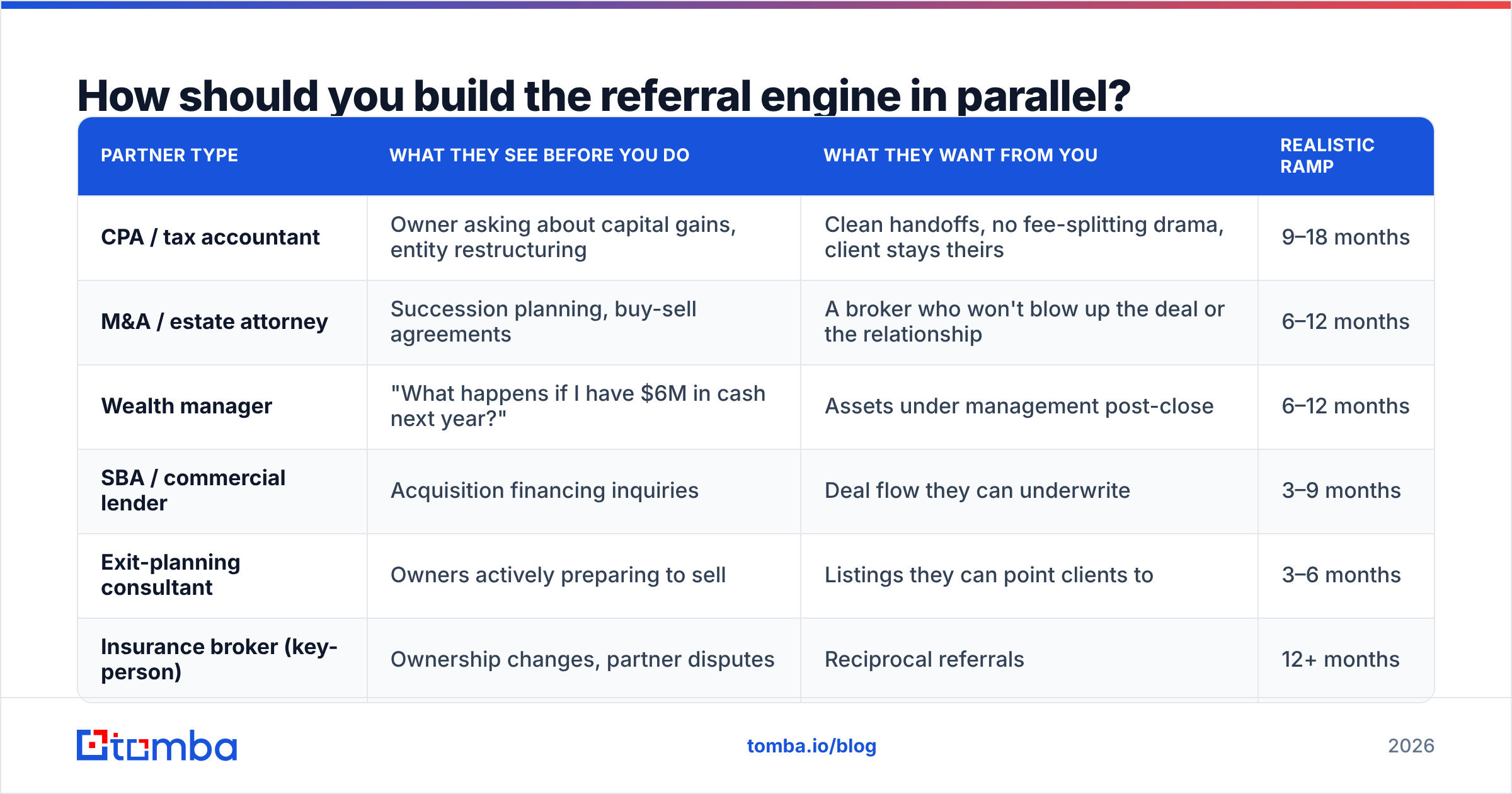
How should you build the referral engine in parallel?#
Treat referral partners as a second outbound campaign with a different ICP. You are prospecting CPAs the same way you prospect owners, just with a partnership offer instead of a valuation offer.
| Partner type | What they see before you do | What they want from you | Realistic ramp |
|---|---|---|---|
| CPA / tax accountant | Owner asking about capital gains, entity restructuring | Clean handoffs, no fee-splitting drama, client stays theirs | 9–18 months |
| M&A / estate attorney | Succession planning, buy-sell agreements | A broker who won't blow up the deal or the relationship | 6–12 months |
| Wealth manager | "What happens if I have $6M in cash next year?" | Assets under management post-close | 6–12 months |
| SBA / commercial lender | Acquisition financing inquiries | Deal flow they can underwrite | 3–9 months |
| Exit-planning consultant | Owners actively preparing to sell | Listings they can point clients to | 3–6 months |
| Insurance broker (key-person) | Ownership changes, partner disputes | Reciprocal referrals | 12+ months |
The mechanics are unglamorous: build a list of the 150 firms in your metro that serve $1M–$20M businesses, find the partner-level contacts, and run a quarterly value-first sequence — a one-page market report on what sold locally, with multiples. No ask in the first three touches. Accountants get pitched constantly and ignore it; almost nobody sends them something their clients will actually ask about.
For finding those partner-level contacts, an email finder beats scraping firm websites by hand, since most accounting and law firm sites list names without addresses. If you're working from a list of LinkedIn profiles instead of domains, a LinkedIn finder closes the same gap.
One warning: measure referral partners by qualified referrals, not total. A CPA who sends you three serious sellers a year is worth more than one who forwards every client who ever mused about retiring. Track it, and concentrate your time on the top five.
How do you handle the buyer side without wasting your week?#
Buyer leads are abundant and mostly unqualified. Research from marketplace operators has long put the ratio of inquiries to genuinely capitalized buyers in the single digits per hundred, and nothing in 2026 has improved that. Your entire buyer strategy should be about filtration speed, not lead volume.
Practical setup:
- Gate the details. NDA and a basic financial-capacity statement before the CIM. This alone eliminates most tire-kickers.
- Automate the first two steps. NDA e-sign, teaser delivery, and a three-question qualification form should run without you touching them.
- Build a private buyer list. Search funds, family offices, and strategics in your verticals. Data enrichment turns a spreadsheet of firm names into a mailable list with titles and verified addresses, which is what lets you promise a seller "I can put this in front of 40 qualified acquirers next week" and mean it.
- Publish where buyers already look. Marketplace presence on platforms like BizBuySell is table stakes; the differentiated work is the off-market list you own.
- Score buyers once, reuse forever. Capital available, industry thesis, timeline, financing type. A simple four-field score on every buyer record compounds across every future listing.
If you want to go deeper on the qualification framework, the lead scoring concepts from standard demand-gen practice port over cleanly — just swap "budget" for "proof of funds."
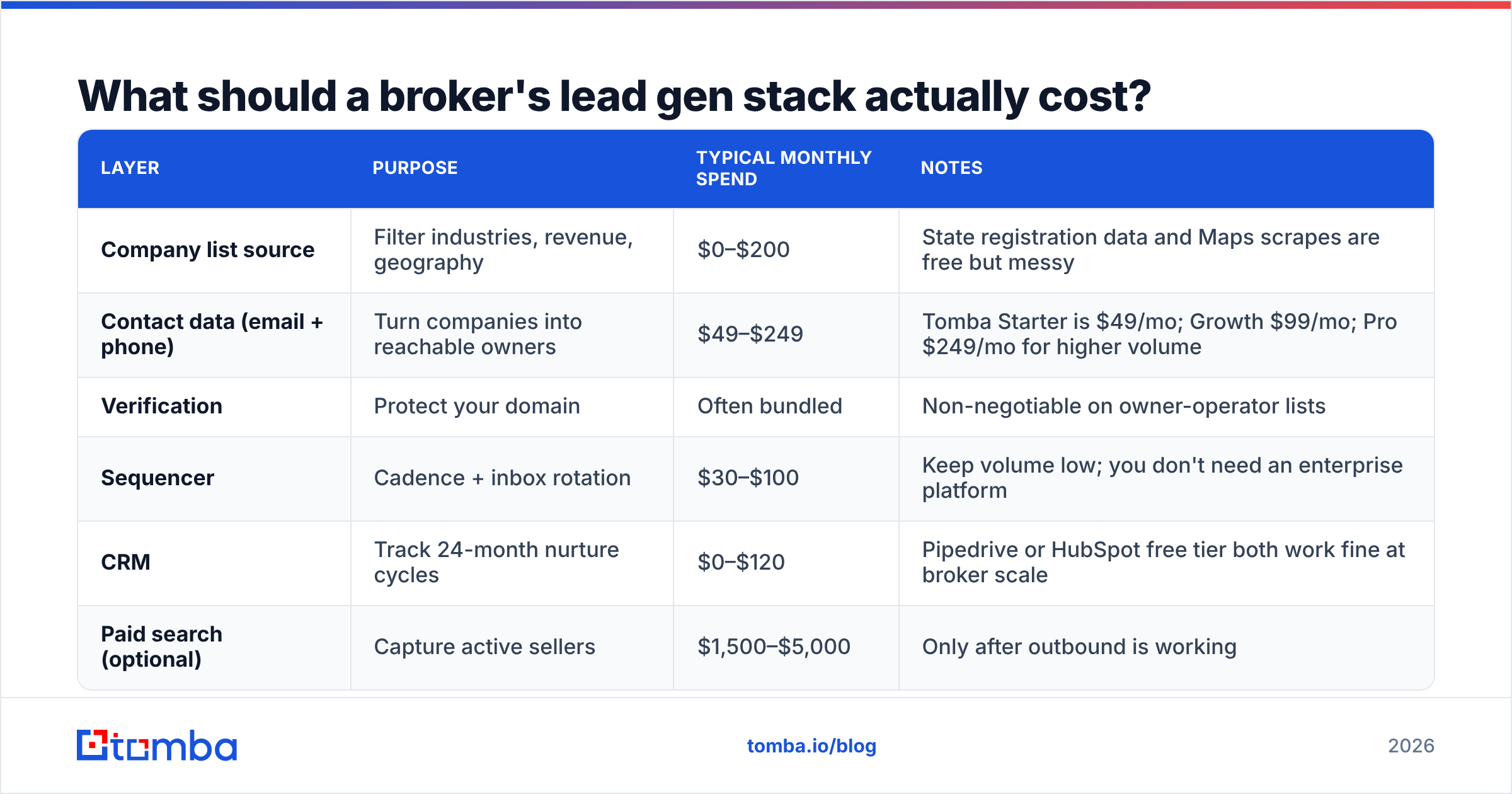
What should a broker's lead gen stack actually cost?#
You need four things: a list source, contact data, a sequencer, and a CRM. Here's how the spend typically shakes out for a one-to-five person brokerage.
| Layer | Purpose | Typical monthly spend | Notes |
|---|---|---|---|
| Company list source | Filter industries, revenue, geography | $0–$200 | State registration data and Maps scrapes are free but messy |
| Contact data (email + phone) | Turn companies into reachable owners | $49–$249 | Tomba Starter is $49/mo; Growth $99/mo; Pro $249/mo for higher volume |
| Verification | Protect your domain | Often bundled | Non-negotiable on owner-operator lists |
| Sequencer | Cadence + inbox rotation | $30–$100 | Keep volume low; you don't need an enterprise platform |
| CRM | Track 24-month nurture cycles | $0–$120 | Pipedrive or HubSpot free tier both work fine at broker scale |
| Paid search (optional) | Capture active sellers | $1,500–$5,000 | Only after outbound is working |
Total for a working outbound motion: roughly $150–$500 a month before ads. Against a $90K average fee, the math is not close — one extra listing a year pays for a decade of tooling. The constraint is never budget; it's the discipline to run a 24-month nurture without losing interest in month four.
On data specifically: check where the numbers come from before you commit. Providers differ enormously on small-business coverage, and the enterprise-focused databases that look impressive in a demo often have thin data exactly where brokers operate — the 14-person landscaping company with no marketing site. Tomba publishes its data sources, and you can compare vendors on real reviews at G2 rather than trusting anyone's coverage claim, including ours. For list-purchase situations where you want pre-built B2B records rather than self-service lookups, BookYourData is a solid option in this segment and worth a look alongside a finder-and-verifier workflow.
What's the 90-day plan if you're starting from zero?#
- Days 1–14. Pick one vertical and one 90-minute-radius geography. Build a 500-company list. Find and verify owner contacts. Warm one sending domain (not your main one).
- Days 15–45. Run 40 emails a day, plain text, four-touch cadence. Call every open. Target: 15–25 conversations, 3–6 valuation requests. Simultaneously build the 150-firm referral partner list.
- Days 46–75. Send the first quarterly market report to both lists. Sign your first engagement or learn precisely why not. Add a second vertical only if the first is producing conversations.
- Days 76–90. Systematize: every "not yet" goes into a quarterly nurture, every referral partner gets a named owner on your team, every buyer inquiry gets scored. Then repeat with a bigger list.
The brokers who win this game are not the best marketers. They're the ones still emailing the same 500 owners in month 20, when the fuse finally burns down on twelve of them.
Start with the data layer. Your outreach is only as good as the owner's name and inbox behind it, and on small-business domains that's the part that breaks. Tomba's Email Finder turns a filtered list of companies into verified owner contacts — domain-level discovery, pattern detection, and verification in one pass — with a free tier of 25 searches a month to test your vertical before you commit. Check Tomba pricing if you want to see how the volume tiers line up with a 500-company farm list.
Related guides#
// get started
Find, verify and enrich your first contacts today
Start on the free plan with 25 searches a month, then scale when your team is ready.
Free plan · No credit card required · GDPR & CCPA
// about the author