Lead Generation for Construction Companies: The 2026 Playbook
Referrals and bid boards still run most construction pipelines — and both are capped. Here's how the channels actually compare on cost, speed, and control, plus a repeatable way to build a targeted GC and developer list yourself.
TL;DR
- Most construction firms run on two lead sources — referrals and bid boards — and both have a hard ceiling. Referrals don't scale on command; bid boards put you in a race to the bottom on price.
- The highest-margin work comes from direct relationships with general contractors, developers, property managers, and facility directors before an RFP goes public.
- Building that pipeline is a data problem first: identify the right firms, find the right role, get a verified contact, then run a short, specific sequence.
- Expect a cost per qualified construction lead somewhere between $80 and $600 depending on channel — direct outbound sits at the low end once your list quality is fixed.
- Track bid-to-win rate and cost per awarded dollar, not raw lead volume. A subcontractor chasing 60 public bids to win two is running a worse business than one chasing 12 private invites to win five.
Why is lead generation for construction companies different from normal B2B?#
Because the buying unit is a project, not a company — and projects appear, staff up, and disappear.
Think of it like fishing a river that changes course every season. In SaaS, your ideal customer is a company that exists year-round and has a budget line every January. In construction, the "customer" is a specific job: a 90-unit multifamily build in Tempe, a hospital wing retrofit in Leeds, a warehouse TI in Rotterdam. The general contractor you sold to last year may have no work in your trade this year, then three jobs in Q3.
That creates four practical constraints that most generic lead-gen advice ignores:
- Timing beats persuasion. You are rarely convincing someone to want concrete, MEP, or glazing. You're trying to be top of mind in the two-to-six week window when the GC is assembling a bid list. A perfect email sent three weeks late is worth nothing.
- The decision-maker isn't the owner. For subcontract work, the person who matters is a preconstruction manager, estimator, or purchasing agent — not the CEO whose email is on the contact page.
- Relationships are the moat, but relationships are also a funnel. Every "we only work with people we know" GC started knowing zero of their current subs. Someone got in. That entry point is almost always a specific, well-timed, credible first touch.
- Public bid boards commoditize you. If 14 firms see the same invitation, the only remaining variable is price. Private invitations are where margin lives.
So the real question isn't "how do I get more construction leads?" It's "how do I get invited to bid on work that isn't on a public board?"
Which construction lead channels actually work in 2026?#
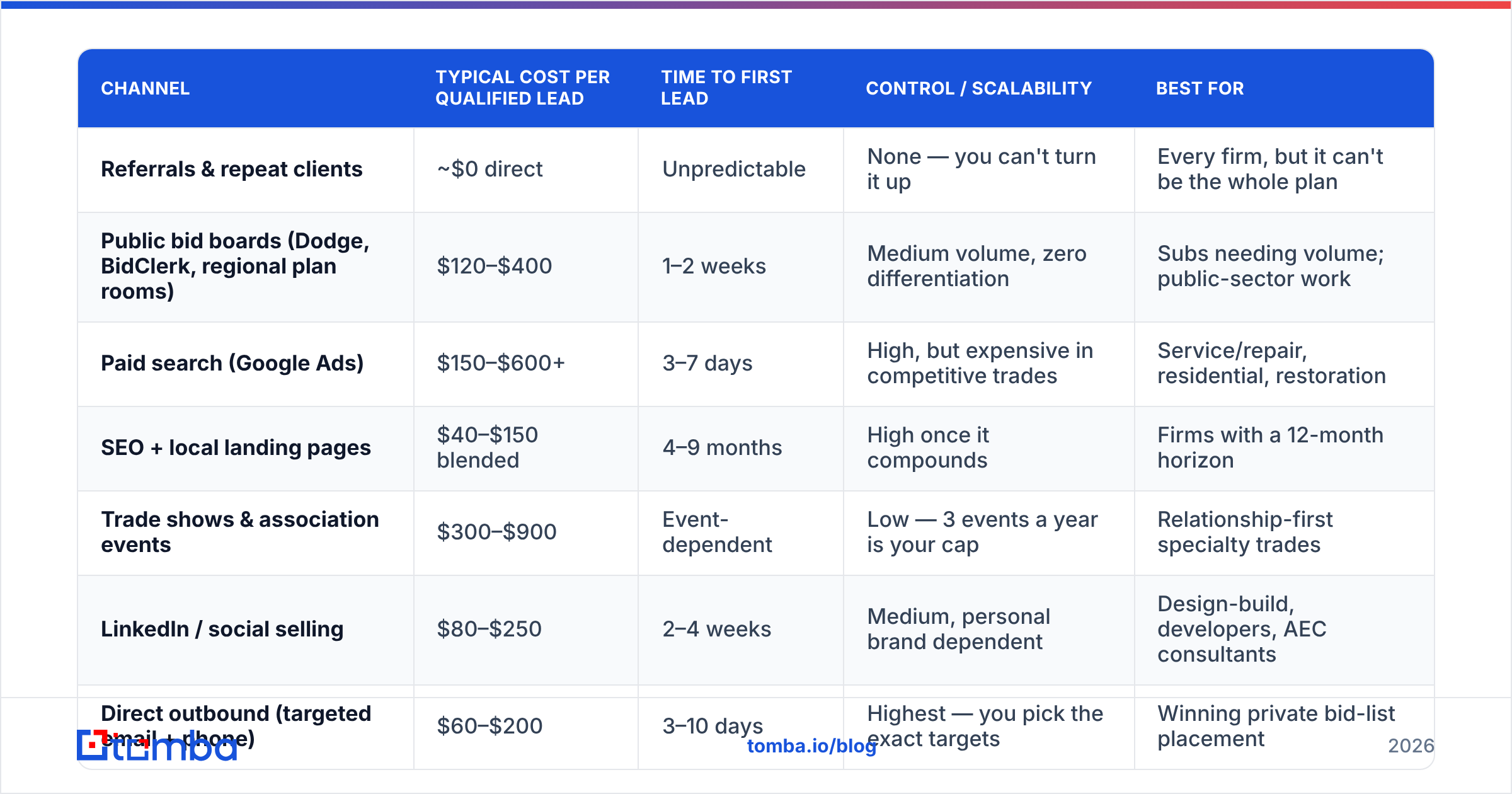
Here's how the main channels compare. The cost figures are realistic mid-market ranges for US/EU commercial contractors — regional and trade variance is wide, so treat them as directional.
| Channel | Typical cost per qualified lead | Time to first lead | Control / scalability | Best for |
|---|---|---|---|---|
| Referrals & repeat clients | ~$0 direct | Unpredictable | None — you can't turn it up | Every firm, but it can't be the whole plan |
| Public bid boards (Dodge, BidClerk, regional plan rooms) | $120–$400 | 1–2 weeks | Medium volume, zero differentiation | Subs needing volume; public-sector work |
| Paid search (Google Ads) | $150–$600+ | 3–7 days | High, but expensive in competitive trades | Service/repair, residential, restoration |
| SEO + local landing pages | $40–$150 blended | 4–9 months | High once it compounds | Firms with a 12-month horizon |
| Trade shows & association events | $300–$900 | Event-dependent | Low — 3 events a year is your cap | Relationship-first specialty trades |
| LinkedIn / social selling | $80–$250 | 2–4 weeks | Medium, personal brand dependent | Design-build, developers, AEC consultants |
| Direct outbound (targeted email + phone) | $60–$200 | 3–10 days | Highest — you pick the exact targets | Winning private bid-list placement |
Two things stand out.
First, referrals and events are the highest-trust channels and the least controllable. You cannot decide on a Monday to generate eight referrals by Friday. Every firm that relies on them exclusively eventually hits a quarter where the phone doesn't ring and there is no lever to pull.
Second, direct outbound is the only channel where you choose the target. If you want to be on the bid list for the four GCs building multifamily in your metro, outbound is the only channel that lets you name those four firms and go get them. Everything else is a bet on who happens to find you.
That doesn't mean referrals are obsolete. It means your channel mix should look like: referrals as the base, SEO compounding underneath, and direct outbound as the dial you turn when the backlog gets thin.
How do you build a targeted construction prospect list from scratch?#
This is the part most contractors skip, and it's the part that decides whether outbound works at all. Bad list, no reply rate — it's that simple.
Work through it in this order:
- Define the project profile, not the company profile. Write down the job you want: type (multifamily, healthcare, industrial TI), contract value band ($2M–$15M), geography (90-minute drive radius), and delivery method (design-build, CM at risk, hard bid). Everything downstream filters against this.
- Source the firms that deliver that profile. Permit databases, local plan rooms, Dodge Construction Network project feeds, city planning commission agendas, and AGC/ABC chapter member directories all publish who's building what. Your list of target GCs and developers is usually 40–200 firms, not 5,000 — this is a precision game.
- Identify the right role at each firm. For subcontract work: preconstruction manager, chief estimator, purchasing agent, project executive. For owner-direct work: facilities director, director of construction, VP of development. Title conventions vary; check the firm's team page and LinkedIn before you assume.
- Find verified contact details. Take the company domain and the person's name and resolve the actual work email — a domain search on the GC's website returns the firm's email pattern and known contacts in one pass, and an email finder resolves specific names to addresses. Construction firms skew heavily toward
first.last@andfinitial+last@formats, which makes pattern-based resolution unusually reliable in this vertical. - Verify before you send. Construction has brutal contact churn — estimators move firms constantly and small GCs abandon domains. Run the list through an email verifier and drop anything that isn't deliverable. A 4% bounce rate will quietly wreck your sender reputation and put your later sends in spam.
- Add phone as a second channel. This industry still answers the phone. Pairing each contact with a direct line via a phone finder roughly doubles connect rates versus email alone, especially with estimators who live in the field.
Two things to watch. Don't buy a generic "construction industry list" of 50,000 contacts — it will be full of residential handymen and dead domains, and it teaches you nothing about your market. And don't skip step 1; a list built without a project profile produces a sequence you can't write, because you have nothing specific to say.
Should you pay for bid boards or run direct outbound?#
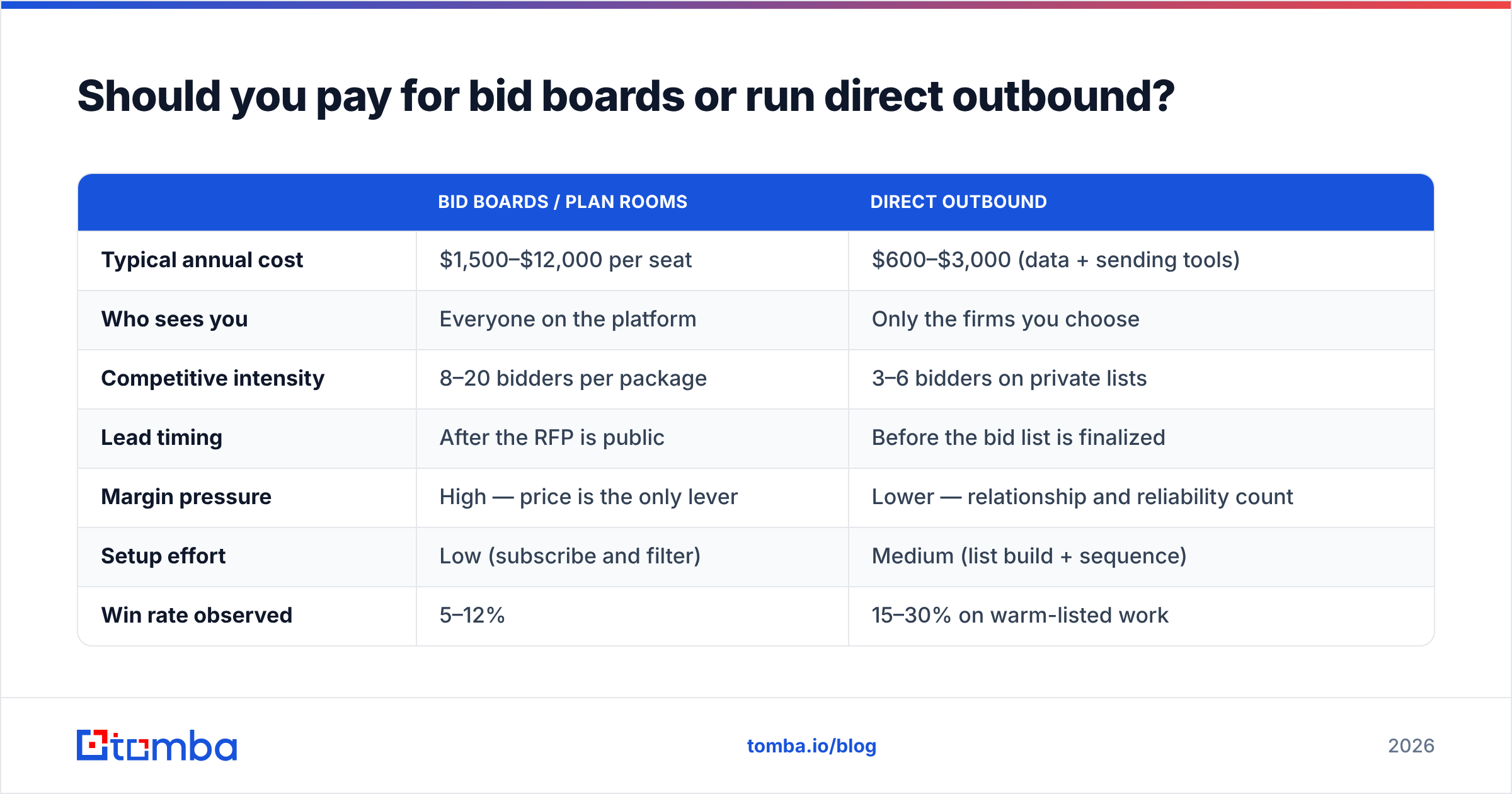
Do both, but understand what each one is buying you.
| Bid boards / plan rooms | Direct outbound | |
|---|---|---|
| Typical annual cost | $1,500–$12,000 per seat | $600–$3,000 (data + sending tools) |
| Who sees you | Everyone on the platform | Only the firms you choose |
| Competitive intensity | 8–20 bidders per package | 3–6 bidders on private lists |
| Lead timing | After the RFP is public | Before the bid list is finalized |
| Margin pressure | High — price is the only lever | Lower — relationship and reliability count |
| Setup effort | Low (subscribe and filter) | Medium (list build + sequence) |
| Win rate observed | 5–12% | 15–30% on warm-listed work |
The honest read: bid boards are a volume utility. They keep estimators busy and they're genuinely useful for public-sector work where the process is mandated. But they are a commodity channel — you're one of a dozen and you win by being cheapest or by being the only one who bid.
Direct outbound is slower to set up and pays better. When you email a preconstruction manager six weeks before an RFP drops, with a relevant project reference in your trade and in their market, you're not competing on price — you're competing to be on the list at all. That's a much easier competition.
How do you reach a GC's preconstruction team without getting ignored?#
Short, specific, and about their project — not your company.
The single biggest mistake in construction outreach is leading with capability: "We're a full-service electrical contractor with 30 years of experience serving the Southeast." Every competing email says that. It carries zero information.
What works instead:
- Reference the actual project or the actual pipeline. "Saw the permit filed for the Riverside multifamily phase 2 — we did the MEP on two comparable 80–120 unit wood-frame builds in Chandler last year."
- Prove capacity, not credentials. Precon managers are worried about one thing: will this sub show up with the crew and finish on schedule. Lead with current bonding capacity, crew availability for the relevant quarter, and one comparable job with a real number attached.
- Ask for the bid list, not a meeting. "Can I be added to your bid list for the electrical package?" is a lower-friction ask than "do you have 30 minutes next week?" — and it's what you actually want.
- Follow up by phone on touch two or three. An email plus a call to a direct line converts far better than four emails. Estimators triage inboxes; they answer phones when the caller ID is local.
- Keep sequences to 4–5 touches over 12–15 days. Construction cycles are fast when they're active. If a bid list closes, more emails won't reopen it — move on and re-approach at the next project.
For deliverability, the basics matter more here than in most verticals because many GCs run tight Microsoft 365 filtering. Authenticate your domain, warm new sending addresses, and keep email deliverability hygiene tight — a clean list is 80% of that battle. If you're sending at any volume, resolve and verify in batch with a bulk email finder rather than looking up contacts one at a time.
What should you actually measure?#
Volume metrics lie in construction. A firm bragging about 200 leads a month might be losing money on every one of them.
Track these instead:
- Bid-to-invite ratio — how many of your target firms actually add you to a list. This is the true output of outbound.
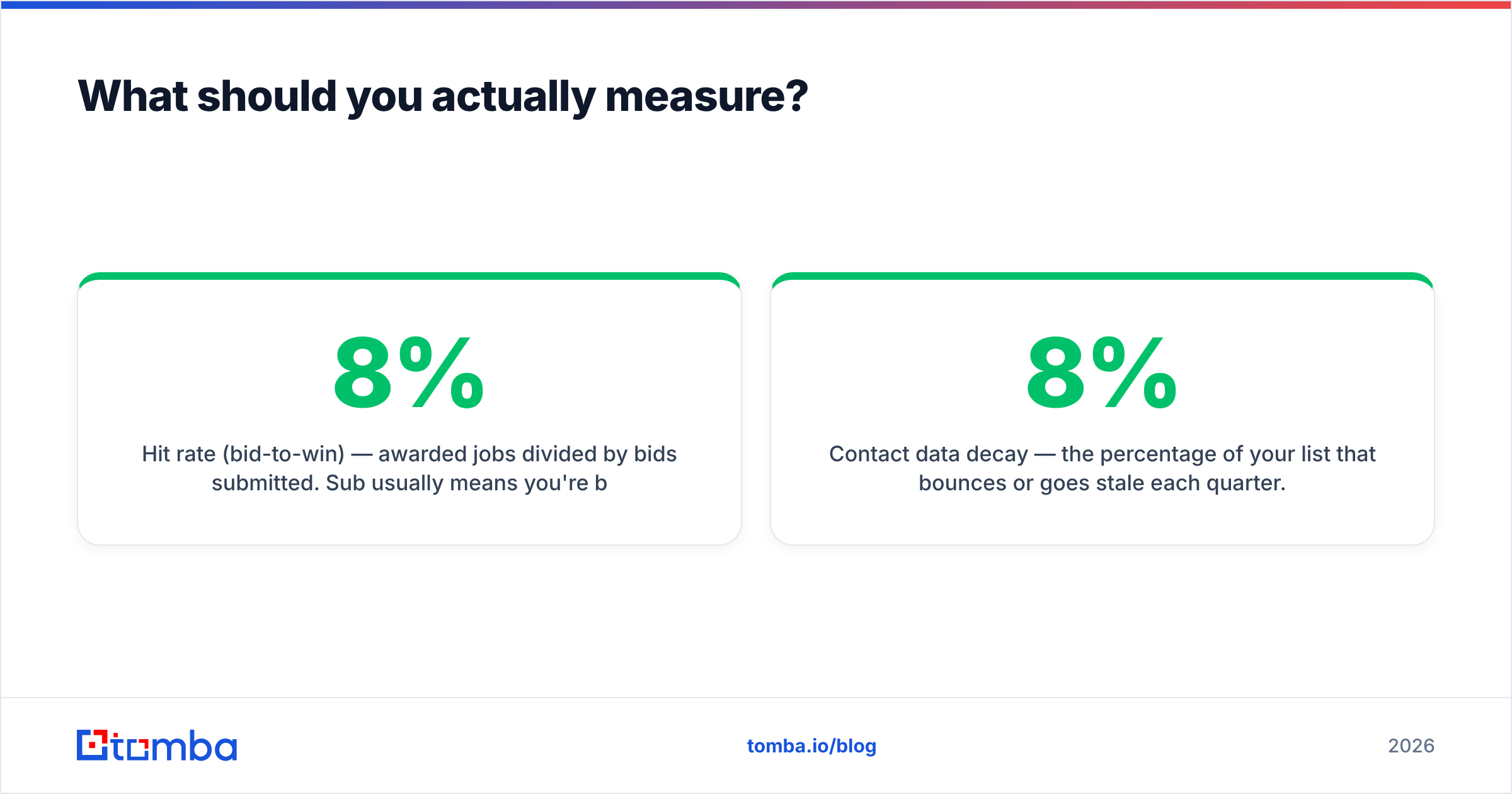
- Hit rate (bid-to-win) — awarded jobs divided by bids submitted. Sub 8% usually means you're bidding the wrong work, not pricing it wrong.
- Cost per awarded contract dollar — total channel spend divided by contract value won. This is the number that tells you whether bid boards or outbound deserve next quarter's budget.
- Pipeline coverage by quarter — backlog value divided by target revenue for each of the next three quarters. If Q3 coverage drops below 2x, that's your signal to turn the outbound dial up, not a signal to panic in September.
- Contact data decay — the percentage of your list that bounces or goes stale each quarter. Above 8%, re-enrich. Sync the clean records into whatever CRM you run so estimators aren't rebuilding contacts from scratch; HubSpot's free CRM is a reasonable starting point for firms without one.
For market context when you're forecasting, US Census construction spending data is the cleanest free source for sector-level trends — useful for deciding whether to lean industrial or multifamily next year.
What does a realistic 90-day plan look like?#
- Days 1–15: Write the project profile. Build a 100–150 firm target list of GCs, developers, and owners that deliver it. Identify one or two roles per firm.
- Days 16–30: Resolve and verify contact data for every name. Aim for 85%+ deliverable. Add direct phone numbers for the top 40 accounts.
- Days 31–60: Run the sequence — four emails and one call over two weeks, 25–40 contacts per week. Keep messaging project-specific. Log every reply, including the "not now, try us in March" replies, which are the most valuable ones.
- Days 61–90: Measure invite rate by segment. Double down on whichever project type and firm size replied best, and cut the rest. Re-run the list build against that narrowed profile.
Most firms see their first bid invitation in weeks three to five. The compounding effect shows up around month four, when the "not now" replies from month one start converting into real invitations.
Where should you start?#
Start with the list. Everything else in construction lead generation — the sequence, the phone follow-up, the CRM — is downstream of knowing exactly which 100 firms you want to work with and having a verified way to reach the person who builds their bid list.
Tomba's Email Finder resolves names and company domains into verified work emails, with domain search for mapping an entire GC's precon team and built-in verification so your sends actually land. The free tier gives you 25 searches a month to test your target list before committing; paid plans start at $49/mo, and you can compare Tomba pricing against whatever bid-board seat you're currently renewing. Build the list first, then go get on the invitation.
Related guides#
// get started
Find, verify and enrich your first contacts today
Start on the free plan with 25 searches a month, then scale when your team is ready.
Free plan · No credit card required · GDPR & CCPA
// about the author