Lead Generation for Consultants: A 2026 Playbook That Works
Referrals are a great business until the month they stop. Here is a channel-by-channel breakdown of what lead generation for consultants actually costs, what it returns, and the outbound stack that replaces feast-or-famine with a predictable pipeline.
TL;DR
- Referrals are the highest-converting channel for consultants and the worst one to depend on — they are unforecastable, and they collapse exactly when your delivery calendar frees up.
- The channels that actually scale for solo and boutique consultancies are narrow-niche outbound, authority content, and partner/referral engineering — in that order of speed, and reverse order of cost.
- A workable target for a $15k–$50k engagement: 300 well-researched prospects per month, 8–12% reply rate, 2–4 discovery calls, 1 close per 6–10 calls.
- List quality beats volume by a wide margin. Bounce rates above 5% will quietly kill your domain before your offer ever gets a fair test.
- Budget under $200/month for the whole data stack. Anything more, at consultant scale, is enterprise pricing you don't need yet.
Why is lead generation for consultants different from normal B2B sales?#
Because you are the product, and you cannot scale yourself.
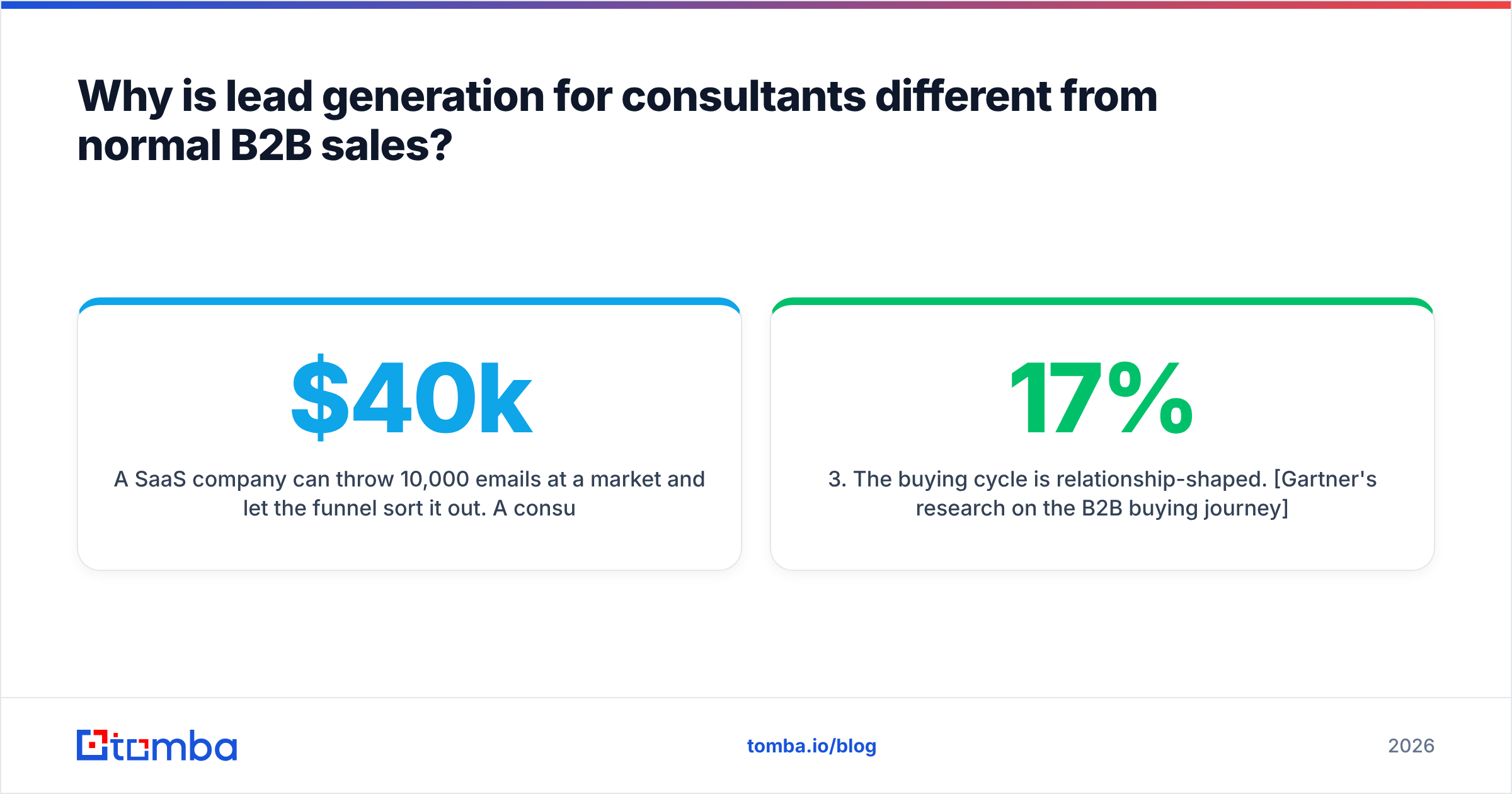
A SaaS company can throw 10,000 emails at a market and let the funnel sort it out. A consultant selling a $40k strategy engagement cannot — and shouldn't. You have maybe 8–10 delivery slots per year. You do not need 500 leads. You need 30 genuinely qualified conversations with people who have the budget and the authority to sign.
That constraint changes everything about how you build a pipeline:
- Targeting matters more than volume. A list of 200 hand-picked accounts, researched properly, outperforms 5,000 scraped contacts. You have the time to do this; a 40-rep SDR team does not. That's your advantage.
- Your reputation is the asset. One spam complaint from a peer in a small niche market travels further than it would in a 50,000-company TAM.
- The buying cycle is relationship-shaped. Gartner's research on the B2B buying journey shows buyers spend only about 17% of the cycle meeting suppliers at all. Most of the decision happens before you're in the room.
- Capacity is the real constraint. Overselling is as damaging as underselling. A pipeline that produces 4x your capacity creates rushed delivery and bad case studies.
- You're selling trust, not features. Which means proof — case studies, named clients, specific numbers — does more work than any subject line you write.
What is the real problem with referral-only pipelines?#
The math is seductive and the variance is brutal.
Referrals convert at 40–60% for most consultants versus 1–3% for cold outbound. That looks like an obvious win, and for the first two years it usually is. Then a client champion changes jobs, a retainer ends, and you discover your entire acquisition strategy was one person's goodwill.
The structural issue is timing. Referrals arrive when your network happens to encounter a need — not when your calendar opens up. So you get the classic consultant sine wave: three months of packed delivery with zero selling, followed by two months of panicked outreach into a cold network. By the time you rebuild momentum, you've burned savings and taken a bad-fit project at a discount.
The fix isn't abandoning referrals. It's adding a second engine that you control the throttle on. Outbound is that engine, because it is the only channel where you can decide on a Monday to double the volume and see replies by Thursday.
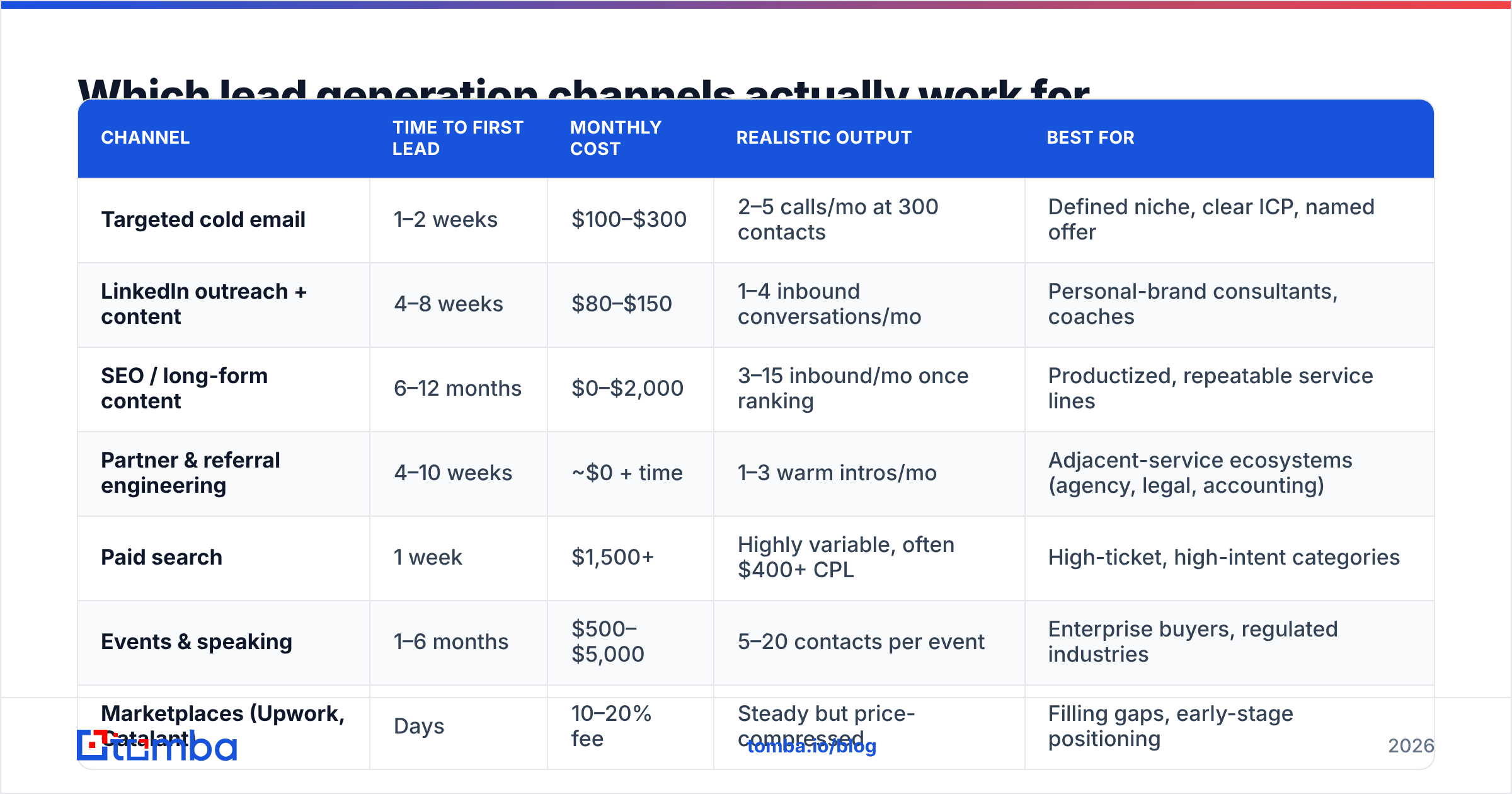
Which lead generation channels actually work for consultants?#
Here's the honest comparison, based on what a solo or 2–5 person consultancy can realistically run alongside client delivery.
| Channel | Time to first lead | Monthly cost | Realistic output | Best for |
|---|---|---|---|---|
| Targeted cold email | 1–2 weeks | $100–$300 | 2–5 calls/mo at 300 contacts | Defined niche, clear ICP, named offer |
| LinkedIn outreach + content | 4–8 weeks | $80–$150 | 1–4 inbound conversations/mo | Personal-brand consultants, coaches |
| SEO / long-form content | 6–12 months | $0–$2,000 | 3–15 inbound/mo once ranking | Productized, repeatable service lines |
| Partner & referral engineering | 4–10 weeks | ~$0 + time | 1–3 warm intros/mo | Adjacent-service ecosystems (agency, legal, accounting) |
| Paid search | 1 week | $1,500+ | Highly variable, often $400+ CPL | High-ticket, high-intent categories |
| Events & speaking | 1–6 months | $500–$5,000 | 5–20 contacts per event | Enterprise buyers, regulated industries |
| Marketplaces (Upwork, Catalant) | Days | 10–20% fee | Steady but price-compressed | Filling gaps, early-stage positioning |
Two things stand out in that table. First, cold email is the only channel with a short time-to-first-lead and a low cost — which is why it's the default second engine. Second, content and partnerships have the best long-run economics but require you to survive the next six months first. Run outbound to fund the patience that content requires.
How do you build a prospect list that doesn't waste your time?#
Start with a written ICP that is narrower than feels comfortable.
"B2B SaaS companies" is not an ICP. "Series A/B vertical SaaS companies, 40–150 employees, with a VP Marketing hired in the last 9 months, using HubSpot" is an ICP. The second one gives you a trigger event, a buying role, and a technology signal you can actually filter on.
Then build the list in this order:
- Account layer first. Pull 150–300 companies matching firmographics and at least one trigger: funding round, leadership change, job posting, tech stack shift, regulatory deadline. A website tech stack check is a fast way to confirm the tooling signal before you spend effort on a contact.
- Role layer second. For each account, identify one primary buyer and one influencer. Two contacts per company, maximum. Consultants who email six people at a 60-person company look like a vendor blast, not a peer.
- Contact layer third. Now find verified work emails. A domain search returns the company's known address patterns and the people behind them in one pass, which is far faster than guessing
first.last@and hoping. - Verification layer fourth. Run everything through an email verifier before a single send. Non-negotiable — more on why below.
- Research layer last. For the 50 highest-fit accounts, spend 3–5 minutes each finding one specific, non-obvious detail. This is what separates a 12% reply rate from a 2% one.
That last step is where consultants beat SDR teams. An SDR has a 60-dials-a-day quota. You have the luxury of reading someone's last three LinkedIn posts before you write to them, and it shows in the first line.
Does email verification actually matter at consultant volume?#
Yes, and disproportionately so — because you are almost certainly sending from your primary business domain.
An SDR team burns throwaway domains on purpose. You cannot. The address on your outbound is the same one your existing clients use to send you contracts. If it lands in spam, you don't just lose a campaign; you lose invoice emails and project threads.
Here's the mechanism. Mailbox providers watch your bounce rate as a proxy for list hygiene. Cross roughly 5% hard bounces and you're flagged as a sender who doesn't know who they're emailing. Gmail and Microsoft then start routing your mail — all of it — to the spam folder. Recovery takes weeks.
Unverified B2B lists decay at roughly 22–30% per year through job changes alone. So a list you built nine months ago and never re-verified is likely sitting somewhere around 15–20% invalid. That's three to four times over the danger line before you write a single word of copy.
Two practical safeguards:
- Verify at build time, then re-verify anything older than 60 days. Bulk verification makes this a two-minute job on a 300-row list.
- Treat catch-all domains carefully. They accept everything at the SMTP layer, so a simple check returns "valid" for addresses that don't exist. A dedicated catch-all verifier applies additional signals instead of guessing.

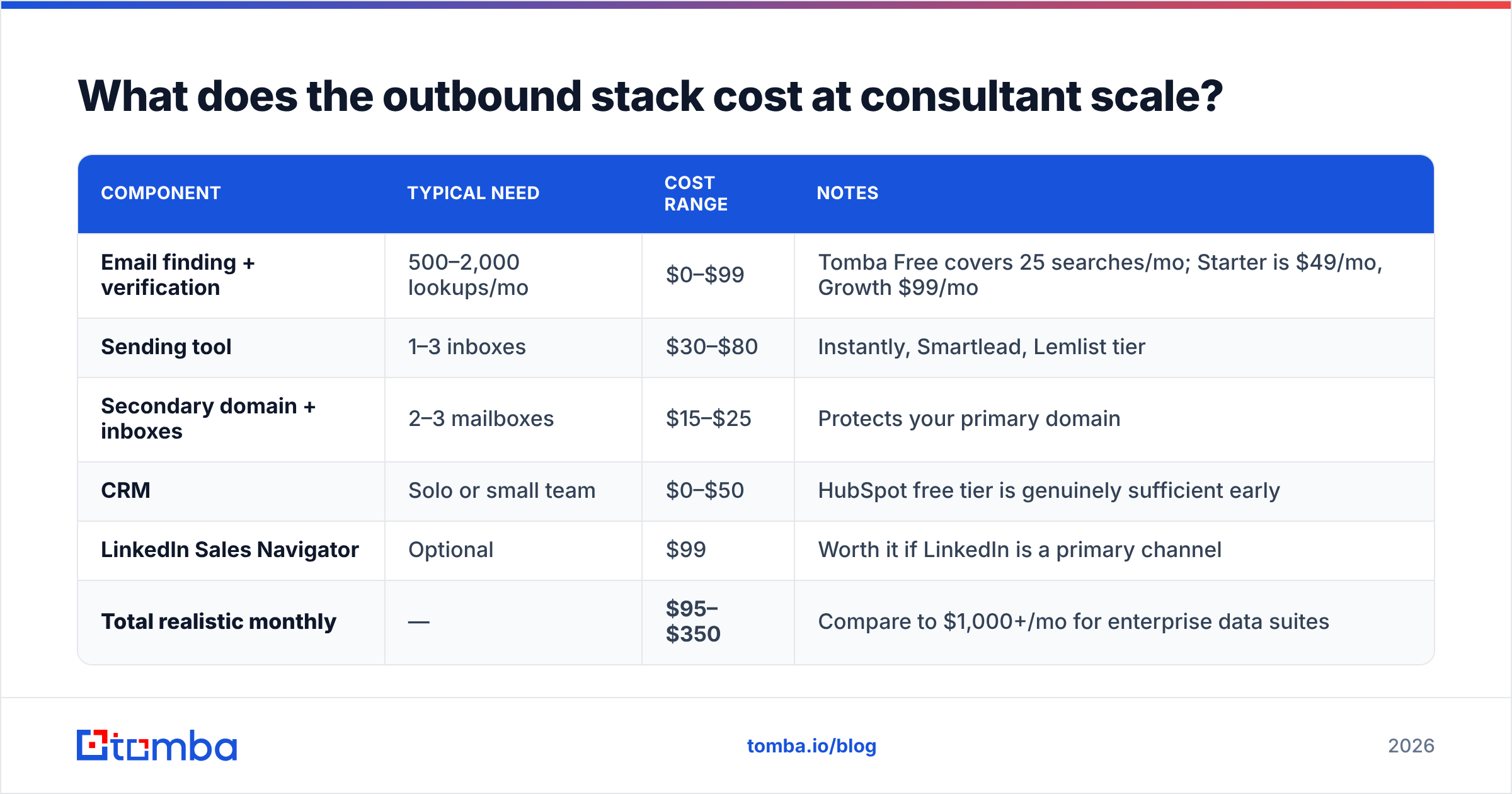
What does the outbound stack cost at consultant scale?#
Less than most people assume, and far less than the enterprise data platforms will quote you.
| Component | Typical need | Cost range | Notes |
|---|---|---|---|
| Email finding + verification | 500–2,000 lookups/mo | $0–$99 | Tomba Free covers 25 searches/mo; Starter is $49/mo, Growth $99/mo |
| Sending tool | 1–3 inboxes | $30–$80 | Instantly, Smartlead, Lemlist tier |
| Secondary domain + inboxes | 2–3 mailboxes | $15–$25 | Protects your primary domain |
| CRM | Solo or small team | $0–$50 | HubSpot free tier is genuinely sufficient early |
| LinkedIn Sales Navigator | Optional | $99 | Worth it if LinkedIn is a primary channel |
| Total realistic monthly | — | $95–$350 | Compare to $1,000+/mo for enterprise data suites |
For context on the data layer: a consultant running 300 prospects a month needs roughly 600–900 credits including verification and re-checks. That sits inside the $49/mo Starter plan comfortably, and the $99/mo Growth tier covers a two-person team running two campaigns in parallel. Full Tomba pricing is public, and the free tier is enough to test whether your ICP is even findable before you commit a dollar.
The mistake to avoid is buying a $12,000/year data platform because it has intent signals. Intent data is genuinely useful at 50-rep scale where you need to triage. At 300 prospects a month, you can read the signals yourself in less time than it takes to learn the platform.
How do you write outreach that a CFO will actually answer?#
Three rules, and they're boring because they work.
Lead with a specific observation, not a compliment. "I saw you're hiring two RevOps analysts while running Salesforce and HubSpot in parallel" is a reason to reply. "Love what you're building" is a reason to delete.
Name the outcome, not the methodology. Buyers don't purchase "a discovery workshop." They purchase "knowing which of your four product lines is actually profitable." Lead with the second thing.
Make the ask absurdly small. Not "do you have 30 minutes Thursday." Try "is this worth a 10-minute look, or is it not a priority this quarter?" Giving an easy out raises replies because it removes the pressure to commit.
On volume: 10–25 sends per inbox per day is the ceiling for a consultant's primary domain. Anything faster looks automated. Three to four touches over 14 days, then stop and move the contact to a quarterly nurture list. The follow-up sequence does most of the work — reply rates typically peak on touch two or three, not touch one.
If you need structural help, HubSpot's lead generation guide covers the funnel mechanics well, and the Wikipedia entry on lead generation is a decent neutral primer on the terminology if you're briefing a new hire.
What numbers should you actually track?#
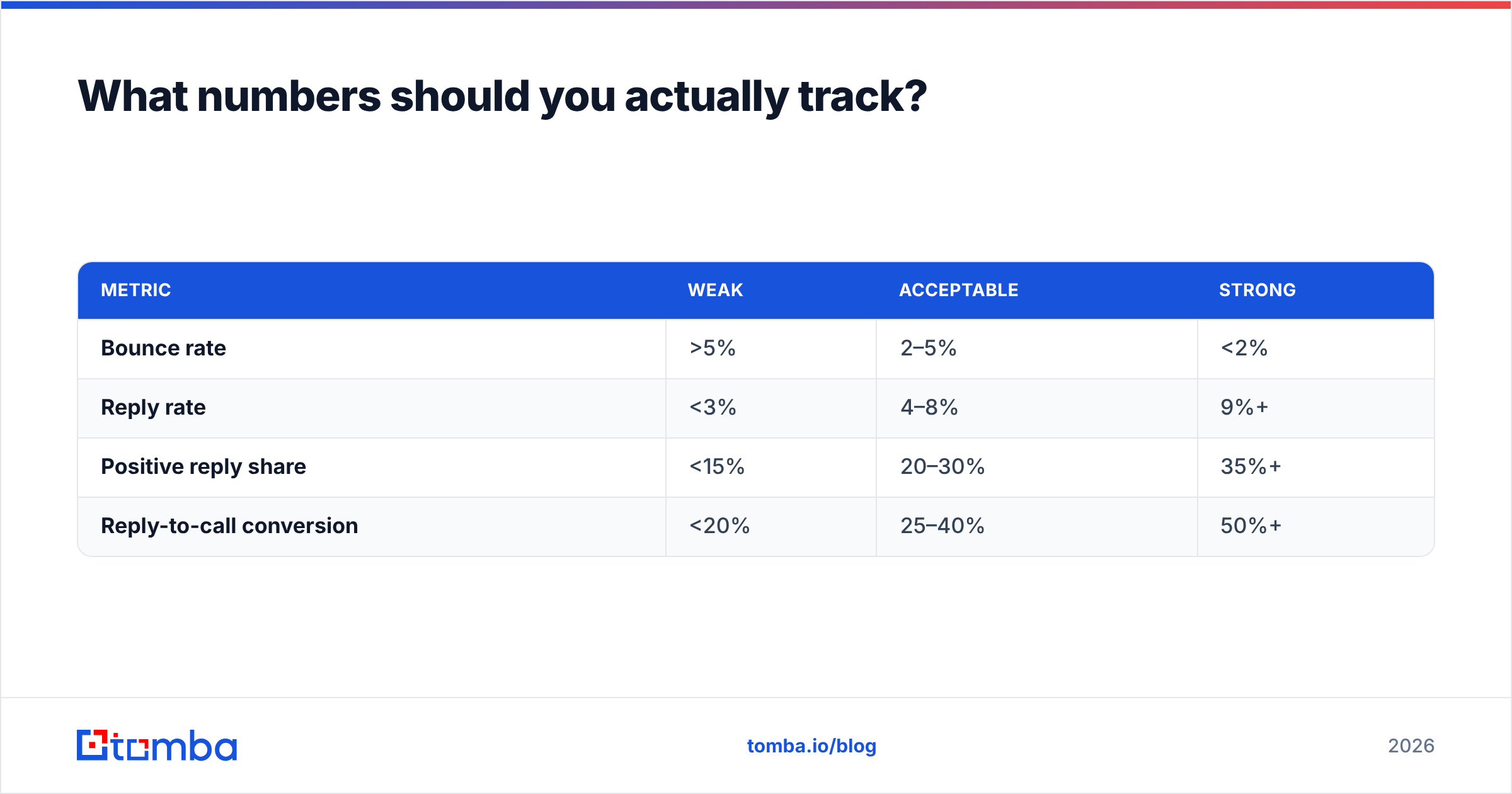
Track four, and ignore the rest until these are stable.
| Metric | Weak | Acceptable | Strong |
|---|---|---|---|
| Bounce rate | >5% | 2–5% | <2% |
| Reply rate | <3% | 4–8% | 9%+ |
| Positive reply share | <15% | 20–30% | 35%+ |
| Reply-to-call conversion | <20% | 25–40% | 50%+ |
Bounce rate diagnoses your data. Reply rate diagnoses your targeting and subject lines. Positive reply share diagnoses your offer. Reply-to-call diagnoses your follow-up speed and your credibility assets.
When something's broken, fix in that order. Most consultants rewrite copy when the actual problem is that 18% of their list doesn't exist and another 40% is the wrong job title. Copy is the last thing to optimize, not the first — and your response rate will tell you which layer is failing if you segment the data properly.
What's the 90-day version of this?#
Days 1–14: Write the ICP. Build 150 target accounts. Find and verify contacts. Set up a secondary sending domain and warm it.
Days 15–45: Send to the first 150 at 15/day. Four-touch sequence over two weeks. Book whatever calls come. Simultaneously publish one substantial piece of content per week on the same narrow topic your outbound addresses.
Days 46–90: Double the list to 300/month based on which segment replied. Start partner conversations with three adjacent-service providers who serve the same buyer. Ask every delivered client for one specific introduction, by name.
By day 90 you should have real data on which segment responds, a warmed domain, and two or three content assets doing quiet background work. That's not a full pipeline yet. It's an engine you can turn up.
Ready to build the list?#
Everything above depends on one thing being solid: knowing who to contact and having an address that actually delivers. That's the layer where consultant pipelines usually break, and it's the cheapest layer to fix.
Start with the Tomba Email Finder — search by company domain, name, or role, get verified professional addresses with a confidence score, and export straight into your sequencing tool. The free tier gives you 25 searches a month to pressure-test your ICP before you spend anything, and the $49/mo Starter plan covers a full 300-prospect monthly cycle with verification included. Build the list properly once, and the rest of the playbook has something real to run on.
Related guides#
// get started
Find, verify and enrich your first contacts today
Start on the free plan with 25 searches a month, then scale when your team is ready.
Free plan · No credit card required · GDPR & CCPA
// about the author