Lead Generation for Design Agencies: The 2026 Playbook
Referrals dry up. Here's the channel-by-channel system design agencies actually use to book qualified calls in 2026 — with real costs, close rates, and the stack that runs it.
TL;DR
- Referrals are the highest-closing channel for design agencies (30-50% close rate) but the least controllable — they cannot be your growth plan.
- The agencies that grow predictably run two or three channels at once: a narrow outbound motion, a proof-led content/portfolio engine, and one partner/referral loop they actively feed.
- Outbound works for design agencies only when the list is tiny and hand-picked. 40 researched prospects beat 4,000 scraped ones every time.
- Your biggest lead-gen leak is not traffic — it's the gap between "loved the portfolio" and "booked a call." Fix the qualification step before you buy more leads.
- Budget reality: a working outbound stack (data + sending + CRM) runs roughly $150-$400/month for a small agency, not the $2k+ most vendors quote you.
Why Is Lead Generation for Design Agencies So Different?#
Because you are selling judgment, not a product, and judgment is expensive to evaluate.
Think of it like hiring an architect versus buying furniture. Furniture you can compare on a spec sheet. An architect you have to trust, and trust takes proof: past buildings, a reference call, a conversation where they understand your site before you finish describing it. That's the buying process for design work, and it breaks most of the standard B2B lead-gen advice.
Three consequences fall out of that:
- Volume-based outbound underperforms. A 5,000-contact blast advertising "we do beautiful web design" reads as commodity. Your differentiation is invisible at scale.
- Your portfolio IS the lead magnet. Not an ebook. Prospects who read three case studies convert dramatically better than those who download a checklist.
- Deal sizes justify manual work. A $40k brand identity project can absorb 90 minutes of research per prospect. A $49/month SaaS cannot. Use that asymmetry — it's your actual advantage over software companies competing for the same inboxes.
The agencies that struggle are usually running SaaS playbooks (high volume, low personalization, automated nurture) on a professional-services business. The math doesn't transfer.

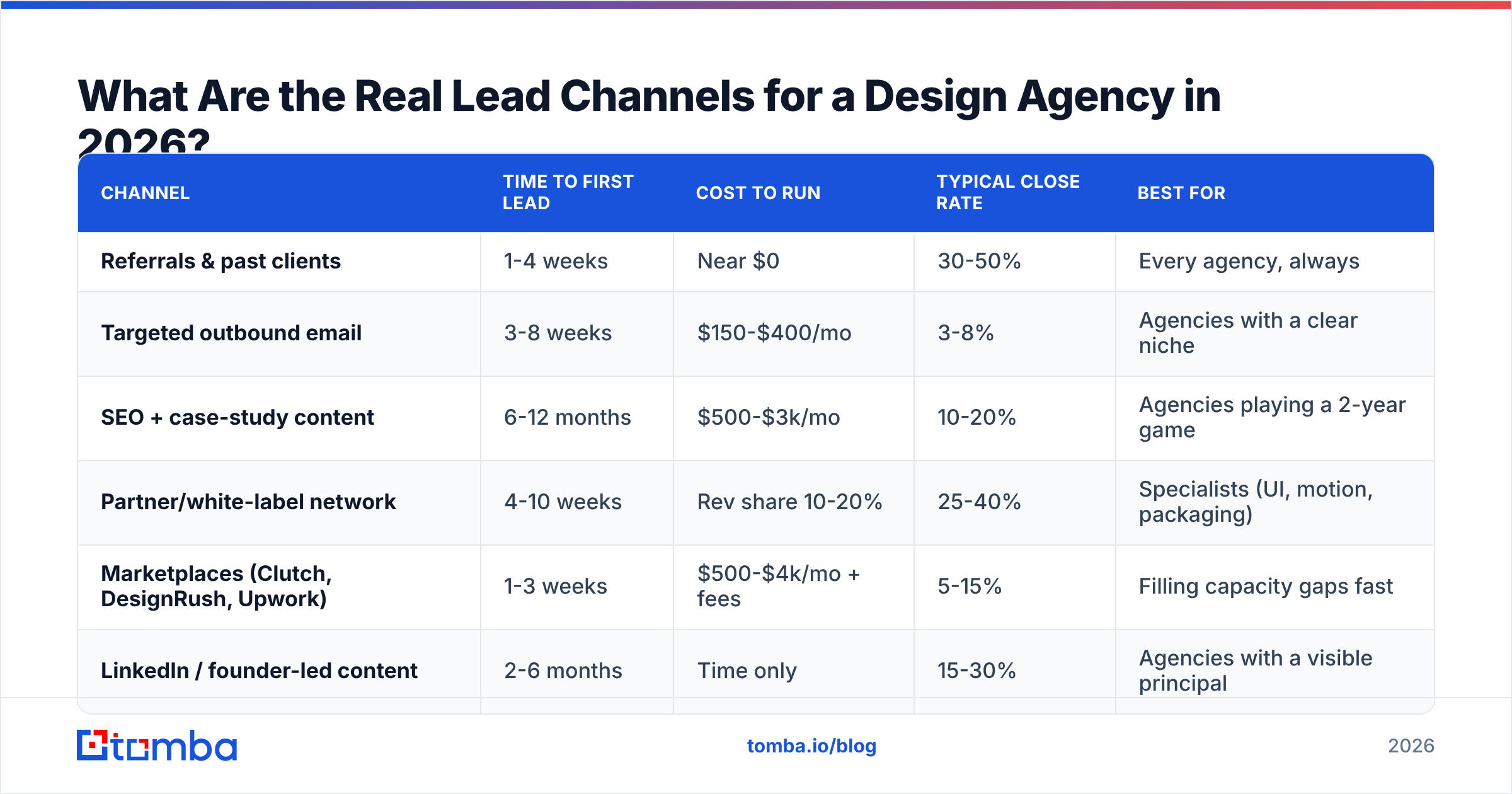
What Are the Real Lead Channels for a Design Agency in 2026?#
There are six that consistently produce work. Most agencies should run two or three, not all six.
| Channel | Time to first lead | Cost to run | Typical close rate | Best for |
|---|---|---|---|---|
| Referrals & past clients | 1-4 weeks | Near $0 | 30-50% | Every agency, always |
| Targeted outbound email | 3-8 weeks | $150-$400/mo | 3-8% | Agencies with a clear niche |
| SEO + case-study content | 6-12 months | $500-$3k/mo | 10-20% | Agencies playing a 2-year game |
| Partner/white-label network | 4-10 weeks | Rev share 10-20% | 25-40% | Specialists (UI, motion, packaging) |
| Marketplaces (Clutch, DesignRush, Upwork) | 1-3 weeks | $500-$4k/mo + fees | 5-15% | Filling capacity gaps fast |
| LinkedIn / founder-led content | 2-6 months | Time only | 15-30% | Agencies with a visible principal |
A few notes that the table flattens:
- Marketplaces buy you speed and cost you margin. A Clutch profile with 15 verified reviews generates inbound, but the leads are price-comparing across four agencies by default. Use them to smooth revenue dips, not as your base.
- SEO is slow but compounds. An agency ranking for "SaaS onboarding UX audit" gets the highest-intent traffic on the internet, for free, forever. The catch is 6-12 months of nothing.
- Outbound is the only channel where you control the volume dial. That's why it belongs in almost every agency's mix even if it isn't the biggest source.
How Do You Build an Outbound List That Actually Converts?#
Start from a trigger, not a title.
The failure pattern is obvious once you see it: an agency picks "Head of Marketing at companies with 50-200 employees," pulls 3,000 contacts, and sends a pitch about design services. Nothing in that sequence tells the prospect why now. Design is almost never urgent — you have to find the moment where it becomes urgent.
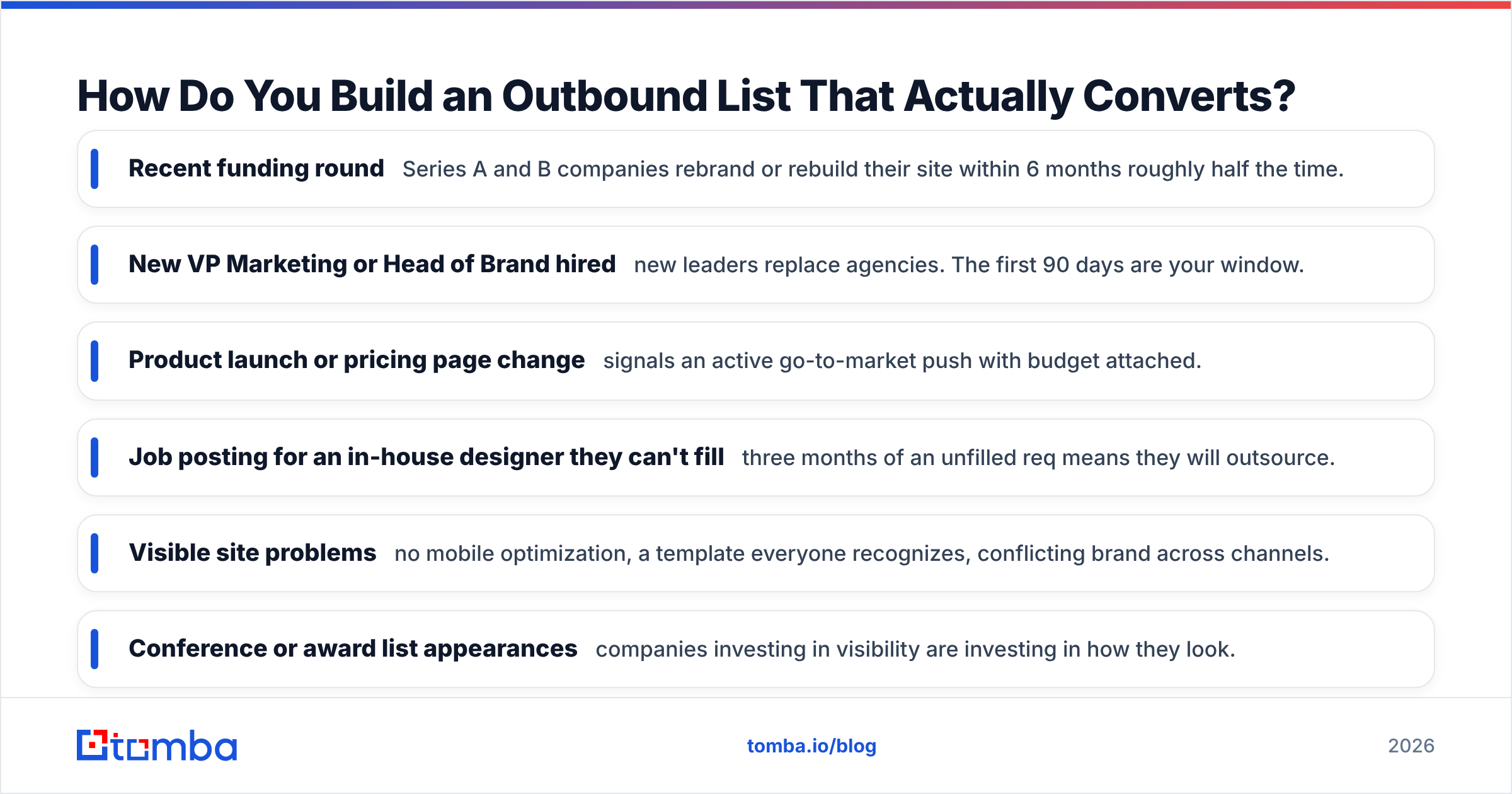
Triggers that actually predict design demand:
- Recent funding round — Series A and B companies rebrand or rebuild their site within 6 months roughly half the time.
- New VP Marketing or Head of Brand hired — new leaders replace agencies. The first 90 days are your window.
- Product launch or pricing page change — signals an active go-to-market push with budget attached.
- Job posting for an in-house designer they can't fill — three months of an unfilled req means they will outsource.
- Visible site problems — no mobile optimization, a template everyone recognizes, conflicting brand across channels.
- Conference or award list appearances — companies investing in visibility are investing in how they look.
Once you have a trigger, build the list narrow. Fifty companies. For each, you need the right human — usually a founder at sub-50 headcount, a marketing lead at 50-500, and a brand/design director above that — and a working email address.
This is where most agency outbound dies. You find the right person on LinkedIn, guess at firstname@company.com, and half your sends bounce. A bounce rate above 3% starts damaging your sender reputation, which quietly kills the campaign you spent two weeks researching. Run your list through an email finder to resolve addresses from name plus domain, then verify emails before the first send. On a 50-contact list that's a five-minute step that protects everything downstream.
For the research pass itself, domain search is faster than hunting person by person — it returns the email pattern plus the known contacts at a company in one query, so you can see whether the decision-maker you want is even reachable before investing time in the account.
What Should a Design Agency's Cold Email Actually Say?#
Show that you looked. Then make the ask small.
The structural rule: your first email should contain one specific observation about their business, one sentence of relevant proof, and one low-commitment ask. No deck, no calendar link in the first message, no "hope this finds you well."
Here's the shape that works for agencies:
Subject: your pricing page vs. the demo flow
Noticed you shipped the new pricing tiers last month but the demo request flow still routes to the old form — three fields on mobile, no context on what happens next.
We rebuilt that exact handoff for [similar company] and their demo-to-meeting rate went from 31% to 48%. Took four weeks.
Worth a 15-minute look at yours? I'll send a two-slide teardown either way.
What makes it work: the observation is checkable, the proof is a number tied to a comparable company, and the ask costs them nothing. The "I'll send it either way" line does real work — it converts non-responders into people who owe you a reply.
What kills agency cold emails:
- Leading with your process. Nobody outside your agency cares about your discovery phase.
- Adjective stacking. "Beautiful, modern, conversion-focused design" describes every agency on earth.
- Attaching a PDF. Kills deliverability and signals mass send.
- Following up four times with "just bumping this." Each follow-up should add something: a new observation, a relevant case study, a competitor example.
Three to four touches over two weeks is the right cadence. If you want to pressure-test your opener before sending, a subject line tester catches the spam-trigger words that quietly route you to promotions.

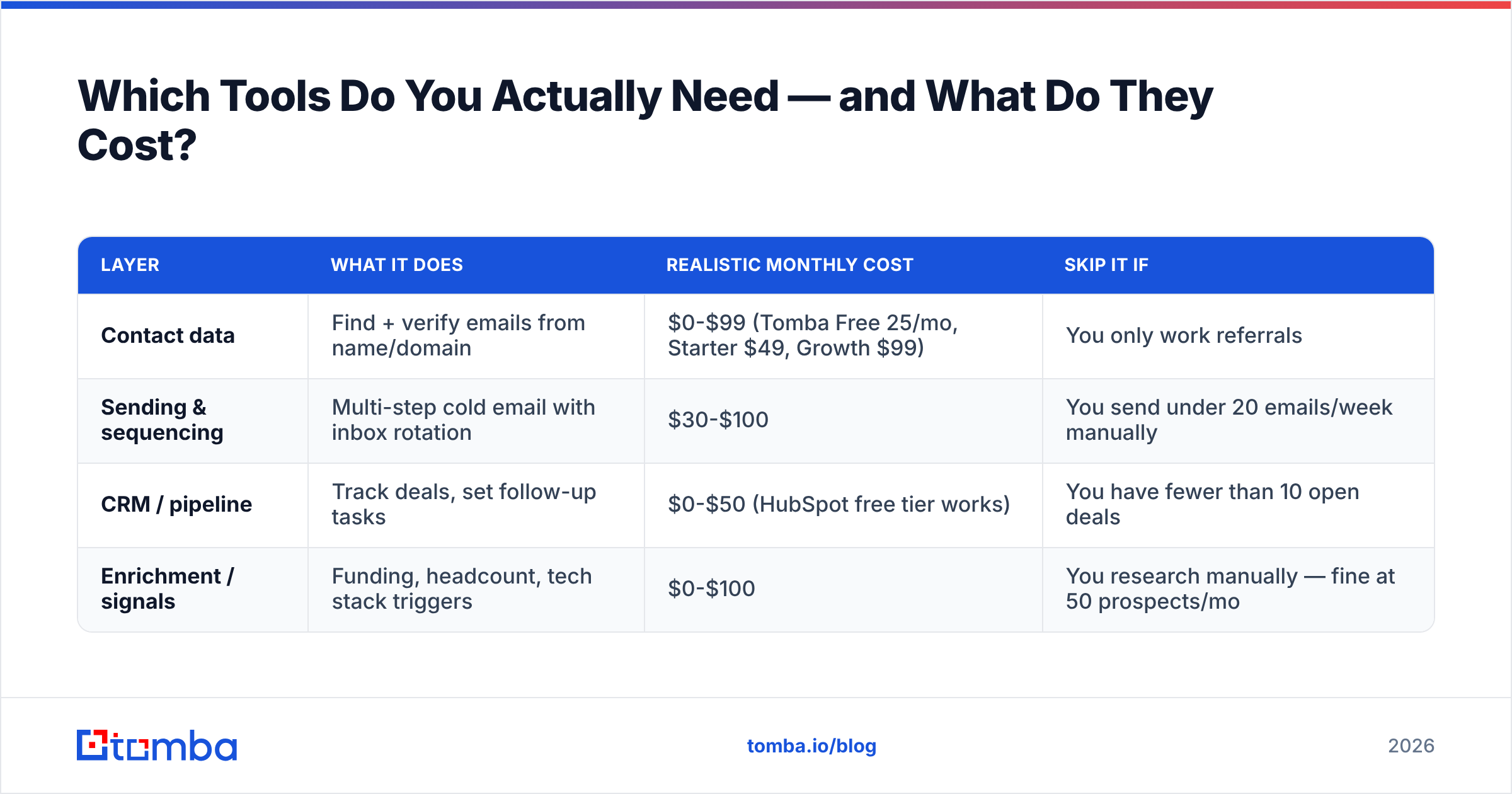
Which Tools Do You Actually Need — and What Do They Cost?#
Less than vendors imply. A functional agency lead-gen stack has four jobs: find contacts, verify them, send sequences, track deals.
| Layer | What it does | Realistic monthly cost | Skip it if |
|---|---|---|---|
| Contact data | Find + verify emails from name/domain | $0-$99 (Tomba Free 25/mo, Starter $49, Growth $99) | You only work referrals |
| Sending & sequencing | Multi-step cold email with inbox rotation | $30-$100 | You send under 20 emails/week manually |
| CRM / pipeline | Track deals, set follow-up tasks | $0-$50 (HubSpot free tier works) | You have fewer than 10 open deals |
| Enrichment / signals | Funding, headcount, tech stack triggers | $0-$100 | You research manually — fine at 50 prospects/mo |
That's $80-$350/month for a small agency running real outbound. Compare that to a single $25k project and the ROI math stops being interesting.
A few selection notes, neutrally:
- Contact data is where accuracy matters most, because every downstream step inherits your bounce rate. Pricing models differ meaningfully: Tomba pricing starts with a free tier at 25 searches/month and moves to $49/month Starter, $99/month Growth, and $249/month Pro. BookYourData takes a different route with pay-as-you-go credits and no subscription, which suits agencies that prospect in bursts around capacity gaps rather than continuously. Both are legitimate choices; the question is whether your prospecting is steady or lumpy.
- Don't buy a sequencer before you have a list. Agencies routinely subscribe to sending tools then discover they have 40 contacts and no research process.
- Your CRM can be a spreadsheet until roughly 25 open opportunities. HubSpot's free CRM is the sensible upgrade after that.
If your research already happens in a spreadsheet, the Google Sheets add-on turns a column of names and domains into verified addresses without leaving the sheet — which removes the most common excuse for skipping verification.
How Do You Qualify Design Leads Before They Waste Your Week?#
Ask about budget and decision process on the first call, out loud, in the first ten minutes.
Agencies burn enormous time on prospects who were never going to buy. The tell is almost always the same: a pleasant 45-minute call full of enthusiasm, followed by a proposal request, followed by silence. That prospect was shopping for ideas, not vendors.
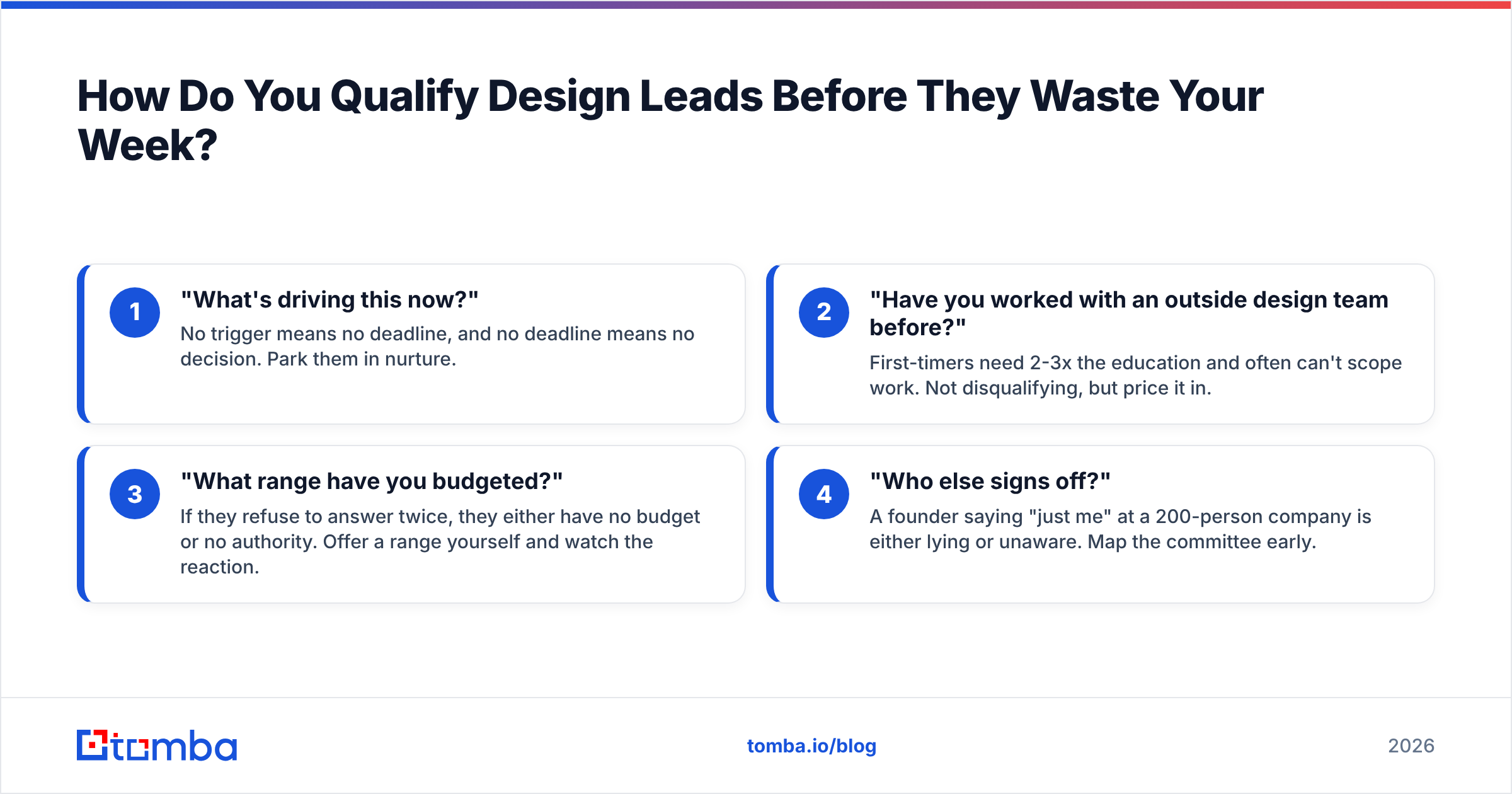
A four-question filter catches most of it:
- "What's driving this now?" No trigger means no deadline, and no deadline means no decision. Park them in nurture.
- "Have you worked with an outside design team before?" First-timers need 2-3x the education and often can't scope work. Not disqualifying, but price it in.
- "What range have you budgeted?" If they refuse to answer twice, they either have no budget or no authority. Offer a range yourself and watch the reaction.
- "Who else signs off?" A founder saying "just me" at a 200-person company is either lying or unaware. Map the committee early.
Score leads on those four plus fit-to-portfolio. A prospect scoring 4+ out of 5 gets a proposal. A prospect scoring 2 gets a templated response and a nurture slot. Formalizing this — even in a spreadsheet — typically recovers 5-8 hours a week at a five-person agency. If you want the framework language, the MQL definition in the glossary maps reasonably well onto services businesses.
How Do You Turn Past Clients Into a Repeatable Referral Engine?#
Systematize the ask. Referrals feel random because most agencies leave them to chance.
Three mechanics that convert a happy client into pipeline:
- The 30-day post-launch check-in. Not an upsell call. You review metrics, note what's working, and close with: "If anyone in your network is wrestling with the same problem, I'd love an intro." Satisfaction peaks around day 30, not at handoff.
- The named ask. "Do you know anyone who needs design?" gets nothing. "You mentioned your former colleague at [Company] just raised — would an intro make sense?" gets a reply. Do the research before you ask.
- The dormant-client sweep, quarterly. Pull every client from 12-24 months ago. Companies rebrand, leaders move, sites age. A four-sentence email referencing something specific about their current site reactivates 10-15% of a healthy list.
That last one has a data problem: the champion who hired you has probably changed jobs. This is where a reverse email lookup earns its keep — feed in the old address, get the person's current company, and you've discovered a warm lead at a new account rather than emailing a dead mailbox. Your best prospects in 2026 are frequently the people who already bought from you, now sitting at a different logo with a new budget.
What Does a 90-Day Lead Gen Plan Look Like?#
Concrete, in order, assuming a small agency starting near zero:
Days 1-30 — Positioning and proof. Pick one vertical or one problem you can defend. "We design onboarding for B2B SaaS" beats "full-service digital agency" in every channel simultaneously. Rewrite three case studies to lead with the client's number, not your process. Fix the contact form so it asks for budget range and timeline.
Days 31-60 — Build the outbound motion. Define two triggers. Build a 50-company list against them. Find and verify contacts. Write three sequences — one per trigger, one for dormant clients. Send in batches of 15/day from a warmed domain. Track reply rate, not open rate.
Days 61-90 — Layer the compounding channels. Publish two teardown-style posts targeting the terms your ICP searches. Submit to two marketplaces. Set up the 30-day check-in cadence for every project. Run your first dormant-client sweep.
By day 90 you should have real data on which channel produces a booked call cheapest for your agency, which is the only version of this answer that matters. If outbound gets you 4 calls from 150 emails and marketplaces get you 3 calls for $1,200, you now know where the next dollar goes.
Where Do Most Design Agencies Go Wrong?#
Four failures account for most of it:
- No niche. A generalist agency competes with everyone and is memorable to no one. Narrowing feels like shrinking your market; it actually multiplies your reply rate because your emails suddenly say something specific.
- Running one channel. Referral-only agencies have brilliant years followed by terrifying ones. Two channels minimum.
- Quitting outbound at week three. Deliverability ramps, list quality improves, and messaging gets sharper over roughly 6-8 weeks. Most agencies quit at week three and conclude "cold email doesn't work for design."
- Chasing volume instead of fit. Doubling your send volume on a bad list doubles your bounces and halves your domain reputation. Doubling your research quality on the same 50 contacts usually doubles replies.
Start With the List#
Every channel above eventually resolves to the same bottleneck: can you reach the specific person at the specific company at the moment they need you? Positioning tells you who to target. Triggers tell you when. But the campaign only exists once you have a verified address for a real decision-maker.
If you're building that first 50-company outbound list, start with the Tomba Email Finder — resolve contacts from a name and domain, verify before you send, and keep your bounce rate low enough that your sequences actually reach the inbox. The free tier covers 25 searches a month, which is enough to test the motion on a real trigger list before you commit budget to it.
Do the research on 50 companies. Send the emails. Measure the replies. That's the whole playbook.
Related guides#
// get started
Find, verify and enrich your first contacts today
Start on the free plan with 25 searches a month, then scale when your team is ready.
Free plan · No credit card required · GDPR & CCPA
// about the author