Lead Generation for Financial Advisors: The 2026 Playbook
Referrals dried up, seminar costs tripled, and compliance says no to half your ideas. Here is the channel-by-channel math on what actually books qualified prospect meetings in 2026.
TL;DR
- Referrals still close best, but they are not a growth channel — they are a retention byproduct. You cannot forecast them, and they cap out at roughly 1.5 new households per year per satisfied client relationship.
- The three channels with defensible economics in 2026 are niche content SEO, targeted outbound to a defined professional segment, and centre-of-influence (COI) partnerships with CPAs and estate attorneys.
- Purchased "pre-qualified annuity leads" average $40–$120 per lead and convert under 2% for most RIAs. The same budget spent on verified direct outreach to a narrow niche usually produces 3–5x the booked meetings.
- Compliance is a design constraint, not a blocker. Build your archive and disclosure workflow first, then scale the channel — retrofitting is what kills advisor marketing programs.
- Data quality is the hidden multiplier. A 12% bounce rate does not just waste sends, it degrades your domain and silences the campaign that was working.
Why is lead generation for financial advisors harder than other B2B?#
Because you are selling an intangible, high-trust, long-cycle service into a market where every competitor says the same thing.
Think of it like being one of forty identical umbrella stands in a shop window. Nobody picks by inspecting the mechanism. They pick the one recommended by someone they already trust, or the one that happens to be visible the exact week it starts raining. Your job in lead generation is to be findable during the rain and recommended during the dry spell.
The structural problems are specific:
- Regulatory drag. SEC Rule 206(4)-1 (the Marketing Rule) governs testimonials, endorsements, and performance claims. FINRA-registered reps face Rule 2210 communication review. Every asset needs archiving. This adds 3–10 days to any campaign launch.
- Long, invisible buying cycles. A prospect who reads your article on Roth conversion ladders in March may not have a triggering event until their company announces layoffs in November.
- Undifferentiated positioning. "Comprehensive financial planning for families and business owners" describes roughly 90% of the 15,000+ SEC-registered advisory firms.
- Trigger-event dependence. Nobody wakes up wanting a financial advisor. They want one after an inheritance, a liquidity event, a divorce, a retirement date, or an equity vest.
- Small effective TAM. If you manage $150M with 90 households, you need maybe 12 new households a year. That is a precision problem, not a volume problem.
That last point matters more than advisors usually admit. Twelve households a year means you do not need a firehose. You need 400 genuinely well-matched conversations, not 40,000 impressions.
Which lead generation channels actually work in 2026?#
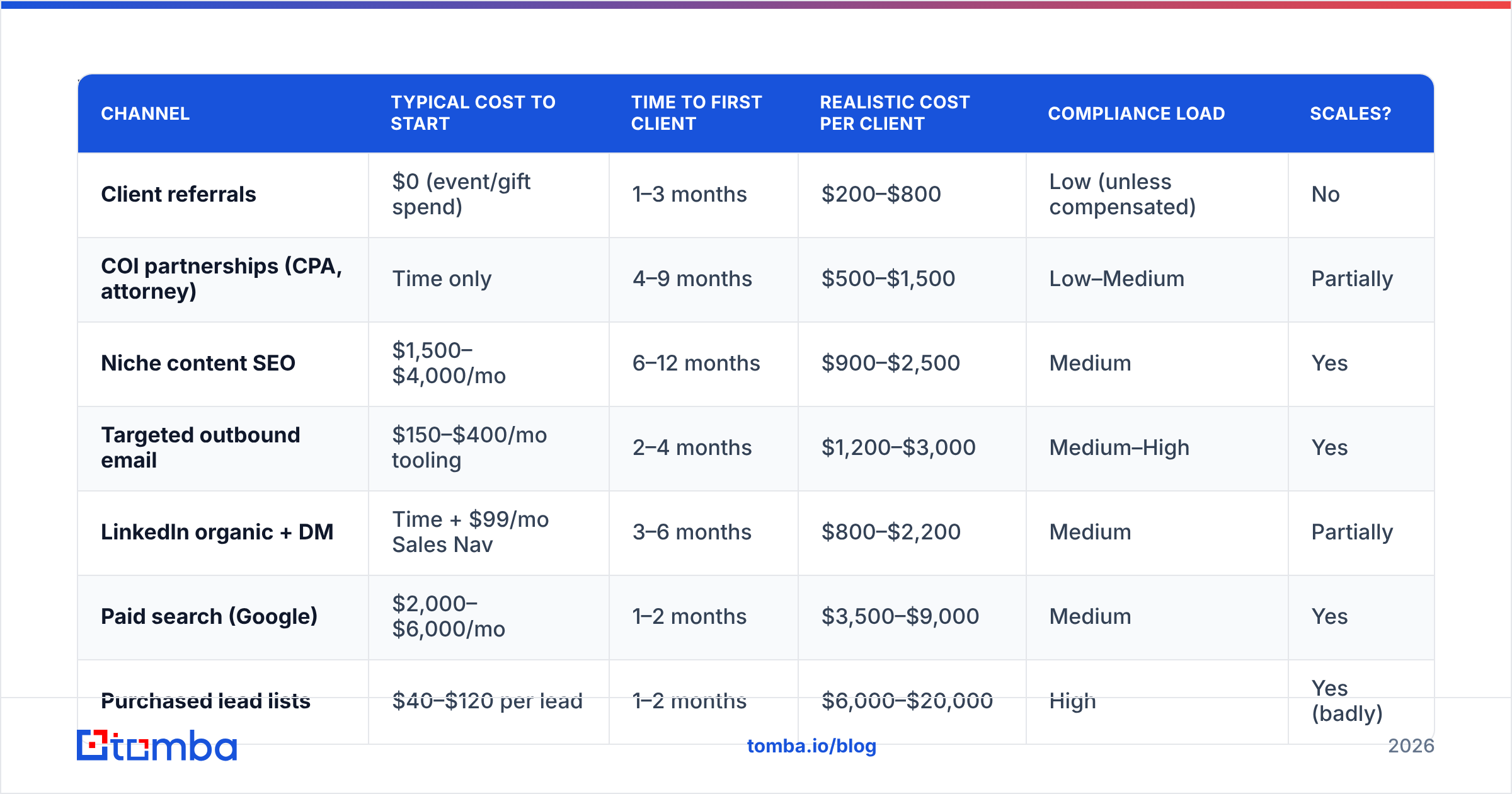
Here is the honest comparison. Costs reflect typical mid-size RIA ($100M–$500M AUM) benchmarks, and "cost per client" assumes a $500K average account at a 1% fee.
| Channel | Typical cost to start | Time to first client | Realistic cost per client | Compliance load | Scales? |
|---|---|---|---|---|---|
| Client referrals | $0 (event/gift spend) | 1–3 months | $200–$800 | Low (unless compensated) | No |
| COI partnerships (CPA, attorney) | Time only | 4–9 months | $500–$1,500 | Low–Medium | Partially |
| Niche content SEO | $1,500–$4,000/mo | 6–12 months | $900–$2,500 | Medium | Yes |
| Targeted outbound email | $150–$400/mo tooling | 2–4 months | $1,200–$3,000 | Medium–High | Yes |
| LinkedIn organic + DM | Time + $99/mo Sales Nav | 3–6 months | $800–$2,200 | Medium | Partially |
| Paid search (Google) | $2,000–$6,000/mo | 1–2 months | $3,500–$9,000 | Medium | Yes |
| Purchased lead lists | $40–$120 per lead | 1–2 months | $6,000–$20,000 | High | Yes (badly) |
| Dinner seminars | $6,000–$15,000/event | 1–3 months | $4,000–$11,000 | High | No |
Three observations from that table.
Referrals and COIs win on cost but lose on control. You cannot double your referral volume next quarter by deciding to. You can double your outbound volume by Tuesday.
Seminars have quietly collapsed. Venue and direct-mail costs roughly doubled between 2021 and 2025 while attendance rates fell. The format still works for a specific profile — advisors targeting pre-retirees aged 58–68 in suburban markets — but the margin for error is gone.
Purchased leads are the most expensive line on the sheet and the most popular. The reason is psychological: the invoice looks small. $80 a lead feels cheap until you run the conversion math. At a 1.5% close rate you have spent $5,300 in lead cost alone before counting a single hour of advisor time.
What does a niche actually look like?#
A niche is not a demographic. It is a group that shares a financial event, a vocabulary, and a place where they congregate.
- Bad niche: "high net worth individuals in Denver." No shared event, no shared vocabulary, no gathering place.
- Good niche: "engineers at Colorado semiconductor firms managing RSU vesting and concentrated stock risk." Shared event (vest dates), shared vocabulary (83(b), 10b5-1, AMT), shared places (company Slack groups, r/stockoptions, industry meetups).
- Good niche: "veterinary practice owners planning a sale to a consolidator." Shared event (DVM roll-up acquisitions), shared vocabulary (EBITDA multiples, earn-outs), shared places (VMX conference, practice-owner Facebook groups).
- Good niche: "widows and widowers aged 60+ inheriting a first advisory relationship." Shared event, high emotional stakes, extremely low competitive density in content.
- Good niche: "federal employees within five years of FERS eligibility." Shared event, complex and specific rules, vast underserved population.
The test: can you write a 1,500-word article that a member of this group would forward to a peer, and that no generalist advisor could have written? If yes, you have a niche. If no, you have a demographic.
Once you have the niche, everything downstream gets cheaper. Your content ranks because you are competing against thirty pages instead of thirty thousand. Your outbound gets replies because the subject line names their exact situation. Your COI partners can actually describe what you do.
How do you build an outbound program that survives compliance?#
Sequence matters. Build in this order.
1. Define the segment in data terms. Not "business owners" — "founders of 20–100 employee SaaS companies in Texas who have raised a Series A or later." That translates into filters you can actually query.
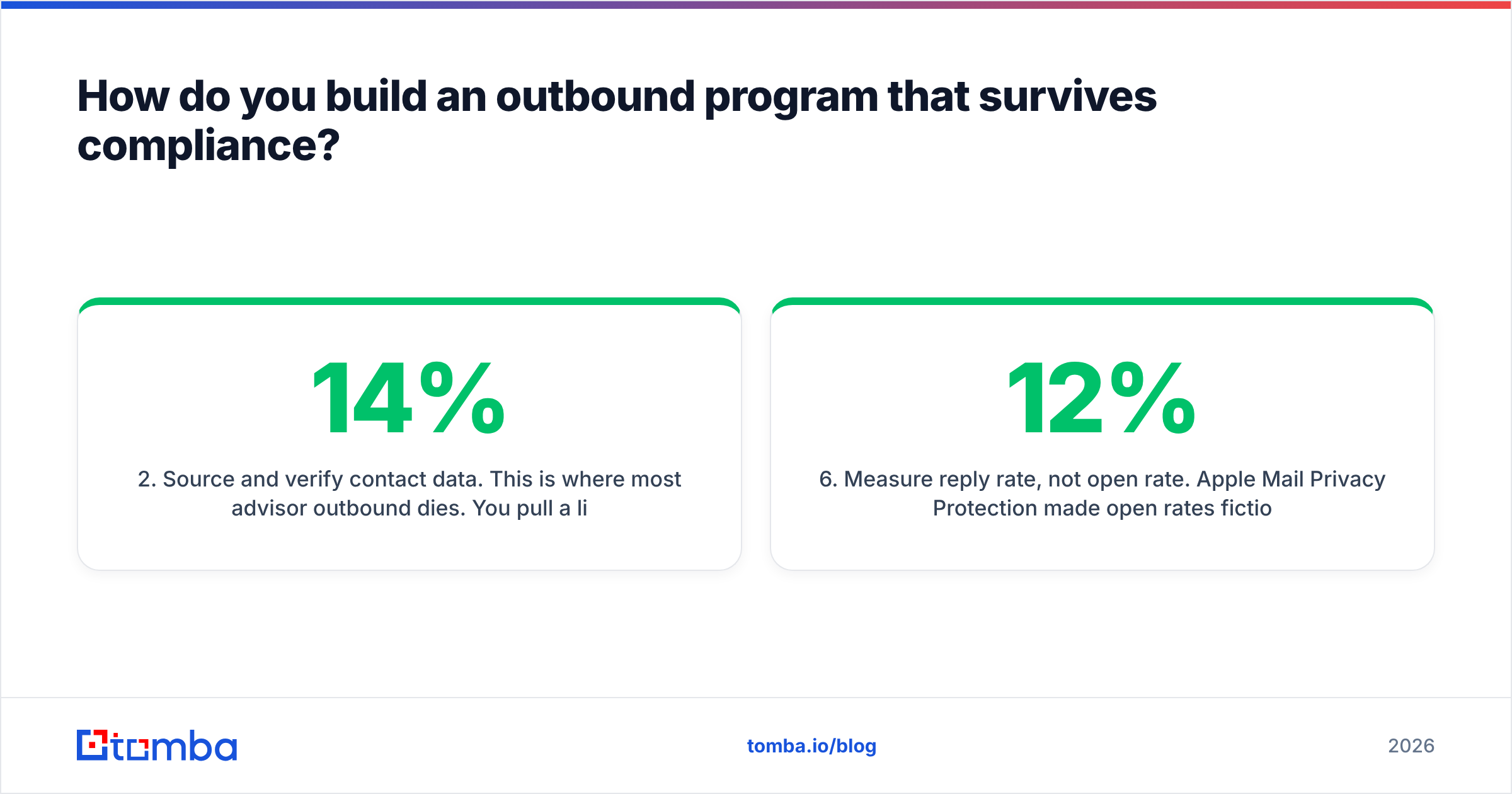
2. Source and verify contact data. This is where most advisor outbound dies. You pull a list from a scraper, blast it, hit a 14% bounce rate, and your domain reputation is damaged for months. Use a proper email finder to build the list from company domains and named individuals, then run the whole file through an email verifier before the first send. For firms targeting a defined set of employers — say every credentialed professional at forty regional accounting firms — domain search pulls the full contact map per company rather than making you hunt one name at a time.
3. Set up sending infrastructure properly. Separate sending domain (not your primary), SPF/DKIM/DMARC configured, 3–4 weeks of warmup, and hard volume caps. Check your SPF record before you send anything. Poor email deliverability is the single most common reason an advisor's outbound "doesn't work" — the messages were fine, they just landed in spam.
4. Get the template pre-approved. Submit your sequence to your CCO or outsourced compliance provider as a template with variable fields, not as individual messages. Approve once, use 500 times. Include your firm disclosure and an unsubscribe mechanism in every message.
5. Archive everything. Your email platform must feed into your archiving solution (Smarsh, Global Relay, or equivalent). If it cannot, pick a different platform. This is non-negotiable and examiners do ask.
6. Measure reply rate, not open rate. Apple Mail Privacy Protection made open rates fiction years ago. Track replies, meetings booked, and meetings-to-client. A healthy advisor outbound sequence to a tight niche runs 6–12% reply rate. Under 3% means your segment or your message is wrong — more volume will not fix it.

What should you say in a cold email to a prospect?#
Lead with the event, not the service.
Nobody replies to "I help business owners with comprehensive wealth management." They reply to "Saw Vista announced the acquisition closes in Q1 — most founders in your position have about 90 days to make the QSBS decision, and it is irreversible after."
The structure that works:
- Line 1 — the specific trigger. Funding round, acquisition, vest date, plan change, executive move. Something they know is true about themselves.
- Line 2 — the consequence they may not have priced in. A tax deadline, a concentration risk, a rule that expires.
- Line 3 — proof you have done this before, without a testimonial. "We have handled eleven of these in the semiconductor space" is fine. "Our clients love us" triggers the Marketing Rule.
- Line 4 — a small ask. Fifteen minutes. Or better, a resource: "I wrote up the decision tree, want it?" A content-first ask converts roughly twice as well as a meeting-first ask on a cold first touch.
Keep it under 120 words. Do not attach a PDF on the first touch. Do not use merge tags that obviously failed. If you need a starting point, the cold email templates library gives you structures you can adapt to your niche rather than generic scripts.
On follow-up: 3–4 touches over 18 days, each adding something new. A follow-up that says "just bumping this to the top of your inbox" trains people to ignore you. A follow-up that says "the IRS just clarified the treatment here, updated my note" earns the read.
How do you turn CPAs and attorneys into a real pipeline?#
Most advisors "network with CPAs" and get nothing, because they treat it as a referral request rather than a value exchange.
The version that works looks like this:
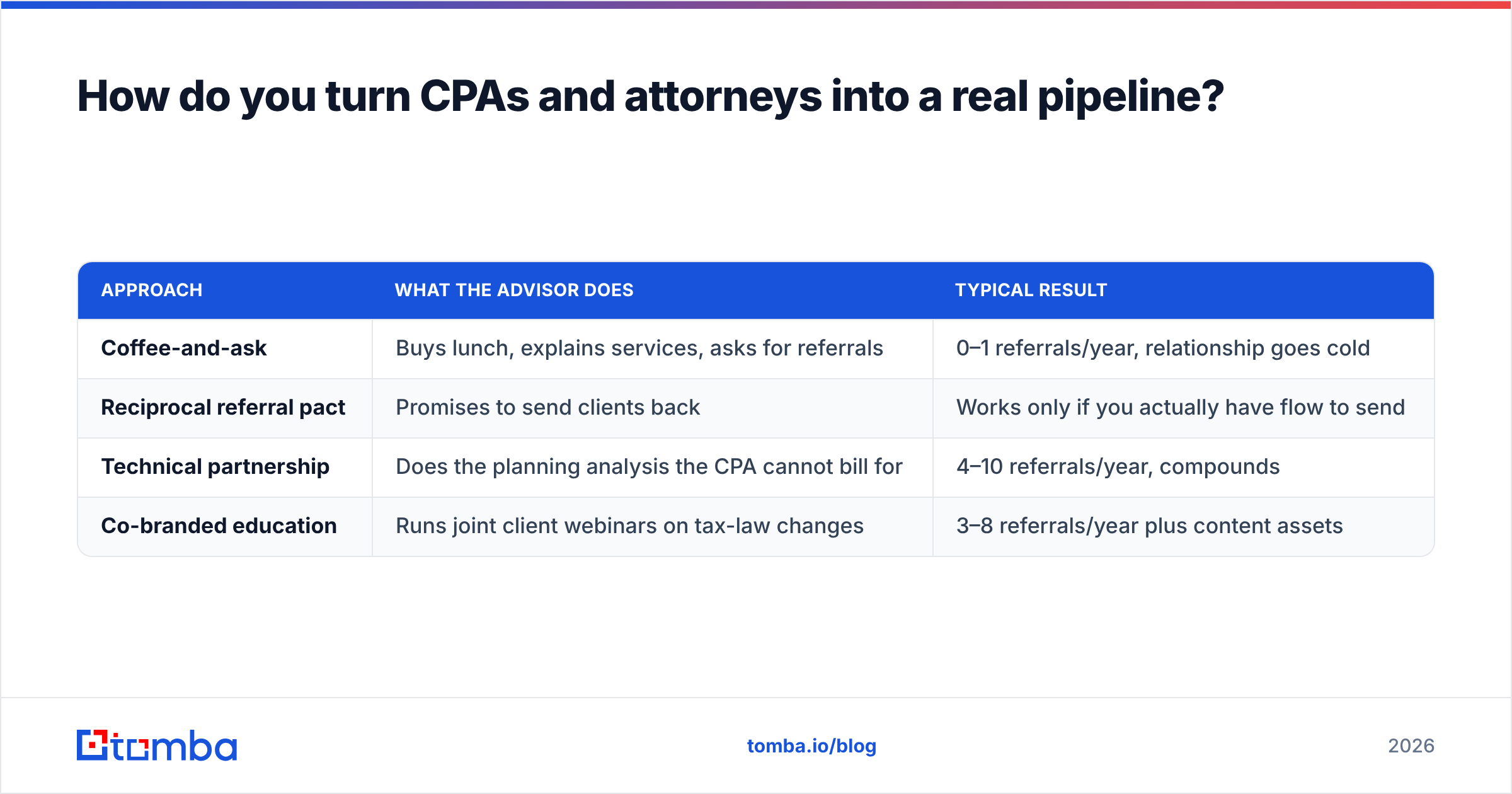
| Approach | What the advisor does | Typical result |
|---|---|---|
| Coffee-and-ask | Buys lunch, explains services, asks for referrals | 0–1 referrals/year, relationship goes cold |
| Reciprocal referral pact | Promises to send clients back | Works only if you actually have flow to send |
| Technical partnership | Does the planning analysis the CPA cannot bill for | 4–10 referrals/year, compounds |
| Co-branded education | Runs joint client webinars on tax-law changes | 3–8 referrals/year plus content assets |
The technical partnership is the one to build. A CPA has fifty clients with a planning problem they can see but cannot solve within their engagement scope — Roth conversion sequencing, charitable bunching, Social Security timing, NUA on employer stock. You build the analysis, they present it, the client asks who did the work.
To build the target list, work from the professional directories and firm websites in your metro. A bulk email finder run against a list of firm domains turns a spreadsheet of 200 local accounting practices into a working contact list in an afternoon, rather than a month of manual site-crawling. Then approach with a specific technical offer, not a coffee invite.
Which tools do you actually need?#
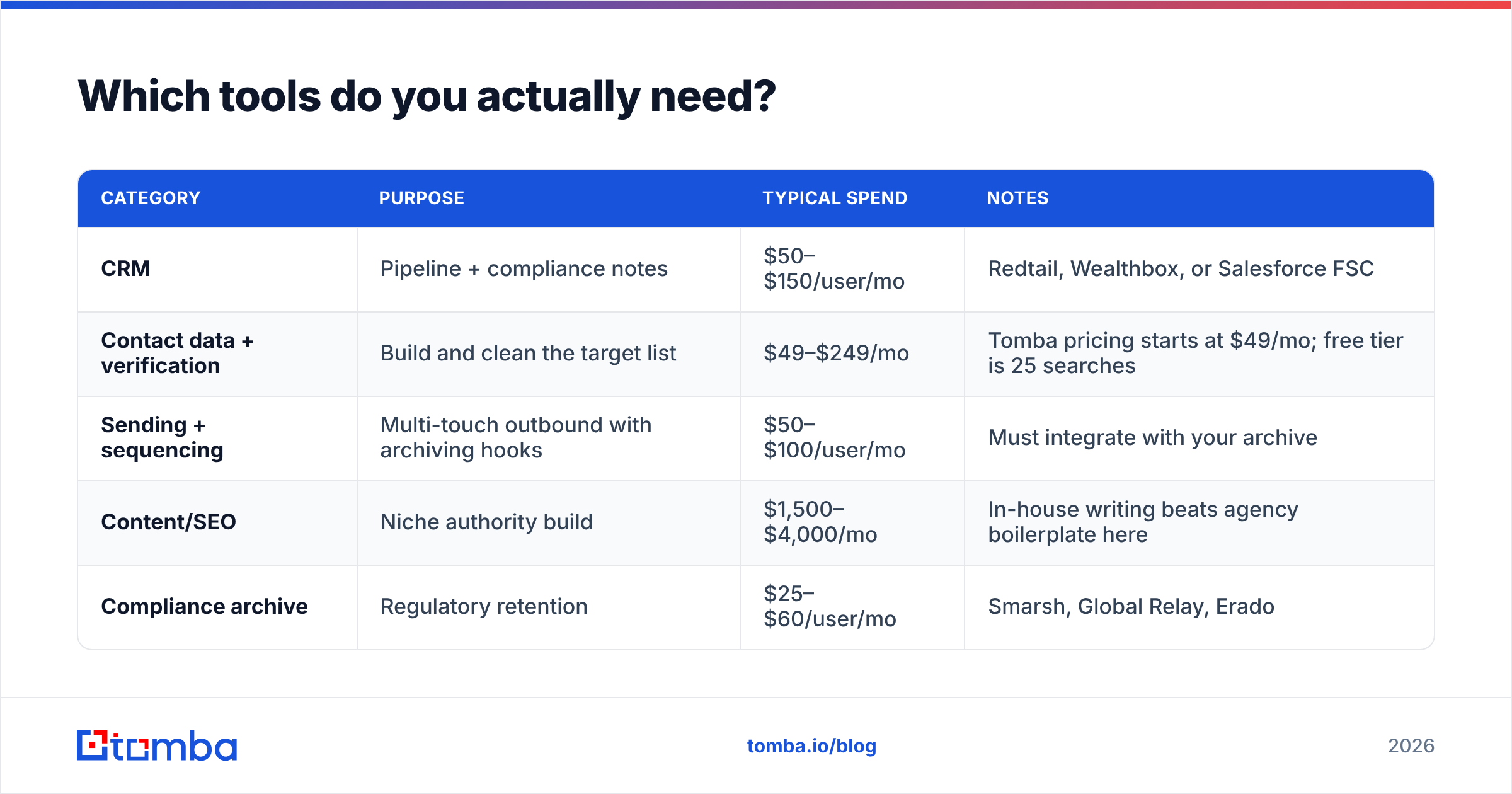
You need fewer than the vendor blogs suggest. A functioning advisor lead-gen stack is five categories:
| Category | Purpose | Typical spend | Notes |
|---|---|---|---|
| CRM | Pipeline + compliance notes | $50–$150/user/mo | Redtail, Wealthbox, or Salesforce FSC |
| Contact data + verification | Build and clean the target list | $49–$249/mo | Tomba pricing starts at $49/mo; free tier is 25 searches |
| Sending + sequencing | Multi-touch outbound with archiving hooks | $50–$100/user/mo | Must integrate with your archive |
| Content/SEO | Niche authority build | $1,500–$4,000/mo | In-house writing beats agency boilerplate here |
| Compliance archive | Regulatory retention | $25–$60/user/mo | Smarsh, Global Relay, Erado |
Skip the "AI lead scoring" layer until you have volume worth scoring. Skip intent-data platforms until you are spending five figures a month on outbound. Skip the all-in-one advisor marketing suite that bundles a website, a newsletter, and a lead feed — the bundled lead feed is almost always the same shared list every competitor in your zip code is calling.
For contact data specifically, the difference between vendors is accuracy on mid-market and private companies, which is exactly where advisor prospects live. Public-company executives are easy and everyone has them. The 40-person engineering firm whose owner is planning an exit is where a lot of databases go blank. Peer platforms like BookYourData take a curated-database approach that works well for volume list buying, while Tomba's real-time domain-search approach suits advisors who already know exactly which companies they want into. Both are legitimate; the choice depends on whether your niche is defined by firmographic filters or by a specific named account list.
How do you measure whether it is working?#
Track four numbers and ignore the rest.
- Qualified conversations per month. A conversation where the prospect stated a financial situation and you stated how you would approach it. Not a coffee. Not a webinar registration.
- Conversation-to-client rate. Advisors with a real niche run 20–35%. Generalists run 8–15%. If yours is under 10%, your targeting is wrong, not your closing.
- Cost per new household, fully loaded. Include your hours at your billing rate. Advisors consistently underprice their own time and conclude that seminars are cheap.
- Average account size by channel. This is the one nobody tracks and it changes every decision. Referral clients may average $700K while paid-search clients average $180K. If that is true for you, the paid-search channel is losing money even at a lower cost per acquisition.
Run the numbers quarterly, not monthly. Advisory sales cycles are long enough that monthly data is noise. And before you kill a channel, check whether the problem was the channel or the execution — most "SEO doesn't work for advisors" conclusions come from twelve months of generic blog posts that never had a chance of ranking. Industry benchmarks from G2 on sales-engagement tooling and HubSpot's annual state-of-marketing data are useful sanity checks on whether your reply and conversion rates are within normal range.
What is the 90-day starting plan?#
If you are starting from referrals-only, do this in order.
Days 1–14. Pick one niche using the forwardable-article test. Write the positioning statement. Get compliance sign-off on your outreach template and disclosure language. Confirm your archiving path.
Days 15–30. Build the target list — 300 to 600 named contacts, verified. Set up the secondary sending domain and start warmup. Write three pieces of niche content, not ten generic ones.
Days 31–60. Launch outbound at 25 sends/day, ramping to 60. Publish the content. Approach eight CPAs or attorneys with a technical partnership offer, not a coffee ask.
Days 61–90. Measure reply rate and qualified conversations. Kill whatever is under 3% reply, double whatever is over 8%. Refresh the list — advisor-market contact data decays roughly 2.5% per month, so a list built in month one is already 7% stale by month three. Re-verify before every major push.
The advisors who win at this are not the ones with the cleverest funnel. They are the ones who picked a narrow group, said something true and specific to them, and kept doing it for four quarters while their competitors rotated through three vendors.
Ready to build the list?#
Everything above depends on one input: accurate contact data for the exact people in your niche. Start with Tomba's Email Finder — search by company domain, name, or firm to build a verified prospect list from the accounting practices, employers, and business owners you have actually targeted. The free tier gives you 25 searches a month to test your segment before committing, and paid plans start at $49/mo with verification built in. Build the list right once, and every channel downstream gets cheaper.
Related guides#
Ready to find emails that actually work?
Join 150,000+ professionals who stopped guessing and started sending. Free credits on signup — no credit card required.
Get the Tomba newsletter
Practical outbound tactics and product updates — once every two weeks.
About the author