Lead Generation for Financial Services: The 2026 Playbook
Compliance rules, long sales cycles, and gated data make financial services lead generation harder than almost any other B2B vertical. Here is what actually works in 2026 — and what quietly wastes budget.
TL;DR — here is what lead generation for financial services looks like in 2026.
Lead generation for financial services is a rules problem first and a marketing problem second. Every channel has to clear FINRA, SEC, GDPR, GLBA, or state review. The cheap tricks that work in SaaS are often off the table.
Paid search in finance is some of the priciest ad space on the web. Insurance and loan keywords often cost $40-$70 per click. That pushes the cost per good lead into the hundreds.
Referrals, advisor networks, and organic content still win on cost per closed client. But they are slow. You cannot turn them up on demand.
Outbound to a verified list is the one channel you can scale fast. The limit is data quality, not effort.
The teams that win in 2026 run a chain: verified contact → compliant first touch → logged follow-up. It is not a volume game.
Why is lead generation for financial services harder than other B2B verticals?#
Three reasons, and they stack up.
Rules shape the funnel. A SaaS team can test a new headline on Tuesday and ship it on Wednesday. A registered investment advisor cannot. That headline goes to compliance, gets logged, and must not promise returns. The SEC marketing rule and FINRA Rule 2210 set what you may say. They also set how you may use reviews, and how long you must keep records. That review takes weeks. It kills the fast test-and-learn loop most growth playbooks assume.
The buying cycle is long. Say you sell a treasury platform to a mid-market CFO. You will also deal with the controller, IT security, and often an outside auditor. Gartner puts the typical B2B buying group at six to ten people. In finance, add a risk officer. Twelve-month cycles are normal.
Data goes stale fast. Finance has a lot of internal churn. Analysts move up to VP. VPs move firms. Whole teams get bought. A list built in January is half dead by June. This is the cost nobody plans for. You pay for the campaign, not for the data under it. Then you blame the campaign.

What does lead generation for financial services cost by channel?#
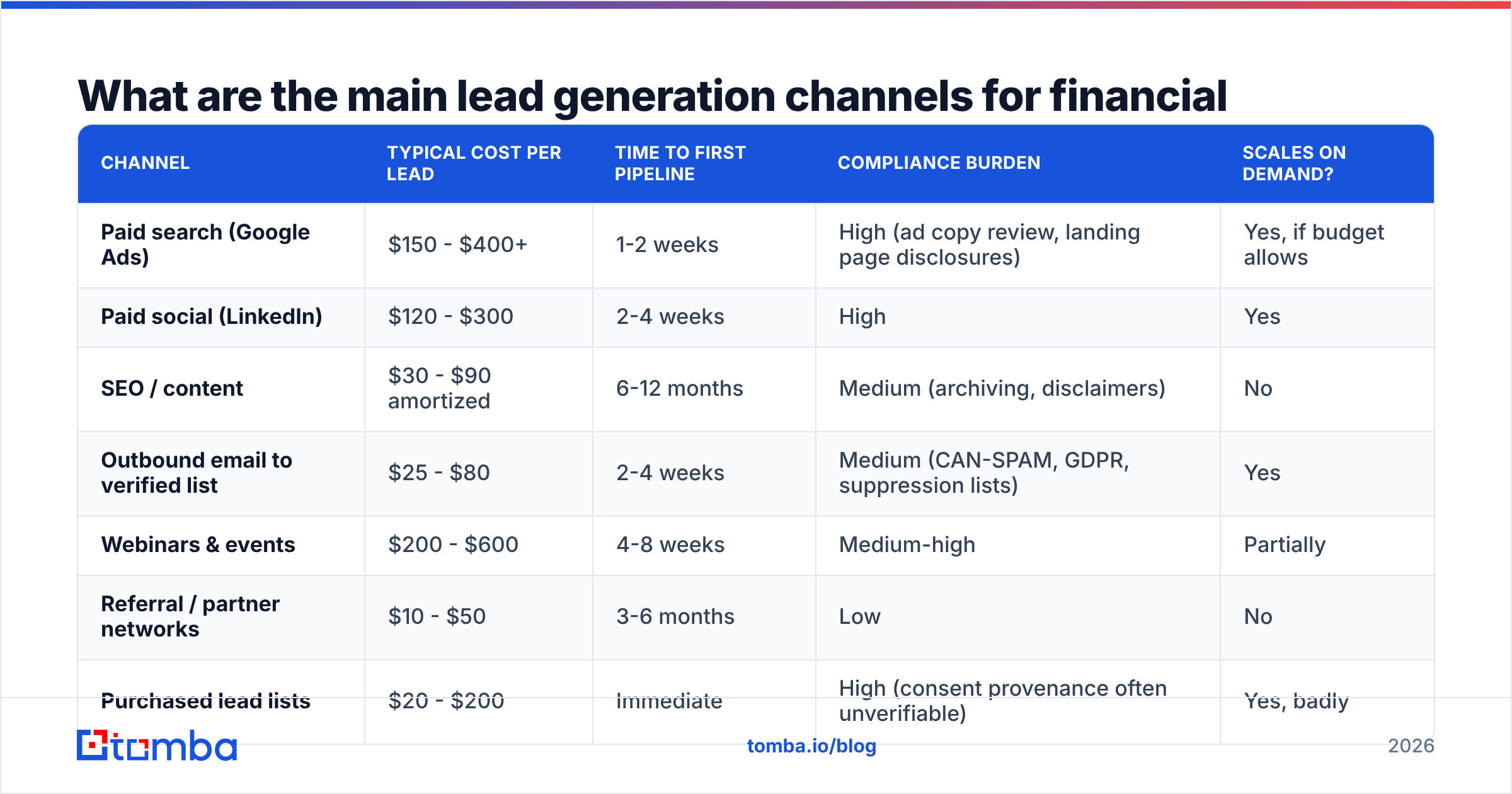
Here is the honest table. The numbers are blended 2025-2026 benchmarks across banking, insurance, wealth, and fintech. Your own numbers will swing a lot by sub-vertical and by country.
| Channel | Typical cost per lead | Time to first pipeline | Compliance burden | Scales on demand? |
|---|---|---|---|---|
| Paid search (Google Ads) | $150 - $400+ | 1-2 weeks | High: ad copy and page review | Yes, if the budget is there. |
| Paid social (LinkedIn) | $120 - $300 | 2-4 weeks | High | Yes. |
| SEO / content | $30 - $90 amortized | 6-12 months | Medium: archiving, disclaimers | No. |
| Outbound email to a verified list | $25 - $80 | 2-4 weeks | Medium: CAN-SPAM, GDPR, opt-out lists | Yes. |
| Webinars and events | $200 - $600 | 4-8 weeks | Medium to high | In part. |
| Referral / partner networks | $10 - $50 | 3-6 months | Low | No. |
| Bought lead lists | $20 - $200 | Now | High: consent trail often missing | Yes, and badly. |
Two things stand out.
First, the cheapest channels are referral and organic. They are also the two you cannot spin up in a quarter. If your CRO wants pipeline this quarter, the real choice is paid or outbound.
Second, bought lists look cheap and are not. You take on someone else's consent trail. You cannot show where a record came from in an audit. Bounce rates on old finance lists often top 25%. That is not a data problem. It is a deliverability and compliance problem wearing a data costume.
How do you build a compliant outbound list for financial services?#
Most teams under-use outbound. They hear "outbound" and think "blast a bought list." Those are not the same thing. A list you can defend is the core of lead generation for financial services, and it gets built like this.
Pick the accounts first, not the contacts. Start with traits you can check: AUM band, charter type, head count, tech stack, filings. A list of 400 credit unions with $500M to $2B in assets is a plan. A list of 40,000 "finance pros" is noise.
Find contacts at the source. Run a domain search on each target firm's site. You get the people who work there now, plus the firm's email pattern. Each record traces back to a public source. That matters a lot when someone asks where the data came from.
Verify right before you send. Run every address through an email verifier on the day you send, not on the day you build. Finance domains are often catch-all. Use a catch-all verifier to tell a real inbox from a server that says yes to everything.
Suppress hard. Cut current clients, open deals, anyone who opted out, and every domain on your do-not-contact list. In this space, one mail to a suppressed contact is a logged incident. It is not an oops.
Add context that will pass review. Job title, time in role, recent public activity, and firm-level news. Compliance is fine with "I saw your firm filed for a new charter." It is not fine with "quick question."
Log it all. Source, date, check result, consent basis. If you cannot pull that record in 60 seconds, you do not have a clean list. You have a spreadsheet.
Step 2 is the whole ball game. It is the gap between a list you can defend and a list you hope nobody asks about.
Which financial services sub-verticals respond to which channels?#
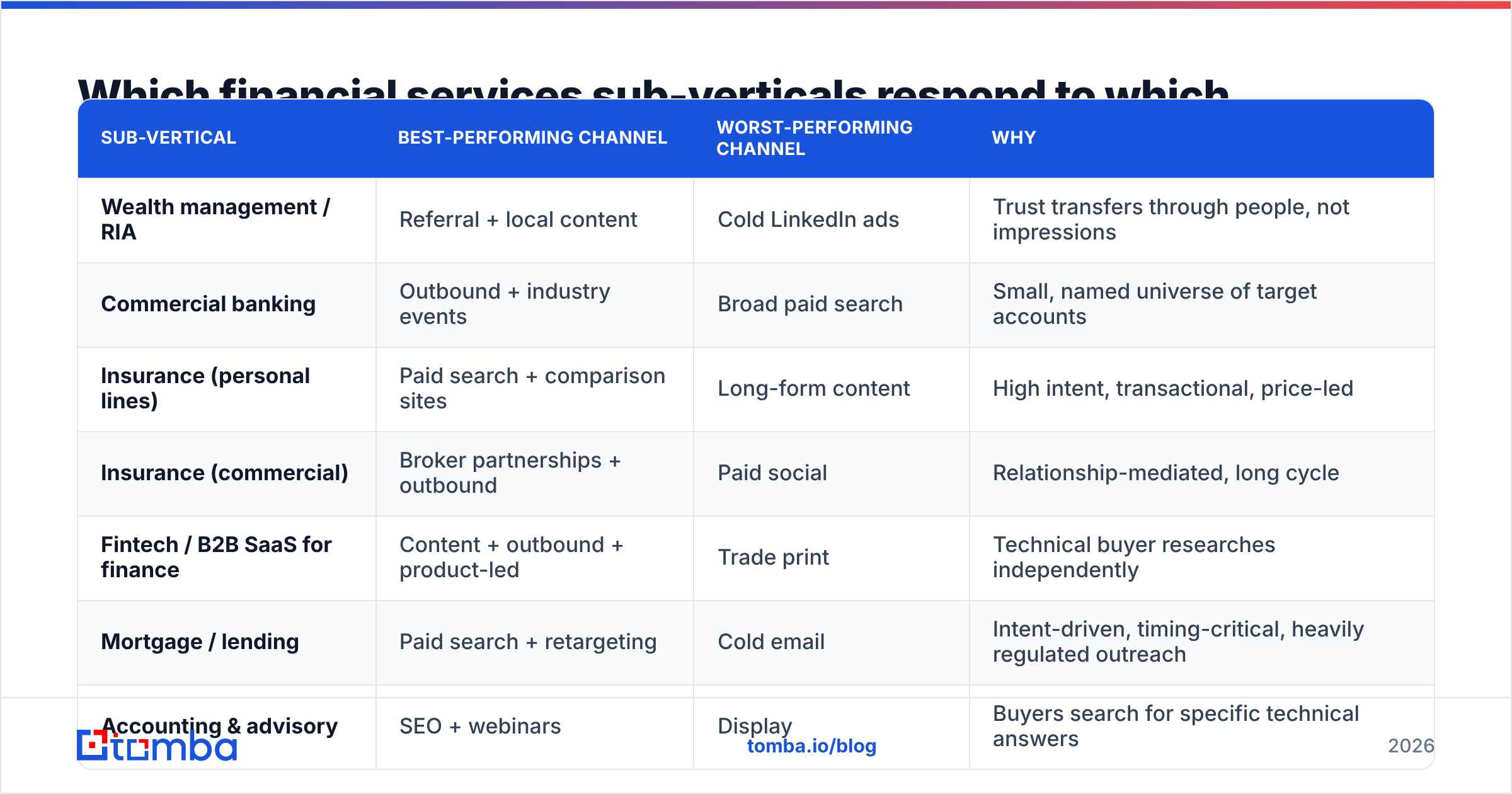
Not all of finance behaves the same way. A wealth RIA and a fintech lender are not the same buyer. Treating them as one is the most common error here.
| Sub-vertical | Best channel | Worst channel | Why |
|---|---|---|---|
| Wealth management / RIA | Referral plus local content | Cold LinkedIn ads | Trust moves through people, not ads. |
| Commercial banking | Outbound plus events | Broad paid search | A small, named set of target accounts. |
| Insurance (personal lines) | Paid search plus comparison sites | Long-form content | High intent, fast, price-led. |
| Insurance (commercial) | Broker ties plus outbound | Paid social | Deals move through brokers, and slowly. |
| Fintech / B2B SaaS for finance | Content plus outbound plus product-led | Trade print | The buyer does their own research. |
| Mortgage and lending | Paid search plus retargeting | Cold email | Timing is everything, and the rules are tight. |
| Accounting and advisory | SEO plus webinars | Display | Buyers search for one exact answer. |
The takeaway: if you have fewer than about 5,000 named accounts, outbound plus events beats paid on cost per deal. Above that, paid starts to earn its keep. You cannot hand-research 50,000 accounts.
What does compliant first-touch outreach look like?#
In a regulated space, the urge is to strip the message bare. You end up with a mail that is legal and dull. That is the wrong trade. Compliance objects to claims, not to detail.
What gets approved fast:
- A fact about the firm, such as "your Q2 call report showed commercial deposits up 14%."
- A plain note on what your product does, with no promise of results.
- An invite to a resource you have logged and kept.
- A clear line on who you are and why you wrote.
What gets rejected:
- Return figures with no required note attached.
- Implied promises, such as "cut your compliance costs in half."
- Client names used as proof with no written consent.
- Anything that reads as advice for one firm's case.
A structure that works: one line that shows you did the homework, one line on what you do, and one line with a small, clear next step. Keep it under 120 words. Send no attachment on the first touch. In finance, attachments trip spam filters and raise doubt in equal measure.
If you send at volume, two tools help. A subject line generator and a spam checker catch the basic faults first. Then compliance can look at what actually matters.
How should you measure lead generation for financial services?#
Stop reporting lead counts. Deals here take twelve months and run to six figures. Lead count is the least useful number you have.
Track these instead.
Cost per qualified opportunity, not cost per lead. In finance the gap is often 20 to 1.
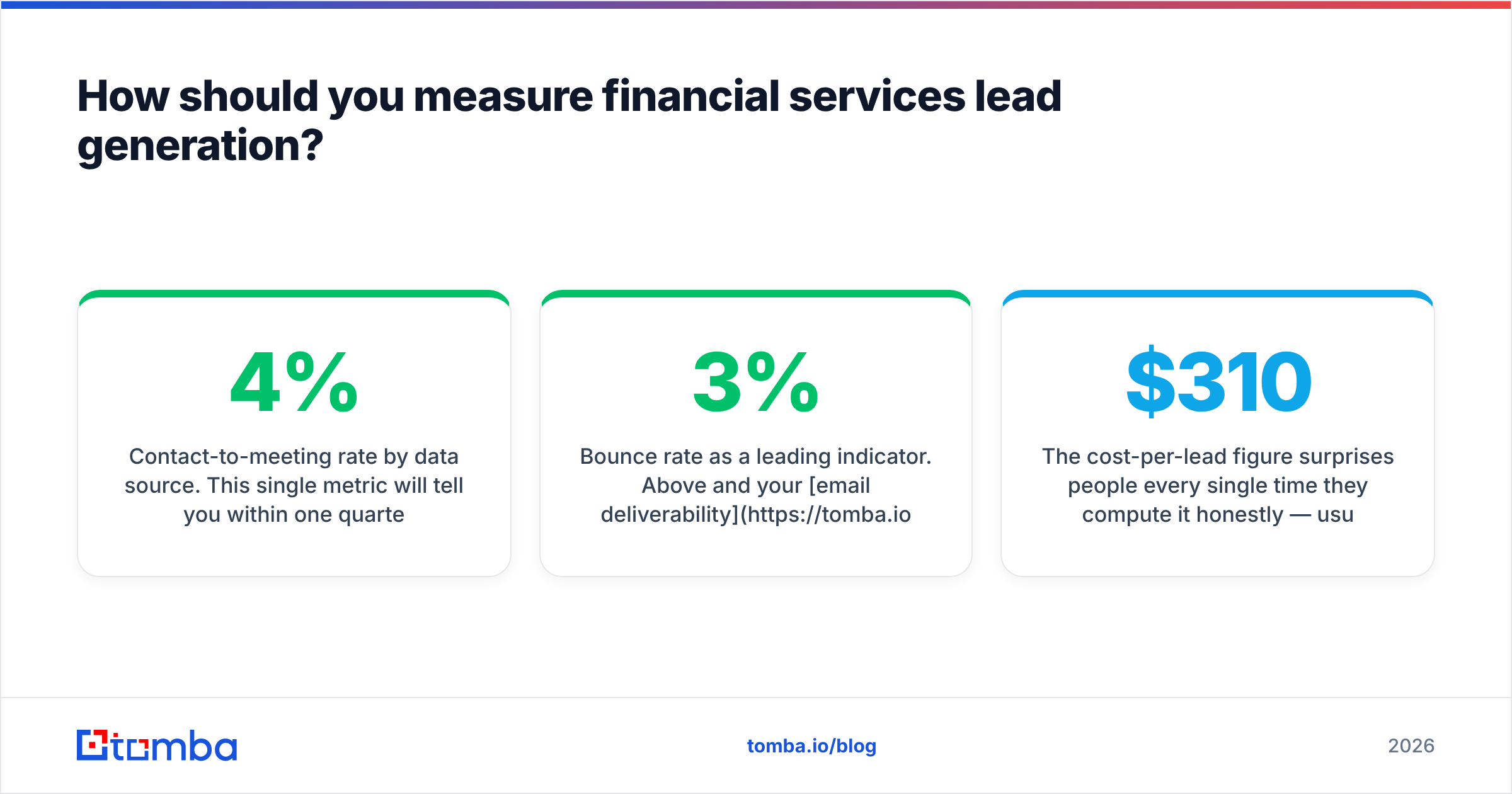
Meeting rate by data source. This one number tells you in a quarter if your list work is paying off. Say verified contacts book at 4% and bought ones book at 0.6%. The budget debate ends right there.
Bounce rate, as an early warning. Above 3%, your email deliverability is slipping. Even your good contacts stop seeing you.
Deal speed by segment. If fintech closes in four months and banking in fourteen, move the budget.
Compliance exceptions. Zero is the goal. A channel that brings pipeline and exceptions brings risk.

The $310 cost per lead shocks people every time they do the math in full. The first number left out the creative, the compliance hours, and the 60% of "leads" that were never going to qualify.
What tools do financial services teams need?#
Fewer than the vendors would like. Here is the stack that works.
A CRM your compliance team can audit. Salesforce Financial Services Cloud and HubSpot both do this. You need field history and export, not more features.
A contact data source you can trace. This is where teams cut corners and pay later.
Checks that run all the time. Not once, at import.
A sending tool with per-domain warmup and opt-out handling.
An archive tool, if FINRA or SEC rules apply to you. This is not optional, and your sending tool does not cover it.
On data, the market splits three ways: all-in-one sales platforms, email finders, and curated list vendors. BookYourData is a good pick if you want a ready, human-checked list for one segment and prefer to buy records outright. Apollo and its peers bundle data with sending, which suits teams who want one vendor. Tomba sits in between. You search by domain or by name, verify in the same flow, and push the result to your CRM or sequencer through integrations or the Tomba API.
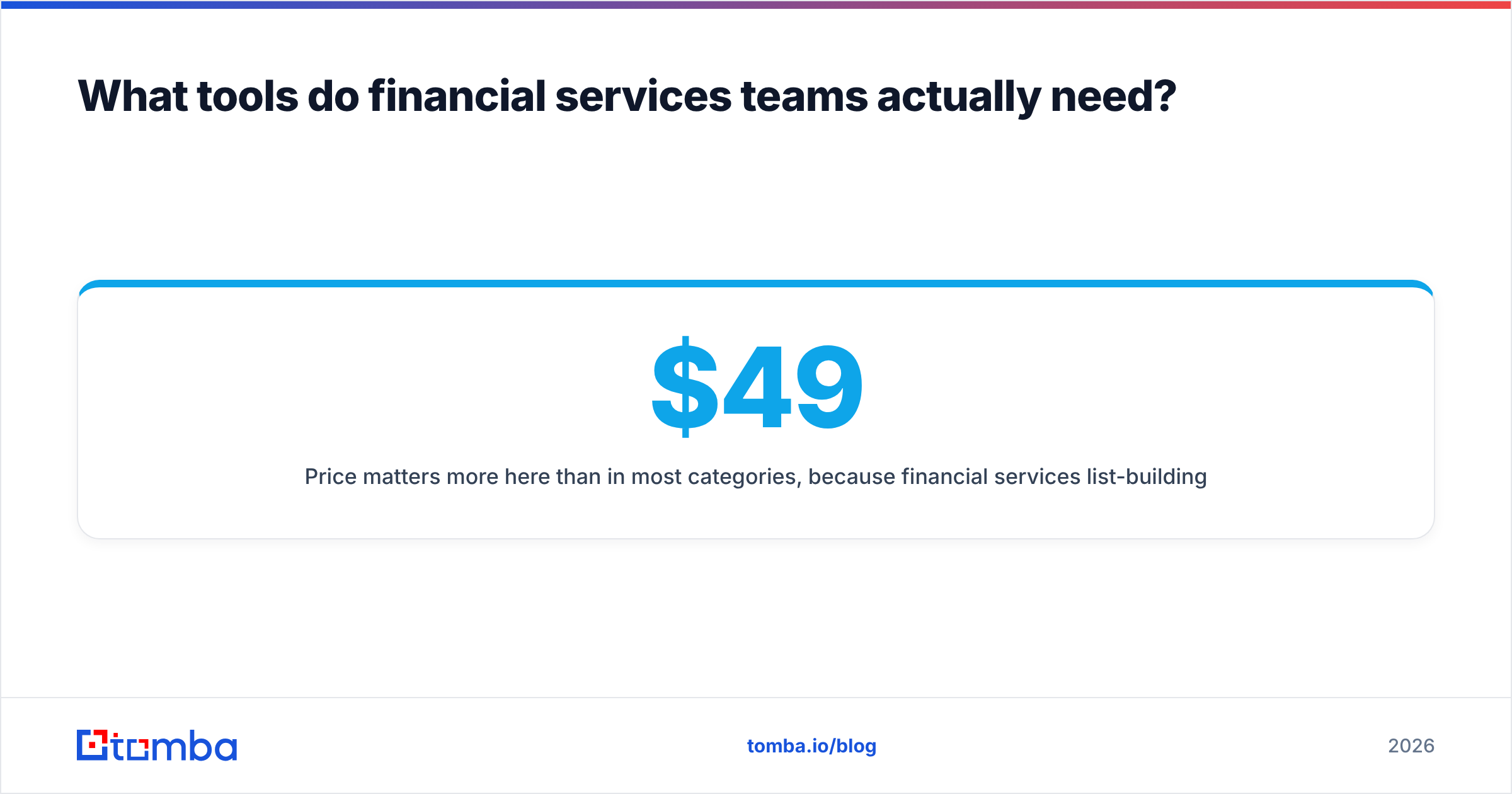
Price matters more here than in most fields, because lead generation for financial services is high-volume research by nature. Tomba's free tier gives you 25 searches a month. Test it on firms you already know. That is the fastest honest test there is. Starter is $49/mo, Growth is $99/mo, and Pro is $249/mo. Full Tomba pricing is public. You cannot say that of every data vendor, since some quote only after a call. G2's category listings are a good place to check vendor claims against real reviews.
What should you do in your first 90 days?#
Days 1-30: build the data foundation. Pick one sub-vertical. Build the named account list and check the firm data. Run a domain search on every target and verify what comes back. Set up your opt-out list.
Days 31-60: ship one outbound sequence and one content piece. Get both through compliance early, so review time does not become the block. Track meeting rate by source from day one.
Days 61-90: read the data and cut. Most teams find that two of their five channels drive 80% of good pipeline. Kill the rest and move the money. Only then add paid. It works far better once it retargets people your outbound has warmed up.
The failure mode is the reverse. Teams launch five channels at once, count leads, and decide after six months that "finance is just hard." Finance is hard. It is not that hard.
Ready to build a financial services list you can defend?#
Start with the data layer, because everything after it inherits the quality. The Tomba Email Finder searches any firm by domain or by name. It returns the verified work email and the source it came from, and it checks the address in the same pass. So the list you hand your SDRs is one you can hand to compliance too.
Test it on twenty firms you already know, on the free tier, before you spend a dollar. If it holds up on accounts you can check by hand, it will hold up on the rest. That is how lead generation for financial services should start.
Related guides#
// get started
Find, verify and enrich your first contacts today
Start on the free plan with 25 searches a month, then scale when your team is ready.
Free plan · No credit card required · GDPR & CCPA
Get the Tomba newsletter
Product and data updates
// about the author