Lead Generation for Law Firms: The 2026 Playbook That Works
Most law firm lead gen advice is written by agencies selling retainers. Here's what actually produces signed clients in 2026 — channel economics, real cost-per-case math, and the ethics rules that kill half the tactics.

TL;DR
- Lead generation for law firms is a cost-per-signed-case problem, not a cost-per-lead problem. A $40 PPC lead that signs at 3% is worse than a $300 referral-partner lead that signs at 40%.
- Paid search still wins for high-intent consumer practice areas (personal injury, family, criminal), but 2026 CPCs in injury markets routinely clear $250 per click in major metros.
- B2B-facing firms — corporate, IP, employment defense, M&A — get far better economics from targeted outbound to named in-house counsel and HR leaders than from any ad channel.
- ABA Model Rules 7.1–7.3 are the constraint most guides ignore. Fee-sharing with non-lawyer lead vendors, undisclosed ad content, and live solicitation all carry real discipline risk.
- The single highest-ROI fix for most firms is not a new channel. It's answering the phone inside five minutes and following up more than twice.
Law firm marketing has a measurement problem. Firms buy leads, count leads, and report leads — then wonder why revenue is flat. The number that matters is signed cases per dollar, and almost every channel that looks cheap on a cost-per-lead basis looks expensive once you run it through close rate and case value.
This guide breaks down what actually produces clients in 2026, what each channel really costs, and where the ethics rules quietly disqualify tactics that work fine in every other industry.
What is lead generation for law firms, really?#
Lead generation for law firms is the process of turning strangers into represented clients through a sequence of identifiable steps: attention, contact, intake, consultation, and signed engagement. Each step has its own conversion rate, and the weakest one caps everything upstream.
Think of it like a sprinkler system with a kink in the hose. You can add pumps at the source — more ads, more content, more outbound — but nothing changes until you find the kink. In most firms the kink is intake, not traffic.
Here's the structure worth memorizing:
- Demand capture — reaching people already looking for a lawyer (paid search, local map pack, legal directories, referrals). High intent, high cost, immediate.
- Demand creation — reaching people who have a problem but haven't defined it as legal yet (content, social, seminars, outbound). Lower intent, lower cost, slower.
- Referral infrastructure — other lawyers, accountants, doctors, brokers who send matters. Highest close rate, hardest to scale, near-zero marginal cost.
- Intake and speed-to-lead — the operational layer that converts inquiries into consults. Almost never the thing firms invest in, almost always where the money leaks.
- Nurture and reactivation — past clients, stale inquiries, closed files. The cheapest source of new matters in almost every practice.
- Measurement — call tracking, matter-source attribution in the CRM, cost per signed case by channel. Without this, every other item is guesswork.
Most firms are running items 1 and 2 with no investment in 3 through 6. That's why the ROI math looks bad.
Which lead generation channels actually work by practice area?#
The honest answer is that practice area determines channel more than budget does. A personal injury firm and a commercial litigation boutique should barely share a playbook.
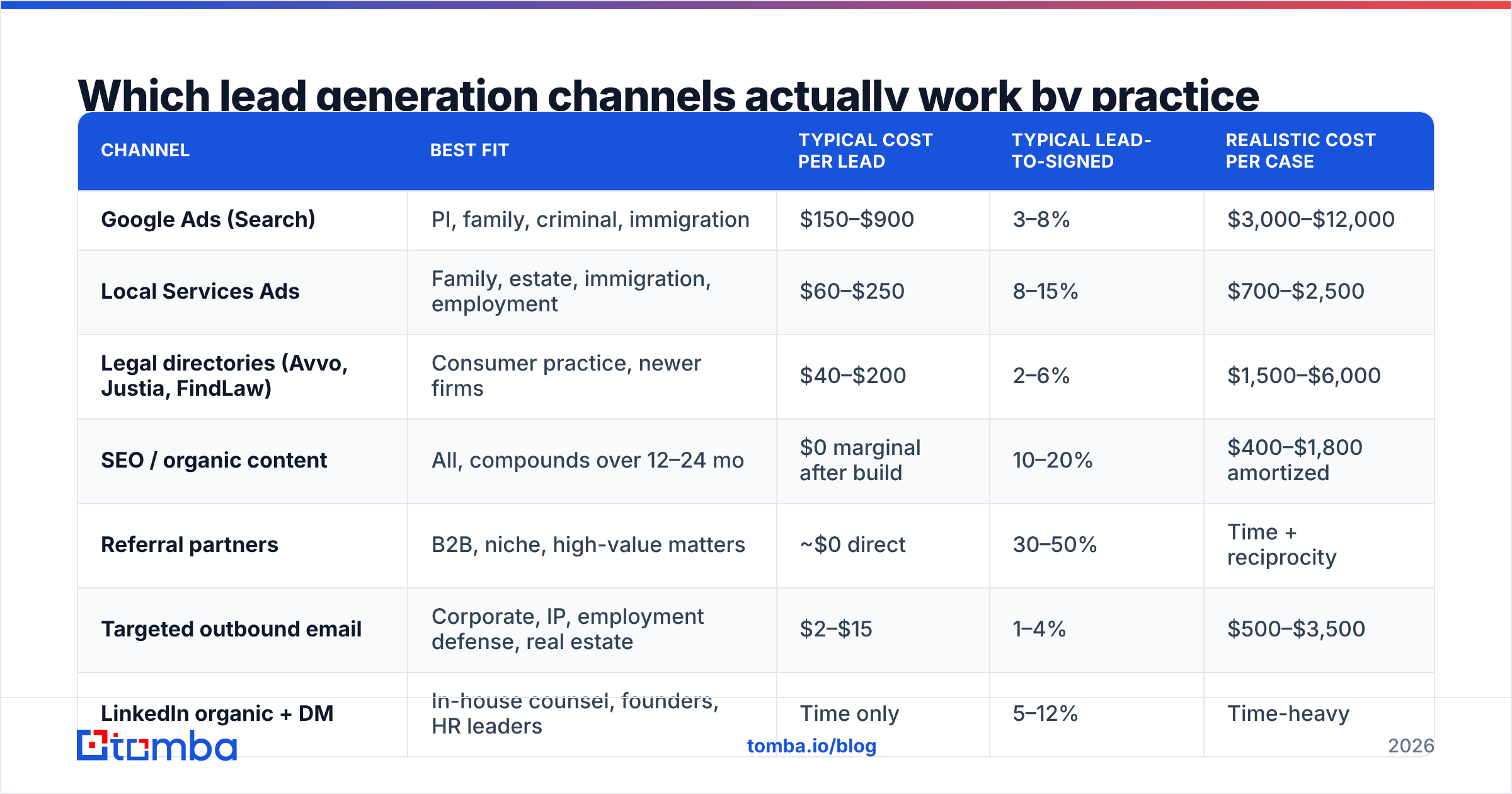
| Channel | Best fit | Typical cost per lead | Typical lead-to-signed | Realistic cost per case |
|---|---|---|---|---|
| Google Ads (Search) | PI, family, criminal, immigration | $150–$900 | 3–8% | $3,000–$12,000 |
| Local Services Ads | Family, estate, immigration, employment | $60–$250 | 8–15% | $700–$2,500 |
| Legal directories (Avvo, Justia, FindLaw) | Consumer practice, newer firms | $40–$200 | 2–6% | $1,500–$6,000 |
| SEO / organic content | All, compounds over 12–24 mo | $0 marginal after build | 10–20% | $400–$1,800 amortized |
| Referral partners | B2B, niche, high-value matters | ~$0 direct | 30–50% | Time + reciprocity |
| Targeted outbound email | Corporate, IP, employment defense, real estate | $2–$15 | 1–4% | $500–$3,500 |
| LinkedIn organic + DM | In-house counsel, founders, HR leaders | Time only | 5–12% | Time-heavy |
| Purchased "exclusive" lead lists | Rarely anyone | $80–$400 | 1–3% | $5,000–$25,000 + ethics risk |
Two things jump out. First, paid search in injury is brutal — Google's own advertising benchmarks and third-party data from WordStream have put legal among the most expensive verticals for years, and 2026 has not improved it. Second, outbound to B2B buyers is dramatically cheaper per signed matter, but almost no firm runs it properly because lawyers were told outbound equals spam.

Is outbound email viable for law firms?#
Yes — for B2B practice areas, and only with correct data and correct framing. It is not viable for consumer-facing personal injury or criminal defense, where direct solicitation of people with known legal problems runs straight into ABA Model Rule 7.3.
The distinction matters. Emailing a general counsel at a 400-person manufacturer about upcoming wage-and-hour compliance changes is business development. Emailing a person whose car accident appeared in a police report is solicitation, and in most states it is either prohibited or heavily restricted with mandatory disclaimers and waiting periods. Read your state's version — the ABA's Model Rules of Professional Conduct are the baseline, not the final word.
For the B2B side, the mechanics are ordinary outbound:
- Build a target list by firmographic filters — industry, headcount, geography, funding stage, whether they have in-house counsel at all.
- Find the right human. For employment defense that's usually the VP of People or CHRO, not the GC. For IP it's often the CTO or head of product at companies under 200 people.
- Verify before you send. Law firm domains often have thin sending reputation because they send so little cold volume — a 6% bounce rate will torch your deliverability in a week.
- Lead with a specific, dated, jurisdiction-relevant trigger. Generic "we handle employment matters" gets deleted.
This is where tooling matters more than copy. A domain search across your target company list gives you the contact map, and running everything through an email verifier before the first send keeps your firm's domain out of spam folders. If you're building from a conference attendee list or a LinkedIn saved search, the LinkedIn finder fills in work emails that the profile never shows.
What does the ethics layer actually prohibit?#
This is the section most marketing guides skip, and it's the one that gets firms in front of a disciplinary board.
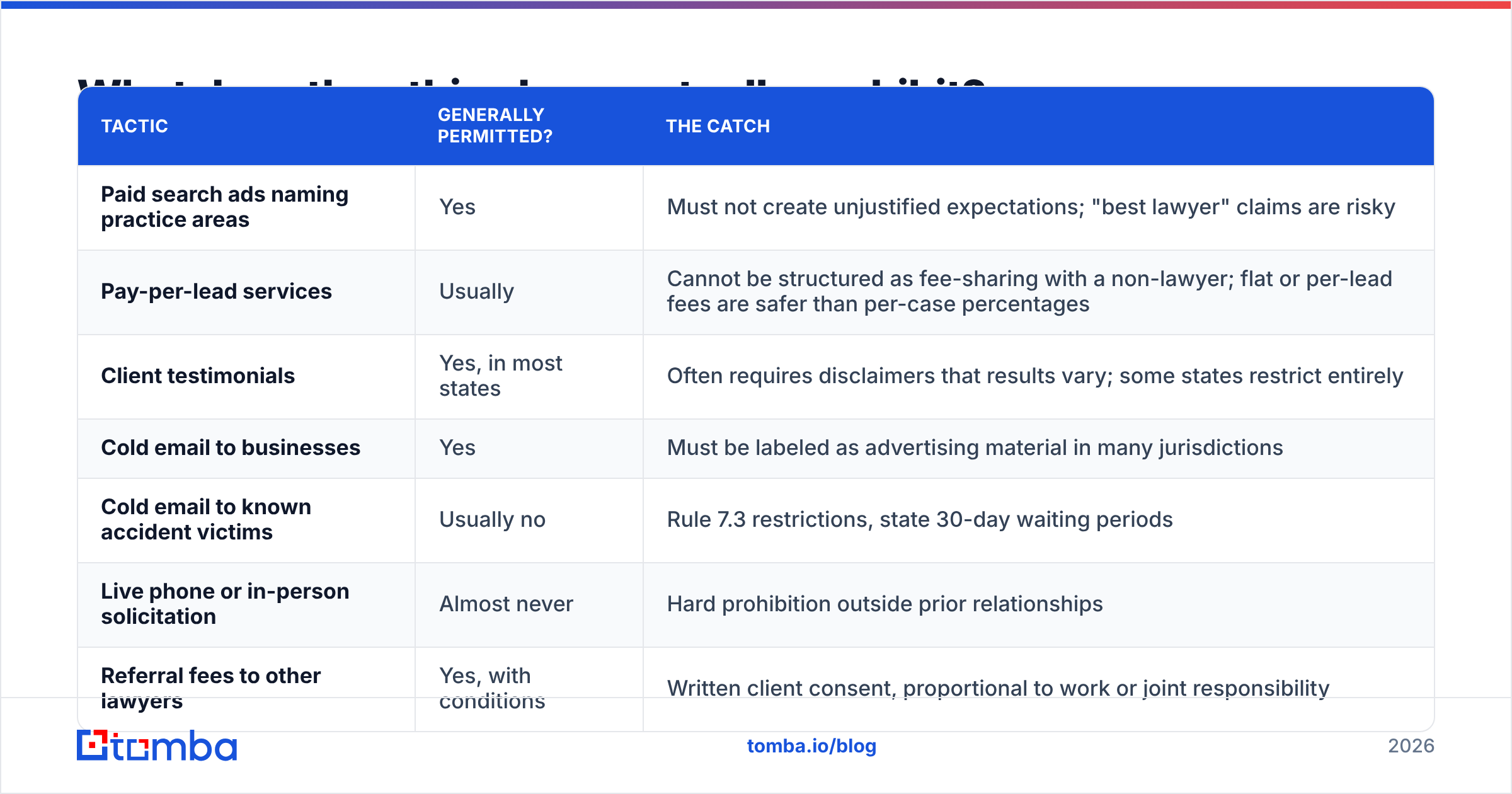
| Tactic | Generally permitted? | The catch |
|---|---|---|
| Paid search ads naming practice areas | Yes | Must not create unjustified expectations; "best lawyer" claims are risky |
| Pay-per-lead services | Usually | Cannot be structured as fee-sharing with a non-lawyer; flat or per-lead fees are safer than per-case percentages |
| Client testimonials | Yes, in most states | Often requires disclaimers that results vary; some states restrict entirely |
| Cold email to businesses | Yes | Must be labeled as advertising material in many jurisdictions |
| Cold email to known accident victims | Usually no | Rule 7.3 restrictions, state 30-day waiting periods |
| Live phone or in-person solicitation | Almost never | Hard prohibition outside prior relationships |
| Referral fees to other lawyers | Yes, with conditions | Written client consent, proportional to work or joint responsibility |
| Non-lawyer marketing agency taking a case percentage | No | Classic Rule 5.4 fee-sharing violation |
The practical rule: pay for access, never for outcome. A vendor that charges per lead or per month is structurally fine. A vendor that wants 15% of the settlement is asking you to violate Rule 5.4. Several state bars have issued opinions on exactly this arrangement, and "the vendor said it was compliant" has never worked as a defense.
How do you fix intake, which is where the money actually leaks?#
Conclusion first: speed-to-lead is worth more than any channel optimization you will do this year.
The classic Harvard Business Review analysis of lead response time found firms responding within an hour were roughly seven times more likely to qualify a lead than those responding an hour later, and sixty times more likely than those waiting 24 hours. Fifteen years later most law firms still route after-hours calls to voicemail.
What a functional intake layer looks like:
- Sub-5-minute callback on every web form during business hours. Not same-day. Five minutes.
- 24/7 answering with a trained legal intake service, not a generic call center reading a script.
- Minimum six follow-up attempts across phone, email, and text before marking a lead dead. Most firms stop at two.
- Intake scripted for conflict checks and disqualifiers up front so attorneys only see consults worth their hour.
- Every inquiry logged with its source — this is the only way the table in the previous section becomes your numbers instead of industry averages.
- A reactivation sequence for every "not now" lead at 30, 90, and 180 days. Family and estate matters in particular go dormant, not dead.
Firms consistently underrate the compounding here. Lifting lead-to-consult from 25% to 40% has the same revenue effect as increasing ad spend by 60%, at a fraction of the cost.

Is SEO still worth it for law firms in 2026?#
Yes, but the shape changed. AI overviews and answer engines absorb a large share of informational queries — "how long do I have to file a claim in Texas" increasingly gets answered above the fold without a click. What survives is:
Bottom-funnel local intent. "Divorce attorney [city]", "trucking accident lawyer near me". These still convert, still click through, and the map pack remains the most valuable real estate in consumer legal search.
Genuine expertise content. Google's quality guidelines lean hard on experience and authority for YMYL topics, and legal is squarely YMYL. A partner-bylined analysis of a recent circuit decision outperforms 40 outsourced 800-word posts. Make sure the byline is a real attorney with a real bio page and real credentials — thin authorship is the fastest way to get filtered.
Practice-area landing pages with actual jurisdictional detail. Statutes, deadlines, local court procedure. This is where small firms beat national aggregators, because the aggregators can't go deep on 3,000 counties.
Digital PR and citations. Getting quoted in trade press and local news builds the entity signals that make everything else rank. It also feeds referral flow, which is the point anyway.
What stopped working: programmatic city-page spam, AI-generated practice-area copy, and link schemes. G2 and similar review-driven platforms have also become a meaningful discovery layer for B2B legal services, which most firms ignore entirely.
How should you build a target list for B2B legal business development?#
Start with the matter type you actually want, then reverse-engineer the company profile that generates it.
If you want employment defense work, the profile is companies with 50–500 employees, no in-house employment counsel, in states with active plaintiff-side bars, ideally hiring aggressively (which correlates with policy gaps). If you want commercial real estate work, the trigger is recent property transactions and permit filings.
The build sequence:
- Define the firmographic filter — size, industry, geography, growth signal. Write it down. Vague targeting produces vague lists.
- Source companies from whatever signal matches the trigger: funding announcements, permit databases, court dockets, trade association member lists, conference exhibitor lists.
- Map the buying role at each company. The person who hires outside counsel is rarely the person on the website's contact page.
- Enrich contact data — email, direct dial, LinkedIn. A bulk email finder handles this at list scale rather than one lookup at a time.
- Verify and dedupe before the first send. Firm domains have almost no sending history; one bad list can put your @firmname.com in spam for months.
- Sequence with a jurisdictional hook, not a capabilities pitch. "The Fifth Circuit's ruling last month changes how your arbitration agreements need to be drafted" beats "our firm has 30 years of experience."
For the data layer specifically, compare what you need against Tomba pricing: the free tier gives 25 searches a month for testing the approach, Starter runs $49/mo, Growth $99/mo, and Pro $249/mo for firms running real volume. BookYourData is a solid option if you'd rather buy a pre-built, pay-as-you-go list than assemble one — different model, same end goal, and worth pricing both ways before committing.
How do you measure whether any of this is working?#
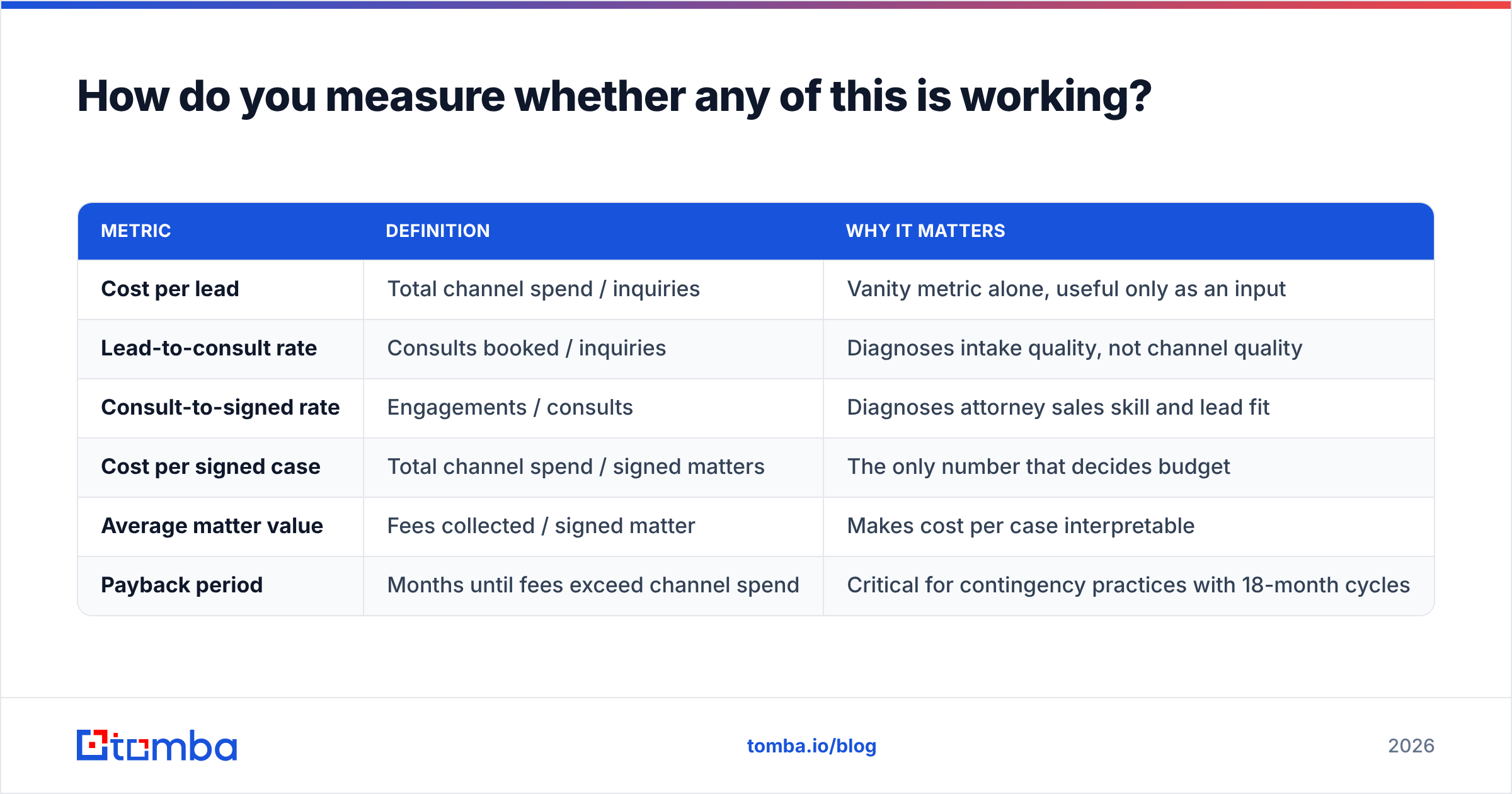
Track four numbers per channel, monthly, in your CRM or case management system:
| Metric | Definition | Why it matters |
|---|---|---|
| Cost per lead | Total channel spend / inquiries | Vanity metric alone, useful only as an input |
| Lead-to-consult rate | Consults booked / inquiries | Diagnoses intake quality, not channel quality |
| Consult-to-signed rate | Engagements / consults | Diagnoses attorney sales skill and lead fit |
| Cost per signed case | Total channel spend / signed matters | The only number that decides budget |
| Average matter value | Fees collected / signed matter | Makes cost per case interpretable |
| Payback period | Months until fees exceed channel spend | Critical for contingency practices with 18-month cycles |
The trap is judging contingency-fee channels on a quarterly window. A PI channel that looks catastrophic at 90 days may be strongly profitable at 24 months. Set the measurement window to your actual matter cycle, or you will cut the channels that fund the firm.
One more discipline: ask every signed client, at intake, how they found you — and record the answer separately from your tracking attribution. The gap between what analytics says and what clients say is where your referral value hides. Most firms discover that a meaningful share of "paid search" conversions were referrals who searched the firm name to find the phone number.
What should you actually do first?#
If you run a consumer practice: fix intake before you touch ad budget. Install call tracking, commit to a five-minute callback standard, and extend follow-up to six attempts. Then audit whether your Google Business Profile and local pages are competitive, because the map pack is cheaper than the ad auction above it.
If you run a B2B or corporate practice: stop waiting for referrals to scale linearly. Build one tight target list of 300 companies that match your best existing client profile, find the right decision-maker at each, and run a genuinely useful, jurisdiction-specific sequence. Three signed matters from 300 contacts is a rounding error in effort and a meaningful year in revenue.
Either way, the constraint is almost never creativity. It's data quality and follow-through.
When you're ready to build that target list, the Tomba Email Finder gives you verified work emails for the in-house counsel, founders, and HR leaders you've identified — by name, company, or domain — so your business development sequence starts with contacts that actually deliver. Start on the free tier, test 25 lookups against your best-fit company list, and scale once the approach proves out.
Related guides#
// get started
Find, verify and enrich your first contacts today
Start on the free plan with 25 searches a month, then scale when your team is ready.
Free plan · No credit card required · GDPR & CCPA
Get the Tomba newsletter
Product and data updates
// about the author