Lead Generation for Manufacturing: The 2026 Playbook That Works
Manufacturing sales cycles run 6-18 months and end in an RFQ, not a demo. Here is how lead generation for manufacturing actually works in 2026: channels, data sourcing, outreach sequences, and the metrics that prove it.
TL;DR
- Manufacturing buying cycles run 6-18 months, involve 6-10 people, and end in an RFQ or a sampling run — not a 30-minute demo. Your lead gen has to be built for that shape or it produces noise.
- The highest-yield channels in 2026 are still unglamorous: industrial directory presence, technical SEO on spec-level pages, targeted outbound to named plants, and trade shows treated as list-building events rather than brand exercises.
- Bad contact data is the single biggest tax on manufacturing outbound. Plant emails rarely sit on LinkedIn, and job titles are inconsistent across NAICS codes.
- Qualify on fit signals a machinist would recognize — volume, tolerance, material, certification, current supplier pain — not on "downloaded an ebook."
- Measure cost per qualified RFQ and quote-to-win rate, not MQL count. An MQL that cannot pass your shop's minimum order quantity is a rounding error.
Why is lead generation for manufacturing different from SaaS lead gen?#
Because almost nothing transfers. The playbooks that dominate B2B marketing content were written for software companies with $200/month price points, self-serve trials, and a single decision maker who can expense the purchase. A contract manufacturer quoting a $1.4M annual program has none of those conditions.
Four structural differences change the entire approach:
- The buying committee is technical and distributed. A design engineer defines the spec, a quality manager owns certification requirements, procurement owns price and terms, and a plant manager owns capacity risk. Gartner's research on B2B buying groups has consistently put the average committee in the 6-10 person range for complex purchases — and industrial purchases sit at the complex end.
- The conversion event is an RFQ, not a demo. Nobody "books a call to see the platform." They send a print, a tolerance sheet, and a volume forecast. Your funnel's job is to earn the right to quote. Everything upstream should be optimized toward that single action.
- Switching costs are enormous. Requalifying a supplier means new PPAP documentation, new first-article inspections, and internal risk. A prospect who is happy with their current vendor will not switch for a 3% price advantage. Timing beats persuasion.
- The total addressable market is small and knowable. A precision machining shop serving aerospace might have 400 realistic accounts in North America. That is not a volume game. It is a coverage game — and coverage games are won with accurate contact data and persistent, multi-threaded outreach.
Once you internalize that, most "generate 500 leads a month" advice becomes obviously wrong. You do not want 500 leads. You want 40 accounts where you are the second call when their current supplier misses a delivery date.
What does a manufacturing lead generation funnel actually look like?#
Five stages, and they map to how industrial buyers actually behave rather than to a generic marketing automation diagram:
- Unaware capacity holder. The account exists, buys what you make, and has no idea you exist. Your only job here is to become a known name before the trigger event happens. Directory listings, technical content, and light-touch outbound do this work.
- Passive researcher. An engineer searches a spec, a material, or a process at 11pm. They land on a page that either speaks their language (tolerances, materials, lead times, certifications) or does not. Most manufacturer websites fail here by leading with "quality is our passion" instead of "±0.0005 in on 4140 steel, AS9100D certified."
- Trigger event. A supplier misses a shipment, a tariff changes landed cost, a new program gets funded, a quality escape happens, or a plant expands. This is when a cold account becomes a live one — and it is almost never visible from your marketing dashboard.
- RFQ issued. You get a print and a due date. Win rate here is determined by responsiveness, quoting accuracy, and whether you already had a relationship. Shops that respond to RFQs within 24 hours quote more and win more, full stop.
- Qualified supplier. Onboarding, first article, documentation. This is where "lead generation" formally ends and account growth begins — and where most manufacturers stop marketing entirely, which is a mistake, since existing accounts are the cheapest expansion revenue you will ever find.
The practical consequence: your lead gen investment should be split roughly 40% toward being findable at stage 2, 40% toward being in-market-present at stage 3, and 20% toward the operational speed that wins stage 4. Spending everything on top-of-funnel awareness while your RFQ response time is four days is a leaky, expensive mistake.
Which channels actually produce qualified manufacturing leads in 2026?#
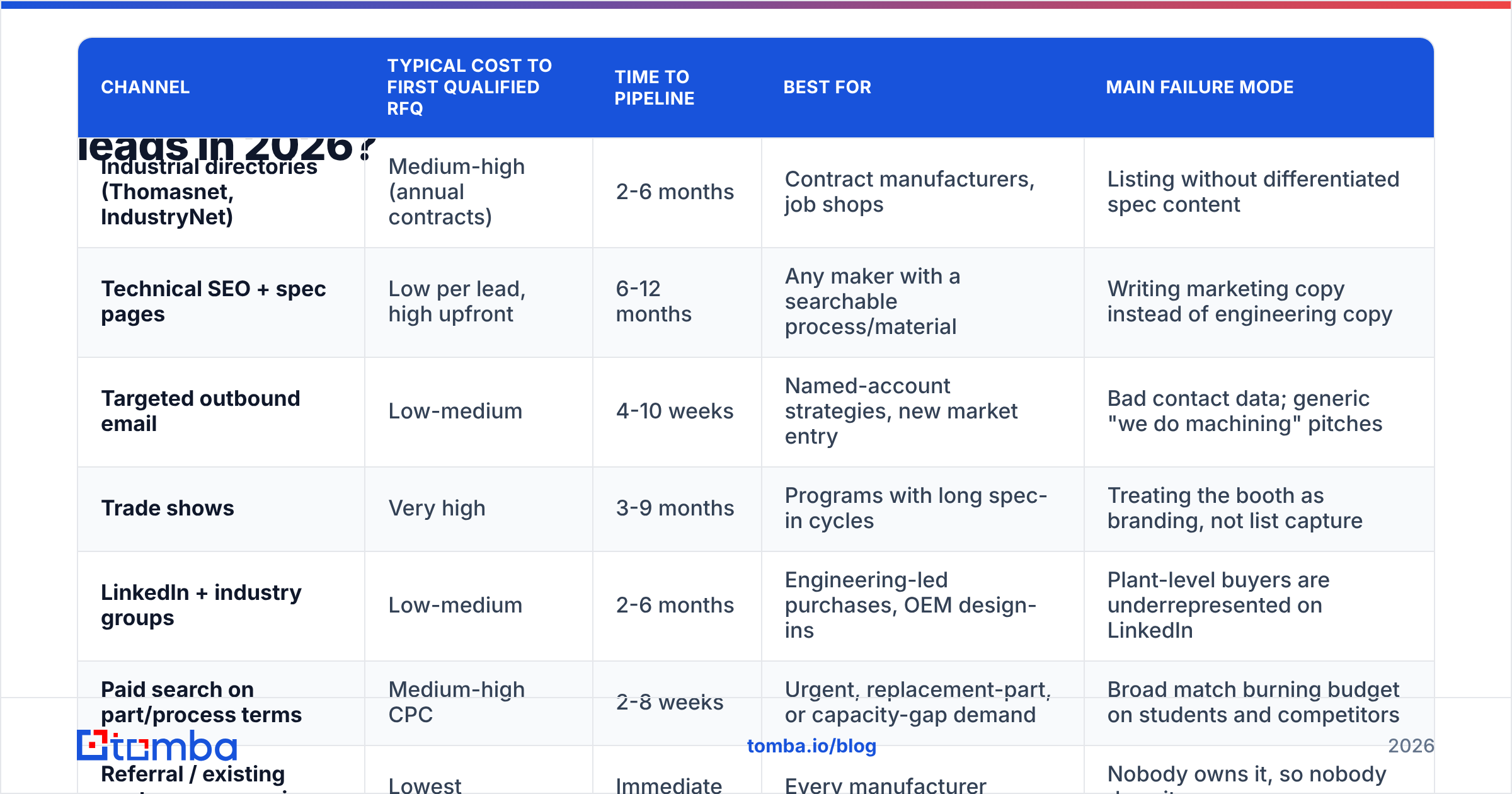
Here is an honest channel comparison based on how industrial sellers typically report results. Costs are directional and vary hugely by niche, but the relative ranking holds up.
| Channel | Typical cost to first qualified RFQ | Time to pipeline | Best for | Main failure mode |
|---|---|---|---|---|
| Industrial directories (Thomasnet, IndustryNet) | Medium-high (annual contracts) | 2-6 months | Contract manufacturers, job shops | Listing without differentiated spec content |
| Technical SEO + spec pages | Low per lead, high upfront | 6-12 months | Any maker with a searchable process/material | Writing marketing copy instead of engineering copy |
| Targeted outbound email | Low-medium | 4-10 weeks | Named-account strategies, new market entry | Bad contact data; generic "we do machining" pitches |
| Trade shows | Very high | 3-9 months | Programs with long spec-in cycles | Treating the booth as branding, not list capture |
| LinkedIn + industry groups | Low-medium | 2-6 months | Engineering-led purchases, OEM design-ins | Plant-level buyers are underrepresented on LinkedIn |
| Paid search on part/process terms | Medium-high CPC | 2-8 weeks | Urgent, replacement-part, or capacity-gap demand | Broad match burning budget on students and competitors |
| Referral / existing customer expansion | Lowest | Immediate | Every manufacturer | Nobody owns it, so nobody does it |
Two notes worth arguing about.
First, trade shows are not dead, but their ROI is entirely determined by what you do with the badge scans. A $25,000 booth that produces 300 scans and zero structured follow-up is a $25,000 donation. A $25,000 booth that produces 300 scans, gets enriched into verified work emails and direct phone numbers within 48 hours, and enters a nine-touch sequence is one of the better channels available to you.
Second, outbound is undervalued in manufacturing specifically because the TAM is small and knowable. When you can name every plant in North America that runs your process at your volume, cold outreach stops being spray-and-pray and becomes account coverage. That only works if the contact data is right.
How do you build a manufacturing prospect list without buying junk data?#
Start from firmographics that actually predict fit, not from a generic "manufacturing" industry filter. The filters that matter:
- NAICS code at the 5- or 6-digit level. "Manufacturing" (31-33) is useless. "332721 Precision Turned Product Manufacturing" is a targeting strategy.
- Employee count as a proxy for volume. A 40-person shop and a 4,000-person plant have completely different purchasing processes.
- Facility count and location. Multi-plant organizations buy centrally; single-plant operations buy locally. The outreach differs completely.
- Certifications and equipment signals. ISO 9001, AS9100, IATF 16949, ITAR registration — these are both qualifiers and conversation openers.
- Technology and system signals. ERP and MES stack tells you a lot about sophistication and integration requirements.
Once the account list exists, the contact problem begins. This is where manufacturing outbound usually breaks. Plant-level buyers — quality managers, maintenance supervisors, operations directors, commodity buyers — are systematically under-represented on social platforms compared with software or finance roles. Scraping LinkedIn gets you the VP of Sales and the marketing coordinator, not the person who signs off on a tooling change.
A workable process looks like this:
- Build the account list from directories, association member lists, trade show exhibitor lists, and industry databases.
- Run a domain search on each company domain to surface the contacts that actually exist on that domain and learn the organization's email pattern.
- Use an email finder for the named roles you identified but could not find in the domain sweep.
- Push everything through an email verifier before a single send. Manufacturing domains skew heavily toward catch-all configurations and legacy on-prem mail servers, which is exactly where unverified lists generate bounces.
- Enrich with B2B phone numbers for the accounts worth calling — because in this vertical, the phone still converts better than email for anyone over 45 in a plant role.
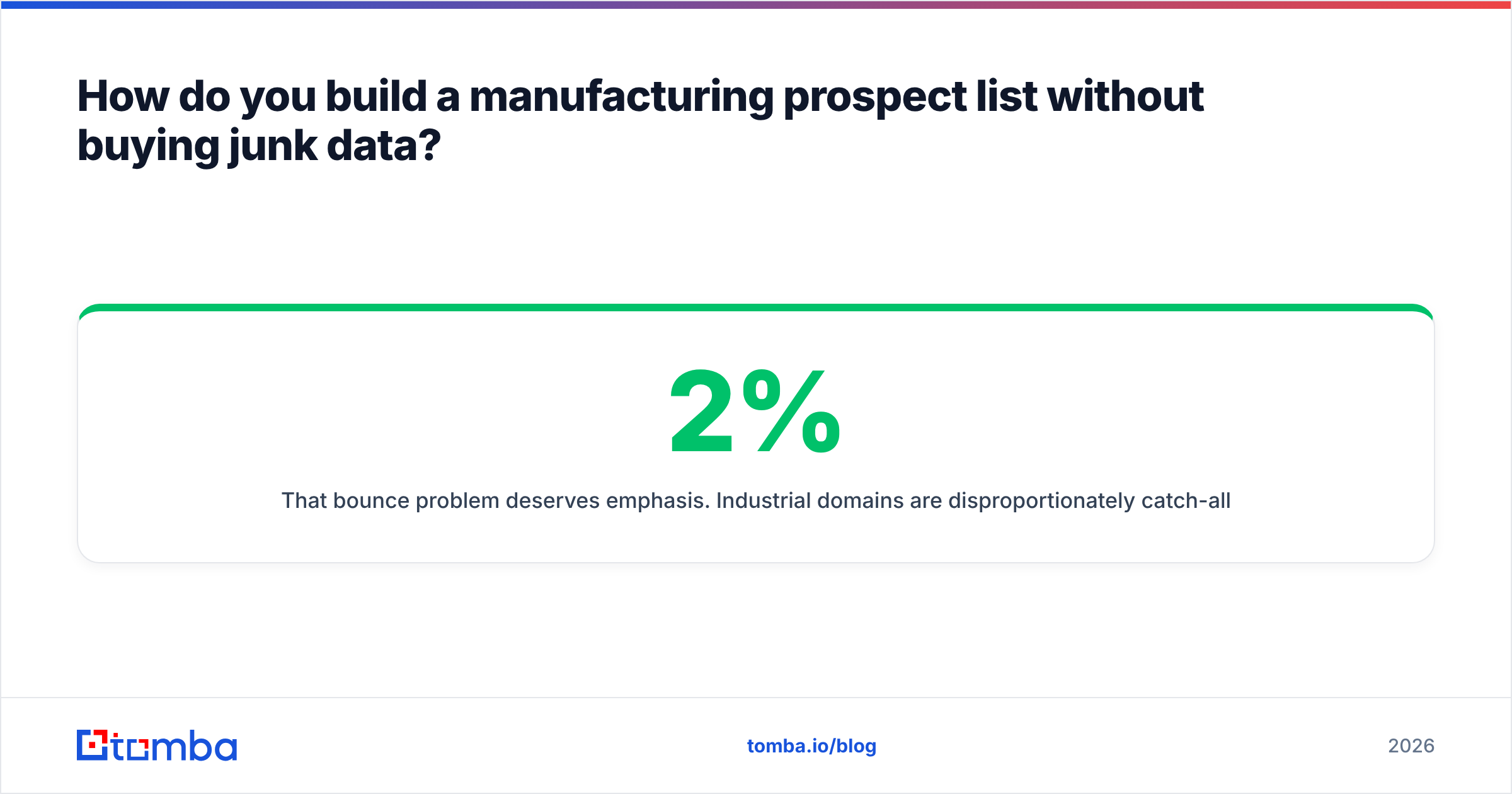
That bounce problem deserves emphasis. Industrial domains are disproportionately catch-all, meaning the mail server accepts everything and validates nothing. A standard verification tool marks those "unknown" and you are left guessing. Running a dedicated catch-all verifier on that segment is the difference between a 2% bounce rate and a 14% one — and at 14% you are damaging sender reputation across every campaign you run.
What should outreach to a plant or procurement buyer look like?#
Short, specific, and grounded in something only a supplier in your industry would know.
The template that works has four parts: a specific trigger or observation, a one-line capability statement with a real number in it, a low-friction ask, and a signature that proves you are a real company with a real address. No "hope this finds you well." No three-paragraph company history.
What kills manufacturing cold email, in order of damage:
- Generic capability claims. "We offer high-quality CNC machining with fast turnaround" describes 9,000 companies.
- Asking for a 30-minute discovery call. A quality manager does not have a calendar link culture. Ask for a print, a sample RFQ, or a two-line reply instead.
- Ignoring the multi-thread. One contact per account is a coin flip. Three to four contacts across engineering, quality, and procurement is coverage.
- Sending from a domain with no SPF record configured. Industrial IT departments run aggressive filtering, and a misconfigured sending domain never reaches the inbox at all.
Cadence matters more than copy volume. A nine-touch sequence over eight weeks mixing email, a phone attempt, and a LinkedIn touch will outperform a four-touch email-only sprint every time, because you are fishing for a trigger event that may be six months away. HubSpot's sales research has repeatedly shown that persistence past the fifth touch is where a large share of connects actually happen — and industrial cycles stretch that pattern further, not shorter.
How do you qualify manufacturing leads before sales wastes a quote?#
Quoting is expensive. A complex RFQ can consume four to twelve hours of estimator time. Quoting everything that comes in is how shops end up with a 12% win rate and an exhausted quoting team.
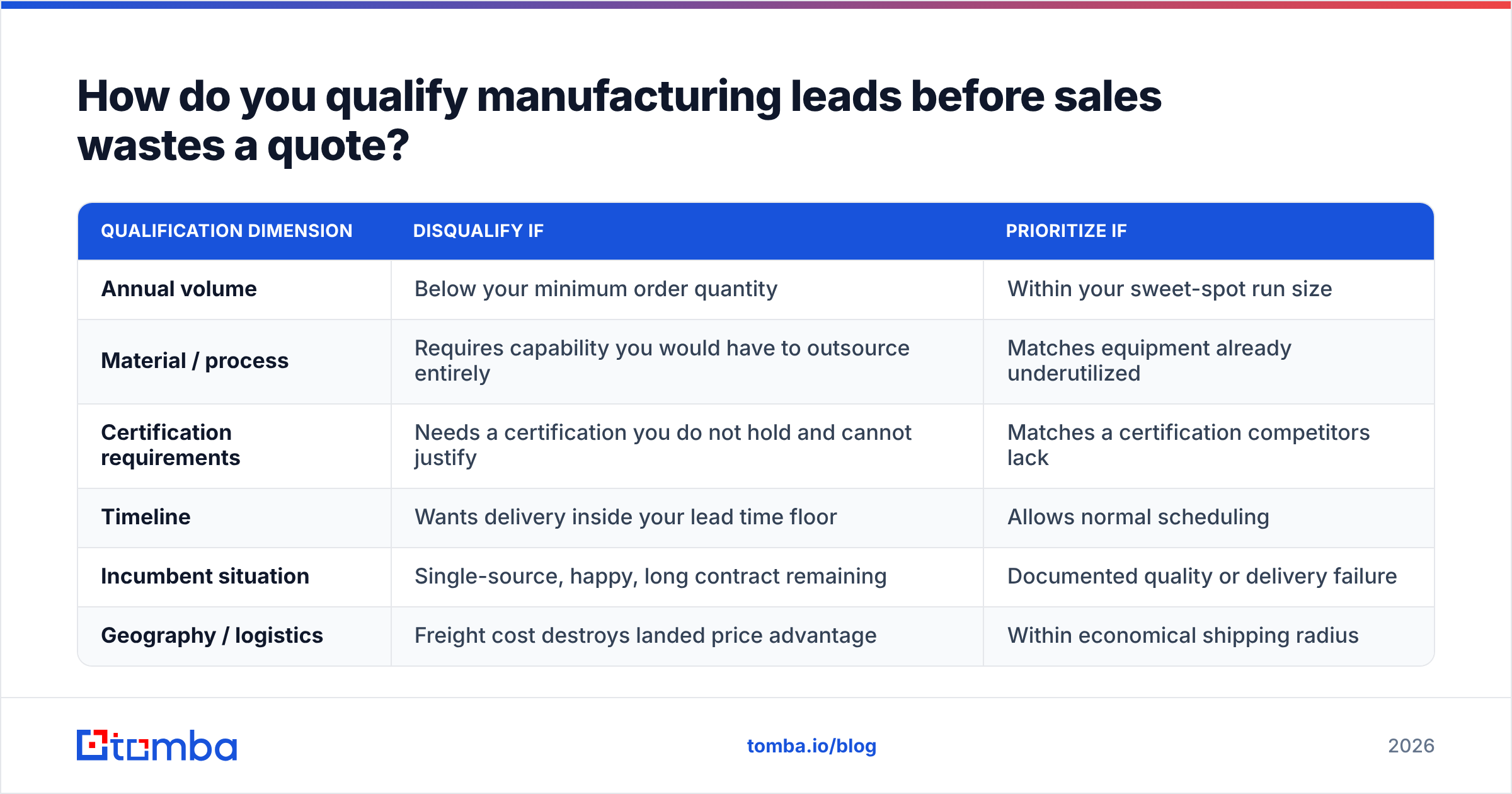
Build a qualification gate around production reality:
| Qualification dimension | Disqualify if | Prioritize if |
|---|---|---|
| Annual volume | Below your minimum order quantity | Within your sweet-spot run size |
| Material / process | Requires capability you would have to outsource entirely | Matches equipment already underutilized |
| Certification requirements | Needs a certification you do not hold and cannot justify | Matches a certification competitors lack |
| Timeline | Wants delivery inside your lead time floor | Allows normal scheduling |
| Incumbent situation | Single-source, happy, long contract remaining | Documented quality or delivery failure |
| Geography / logistics | Freight cost destroys landed price advantage | Within economical shipping radius |
Put those six questions into your RFQ intake form and your qualification call script. You will disqualify 30-40% of inbound faster, which sounds like losing leads and is actually reclaiming estimator hours to quote the deals you can win.
What tools stack best for manufacturing lead generation?#
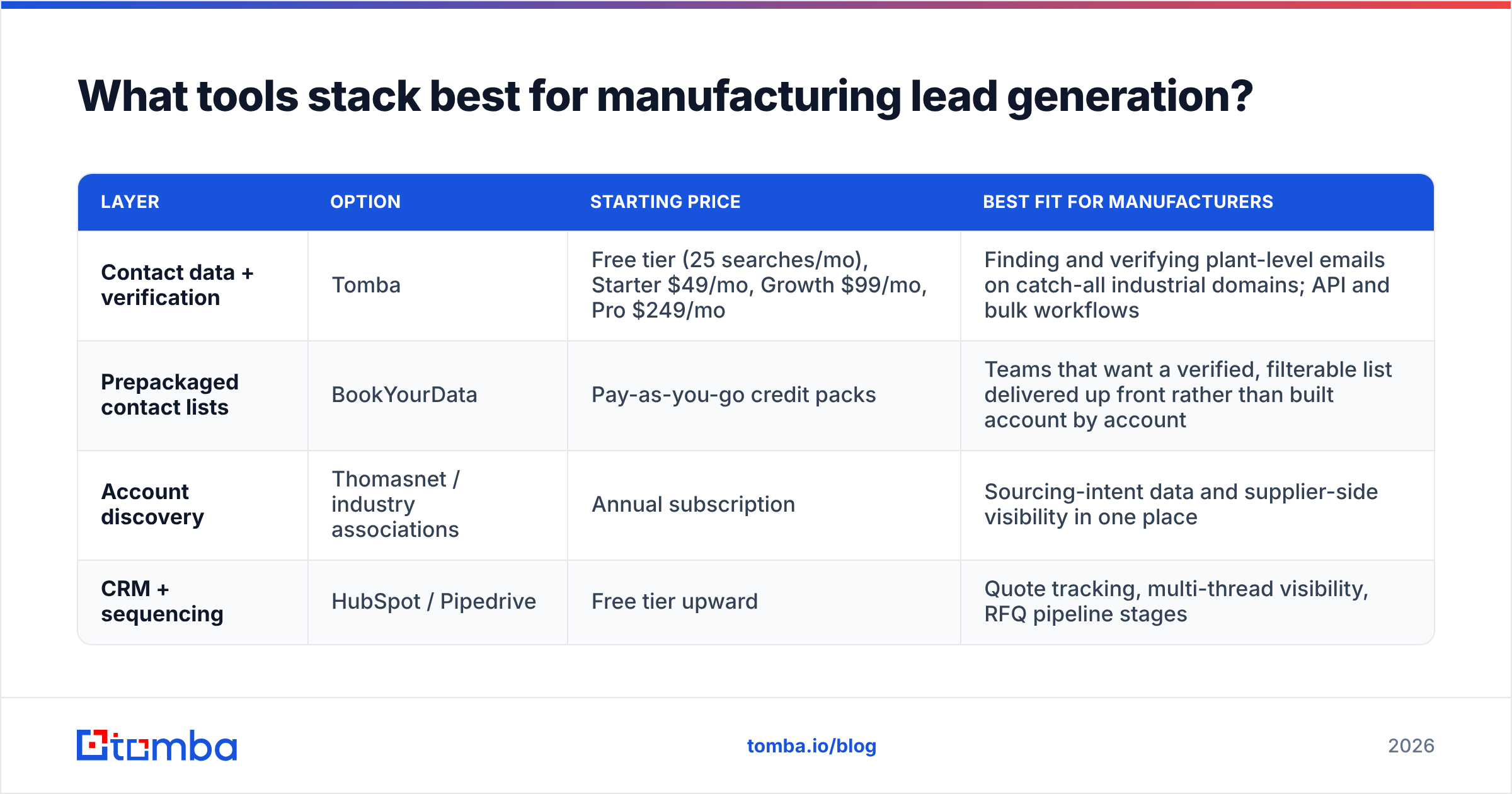
You need four capabilities: account discovery, contact data, outreach execution, and CRM. A lean stack:
| Layer | Option | Starting price | Best fit for manufacturers |
|---|---|---|---|
| Contact data + verification | Tomba | Free tier (25 searches/mo), Starter $49/mo, Growth $99/mo, Pro $249/mo | Finding and verifying plant-level emails on catch-all industrial domains; API and bulk workflows |
| Prepackaged contact lists | BookYourData | Pay-as-you-go credit packs | Teams that want a verified, filterable list delivered up front rather than built account by account |
| Account discovery | Thomasnet / industry associations | Annual subscription | Sourcing-intent data and supplier-side visibility in one place |
| CRM + sequencing | HubSpot / Pipedrive | Free tier upward | Quote tracking, multi-thread visibility, RFQ pipeline stages |
The reason contact data sits at the top of that table is that every other layer depends on it. A great CRM full of bounced addresses is an expensive filing cabinet. If you are running list building at scale, the bulk email finder workflow — upload the account list, get verified contacts back — is usually faster than any manual process, and the Tomba API lets you wire enrichment directly into your CRM so new accounts get contacts attached automatically.
One caution on buying lists versus building them: both work, and the right answer depends on how narrow your target is. If your ideal account list is 300 plants, build it deliberately and verify every contact. If you are entering a broad new vertical and need coverage fast, a reputable list provider gets you moving in days rather than weeks. Just verify whatever you buy before you send — no provider's freshness guarantee survives contact with a plant that reorganized last quarter.
What metrics prove your manufacturing lead gen is working?#
Throw out MQL counts. The metrics that predict revenue in this vertical:
- Cost per qualified RFQ. The only top-line efficiency number that matters. Track it per channel.
- RFQ response time. Hours, not days. This correlates with win rate more tightly than almost anything else you control.
- Quote-to-win rate by segment. If it is under 20% overall, your qualification gate is too loose, not your pricing.
- Accounts multi-threaded. Percentage of active opportunities with 3+ contacts engaged. Single-threaded deals die when one person changes jobs.
- Time from first touch to first RFQ. This tells you how far ahead of demand you need to be prospecting. If it is nine months, your Q4 pipeline was determined by what you did in Q1.
- Email bounce and deliverability health. A rising bounce rate is an early warning that your data source is decaying. Watch it weekly, not quarterly.
Review these monthly with sales and operations in the same room. Marketing metrics reviewed without the estimating team present are how shops end up celebrating lead volume while the quoting queue fills with work they cannot profitably run.
Where should you start this quarter?#
Pick the narrowest segment you can win — one NAICS code, one process, one certification advantage — and build a complete, verified account and contact list for it. Not a broad list. A complete one. Then run one disciplined eight-week multi-channel sequence against it and measure cost per qualified RFQ against whatever you currently spend on trade shows.
Most manufacturers discover the outbound number is dramatically lower, and that the constraint was never demand. It was knowing exactly who to reach and having an address that actually delivers.
That is the part Tomba Email Finder is built for: turn a list of plant domains and target roles into verified, deliverable contacts — including on the catch-all industrial domains that break most verification tools. Start free with 25 searches a month, and check Tomba pricing when you are ready to run your full account list. If you can name the plants you want, you can reach the people inside them.
Related guides#
// get started
Find, verify and enrich your first contacts today
Start on the free plan with 25 searches a month, then scale when your team is ready.
Free plan · No credit card required · GDPR & CCPA
// about the author